United States Cystometry Catheters Market Size & Forecast:
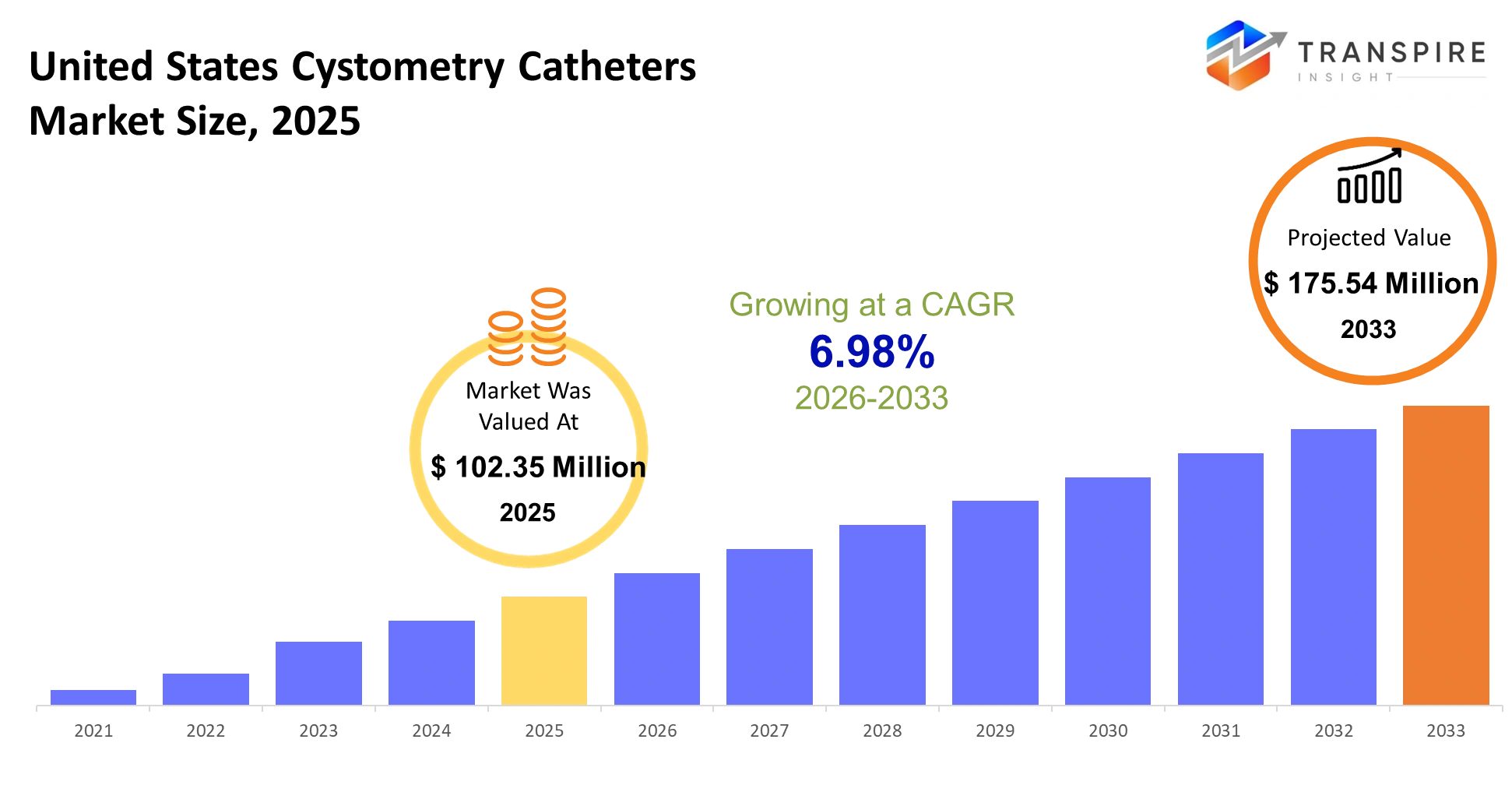
- United States Cystometry Catheters Market Size 2025: USD 102.35 Million
- United States Cystometry Catheters Market Size 2033: USD 175.54 Million
- United States Cystometry Catheters Market CAGR: 6.98%
- United States Cystometry Catheters Market Segments: By Product Type (Water-filled Catheters, Air-charged Catheters, Micro-tip Catheters, Disposable Catheters, Reusable Catheters, Dual-lumen Catheters), By Application (Urodynamic Testing, Bladder Pressure Monitoring, Urinary Incontinence Diagnosis, Neurogenic Bladder Diagnosis), By End User (Hospitals, Diagnostic Centers, Urology Clinics, Ambulatory Surgical Centers).
To learn more about this report,  Download Free Sample Report
United States Cystometry Catheters Market Summary:
The United States Cystometry Catheters Market size is estimated at USD 102.35 Million in 2025 and is anticipated to reach USD 175.54 Million by 2033, growing at a CAGR of 6.98% from 2026 to 2033. In the United States cystometry catheters market, these devices play a sort of critical yet practical role in urodynamic testing—basically they help physicians read bladder pressure, urine flow, and neuromuscular performance, especially for people dealing with urinary incontinence, neurogenic bladder conditions, spinal cord injuries, and after-surgery complications. In day to day practice , cystometry catheters let clinicians move past treating only the symptoms, and instead take more accurate calls on pelvic floor therapy, reconstructive options, and ongoing bladder management that actually stays consistent over time.
Over the last three to five years, the market has leaned away from reusable systems and more toward sterile single-use catheter platforms. This happened as hospitals tightened infection control rules, and as outpatient urology procedures grew in volume. The shift picked up speed after the COVID-19 pandemic, because it highlighted weak points in device reprocessing processes and brought more attention to hospital-acquired infections, you know, the contamination side of it. Meanwhile, the aging U.S. population, plus higher diagnosis levels for chronic urinary dysfunction, has also pushed up procedural numbers in ambulatory care settings. And as urology clinics try to keep turnaround times quick, while maintaining a low risk of contamination, manufacturers are seeing stronger revenue from premium disposable products, catheter designs that include pressure sensing, and procedure tailored catheter formats that can boost diagnostic efficiency.
Key Market Insights
- The Northeast United States basically took the lead in the United States Cystometry Catheters Market, with something like 32% market share in 2025, mostly because of more advanced urology care infrastructure and the usual better clinical support.
- Meanwhile, the Southern United States is showing the fastest momentum through 2032, and that is largely backed by expanding ambulatory surgical centers, plus an aging patient population which keeps adding demand, and people get older i guess.
- On the Western U.S. side, healthcare systems are steadily increasing their use of single use cystometry catheters to lower cross contamination risks and also speed up procedural flow, that part matters a lot.
- Disposable cystometry catheter products represented around 58% of industry share in 2025, since hospitals were prioritizing sterile and infection-control compliant options, not just because it is easy but because it is safer.
- Reusable cystometry catheter systems stayed as the second-largest segment, largely owing to cost advantages for high volume hospital urodynamic laboratories where budgets are always under pressure.
- Pressure sensing smart catheter systems are expected to grow the quickest through 2032, mainly due to real-time diagnostic accuracy improvements that clinicians can actually notice.
- Also, dual-lumen catheter devices are getting a lot of attention across urology clinics, for simultaneous bladder filling and pressure measurement, which sounds simple but it helps the workflow.
- When it comes to applications, urinary incontinence diagnostics dominated the United States Cystometry Catheters Market with nearly 41% application share in 2025.
- Neurogenic bladder assessment is the fastest-growing application slice, driven by rising spinal cord injury cases and neurological disorder incidence nationwide.
- Post-operative bladder dysfunction monitoring keeps producing solid procedural demand across tertiary care hospitals and rehabilitation centers, so the demand keeps going.
- And finally, hospitals held the leading market share of nearly 48% in 2025, because complicated urodynamic testing procedures still tend to be concentrated in specialized facilities where equipment and staff are focused.
What are the Key Drivers, Restraints, and Opportunities in the United States Cystometry Catheters Market?
The United States cystometry catheters market kind of plays a core role in urodynamic testing, like an invisible step that helps physicians measure bladder pressure, urine flow, and neuromuscular function in people with urinary incontinence, neurogenic bladder conditions, spinal cord injuries, and post surgical complications. In everyday practice, these catheters let clinicians go beyond symptom-only care and then make more careful selections about pelvic floor therapies, reconstructive options, and longer term bladder strategy.
Over the past three to five years, the market has quietly shifted from reusable arrangements toward sterile, single use catheter platforms, as hospitals tightened their infection control rules , and outpatient urology procedures kept widening their reach. That shift sped up after the COVID-19 pandemic revealed weak points in device reprocessing routines and raised additional focus on hospital acquired infections. Meanwhile, the aging population in the U.S. and higher rates of chronic urinary dysfunction diagnoses have increased procedure counts, especially in ambulatory care settings. Since many urology clinics now push for quicker turnaround times, and lower contamination risk, manufacturers are seeing growth by selling higher margin disposable products, pressure-sensing features built in, and catheter designs tailored for specific procedures. These upgrades, in turn, support faster diagnostic efficiency and more consistent outcomes.
There’s a big growth opening coming up via digitally connected urodynamic platforms that kind of stitch together pressure-sensing catheters and real time analytics software. A few companies are betting on AI-assisted bladder interpretation, plus wireless catheter monitoring systems, and it seems like they’re setting themselves up for more reach in outpatient diagnostic services, especially across the faster growing health network scene in the Southern U.S. where ambulatory infrastructure investment keeps ramping up.
What Has the Impact of Artificial Intelligence Been on the United States Cystometry Catheters Market?
Artificial intelligence plus advanced digital tech are starting to reshuffle the United States cystometry catheters market, mostly because they help urodynamic diagnostics become more accurate, quicker, and steadier. AI powered urodynamic setups are now automating the interpretation of pressure waveforms, the appraisal of bladder compliance, and even the grouping of voiding dysfunctions, so the time for manual checking drops for urology specialists. A number of hospital groups and outpatient urology centers are rolling in digital catheter platforms that connect with electronic health records , which seems to make patient data capture smoother and trims down the time spent on routine procedural notes.
At the same time, machine learning models are strengthening predictive diagnostic work by spotting abnormal bladder patterns linked to neurogenic bladder disorders, urinary retention, and pelvic floor dysfunction. The systems review past patient information together with near real time catheter pressure signals, to nudge earlier intervention decisions and also lower repeat testing frequency. So, clinicians are often describing faster diagnostic routes, more consistent procedures, and better use of outpatient urodynamic labs.
On top of that, sensor enabled catheter systems improve day to day performance by giving steadier pressure measurements and cutting down signal noise artifacts during the tests. Still, AI take up is somewhat constrained by the cost of integration , and by clinical data that is split across different systems. Many smaller urology practices don’t have the digital backbone, nor the standardized patient information, needed to train dependable predictive models across the wide set of real world care situations.
Key Market Trends
- Since 2021 outpatient urology centers started buying single use catheter more often, because hospitals kinda eased up on reusable device handling after those tougher infection control protocols rolled in.
- Between 2022 and 2025 urodynamic testing volumes kinda drifted toward ambulatory surgery centers, mostly over lower procedural costs and quicker patient turnarounds, it felt faster in practice.
- Laborie Medical Technologies put more money into its digital urodynamic platform after clinics asked for integrated pressure monitoring plus automated reporting, especially when care was spread out across decentralized settings.
- Adoption of hydrophilic coated catheter went up quickly after 2020 as providers leaned into less patient discomfort and reduced urethral irritation tied to repeat diagnostics.
- During 2021 supply chain disruptions showed how dependent the market was on imported catheter components, which then led multiple U.S. manufacturers to regionalize production and supplier networks.
- AI assisted waveform interpretation tools started showing up in bigger hospital systems after staffing shortages added extra pressure on trained urodynamic techs, and urodynamic specialists too.
- Since 2023 community urology clinics have been increasing purchases of compact portable urodynamic systems, so bladder dysfunction testing could expand beyond tertiary hospitals without as much delay.
- BD and Cook Medical increased attention on sterile disposable portfolios too, because reimbursement pressure lowered how much tolerance providers had for device reprocessing costs.
- Neurogenic bladder diagnostics gained more procedural share from 2022 to 2025, linked with improved spinal cord injury survival rates and an aging population of neurological patients.
- Digital integration with electronic health records got stronger after 2021, since health systems were chasing quicker documentation workflows and more consistent urodynamic reporting accuracy, overall.
United States Cystometry Catheters Market Segmentation
By Product Type
Disposable plus dual-lumen catheter systems kinda hold the top spot in the product type space right now, mainly because care teams keep leaning harder into infection prevention, faster procedures, and a more streamlined workflow— you know, less fuss during day to day practice. The water- filled catheter approach still takes the lead for standard urodynamic testing, largely due to lower costs to acquire and that general familiarity most hospital networks already have. That said, air- charged and micro tip catheter designs are getting more attention in more specialized diagnostic cases, where sharper sensitivity and near real time pressure tracking can boost how confident clinicians feel about the readings.
Reusable catheter systems are not totally gone either, they still matter in busy high volume settings that want long term budget control, though tighter sterilization expectations keep slowing broader adoption. Looking at demand, it seems more and more customers are steering toward single-use and digitally integrated catheter concepts, especially as outpatient testing grows across the United States. Companies are answering with hydrophilic coatings, smaller sensor architectures ,and pressure stabilization elements aimed at improving patient comfort and keeping procedures consistent.
So, competition going forward will probably revolve around top tier disposable platforms and AI supported diagnostic integration, rather than focusing as much on the older reusable lineups.

To learn more about this report, Download Free Sample Report
By Application
Urodynamic testing still shows up as the most prominent application segment because doctors, are leaning more and more on some sort of objective evaluation of bladder function before any surgery, pelvic floor therapy, or even chronic incontinence management. Urinary incontinence diagnosis takes a big portion of the procedural demand too, partly because prevalence keeps rising in older groups and among post-menopausal patients. Bladder pressure monitoring also holds a steady growth curve across rehabilitation and after-surgery care, where clinicians want that continuous functional check following spinal injury, or reconstructive surgery. Neurogenic bladder diagnosis looks like the quickest-growing application area, since neurological disorders, diabetes–related nerve complications, and spinal trauma cases keep coming up more often nationwide.
At the same time demand patterns seem to shift after healthcare systems rolled out expanded outpatient diagnostic programs which in turn lowered the reliance on inpatient urology units. Diagnostic providers increasingly pick faster testing protocols, and they integrate digital reporting platforms so they can move patients through quicker while also improving reimbursement efficiency. Going forward, the market direction will likely be driven by predictive analytics, automated waveform interpretation, and minimally invasive catheter technologies, these together enabling more decentralized bladder diagnostics.
By End-User
Hospitals keep edging ahead in the end-user landscape, mainly because complex urodynamic procedures kind of need multidisciplinary evaluation, better imaging access, and seasoned specialists. On top of that, big hospital systems usually bring more purchasing strength for unified urodynamic platforms and top-tier catheter technologies. Urology clinics sit in the second-largest place, since outpatient bladder dysfunction management keeps becoming more niche, more procedure driven. Diagnostic centers are also moving up steadily, boosting catheter utilization via focused continence assessment programs and lower-cost procedural models, which tends to match insurer preferences a bit better.
Ambulatory surgical centers, though, are showing the quickest growth curve, due to briefer appointment cycles, reduced operating expenses, and a growing patient preference for non inpatient treatment pathways. Staffing shortages, plus reimbursement pressure, are still nudging procurement decisions across essentially every end-user type. This is why many groups look toward simpler disposable systems that cut down sterilization workload and help avoid procedural delays.
Looking ahead, expansion will probably lean toward portable digital testing systems and cloud-connected diagnostic platforms. That setup helps smaller outpatient facilities run advanced urodynamic assessments without needing massive infrastructure commitments.
What are the Key Use Cases Driving the United States Cystometry Catheters Market?
Urodynamic bladder function testing stays kinda the main use case, and it’s really pushed by hospitals, plus urology clinics, that count on cystometry catheters to figure out incontinence and also to steer surgical or pharmacological choices. This thing, the overall application, is seeing the biggest demand, because reimbursement supported diagnostic workflows need a more objective kind of bladder pressure readout before any invasive steps are taken.
After surgery urinary monitoring is increasing, and so is neurogenic bladder assessment , across rehab centers and even ambulatory surgical facilities. These environments use cystometry systems to evaluate people with spinal cord injury, and also cases during surgical recovery, which helps clinicians choose better in real time and can lower the chance of readmission when patients are handled in outpatient care routes.
What’s starting to show up next includes AI assisted urodynamic interpretation plus portable at home bladder monitoring programs that get tied into tele urology platforms. Early pilots, seen across integrated care networks and digital health startups, suggest there could be a shift for some diagnostic workflows outside the usual clinic walls over the forecast period.
|
Report Metrics |
Details |
|
Market size value in 2025 |
USD 102.35 Million |
|
Market size value in 2026 |
USD 109.49 Million |
|
Revenue forecast in 2033 |
USD 175.54 Million |
|
Growth rate |
CAGR of 6.98% from 2026 to 2033 |
|
Base year |
2025 |
|
Historical data |
2021 - 2024 |
|
Forecast period |
2026 - 2033 |
|
Report coverage |
Revenue forecast, competitive landscape, growth factors, and trends |
|
Geographic scope |
United States of America |
|
Key company profiled |
Laborie, Medtronic, Cook Medical, Coloplast, Dantec Dynamics, Albyn Medical, Boston Scientific |
|
Customization scope |
Free report customization (country, regional & segment scope). Avail customized purchase options to meet your exact research needs. |
|
Report Segmentation |
By Product Type (Water-filled Catheters, Air-charged Catheters, Micro-tip Catheters, Disposable Catheters, Reusable Catheters, Dual-lumen Catheters), By Application (Urodynamic Testing, Bladder Pressure Monitoring, Urinary Incontinence Diagnosis, Neurogenic Bladder Diagnosis), By End User (Hospitals, Diagnostic Centers, Urology Clinics, Ambulatory Surgical Centers) |
Which Regions are Driving the United States Cystometry Catheters Market Growth?
The Northeast United States ends up holding the first position in the cystometry catheters market, backed by a dense web of academic hospitals and specialized urology clinics , not just general care. There is also strong funding for clinical studies , plus early take-up of high precision urodynamic testing systems which really supports the procedural workload in the area. Infection control rules stay pretty strict across most big healthcare institutions, and that keeps pushing the swap away from reusable devices toward sterile single use catheters. On top of that, a solid reimbursement structure for diagnostic urology steps helps maintain consistent procedure throughput. So in effect, the region builds a sort of mature clinical environment that keeps driving higher end device adoption.
The Western United States sits as a stable second contributor. It is more about technology-integrated healthcare infrastructure rather than raw procedural density. In places like California and Washington, major integrated health systems stress digital health records and outpatient diagnostic efficiency, which supports ongoing catheter usage. And instead of leaning so much on research, this area benefits from strong private healthcare investment, along with continuous updates in ambulatory surgical centers. There is also climate driven population shifting that grows patient volumes for longer term urological management. Because of this setup, demand trends tend to stay predictable and procurement of advanced cystometry systems stays steady.
The Southern United States is the fastest-growing segment, mostly because ambulatory surgical centers are spreading quickly and geriatric population density is rising. Recent healthcare infrastructure spending in Texas, Florida, and Georgia has noticeably increased outpatient diagnostic capacity, and that shift is accelerating catheter demand.
Who are the Key Players in the United States Cystometry Catheters Market and How Do They Compete?
In the United States, the cystometry catheters market looks like its sort of moderately consolidated, with a small group of specialty urology device firms basically holding stronger institutional contracts while a bunch of regional suppliers are still pushing on price, more or less. Most competition seems to lean toward integrated urodynamic systems, single-use catheter formats and software-enabled diagnostic precision, not just the standalone consumables. So, the more established brands tend to defend their share by bundling equipment plus service packages , and then leaning on long-term hospital purchasing arrangements that keep them sticky.
Laborie Medical Technologies is going with a technology-first approach, kind of anchored on integrated urodynamic platforms where the catheter work is tied together with real-time pressure analytics software, and that’s where it gets momentum, especially inside hospital diagnostic labs. BD meanwhile plays a scale driven efficiency game , using its broad hospital distribution and trying to make costs behave, while it bundles catheter supply along with larger urology product deals from its wider consumables portfolio. Cook Medical differentiates by using procedure-specific catheter kits, designed for more complex urological interventions, which helps it sit stronger in specialty clinics and surgical centers.
Coloplast is kind of more into niche specialization for continence care and urology, and it’s pushing hydrophilic-coated catheter adoption via clinician training programs and outpatient urology collaborations across U.S. surgical centers , sort of “in the trenches.” Medtronic leans on its wider surgical technology ecosystem, tying diagnostic analytics into hospital monitoring platforms so it can cross-sell into urology departments with less friction, no big dramatics. Both orgs also keep expanding through healthcare network collaborations and specific product upgrades, all aiming to support minimally invasive diagnostic routines across more sites ,even when the workflows get pretty complicated.
Company List
- Laborie
- Medtronic
- Cook Medical
- Coloplast
- Dantec Dynamics
- Albyn Medical
- Boston Scientific
Recent Development News
In May 2026, Bright Uro expands catheter-free urodynamics system: Bright Uro received FDA clearance for its upgraded Glean abdominal sensor, expanding its urodynamics platform used in bladder pressure testing and cystometry-related diagnostics. The innovation reduces reliance on traditional catheter-based pressure measurement during urodynamic studies in the U.S.
Source: https://www.urologytimes.com
In May 2026, Bright Uro FDA clearance expands Glean platform: Bright Uro announced FDA 510(k) clearance for its abdominal sensor integrated into the Glean system, enabling multi-channel urodynamic testing including bladder pressure and flow assessment. The system enhances cystometry-related diagnostics while reducing invasive catheter use.
Source: https://www.biospace.com
What Strategic Insights Define the Future of the United States Cystometry Catheters Market?
The United States cystometry catheters market is sort of shifting, like quietly, toward a digitally enabled outpatient centric model where diagnostic accuracy and workflow speed matter more than the old, traditional thinking about device cost. This direction is being pulled by ambulatory urology expansion , stricter infection-control enforcement and the way urodynamic data is now getting folded into wider electronic health environments. In the next 5 to 7 years , you should expect demand to keep clustering around smart single-use catheter systems that lower procedural variability and help standardize bladder function evaluation across decentralized care areas.
There’s also a less obvious risk creeping in: a growing reliance on a limited group of suppliers for sensor integrated components and hydrophilic coated parts. That dependence can leave healthcare systems exposed to pricing volatility , and it can create procurement bottlenecks when supply interruptions happen. At the same time, there’s an emerging opportunity that is a bit more visible for some companies, AI assisted remote urodynamic diagnostics connected to tele-urology platforms. This is especially relevant in underserved Southern and Midwestern outpatient networks where specialist availability is still thin.
Market participants should focus on interoperability between catheter hardware and clinical data platforms so integration stays smooth with hospital analytics systems. Doing that helps support longer term institutional agreements and it also reduces the risk of substitution later on.
United States Cystometry Catheters Market Report Segmentation
By Product Type
- Water-filled Catheters
- Air-charged Catheters
- Micro-tip Catheters
- Disposable Catheters
- Reusable Catheters
- Dual-lumen Catheters
By Application
- Urodynamic Testing
- Bladder Pressure Monitoring
- Urinary Incontinence Diagnosis
- Neurogenic Bladder Diagnosis
By End User
- Hospitals
- Diagnostic Centers
- Urology Clinics
- Ambulatory Surgical Centers
Frequently Asked Questions
Find quick answers to common questions.
The approximate United States Cystometry Catheters Market size for the market will be USD 175.54 Million in 2033.
The key segments of the United States Cystometry Catheters Market are By Product Type (Water-filled Catheters, Air-charged Catheters, Micro-tip Catheters, Disposable Catheters, Reusable Catheters, Dual-lumen Catheters), By Application (Urodynamic Testing, Bladder Pressure Monitoring, Urinary Incontinence Diagnosis, Neurogenic Bladder Diagnosis), By End User (Hospitals, Diagnostic Centers, Urology Clinics, Ambulatory Surgical Centers).
Major players in the United States Cystometry Catheters Market are Laborie, Medtronic, Cook Medical, Coloplast, Dantec Dynamics, Albyn Medical, Boston Scientific.
The current market size of the United States Cystometry Catheters Market is USD 102.35 Million in 2025.
The United States Cystometry Catheters Market CAGR is 6.98%.
- Laborie
- Medtronic
- Cook Medical
- Coloplast
- Dantec Dynamics
- Albyn Medical
- Boston Scientific
Recently Published Reports
-
Apr 2026
AI in Diabetic Retinopathy Market
AI in Diabetic Retinopathy Market Size, Share & Analysis Report By Type (Screening AI Systems, Diagnostic AI Systems, and Predictive AI Models), By Application Segment (Hospitals, Ophthalmology Clinics, Diagnostic Centers, and Research and Development), and Geography (North America, Europe, Asia-Pacific, Middle East and Africa, South and Central America), 2021 - 2031
-
Apr 2026
Psychometric Tests Market
Psychometric Tests Market Size, Share & Analysis Report By Type (Personality Tests, Ability/Aptitude Tests, Skill/Knowledge Tests, and Others), By Application (Talent Acquisition and Talent Management), and Geography (North America, Europe, Asia-Pacific, Middle East and Africa, South and Central America), 2021 – 2031
-
Apr 2026
Rare Biological Sample Collection Market
Rare Biological Sample Collection Market Size, Share & Analysis Report By Type (Isolation Kits & Reagent, Blood Collection Tubes, and Others), By Application (Oncology, Transcriptomics, Pharmacogenomics, and Others), and Geography (North America, Europe, Asia-Pacific, Middle East and Africa, South and Central America), 2021 – 2031
-
Apr 2026
Patient Lift Pendant Market
Patient Lift Pendant Market By Product Type (Wired Pendants, Wireless, Programmable), By Operation Type(Manual, Electric), By End-Users (Healthcare Professionals, Patients), By Application (Hospitals, Homecare, Rehabilitation Centers, Others), By Industry Analysis, Size, Share, Growth, Trends, and Forecasts 2021-2033
Our Clients
.jpg)