

United States Cryptocurrency Custody Software Market Summary
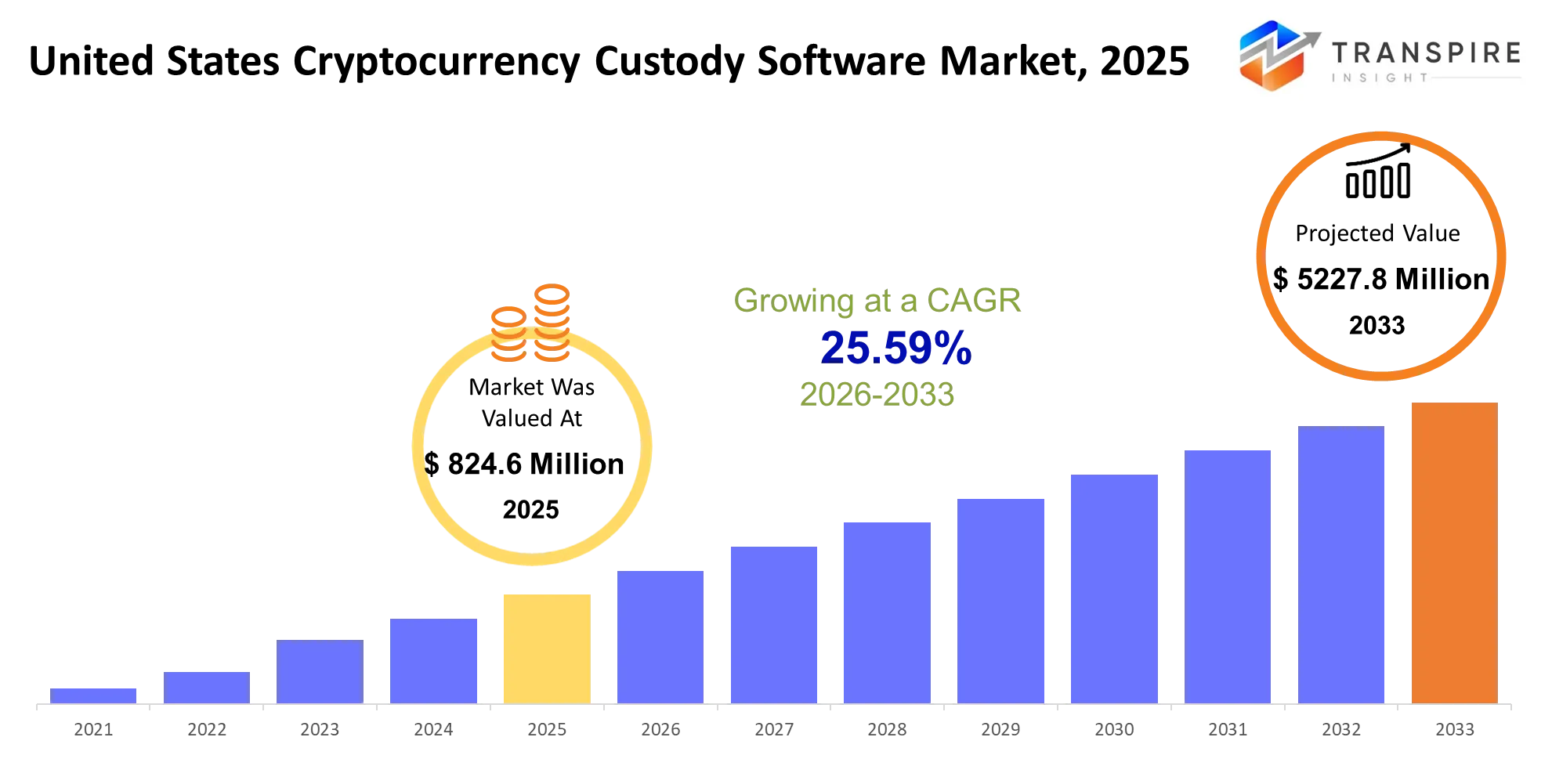
As per Transpire Insight Analysis the United States Cryptocurrency Custody Software Market size is estimated at USD 824.6 Million in 2025 and is anticipated to reach USD 5227.8 Million by 2033, growing at a CAGR of 25.59% from 2026 to 2033.
The United States Cryptocurrency Custody Software Market is basically about secure storage, authorization, moving, and watching digital assets for organizations that can’t just lean on plain exchange wallets or do all the key management by hand. These custody platforms bring together wallet infrastructure and a sort of approval routine, plus transaction guardrails, compliance routines, and security technologies like MPC and hardware security modules. In the last three to five years, the whole market drifted a bit from crypto-native safekeeping toward institutional-level foundation work, since asset managers, banks, exchanges, and ETF sponsors started entering the space.
Then in 2024, the green light for spot Bitcoin ETFs turned into a big trigger, and suddenly there were large-scale demands for regulated custody and day to day operational controls. Coinbase also shared that 9 of the 11 approved spot Bitcoin ETFs partnered with Coinbase, for custody. At the same time, regulatory clarification, plus more trust-bank activity, has further encouraged institutional participation.
United States Cryptocurrency Custody Software Market Size & Forecast:
- United States Cryptocurrency Custody Software Market Size 2025: USD 824.6 Million
- Expected Market Value 2033: USD 5227.8 Million
- Forecast CAGR: 25.59%
- Key Profile: Coinbase, Fireblocks, BitGo, Anchorage Digital, Gemini Trust Company, Ripple, Consensys, Ledger Enterprise, Copper Technologies, Taurus SA, Fidelity Digital Assets, BNY Mellon, Hex Trust, Bakkt Holdings, Zodia Custody
Key Market Insights
- Northeast markets kind of dominate most institutional activity, helped along by New York ’s financial ecosystem and those regulated trust companies that end up serving digital asset investors, in a very hands-on way.
- Meanwhile the Western states are set up for quicker expansion, because of tech firms, crypto infrastructure providers venture capital, and bunches of blockchain development clusters that keep feeding talent.
- Cloud based custody software is leading the way, since institutions want something scalable for wallet management , with transaction controls, plus APIs and a faster path to deployment, not a lot of extra friction.
- Even with all the change, institutional custody is still strategically important, especially for ETF issuers who lean on qualified custodians like Coinbase, Anchorage Digital, and BitGo.
- Cold storage infrastructure keeps acting like the backbone for security strategies, while MPC is getting more emphasis too, because it supports controlled transaction signing without needing to rebuild complete private keys.
- The Spot Bitcoin ETF approvals also shifted the custody economics, with 11 Bitcoin ETF applications approved in 2024 and nine of those lined up with Coinbase.
- Multi custodian strategies are starting to pull ahead, since large holders diversify their counterparty risk across Coinbase, Anchorage Digital, and Fidelity Digital Assets, more than before.
- Tokenization is also broadening what custody has to cover, creating real demand for systems that can handle blockchain based securities stablecoins, collateral, and programmable assets.
- On the security side, platforms are adding automated fraud controls as AI powered detection keeps spotting suspicious transactions and scam patterns before anything settles.
- And lately the edge is moving toward integrated platforms, where custody trading compliance settlement reporting, and institutional APIs come together in one workflow, basically a single loop end to end.
What are the Key Drivers, Restraints, and Opportunities in the United States Cryptocurrency Custody Software Market?
Driver: Institutionalization of digital assets, kind of like it, is still the most powerful growth driver. The SEC green light for spot Bitcoin ETFs in 2024 basically made it a must-have to build professional custody infrastructure. That includes segregation controls, ongoing reporting , and very careful management of private keys in secure ways. Coinbase noted that 9 out of 11 approved spot Bitcoin ETFs teamed with Coinbase, showing , in a fairly straightforward way, how regulated investment products can turn right into custody work and service-related income.
Restraint: Security plus regulatory obligations still act as a sturdy brake, because custody failures can cause financial damage, legal exposure, and reputational harm. Institutions have to examine how private-key controls work, whether segregation is real, how operational resilience is handled, what insurance covers , also counterparty risk, and what the regulatory status looks like, before they move any assets. Bigger holders are starting to diversify custodians, but a setup with multiple custodians also brings extra integration and reconciliation work, plus governance headaches, and higher transaction-management costs, all of it.
Opportunity: Tokenization and stablecoin infrastructure provide a real expansion route beyond just conventional “crypto storage.” Fidelity Digital Assets, for instance, has launched a dollar-backed stablecoin that relies on institutional custody and reserve-management infrastructure. As banks and asset managers move more financial instruments onto blockchain networks, custody software can unlock additional revenue streams via programmable controls, collateral administration, settlement workflows , and institutional-grade transaction monitoring.
What Has the Impact of Artificial Intelligence Been on the United States Cryptocurrency Custody Software Market?
Artificial intelligence is shifting digital-asset custody , mostly by doing transaction monitoring and helping with fraud detection and anomaly identification plus automated risk evaluation rather than actually managing physical asset storage . Machine-learning systems can look at wallet behavior , transaction histories , address connections , and overall transaction patterns to flag activity that veers away from what’s usually seen in a given customer’s routine. Chainalysis bought Alterya in 2025 , after the AI fraud-detection platform had been watching more than $8 billion in transactions each month and had spotted $10 billion being sent to scams during 2024 , which basically highlights how large the AI-supported risk watch is in crypto markets.
There’s also advanced analytics that can assist with automated screening before transactions even reach final settlement. AI may triage suspicious transfers, throw out risk signals , and enable quicker intervention across huge transaction volumes , so there is less reliance on manual review. Custody platforms are increasingly stacking these features with MPC, hardware security, encryption, and multi-tier approval mechanisms , so the controls around high-value movement become more robust.
Still, a big sticking point is data quality and integration complexity. AI models need trustworthy transaction and behavioral inputs, but new blockchain networks , unfamiliar tokens , scam methods that evolve quickly , and the threat of false positives can all weaken detection performance. On top of that, plugging AI into current banking workflows , custody ledgers , compliance systems , and security infrastructure can increase project costs, sometimes long before any clear operational payoff shows up.
Key Market Trends
- Since 2024 , spot Bitcoin ETFs have sort of accelerated institutional custody obligations and at the same time made regulated digital-asset infrastructure more desirable or in demand, in general.
- Coinbase said it handled custody for nine out of 11 approved U.S. spot Bitcoin ETFs that partnered with them during 2024, so yeah.
- MPC adoption has also widened, as institutions want private key governance that cuts down single places of failure or compromise when transaction signing happens.
- Multi custodian setups became more significant as big holders started spreading their exposure across Coinbase, Anchorage Digital, and Fidelity Digital Assets , instead of keeping everything in one place.
- In 2025, Fidelity Digital Assets got a national trust bank charter , which deepened the link between normal banking and digital-asset custody.
- AI driven fraud prevention moved forward in 2025, and Alterya reported monitoring more than $8 billion every month across both crypto and fiat transaction networks, rails, and other routes.
- Regulatory conversation shifted toward more custody flexibility in 2025, including ideas that address MPC , plus multi signature safeguarding structures.
- Institutional platforms are increasingly bundling custody with trading , so assets can stay in cold storage but still support execution and liquidity access, all in the same workflow.
- Stablecoins went beyond payments and into institutional infrastructure, which in turn created extra custody obligations for reserves, issuance, settlement, plus transaction oversight and controls.
- ETF and fund frameworks are pushing for better segregation, stronger reporting, and tighter operational controls as digital assets keep moving into mainstream investment products.
United States Cryptocurrency Custody Software Market Segmentation
By Deployment:
Cloud-based deployment can back scalable custody infrastructure, a centralized administration style, API connectivity, and quick hand-integration with exchanges, banks , and asset management platforms. On-premise deployment is still used by organizations that want direct grip over their infrastructure, security policies, sensitive transaction data, and internal governance, like you can’t really hand over everything. Hybrid cloud models mix institutional infrastructure with external computing resources and, in a way, keep things more fitted, while SaaS custody platforms lower the implementation effort by using subscription-based custody software. Private cloud environments usually allow controlled access and security policies that get tuned, whereas public cloud deployment gives flexible capacity to institutions that already have cloud governance frameworks in place .
Multi-cloud deployment, meanwhile, may cut down the dependence on a lone infrastructure provider and improve resilience across custody operations. Edge deployment can enable localized processing for transaction validation, authentication , and security monitoring, especially where low-latency controls actually matter. There are also other deployment models that cover specialized institutional needs, for example dedicated infrastructure and customized custody environments, so teams can align their whole setup more smoothly.
By Custody Type:
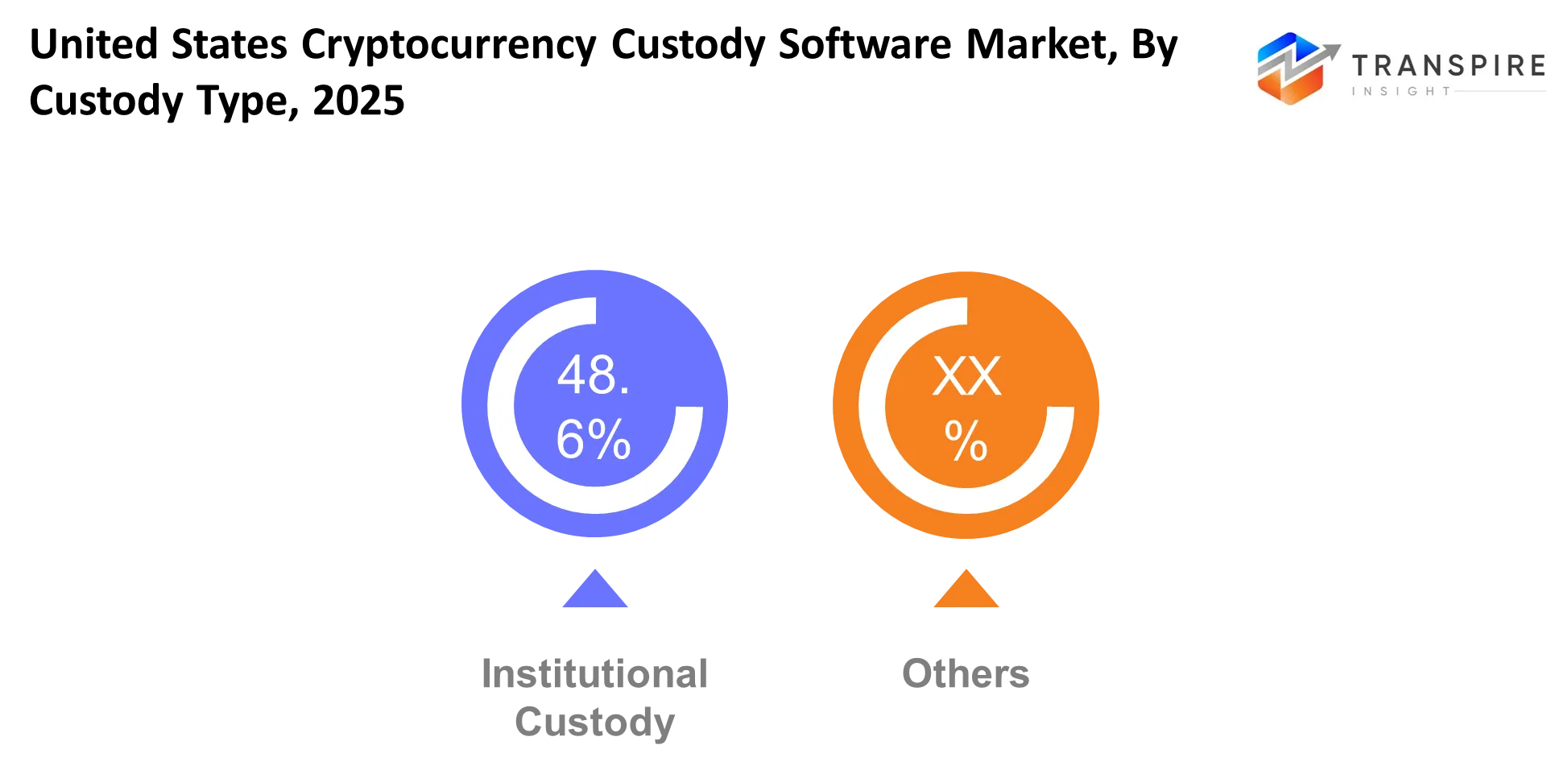
Hot wallet custody is generally good for high frequency operations and liquidity handling, so it fits the kind of setting where exchanges need to move funds often , and trading has to stay responsive. Cold wallet custody gives much tighter isolation for long term holding, but it’s also less about constant activity. The hybrid approach kind of blends both, you still get day to day transaction availability while keeping a portion secured in offline style protection. Multi signature custody works by forcing multiple approvals before any transfer can happen, this supports role separation and it also lowers the chance of an unauthorized payout. Institutional custody goes further with regulated workflows, plus reporting, governance, and operational controls that professional investors expect.
Self custody solutions, meanwhile, give you direct dominion over your private keys, not just a mediated process. MPC custody takes a different direction , it spreads cryptographic key shares across several environments rather than storing one complete key in a single place. If you integrate a hardware wallet, you get dedicated signing safeguards along with physical security controls, so signing is protected at a more tangible layer. Coinbase and Fidelity both stress cold storage plus multi layer security choices, and they frame it as part of a broader institutional custody setup.
By Application:
Digital asset management is a major use case, because investors at a professional level need secure storage, approval of transactions, reporting, and portfolio controls that actually hold up. Institutional trading adds even more pressure for quick transfers, careful liquidity management, plus API connectivity, and the ability to run settlement in a controlled way between custody and execution platforms, sort of hand in hand. Crypto exchanges then bring their own needs around high-volume wallet operations, continuous transaction monitoring, withdrawal constraints, and proper segregation of customer assets.
Tokenization also changes the game ,it introduces custody demands for blockchain-based securities, funds, stablecoins, and other programmable assets. In DeFi, asset custody typically means controlled access to decentralized protocols, while NFT custody focuses on specialized ownership records that are tied to tokens. On the other side, fund management and banking style applications demand sturdier governance, reconciliation workflows, compliance checks, and deeper reporting features. ETF structures have increased institutional custody activity too, with several U.S. investment products relying on professional digital-asset custodians to keep everything managed.
By End User:
Banks and financial institutions, need custody systems that pretty much align digital assets with established governance and audit, security and regulatory processes . Crypto exchanges , in contrast, need to handle very high volume transaction processing and then do wallet administration, withdrawal controls, plus automated monitoring. Asset management firms and hedge funds want institutional custody, portfolio reporting and segregation , but also controlled access for investment operations.
Family offices and larger enterprises increasingly ask for secure digital asset administration , without having to build complete custody infrastructure in house, themselves. Government agencies can also use custody platforms for more controlled management of digital assets that are tied to public-sector work and legal processes. Institutional requirements tend to favor regulated custodians , multi-custodian setups, cold storage, and documented security controls that stand up in reviews. Public filings often show major Bitcoin holders using Coinbase , Anchorage Digital and Fidelity Digital Assets at the same time , sort of to diversify custody exposure and mitigate concentration.
By Security Technology:
MPC makes distributed key management work by stoping the whole private-key reconstruction happening inside one place, more like no complete “single environment” takeover. In parallel, hardware security modules guard cryptographic operations using their own secure setup, and biometric authentication strengthens identity checks for privileged access , so it s harder to slip in. Zero Trust security keeps doing ongoing validation and uses least-privilege rules everywhere across custody systems.
Then AI fraud detection looks at transaction conduct plus a bundle of risk indicators , to spot weird behavior before settlement. Encryption meanwhile shields sensitive data during storage and across transmission, while blockchain security tools track addresses, transactions, smart contracts and even network behavior. Identity management links user sign in with role-based permissions and review, approval workflows. Coinbase has outlined MPC, geographic key-share dispersal, least-privilege controls and hardware security measures inside institutional custody infrastructure.
What are the Key Use Cases Driving the United States Cryptocurrency Custody Software Market?
Institutional digital asset management stays kinda the core use case, because banks asset managers hedge funds and ETF sponsors need secure storage, controlled transfers , reporting and recorded governance. In 2024 the spot Bitcoin ETF approvals really boosted this use, by effectively placing professional custody infrastructure right inside regulated investment products, so the whole workflow feels closer. Coinbase ended up as custodian for multiple Bitcoin and Ethereum ETFs, showing that investment product growth and custody needs kinda move together.
Institutional trading and fund management are also getting bigger over time, mainly because custody platforms now connect cold storage with execution , collateral, liquidity, and settlement routines. Fidelity Digital Assets, for instance, supports custody , execution and collateral services via one institutional platform , which reduces handoffs and keeps things more governed. Meanwhile banks and other financial institutions are building digital asset services too, and they’re focusing on stronger transaction controls plus operational segregation.
Tokenization and stablecoin infrastructure look like emerging use cases with a pretty solid long term runway. Digital securities , tokenized funds, and dollar backed digital assets need custody systems that can handle programmable ownership, settlement, reserves and transaction permissions. Fidelity’s institutional stablecoin infrastructure is a good example, showing how custody can go beyond typical cryptocurrency holdings and expand into wider on chain financial services.
|
Report Metrics |
Details |
|
Market size value in 2025 |
USD 824.6 Million |
|
Market size value in 2026 |
USD 1061.4 Million |
|
Revenue forecast in 2033 |
USD 5227.8 Million |
|
Growth rate |
CAGR of 25.59% from 2026 to 2033 |
|
Base year |
2025 |
|
Historical data |
2021 - 2024 |
|
Forecast period |
2026 - 2033 |
|
Report coverage |
Revenue forecast, competitive landscape, growth factors, and trends |
|
Regional scope |
United States; Canada; Mexico; United Kingdom; Germany; France; Italy; Spain; Denmark; Sweden; Norway; China; Japan; India; Australia; South Korea; Thailand; Brazil; Argentina; South Africa; Saudi Arabia; United Arab Emirates |
|
Key company profiled |
Coinbase, Fireblocks, BitGo, Anchorage Digital, Gemini Trust Company, Ripple, Consensys, Ledger Enterprise, Copper Technologies, Taurus SA, Fidelity Digital Assets, BNY Mellon, Hex Trust, Bakkt Holdings, Zodia Custody |
|
Customization scope |
Free report customization (country, regional & segment scope). Avail customized purchase options to meet your exact research needs. |
|
Report Segmentation |
By Deployment (Cloud-Based, On-Premise, Hybrid Cloud, SaaS, Private Cloud, Public Cloud, Multi-Cloud, Edge Deployment, Others); By Custody Type (Hot Wallet Custody, Cold Wallet Custody, Hybrid Custody, Multi-Signature Custody, Institutional Custody, Self-Custody Solutions, MPC Custody, Hardware Wallet Integration, Others); By Application (Digital Asset Management, Institutional Trading, Crypto Exchanges, Tokenization, DeFi Asset Custody, NFT Custody, Fund Management, Banking, Others); By End User (Banks, Financial Institutions, Crypto Exchanges, Asset Management Firms, Hedge Funds, Family Offices, Enterprises, Government Agencies, Others); By Security Technology (Multi-Party Computation (MPC), Hardware Security Modules, Biometric Authentication, Zero Trust Security, AI Fraud Detection, Encryption Solutions, Blockchain Security, Identity Management, Others) |
Which Regions are Driving the United States Cryptocurrency Custody Software Market Growth?
New York and the wider Northeast kind of hold the dominant regional position because the area brings together a big institutional finance base, and also a pretty mature regulatory setup for digital asset custody. In New York the bank plus trust-company structure feels more direct for custody providers, letting them serve asset managers , ETF issuers, banks and a range of other regulated entities more easily. BNY, Coinbase Custody and other providers do well from being near major financial institutions, compliance folks, investment managers, and the whole capital markets support web. When decision-makers are concentrated like that, it tends to back higher value custody agreements , and it pushes providers to blend custody with trading, fund administration, settlement, and reporting duties.
The Midwest shows a different growth curve, more tied to financial-sector steadiness, corporate treasury work, and the slow incorporation of digital assets into long standing banking routines. Chicago stands out with a strong financial services base and a derivatives ecosystem, so custody providers can connect digital assets with trading , collateral, and institutional risk-management workflows. Compared to New York where the regulators cluster, this region basically gives a wider set of links into traditional financial institutions and corporate users trying to get controlled digital asset exposure.
The Western United States is set up as the fastest growing regional market, because tech companies, blockchain developers, venture investors, and digital asset infrastructure teams are concentrated across California and surrounding states.
Who are the Key Players in the United States Cryptocurrency Custody Software Market and How Do They Compete?
Competition is slowly moving away from the “just standalone wallet” security mindset, toward something more like integrated institutional infrastructure, and honestly the whole area is getting more smushed together, like custody plus ops and not just the keys. Most providers end up competing mainly through security architecture, regulatory credentials , asset coverage, transaction controls, institutional connectivity, and then this ability to mash custody with trading, settlement, compliance, and also tokenization.
Coinbase seems to lean on its New York-regulated custody structure , its cold-storage capabilities, plus support for more than 470 assets. Meanwhile Fidelity Digital Assets, sort of blends custody and execution using an internally developed institutional platform. Fireblocks differentiates using MPC-based infrastructure and a pretty wide institutional network, and then in January 2026 its acquisition of TRES added accounting , reconciliation, and financial-control capabilities into the digital-asset platform.
BitGo competes with institutional custody and prime-service capabilities that tie asset protection with liquidity and treasury requirements, which is kind of the point. Anchorage Digital uses its regulated trust-bank structure to target institutions that need qualified custody plus regulatory controls. BNY Mellon takes a more classic custodian angle, integrating digital-asset custody into a broader asset servicing setup, including tokenized fund infrastructure and on-chain data services.
On the expansion side, Fidelity is going beyond Bitcoin and Ether by adding Solana custody and execution, but still keeping that integrated custody, trading, collateral, and stablecoin proposition. Fireblocks is doing something similar in reverse direction, extending its platform past custody into stablecoin payments, tokenization, and general financial operations, which should raise switching costs for institutional customers.
Company List
- Coinbase
- Fireblocks
- BitGo
- Anchorage Digital
- Gemini Trust Company
- Ripple
- Consensys
- Ledger Enterprise
- Copper Technologies
- Taurus SA
- Fidelity Digital Assets
- BNY Mellon
- Hex Trust
- Bakkt Holdings
- Zodia Custody
Recent Development News
- "In January 2026, Fireblocks announced acquisition of TRES Finance. The transaction added crypto accounting, reconciliation, and financial-control capabilities to Fireblocks' institutional digital-asset platform, strengthening its ability to provide broader financial operations infrastructure alongside custody. https://www.fireblocks.com/blog/fireblocks-acquires-tres (Fireblocks)."
- "In February 2026, Fidelity Investments launched Fidelity Digital Dollar (FIDD). The stablecoin, issued by Fidelity Digital Assets, National Association, extends Fidelity's institutional digital-asset infrastructure into dollar-based on-chain transactions and creates additional custody requirements for digital cash. https://www.fidelitydigitalassets.com/research-and-insights/fidelity-investmentsr-expands-digital-asset-investment-lineup-stablecoin (Fidelity Digital Assets)."
What Strategic Insights Define the Future of the United States Cryptocurrency Custody Software Market?
The market is kind of structurally shifting toward full stack digital asset infrastructure, where custody is just one part , of a wider platform that also touches trading, tokenization, stablecoins , settlement, collateral, compliance and financial reporting. The most powerful underlying pull is the move of usual financial products onto blockchain networks , because tokenized funds, stablecoins and digital securities basically need institutional guardrails around ownership and transaction sign off. Like BNY’s work with tokenized funds, and Fidelity’s 2026 stablecoin launch show, custody providers can start earning from the surrounding infrastructure, not only from “holding” storage.
There’s also a quieter risk, platform concentration . If institutions end up consolidating custody with a small set of regulated providers, then a tech failure , cyber incident , regulatory action, or counterparty stumble at one big firm could spill over and hit a huge share of assets at once. Still, the emerging opportunity is policy controlled custody for tokenized real world assets, and stablecoins too , especially the infrastructure that links traditional banks with blockchain networks. Market participants should focus on modular platforms that can support several blockchains, different custodians, authentication approaches and settlement rails rather than building a solution that’s tied to one network , or one provider, like it’s the only option.
United States Cryptocurrency Custody Software Market Report Segmentation
By Deployment
- Cloud-Based
- On-Premise
- Hybrid Cloud
- SaaS
- Private Cloud
- Public Cloud
- Multi-Cloud
- Edge Deployment
- Others
By Custody Type
- Hot Wallet Custody
- Cold Wallet Custody
- Hybrid Custody
- Multi-Signature Custody
- Institutional Custody
- Self-Custody Solutions
- MPC Custody
- Hardware Wallet Integration
- Others
By Application
- Digital Asset Management
- Institutional Trading
- Crypto Exchanges
- Tokenization
- DeFi Asset Custody
- NFT Custody
- Fund Management
- Banking
- Others
By End User
- Banks
- Financial Institutions
- Crypto Exchanges
- Asset Management Firms
- Hedge Funds
- Family Offices
- Enterprises
- Government Agencies
- Others
By Security Technology
- Multi-Party Computation (MPC)
- Hardware Security Modules
- Biometric Authentication
- Zero Trust Security
- AI Fraud Detection
- Encryption Solutions
- Blockchain Security
- Identity Management
- Others
Frequently Asked Questions
Find quick answers to common questions.
The expected United States Cryptocurrency Custody Software Market size for the market will be USD 5227.8 Million in 2033.
Key segments for the United States Cryptocurrency Custody Software Market are By Deployment (Cloud-Based, On-Premise, Hybrid Cloud, SaaS, Private Cloud, Public Cloud, Multi-Cloud, Edge Deployment, Others); By Custody Type (Hot Wallet Custody, Cold Wallet Custody, Hybrid Custody, Multi-Signature Custody, Institutional Custody, Self-Custody Solutions, MPC Custody, Hardware Wallet Integration, Others); By Application (Digital Asset Management, Institutional Trading, Crypto Exchanges, Tokenization, DeFi Asset Custody, NFT Custody, Fund Management, Banking, Others); By End User (Banks, Financial Institutions, Crypto Exchanges, Asset Management Firms, Hedge Funds, Family Offices, Enterprises, Government Agencies, Others); By Security Technology (Multi-Party Computation (MPC), Hardware Security Modules, Biometric Authentication, Zero Trust Security, AI Fraud Detection, Encryption Solutions, Blockchain Security, Identity Management, Others).
Major United States Cryptocurrency Custody Software Market players are Coinbase, Fireblocks, BitGo, Anchorage Digital, Gemini Trust Company, Ripple, Consensys, Ledger Enterprise, Copper Technologies, Taurus SA, Fidelity Digital Assets, BNY Mellon, Hex Trust, Bakkt Holdings, Zodia Custody.
The United States Cryptocurrency Custody Software Market size is USD 824.6 M Million in 2025.
The United States Cryptocurrency Custody Software Market CAGR is 25.59%from 2026 to 2033.
- Coinbase
- Fireblocks
- BitGo
- Anchorage Digital
- Gemini Trust Company
- Ripple
- Consensys
- Ledger Enterprise
- Copper Technologies
- Taurus SA
- Fidelity Digital Assets
- BNY Mellon
- Hex Trust
- Bakkt Holdings
- Zodia Custody
About the Authors

Mayur Shinde
I am Mayur Shinde, a Senior Research Analyst at Transpire Insight, specializing in the Automotive & Transportation and Information & Communication Technology (ICT) Industry. My work focuses on analyzing emerging market trends, technological advancements, competitive landscapes, and industry developments to deliver accurate, data-driven insights. I am passionate about transforming complex market information into clear, actionable content that helps businesses, professionals, and decision-makers stay informed and make confident strategic decisions.

Chakradhar Khansole
Chakradhar serves as the Research Director at Transpire Insight, bringing over 8 years of experience in technology, innovation, and strategic market intelligence. He specializes in transforming complex market data into actionable business insights that enable organizations to make informed, growth-oriented decisions. Recognized for his strategic vision and analytical expertise, Chakradhar leads high-impact research initiatives, delivering comprehensive market assessments, competitive intelligence, and forward-looking industry analysis.
Recently Published Reports
-
Apr 2026
3D Optical Profiler Market
3D Optical Profiler Market Size, Share & Analysis Report By Type (Desktop 3D Optical Profiler, and Portable 3D Optical Profiler), By Technology (Confocal Technology, and White Light Interference), By End-Use Industry (Manufacturing, Research Institutions, Automotive, Aerospace and Defense, Medical Devices, and Other), and Geography (North America, Europe, Asia-Pacific, Middle East and Africa, South and Central America), 2021 - 2031
-
Apr 2026
Depth Sensor Market
Depth Sensor Market Size, Share & Analysis Report By Type (Infrared Depth Sensors, Time-of-Flight (ToF) Sensors, Stereo Vision Sensors, Structured Light Sensors, Ultrasonic Depth Sensors), By Application (Automotive, Robotics, Gaming, Consumer Electronics, Industrial Automation, Healthcare, Security & Surveillance, Others), By End Users (Automotive Manufacturers, Consumer Electronics Companies, Healthcare Providers, Industrial Companies, Security Agencies, Gaming Companies, Robotics Companies, Others), and Geography (North America, Europe, Asia-Pacific, Middle East and Africa, South and Central America), 2021 – 2031
-
Apr 2026
Digital Manufacturing Market
Digital Manufacturing Market Size, Share & Analysis Report By Component (Hardware, Software, and Services), By Technology (Robotics, 3D Printing, Internet of Things (IoT), and Others), By Application (Automotive and Transportation, Aerospace and Defense, Consumer Electronics, Industrial Machinery, and Others), By Process Type (Computer-Based Designing, Computer-Based Simulation, Computer 3D Visualization, Analytics, and Others), and Geography (North America, Europe, Asia-Pacific, Middle East and Africa, South and Central America), 2021 – 2031
-
Apr 2026
Digital Visa Services Market
Digital Visa Services Market Size, Share & Analysis Report By Type (Individual Travelers, Group Travelers), By Application (Tourism, Business Travel, Others), and Geography (North America, Europe, Asia-Pacific, Middle East and Africa, South and Central America), 2021 – 2031