
United States Container Depot Services Market Size & Forecast:
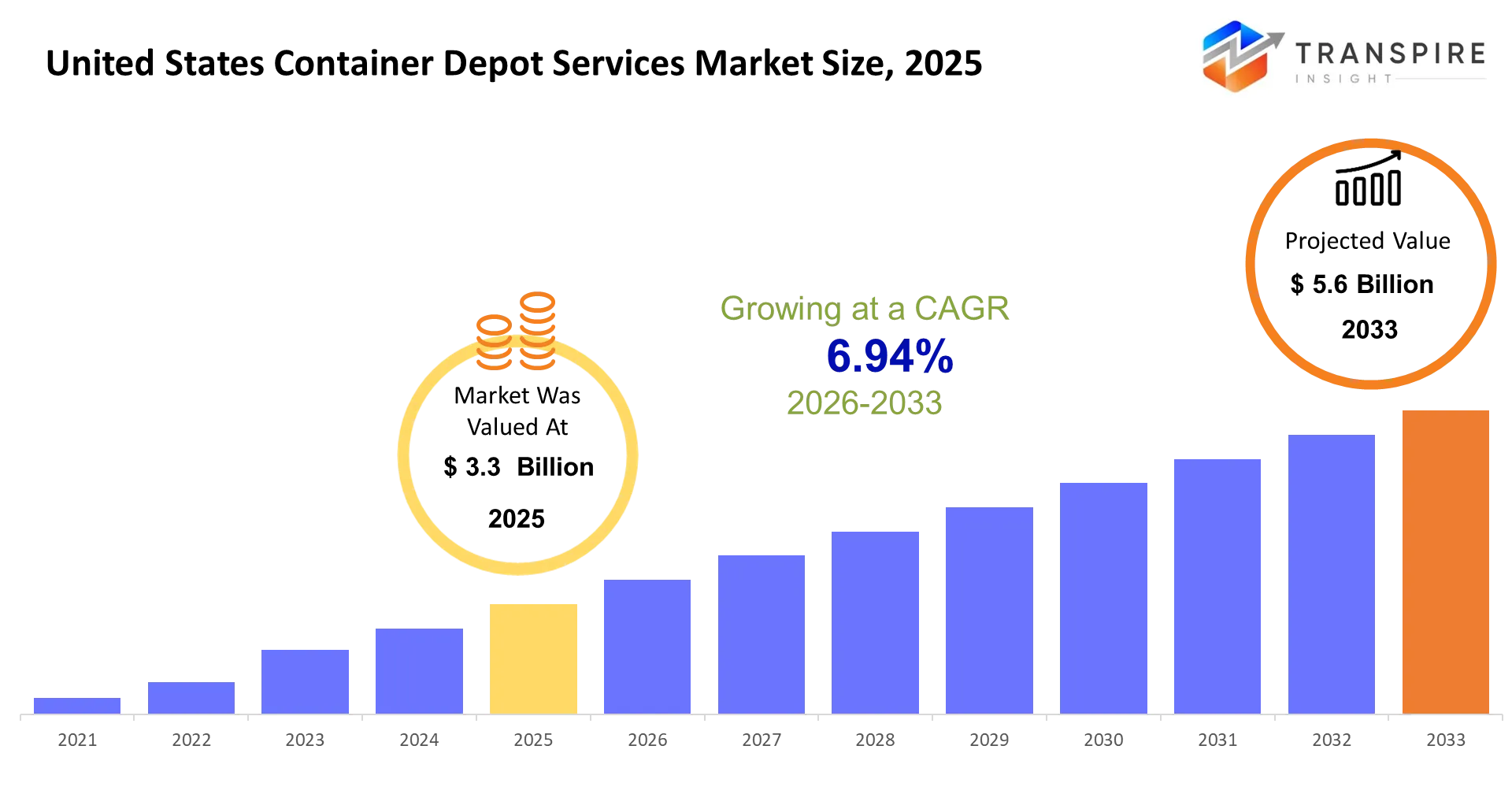
- United States Container Depot Services Market Size 2025: USD 3.3 Billion
- United States Container Depot Services Market Size 2033: USD 5.6 Billion
- United States Container Depot Services Market CAGR: 6.94%
- United States Container Depot Services Market Segments: By Service Type (Storage Services, Maintenance & Repair, Cleaning Services, Reefer Services, Inspection Services, Transportation Services, Others), By Container Type (Dry Containers, Reefer Containers, Tank Containers, Open Top Containers, Flat Rack Containers, Others), By End User (Shipping Companies, Logistics Providers, Freight Forwarders, Importers & Exporters, Port Authorities, Others), By Deployment (Port-based Depots, Inland Depots, Rail-linked Depots, Private Depots, Others).
To learn more about this report,  Download Free Sample Report
United States Container Depot Services Market Summary:
The United States Container Depot Services Market size is estimated at USD 3.3 Billion in 2025 and is anticipated to reach USD 5.6 Billion by 2033, growing at a CAGR of 6.94% from 2026 to 2033.The United States Container Depot Services Market does this kind of kinda critical stuff, like it quietly sits in-between ports rail terminals warehouses and trucking routes. Container depots basically take care of storage, checking, maintenance, cleaning, repositioning, plus a sort of turnaround for shipping containers so the whole cargo pipeline keeps rolling, without turning into a bottleneck. In reality these places let shipping lines, and other logistics providers, cut down on dwell time, dodge those port congestion penalty headaches, and keep containers available across the inland freight corridors.
Over the past 3 to 5 years the market moved away from only basic warehousing type actions, and toward digitally coordinated asset management. Depot operators now lean on tracking platforms, predictive maintenance tools, and automated gate operations, so container movement is handled with more precision. That shift picked up steam after COVID-19, when supply chain disruptions made it painfully obvious that container availability and inland logistics capacity were out of sync. Shippers started to lean into resilience instead of super lean inventory models, so depot networks also began expanding near intermodal hubs and manufacturing clusters. and yes this is now pushing demand for higher value depot services, which helps utilization rates, and it also creates additional income opportunities linked to repairs, refurbishment, and near real time container visibility.
Key Market Insights
- The Gulf Coast region kind of dominated the United States Container Depot Services Market, with almost 34% market share in 2025, mostly because petrochemical demand and export activity stayed pretty strong.
- The West Coast depots still hold a meaningful portion because the ports at Los Angeles and Long Beach push huge container throughput , and the trans- Pacific trade volumes keep flowing.
- The Southeast United States is probably the fastest-growing regional market all the way through 2030, and that is tied to manufacturing relocation and ongoing port expansion investments.
- Also, inland logistics hubs across Texas, Georgia, and Illinois are seeing emerging demand for off-dock container storage plus maintenance services, not just simple parking.
- In terms of services, container storage services took the lead in the United States Container Depot Services Market, with more than 38% of revenue share in 2025. This seems linked to persistent chassis shortages and careful dwell-time management.
- Repair and maintenance services came in as the second-largest market share, since carriers raised refurbishment cycles for older container fleets, and they were pretty focused on extending asset lifespans.
- Reefer container inspection services are gaining momentum because food, plus pharmaceutical logistics, really need tighter temperature-compliance expectations.
- On the application side, maritime shipping applications held close to 46% market share in 2025, driven by expanding containerized trade volumes across major U.S. ports.
- Meanwhile intermodal rail logistics emerged as the fastest-growing application segment, due to more inland freight movement and rail-connected distribution centers that keep expanding.
- Lastly, e-commerce supply chains are creating a lot of need for quick container turnaround and short-term storage options near city fulfillment hubs, since fulfillment timelines can be pretty short.
What are the Key Drivers, Restraints, and Opportunities in the United States Container Depot Services Market?
The strongest force pushing the United States Container Depot Services Market forward is sort of the reshaping of home supply routes after the COVID-19 logistics crisis. Importers and shipping lines took on heavy setbacks due to container shortages, port gridlock , and those long dwell intervals between 2020 and 2022. After that, many firms moved away from lean inventory thinking toward a more regional buffer approach and inland container positioning. With that shift, depot operators became more central for warehousing, service work, repositioning, plus real-time container monitoring. At the same time, the build-out and expansion around Gulf Coast and Southeast ports rerouted cargo streams,so it went past the usual West Coast lanes , and that created new income areas for inland depots that are tied into rail and trucking corridors.
Land availability right by major ports stays the biggest structural stumbling block for this market. Container depots need big industrial parcels with direct highway access and rail connections , but zoning limitations along with climbing industrial land costs keep slowing down expansion. And this issue doesn’t get fixed fast, because infrastructure near ports often needs multi-year permitting, plus environmental sign-offs that take time. So operators end up paying more to run day-to-day, adding capacity later than planned, and dealing with reduced turnaround efficiency when freight demand peaks.
The next growth phase will likely come from smarter depot automation systems. Companies are putting money into AI-driven yard control, RFID-based container observability, and automated gate handling to cut down idle container time and reduce dependence on human labor. Texas and Georgia are starting to look like major investment corridors, mainly because intermodal systems and manufacturing activity are growing at the same time.
What Has the Impact of Artificial Intelligence Been on the United States Container Depot Services Market?
Artificial intelligence along with newer digital systems are, sort of, reshaping how container depots handle asset use, turnaround pace, and overall operational dependability across the U.S. logistics web. Depot teams are now leaning on AI powered yard management platforms, to automate stuff like container assignment, gate time slots, chassis pairing, and inventory record keeping. There are computer vision setups tied to OCR cameras, that can spot container wear and tear, confirm container identifiers, and cut down on a lot of manual checking during both inbound and outbound moves. Overall these tools tend to lift gate throughput, and they bring down truck waiting time especially at busy intermodal hubs.
On top of that, machine learning models are making predictive maintenance feel more practical across depot equipment fleets, including reach stackers, refrigerated container power modules, and automated gate systems. By looking at vibration signatures, fuel usage figures, and past repair rhythms operators can flag equipment failure risk, before a breakdown even starts. Several big depot groups, say they’ve seen concrete declines in unexpected downtime and reduced maintenance expenses after they plugged predictive analytics into everyday fleet management. AI based routing plus yard optimization approaches are also helping minimize needless container shuffling, and even lessen fuel consumption across trucking activities.
Still, adoption hits a clear roadblock because many depot locations run on scattered legacy software, and their data collection habits are often not consistent. When you try to mesh AI platforms with older terminal operating systems, it usually means major upfront spending, a long customization effort, and workforce re training, which basically delays rollouts for mid sized operators.
Key Market Trends
- Since 2021, Gulf Coast depots started expanding kind of aggressively, as cargo rerouting away from West Coast ports quietly reshaped the whole container distribution picture nationally, not always in a simple way.
- Depot operators then leaned down on manual gate handling, because AI-enabled OCR systems shaved truck turnaround times by close to 20% at several major intermodal hubs. It was not just faster, but also more consistent in day to day rhythm.
- Meanwhile, shipping lines like Maersk, and Mediterranean Shipping Company, were sending more of the container maintenance work to specialized inland depot networks, especially after those pandemic-era disruptions left gaps in service coverage and scheduling.
- Between 2020 and 2024, reefer container inspection numbers climbed a lot, driven by the pharmaceutical pipeline, and also the temperature-controlled food supply chain that keeps getting bigger and more demanding.
- Rail-connected depots across Texas and Illinois gained extra leverage, as manufacturers began shifting inventory buffering closer to domestic production sites. That “closer-to-the-factory” approach became a real planning default.
- Operators also started taking predictive maintenance software more seriously, after equipment idle time and chassis shortages disrupted container availability during peak freight windows. In practice, fewer delays, or at least fewer surprises.
- Industrial land shortages near Los Angeles and New York ports, pushed depot development toward secondary logistics corridors, with lower running costs, and fewer hard-to-handle constraints.
- Since 2022, digital container visibility platforms improved compliance tracking, and also reduced misplaced container incidents across multi terminal logistics operations. Less friction, more control, even when volumes spiked.
- Third-party logistics providers expanded long-term depot relationships, aiming to steady container access, and avoid detention fees during seasonal freight surges that can get pretty intense.
- Companies including DCLI and TRAC Intermodal increased spending on smart yard systems, and automated inventory management technologies, after labor expenses jumped sharply.
United States Container Depot Services Market Segmentation
By Service Type
Storage services still keep that sort of leading spot in service type segmentation, mainly because shipping lines together with logistics operators need big scale container staging pretty close to ports, rail terminals and those inland freight corridors. The congestion situation keeps lingering , and inventory holding cycles get longer too , so since after 2020 people leaned more on storage infrastructure .
Maintenance and repair services sit as the second biggest chunk , and that makes sense since container aging is rising, plus safety requirements are getting stricter along international trade routes.
Reefer services and inspection services are also pulling more attention, because moving pharma , food and chemical cargo means tighter compliance monitoring , and temperature validation that is not negotiable. Cleaning and transportation services have grown as well , partly because container turnaround efficiency turned into a competitive scorecard for freight operators, like a quiet KPI .
Looking ahead, future investment is probably going to gather around digitally integrated service platforms—ones that stitch together storage, predictive maintenance and automated inspection systems. Depot operators that can offer multiple services are expected to land steadier long term contracts from carriers and third-party logistics providers , especially those trying to consolidate operations in one place.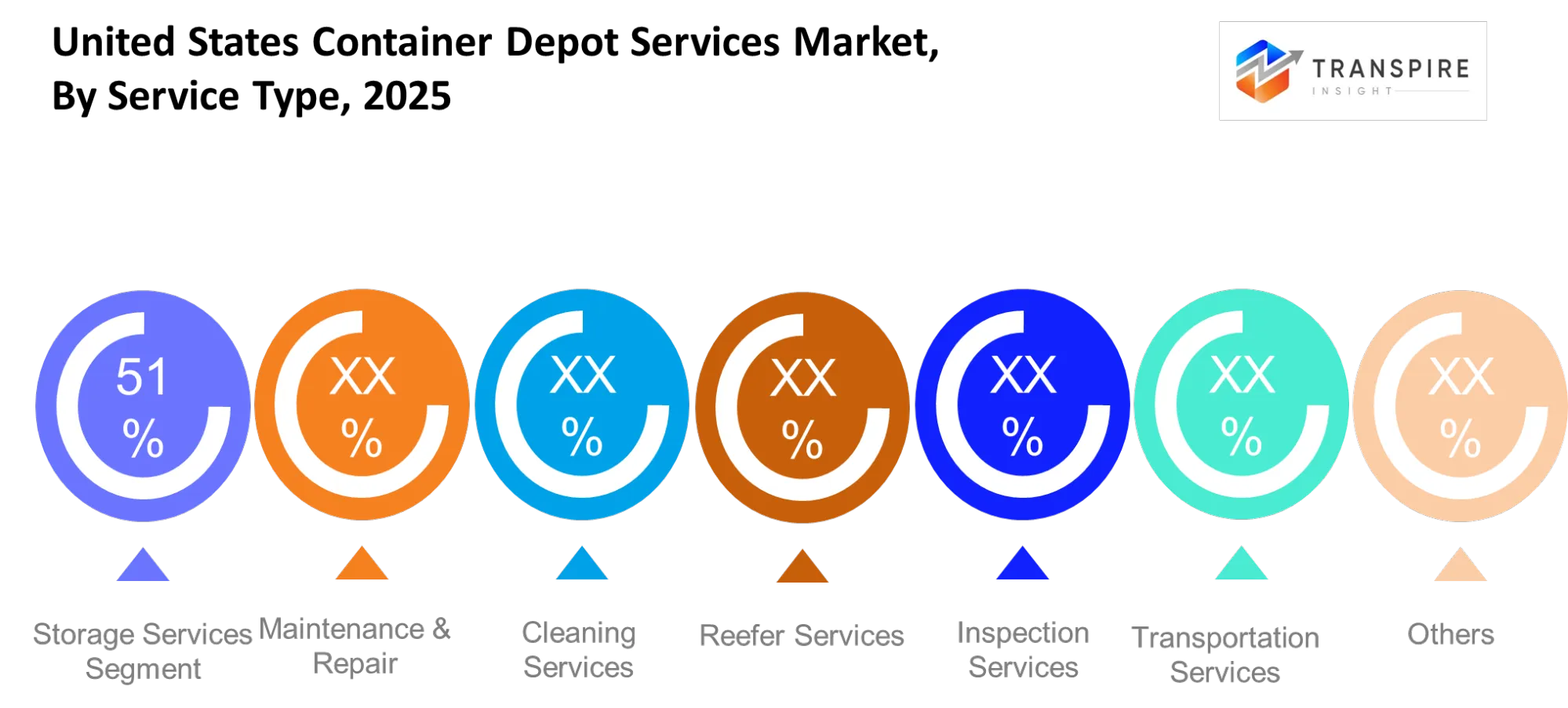
To learn more about this report, Download Free Sample Report
By Container Type
Dry containers kind of end up dominating the container type split, since consumer goods, industrial products, retail inventory, and e-commerce shipments keep moving mostly through standardized dry freight gear. The broad fit with intermodal transport systems and that lower handling fuss help keep utilization rates pretty strong across domestic lanes, and also international trade corridors. Reefer containers show up as the quickest growing category because cold chain logistics keeps stretching for pharmaceuticals, processed food, and agricultural exports. Tank containers still hold steady demand from chemical as well as energy-linked industries, though transport rules and those specialized infrastructure needs can curb wider take-up. Open top containers paired with flat rack containers basically cover project cargo, and oversized industrial equipment moves through them especially when construction and manufacturing are involved.
At the same time , the need for specialized container handling services is expected to rise as trade patterns shift, and cargo sensitivity standards get tighter. Depot operators who put money into reefer inspection systems, hazardous material compliance infrastructure, and specialized repair capabilities should, in theory, boost profit margins, and also lock in longer relationships with higher-value industrial clients.
By End-User
Shipping companies still pretty much dominate the end-user side, mainly because container carriers lean hard on depot networks for repositioning, storage optimization, fleet maintenance, and basically turnaround coordination. Big shipping operators also increasingly send depot work out to third parties, in order to squeeze better asset utilization and lower the operational costs tied to idle containers—yes even when demand is uneven.
Logistics providers are the fastest-growing end-user segment, maybe not surprising because integrated supply chain management models are spreading through retail, manufacturing, and e-commerce. Freight forwarders have been using depots more as well, after global disruptions, made it clearer where container visibility fails and where inland distribution coordination gets messy.
Meanwhile, importers and exporters are asking for depot arrangements that are more flexible, ideally near distribution centers so they can cut down detention charges and avoid delivery delays that pile up. Port authorities keep backing depot expansion projects too, largely to ease congestion pressure inside marine terminals.
Looking ahead, growth should favor operators that can deliver data-driven inventory visibility, coordinate transportation end to end, and provide scalable yard capacity for multiple customer groups moving across regional freight networks.
By Deployment
Port based depots still sort of lead the way in deployment segmentation, mostly because being nearby marine terminals lets you move containers quicker, plus makes customs coordination a bit smoother and helps with vessel turnaround operations. Cargo tends to cluster heavily around big coastal gateways like Los Angeles, Houston, and Savannah, and that keeps these facilities operationally important. Inland depots however have grown faster too, particularly after manufacturers and retailers started keeping inventory buffers closer to where production happens and where people actually consume.
Rail linked depots are also pushing ahead quickly, since intermodal freight transportation can deliver lower transport expenses and stronger long distance cargo efficiency than truck only hauling. Meanwhile private depots run by shipping firms and large logistics providers are gaining traction, as supply chain control turned into a strategic priority after those pandemic disruptions. There’s also the matter of land scarcity and the rising costs of industrial property near major ports, which kind of blocks big coastal expansion. Looking forward, deployment strategies will likely favor inland and rail connected infrastructure, backed by automation, AI enabled yard management systems, and joined up freight visibility platforms .
What are the Key Use Cases Driving the United States Container Depot Services Market?
So the main use case is kind of container storage plus repositioning, especially for international shipping lines that are moving cargo via big U.S. ports like Los Angeles , Houston , and Savannah. With high import volumes , tight vessel schedules , and not much terminal space, the demand stays pretty strong for off-dock container staging and quick turnaround services.
A secondary set of uses is slowly pushing farther into cold chain logistics and intermodal freight transport too. Pharmaceutical distributors and food exporters are leaning more and more on reefer inspection combined with powered storage, so they can stay inside temperature compliance rules. Rail-linked depots are also getting attention, among automotive and retail supply chains that want cheaper inland movement costs, while still keeping flow steady.
Then there are the emerging things, like AI-enabled smart yard operations, plus specialized handling for battery materials and renewable energy equipment. More domestic manufacturing spending, along with stricter cargo traceability rules, should nudge adoption forward. That means automated inspection systems and digitally integrated depot infrastructure are expected to spread over the forecast period, even if it happens in phases.
|
Report Metrics |
Details |
|
Market size value in 2025 |
USD 3.3 Billion |
|
Market size value in 2026 |
USD 3.5 Billion |
|
Revenue forecast in 2033 |
USD 5.6 Billion |
|
Growth rate |
CAGR of 6.94% from 2026 to 2033 |
|
Base year |
2025 |
|
Historical data |
2021 - 2024 |
|
Forecast period |
2026 - 2033 |
|
Report coverage |
Revenue forecast, competitive landscape, growth factors, and trends |
|
Geographic scope |
United States of America |
|
Key company profiled |
DP World, APM Terminals, CMA CGM, Hapag-Lloyd, MSC, Evergreen Marine, Maersk, Container Maintenance Corporation, Triton International, Textainer Group, Gateway Container Line, FlexiVan Leasing, SeaCube Containers, COSCO Shipping, CAI International |
|
Customization scope |
Free report customization (country, regional & segment scope). Avail customized purchase options to meet your exact research needs. |
|
Report Segmentation |
By Service Type (Storage Services, Maintenance & Repair, Cleaning Services, Reefer Services, Inspection Services, Transportation Services, Others), By Container Type (Dry Containers, Reefer Containers, Tank Containers, Open Top Containers, Flat Rack Containers, Others), By End User (Shipping Companies, Logistics Providers, Freight Forwarders, Importers & Exporters, Port Authorities, Others), By Deployment (Port-based Depots, Inland Depots, Rail-linked Depots, Private Depots, Others) |
Which Regions are Driving the United States Container Depot Services Market Growth?
The West Coast region is pretty much in the front of the United States Container Depot Services Market, supported by major gateways like Los Angeles and Long Beach. There’s a high vessel rhythm across Asia–U.S. trade corridors so containers keep coming in steadily, which keeps depot utilization rates strong. Also, strict rules on environmental impact and terminal congestion kinda push shipping lines into using off-dock storage and repositioning workspaces. On top of that, you get a tight set of rail intermodal links, chassis providers, and third-party logistics operators, and it all sort of locks in that lead. Plus, long-running carrier routes, plus heavy import dependency, means there’s always demand for repair , storage, and inspection services across the coast depots.
Meanwhile the Gulf Coast region acts like a steady second contributor, not because of extreme container volume intensity but more because its cargo profile is tied to energy. Ports such as Houston and New Orleans have petrochemical exports and industrial manufacturing activity, so freight cycles are more predictable. Compared with the West Coast, this area leans less on Asia-bound trade swings and more on longer term contracts with shipping lines serving Latin America and Europe. Stable refinery output and ongoing industrial investments help depot utilization stay consistent, even when the global shipping scene gets shaky. That steadiness makes it a dependable revenue contributor inside the overall depot services mix.
The Southeast region shows the fastest growth momentum, sort of driven by rapid port expansion in Savannah, Jacksonville and Charleston. New terminal investments, and inland rail corridor upgrades have reshaped the way freight gets routed since 2022 , it feels pretty significant. Manufacturing relocation into Georgia, Tennessee and the Carolinas has nudged up demand for inland container staging and repair services. The state-level logistics incentives, plus reduced congestion compared with older legacy ports has sped up depot capacity development. From 2026 to 2033 , the region is expected to pull in new entrants and private investors who are looking for lower-cost expansion chances and long-term intermodal growth potential.
Who are the Key Players in the United States Container Depot Services Market and How Do They Compete?
The competitive landscape of the United States Container Depot Services market is, uh , fairly consolidated, but there’s still a big tug of war driven by global carriers and asset-heavy operators. A lot of the fighting i guess is mostly about how packed the depot network feels, how quickly containers swing back into use, whether the chassis are actually available right when theyre needed, and how strong those digital visibility systems are. Integrated logistics firms then lean on their sheer overall size to grab long term contracts, and keep everyone kinda stuck in that arrangement. Meanwhile independent depots tend to win (or at least stay relevant) through regional access and tighter cost discipline, sort of straightforward in that sense. Also, the barriers aren’t small: high capital needs and land restrictions really slow down new entrants. At the same time, tech integration is becoming a real differentiator, like a “quiet advantage” that people can’t ignore anymore.
Maersk leans on an integrated logistics approach , tying together shipping operations, inland depot coverage, and digital tracking platforms so they can provide end-to-end container sight across U.S. corridors. MSC pushes ahead by repositioning containers through its worldwide network and leaning hard on fleet capacity, with an emphasis on asset scale plus inland collaboration with logistics providers. SSA Marine, on the other hand, keeps building on West Coast strength by blending terminal operations with depot services near the Los Angeles and Seattle port areas, which helps vessel-to-rail transfer move more efficiently.
DCLI puts a lot of weight on chassis availability and inland pooling systems , then expands through partnerships with rail operators and port authorities to ease equipment shortages that pop up at the worst times. TRAC Intermodal focuses more on digital chassis tracking and improving fleet utilization, using smart asset monitoring platforms to watch performance continuously. FlexiVan Leasing leans into long-term container leasing agreements with shipping lines, and they also broaden their dry container fleets across U.S. inland depots, aiming to keep asset utilization steadier over time.
Company List
- DP World
- APM Terminals
- CMA CGM
- Hapag-Lloyd
- MSC
- Evergreen Marine
- Maersk
- Container Maintenance Corporation
- Triton International
- Textainer Group
- Gateway Container Line
- FlexiVan Leasing
- SeaCube Containers
- COSCO Shipping
- CAI International
Recent Development News
In February 2026, Depot Connect International Streamlines U.S. Depot Portfolio Through Strategic Asset Sale : Depot Connect International (DCI), a major player in tank container and depot services, announced the divestiture of five U.S. service locations across Ohio, Louisiana, and Texas as part of a portfolio optimization strategy. The move is aimed at improving operational efficiency and concentrating investments in higher-growth logistics and container handling hubs within the United States.
Source: https://finance.yahoo.com
In February 2026, Descartes Reports Decline in U.S. Container Imports, Signaling Operational Shifts for Depot Operators: Supply chain technology provider Descartes Systems Group reported that U.S. container imports fell 6.8% in January 2026 compared with the previous year. The update is significant for container depot operators because lower import throughput directly affects storage demand, empty container repositioning, and inland depot utilization across major U.S. logistics corridors.
Source: https://neworleanscitybusiness.com
What Strategic Insights Define the Future of the United States Container Depot Services Market?
The United States Container Depot Services market is kinda shifting toward digitally coordinated inland logistics ecosystems, where container depots don’t really behave like static storage yards anymore. Instead they act more like changing inventory nodes, in a way that is almost always responsive . There’s also a fairly clear push coming from continued intermodal freight growth , plus the need to counter persistent port congestion across the major coastal gateways. Over the next 5 to 7 years , demand should get more clustered around rail connected inland depots, and these places will increasingly blend real time visibility, automated handling, and predictive asset positioning across the whole supply chain.
One less obvious risk is technology concentration among just a few platform providers that end up controlling depot management systems. If operators lean too heavily on proprietary software ecosystems, it can create pricing pressure, lead to data lock-in, and create operational exposure. Especially if the systems stumble, or if they get disrupted , even briefly.
An emerging opportunity is connecting depot networks with nearshoring manufacturing corridors in the Southeast and Midwest, where container repositioning demand is rising while the infrastructure is still sort of behind. Firms that time depot expansion alongside industrial relocation zones, and also invest in interoperable digital platforms, may grab an early edge. Operators should focus on modular automation systems that can scale across inland nodes without stacking heavy capital duplication each time they expand, or when they add another node.
United States Container Depot Services Market Report Segmentation
By Service Type
- Storage Services
- Maintenance & Repair
- Cleaning Services
- Reefer Services
- Inspection Services
- Transportation Services
- Others
By Container Type
- Dry Containers
- Reefer Containers
- Tank Containers
- Open Top Containers
- Flat Rack Containers
- Others
By End User
- Shipping Companies
- Logistics Providers
- Freight Forwarders
- Importers & Exporters
- Port Authorities
- Others
By Deployment
- Port-based Depots
- Inland Depots
- Rail-linked Depot
- Private Depots
- Others
Frequently Asked Questions
Find quick answers to common questions.
The Approximate United States Container Depot Services Market size for the Market will be USD 5.6 Billion in 2033.
The key Segments of the United States Container Depot Services Market are By Service Type (Storage Services, Maintenance & Repair, Cleaning Services, Reefer Services, Inspection Services, Transportation Services, Others), By Container Type (Dry Containers, Reefer Containers, Tank Containers, Open Top Containers, Flat Rack Containers, Others), By End User (Shipping Companies, Logistics Providers, Freight Forwarders, Importers & Exporters, Port Authorities, Others), By Deployment (Port-based Depots, Inland Depots, Rail-linked Depots, Private Depots, Others).
Major Players in the United States Container Depot Services Market are DP World, APM Terminals, CMA CGM, Hapag-Lloyd, MSC, Evergreen Marine, Maersk, Container Maintenance Corporation, Triton International, Textainer Group, Gateway Container Line, FlexiVan Leasing, SeaCube Containers, COSCO Shipping, CAI International.
The Current Market size of the United States Container Depot Services Market is USD 3.3 Billion in 2025.
The United States Container Depot Services Market CAGR is 6.94%.
- DP World
- APM Terminals
- CMA CGM
- Hapag-Lloyd
- MSC
- Evergreen Marine
- Maersk
- Container Maintenance Corporation
- Triton International
- Textainer Group
- Gateway Container Line
- FlexiVan Leasing
- SeaCube Containers
- COSCO Shipping
- CAI International
Recently Published Reports
-
Apr 2026
ATV & UTV Market
ATV & UTV Market Size, Share & Analysis Report By Type (ATV, and UTV), By Variants (Less Than 400 CC, 400 CC To 800 CC, and More Than 800 CC), and Geography (North America, Europe, Asia-Pacific, Middle East and Africa, South and Central America), 2021 - 2031
-
Apr 2026
Automotive Central Gateway Module Market
Automotive Central Gateway Module Market Size, Share & Analysis Report By Type (Ethernet Central Gateway Module, CAN Central Gateway Module, LIN Central Gateway Module, and FlexRay), By Application (Powertrain Control, Body Control, Infotainment System, Advanced Driver Assistance Systems (ADAS), and Others), By End User (Passenger Vehicles, and Commercial Vehicles), and Geography (North America, Europe, Asia-Pacific, Middle East and Africa, South and Central America), 2021 - 2031
-
Apr 2026
Automotive Engine Oil Filter Market
Automotive Engine Oil Filter Market Size, Share & Analysis Report By Filter Type (Fuel Filter, Engine Oil Filter, Hydraulic Oil Filter, and Others), By Filter Media (Cellulose, Synthetic, and Micro), By Sales Channel (OEMs, and Aftermarket), By Vehicle Type (Passenger Cars, Light Commercial Vehicles, Heavy Duty Trucks, Buses and Coaches, and Off-road Vehicles), and Geography (North America, Europe, Asia-Pacific, Middle East and Africa, South and Central America), 2021 - 2031
-
Apr 2026
Automotive Parts Aluminium Die Casting Market
Automotive Parts Aluminium Die Casting Market Size, Share & Analysis Report By Production Process (Pressure Die Casting, Vacuum Die Casting, Squeeze Die Casting, Gravity Die Casting), By Application (Body Parts, Engine Parts, Transmission Parts, Battery And Related Components, Other Application Types), and Geography (North America, Europe, Asia-Pacific, Middle East and Africa, South and Central America), 2021 - 2031
Our Clients