
Europe IT Services Outsourcing Market Size & Forecast:
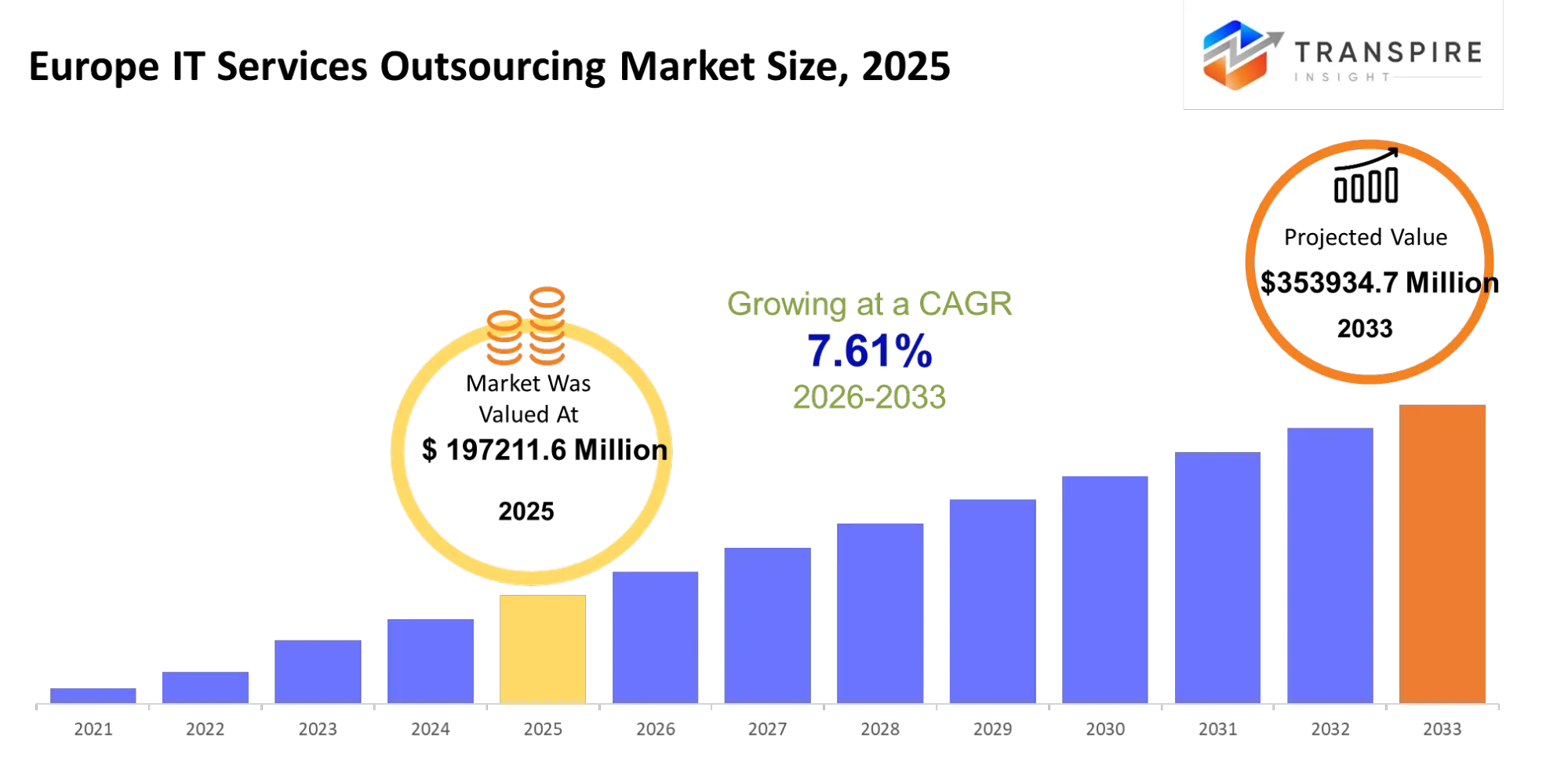
- Europe IT Services Outsourcing Market Size 2025: USD 197211.6 Million
- Europe IT Services Outsourcing Market Size 2033: USD 353934.7 Million
- Europe IT Services Outsourcing Market CAGR: 7.61%
- Europe IT Services Outsourcing Market Segments: By Type (Application Outsourcing, Infrastructure Outsourcing, BPO, KPO, Others), By Application (IT Services, Finance & Accounting, HR Services, Customer Support, Data Analytics, Others), By End-User (Enterprises, SMEs, BFSI, Healthcare, IT & Telecom, Government, Others), By Deployment (Onshore, Offshore, Nearshore, Hybrid, Others).
To learn more about this report,  Download Free Sample Report
Europe IT Services Outsourcing Market Summary:
The Europe IT Services Outsourcing Market size is estimated at USD 197211.6 Million in 2025 and is anticipated to reach USD 353934.7 Million by 2033, growing at a CAGR of 7.61% from 2026 to 2033. The Europe IT services outsourcing market enables businesses to execute their intricate digital workflows through external service providers instead of developing all required technologies internally. The maritime industry together with manufacturing and logistics companies depends on third-party vendors to handle their cloud computing and security needs and software development and data analysis work so they can maintain essential business functions while their systems grow and stay protected.
The market has experienced a permanent transformation during the last three to five years because companies now select service providers based on their technological abilities instead of their cost advantages. Buyers now evaluate potential partners based on their capacity to drive innovation instead of assessing their cost-saving abilities because this change has occurred. The COVID-19 pandemic which required organizations to shift their operations to remote work revealed weaknesses within existing IT infrastructure systems. Organizations implemented faster cloud adoption while they transferred their essential IT operations to external providers for better business continuity and security measures.
The ongoing contract growth occurs because outsourcing has become a permanent part of digital transformation efforts which organizations now treat as an essential business investment instead of a temporary expense.
Key Market Insights
- The IT Services Outsourcing Market in Europe remains under the control of Western Europe because it holds more than 60 percent of the market share which will reach 2025. The market operates through three main countries which include the UK and Germany and France.
- Eastern Europe shows the highest growth potential because it anticipates a growth rate above 9% until 2030 and this growth comes from its skilled workforce and cost-effective solutions.
- The sector of infrastructure outsourcing leads the market with a 35% share because companies now move their systems to cloud solutions and hybrid IT setups.
- Application outsourcing maintains its position as the second-largest market segment because it generates more than 25% of market share through the conversion of outdated systems into modern technologies.
- The business process outsourcing (BPO) market segment represents the most rapidly expanding area which will experience substantial growth between 2026 and 2030 because of the implementation of automated systems and artificial intelligence technologies.
- The BFSI sector leads the market for application usage because it requires security solutions and regulatory compliance services which create a need for outsourcing.
- The healthcare IT outsourcing market shows the highest growth rate for its applications because digital health services and data management needs will drive market demand until 2030.
- The IT Services Outsourcing market in Europe shows dominance from large enterprises because they control more than 65% of the market through their global operations and complex IT systems.
- Small and medium enterprises (SMEs) represent the fastest-growing segment which uses outsourcing to obtain advanced technologies while avoiding expensive capital costs.
What are the Key Drivers, Restraints, and Opportunities in the Europe IT Services Outsourcing Market?
The Europe Display Material Market is structuring its development toward materials which deliver high value and exceptional performance for OLED and microLED and flexible design applications. The automotive industry now uses digital technology while premium consumer electronics develop new products because material performance creates distinct product differences which impact pricing authority. The market trend toward emissive energy-efficient materials for multiple applications will continue because OLED devices experience rapid adoption while device yields reach better levels ([IMARC Group][1]). Suppliers who provide materials with better efficiencyand longer material life andready-to-use integration solutions will achieve greater market success during the upcoming 5–7 year period
The hidden danger from upstream material extraction and technological control stands as a less visible threat. Europe handles high-value chemical exports while obtaining display panels through imports which creates a fundamental trade imbalance that restricts Europe from controlling all aspects of product development and market pricing ([IndexBox][2]). Local suppliers face a threat of being pushed into secondary positions if Asian panel manufacturers adopt tandem OLED and microLED technologies at a faster pace than European material systems can respond.
France and Germany will develop microLED and advanced photonics production clusters through their semiconductor policy incentives. These initiatives enable Europe to transform from a materials exporter into a co-innovator who develops advanced display stack technologies. Market participants should establish strategic partnerships with panel manufacturers while developing pilot-scale production capabilities to achieve initial entry into emerging value chains.
What Has the Impact of Artificial Intelligence Been on the Europe IT Services Outsourcing Market?
European outsourcing contracts expand beyond IT support because artificial intelligence enables businesses to control their maritime and industrial systems in real time. Service providers now use AI-based platforms to automate scrubber performance systems which track exhaust gas cleaning technology compliance with IMO sulfur limits. The systems operate without human operation because they use automatic flow rate adjustment and chemical dosing and control parameter management. The outsourced providers use these resources together with their fleet monitoring systems to create a system that tracks compliance throughout all their ships.
Machine learning models are also strengthening predictive capabilities. Providers use sensor data to teach their algorithms which predict when pumps and valves and emission control units will fail so they can schedule maintenance before breakdowns happen. The models predict emissions output based on different fuel and load conditions which enables operators to improve fuel efficiency while maintaining regulatory compliance. The applications have increased vessel uptime and decreased unexpected maintenance while achieving measurable improvements in fuel efficiency.
AI implementation in sea operations encounters a practical barrier because of inconsistent data quality and connection problems that arise during maritime operations. The satellite links that operate intermittently together with the different sensor standards reduce model precision while they slow down real-time decision-making which creates challenges for implementing global fleet operations.
Key Market Trends
- The businesses adopted nearshoring operations in Poland and Romania after 2020 because they wanted to decrease geopolitical dangers while they provided services from nearby locations.
- The buyers shifted from fixed-cost outsourcing agreements to outcome-based pricing systems which connected vendor payments to performance indicators that included uptime and security compliance and system efficiency.
- The adoption of cloud outsourcing services increased after 2021 because more than 65% of European companies shifted their operations to hybrid and multi-cloud environments that external service providers managed.
- The implementation of the General Data Protection Regulation brought stricter enforcement measures which led to cybersecurity firms expanding their services through managed detection and response solutions that they offered to specialized vendors.
- AI integration started with pilot projects during 2019 but it achieved full-scale deployment by 2024 which included automation and predictive maintenance and IT operations management.
- The vendor consolidation process increased as Accenture and Capgemini acquired niche companies to enhance their cloud capabilities and artificial intelligence expertise.
- After 2022, SMEs started to outsource their main IT operations because they needed enterprise-level cybersecurity protection but they could not afford the high costs of traditional security measures.
- The market moved toward industry-specific solutions because BFSI and healthcare clients needed outsourcing services that met compliance requirements for upcoming European data protection laws.
- Automation reduced the need for human workers to deliver services because providers reported that AI-driven process improvements delivered up to 30�tter operational results.
Europe IT Services Outsourcing Market Segmentation
By Type
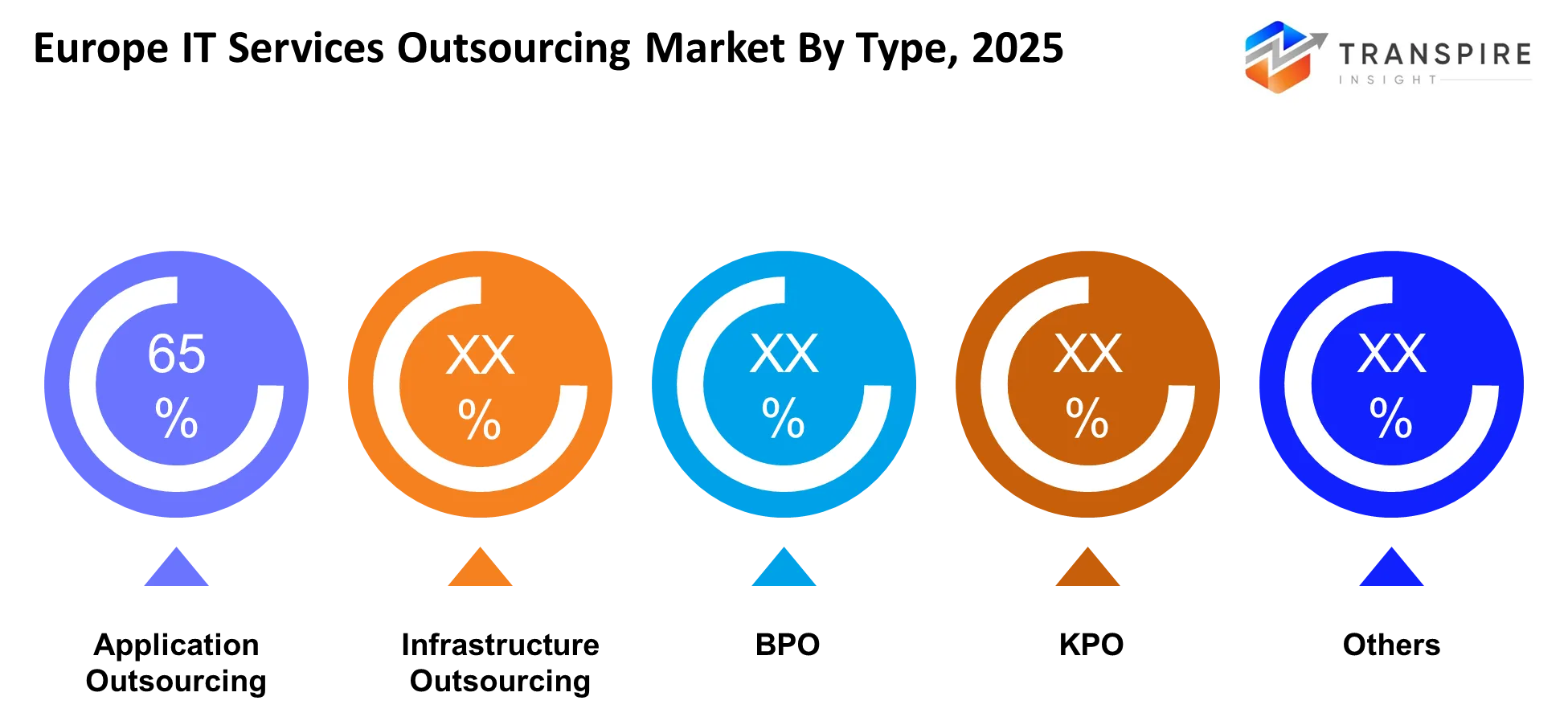
The strongest position in outsourcing systems for organizations lies with infrastructure outsourcing because organizations need to manage their cloud systems and protect their cybersecurity operations and update their network systems across their distributed networks. Application outsourcing follows closely, which receives support from both the extensive transformation of outdated systems and the rising need for cloud-native development. Business process outsourcing continues to grow because automation tools minimize human effort in financial and human resource and customer service operations, while knowledge process outsourcing expands its reach in analytics and research activities.
Businesses are moving away from traditional labor practice to embrace platform-based service delivery, which drives their infrastructure and application segment growth. AI-enabled monitoring and automation solutions, which vendors build, help them achieve higher profit margins while creating unique product offerings. Integrated service models will dominate future development as service providers offer complete infrastructure, application, and business process solutions through their bundled contract packages, which customer organizations will find difficult to change and will keep them as clients for extended periods.
To learn more about this report, Download Free Sample Report
By Application
The IT services market leads all other sectors because businesses require external vendors to provide system integration services and cloud migration solutions and cybersecurity management. Financial companies continue to outsource their accounting functions because businesses need to establish standard procedures for handling their routine financial transactions. The field of customer support outsourcing has advanced through the implementation of AI-based chat and voice systems. The application of data analytics represents the fastest expansion area because organizations require immediate access to their operational data. The HR services outsourcing market experiences steady growth because organizations adopt digital workforce management systems.
Organizations now prefer to acquire high-value services which provide them with business insights instead of choosing repetitive work processes. The providers create solutions that meet both compliance requirements and operational needs through their development of special industry-based offerings. The primary focus for future growth will involve incorporating analytics and automation across all software application areas that support upcoming predictive decision-making processes while enhancing the strategic functions of outsourcing partners.
By End-User
The major corporations of the world control the market because their complex IT systems and their need for outsourcing services to various sectors including BFSI healthcare and IT and telecom. The BFSI sector leads technology adoption because it must comply with government regulations and needs ongoing cybersecurity and transaction processing systems. The healthcare sector experiences rapid expansion because digital health systems and data compliance requirements are becoming more widespread.
Small and medium enterprises represent the fastest-growing segment which results from their need for SaaS solutions and their restricted ability to maintain internal IT systems. The government and telecom sectors prioritize data sovereignty and infrastructure resilience while different industries have their own specific needs. The future of the industry will see more small and medium enterprises join the market because service providers will deliver modular and subscription-based outsourcing services that enable smaller businesses to use advanced technologies without needing to spend heavily on infrastructure.
By Deployment
The delivery centers in Asia made offshore outsourcing the preferred option which companies used until deployment because it offered cost-effective solutions. Companies prefer Eastern European nearshore models because they provide better regulatory alignment and time zone matching and better geopolitical stability. Organizations use onshore outsourcing to protect sensitive operations which need complete data security in industries that require strict regulations.
Enterprises adopt hybrid deployment models because they want to use offshore resources and nearshore flexibility and onshore regulatory compliance. The growth logic of organizations has transitioned from seeking only cost savings to implementing balanced risk-based sourcing methods. Providers create delivery networks which operate in multiple locations to fulfill various client requirements. Nearshore and hybrid models will continue to expand because they enable businesses to deliver services faster while working together more effectively and maintaining better compliance with European market regulations.
What are the Key Use Cases Driving the Europe IT Services Outsourcing Market?
The primary application of this system focuses on managing cloud infrastructure and conducting cybersecurity operations for large enterprises which operate in the banking and financial services and manufacturing sectors. Banks implement outsourcing for their real-time transaction monitoring system together with their threat detection system in order to fulfil both GDPR requirements and payment security standards. The manufacturing sector depends on outside service providers to operate their enterprise resource planning systems and industrial internet of things platforms, which maintain system availability and operational strength without requiring additional resources from their internal IT departments.
The company provides expanded services which include outsourcing finance and accounting functions for multinational corporations together with automating customer support services for telecommunications companies. BFSI institutions outsource compliance reporting and audit processes, while telecom companies deploy AI-driven contact centers to manage high customer volumes with lower operational costs.
AI-driven data analytics together with IT operations prediction systems create new use cases which are currently being developed. Healthcare providers outsource their clinical data management needs together with their analytics requirements, while logistics companies implement predictive maintenance systems for their digital infrastructure which supports both fleet operations and warehouse management.
|
Report Metrics |
Details |
|
Market size value in 2025 |
USD 197211.6 Million |
|
Market size value in 2026 |
USD 211810.1 Million |
|
Revenue forecast in 2033 |
USD 353934.7 Million |
|
Growth rate |
CAGR of 7.61% from 2026 to 2033 |
|
Base year |
2025 |
|
Historical data |
2021 - 2024 |
|
Forecast period |
2026 - 2033 |
|
Report coverage |
Revenue forecast, competitive landscape, growth factors, and trends |
|
Regional scope |
Europe (Germany, United Kingdom, France, Italy, Spain and Rest of Europe) |
|
Key company profiled |
Accenture, TCS, Infosys, Wipro, Cognizant, Capgemini, IBM, HCLTech, Tech Mahindra, DXC Technology, Fujitsu, NTT Data, Atos, CGI, Sopra Steria |
|
Customization scope |
Free report customization (country, regional & segment scope). Avail customized purchase options to meet your exact research needs. |
|
Report Segmentation |
By Type (Application Outsourcing, Infrastructure Outsourcing, BPO, KPO, Others), By Application (IT Services, Finance & Accounting, HR Services, Customer Support, Data Analytics, Others), By End-User (Enterprises, SMEs, BFSI, Healthcare, IT & Telecom, Government, Others), By Deployment (Onshore, Offshore, Nearshore, Hybrid, Others) |
Which Regions are Driving the Europe IT Services Outsourcing Market Growth?
The Europe IT Services Outsourcing Market maintains its largest market share in Western Europe because of its stringent regulatory framework and well-developed digital systems and businesses that invest heavily in information technology. The UK and Germany and France implement strict data protection regulations which require companies to use managed cybersecurity services and compliance solutions. The large-scale outsourcing contracts at various organizations benefit from the well-developed ecosystem which includes global service providers and cloud hyperscalers and highly skilled workers. Organizations need digital transformation services which deliver high-value solutions because of their strong financial performance and industrial operations.
Northern European countries maintain their position as stable economic contributors through their early digital adoption and extensive public sector IT spending. Sweden and Denmark establish secure digital governance systems which require long-term outsourcing contracts instead of allowing vendors to switch rapidly between partners. This area emphasizes environmental sustainability and digital public services and transparent regulatory systems, which create a distinct identity that sets it apart from Western Europe. The combination of consistent enterprise investments and high outsourcing provider trust leads to revenue predictability and contract stability which lasts over time.
Eastern European countries experience their most rapid growth period because of rising demand for nearshoring services and the development of technical talent in Poland and Romania. Western European companies moved their outsourcing activities to nearby markets because of the recent geopolitical changes and supply chain problems. The local delivery capabilities of organizations improved through investments made in technology parks and educational institutions. The period from 2026 to 2033 will create significant economic development opportunities for new businesses and investors who want to expand their operations while hiring local workers.
Who are the Key Players in the Europe IT Services Outsourcing Market and How Do They Compete?
The Europe IT Services Outsourcing Market shows moderate consolidation between its leading players while regional specialists and niche providers continue to compete. The major companies maintain their market position through long-term transformation contracts while the smaller companies create new market segments for cybersecurity and analytics services. Businesses now choose between competing companies based on their technological expertise and industry knowledge, which includes their capacity to handle intricate hybrid cloud systems. Current market trends show that buyers prefer to assess vendor companies based on their ability to innovate and their capacity to meet regulatory requirements, rather than their employee count.
Accenture utilizes technology-driven transformation to compete with its competitors through service packages which combine artificial intelligence, cloud technology, and specialized industry platforms. Accenture uses its strong relationships with hyperscalers and its strategic cybersecurity and data analytics acquisitions to create complete solutions for regulated industries. Capgemini establishes its market position through its European data compliance knowledge and its extensive nearshore delivery system, which operates mostly in Eastern European countries. Capgemini establishes itself as the top choice for clients who need data residency and regulatory control through its investments in sovereign cloud and engineering services.
IBM develops hybrid cloud solutions and artificial intelligence systems through its unique platforms, which allow customers to upgrade their outdated systems without doing complete system transfers. The company TCS operates its business across Europe through its team-based delivery system, which provides cost-effective international service and its specialized banking, financial services, and insurance solutions. Atos specializes in cybersecurity and high-performance computing, which enables the company to win government and defense contracts that require data sovereignty and dependable system operation.
Company List
- Accenture
- TCS
- Infosys
- Wipro
- Cognizant
- Capgemini
- IBM
- HCLTech
- Tech Mahindra
- DXC Technology
- Fujitsu
- NTT Data
- Atos
- CGI
- Sopra Steria
Recent Development News
In April 2026, Capgemini reports strong Q1 2026 growth driven by AI and US expansion: Capgemini posted a 7% revenue increase in Q1 2026, supported by strong demand for AI-enabled IT services and expansion in North America. AI and agentic automation now account for over 10% of bookings, highlighting accelerating enterprise adoption across Europe’s IT services outsourcing ecosystem.
Source: https://www.reuters.com
In April 2026, Sopra Steria returns to growth on defence and digital consulting demand: French IT services firm Sopra Steria reported 3.2% organic revenue growth in Q1 2026, driven by increased European demand in defence, aerospace, and AI/data sovereignty projects. The company also expanded its workforce and strengthened its consulting portfolio through targeted acquisitions.
Source: https://www.reuters.com
What Strategic Insights Define the Future of the Europe IT Services Outsourcing Market?
The Europe IT Services Outsourcing Market will develop during the next five to seven years into service ecosystems that offer specialized intelligence-based solutions. Businesses require seamless artificial intelligence and cybersecurity and compliance solutions which their internal IT departments fail to deliver at required speed. Companies will move their outsourcing activities from basic delivery work toward developing strategic partnerships which will enable them to work together with vendors to create new products and share operational insights and establish digital control methods.
The service providers who depend on hyperscale data centers create a market risk which remains hidden from view. As cloud infrastructure and AI platforms become tightly controlled by a few technology ecosystems, outsourcing firms may face margin compression and reduced differentiation. The enterprise buyers will experience restricted options which will cause pricing pressures throughout the entire value chain.
Central and Eastern Europe presents a new business opportunity through sovereign AI infrastructure development which has emerged because government regulations require data residency. The market participants should make immediate investments in developing local AI delivery centers and establishing service capabilities that meet compliance standards. Organizations that establish themselves in sovereign cloud solutions and industry-specific AI services will create strong market positions which will protect them as authorities conduct more thorough regulatory assessments.
Europe IT Services Outsourcing Market Report Segmentation
By Type
- Application Outsourcing
- Infrastructure Outsourcing
- BPO
- KPO
- Others
By Application
- IT Services
- Finance & Accounting
- HR Services
- Customer Support
- Data Analytics
- Others
By End-User
- Enterprises
- SMEs
- BFSI
- Healthcare
- IT & Telecom
- Government
- Others
By Deployment
- Onshore
- Offshore
- Nearshore
- Hybrid
- Others
Frequently Asked Questions
Find quick answers to common questions.
The approximate Europe IT Services Outsourcing Market size for the market will be USD 353934.7 Million in 2033.
The key segments of the Europe IT Services Outsourcing Market are By Type (Application Outsourcing, Infrastructure Outsourcing, BPO, KPO, Others), By Application (IT Services, Finance & Accounting, HR Services, Customer Support, Data Analytics, Others), By End-User (Enterprises, SMEs, BFSI, Healthcare, IT & Telecom, Government, Others), By Deployment (Onshore, Offshore, Nearshore, Hybrid, Others).
Major players in the Europe IT Services Outsourcing Market are Accenture, TCS, Infosys, Wipro, Cognizant, Capgemini, IBM, HCLTech, Tech Mahindra, DXC Technology, Fujitsu, NTT Data, Atos, CGI, Sopra Steria.
The current market size of the Europe IT Services Outsourcing Market is USD 197211.6 Million in 2025.
The Europe IT Services Outsourcing Market CAGR is 7.61%.
- Accenture
- TCS
- Infosys
- Wipro
- Cognizant
- Capgemini
- IBM
- HCLTech
- Tech Mahindra
- DXC Technology
- Fujitsu
- NTT Data
- Atos
- CGI
- Sopra Steria
Recently Published Reports
-
Apr 2026
3D Optical Profiler Market
3D Optical Profiler Market Size, Share & Analysis Report By Type (Desktop 3D Optical Profiler, and Portable 3D Optical Profiler), By Technology (Confocal Technology, and White Light Interference), By End-Use Industry (Manufacturing, Research Institutions, Automotive, Aerospace and Defense, Medical Devices, and Other), and Geography (North America, Europe, Asia-Pacific, Middle East and Africa, South and Central America), 2021 - 2031
-
Apr 2026
Depth Sensor Market
Depth Sensor Market Size, Share & Analysis Report By Type (Infrared Depth Sensors, Time-of-Flight (ToF) Sensors, Stereo Vision Sensors, Structured Light Sensors, Ultrasonic Depth Sensors), By Application (Automotive, Robotics, Gaming, Consumer Electronics, Industrial Automation, Healthcare, Security & Surveillance, Others), By End Users (Automotive Manufacturers, Consumer Electronics Companies, Healthcare Providers, Industrial Companies, Security Agencies, Gaming Companies, Robotics Companies, Others), and Geography (North America, Europe, Asia-Pacific, Middle East and Africa, South and Central America), 2021 – 2031
-
Apr 2026
Digital Manufacturing Market
Digital Manufacturing Market Size, Share & Analysis Report By Component (Hardware, Software, and Services), By Technology (Robotics, 3D Printing, Internet of Things (IoT), and Others), By Application (Automotive and Transportation, Aerospace and Defense, Consumer Electronics, Industrial Machinery, and Others), By Process Type (Computer-Based Designing, Computer-Based Simulation, Computer 3D Visualization, Analytics, and Others), and Geography (North America, Europe, Asia-Pacific, Middle East and Africa, South and Central America), 2021 – 2031
-
Apr 2026
Digital Visa Services Market
Digital Visa Services Market Size, Share & Analysis Report By Type (Individual Travelers, Group Travelers), By Application (Tourism, Business Travel, Others), and Geography (North America, Europe, Asia-Pacific, Middle East and Africa, South and Central America), 2021 – 2031