United States Computer Aided Detection (CAD) Market Size & Forecast:
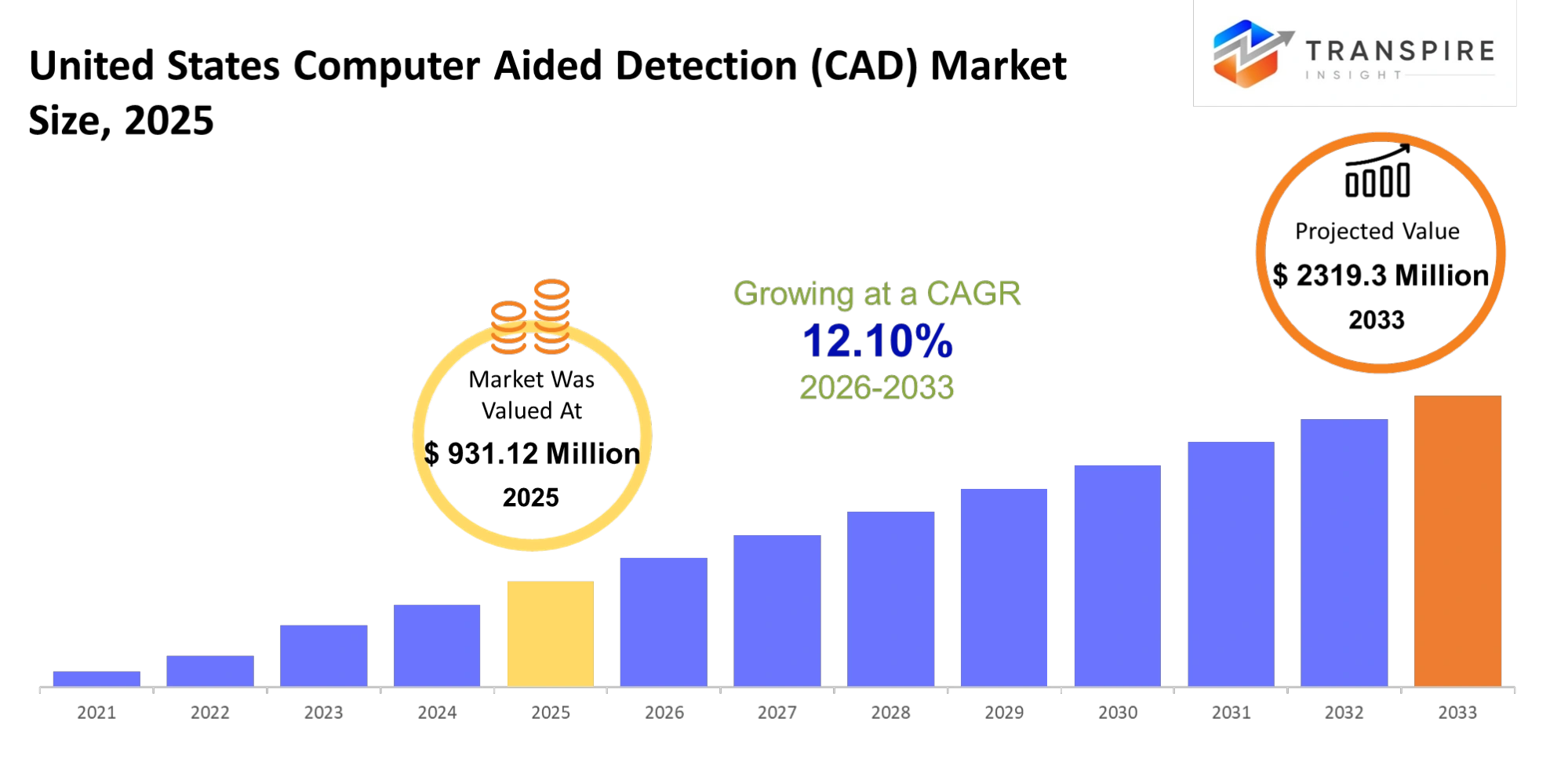
- United States Computer Aided Detection (CAD) Market Size 2025: USD 931.12 Million
- United States Computer Aided Detection (CAD) Market Size 2033: USD 2319.3 Million
- United States Computer Aided Detection (CAD) Market CAGR: 12.10%
- United States Computer Aided Detection (CAD) Market Segments:By Application (Breast Cancer Detection, Lung Cancer Detection, Colorectal Cancer Detection, Prostate Cancer Detection), By End User (Hospitals, Diagnostic Centers).
To learn more about this report,  Download Free Sample Report
United States Computer Aided Detection (CAD) Market Summary:
The United States Computer Aided Detection (CAD) market size is estimated at USD 931.12 million in 2025 and is anticipated to reach USD 2319.3 million by 2033, growing at a CAGR of 12.10% from 2026 to 2033. The United States Computer-Aided Detection (CAD) market experiences ongoing growth because there is increasing demand for early disease diagnosis and advanced imaging technologies. Radiologists use CAD systems to improve their ability to detect cancer and other medical conditions through better diagnostic results. The market environment develops through ongoing technological progress and artificial intelligence implementation and increasing healthcare funding. CAD solutions have become essential for contemporary diagnostic processes which hospitals across the United States implement to achieve accurate and rapid results.
Key Market Trends & Insights:
- Artificial intelligence now enhances CAD systems through better detection methods which decrease false positive results. Healthcare providers are increasingly using AI-powered tools because these tools enable them to deliver faster and more accurate medical diagnoses.
- Healthcare providers are shifting towards preventive treatments, which creates higher demand for CAD technologies used in early diagnosis. This trend is especially prominent in cancer screening programs across the U.S.
- CAD applications have expanded beyond their original mammography functions to include CT scans, MRI tests and ultrasound procedures. This broader usage is enhancing diagnostic capabilities across multiple medical fields.
- CAD solutions help radiologists by using automated image analysis to decrease their work requirements. This system enables medical professionals to work on more complicated cases while increasing their work efficiency.
- Software algorithm development creates new software solutions which improve both accuracy and usability for CAD systems. Cloud-based platforms have become popular because they enable users to access data and manage their information easily.
- The rise of cancer and cardiovascular diseases has created a higher demand for precise diagnostic instruments. CAD systems serve as essential tools which help detect these diseases during their initial development stage.
United States Computer Aided Detection (CAD) Market Segmentation
By Application
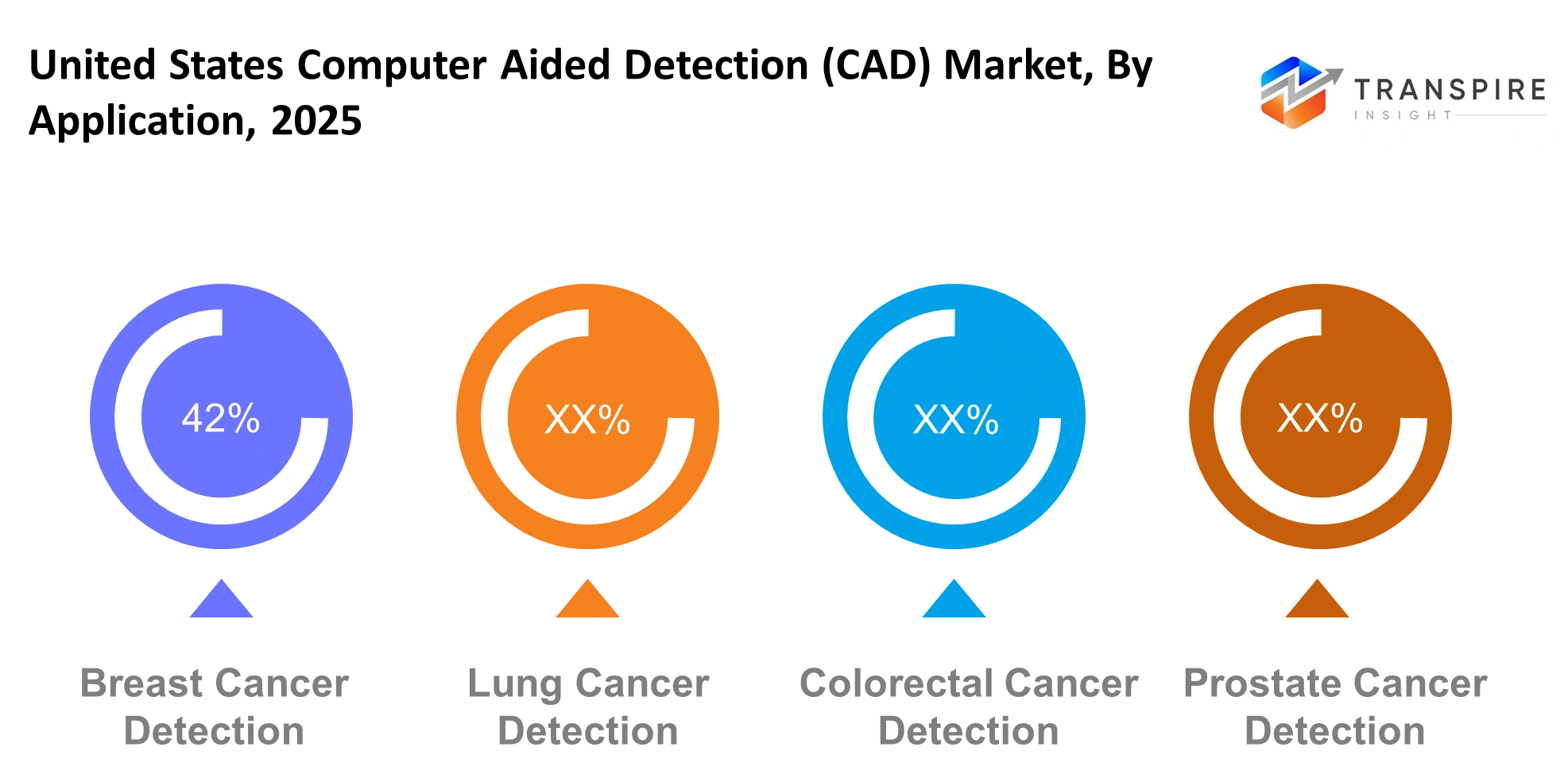
- Breast Cancer Detection: Breast cancer CAD solutions now enable radiologists to detect tumours during initial stages with improved accuracy. The systems function as essential medical equipment because they decrease diagnostic mistakes and enhance mammography screening results while helping women throughout the United States.
- Lung Cancer Detection: The CAD systems for lung cancer screening improve CT scan analysis through their ability to discover small nodules which human observers typically miss. The technology enables physicians to make early interventions, which lead to higher survival rates, and assists with nationwide preventive care programmes.
- Colorectal Cancer Detection: Colorectal cancer CAD technology operates together with colonoscopy and imaging systems to discover both polyps and initial lesions. The solutions help doctors identify patients who need immediate care because they increase detection accuracy and decrease the chance of disease advancement.
- Prostate Cancer Detection: Prostate cancer CAD applications enable radiologists to improve their capacity to analyse medical images, which include MRI and ultrasound studies. The process helps medical professionals to make early diagnoses, while it enables them to guide biopsy procedures and develop individualised treatment strategies for better patient care.
To learn more about this report, Download Free Sample Report
By End User
- Hospitals: Hospitals are increasingly using CAD systems to improve their diagnostic processes and better serve their patients. The solutions enable radiologists to interpret medical images with greater accuracy, while they decrease human mistakes and boost operational productivity, which makes these solutions vital for present-day healthcare institutions.
- Diagnostic Centers: Diagnostic centres use CAD technology to provide specialised screening services which focus on cancer detection. The centres achieve better diagnostic accuracy through advanced detection tools which also enable faster reporting and help attract patients who need dependable and quick testing services.
Country Insights
The United States leads the global Computer-Aided Detection (CAD) market because its healthcare system possesses advanced facilities which enable researchers to create new diagnostic technologies. Hospitals and diagnostic centres throughout the nation now spend more money on CAD systems, which allow them to detect diseases at earlier stages, especially for breast cancer, lung cancer, colorectal cancer and prostate cancer. CAD systems experience a transformation because artificial intelligence and machine learning technology enable radiologists to deliver accurate results at faster speeds, which decreases their chances of making mistakes.
Government initiatives that support preventive healthcare together with public awareness about early screening programmes create incentives for market expansion. The nation sustains its research and development efforts, which lead to ongoing advancements in imaging algorithms and software development. U.S. healthcare providers choose to implement CAD systems because these solutions help them achieve better patient results while optimising their operational processes and satisfying the increasing requirement for precise medical treatments, which establishes the country as a centre for cutting-edge diagnostic equipment.
Recent Development News
Radiology AI Firm Seeks FDA Exemption for CAD Devices: A U.S.‑market radiology artificial intelligence firm has petitioned the Food and Drug Administration to exempt certain CAD systems from premarket review, sparking industry debate on regulatory modernisation.
U.S. AI Diagnostics Market Set for Rapid Growth: A recent report highlights that the United States artificial intelligence in the diagnostics sector, including CAD tools, is projected to grow sharply through 2033, driven by precision imaging analytics.
|
Report Metrics |
Details |
|
Market size value in 2025 |
USD 931.12 Million |
|
Market size value in 2026 |
USD 1042.84 Million |
|
Revenue forecast in 2033 |
USD 2319.3 Million |
|
Growth rate |
CAGR of 12.10% from 2026 to 2033 |
|
Base year |
2025 |
|
Historical data |
2021 – 2024 |
|
Forecast period |
2026 – 2033 |
|
Report coverage |
Revenue forecast, competitive landscape, growth factors, and trends |
|
Country scope |
United States |
|
Key company profiled |
Hologic Inc., GE HealthCare Technologies Inc., Siemens Healthineers AG, Philips Healthcare, Canon Medical Systems Corporation, Fujifilm Holdings Corporation, iCAD Inc., Zebra Medical Vision Ltd., Riverain Technologies LLC, Therapixel SA, Lunit Inc., ScreenPoint Medical BV, Volpara Health Technologies Ltd., DeepHealth Inc., ContextVision AB. |
|
Customization scope |
Free report customization (country, regional & segment scope). Avail customized purchase options to meet your exact research needs. |
|
Report Segmentation |
By Application (Breast Cancer Detection, Lung Cancer Detection, Colorectal Cancer Detection, Prostate Cancer Detection), By End User (Hospitals, Diagnostic Centers). |
Key United States Computer Aided Detection (CAD) Company Insights
Leading American companies in the computer-aided detection market create their products through three key factors, which include three essential elements from growing healthcare requirements. The main companies in the market allocate their resources to develop artificial intelligence software together with cloud solutions and new imaging technologies which will improve their diagnostic processes. The companies establish strategic alliances with hospitals and diagnostic centres which help them reach more customers, while their ongoing research work leads to better results in disease detection. The companies focus on three areas, which include precise results, more efficient work processes and patient protection, to become essential players who will drive the development of radiology and preventive health services throughout the United States.
Company List
- Hologic Inc.
- GE HealthCare Technologies Inc.
- Siemens Healthineers AG
- Philips Healthcare
- Canon Medical Systems Corporation
- Fujifilm Holdings Corporation
- iCAD Inc.
- Zebra Medical Vision Ltd.
- Riverain Technologies LLC
- Therapixel SA
- Lunit Inc.
- ScreenPoint Medical BV
- Volpara Health Technologies Ltd.
- DeepHealth Inc.
- ContextVision AB.
United States Computer Aided Detection (CAD) Market Report Segmentation
By Application
- Breast Cancer Detection
- Lung Cancer Detection
- Colorectal Cancer Detection
- Prostate Cancer Detection
By End User
- Hospitals
- Diagnostic Centers
Frequently Asked Questions
Find quick answers to common questions.
The approximate United States Computer Aided Detection (CAD) Market size will be USD 2319.3 million in 2033.
The key segments of the United States Computer Aided Detection (CAD) market are By Application (Breast Cancer Detection, Lung Cancer Detection, Colorectal Cancer Detection, Prostate Cancer Detection), By End User (Hospitals, Diagnostic Centers).
Major players in the United States Computer Aided Detection (CAD) Market are Hologic Inc., GE HealthCare Technologies Inc., Siemens Healthineers AG, Philips Healthcare, Canon Medical Systems Corporation, Fujifilm Holdings Corporation, iCAD Inc., Zebra Medical Vision Ltd., Riverain Technologies LLC, Therapixel SA, Lunit Inc., ScreenPoint Medical BV, Volpara Health Technologies Ltd., DeepHealth Inc., ContextVision AB.
The current market size of the United States Computer Aided Detection (CAD) Market is USD 931.12 million in 2025.
The United States Computer Aided Detection (CAD) Market CAGR is 12.10%.
- Hologic Inc.
- GE HealthCare Technologies Inc.
- Siemens Healthineers AG
- Philips Healthcare
- Canon Medical Systems Corporation
- Fujifilm Holdings Corporation
- iCAD Inc.
- Zebra Medical Vision Ltd.
- Riverain Technologies LLC
- Therapixel SA
- Lunit Inc.
- ScreenPoint Medical BV
- Volpara Health Technologies Ltd.
- DeepHealth Inc.
- ContextVision AB.
Recently Published Reports
-
Apr 2026
AI in Diabetic Retinopathy Market
AI in Diabetic Retinopathy Market Size, Share & Analysis Report By Type (Screening AI Systems, Diagnostic AI Systems, and Predictive AI Models), By Application Segment (Hospitals, Ophthalmology Clinics, Diagnostic Centers, and Research and Development), and Geography (North America, Europe, Asia-Pacific, Middle East and Africa, South and Central America), 2021 - 2031
-
Apr 2026
Psychometric Tests Market
Psychometric Tests Market Size, Share & Analysis Report By Type (Personality Tests, Ability/Aptitude Tests, Skill/Knowledge Tests, and Others), By Application (Talent Acquisition and Talent Management), and Geography (North America, Europe, Asia-Pacific, Middle East and Africa, South and Central America), 2021 – 2031
-
Apr 2026
Rare Biological Sample Collection Market
Rare Biological Sample Collection Market Size, Share & Analysis Report By Type (Isolation Kits & Reagent, Blood Collection Tubes, and Others), By Application (Oncology, Transcriptomics, Pharmacogenomics, and Others), and Geography (North America, Europe, Asia-Pacific, Middle East and Africa, South and Central America), 2021 – 2031
-
Apr 2026
Patient Lift Pendant Market
Patient Lift Pendant Market By Product Type (Wired Pendants, Wireless, Programmable), By Operation Type(Manual, Electric), By End-Users (Healthcare Professionals, Patients), By Application (Hospitals, Homecare, Rehabilitation Centers, Others), By Industry Analysis, Size, Share, Growth, Trends, and Forecasts 2021-2033
Our Clients
.jpg)