

United States Compressed Air Treatment Equipment Market Size & Forecast:
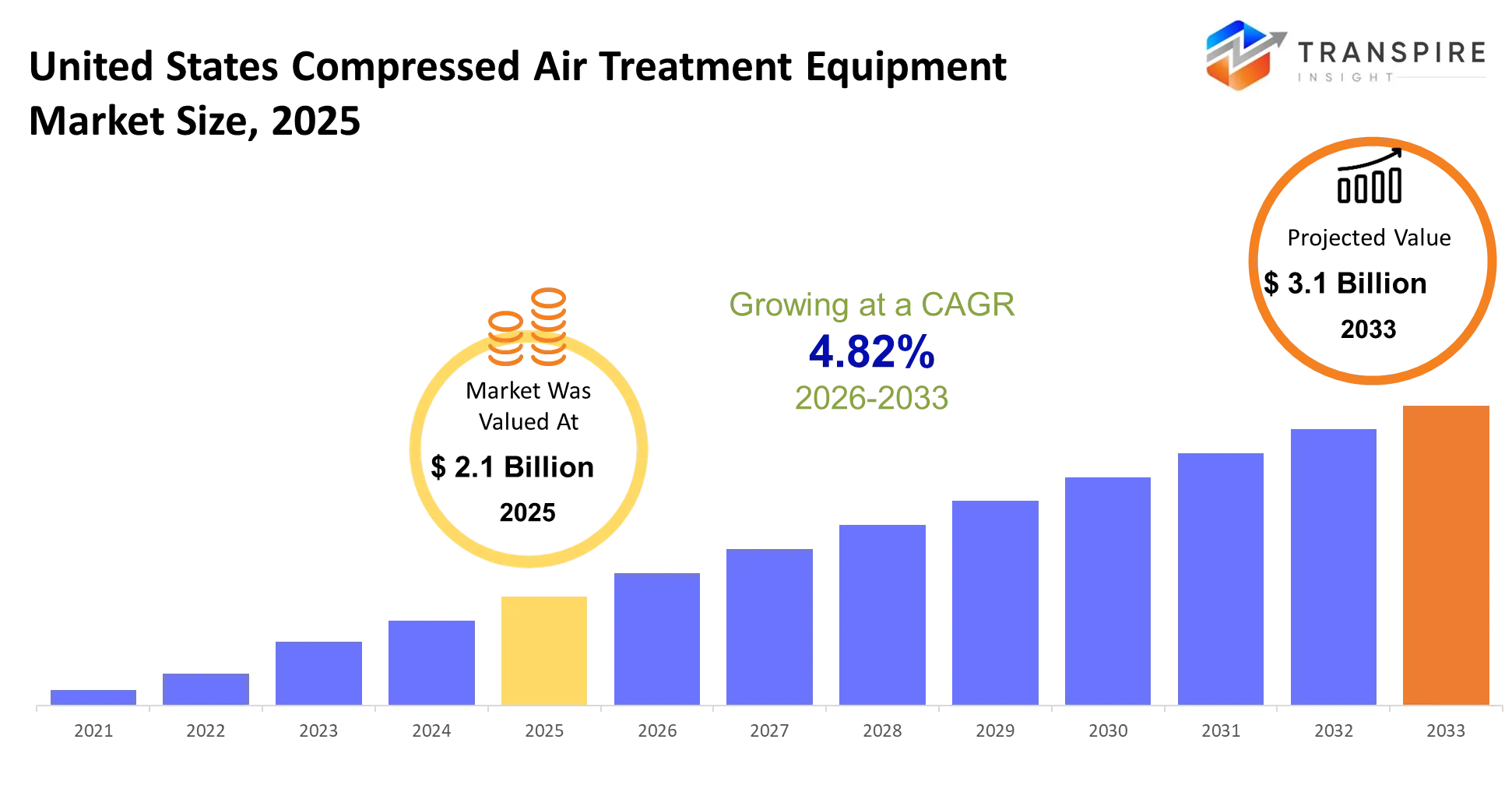
- United States Compressed Air Treatment Equipment Market Size 2025: USD 2.1 Billion
- United States Compressed Air Treatment Equipment Market Size 2033: USD 3.1 Billion
- United States Compressed Air Treatment Equipment Market CAGR: 4.82%
- United States Compressed Air Treatment Equipment Market Segments: By Equipment Type (Air Dryers, Filters, Condensate Management Systems, Aftercoolers, Oil-water Separators, Others), By Technology (Refrigerated Dryers, Desiccant Dryers, Membrane Dryers, Activated Carbon Filters, Others), By Application (Manufacturing, Food & Beverage, Pharmaceuticals, Automotive, Electronics, Oil & Gas, Others), By End User (Industrial Sector, Healthcare Sector, Chemical Industry, Energy Sector, Commercial Facilities, Others).
To learn more about this report,  Download Free Sample Report
United States Compressed Air Treatment Equipment Market Summary:
The United States Compressed Air Treatment Equipment Market size is estimated at USD 2.1 Billion in 2025 and is anticipated to reach USD 3.1 Billion by 2033, growing at a CAGR of 4.82% from 2026 to 2033.The United States Compressed Air Treatment Equipment Market kinda sits at the core of industrial reliability, yknow. These systems strip away moisture, oil, and particulate contamination from compressed air before it reaches production lines or pneumatic tools and even food processing equipment, pharmaceutical filling systems, plus semiconductor manufacturing environments. In real life, they help stop corrosion, keep product purity in check, reduce equipment failure, and avoid costly production downtime … that can pause operations across factories, refineries, and logistics facilities.
Over the last five years the market sort of shifted away from very basic filtration and toward more integrated, energy-optimized air quality management systems , you know. A lot of manufacturers now seem to lean on smart dryers, IoT enabled monitoring, and low-pressure-drop filtration because electricity expenses and those sustainability targets really do shape operating margins. The Inflation Reduction Act, together with tighter industrial efficiency standards, basically forced quicker capital upgrades, and the pandemic-era supply chain disruptions also made it clear how vulnerable production systems can be to unexpected shutdowns. So operators increasingly view compressed air treatment not just like a maintenance cost , but more like a productivity and risk-management investment , protecting throughput , regulatory compliance, and energy performance all at once .
Key Market Insights
- The Midwest kinda dominates the United States Compressed Air Treatment Equipment Market, with almost 34% market share in 2025, mostly because it has this dense manufacturing base, you know.
- Texas and the Southeast are also the fastest-growing regional cluster through 2030, backed by expansions at semiconductor, automotive, and petrochemical sites, which is pretty clear.
- California still holds big demand, because food processing , pharmaceuticals, and electronics firms basically need contamination-free compressed air systems, daily.
- Meanwhile the Gulf Coast industrial corridors keep pushing strategic growth for compressed air infrastructure across refining, chemicals, and LNG processing facilities too.
- In terms of what’s taking up the most space, air dryers end up leading the industry size landscape, at roughly 41% market share in 2025, driven by moisture-control needs in industrial work.
- Coalescing filters stay in the second-largest segment, since producers tend to focus on oil-free and particulate-free compressed air, for regulatory compliance and all.
- Smart monitoring systems are the fastest-growing segment from 2025 to 2030, because predictive maintenance helps cut downtime , and also reduces energy losses.
- Refrigerated dryers keep strong adoption in general manufacturing, they offer a cost-effective compressed air treatment approach.
- On the application side, manufacturing applications lead with nearly 46% revenue share, powered by automation investments, and continuous production line requirements.
- Food and beverage processing is showing more interest lately, due to stricter FDA hygiene standards, plus contamination prevention expectations.
- Semiconductor fabrication facilities are projected to grow the quickest across the forecast, mainly because ultra-clean compressed air is mission critical.
What are the Key Drivers, Restraints, and Opportunities in the United States Compressed Air Treatment Equipment Market?
The most strong force pushing the United States Compressed Air Treatment Equipment Market is kind of the industrial move toward energy-efficient manufacturing. Compressed air systems take up a large slice of factory electricity use, and after 2021 higher power costs made many manufacturers look at their filtration and drying setups, the ones that were not so efficient. This momentum really picked up once federal support started pointing toward industrial efficiency upgrades , with requirements that linked back to the Inflation Reduction Act , so modernization seemed a bit more affordable. As organizations roll out variable-speed compressor units, automated drying systems, and observation tools that are IoT-enabled, they reduce energy waste from pressure losses plus moisture troubles, at least that’s how it feels in practice. In practice that operating savings story is speeding up equipment replacement timing and boosting aftermarket service revenue.
Still, the market has a stubborn structural obstacle, it’s the expensive burden of retrofitting older industrial sites. Quite a few plants still run legacy pneumatic systems built decades ago, so adding advanced compressed air treatment equipment becomes technically complex and also capital intensive. Retrofitting can mean production downtime, piping redesign, and even workforce retraining, so the purchase decisions get delayed. Smaller and mid-sized manufacturers often hold off on upgrades even when the efficiency payback makes sense, and that slows down wider market adoption, especially in secondary industrial regions where growth tends to lag.
A longer-term opportunity comes from semiconductor manufacturing expansion. New fabrication locations across Arizona, Texas, and Ohio need extremely dry compressed air, clean and contamination free, because cleanroom production standards are strict and they don’t really allow compromise.
What Has the Impact of Artificial Intelligence Been on the United States Compressed Air Treatment Equipment Market?
Artificial intelligence alongside advanced digital technologies are shifting the United States Compressed Air Treatment Equipment Market, kinda turning what used to be reactive maintenance, into more predictive data based operational setups. A lot of industrial sites now use AI enabled sensors and cloud connected control systems to keep an eye on pressure readings, humidity levels, oil carryover, and also filtration effectiveness all the way through compressed air lines. Instead of waiting around, these systems handle dryer duties more intelligently, tune the airflow in practical ways, and flag contamination threats while things are running, which cuts down on wasted energy and helps keep production steadier
Also, machine learning is quietly getting better at predictive maintenance. Equipment makers and plant teams pull in past operating data to spot off normal vibration signals, pressure losses, and temperature swings before parts actually fail. That way, facilities can lower unexpected stoppages, stretch the useful lives of filters and dryers, and make maintenance timing more accurate. And in faster moving high volume industries like semiconductors, pharmaceuticals, and automotive assembly, predictive analytics can trim maintenance interruptions by double digit shares while also reducing compressed air energy waste
On top of that, digital twin frameworks and remote monitoring platforms support regulatory compliance and give clearer operational insight across multi-site industrial networks. Still, AI rollouts run into a big snag, because many legacy manufacturing facilities don’t have compatible digital infrastructure in place
Key Market Trends
- Since 2022 , many manufacturers started swapping fixed-cycle dryers for variable-speed units, mostly to cut compressed air energy use roughly 15% to 25% , though the exact savings varied by site.
- Automotive plants also moved toward oil-free compressed air setups after contamination-related production losses started climbing, and that pushed warranty, plus maintenance budgets up across robotic assembly lines, pretty fast.
- Atlas Copco and Ingersoll Rand meanwhile grew their IoT-enabled monitoring platforms , between 2021 and 2025 , aiming to support aftermarket service income as a more stable revenue stream.
- On the semiconductor side, new fabrication spending in Arizona, Texas, and Ohio drove more demand for ultra-low dew point adsorption dryers , and also for improved particulate filtration systems.
- Food and beverage processors accelerated stainless steel filtration upgrades after FDA compliance reviews became stricter, so contamination control expectations tightened during the post-pandemic production expansion.
- Since 2020, supply chain issues made industrial buyers lean toward domestic equipment servicing options, and shorter replacement component delivery times, in practice this helped reduce downtime risk.
- Mid sized manufacturers increasingly took up predictive maintenance software after unplanned pneumatic failures caused longer production halts, especially during the labor shortages seen in 2022, and again in 2023.
- Compressed air treatment providers expanded rental and subscription based service models because customers started stepping back from big upfront capital buys.
- Industrial sites are also rolling out AI-enabled pressure monitoring systems to spot leakage patterns earlier, which in some facilities lowered compressed air losses by double digit percentages.
- Finally, Gulf Coast petrochemical operators upgraded high-capacity filtration infrastructure after reliability failures disrupted continuous processing, and this happened during extreme weather events.
United States Compressed Air Treatment Equipment Market Segmentation
By Equipment Type
Air dryers kind of take the lead in the equipment segment because moisture contamination poses real operational hazards across almost every industrial compressed air setup. Refrigerated dryers stay pretty popular in general manufacturing, mainly for cost efficiency and that steady, reliable operation, while desiccant dryers usually grab the premium slice in semiconductor fabrication, pharmaceuticals and food processing— where ultra-dry air just has to stay consistent. Filters still show up as a major share too, since oil aerosols and particulate contamination can hit product quality and also shorten equipment service life, pretty directly. Then there are condensate management systems, aftercoolers, and oil-water separators, they’re also seeing more adoption as plants tighten wastewater discharge rules and push harder on environmental compliance.
Overall demand seems to be leaning toward integrated systems, you know, ones that bundle filtration, monitoring and energy optimization into a single centralized platform. Going forward, the market direction points to compact digitally connected equipment packages, these can cut down on maintenance intervals and reduce energy losses. Companies that provide predictive maintenance features, plus lower lifecycle operating costs, should end up strengthening their long-term competitive position.

To learn more about this report, Download Free Sample Report
By Technology
Refrigerated dryer tech is, honestly, the main driver in most market deployments, because big manufacturing sites tend to lean toward low cost moisture control options, for steady run production , all day long. Then you have activated carbon filters , plus membrane dryers holding a smaller but still pretty meaningful niche especially in electronics, healthcare, and food packaging where the air has to stay high purity. Desiccant dryers keep moving the quickest, seems like, as semiconductor buildouts and pharmaceutical spending push more demand for that extremely low dew point result.
And operational efficiency sort of turns into the big deciding factor lately, since compressed air systems consume a lot of industrial electricity. Buyers in the field are looking hard at pressure drop reduction, smarter controls, and automatic load management before they even pick a treatment system. On top of that AI enabled monitoring platforms , and remote diagnostics are changing how equipment is serviced, since people can spot contamination, or efficiency losses before shutdowns actually happen. Providers that invest in sensor integration, cloud based monitoring, and energy analytics are, likely, the ones that grab more aftermarket service income over the next ten years.
By Application
Manufacturing stays the dominant application segment because pneumatic tools, robotic assembly systems, and automated production lines all depend on steady, contamination free compressed air, which is kinda the baseline. Automotive production facilities keep showing the highest installation volumes, since they intensively use air powered equipment for painting, welding, and material handling, basically all the daily stuff. Food and beverage processing has become a big growth theme after stricter hygiene enforcement pushed wider adoption of oil free and moisture controlled air systems, even where it was previously “good enough”. Pharmaceutical production also picked up speed as companies invested in advanced filtration infrastructure to back sterile packaging and precision manufacturing requirements, without cutting corners.
Electronics manufacturing is creating yet another fast expanding application area, because semiconductor fabrication sites need extremely dry and particle free compressed air environments. Oil and gas operations continue deploying heavy duty treatment systems, to boost reliability when the environmental conditions are more punishing than expected. Looking ahead, future application growth will rely more often on industries that mix high automation intensity with uncompromising contamination control, and that pattern opens doors for specialized, high performance equipment suppliers.
By End-User
Industrial end users grab the biggest share, mostly because manufacturing plants, processing facilities, and logistics operations rely heavily on compressed air infrastructure, for day to day production. Chemical producers and energy companies are also big demand hubs, since their continuous processing routines need steady air quality, plus system reliability. In healthcare, adoption is moving faster toward advanced treatment systems, because medical air applications need strict contamination control, and also operational consistency, without much room for drift.On the commercial side, places like refrigeration warehouses and automated distribution centers are slowly, boosting investment in compressed air efficiency systems, especially since electricity costs keep climbing, and that sort of thing.
Meanwhile smaller and mid-sized enterprises still hit roadblocks around retrofit expenses and limited digital infrastructure, which then kinda slows down the adoption of advanced monitoring technologies. Looking ahead, market momentum will probably lean toward suppliers that can deliver modular system builds, provide financing flexibility and also, not just that, long-term maintenance support. End users are, more and more, favoring service led models that mix equipment performance guarantees with predictive maintenance, plus remote operational monitoring, which is a good sign.
What are the Key Use Cases Driving the United States Compressed Air Treatment Equipment Market?
Automotive and general manufacturing facilities really are the core use case, for compressed air treatment equipment, because robotic assembly, pneumatic tooling , and paint systems need dry air, and no contaminants, otherwise production kind of stalls. There are lots of operating hours and downtime gets expensive, so filtration and drying systems become pretty much essential, across big industrial plants.
Food processing and pharmaceutical manufacturing are also seeing more adoption now, since stricter FDA sanitation standards create more pressure for facilities to keep oil-free compressed air and properly moisture controlled systems. Electronics manufacturers meanwhile are rolling out advanced adsorption dryers, to support semiconductor fabrication, and cleanroom work too.
Then, there are emerging use cases in battery manufacturing and hydrogen production facilities, where the exact compressed air quality affects process stability , and the final product integrity. Even data centers and automated logistics hubs are starting to use smart compressed air monitoring systems, aiming to improve energy efficiency and predictive maintenance results.
|
Report Metrics |
Details |
|
Market size value in 2025 |
USD 2.1 Billion |
|
Market size value in 2026 |
USD 2.23 Billion |
|
Revenue forecast in 2033 |
USD 3.1 Billion |
|
Growth rate |
CAGR of 4.82% from 2026 to 2033 |
|
Base year |
2025 |
|
Historical data |
2021 - 2024 |
|
Forecast period |
2026 - 2033 |
|
Report coverage |
Revenue forecast, competitive landscape, growth factors, and trends |
|
Geographic scope |
United States of America |
|
Key company profiled |
Atlas Copco, Ingersoll Rand, Parker Hannifin, Donaldson Company, Kaeser Kompressoren, Sullair, Gardner Denver, SPX Flow, Quincy Compressor, BEKO Technologies, Hankison, FS-Curtis, CompAir, Chicago Pneumatic, Mikropor |
|
Customization scope |
Free report customization (country, regional & segment scope). Avail customized purchase options to meet your exact research needs. |
|
Report Segmentation |
By Equipment Type (Air Dryers, Filters, Condensate Management Systems, Aftercoolers, Oil-water Separators, Others), By Technology (Refrigerated Dryers, Desiccant Dryers, Membrane Dryers, Activated Carbon Filters, Others), By Application (Manufacturing, Food & Beverage, Pharmaceuticals, Automotive, Electronics, Oil & Gas, Others), By End User (Industrial Sector, Healthcare Sector, Chemical Industry, Energy Sector, Commercial Facilities, Others) |
Which Regions are Driving the United States Compressed Air Treatment Equipment Market Growth?
The Midwest leads the United States compressed air treatment equipment landscape, mostly because the region still has the country largest concentration of automotive , heavy machinery, and industrial production facilities. States like Michigan Ohio , and Illinois keep putting money into factory automation so this kind of thing bumps demand for better filtration and drying systems, in a pretty direct way. There is also strong industrial bones, skilled technical labor, and long standing supplier connections, which all help keep equipment replacement cycles moving and make aftermarket servicing feel more steady. On top of that, regional manufacturers tend to tap into state level energy efficiency programs, those nudge modernization of older compressed air systems across huge production plants.
The Southeast comes in as the second-largest regional contributor, but the growth story is not quite the same as the Midwest, expansion happens more from industrial diversification rather than legacy manufacturing muscle. Texas, Georgia and the Carolinas keep drawing food processing, chemical production, and logistics spending, and those efforts need dependable compressed air quality infrastructure. Lower operating expenses, plus a steady drift of industry from higher cost states, builds a workable stream for equipment installs and ongoing maintenance contracts. Also consistent regulatory attention around workplace safety and industrial emissions, sort of keeps adoption on track for energy efficient compressed air treatment technologies.
The Southwest, and these emerging semiconductor corridors are showing the quickest growth momentum, mainly because of recent federal manufacturing incentives and big scale chip fabrication investments. Arizona and Texas saw an uptick in installation work, after CHIPS Act funding helped kick off the construction of advanced semiconductor and electronics facilities, that really need ultra-dry compressed air spaces. At the same time data center expansion and battery manufacturing projects are adding more demand for digitally monitored air treatment systems, plus they’re asking for predictive maintenance features. So yeah, this quick industrial buildout is creating strong opportunities for equipment suppliers, automation providers, and aftermarket service companies that focus on high specification industrial infrastructure between 2026 and 2033.
Who are the Key Players in the United States Compressed Air Treatment Equipment Market and How Do They Compete?
The United States compressed air treatment equipment market still feels pretty moderately consolidated, you know, like a small clique of multinational manufacturers that control most of the higher value industrial deals while local suppliers sorta fight it out via servicing, and even retrofit specialization. Lately, competition seems less about the sticker price for the hardware and more about energy efficiency, digital monitoring capability, and the total lifecycle operating cost. Big industrial buyers also increasingly ask for predictive maintenance tools, remote diagnostics , and even compressed air optimization platforms that get tied into the whole procurement decision not just bolted on later. Meanwhile, the established players keep protecting their share using aftermarket service agreements and regional distribution expansion, while smaller entrants tend to lean into niche filtration technologies and customized retrofit solutions for older industrial sites that are… still running.
Atlas Copco stands out with AI-enabled compressor optimization platforms plus integrated air management systems, the idea being that they reduce energy losses across multi-facility industrial networks. They also keep growing service-based revenue using remote monitoring subscriptions and predictive maintenance programs aimed specifically at semiconductor and pharmaceutical manufacturers. Ingersoll Rand, on the other hand, goes hard on product integration and the strength of its aftermarket servicing footprint across automotive and general manufacturing regions around the Midwest. More recent acquisition moves helped deepen the portfolio in energy-efficient dryers and industrial filtration technologies, so the company can bundle equipment together with longer term maintenance agreements, more like a package thing rather than separate purchases.
Parker Hannifin kinda focuses on high purity filtration systems for healthcare , electronics, and food processing uses where contamination control really can touch regulatory compliance , and yeah that matters a lot. The firm seems to get the edge via specialized engineering talent and custom system setups that fit these critical production environments. Then Donaldson Company puts emphasis on advanced particulate filtration along with industrial dust management solutions, made for tough manufacturing conditions. Lately their move toward digitally connected filtration monitoring has helped keep customers , mostly by giving better maintenance visibility, and cutting down those unplanned stoppages across big industrial operations.
Company List
- Atlas Copco
- Ingersoll Rand
- Parker Hannifin
- Donaldson Company
- Kaeser Kompressoren
- Sullair
- Gardner Denver
- SPX Flow
- Quincy Compressor
- BEKO Technologies
- Hankison
- FS-Curtis
- CompAir
- Chicago Pneumatic
- Mikropor
Recent Development News
In April 2026, Donaldson Completes Acquisition of Facet Filtration: U.S.-based Donaldson Company completed its acquisition of Facet Filtration in May 2026, strengthening its industrial filtration and compressed air treatment portfolio. The acquisition is expected to improve Donaldson’s position in mission-critical filtration technologies used across manufacturing, energy, and industrial air systems.
Source: https://www.businesswire.com
In January 2026, Atlas Copco Acquires Compressed Air Distributor in Florida: Sweden-based Atlas Copco expanded its U.S. compressed air distribution footprint through the acquisition of a Florida-based distributor in early 2026. The move strengthens the company’s aftermarket services and regional support capabilities for industrial compressed air and treatment equipment customers across the southeastern United States.
Source: https://www.tradingview.com
What Strategic Insights Define the Future of the United States Compressed Air Treatment Equipment Market?
The United States Compressed Air Treatment Equipment Market is kinda shifting, structurally speaking toward intelligent, fully integrated air management ecosystems, instead of just standalone filtration or drying products. Over the next five to seven years, the competitive edge will be less about the hardware alone and more about digital optimization abilities , energy analytics and lifecycle service tie-ins, as industrial operators start feeling more pressure to cut electricity consumption and also keep production resilient. Semiconductor fabrication, battery manufacturing, and advanced pharmaceuticals will likely become the key demand anchors, mainly because these sectors really can’t accept air impurities or erratic pneumatic behavior.
One thing that’s easy to miss is the hidden risk around supply chain concentration for high performance filtration media, sensors, and electronic control parts. If manufacturers lean heavily on a small supplier group, it can turn into margin pressure and delivery delays, especially during future geopolitical turbulence or semiconductor scarcity. But at the same time there’s a real opening too , because hydrogen production sites and next generation data centers are popping up as growth areas, since both need very stable compressed air, with moisture under control, and a lot of today’s setups just aren’t strong enough for that requirement.
Market participants should probably move first toward modular, software-enabled systems and pair them with long term service contracts. Recurring operational support revenue is likely to beat one-time equipment sales over the coming decade, even if the sales cycle looks competitive at first.
United States Compressed Air Treatment Equipment Market Report Segmentation
By Equipment Type
- Air Dryers
- Filters
- Condensate Management Systems
- Aftercoolers
- Oil-water Separators
- Others
By Technology
- Refrigerated Dryers
- Desiccant Dryers
- Membrane Dryers
- Activated Carbon Filters
- Others
By Application
- Manufacturing
- Food & Beverage
- Pharmaceuticals
- Automotive
- Electronics
- Oil & Gas
- Others
By End User
- Industrial Sector
- Healthcare Sector
- Chemical Industry
- Energy Sector
- Commercial Facilities
- Others
Frequently Asked Questions
Find quick answers to common questions.
The approximate United States Compressed Air Treatment Equipment Market size for the market will be USD 3.1 Billion in 2033.
The key segments of the United States Compressed Air Treatment Equipment Market are By Equipment Type (Air Dryers, Filters, Condensate Management Systems, Aftercoolers, Oil-water Separators, Others), By Technology (Refrigerated Dryers, Desiccant Dryers, Membrane Dryers, Activated Carbon Filters, Others), By Application (Manufacturing, Food & Beverage, Pharmaceuticals, Automotive, Electronics, Oil & Gas, Others), By End User (Industrial Sector, Healthcare Sector, Chemical Industry, Energy Sector, Commercial Facilities, Others).
Major players in the United States Compressed Air Treatment Equipment Market are Atlas Copco, Ingersoll Rand, Parker Hannifin, Donaldson Company, Kaeser Kompressoren, Sullair, Gardner Denver, SPX Flow, Quincy Compressor, BEKO Technologies, Hankison, FS-Curtis, CompAir, Chicago Pneumatic, Mikropor.
The current market size of the United States Compressed Air Treatment Equipment Market is USD 2.1 Billion in 2025.
The United States Compressed Air Treatment Equipment Market CAGR is 4.82%.
- Atlas Copco
- Ingersoll Rand
- Parker Hannifin
- Donaldson Company
- Kaeser Kompressoren
- Sullair
- Gardner Denver
- SPX Flow
- Quincy Compressor
- BEKO Technologies
- Hankison
- FS-Curtis
- CompAir
- Chicago Pneumatic
- Mikropor
Recently Published Reports
-
Apr 2026
Active Power Filter Market
Active Power Filter Market Size, Share & Analysis Report By Type (Shunt Active Power Filters, Series Active Power Filter, Hybrid Active Power Filter), By Application (Harmonics Mitigation, Reactive Power Compensation, Voltage Regulation, Power Factor Correction), By Phase (Single Phase, Three Phase), By End-User Industry (Manufacturing, Healthcare, Commercial, Automotive, Oil and Gas, Others), and Geography (North America, Europe, Asia-Pacific, Middle East and Africa, South and Central America), 2021 - 2031
-
Apr 2026
Electrical Transformer Market
Electrical Transformer Market Size, Share & Analysis Report By Core (Closed, Shell, and Berry), By Insulation (Gas, Oil, Solid, Air, and Other), By Phase (Single, and Three), By Rating (100 MVA to 500 MVA, 501 MVA to 800 MVA, and 801 MVA to 1200 MVA), and Geography (North America, Europe, Asia-Pacific, Middle East and Africa, South and Central America), 2021 – 2031
-
Apr 2026
Hydraulic Piston Pumps Market
Hydraulic Piston Pumps Market Size, Share & Analysis Report By Type (Axial Piston Pumps, Radial Piston Pumps), By Operating Pressure (Low Pressure, Medium Pressure, High Pressure), By Application (Construction, Mining, Agriculture, Automotive, Oil & Gas, Industrial Machinery, Others), By End-User (OEMs, Aftermarket), and Geography (North America, Europe, Asia-Pacific, Middle East and Africa, South and Central America), 2021 – 2031
-
Apr 2026
Laboratory Gas Generators Market
Laboratory Gas Generators Market Size, Share & Analysis Report By Product (Nitrogen Gas Generator, Hydrogen Gas Generator, Zero Air Gas Generator, Purge Gas Generator, TOC Gas Generators, Others), By Application (Gas Chromatography, Liquid Chromatography-mass Spectrometry (LC-MS), Gas Analyzers, Others), By End-user (Life Science, Chemical & Petrochemical, Food & Beverage, Others), and Geography (North America, Europe, Asia-Pacific, Middle East and Africa, South and Central America), 2021 – 2031