
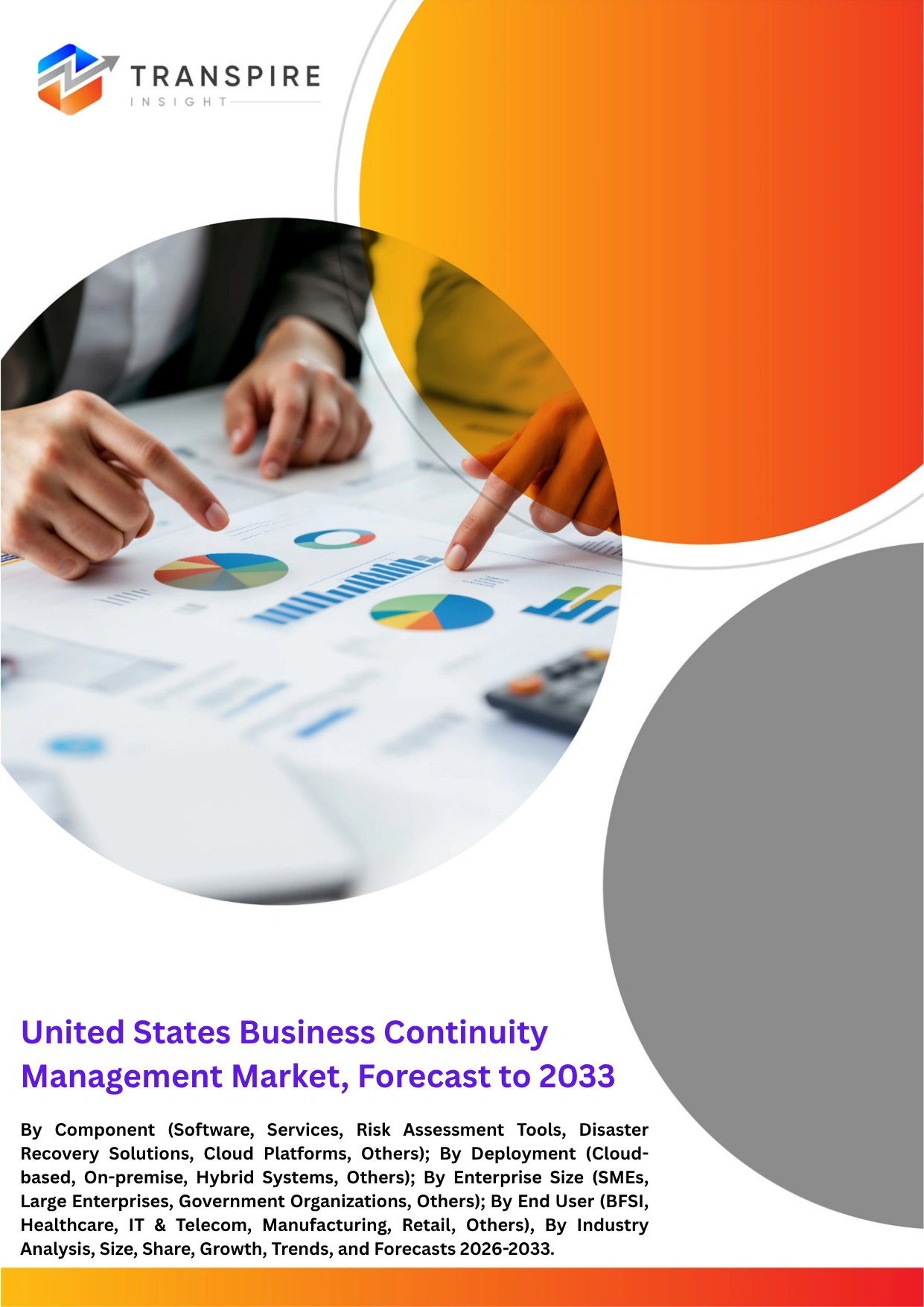
United States Business Continuity Management Market Size & Forecast:
- United States Business Continuity Management Market Size 2025: USD 309.26 Million
- United States Business Continuity Management Market Size 2033: USD 799.31 Million
- United States Business Continuity Management Market CAGR: 12.60%
- United States Business Continuity Management Market Segments: By Component (Software, Services, Risk Assessment Tools, Disaster Recovery Solutions, Cloud Platforms, Others); By Deployment (Cloud-based, On-premise, Hybrid Systems, Others); By Enterprise Size (SMEs, Large Enterprises, Government Organizations, Others); By End User (BFSI, Healthcare, IT & Telecom, Manufacturing, Retail, Others).
To learn more about this report,  Download Free Sample Report
United States Business Continuity Management Market Summary
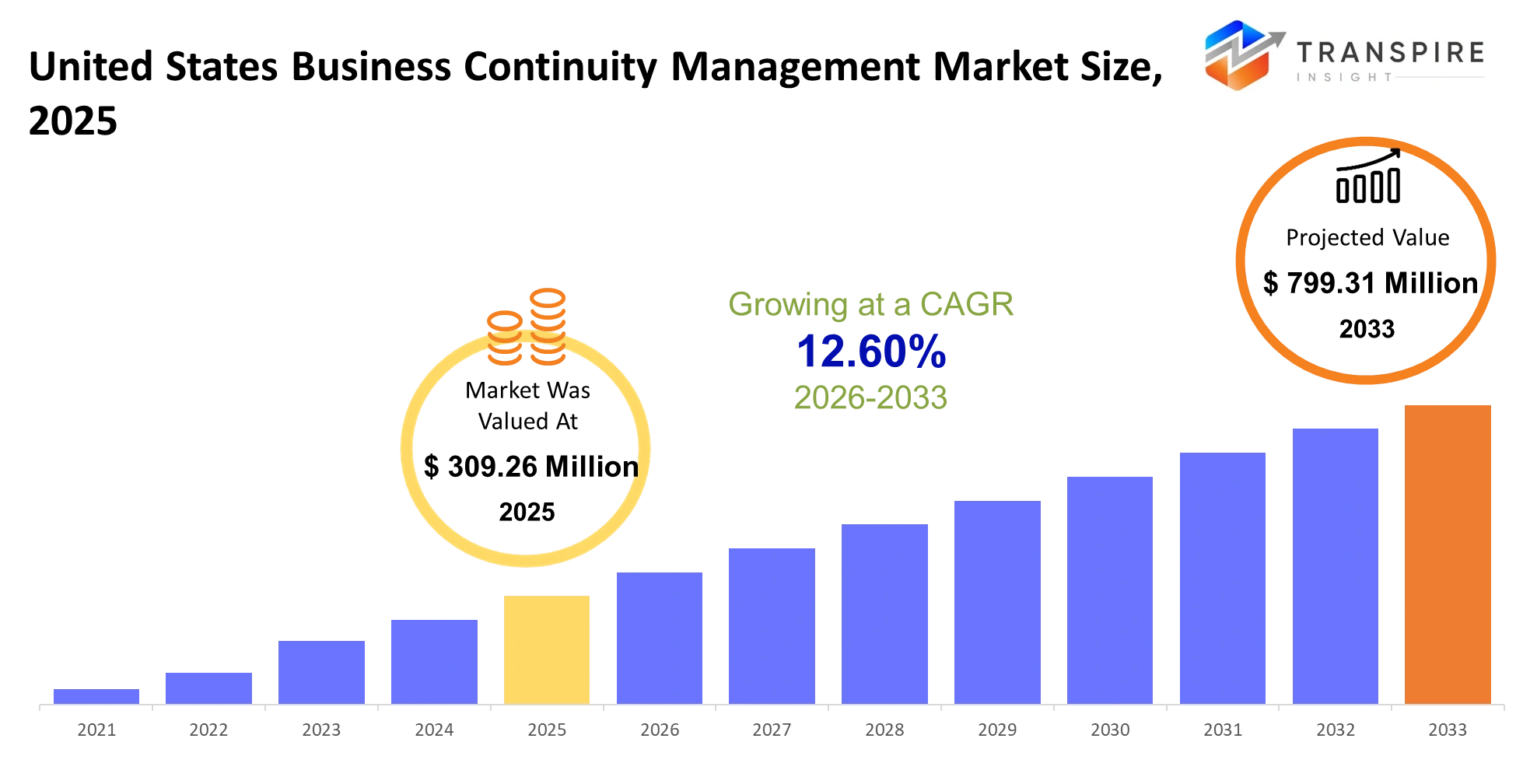
The United States Business Continuity Management Market was valued at USD 309.26 Million in 2025. It is forecast to reach USD 799.31 Million by 2033. That is a CAGR of 12.60% over the period.
The United States Business Continuity Management market has sort of moved on from being a compliance driven task into this real operational safeguard role for enterprises running distributed work, digital infrastructure, and those complicated supplier networks. In real life these platforms help keep essential business functions going when there are cyberattacks, cloud outages, severe weather events, labor disruptions or supply chain breakdowns and so on. Over the past five years, the market has been changing in a more structural way, like from static disaster recovery planning into real time resilience orchestration, which is often powered by cloud based monitoring, AI led risk analytics, and incident response systems that are actually integrated together.
The COVID-19 pandemic, kinda acted as a big push, and it showed how fast operational paralysis can spread across connected business ecosystems. That disruption then shifted executive spending priorities. Now companies tend to fund continuity platforms not only to cut downtime costs but also to safeguard revenue continuity, meet regulatory commitments, maintain customer trust, and keep digital services available. And as cyber risk grows, plus third party dependencies keep intensifying, adoption is widening from heavily regulated industries into more everyday mainstream enterprise operations.
Key Market Insights
- The Northeast region kinda dominated the United States Business Continuity Management Market with roughly 34% share in 2025, because there is high enterprise concentration plus a strong financial sector presence.
- The Western United States, on the other hand, is showing the fastest growth through 2032, supported by the expansion of cloud infrastructure, stronger technology investments, and a push toward digital transformation programs.
- Southern states are starting to see rising demand for resilience platforms as logistics , energy , and healthcare operators modernize their continuity measures and emergency response systems, little by little.
- In 2025, business continuity planning and risk assessment services took almost 41% market share , since companies want tailored resilience frameworks along with compliance guidance.
- Disaster recovery solutions stayed the second-largest segment, fueled by how much enterprises rely on cloud applications and distributed data environments these days.
- AI powered continuity automation platforms are expected to become the quickest growing chunk from 2026 to 2032, mostly because they enable real time threat monitoring capabilities which feels kind of critical now and later too.
- BFSI led the application demand with more than 29% share in 2025, since financial institutions are leaning into operational uptime, regulatory compliance, and cyber resilience approaches—mostly to keep things steady even when the environment gets messy.
- Big enterprises made up almost 63% of the United States Business Continuity Management Market in 2025, largely due to complicated operational networks and extra compliance exposure, so yeah there’s a lot riding on it.
- Smaller and mid sized organizations are showing the fastest growth among end users because affordable SaaS based BCM platforms are improving accessibility and make deployments more flexible than before.
- Government agencies are also boosting spending on continuity planning tools in order to strengthen emergency preparedness programs and infrastructure resilience efforts, even when budgets get tight.
What are the Key Drivers, Restraints, and Opportunities in the United States Business Continuity Management Market?
The main thing moving the United States Business Continuity Management market forward is kinda obvious but still, the rapid escalation of cyberattacks aimed at operational infrastructure, as well as at enterprise data environments. A bunch of well-publicized ransomware cases in healthcare systems, financial institutions and logistics operators showed how expensive long downtime can get, so firms started treating continuity planning more like a revenue shield instead of just a compliance box to tick. On top of that, cyber insurance providers, plus federal cybersecurity guidelines got stricter after 2021, which basically pushed enterprises to pour money into automated recovery systems, cloud backup infrastructure, and real-time incident response platforms. Because of this the market has seen higher spending on subscription based BCM software and managed resilience services, especially at large enterprises running multi-site digital ecosystems.
The biggest slowdown is that legacy IT is often, and still fragmented across critical industries. A lot of organizations keep using older infrastructure that cannot really, or not easily connect with modern continuity platforms, cloud recovery setups, or AI driven monitoring tools. Even swapping these systems means big capital commitments, extended migration timelines, and a lot of operational retraining. So mid-sized enterprises tend to postpone go-live decisions, and that tends to limit wider market penetration, while also making recurring software revenue growth move slower.
A big opening is showing up via AI powered predictive resilience platforms, that can sniff out operational risks before the whole thing goes sideways. Money is flowing into intelligent automation, especially across healthcare and financial services, and that’s fueling demand for continuity systems which can anticipate outages, figure out supply chain breaks, and detect cyber weaknesses in real time.
What Has the Impact of Artificial Intelligence Been on the United States Business Continuity Management Market?
Artificial intelligence and advanced digital technologies are kind of reshaping the United States Business Continuity Management market, moving continuity planning from reactive recovery toward predictive operational resilience. In practice, many enterprises now use AI enabled monitoring systems, in a way that automates incident detection, then it helps sort risk alerts by urgency, and coordinates response workflows across cloud infrastructure , cybersecurity platforms, and those distributed operational networks. Machine learning models take a look at network traffic, system logs, and operational dependencies to spot disruption patterns earlier , before those issues snowball into major outages. Financial institutions and healthcare providers are also leaning into predictive analytics tools to anticipate server instability, ransomware exposure, and supply chain interruptions. That, in turn, supports lower unplanned downtime and speeds up recovery timelines.
Then there are advanced automation platforms, which push operational efficiency further with real time compliance tracking, automated backup verification, and intelligent workload redistribution when outages happen. Bigger enterprises often report real gains in service availability and lower recovery costs when they blend AI driven continuity orchestration with cloud infrastructure management systems. Some organizations even say incident response times improved by more than 30% , mainly because automated threat classification is followed by recovery sequencing that runs in the right order.
Still, AI adoption runs into structural limitations. A lot of enterprises keep fragmented legacy infrastructure, and it tends not to have standardized data environments needed for accurate machine learning outputs. Integration costs can be steep, and inconsistent operational data along with cybersecurity silos can make forecasting less reliable, especially in complicated multi cloud setups.
Key Market Trends
- Since 2021, ransomware attacks have pushed financial institutions and healthcare providers to swap manual continuity plans for automated incident response platforms, kinda fast and quietly.
- Cloud-native BCM deployments started outpacing on-premise implementations after 2023 because enterprises wanted remote recovery access , plus scalable infrastructure resilience , without so much friction
- At the same time large enterprises began pooling cybersecurity and continuity management budgets , which basically increased the appetite for integrated resilience software from IBM and ServiceNow and not just separate tools in a pile.
- After 2022, AI-driven predictive analytics adoption sped up, it helped enterprises cut incident response times by nearly 30% via automated threat prioritization , in a more orderly way then before
- Regulatory pressure got harsher after multiple critical infrastructure cyber incidents, so by 2025 utilities and healthcare systems were forced to toughen operational recovery frameworks.
- Between 2020 and 2023, supply chain disruptions also nudged continuity planning beyond IT recovery, toward vendor risk monitoring , and logistics contingency coordination , which sounds simple but gets complicated quickly
- Mid-sized enterprises increasingly leaned into SaaS-based resilience platforms after subscription pricing reduced upfront deployment costs, compared with legacy recovery infrastructure.
- Hybrid workforce expansion changed continuity priorities too , with organizations investing heavily into secure remote access cloud backup , and distributed workflow recovery systems , because people are not always in one place anymore
- And in terms of competitive differentiation, the focus shifted toward real-time visibility dashboards, AI-assisted recovery sequencing, and automated compliance reporting capabilities across enterprise continuity platforms, no extra guesswork really.
United States Business Continuity Management Market Segmentation
By Component :
Software solutions still help the United States Business Continuity Management Market, kinda indirectly, by letting organizations keep an eye on daily operations, handle emergency communication, and protect their data when things break down. A lot of companies rely on automated systems now, because they can speed up reactions, and cut the annoying delays that pop up during operational failures. For that reason, cloud-based monitoring and recovery software is seeing more demand too, since many teams want flexible setups that let staff access services remotely and coordinate more quickly when the unexpected shows up.
That said, services remain a big deal, mostly because many organizations need ongoing consulting, training, testing, and maintenance support, so continuity planning isn’t just on paper. Risk assessment tools are used to spot fragile operational areas before they turn into major disruptions, and disaster recovery solutions are there for rebuilding systems, applications, and other critical business capabilities. Cloud platforms are getting more attention as well, since scalable infrastructure enables companies to safeguard information and keep operating across multiple sites, with less downtime, and steadier operations.
By Deployment :
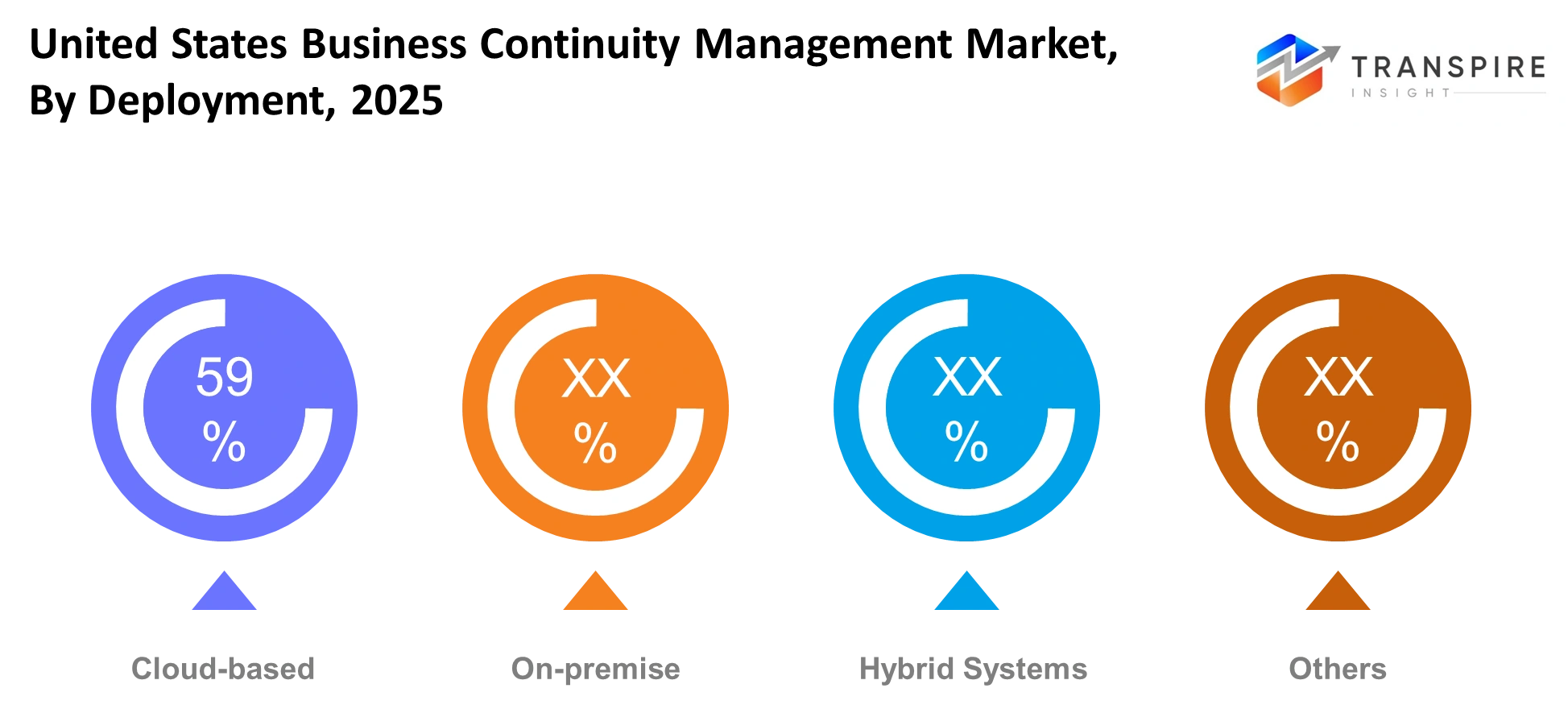
Cloud-based deployment has gained strong acceptance in the United States Business Continuity Management Market, because businesses are looking for more cost-effective frameworks, with easy availability, and faster roll-outs. In practice, cloud platforms let organizations keep running their business functions even when physical offices get hit by disruptions or temporary issues. And also the option to reach systems from a remote location has been useful for adoption in companies that have distributed groups, or teams spread across several offices, with different address points.
Meanwhile on-premise deployment is still important for organizations that handle confidential details and want direct command over infrastructure plus security related procedures. Big institutions often lean toward internal systems, partly for tighter customization and for more controlled compliance management. Hybrid setups are also growing steadily, because many enterprises try to mix cloud flexibility with on-site data handling. This path, in turn, supports operational continuity while also trying to balance performance, protection, and longer-term infrastructure demands across the range of business situations they operate in.
To learn more about this report, Download Free Sample Report
By Enterprise Size :
SMEs are gradually increasing their investment in the United States Business Continuity Management market, mostly because awareness around operational risks keeps growing. Smaller companies are starting to see the real financial ripple from cyberattacks, system disruptions, and supply chain interruptions, so they take it more seriously. Affordable cloud options and managed continuity services are making it easier for them to strengthen preparedness while not having to pour money into a large infrastructure.
Large enterprises, on the other hand, keep taking a major share because their operational structures are more tangled, which means continuity planning has to be detailed and recovery systems tend to be more advanced. A lot of multinational organizations also run dedicated teams for risk management and crisis response. Government agencies contribute too, since they need uninterrupted public services, strong data protection, and coordinated emergency response. Continuity planning stays essential, in order to keep communication systems working, transportation networks moving, and administrative functions running during disruptions.
By End User :
The BFSI sector still stays a big contributor to the United States Business Continuity Management Market, because financial institutions need continuous transaction handling, customer care, and secure data management. Tight regulatory standards, and growing cybersecurity worries, are still pushing organizations to fund continuity platforms that help with operational resilience and keep financial infrastructure safe from those sudden, unplanned interruptions.
Healthcare organizations are also doubling down on continuity preparation, so they can keep patient records available, ensure emergency services keep working , and maintain hospital routines when systems fail or during natural disasters. IT and telecom firms lean on continuity solutions too, since communication networks and digital services pretty much demand nonstop availability. Manufacturing businesses tend to prioritize reducing production downtime and guarding the supply chain, whereas retail companies use continuity mechanisms to keep inventory tracking steady, support digital payment systems and keep day to day customer operations running during disruptive periods.
What are the Key Use Cases Driving the United States Business Continuity Management Market?
The biggest use case for business continuity management platforms still hovers around operational recovery and cyber resilience, especially in the BFSI sector. Banks, insurance firms, and payment processors depend on continuity systems to keep transaction processing running, safeguard client data, and get digital services back fast during ransomware incidents or cloud outages. There is also a strict regulatory pressure, and the very high cost of downtime keeps showing up as the main reason companies keep spending enterprise wide.
Healthcare and manufacturing are catching up, and the adoption keeps climbing as hospitals and industrial facilities digitize what matters. In healthcare, continuity platforms are used to lock down patient records, keep telehealth services steady, and coordinate emergency response workflows, with less improvisation and more control. Manufacturers, on the other hand, are deploying continuity software to track supplier disruptions, protect production calendars, and shrink the losses that show up after operational shutdowns.
More recently, you see AI-driven predictive resilience and third party risk intelligence platforms gaining attention. Big organizations are starting to use tools that basically forecast operational disruptions across multi cloud setups and vendor ecosystems before failures spill over into customer facing services, or before regulatory compliance gets shaky.
|
Report Metrics |
Details |
|
Market size value in 2025 |
USD 309.26 Million |
|
Market size value in 2026 |
USD 348.24 Million |
|
Revenue forecast in 2033 |
USD 799.31 Million |
|
Growth rate |
CAGR of 12.60% from 2026 to 2033 |
|
Base year |
2025 |
|
Historical data |
2021 - 2024 |
|
Forecast period |
2026 - 2033 |
|
Report coverage |
Revenue forecast, competitive landscape, growth factors, and trends |
|
Geographic scope |
United States of America |
|
Key company profiled |
IBM, Microsoft, Oracle, VMware, ServiceNow, Fusion Risk Management, Sungard Availability Services, MetricStream, LogicManager, Castellan Solutions, Everbridge, RSA Security, Deloitte, Accenture, Cognizant. |
|
Customization scope |
Free report customization (country, regional & segment scope). Avail customized purchase options to meet your exact research needs. |
|
Report Segmentation |
By Component (Software, Services, Risk Assessment Tools, Disaster Recovery Solutions, Cloud Platforms, Others); By Deployment (Cloud-based, On-premise, Hybrid Systems, Others); By Enterprise Size (SMEs, Large Enterprises, Government Organizations, Others); By End User (BFSI, Healthcare, IT & Telecom, Manufacturing, Retail, Others). |
Which Regions are Driving the United States Business Continuity Management Market Growth?
The Northeast region kind of leads the United States Business Continuity Management market, mostly because it has this dense mix of financial institutions, healthcare networks , insurance providers, and big enterprise headquarters. In places like New York, Massachusetts , and New Jersey organizations work under pretty strict cybersecurity rules, data protection expectations, and operational resilience requirements… and that keeps pushing continuity platform adoption forward. On top of that the region tends to have mature cloud infrastructure, plus more advanced managed security service ecosystems, and good enterprise software integration fit. Then you have large consulting firms, cybersecurity vendors, and compliance specialists forming a solid support mesh, which helps keep the long-term market leadership going.
The Midwest feels more stability oriented, like it’s shaped by industrial continuity planning and operational reliability rather than going all in on aggressive digital expansion. Manufacturing groups, logistics operators, and energy companies across Illinois, Ohio, and Michigan keep funding disaster recovery and supply chain resilience systems, with the goal of keeping production continuity intact. Compared with the Northeast—where cyber regulation is the spending lever—the Midwest enterprises lean harder on reducing operational downtime and maintaining business continuity across distributed supplier networks. This more practical investment pattern creates steadier recurring revenue streams for continuity software providers, and for managed resilience service firms too.
The Western United States is showing up as the fastest-growing regional market , mostly because cloud adoption is moving really quickly , plus AI infrastructure investment and more digital operations across a lot of tech-driven industries. California, Washington and Texas saw a noticeable change after 2021 , as ransomware events and the rise of remote work exposed a few cracks in older recovery systems. Then tech companies and cloud service providers started pushing harder on automated continuity orchestration , predictive risk analytics, and even multi-cloud recovery environments. This overall momentum should translate into solid opportunities for software vendors, cybersecurity firms , and AI-enabled resilience platform providers during 2026 to 2033.
Who are the Key Players in the United States Business Continuity Management Market and How Do They Compete?
The United States Business Continuity Management market still looks moderately consolidated, where big enterprise software companies are in the same arena as specialized resilience and incident management firms. What’s happening more and more is that competition kind of “slides” toward technology integration, AI-driven automation, and the ability to stitch together cybersecurity, operational recovery, and compliance management into a single platform, or at least a very tight set of tools. The well known vendors keep trying to hold share via long-term enterprise contracts and cloud ecosystem partnerships, but smaller specialists push back, using industry specific resilience tooling and deployment models that are simply faster. Right now buyers tend to favor interoperability, predictive analytics, and automated recovery orchestration more than standalone disaster recovery software, and that has basically ramped up product innovation across the whole sector.
IBM stands out with enterprise level cyber resilience plus hybrid cloud recovery features, tied into its wider security and infrastructure lineup. IBM tries to strengthen its place by blending continuity management with AI powered threat intelligence and managed security services, so large enterprises can get centralized operational visibility. ServiceNow in contrast leans pretty hard into workflow automation and cross functional incident coordination,so it ends up letting enterprises handle IT outages, compliance actions, and operational disruptions all from one unified platform. It also seems to keep growing by leaning on partnerships with cloud providers and cybersecurity firms, to deepen those enterprise integrations even when the environment is messy or kind of multi vendor, not always clean.
Fusion Risk Management kind of competes by staying in a narrower lane around operational resilience and risk intelligence, especially where rules are strict like healthcare, and financial services. They separate themselves using scenario modeling, plus business impact analysis tools meant for the kind of regulatory maze most firms don’t handle easily.
Everbridge meanwhile leans into critical event management, and those real time emergency communication systems, which helps with big scale crisis coordination. At the same time, Microsoft expands its continuity footprint by having resilience and recovery functions built right into Azure cloud infrastructure, and into enterprise productivity ecosystems. That reduces deployment complexity for existing enterprise customers , and it also keeps things smoother overall.
Company List
- IBM
- Microsoft
- Oracle
- VMware
- ServiceNow
- Fusion Risk Management
- Sungard Availability Services
- MetricStream
- LogicManager
- Castellan Solutions
- Everbridge
- RSA Security
- Deloitte
- Accenture
- Cognizant
Recent Development News
In February 2025,Fusion Risk Management launched BC Plan inFusion. The company introduced a GenAI-powered business continuity planning capability that automates the conversion of static continuity plans into structured operational data, helping enterprises accelerate resilience and crisis response workflows in the United States BCM market.
Source: https://www.fusionrm.com/
In September 2025, Swimlane launched its Business Continuity Management solution on the Swimlane Turbine platform. The AI-powered platform introduced centralized oversight, automated disruption response, and flat-cost pricing, expanding access to BCM tools for mid-market and enterprise organizations across the United States.
Source: https://swimlane.com/
What Strategic Insights Define the Future of the United States Business Continuity Management Market?
The United States Business Continuity Management market is kind of moving toward integrated operational resilience ecosystems where cyber security , cloud infrastructure , supply chain monitoring and crisis response all sort of work through unified AI driven platforms. Over the next five to seven years, the market will shift even more away from static recovery planning as enterprises care more about continuous operational availability and they start leaning into predictive disruption management. This direction is being pushed by the growing financial impact of downtime in highly digitized areas like healthcare , banking , logistics , and critical infrastructure.
One under recognized risk is the increasing concentration of continuity work within a small group of hyperscale cloud providers. Since enterprises centralize resilience architecture around a few big cloud environments, outages or security mishaps at a single provider could trigger cascading operational disruptions across multiple industries all at once, which is … honestly hard to untangle quickly.
A big emerging opportunity is AI powered third party risk intelligence platforms that can map supplier, vendor, and infrastructure dependencies in real time. Companies trying to enter this space should concentrate on interoperability with existing enterprise cybersecurity and ERP systems, because integration flexibility will become a stronger competitive differentiator than standalone recovery functionality.
United States Business Continuity Management Market Report Segmentation
By Component
- Software
- Services
- Risk Assessment Tools
- Disaster Recovery Solutions
- Cloud Platforms
By Deployment
- Cloud-based
- On-premise
- Hybrid Systems
By Enterprise Size
- SMEs
- Large Enterprises
- Government Organizations
By End User
- BFSI
- Healthcare
- IT & Telecom
- Manufacturing
- Retail
Frequently Asked Questions
Find quick answers to common questions.
The United States Business Continuity Management Market size is USD 799.31 Million in 2033.
Key segments for the United States Business Continuity Management Market are By Component (Software, Services, Risk Assessment Tools, Disaster Recovery Solutions, Cloud Platforms, Others); By Deployment (Cloud-based, On-premise, Hybrid Systems, Others); By Enterprise Size (SMEs, Large Enterprises, Government Organizations, Others); By End User (BFSI, Healthcare, IT & Telecom, Manufacturing, Retail, Others).
Major United States Business Continuity Management Market players are IBM, Microsoft, Oracle, VMware, ServiceNow, Fusion Risk Management, Sungard Availability Services, MetricStream, LogicManager, Castellan Solutions, Everbridge, RSA Security, Deloitte, Accenture, Cognizant.
The United States Business Continuity Management Market size is USD 309.26 Million in 2025.
The United States Business Continuity Management Market CAGR is 12.60% from 2026 to 2033.
- IBM
- Microsoft
- Oracle
- VMware
- ServiceNow
- Fusion Risk Management
- Sungard Availability Services
- MetricStream
- LogicManager
- Castellan Solutions
- Everbridge
- RSA Security
- Deloitte
- Accenture
- Cognizant
Recently Published Reports
-
Apr 2026
3D Optical Profiler Market
3D Optical Profiler Market Size, Share & Analysis Report By Type (Desktop 3D Optical Profiler, and Portable 3D Optical Profiler), By Technology (Confocal Technology, and White Light Interference), By End-Use Industry (Manufacturing, Research Institutions, Automotive, Aerospace and Defense, Medical Devices, and Other), and Geography (North America, Europe, Asia-Pacific, Middle East and Africa, South and Central America), 2021 - 2031
-
Apr 2026
Depth Sensor Market
Depth Sensor Market Size, Share & Analysis Report By Type (Infrared Depth Sensors, Time-of-Flight (ToF) Sensors, Stereo Vision Sensors, Structured Light Sensors, Ultrasonic Depth Sensors), By Application (Automotive, Robotics, Gaming, Consumer Electronics, Industrial Automation, Healthcare, Security & Surveillance, Others), By End Users (Automotive Manufacturers, Consumer Electronics Companies, Healthcare Providers, Industrial Companies, Security Agencies, Gaming Companies, Robotics Companies, Others), and Geography (North America, Europe, Asia-Pacific, Middle East and Africa, South and Central America), 2021 – 2031
-
Apr 2026
Digital Manufacturing Market
Digital Manufacturing Market Size, Share & Analysis Report By Component (Hardware, Software, and Services), By Technology (Robotics, 3D Printing, Internet of Things (IoT), and Others), By Application (Automotive and Transportation, Aerospace and Defense, Consumer Electronics, Industrial Machinery, and Others), By Process Type (Computer-Based Designing, Computer-Based Simulation, Computer 3D Visualization, Analytics, and Others), and Geography (North America, Europe, Asia-Pacific, Middle East and Africa, South and Central America), 2021 – 2031
-
Apr 2026
Digital Visa Services Market
Digital Visa Services Market Size, Share & Analysis Report By Type (Individual Travelers, Group Travelers), By Application (Tourism, Business Travel, Others), and Geography (North America, Europe, Asia-Pacific, Middle East and Africa, South and Central America), 2021 – 2031