
United States Biogas Plant Market Size & Forecast:
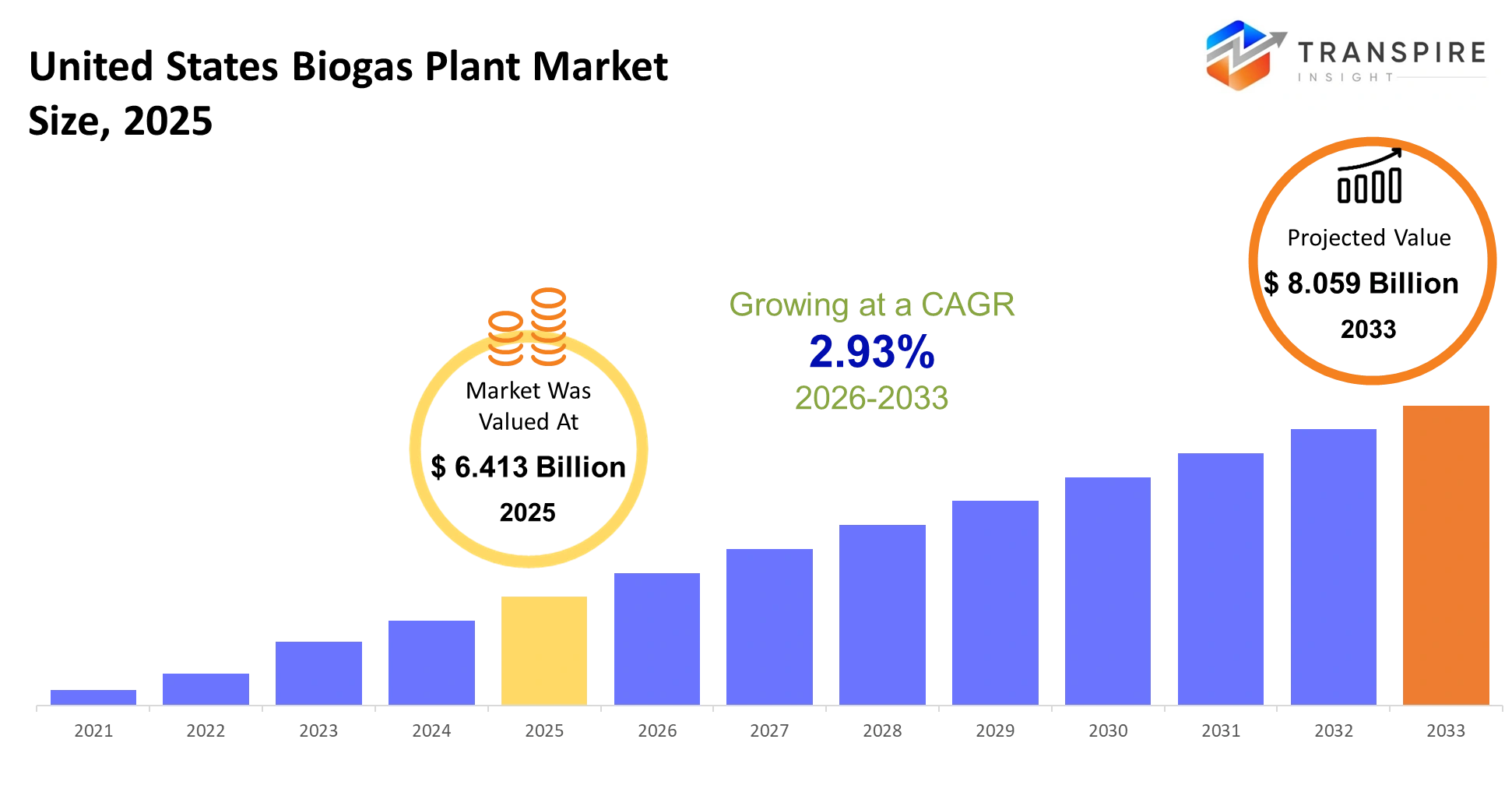
- United States Biogas Plant Market Size 2025: USD 6.413 Billion
- United States Biogas Plant Market Size 2033: USD 8.059 Billion
- United States Biogas Plant Market CAGR: 2.93%
- United States Biogas Plant Market Segments:By Feedstock (Agricultural Waste, Food Waste, Municipal Waste, Sewage Sludge, Industrial Wastewater, Animal Manure, Energy Crops), By Technology (Wet Anaerobic Digestion, Dry Anaerobic Digestion, Continuous Digestion, Batch Digestion, Thermophilic Digestion, Mesophilic Digestion), By Application (Electricity Generation, Heat Generation, Biomethane Production, Vehicle Fuel, CHP Generation, Industrial Fuel).
To learn more about this report,  Download Free Sample Report
United States Biogas Plant Market Summary:
The United States Biogas Plant Market size is estimated at USD 6.413 Billion in 2025 and is anticipated to reach USD 8.059 Billion by 2033, growing at a CAGR of 2.93% from 2026 to 2033. The United States biogas plant market is kinda becoming a real essential piece of the country’s waste-to-energy infrastructure, where agricultural residue, landfill gas, municipal organic waste, and wastewater sludge get turned into usable electricity, renewable natural gas, and even industrial heat. And in practice, those plants assist utilities, municipalities, plus big farms lower disposal expenses, while also building a more domestic source of low-carbon fuel, that can be injected into gas grids or used by heavy transport fleets.
Over the past five years, the market has moved away from smaller electricity generation and leaned more toward renewable natural gas production, mostly because federal and state carbon credit programs made the project math much better. The Renewable Fuel Standard, and California’s Low Carbon Fuel Standard, helped speed things up by making methane capture financially attractive. Meanwhile, energy price volatility after global supply disruptions showed the downside of depending on conventional fuel markets too much. So, industrial operators and waste management companies are adopting biogas systems not only for sustainability compliance, but also for long run fuel security and steady revenue from environmental credits, kind of a double win.
Key Market Insights
- In the Midwest region, which sort of dominated the United States Biogas Plant Market , it held nearly 38% market share in 2025 because the agricultural feedstock is just readily available.
- California stays on top for speed, it’s the fastest-growing regional market through 2032, largely tied to Low Carbon Fuel Standard incentives and spending on renewable gas infrastructure, you know those investments that keep expanding.
- Meanwhile , Southern states showed notable biogas industry momentum , especially as livestock waste management projects rolled out across Texas , North Carolina and Georgia.
- In the Northeast, municipalities pushed anaerobic digestion adoption more widely to reduce landfill dependency and to boost regional renewable energy generation capacity, that kind of circular benefit.
- When it comes to process choices, anaerobic digestion technology led the United States Biogas Plant Market with more than 64% industry share in 2025, mainly due to operational efficiency advantages.
- Landfill gas recovery was still the second-largest segment , backed by strict methane emission compliance standards across industrial waste facilities.
- Renewable natural gas upgrading systems are emerging as the fastest-growing segment during the forecast period , since transportation fuel demand keeps accelerating, year after year.
- Modular biogas plant systems also pulled in growing interest among mid-sized farms that want lower installation costs and scalable energy production solutions.
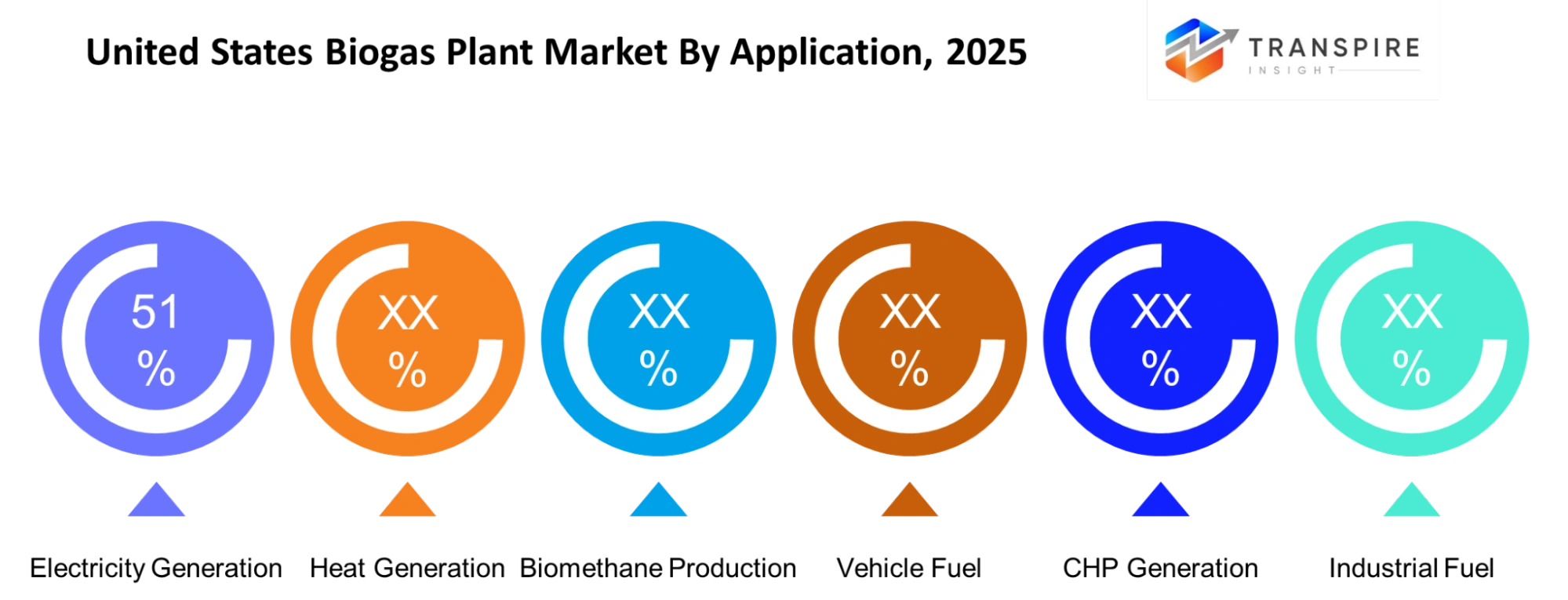
- Electricity and combined heat generation represented nearly 46% market share in 2025, across wastewater treatment and industrial processing facilities , broadly speaking.
- On the application side, renewable natural gas for transportation surfaced as the fastest-growing area , driven by fleet decarbonization targets and federal fuel credit incentives.
- Lastly, industrial heating applications kept showing strong market traction as manufacturers pursued steadier energy sourcing and lower long-term operating expenses, basically aiming for less cost stress later on.
What are the Key Drivers, Restraints, and Opportunities in the United States Biogas Plant Market?
The biggest driver behind the United States Biogas Plant Market is sort of the quick expansion of renewable natural gas monetization programs, linked up to federal and state carbon credit frameworks. Rules like the Renewable Fuel Standard and California’s Low Carbon Fuel Standard changed the deal math, by giving captured methane a measurable dollar value. After that, biogas plants stopped being only waste handling setups and became those recurring revenue engines. Dairy farms, wastewater operators , and landfill owners can now lock in longer term income via renewable fuel credits , pipeline gas sales and utility collaborations. As the credit numbers got stronger over the last few years developers pushed harder into gas upgrading systems and bigger anaerobic digestion layouts.
Still, the market’s most important structural obstacle is the heavy capital requirement of biogas infrastructure plus the scattered way feedstock supply chains work. To get digesters built, gas purification units installed, and pipeline connections approved, you need a large up front spend and, long permitting timelines . Smaller farm operators often can’t get financing easily or they don’t have enough waste volume, so standalone plants don’t really pencil out. Because of those limits, commissioning happens later, rural adoption gets slowed, and overall market reach stays narrow outside well established waste management hubs.
A big future opportunity is in tying together biogas units with dairy clusters and carbon capture systems across the Midwest, like somewhat in a connected way. Right now, developers are more and more putting money into centralized manure-to-RNG networks, where they gather residues from several farms into one or more shared upgrading facilities. That approach helps with operating efficiency, cuts back on hauling expenses, and builds a more scalable renewable fuel setup, able to back heavy-duty transport as well as industrial energy markets.
What Has the Impact of Artificial Intelligence Been on the United States Biogas Plant Market?
Artificial intelligence and advanced digital technologies are, yeah, reshaping operations across the United States biogas sector more and more by lifting plant efficiency, improving methane recovery rates, and making compliance management feel a bit more manageable. In practice operators are now leaning on AI enabled control systems to automate anaerobic digester conditions, and they keep tuning temperature , feedstock mix , and even gas flow rates by using sensor readings in real time. That kind of control tends to keep methane production steadier, and it also cuts down the annoying process interruptions that happen when the organic waste composition swings around. On top of that, digital monitoring platforms are being folded into gas upgrading units and scrubber performance setups, so contaminant removal gets better and renewable natural gas quality standards stay on track.
Meanwhile machine learning models are getting a lot of attention for predictive maintenance , not just general optimization. Operators look at vibration patterns, pressure changes , and equipment runtime logs to anticipate compressor failures, membrane degradation, or pipeline injection headaches, before any shutdown actually happens. The upside is fewer unplanned downtime events, and lower maintenance costs too, because servicing can be scheduled on purpose instead of after something breaks. There are also AI driven emissions forecasting tools that help facilities tighten regulatory compliance by spotting methane leakage risks early , and by adjusting flare operations so the performance is closer to what regulators expect.
Still, adoption has limits. The integration costs are high, and operational data is often fragmented. A lot of older biogas facilities still run legacy equipment that doesn’t match well with modern digital infrastructure. So deploying large scale AI ends up being both technically complex and capital intensive, despite the potential benefits.
Key Market Trends
- Since 2021, renewable natural gas projects have, kind of outpaced the electricity focused biogas facilities , as fuel credit revenues kept improving long term project profitability, even with all the usual bumps.
- California tightened its market influence after Low Carbon Fuel Standard incentives, kicked in more strongly, which increased dairy based RNG project investments across a lot of western United States facilities.
- Major operators, including Ameresco and Clean Energy Fuels, moved faster on landfill gas partnerships between 2022 and 2025, not just slowly hovering around.
- Municipal wastewater plants increasingly rolled out AI enabled monitoring systems after labor shortages made operational reliability feel more fragile during post pandemic infrastructure modernization efforts.
- Dairy cooperatives shifted toward centralized anaerobic digestion hubs starting in 2023, in order to reduce methane compliance costs, and also to boost renewable fuel scalability.
- Biogas upgrading technology adoption sped up when membrane separation systems cut methane purification costs, compared with the more conventional water scrubbing methods.
- Pipeline interconnection projects spread across Midwest states, as utilities chased domestic low carbon gas sourcing after natural gas price volatility rose around 2022.
- Food processing companies started moving away from waste disposal contracts, toward on site digestion systems, so they could stabilize energy expenses and also reduce landfill transportation costs.
- Investors have been leaning more toward multi feedstock biogas facilities since 2024, because diversified organic waste inputs seemed to strengthen operational resilience and support steadier year round methane output.
- Equipment suppliers introduced predictive maintenance platforms that reduced unexpected compressor downtime , and helped plant uptime across industrial renewable gas facilities feel a lot more consistent.
United States Biogas Plant Market Segmentation
By Feedstock
Animal manure and farm leftovers kinda hold the top spot in the feedstock segment, mainly because big dairy operations and livestock farms crank out steady organic volumes pretty much the whole year. Municipal waste plus sewage sludge also keep a notable market slice, mostly due to those long term contracts between local governments and waste handling operators. Food waste has really picked up pace lately, since supermarkets, restaurants, and food manufacturers now deal with tighter landfill diversion rules. Industrial wastewater projects stay more clustered, especially around food processing and beverage manufacturing, where the costs to treat organic discharge keep going up. Energy crops sit smaller, and it’s not just one reason, cultivation expenses and land use concerns together curb broad commercial scalability.
In the future, growth probably leans toward more integrated feedstock aggregation systems, where manure mixes with municipal organics and industrial waste streams, then gets routed into centralized digestion hubs. If that happens, methane consistency may improve, project economics could get better, and it may also spark more infrastructure investment from utilities and private developers that want greater renewable gas output capacity.
By Technology
Wet anaerobic digestion pretty much leads the technology segment, mainly because wastewater sludge, manure, and food waste streams usually carry a lot of moisture, so they fit continuous biological processing pretty naturally. In a similar way, the continuous digestion systems tend to get adopted more easily because gas keeps coming in a steadier fashion and there are fewer operational hiccups versus the batch digestion units. Mesophilic digestion keeps a pretty solid market position too, operators seem to like the lower energy demand and the more predictable microbial activity when temperatures stay moderate, it feels safer. Meanwhile thermophilic digestion keeps picking up steam especially inside big industrial facilities, since the methane output can be higher and decomposition goes faster, so the extra heating expense becomes easier to justify. Dry anaerobic digestion stays kind of niche, mostly in a few municipal solid waste projects, because getting the feedstock ready and managing contaminants really needs solid sorting infrastructure and more careful handling.
Looking ahead, tech development is drifting toward automated control setups, predictive maintenance software, and modular digester designs that cut down the daily operating complications. Equipment manufacturers and engineering firms are expected to shift focus toward scalable systems that can manage mixed organic inputs without too much fuss, and at the same time they should bring maintenance costs down plus help improve renewable natural gas quality.
By Application
Electricity generation and combined heat and power systems kind of stay on top of application demand , because a lot of wastewater facilities, farms, and landfills already run some onsite energy recovery stuff. Biomethane production is now showing up as the fastest-growing application, mostly because renewable natural gas gets more policy push, from federal and state fuel credit programs. Then, vehicle fuel use is expanding quickly inside heavy-duty trucking and municipal transit fleets, where fleet operators are looking for lower-carbon alternatives that should still work with existing natural gas engines. Industrial fuel applications also picked up steam, as manufacturers try to cut their exposure to volatile fossil fuel prices, and lock in dependable long-term energy sourcing. Heat generation projects remain pretty active in agriculture and food processing, where thermal energy demand matches that steady flow of organic waste production.
The market future direction seems to sort of lean toward pipeline-grade biomethane plus transportation fuel integration, not those standalone electricity centered setups. This shift is expected to, reshuffle investment priorities, spur more deployment of gas upgrading infrastructure, and build tighter partnerships between utilities, waste operators, and the transportation fuel providers .
To learn more about this report, Download Free Sample Report
What are the Key Use Cases Driving the United States Biogas Plant Market?
Municipal wastewater treatment plants basically are the biggest use case for biogas facilities, because the sludge keeps showing up in a steady way so methane output stays more stable. From that, onsite electricity is easier to run, and the process ends up feeling more reliable overall, not just “sometimes”. Many utilities then lean on combined heat and power setups to cancel out grid energy spending a bit and they also help meet methane reduction mandates with less headache, in practice.
Renewable natural gas production is getting more momentum for heavy duty transportation, especially with dairy cooperatives, landfill operators, and municipal fleet operators. Meanwhile food processing companies are also, more and more, adopting anaerobic digestion units to turn organic waste into industrial heat. This also reduces landfill disposal expenses, sort of the two birds one stone thing, except less poetic.
Newer angles are starting to appear too. Hydrogen production via biogas reforming is one, and there’s also carbon-negative fuel generation that’s paired with carbon capture systems. On top of that, large livestock operations in Midwest states are looking at centralized renewable gas hubs that bundle manure from several farms into one shared upgrading facility, instead of doing it all farm by farm.
|
Report Metrics |
Details |
|
Market size value in 2025 |
USD 6.413 Billion |
|
Market size value in 2026 |
USD 6.586 Billion |
|
Revenue forecast in 2033 |
USD 8.059 Billion |
|
Growth rate |
CAGR of 2.93% from 2026 to 2033 |
|
Base year |
2025 |
|
Historical data |
2021 - 2024 |
|
Forecast period |
2026 - 2033 |
|
Report coverage |
Revenue forecast, competitive landscape, growth factors, and trends |
|
Geographic scope |
United States of America |
|
Key company profiled |
Wärtsilä, EnviTec Biogas, Ameresco, PlanET Biogas, Xebec Adsorption, Bioenergy DevCo, DVO Inc. |
|
Customization scope |
Free report customization (country, regional & segment scope). Avail customized purchase options to meet your exact research needs. |
|
Report Segmentation |
By Feedstock (Agricultural Waste, Food Waste, Municipal Waste, Sewage Sludge, Industrial Wastewater, Animal Manure, Energy Crops), By Technology (Wet Anaerobic Digestion, Dry Anaerobic Digestion, Continuous Digestion, Batch Digestion, Thermophilic Digestion, Mesophilic Digestion), By Application (Electricity Generation, Heat Generation, Biomethane Production, Vehicle Fuel, CHP Generation, Industrial Fuel) |
Which Regions are Driving the United States Biogas Plant Market Growth?
The Midwest is still kinda the leading regional market, mostly because big dairy operations, livestock farms, and agricultural processing plants generate a steady and pretty concentrated feedstock base. States like Wisconsin, Iowa, and Minnesota do well there too, helped by renewable fuel policies that actually get used, plus active involvement in methane reduction programs tied to renewable natural gas credits. There’s also existing natural gas pipeline infrastructure, which lets developers hook up upgrading facilities more smoothly than in other, less developed rural areas. And you can feel how a mature ecosystem—engineering firms, farm cooperatives, utilities , and waste management operators—keeps backing project scalability and long-term investment activity.
California is usually the second-largest contributor, but its market behavior seems different in practice, because regulatory enforcement steers adoption more than just feedstock concentration. The state stays on a pretty steady investment cadence, largely because of the Low Carbon Fuel Standard incentives, but also because it keeps pressing these intense landfill diversion goals, which in practice kinda nudge renewable gas output out of municipal waste streams. Municipal utilities along with the transportation fleet operators still move things along with long-term buy/supply procurement agreements for low-carbon fuels, so the developers get a more predictable revenue view. And with solid financing access too, plus more advanced environmental compliance systems, California ends up feeling like a steadier market, even if construction and permitting costs sometimes run on the higher side.
The Southern region seems to be coming up as the fastest-growing market, mainly because livestock waste management projects are expanding quickly and the whole infrastructure is getting modernized across states like Texas, and North Carolina. After 2023, new capital tied to renewable natural gas pipeline interconnections plus centralized manure aggregation systems, really helped the numbers work better, in a way that stakeholders could feel. Also food processing facilities and big poultry operations pulled this along, because anaerobic digestion got adopted faster as the rules around waste disposal became stricter , and energy costs stayed kinda unstable. If this keeps going, the trajectory should open up solid chances for technology providers, infrastructure investors, and renewable fuel developers who are looking for scalable projects between 2026 and 2033.
Who are the Key Players in the United States Biogas Plant Market and How Do They Compete?
The competitive landscape for the United States biogas plant market is still kinda moderately fragmented, with competition get shaped by technology integration, feedstock access, and the whole long-term renewable fuel monetization piece. Big infrastructure developers show up next to specialized engineering firms and regional waste management operators. A lot of players are starting to separate themselves less by just equipment pricing, and more by renewable natural gas upgrading efficiency, project financing know how, plus pipeline interconnection capabilities. Meanwhile, established companies still defend their market share using vertically integrated service models, like plant design, gas upgrading, operations management, and environmental credit optimization all sort of under one roof. Newer entrants, in turn, seem to chase agricultural and municipal waste clusters that are still underserved, using modular systems and flexible deployment approaches, so they can move quicker and less complicated.
Ameresco leans into long-term infrastructure partnerships with municipalities and landfill operators, so they get more control over feedstock supply and those recurring renewable gas revenue streams too. They differentiate with integrated project financing and energy-as-a-service contracts, which helps reduce upfront investment pressure for public sector customers. Veolia basically brings its waste management operations and wastewater treatment know-how into the mix, and uses that to win municipal biogas contracts, especially across densely populated urban regions. For growth, a lot of these strategies now focus on upgrading landfill gas facilities into pipeline-quality renewable natural gas production sites, not just staying at basic generation.
Wärtsilä kind of competes with advanced automation systems, digital monitoring platforms, and high efficiency gas processing tech which improves the plant uptime plus methane recovery rates. There’s also strong engineering muscle, along with predictive maintenance software, and that combination feels like a differentiator for bigger industrial projects where operational reliability is nonnegotiable. EnviTec Biogas goes more toward agricultural digestion systems , and also centralized manure processing networks, especially in dairy heavy regions across the Midwest. Then Clean Energy Fuels expands kind of fast via transportation fuel partnerships, and renewable natural gas supply agreements with heavy-duty fleet operators, so it ends up creating downstream demand paths , which in turn helps stabilize long term project economics.
Company List
- Wärtsilä
- EnviTec Biogas
- Ameresco
- PlanET Biogas
- Xebec Adsorption
- Bioenergy DevCo
- DVO Inc.
Recent Development News
In March 2026, American Biogas Council Announces New 2026 Executive Leadership: American Biogas Council appointed five new officers to its executive committee for 2026. The leadership reshuffle comes as U.S. biogas developers accelerate investments in renewable natural gas facilities and landfill methane recovery projects.
Source: https://www.bioenergy-news.com
In April 2026, Biogas Companies Report Strong 2025 Results Amid RNG Expansion: Major U.S.-linked renewable natural gas operators, including Waga Energy and Nopetro, reported infrastructure expansion and stronger earnings tied to rising demand for landfill and biogas-derived fuels. The update reflected continued capital deployment into new RNG plants and methane capture projects across the U.S. market.
Source: https://www.wastedive.com
What Strategic Insights Define the Future of the United States Biogas Plant Market?
The United States biogas plant market is kinda moving, structurally I mean, toward big scale renewable natural gas ecosystems that get stitched into transportation fuel networks, utility infrastructure, and those industrial decarbonization moves. In the next five to seven years, growth is going to lean more and more on whether companies can bundle feedstock from a bunch of waste sources and then deliver pipeline-grade gas at a commercial scale. Financial results are also sliding away from “just” standalone electricity generation and instead toward repeatable revenue stuff tied to carbon intensity credits , long term fuel agreements and methane reduction compliance programs.
One thing that feels underrecognized is how much the market’s starting to lean on policy driven credit markets. If the value of renewable fuel incentives drops, or if state-level low-carbon fuel rules get changed, project economics could get squeezed, especially for developers who are highly leveraged. But at the same time, there are new opportunities forming around carbon-negative fuel production, using biogas facilities that are integrated with carbon capture systems, particularly in Midwest dairy corridors where methane volumes are still pretty concentrated.
Market participants should really push for vertically integrated partnerships, you know combining feedstock control, gas upgrading infrastructure, and downstream fuel distribution, so margins stay steadier over the long run and regulatory exposure stays smaller.
United States Biogas Plant Market Report Segmentation
By Feedstock
- Agricultural Waste
- Food Waste
- Municipal Waste
- Sewage Sludge
- Industrial Wastewater
- Animal Manure
- Energy Crops
By Technology
- Wet Anaerobic Digestion
- Dry Anaerobic Digestion
- Continuous Digestion
- Batch Digestion
- Thermophilic Digestion
- Mesophilic Digestion
By Application
- Electricity Generation
- Heat Generation
- Biomethane Production
- Vehicle Fuel
- CHP Generation
- Industrial Fuel
Frequently Asked Questions
Find quick answers to common questions.
The approximate United States Biogas Plant Market size for the market will be USD 8.059 Billion in 2033.
The key segments of the United States Biogas Plant Market are By Feedstock (Agricultural Waste, Food Waste, Municipal Waste, Sewage Sludge, Industrial Wastewater, Animal Manure, Energy Crops), By Technology (Wet Anaerobic Digestion, Dry Anaerobic Digestion, Continuous Digestion, Batch Digestion, Thermophilic Digestion, Mesophilic Digestion), By Application (Electricity Generation, Heat Generation, Biomethane Production, Vehicle Fuel, CHP Generation, Industrial Fuel).
Major players in the United States Biogas Plant Market are Wärtsilä, EnviTec Biogas, Ameresco, PlanET Biogas, Xebec Adsorption, Bioenergy DevCo, DVO Inc..
The current market size of the United States Biogas Plant Market is USD 6.413 Billion in 2025.
The United States Biogas Plant Market CAGR is 2.93%.
- Wärtsilä
- EnviTec Biogas
- Ameresco
- PlanET Biogas
- Xebec Adsorption
- Bioenergy DevCo
- DVO Inc.
Recently Published Reports
-
Apr 2026
Active Power Filter Market
Active Power Filter Market Size, Share & Analysis Report By Type (Shunt Active Power Filters, Series Active Power Filter, Hybrid Active Power Filter), By Application (Harmonics Mitigation, Reactive Power Compensation, Voltage Regulation, Power Factor Correction), By Phase (Single Phase, Three Phase), By End-User Industry (Manufacturing, Healthcare, Commercial, Automotive, Oil and Gas, Others), and Geography (North America, Europe, Asia-Pacific, Middle East and Africa, South and Central America), 2021 - 2031
-
Apr 2026
Electrical Transformer Market
Electrical Transformer Market Size, Share & Analysis Report By Core (Closed, Shell, and Berry), By Insulation (Gas, Oil, Solid, Air, and Other), By Phase (Single, and Three), By Rating (100 MVA to 500 MVA, 501 MVA to 800 MVA, and 801 MVA to 1200 MVA), and Geography (North America, Europe, Asia-Pacific, Middle East and Africa, South and Central America), 2021 – 2031
-
Apr 2026
Hydraulic Piston Pumps Market
Hydraulic Piston Pumps Market Size, Share & Analysis Report By Type (Axial Piston Pumps, Radial Piston Pumps), By Operating Pressure (Low Pressure, Medium Pressure, High Pressure), By Application (Construction, Mining, Agriculture, Automotive, Oil & Gas, Industrial Machinery, Others), By End-User (OEMs, Aftermarket), and Geography (North America, Europe, Asia-Pacific, Middle East and Africa, South and Central America), 2021 – 2031
-
Apr 2026
Laboratory Gas Generators Market
Laboratory Gas Generators Market Size, Share & Analysis Report By Product (Nitrogen Gas Generator, Hydrogen Gas Generator, Zero Air Gas Generator, Purge Gas Generator, TOC Gas Generators, Others), By Application (Gas Chromatography, Liquid Chromatography-mass Spectrometry (LC-MS), Gas Analyzers, Others), By End-user (Life Science, Chemical & Petrochemical, Food & Beverage, Others), and Geography (North America, Europe, Asia-Pacific, Middle East and Africa, South and Central America), 2021 – 2031