
Asia Pacific Hazardous Waste Market Size & Forecast:
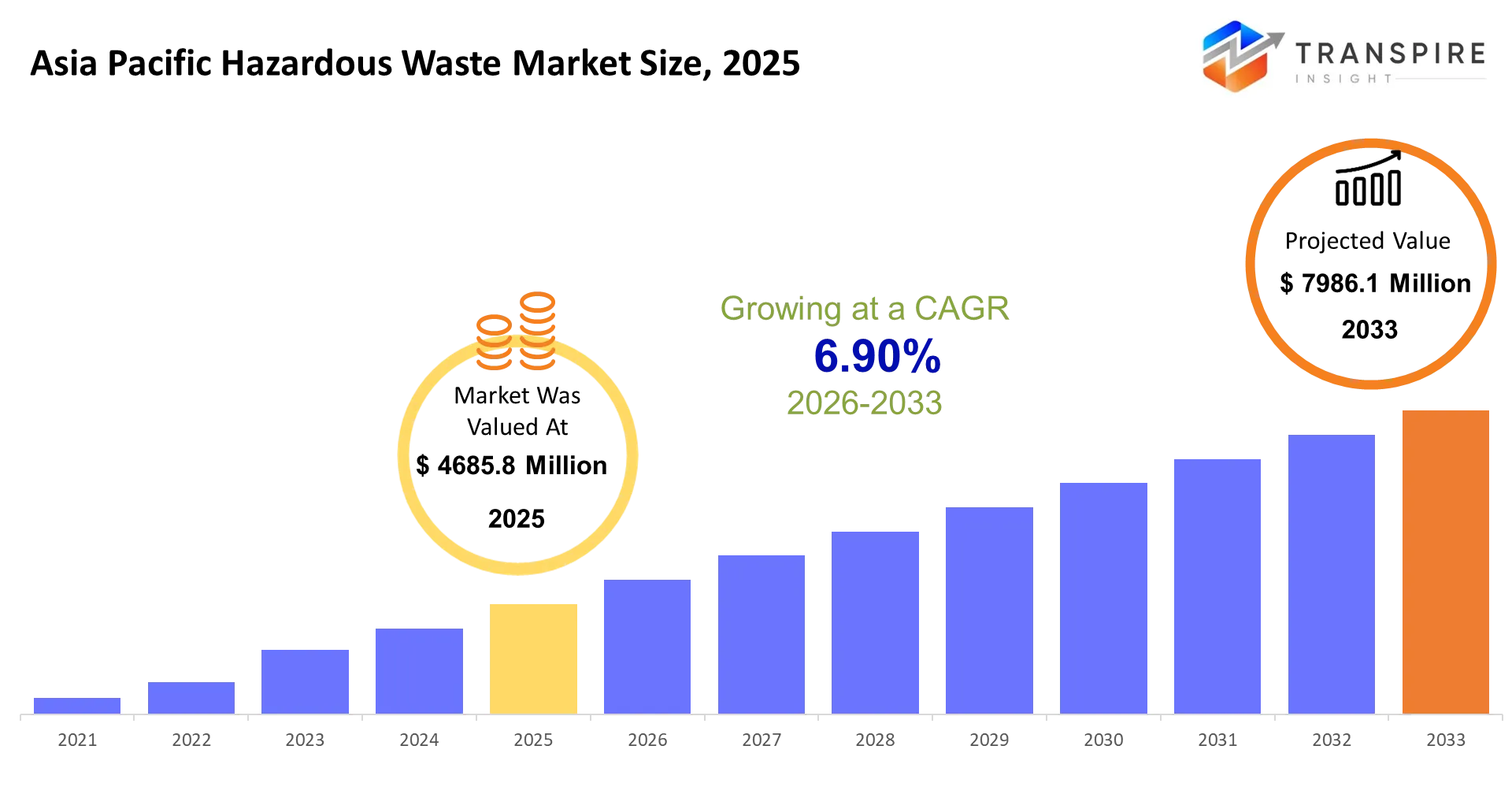
- Asia Pacific Hazardous Waste Market Size 2025: USD 4685.8 Million
- Asia Pacific Hazardous Waste Market Size 2033: USD 7986.1 Million
- Asia Pacific Hazardous Waste Market CAGR: 6.90%
- Asia Pacific Hazardous Waste Market Segments: By Type (Solid Waste, Liquid Waste, Sludge Waste, Others); By Application (Industrial Waste, Medical Waste, Chemical Waste, Nuclear Waste, Others); By End-User (Industrial Sector, Healthcare Sector, Government, Waste Management Firms, Others); By Treatment (Recycling, Incineration, Landfill, Others)
To learn more about this report,  Download Free Sample Report
Asia Pacific Hazardous Waste Market Summary
The Asia Pacific Hazardous Waste Market was valued at USD 4685.8 Million in 2025. It is forecast to reach USD 7986.1 Million by 2033. That is a CAGR of 6.90% over the period.
The Asia Pacific hazardous waste market functions as an essential business environment because it enables industries to conduct safe operations for collecting, transporting, treating, recycling, and disposing of their toxic waste materials which they generate during their manufacturing processes and chemical production and healthcare operations and mining activities and electronics manufacturing. The system handles hazardous waste materials to safeguard land areas and water resources and industrial supply networks while enabling businesses to fulfill regulations and operate without interruptions. The function gained greater business importance after industrial activities in the area developed into complex systems which operated under strict governmental oversight.
The market has developed during the last three to five years from its original state of providing simple waste disposal services to offer complete waste treatment systems which include resource recovery and digital waste monitoring solutions. The waste management transition established more stringent waste traceability requirements which various nations including China and India and South Korea enforced. The manufacturing sector experienced a major recovery period after the pandemic which resulted in increased production of chemical and electronic waste materials. Businesses now establish advanced treatment partnerships while they create permanent waste management contracts which enable better income forecasting for service providers and drive the use of advanced processing technologies.
Key Market Insights
- China controls the Asia Pacific Hazardous Waste Market because it will have a market share of almost 38% by 2025 due to its extensive industrial production capacity and its strict environmental waste management practices.
- The hazardous waste treatment infrastructure in India will attract large investments which drive the country to become the fastest-growing regional market until 2032.
- The advanced recycling systems of South Korea and Japan together with their high-value chemical waste processing technologies.
- The Asia Pacific Hazardous Waste Market generates about 46% of its revenue from treatment and disposal services because regulations have become more strict.
- The market share of collection and transportation services ranks as the second largest because industrial compliance requirements continue to grow.
- The fastest expanding segment of the market consists of resource recovery and recycling solutions which will experience substantial growth from 2026 until 2032.
- Industrial manufacturing maintains its position as the leading sector because it generates more than 34% of hazardous waste through its chemical and electronic and metal processing activities.
- The healthcare sector experiences its fastest expansion through waste management services which stem from new biohazard disposal requirements and the growth of medical facilities that started after 2021.
- Chemical and petrochemical companies constitute the main end-user market because they produce almost 31% of all hazardous waste materials that require treatment.
- The second-largest category of pharmaceutical manufacturers exists because they must comply with strict requirements for contamination control.
What are the Key Drivers, Restraints, and Opportunities in the Asia Pacific Hazardous Waste Market?
The regulatory framework for industrial waste disposal has become more stringent across all major economies which has become the primary driver of growth for the Asia Pacific Hazardous Waste Market because China strengthened its hazardous disposal rules and India implemented more severe waste management regulations. The first international environmental standards which organizations must meet select base environmental performance criteria for certification when assessing their environmental compliance programs. The direct commercial impact is substantial. Manufacturers must now obtain certified collection and treatment services which include digital tracking systems to maintain their operational licenses and export rights. This development has led to increased contract volumes for waste service providers which now includes more revenue opportunities from compliance monitoring and treatment infrastructure and waste traceability platforms.
The main structural challenge for the market exists because emerging Asia Pacific economies lack access to modern hazardous waste treatment facilities. The process of constructing compliant incineration plants and secure landfill systems and chemical neutralization facilities requires organizations to invest substantial financial resources because they need to complete approval processes which require expertise and technical knowledge. The existing problems need time to resolve because they require joint efforts between public and private sectors to secure land and develop consistent regulatory frameworks. The industrial clusters depend on their existing disposal systems which only provide basic service because they have not yet adopted new waste management systems which would generate higher income from better waste management services.
Resource recovery technologies which include solvent recycling and battery material extraction create a significant opportunity for growth. The development of electric vehicle supply chains through investments in South Korea and India enables hazardous waste treatment facilities to produce industrial materials which will result in increased circular economy profits.
What Has the Impact of Artificial Intelligence Been on the Asia Pacific Hazardous Waste Market?
Hazardous waste operators throughout the Asia Pacific region face new challenges in their treatment efficiency operations and compliance monitoring processes and logistics control systems because of artificial intelligence and advanced digital systems. Real-time systems now use AI-enabled automation platforms to track incinerator temperature and scrubber system performance and leachate treatment parameters and hazardous waste transportation routes through fleet-based monitoring. The systems automatically control chemical process conditions to handle variable chemical loads which decreases the need for manual work while maintaining operational stability. Automated control systems in large-scale treatment facilities provide better control of their operations while decreasing the chances of unexpected shutdowns.
The development of machine learning models has increased the accuracy of forecasting future outcomes. Operators use the equipment to predict how thermal treatment units will wear out and choose the best emissions control settings while finding system problems before they lead to operational breakdowns. Predictive maintenance applications have helped some facilities reduce unscheduled downtime by 15 to 20 percent while lowering maintenance costs through condition-based servicing. Waste collection fleets achieve better fuel efficiency through route optimization software which enables them to comply with stricter deadlines.
The technologies provide measurable operational improvements through increased equipment availability and decreased energy use and improved accuracy of regulatory compliance documentation. The main challenge for organizations that want to use artificial intelligence technology remains the high costs and difficult implementation process which arises when organizations attempt to connect new digital solutions with existing treatment systems. The absence of standardized sensor networks and historical operational data at most facilities creates challenges for model development which results in delays when trying to implement systems at smaller waste processing facilities.
Key Market Trends
- Between 2022 and 2025, China and India improved their hazardous waste enforcement efforts which resulted in their industries ending informal waste disposal practices to use official treatment contracts and compliance verification processes.
- From 2023 onward, waste operators rapidly adopted digital tracking platforms which allowed them to track operating activities in real time while monitoring their waste operations at Asia Pacific facilities.
- Between 2024 and 2026, EV and electronics manufacturers increased their financial commitments toward hazardous waste recovery systems which focused on recycling lithium batteries and recovering solvent materials.
- Since 2021, Southeast Asia has experienced infrastructure deficits that prompted governments and private companies to invest together in building large-scale incineration plants and chemical waste treatment facilities.
- Between 2022 and 2025, Veolia and SUEZ and Cleanaway expanded their business operations through their acquisition of municipal hazardous waste contracts in emerging Asian markets.
- Post-2020 pandemic effects caused healthcare facilities to produce hazardous waste at higher volumes which reached a stable level after 2023 yet remained above the pre-pandemic waste baseline in hospitals and laboratories.
- From 2022 onward, East Asia's semiconductor and electronics manufacturing sector expansion led to higher requirements for hazardous waste treatment services that handle specific waste materials.
- In 2023, stricter transboundary waste movement regulations reduced cross-border hazardous shipments which resulted in major Asia Pacific economies needing to increase their domestic waste treatment capacity.
Asia Pacific Hazardous Waste Market Segmentation
By Type :
The Asia Pacific Hazardous Waste Market which needs to manage dangerous waste materials shows solid waste as its largest component because factories and construction sites produce dangerous waste materials. The waste material consists of contaminated waste and packaging waste and industrial waste which needs special disposal methods to protect the environment and public health.
The market includes both liquid waste and sludge waste as important components. The chemical industry and industrial operations produce liquid waste while treatment facilities produce sludge waste. The two types of waste need treatment methods which use filtration and chemical processing to stop soil and water contamination from occurring.
By Application :
Industrial waste leads the application segment because production activities operate at high volumes throughout manufacturing and textile and automotive industries. The waste includes dangerous waste materials which need special treatment systems for safe disposal according to environmental regulations.
The market demand increases because of medical waste and chemical waste and nuclear waste. Medical waste requires safe handling due to infection risks while chemical waste involves toxic substances needing controlled neutralization. Nuclear waste, though smaller in volume, needs secure storage and permanent waste management methods.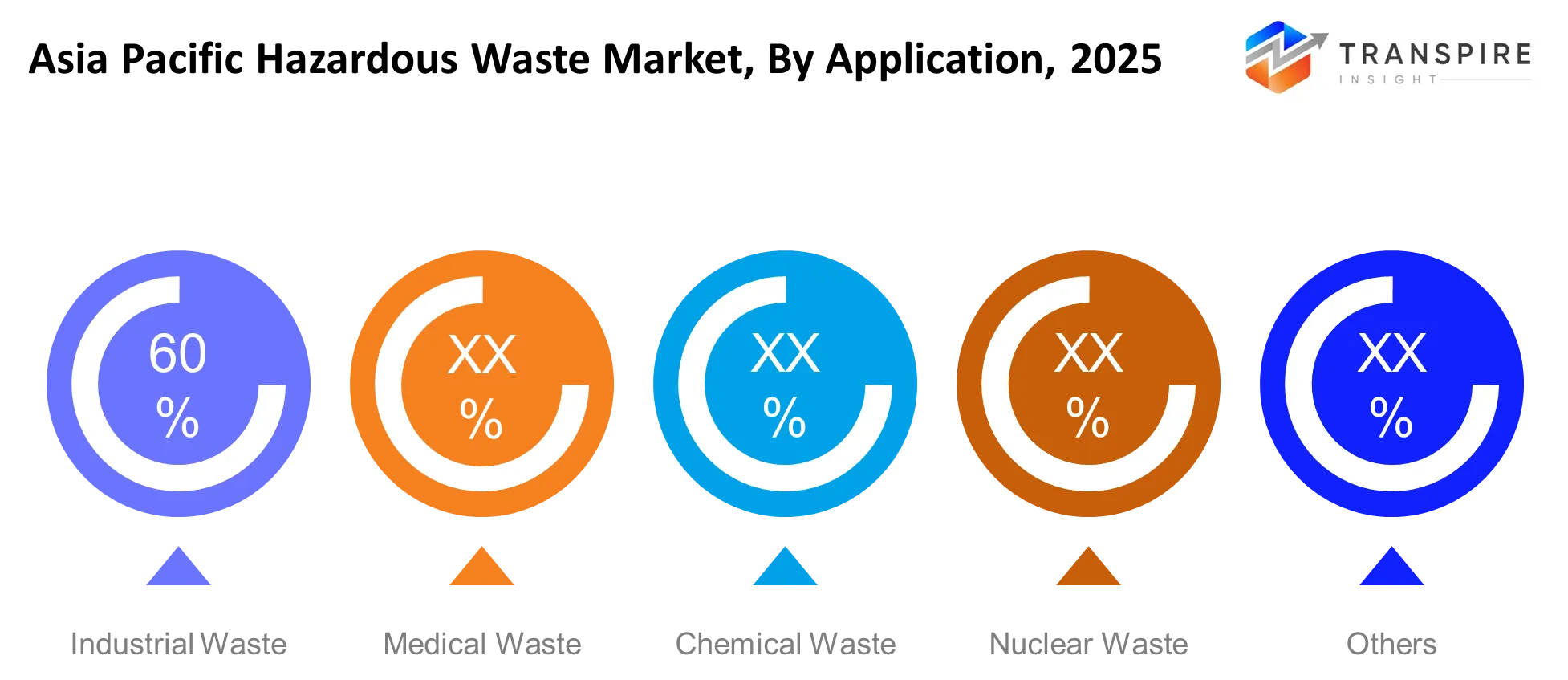
To learn more about this report, Download Free Sample Report
By End-User :
Industries generate continuous waste which establishes their status as the main end-user of industrial services. The industrial sector requires specialized waste management services because they need to comply with regulations and decrease their environmental effects through safe waste disposal and recycling methods.
Healthcare institutions and government agencies and waste management companies all contribute essential functions. Healthcare institutions generate hazardous biomedical waste, while governments enforce regulations and infrastructure development. The waste management companies offer collection services and treatment services and disposal services to maintain environmental safety and comply with regulations.
By Treatment :
The Asia Pacific Hazardous Waste Market currently sees rising demand for recycling services because industries want to recycle materials instead of using new virgin resources. Companies achieve waste material reuse through their ability to sort and process waste materials which decreases both environmental effects and operational expenses.
The two disposal methods of incineration and landfill remain common for handling hazardous waste that cannot be recycled. The process of incineration eliminates waste through volume reduction and the destruction of hazardous contaminants, whereas landfills function as safe waste disposal locations. Environmental risks decrease through chemical processing and stabilization methods which serve as additional treatment options.
What are the Key Use Cases Driving the Asia Pacific Hazardous Waste Market?
The primary application of industrial hazardous waste treatment in the Asia Pacific Hazardous Waste Market exists to handle the dangerous waste materials produced by chemical and petrochemical and manufacturing operations. The operations generate substantial amounts of toxic materials which must undergo compliant collection and neutralization and disposal processes to satisfy rising environmental regulations while minimizing the risk of production shutdowns. The essential requirement for operational maintenance demands continuous treatment services.
The current waste management solutions extend their services to handle pharmaceutical waste and to treat waste from electronics manufacturing. Pharmaceutical facilities produce biohazardous materials which need to undergo controlled incineration. Semiconductor and electronics manufacturers depend on acid neutralization systems and solvent recovery systems to manage their chemical waste streams which contain high-purity materials.
The first use case operates with lithium-ion battery recycling while the second one manages maritime hazardous waste. Closed-loop recovery systems for metals and electrolytes now operate as mandatory requirements in EV battery production facilities. Shipping operators mandate their vessels to implement onboard waste segregation while they utilize port-linked treatment services under new marine pollution regulations which exist throughout Asia Pacific industrial trade corridors.
|
Report Metrics |
Details |
|
Market size value in 2025 |
USD 4685.8 Million |
|
Market size value in 2026 |
USD 5004.5 Million |
|
Revenue forecast in 2033 |
USD 7986.1 Million |
|
Growth rate |
CAGR of 6.90% from 2026 to 2033 |
|
Base year |
2025 |
|
Historical data |
2021 - 2024 |
|
Forecast period |
2026 - 2033 |
|
Report coverage |
Revenue forecast, competitive landscape, growth factors, and trends |
|
Regional scope |
Asia Pacific (China, India, Japan, South Korea, Australia, Rest of Asia Pacific) |
|
Key company profiled |
Veolia, SUEZ, Clean Harbors, Stericycle, Waste Management Inc, Republic Services, Covanta, Biffa, Remondis, GFL Environmental, FCC Environment, Hitachi Zosen, EnviroServ, Daiseki, China Everbright |
|
Customization scope |
Free report customization (country, regional & segment scope). Avail customized purchase options to meet your exact research needs. |
|
Report Segmentation |
By Type (Solid Waste, Liquid Waste, Sludge Waste, Others); By Application (Industrial Waste, Medical Waste, Chemical Waste, Nuclear Waste, Others); By End-User (Industrial Sector, Healthcare Sector, Government, Waste Management Firms, Others); By Treatment (Recycling, Incineration, Landfill, Others) |
Which Regions are Driving the Asia Pacific Hazardous Waste Market Growth?
The East Asian region, especially China, dominates the Asia Pacific Hazardous Waste Market because its industrial operations produce hazardous waste that needs treatment under strict environmental regulations. National pollution control laws create strong regulatory frameworks which force manufacturers to use certified disposal methods and maintain traceable waste disposal processes. The system operates through a network of incineration plants and chemical treatment centers which work together with their distribution infrastructure to provide uninterrupted services. The industrial clusters located in coastal provinces create constant waste streams from their chemical and electronic and manufacturing operations, which help the waste market sustain its position.
Japan and South Korea represent a more stable but structurally different contributor to the market. The economies of these countries require standardized compliance systems together with advanced waste processing technologies, which differ from China's demand that drives its volume-based market requirements. Industrial conglomerates maintain consistent operations through their ongoing investments which create predictable hazardous waste generation from their electronics and automotive and precision manufacturing business operations. The company maintains its operations through strict environmental governance and long-term agreements with its specialized service providers. The region maintains its stable condition because efficiency improvements drive revenue growth while capacity expansion occurs at a slower pace.
The current fastest growth rate in Southeast Asia results from industrial relocation patterns and the expansion of manufacturing facilities which Vietnam and Indonesia and Thailand currently establish. The new environmental regulations which became effective after 2022 started to establish formal procedures for waste management that previously existed as informal practices. The combination of rapid port infrastructure development and increased foreign direct investment in the electronics and textiles sectors has created dangerous waste production because these two factors combine to create more hazardous materials. The region provides investors and market entrants with strong growth opportunities, but they need to establish scalable infrastructure and develop compliance systems for local markets to meet demand that will emerge between 2026 and 2033.
Who are the Key Players in the Asia Pacific Hazardous Waste Market and How Do They Compete?
The Asia Pacific Hazardous Waste Market exhibits moderate consolidation because competitive treatment services which generate high-value treatment services and most basic waste collection operations and disposal services are provided by different local companies. Global companies maintain their market share by using their knowledge of regulatory requirements together with their advanced treatment facilities and their complete logistics systems instead of competing on prices. Industrial clients now consider traceability and audit readiness together with certified handling capacity as their most essential requirements which creates entry barriers and makes technology and service quality become the main factors for market competition.
Veolia strengthens its position in industrial chemical waste streams across China and Southeast Asia through high-temperature treatment upgrades and circular recovery systems. SUEZ uses its integrated water and hazardous waste contracts together with digital monitoring tools to create visible compliance capabilities which enable industrial clients to develop their compliance standards. Cleanaway Waste Management expands through acquisition-led consolidation in Australia, modernizing fleets and securing long-term municipal and industrial contracts.
The state-backed investment of Beijing Capital Eco-Environment Group enables the organization to expand its incineration and landfill operations within China's controlled industrial zones. Remondis focuses on specialized recycling and engineering-led hazardous waste treatment partnerships across selected Asia Pacific markets. Waste Management Inc. maintains its regional presence through efficient landfill management operations and advisory services instead of expanding through major physical growth.
Company List
- Veolia
- SUEZ
- Clean Harbors
- Stericycle
- Waste Management Inc
- Republic Services
- Covanta
- Biffa
- Remondis
- GFL Environmental
- FCC Environment
- Hitachi Zosen
- EnviroServ
- Daiseki
- China Everbright
Recent Development News
In November 2025, Veolia announced acquisition of Clean Earth from Enviri for approximately US$3 billion. The deal significantly expands Veolia’s hazardous waste processing footprint and strengthens its ability to serve fast-growing industrial and healthcare hazardous waste streams across Asia Pacific through broader global technology deployment and operational scale.
Source https://www.reuters.com/
In October 2025, Veolia secured Singapore’s first license for treatment of PFAS-containing firefighting foam at its hazardous waste treatment facility. This regulatory certification validates advanced destruction technology for hazardous contaminants and is expected to accelerate adoption of high-specification hazardous waste treatment solutions across Asia Pacific as governments tighten disposal standards for persistent pollutants. Source https://www.veolia.com/
What Strategic Insights Define the Future of the Asia Pacific Hazardous Waste Market?
The Asia Pacific Hazardous Waste Market is undergoing a fundamental transition toward waste management systems that combine digital technologies with full compliance requirements and waste tracking systems and methods for recovering resources. The current trend develops through two factors which include stricter environmental regulations that industrial nations enforce and the increasing difficulty of managing waste from chemical products and electronic devices and battery production. The upcoming 5 to 7 year period will lead to increased revenue concentration among companies which operate treatment facilities and offer both real-time monitoring and circular recovery solutions.
The main danger of the situation originates from the excessive reliance on treatment facilities which operate advanced technology in both China and the developed countries of East Asia. Any implementation of stricter regulations regarding cross-border waste transportation together with local capacity limitations will create bottlenecks which disrupt waste movement across the region while interrupting essential services to markets that depend on those services.
The Southeast Asian electric vehicle supply chain which includes Indonesia and Vietnam presents new business possibilities for developing lithium-ion battery material recovery systems. The industry segment currently lacks complete structure but it attracts both governmental interest and rising industrial investment. Market participants need to establish mobile modular treatment plants and initiate partnerships with battery production companies for securing continuous access to materials and establishing a favorable regulatory standing.
Asia Pacific Hazardous Waste Market Report Segmentation
By Type
- Solid Waste
- Liquid Waste
- Sludge Waste
By Application
- Industrial Waste
- Medical Waste
- Chemical Waste
- Nuclear Waste
By End-User
- Industrial Sector
- Healthcare Sector
- Government
- Waste Management Firms
By Treatment
- Recycling
- Incineration
- Landfill
Frequently Asked Questions
Find quick answers to common questions.
The Asia Pacific Hazardous Waste Market size is USD 7986.1 Million in 2033.
Key Segments for the Asia Pacific Hazardous Waste Market are By Type (Solid Waste, Liquid Waste, Sludge Waste, Others); By Application (Industrial Waste, Medical Waste, Chemical Waste, Nuclear Waste, Others); By End-User (Industrial Sector, Healthcare Sector, Government, Waste Management Firms, Others); By Treatment (Recycling, Incineration, Landfill, Others).
Major Asia Pacific Hazardous Waste Market Players are Veolia, SUEZ, Clean Harbors, Stericycle, Waste Management Inc, Republic Services, Covanta, Biffa, Remondis, GFL Environmental, FCC Environment, Hitachi Zosen, EnviroServ, Daiseki, China Everbright.
The Asia Pacific Hazardous Waste Market size is USD 4685.8 Million in 2025.
The Asia Pacific Hazardous Waste Market CAGR is 6.90% from 2026 to 2033.
- Veolia
- SUEZ
- Clean Harbors
- Stericycle
- Waste Management Inc
- Republic Services
- Covanta
- Biffa
- Remondis
- GFL Environmental
- FCC Environment
- Hitachi Zosen
- EnviroServ
- Daiseki
- China Everbright
Recently Published Reports
-
Apr 2026
Handling and Lifting Equipment Market
Handling and Lifting Equipment Market Size, Share & Analysis Report By Product (Cranes and Hoists, Forklifts, Conveyor Systems, Aerial Work Platforms, Others), By Application (E-Commerce, Automotive and Railway, Food and Beverages, Aviation, Others), and Geography (North America, Europe, Asia-Pacific, Middle East and Africa, South and Central America), 2021 - 2031
-
Apr 2026
HVAC Equipment Market
HVAC Equipment Market Size, Share & Analysis Report By Heating Equipment Type (Boilers and Furnaces, Heat Pumps, and Unitary Heaters), By Ventilation Equipment (Air Handling Units, Humidifiers and Dehumidifiers, Air Filters, and Fan Coiling Units), By Air Conditioning Equipment (Unitary Air Conditioners, Room Air Conditioners, Packaged Terminal Air Conditioners, and Chillers), By End User (Commercial, Residential, Industrial, and others), and Geography (North America, Europe, Asia-Pacific, Middle East and Africa, South and Central America), 2021 – 2031
-
Apr 2026
Refrigeration Valves Market
Refrigeration Valves Market Size, Share & Analysis Report By Type (Solenoid Valves, Expansion Valves, Check Valves, Service Valves, Others), By Application (Commercial Refrigeration, Industrial Refrigeration, Transport Refrigeration, Residential Refrigeration, Air Conditioning Systems), By End User (Food and Beverage Industry, Pharmaceutical Industry, HVAC Industry, Chemical Industry, Others), and Geography (North America, Europe, Asia-Pacific, Middle East and Africa, South and Central America), 2021 – 2031
-
Apr 2026
E-Commerce Packaging Materials Market
E-Commerce Packaging Materials Market By Material Type (Corrugated Boxes, Paper & Paperboard, Foam & Cushioning Materials, Plastic Packaging, Flexible Packaging, Protective Packaging, Others), By Product(Primary Packaging, Secondary Packaging, Tertiary Packaging), By Packaging Function (Protective Packaging, Branding & Presentation Packaging, Transit & Logistic Packaging, Sustainable Packaging, Tamper Evidence Packaging), By End-User (Retail & Consumer Goods, Electronic Appliances, Food & Beverages, Healthcare & Pharmaceutical, Fashion & Apparel, Home & Furnishing, Others); By Industry Analysis, Size, Share, Growth, Trends, and Forecasts 2021-2033