
France Solid Recovered Fuel Market Size & Forecast:
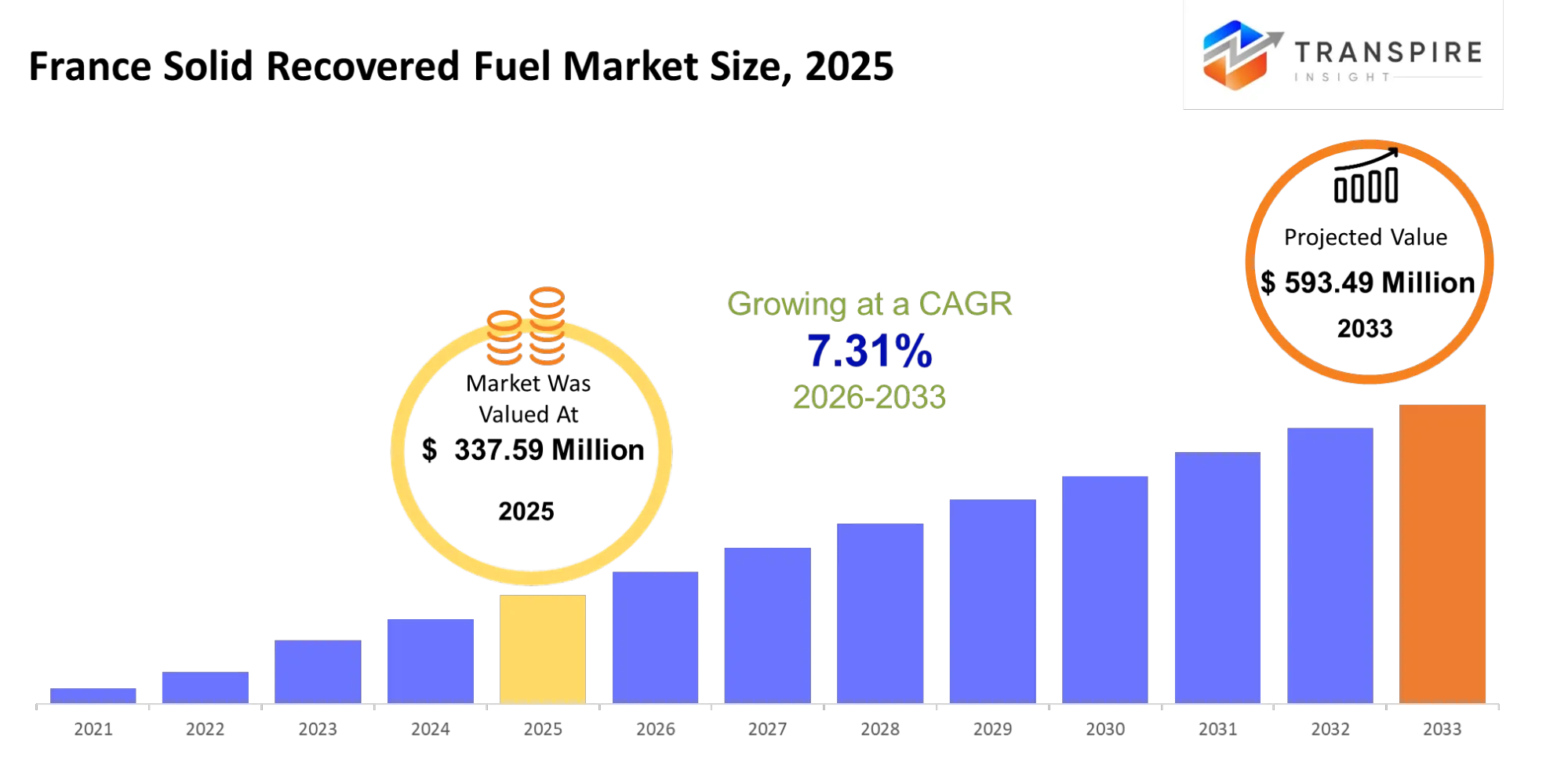
- France Solid Recovered Fuel Market Size 2025: USD 337.59 Million
- France Solid Recovered Fuel Market Size 2033: USD 593.49 Million
- France Solid Recovered Fuel Market CAGR: 7.31%
- France Solid Recovered Fuel Market Segments: By Type (Refuse Derived Fuel, Solid Recovered Fuel, Others); By Application (Power Generation, Cement Kilns, Industrial Boilers, Others); By End-User (Energy Companies, Cement Industry, Industrial Sector, Waste Management Firms, Others); By Source (Municipal Waste, Industrial Waste, Others)
To learn more about this report,  Download Free Sample Report
France Solid Recovered Fuel Market Summary
The France Solid Recovered Fuel Market was valued at USD 337.59 Million in 2025. It is forecast to reach USD 593.49 Million by 2033. That is a CAGR of 7.31% over the period.
Polymeric membranes dominate material usage because they provide cost-effective solutions which deliver flexible performance across different municipal and industrial applications. The product achieves strong market acceptance because its manufacturing process proves simple while it supports various filtration methods. The design features of polymeric materials make them the preferred material choice for installation in large operational facilities.
Ceramic membranes represent the fastest-growing material category because of their exceptional durability and resistance to extreme operating conditions. The materials find increased usage in industrial settings that deal with extreme contamination because their extended service life and chemical resistance properties make them essential. The demand for high-purity filtration in pharmaceutical and chemical sectors supports business expansion. The upcoming research period will concentrate on developing hybrid material systems which integrate polymer performance with ceramic strength to improve system efficiency while decreasing upkeep requirements.
Key Market Insights
- The Northern cement factories and industrial waste processing facilities produce 38 percent of the total cement production in Northern France.
- The Southern region will experience its highest development period from 2025 until 2033 because of the upcoming SRF production centers.
- Île-de-France experiences continuous demand growth because of its urban waste consolidation systems.
- The market for processed SRF pellets reaches a 45 percent market share because these pellets provide better calorific value and industrial applications.
- Fluff-type SRF remains the second-largest segment used in flexible combustion systems across mid-scale facilities.
- The refined high-grade SRF segment experiences its fastest growth until 2033 because of new emission control regulations.
- Cement kilns currently operate with 52 percent of their capacity because they use alternative fuel mixtures instead of coal.
- The decentralized biomass and waste energy systems which provide power generation services represent the industry that is growing at the highest rate.
- The manufacturing facilities in France show consistent growth for industrial boiler usage.
- The France Solid Recovered Fuel Market demand distribution shows cement and construction end-users controlling 55 percent of the market.
- The end-user group which uses energy utilities represents the sector with the fastest market growth because of renewable energy integration requirements.
- The chemical and paper industries are expanding their use of cost-effective thermal energy solutions.
- The strategic partnerships between our company and cement manufacturers help us establish permanent SRF supply agreements.
- The organization developed advanced waste pre-treatment facilities which now serve as key assets for regional waste processing operations.
- The digital monitoring systems enable organizations to maintain consistent fuel quality while meeting regulatory requirements.
What are the Key Drivers, Restraints, and Opportunities in the France Solid Recovered Fuel Market?
The primary factor that drives the situation forward comes from France's stringent landfill diversion requirements which mandate all waste materials to be transformed into usable energy resources according to European Union circular economy regulations. Cement companies and major industrial operations now use SRF as a coal substitute because carbon taxes and emission regulations have increased their costs for using fossil fuels. The policy creates a cost difference which results in companies choosing SRF as their preferred material because they need to extend their industrial contracts and secure stable revenue streams from suppliers.
Municipal waste streams present the main challenge because they produce different feedstock quality which leads to changes in both calorific value and combustion effectiveness. The existing structural problem requires a long duration to fix because it relies on national waste separation habits and the development of waste management systems throughout the country. The manufacturing sector faces operational problems because industrial users need to spend extra money on preprocessing which delays implementation in smaller production facilities.
Advanced automated waste sorting systems together with artificial intelligence-based preprocessing technologies create an important opportunity because they produce standardized SRF output quality. France is implementing pilot projects for intelligent waste sorting facilities which use optical and sensor-based systems to classify waste materials. The systems enable better fuel consistency which allows industries to use SRF in high-efficiency cement kilns and industrial boilers that previously rejected this material because of variable quality.
What Has the Impact of Artificial Intelligence Been on the France Solid Recovered Fuel Market?
The operational systems which support the France solid recovered fuel ecosystem use artificial intelligence for waste sorting and fuel quality assessment and combustion efficiency systems. AI-powered optical sorting systems now classify waste streams more accurately, which results in SRF batches obtaining better calorific consistency before their delivery to cement kilns and industrial boilers. The system decreases the need for manual work which leads to better operational efficiency at the preprocessing facilities.
Machine learning models maintain shredders and conveyors and combustion systems through predictive maintenance which helps operators maintain consistent operations and reduce unexpected equipment failures. The AI-based emissions forecasting tools at some facilities modify combustion settings automatically during operation to ensure compliance with EU emission standards, which helps organizations meet regulations while decreasing their chances of receiving penalties.
These technologies have improved plant operational time and fuel-to-energy conversion efficiency in particular with their application at large cement manufacturing facilities. The adoption of AI technology encounters a primary obstacle because organizations have developed different methods to collect their waste stream information. Municipal waste composition variations create model accuracy problems, and the absence of complete integration between outdated sorting systems and contemporary AI technology drives up implementation expenses. The implementation of complete digital transformation remains slow because organizations need to experience complete efficiency improvements.
Key Market Trends
- The EU landfill diversion regulations required all European Union member states to establish their waste management systems through waste processing facilities which match their established diversion targets from 2022.
- The cement manufacturers operating their industrial facilities achieved systemwide efficiency improvements by using SRF material for more than 50 percent of their total coal needs.
- The advanced optical sorting technologies successfully achieved their goal of diminishing contamination levels during the SRF feedstock processing operation which took place between 2023 and 2025.
- The Paprec Group together with Veolia expanded their joint waste-to-energy system contracts which provide long-term services to industrial clients.
- Energy price fluctuations during the period between 2022 and 2024 drove industrial facilities to adopt SRF because it served as an economical solution which stabilized their fuel expenses.
- The automated preprocessing systems generated better calorific value results which enabled cement kilns to function with higher operational efficiency.
- The manufacturing facilities transitioned from using coal as their primary fuel to implementing SRF blending methods for their boiler operations.
- The digital monitoring systems enhanced emissions compliance tracking capabilities for all SRF combustion operations which took place at extensive combustion facilities.
- The Northern France region maintained its position as the leading cement production area because of its unified cement manufacturing operations and extensive transportation network.
- The demand for high-grade SRF increased continuously because European Union emission regulations required stricter fuel quality standards which reduced available emission limits.
France Solid Recovered Fuel Market Segmentation
By Type
The French Solid Recovered Fuel systems operate through four distinct output categories which demonstrate different degrees of waste treatment and fuel production efficiency. The market is gradually shifting from low-grade waste-derived outputs toward more standardized and high-calorific fuels as industrial users demand consistent combustion performance and stricter emissions compliance. Suppliers must allocate resources toward advanced sorting and shredding and fuel conditioning technology development because regulatory requirements from EU circular economy directives compel them to do so.
Refuse Derived Fuel continues to serve cost-sensitive industrial applications where flexible combustion is more important than fuel uniformity, especially in smaller boilers and mixed waste systems. The high-quality category of Solid Recovered Fuel has become the dominant category which cement kilns and heavy industries use because of its consistent energy output and reduced environmental effects. High-grade SRF is gaining traction in decarbonization-focused industries that require tighter emission control and predictable fuel behavior. The experimental and blended fuels remain limited to specific applications but are currently expanding through pilot projects that focus on developing circular waste utilization methods and hybrid energy systems.
By Application
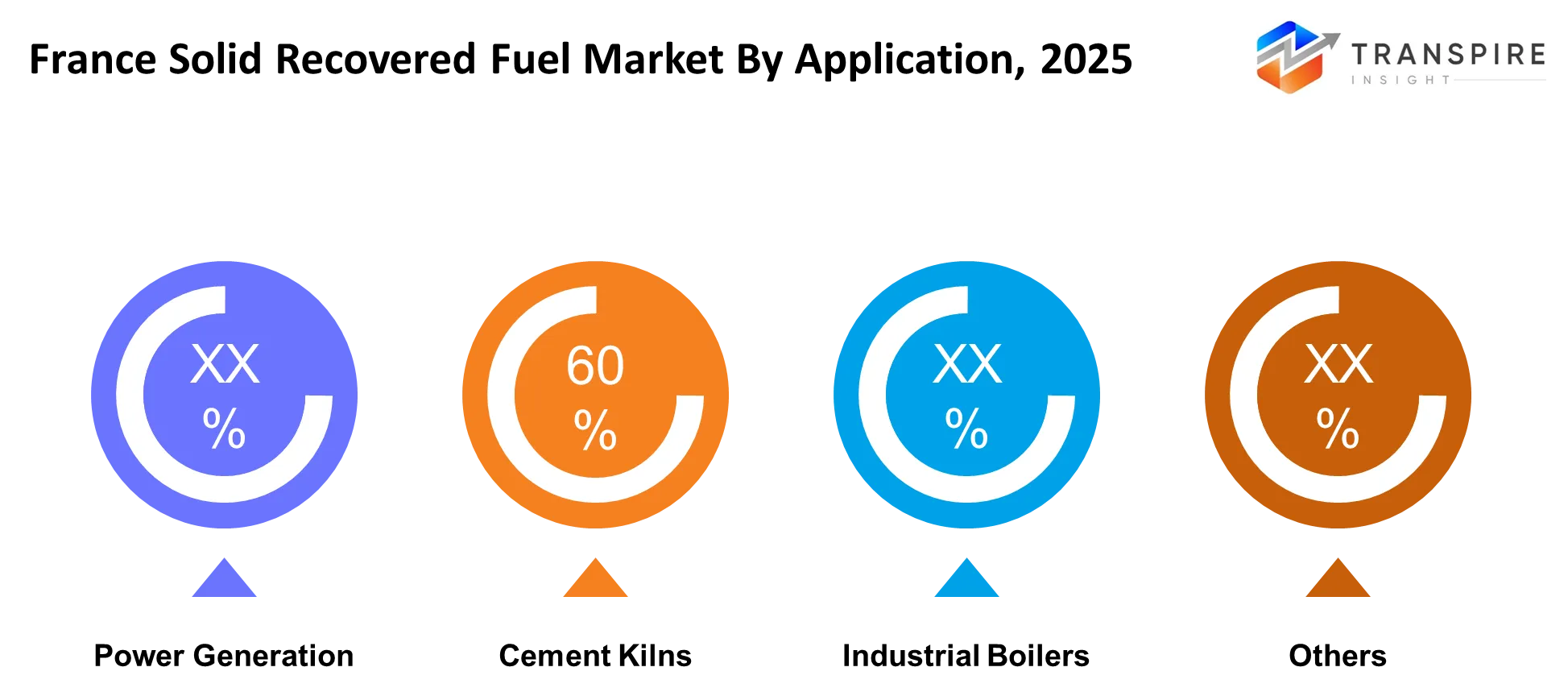
The France Solid Recovered Fuel Market develops its application structure because industrial decarbonization requirements and waste-to-energy integration policies create its fundamental operational needs. Cement kilns represent the dominant application because they require high thermal energy and consistently substitute coal with SRF to meet EU emission reduction targets. The cement manufacturing sector maintains its stability through permanent agreements which waste processing companies and cement manufacturers use to maintain their operational activities and secure fuel supply.
Power generation serves as the most active application area because utilities begin to use SRF for waste-to-energy plants to decrease their fossil fuel usage and maintain their electricity expenses. Industrial boilers across chemical, paper, and manufacturing sectors are also expanding their use of SRF to manage rising energy expenses and comply with sustainability mandates. District heating systems and hybrid energy facilities which implement SRF together with biomass materials will emerge as new applications because regional decarbonization programs and infrastructure modernization efforts create the necessary support across France.
To learn more about this report, Download Free Sample Report
By End-User
The France Solid Recovered Fuel Market by end-user is shaped by industrial decarbonization priorities and waste-to-energy integration across key sectors. Energy companies operate waste-to-energy plants which they use to produce electricity and heat by burning SRF to decrease their need for fossil fuels. The demand for SRF remains constant because regulations require companies to reduce their carbon emissions and build renewable energy resources.
The cement industry remains the most dominant end-user due to its high thermal energy requirements and strong ability to substitute coal with SRF without affecting production efficiency. Industries in the chemical, paper, and manufacturing sectors are beginning to adopt sustainable practices to achieve their energy cost management and environmental compliance objectives. Waste management firms play a dual role by collecting, processing, and supplying SRF, ensuring feedstock continuity and quality control across the value chain, while other smaller users contribute through localized and pilot-scale energy recovery projects.
By Source
The waste streams available in urban and industrial areas determine how the France Solid Recovered Fuel Market operates because it relies on their available waste materials and their specific waste properties. The French solid waste collection system together with its strict regulations on landfill waste disposal serves as the primary mechanism which directs substantial quantities of waste materials toward solid recovered fuel facilities. The stream provides a permanent fuel supply which requires sophisticated material separation and initial processing methods to achieve industrial combustion fuel quality standards.
Industrial waste serves as a higher-value input due to its relatively stable composition and higher calorific content which makes it the preferred material for both cement kilns and energy-intensive industries. The system provides better fuel combustion results because it enables cleaner processing operations which need less time than mixed municipal waste. Circular economy initiatives have made commercial and construction waste sources more important than before, yet their impact remains restricted because their waste materials have unpredictable patterns and need more effort to recycle.
What are the Key Use Cases Driving the France Solid Recovered Fuel Market?
The France Solid Recovered Fuel Market sees its main application through co-processing which occurs in cement kilns that use SRF to substitute coal during clinker production which requires stable high-temperature combustion. Cement producers prefer this application because it directly reduces fuel costs while helping meet strict EU carbon intensity targets which makes this application the most important demand driver of the market.
The paper, chemical, and manufacturing industries are expanding their use of secondary applications which now operate in industrial boilers and district heating systems. These end-users adopt SRF to stabilize energy costs while complying with France’s landfill diversion mandates, especially in energy-intensive mid-scale facilities.
New applications have emerged which combine decentralized waste-to-energy plants with hybrid biomass-SRF systems. Regional governments are implementing these applications to test their circular energy models which aim to reduce transport emissions while achieving greater energy independence.
|
Report Metrics |
Details |
|
Market size value in 2025 |
USD 337.59 Million |
|
Market size value in 2026 |
USD 362.27 Million |
|
Revenue forecast in 2033 |
USD 593.49 Million |
|
Growth rate |
CAGR of 7.31% from 2026 to 2033 |
|
Base year |
2025 |
|
Historical data |
2021 - 2024 |
|
Forecast period |
2026 - 2033 |
|
Report coverage |
Revenue forecast, competitive landscape, growth factors, and trends |
|
Regional scope |
France |
|
Key company profiled |
Veolia, SUEZ, Biffa, FCC Environment, Covanta, Renewi, Viridor, Hitachi Zosen, Mitsubishi Heavy Industries, CNIM, Keppel Seghers, Doosan Lentjes, Fortum, Indaver, Waste Management |
|
Customization scope |
Free report customization (country, regional & segment scope). Avail customized purchase options to meet your exact research needs. |
|
Report Segmentation |
By Type (Refuse Derived Fuel, Solid Recovered Fuel, Others); By Application (Power Generation, Cement Kilns, Industrial Boilers, Others); By End-User (Energy Companies, Cement Industry, Industrial Sector, Waste Management Firms, Others); By Source (Municipal Waste, Industrial Waste, Others) |
Which Regions are Driving the France Solid Recovered Fuel Market Growth?
Northern France leads the France Solid Recovered Fuel Market due to its dense concentration of cement plants and heavy industrial corridors. The region benefits from its strong logistics network which connects to major ports that include Le Havre and Dunkirk to handle continuous waste shipments and fuel delivery operations. Municipalities direct their leftover waste to established SRF processing facilities because of strict EU landfill diversion regulations which require their enforcement. The industrial ecosystem functions as a complete system which enables waste operators and cement manufacturers to establish long-term partnerships that strengthen their market leadership.
Central France provides a constant contribution which results from its uniform industrial development and the effective execution of policies by its different administrative bodies. The southern industrial regions show less dependence on cement production compared to their industrial clusters which use diverse chemical products from manufacturing and paper and energy utility sources. The organization achieves its expansion through two main elements which are its consistent municipal waste collection system and its ongoing development of waste-to-energy facilities. The system maintains stable operations which ensure dependable material supply while the system does not experience any rapid development.
Southern France experiences its fastest growth rate because of new financial backing which supports waste treatment and energy recovery facilities that operate near Marseille and Toulouse. The new regulations now match regional decarbonization objectives which have led to faster SRF implementation in industrial boilers and district heating systems. The modernization of ports together with enhanced waste management systems has resolved the transport delays which used to hinder operational efficiency. The period from 2026 to 2033 will see significant infrastructure development which provides investors and technology providers with excellent chances to enter the market.
Who are the Key Players in the France Solid Recovered Fuel Market and How Do They Compete?
The France Solid Recovered Fuel Market shows moderate competition because multiple integrated waste management companies which control all aspects of waste collection, preprocessing, and fuel distribution operations dominate the market. The primary market challenge resides in two areas which include waste processing cost efficiency and the capacity to produce fuel that meets cement kiln requirements. Market incumbents use municipal contracts to maintain their market position while new market entrants develop specialized preprocessing methods and establish operations in underrepresented regional markets.
Veolia operates its waste-to-energy systems through complete vertical integration which links its waste collection operations to its state-of-the-art SRF preprocessing facilities. SUEZ builds its competitive advantage through technology-based sorting and recycling systems which use precise waste classification methods to enhance industrial fuel quality. Paprec Group uses its fast development throughout France to build its market strength by winning municipal contracts and expanding its shredding and sorting operations to boost SRF production capabilities.
The companies FCC Environment and Viridor build their business model through contracts which provide stability and they establish long-term business relationships with cement manufacturers who need dependable fuel supply contracts. Covanta uses its energy recovery specialization to provide clients with operational systems which help power plants reach peak efficiency while meeting emission standards. Hitachi Zosen establishes its market position through the export of its cutting-edge waste-to-energy solutions which include highly efficient thermal conversion technologies that enable European facilities to implement hybrid SRF systems.
Company List
- Veolia
- SUEZ
- Biffa
- FCC Environment
- Covanta
- Renewi
- Viridor
- Hitachi Zosen
- Mitsubishi Heavy Industries
- CNIM
- Keppel Seghers
- Doosan Lentjes
- Fortum
- Indaver
- Waste Management
Recent Development News
In February 2026, Veolia announced expansion of its SRF preprocessing facility network in northern France. The initiative increases production capacity for high-calorific fuel used in cement kiln co-processing and strengthens long-term industrial supply contracts.https://www.veolia.com
In November 2025, SUEZ entered a strategic partnership with a French cement manufacturer to supply standardized solid recovered fuel. The collaboration focuses on improving fuel consistency and reducing carbon emissions across large-scale clinker production facilities.https://www.suez.com
What Strategic Insights Define the Future of the France Solid Recovered Fuel Market?
The France Solid Recovered Fuel Market is structurally moving toward high-standardized, contract-driven industrial fuel systems where SRF becomes a core input in decarbonized cement and manufacturing operations. This shift is driven by tightening EU emissions rules and rising carbon pricing, which are steadily forcing fossil fuel substitution across heavy industries.
A hidden risk lies in overdependence on a limited number of industrial off-takers, particularly cement producers, which creates demand concentration vulnerability if construction cycles slow. Another concern is inconsistent regulatory harmonization across regions, which can delay infrastructure scaling.
A key emerging opportunity is the integration of AI-enabled waste sorting systems that significantly improve fuel consistency and unlock adoption in stricter industrial combustion environments. Market participants should prioritize long-term supply contracts with industrial users while investing in advanced preprocessing technologies to secure quality leadership and reduce exposure to regulatory or demand volatility.
France Solid Recovered Fuel Market Report Segmentation
By Type
- Refuse Derived Fuel
- Solid Recovered Fuel
- Others
By Application
- Power Generation
- Cement Kilns
- Industrial Boilers
- Others
By End-User
- Energy Companies
- Cement Industry
- Industrial Sector
- Waste Management Firms
- Others
By Source
- Municipal Waste
- Industrial Waste
- Others
Frequently Asked Questions
Find quick answers to common questions.
The confirmed 2033 market size figure in USD 593.49 Million.
Key segments for the France Solid Recovered Fuel Market are By Type (Refuse Derived Fuel, Solid Recovered Fuel, Others); By Application (Power Generation, Cement Kilns, Industrial Boilers, Others); By End-User (Energy Companies, Cement Industry, Industrial Sector, Waste Management Firms, Others); By Source (Municipal Waste, Industrial Waste, Others).
Major France Solid Recovered Fuel Market players are Veolia, SUEZ, Biffa, FCC Environment, Covanta, Renewi, Viridor, Hitachi Zosen, Mitsubishi Heavy Industries, CNIM, Keppel Seghers, Doosan Lentjes, Fortum, Indaver, Waste Management .
The France Solid Recovered Fuel Market size is USD 337.59 Million in 2025.
The France Solid Recovered Fuel Market CAGR is 7.31% from 2026 to 2033.
- Veolia
- SUEZ
- Biffa
- FCC Environment
- Covanta
- Renewi
- Viridor
- Hitachi Zosen
- Mitsubishi Heavy Industries
- CNIM
- Keppel Seghers
- Doosan Lentjes
- Fortum
- Indaver
- Waste Management
Recently Published Reports
-
Apr 2026
Active Power Filter Market
Active Power Filter Market Size, Share & Analysis Report By Type (Shunt Active Power Filters, Series Active Power Filter, Hybrid Active Power Filter), By Application (Harmonics Mitigation, Reactive Power Compensation, Voltage Regulation, Power Factor Correction), By Phase (Single Phase, Three Phase), By End-User Industry (Manufacturing, Healthcare, Commercial, Automotive, Oil and Gas, Others), and Geography (North America, Europe, Asia-Pacific, Middle East and Africa, South and Central America), 2021 - 2031
-
Apr 2026
Electrical Transformer Market
Electrical Transformer Market Size, Share & Analysis Report By Core (Closed, Shell, and Berry), By Insulation (Gas, Oil, Solid, Air, and Other), By Phase (Single, and Three), By Rating (100 MVA to 500 MVA, 501 MVA to 800 MVA, and 801 MVA to 1200 MVA), and Geography (North America, Europe, Asia-Pacific, Middle East and Africa, South and Central America), 2021 – 2031
-
Apr 2026
Hydraulic Piston Pumps Market
Hydraulic Piston Pumps Market Size, Share & Analysis Report By Type (Axial Piston Pumps, Radial Piston Pumps), By Operating Pressure (Low Pressure, Medium Pressure, High Pressure), By Application (Construction, Mining, Agriculture, Automotive, Oil & Gas, Industrial Machinery, Others), By End-User (OEMs, Aftermarket), and Geography (North America, Europe, Asia-Pacific, Middle East and Africa, South and Central America), 2021 – 2031
-
Apr 2026
Laboratory Gas Generators Market
Laboratory Gas Generators Market Size, Share & Analysis Report By Product (Nitrogen Gas Generator, Hydrogen Gas Generator, Zero Air Gas Generator, Purge Gas Generator, TOC Gas Generators, Others), By Application (Gas Chromatography, Liquid Chromatography-mass Spectrometry (LC-MS), Gas Analyzers, Others), By End-user (Life Science, Chemical & Petrochemical, Food & Beverage, Others), and Geography (North America, Europe, Asia-Pacific, Middle East and Africa, South and Central America), 2021 – 2031