

Europe Aroma Chemicals Market Size & Forecast:
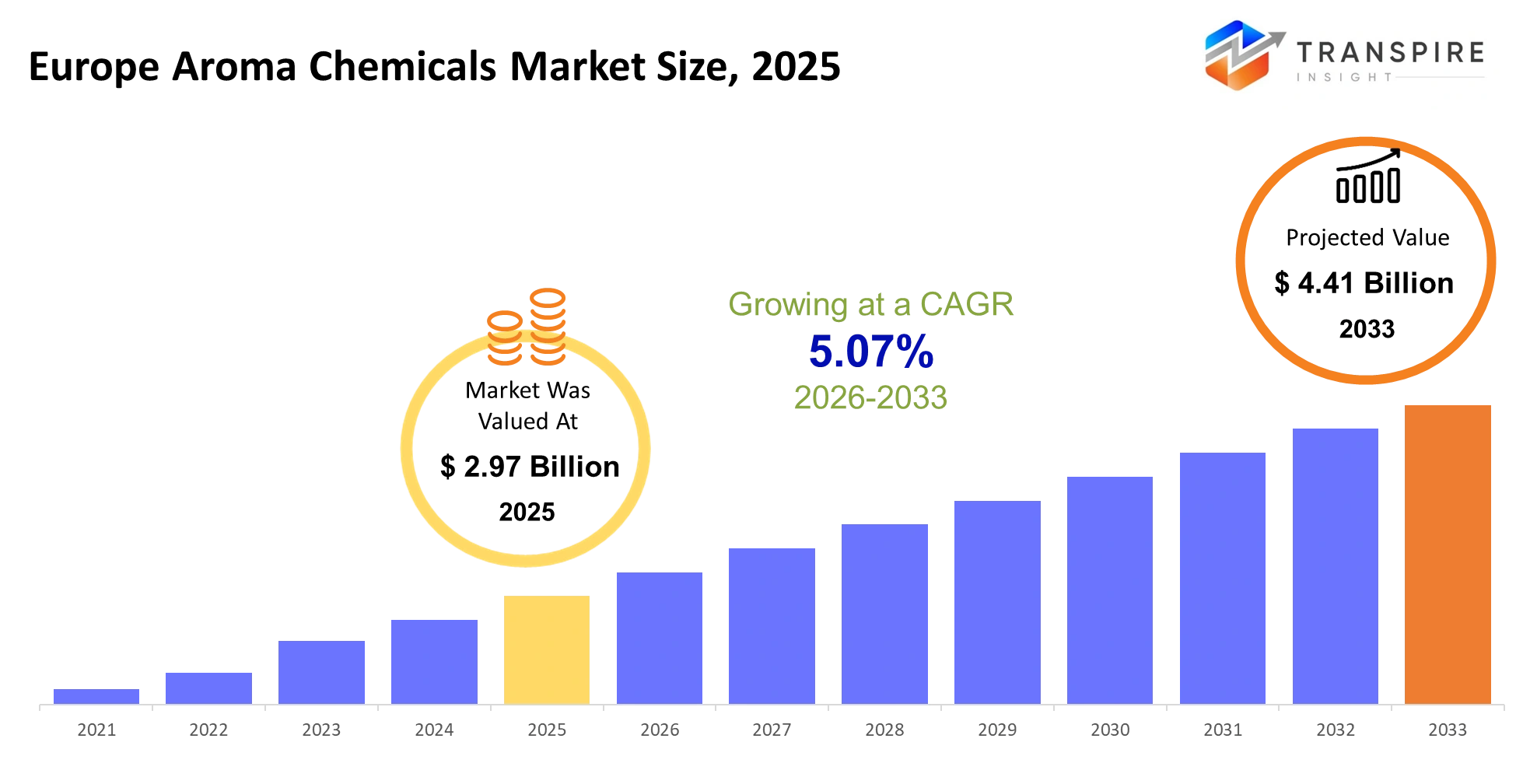
- Europe Aroma Chemicals Market Size 2025: USD 2.97 Billion
- Europe Aroma Chemicals Market Size 2033: USD 4.41 Billion
- Europe Aroma Chemicals Market CAGR: 5.07%
- Europe Aroma Chemicals Market Segments: By Type (Natural Aroma Chemicals, Synthetic Aroma Chemicals, Others); By Application (Fragrances, Flavors, Personal Care, Others); By End-User (Cosmetics Industry, Food Industry, Pharma, Others); By Form (Liquid, Powder, Others).
To learn more about this report,  Download Free Sample Report
Europe Aroma Chemicals Market Summary
The Europe Aroma Chemicals Market was valued at USD 2.97 Billion 2025. It is forecast to reach USD 4.41 Billion by 2033. That is a CAGR of 5.07% over the period.
Aroma chemicals function as essential components which enable fragrance and cosmetics and food and household product makers to establish uniform scent experiences which they can produce at business level operations. These ingredients provide perfumes with extended wear time and maintain product flavors while they help different industries develop unique products which depend on scent and taste to drive customer buying decisions. The market experienced a transformation during the past five years which resulted in European regulations enforcing stricter ingredient disclosure requirements and environmental regulations to create a demand for traceable bio-based and biotechnology-produced aroma substances instead of cost-effective synthetic materials. The Russia-Ukraine war disrupted supply chains while global raw material prices fluctuated which led companies to invest in building local production facilities and developing new feedstock technologies.
The industry underwent a structural redesign which resulted in changed purchasing preferences throughout the market. Suppliers who provide compliant sustainable ingredients with low carbon emissions and reliable long-term supply to premium beauty brands and consumer goods companies now represent the preferred choice for these companies. Companies which invest in precision fermentation and green chemistry and vertically integrated sourcing models achieve higher profits through supply contracts which extend beyond their actual production needs while traditional commodity producers encounter increased competition.
Key Market Insights
- The combined market share between Germany and France together with Switzerland reached more than 45 percent in 2025 because these countries had strong fragrance manufacturing capabilities together with their export-oriented cosmetics production system.
- The Asia Pacific region established itself as the most rapidly expanding market between 2026 and 2033 because it developed local fragrance production facilities while premium personal care products became more popular.
- The percentage of synthetic aroma chemicals in 2025 reached nearly 65 because major manufacturers needed to achieve product consistency while delivering higher production output through lower manufacturing expenses.
- After 2023 European beauty brands began using traceable biotechnology-derived fragrance ingredients because natural aroma compounds showed the fastest growth rate in market forecasts.
- Fragrances generated over 40 percent of revenue in the European Aroma Chemicals Market because customers continued to purchase luxury perfumes and household air care products.
- After 2024 functional wellness fragrances established themselves as a new application area when skincare and aromatherapy companies began using scent technologies that enhance mood in their product offerings.
- The cosmetics manufacturing industry served as the primary customer base which held about 38 percent of total market share because product development in premium skincare and deodorant products created new business opportunities.
- The period from 2025 to 2026 saw nutraceutical and pharmaceutical companies using aroma ingredients to create flavors that would mask unpleasant tastes while enhancing the sensory experience of their oral wellness products.
- BASF established new aroma ingredient manufacturing facilities in Germany during 2026 to improve local supply chain operations and boost production capabilities for specialty molecules.
- DSM-firmenich dedicated more funding toward developing neuroscience-based fragrance technologies which focus on enhancing emotional well-being while providing distinctive experience-based consumer solutions.
What are the Key Drivers, Restraints, and Opportunities in the Europe Aroma Chemicals Market?
The European aroma chemicals industry experiences its strongest growth because of stricter European Union regulations which require companies to track their ingredients and disclose allergens and control their carbon emissions from chemical production. The regulations required fragrance and flavor manufacturers to create new products which used aroma molecules that met compliance standards and had high purity and increasing bio-based content. Between 2023 and 2025, beauty and household product categories faced increased regulatory scrutiny which led premium cosmetics and personal care brands to increase their procurement of certified sustainable ingredients. The market demand for specialty aroma compounds which have documented sourcing and reduced environmental impact grew because suppliers with advanced compliance systems could access more profitable agreements.
The market experiences its main structural constraint through raw material price fluctuations which occur because natural feedstocks like citrus oils and floral extracts and plant-derived intermediates rely on agricultural supply chains that depend on climate conditions. The fragrance industry faces pricing challenges and production difficulties because of ongoing weather disruptions and geopolitical trade disturbances and changing crop yield patterns. The cost fluctuations create difficulties for smaller manufacturers who cannot handle these expenses which leads to their restricted ability to enter long-term supply agreements and their postponement of investments in natural ingredient production expansion.
European manufacturers require scalable solutions to replace their current method of using unpredictable natural resources which creates a significant opportunity for precision fermentation development. The companies dsm-firmenich and Givaudan are using their increased financial resources to develop biotechnology platforms which create sustainable aroma molecules that require less land and water resources. The growing market demand for fragrance ingredients produced through fermentation processes will transform supply chain economics while providing new market benefits to initial investors until the year 2033.
What Has the Impact of Artificial Intelligence Been on the Europe Aroma Chemicals Market?
Artificial intelligence together with digital technologies that have advanced their capacity to create automated systems which monitor maritime emissions through their predictive analytics and their ability to optimize compliance in real time. AI-enabled scrubber performance systems which ship operators currently use enable them to clean exhaust gas through automated adjustments which consider sulfur content and engine load and maritime regulations that update their status. The new sensor network system tracks washwater quality together with pressure balance and emissions data in real time while it needs less manual work to maintain regulatory reporting accuracy. Fleet operators achieved reduced downtime with faster compliance verification after they implemented cloud-based monitoring systems which link to their onboard scrubber control systems.
Machine learning models enhance predictive maintenance capabilities for exhaust gas cleaning technology installations through their implementation. Operators use vibration analysis together with corrosion monitoring and temperature tracking to find component failures before they cause operational interruptions. The systems enable maintenance costs to decline because they help schedule maintenance while scrubber equipment availability and fuel efficiency increase through operational settings that reach their most efficient state. European shipping companies adopt digital twins together with emissions forecasting software to achieve compliance with stricter IMO and EU maritime emission regulations.
The high costs of integration together with poor onboard connectivity prevent organizations from using AI technologies at their full capacity. The digital infrastructure which enables older vessels to transmit data continuously and perform real-time analytics does not exist on many vessels which operate in difficult marine conditions.
Key Market Trends
- The EU sustainability and traceability requirements which became more stringent since 2022 have led fragrance houses to replace petroleum-based components with aroma molecules developed through fermentation.
- BASF expanded its European production capacity for aroma ingredients in 2026 because of increased demand which required secure local supply chains after recent raw material shortages.
- Between 2023 and 2025 premium cosmetics brands changed their purchasing practices from inexpensive fragrance materials to certified sustainable bio-based aromatic ingredients.
- dsm-firmenich increased its funding for neuroscience-based fragrance research because European personal care products with wellness attributes gained popularity among consumers.
- European regulations became more strict when they required companies to provide allergen information and disclose synthetic ingredients, which forced smaller companies to update their compliance systems and product reformulation methods.
- Since 2024, flavor manufacturers increased their use of encapsulated aroma systems which help maintain shelf stability for plant-based foods and beverages with reduced sugar content.
- The manufacturing industry expanded precision fermentation partnerships throughout Germany, Switzerland, and the Netherlands as companies looked for substitutes to unpredictable natural feedstock procurement.
- The household care industry started to implement permanent scent technologies after customers began to prefer high-end laundry products and home fragrance solutions.
- Global fragrance companies began to merge with biotech startups, which resulted in acquisition deals that targeted the development of sustainable molecular solutions and proprietary fermentation technology.
- The premium beauty industry has invested in data-driven scent customization systems, which resulted in AI-based fragrance personalization moving from experimental use to mainstream business operations.
Europe Aroma Chemicals Market Segmentation
By Type:
The market for synthetic aroma chemicals dominates because fragrance and flavor producers need to maintain constant prices while their products must meet high purity standards and consistent formulation requirements for large-scale distribution. The production of synthetic materials maintains its high levels because detergents and cosmetics and packaged food products create strong market demand for these synthetic materials. Household and personal care products that need to be produced in bulk benefit from synthetic materials because these materials provide better cost savings and production scalability than their natural counterparts. European manufacturers who follow strict quality standards will gain from regulatory compliance and extended product shelf life because these factors enable them to meet industry requirements.
The natural aroma chemical market keeps expanding because consumers increasingly demand clean label beauty products and food items. The premium fragrance industry and organic cosmetics sector now prefer plant-based materials for their production because these materials help them achieve their sustainability goals and provide consumers with product transparency. The supply chain restrictions and shifting availability of raw materials limit companies from using sustainable materials while smaller manufacturers face additional challenges because they cannot access multiple sourcing options. The cost differential between synthetic products and natural products will diminish during the upcoming years because biotechnology and precision fermentation technologies will advance, leading to increased investment activities in the bio-based ingredient market and sustainable sourcing alliances.

To learn more about this report, Download Free Sample Report
By Application:
The primary application of fragrances dominates the market because luxury perfumes and deodorants and household air care products use complex aroma formulations to create their unique brand identities. European consumers show a preference for premium scents that last longer, which drives the demand for specialty aroma molecules used in fine fragrances and home care products.The cosmetics and personal hygiene industries generate ongoing demand for unique fragrance solutions which drive their product innovation cycles. The European market maintains its dominant position in the fragrance industry because most global fragrance companies operate from that region.
Food manufacturers and skincare brands are increasingly developing products with sensory experiences which leads to growth in flavors and personal care markets. Beverage producers and confectionery companies are adopting advanced flavor compounds to meet demand for natural and region-specific taste profiles. The rising demand for wellness-oriented skincare and haircare products which use functional fragrance systems helps personal care applications to gain advantages. Future growth is expected to come from multifunctional aroma ingredients that combine scent performance with emotional wellness and clean-label positioning, which will drive companies to raise their research and development expenditures in both sectors.
By End-User:
The cosmetics industry uses fragrance composition to differentiate its products, which makes it the largest end-user segment for the industry because fragrance composition drives skin care and hair care and deodorant and premium beauty product development. European beauty brands consistently invest in signature scent profiles and sustainable ingredient sourcing to strengthen brand value and consumer loyalty. Strict ingredient safety regulations create a need for collaboration with aroma chemical suppliers who can provide traceable and compliant product formulations. The high volume of European cosmetics exports helps to create steady demand for aroma ingredients in all regional production sites.
The food and pharmaceutical industries create new growth paths through their demand for unique flavor and medical usage needs. Food manufacturers use aroma compounds more often to enhance taste in their reduced-sugar products and plant-based products. Pharmaceutical companies use flavor masking technologies to develop their oral medicines and nutraceutical products. People who want functional wellness products drive innovation that links the fragrance industry and flavor industry with healthcare. Customized aroma systems which create specific scents for nutraceuticals medical nutrition and therapeutic wellness products will bring new funding and special product development during the forecast period.
By Form:
Liquid aroma chemicals dominate the market because liquid formulations provide easier blending, faster processing, and greater formulation flexibility for fragrance and flavor manufacturers. Large cosmetics and household product manufacturers prefer liquid variants because these products enable their automated production systems to create products with consistent scent distribution throughout their entire product range. The material demonstrates strong compatibility with sprays creams detergents and beverages which leads to its widespread adoption in industrial applications. The segment benefits from efficient transportation and storage systems which operate throughout Europe since these systems strengthen its commercial advantages.
The powder form of products has become more popular in dry food products, powdered beverages and pharmaceutical tablets which need longer shelf stability and through their use of encapsulated fragrance systems. Manufacturers increasingly adopt powdered aroma chemicals for controlled-release applications and moisture-sensitive formulations. The development of encapsulation and spray-drying technology has advanced scent retention abilities and product performance capabilities which benefit functional food and healthcare products.The market will expand in the future to benefit companies which create delivery systems that maintain scent durability while using environmentally friendly packaging and shipping solutions.
What are the Key Use Cases Driving the Europe Aroma Chemicals Market?
The European market uses aroma chemicals mostly for fine fragrances and premium personal care products. The skincare industry and luxury perfume brands depend on high-purity synthetic and bio-based aroma molecules to create consistent scents which meet regulatory standards and produce enduring products. The beauty market experiences continuous growth because consumers demand premium sustainable products.
The market shows increasing interest in household cleaning products and functional wellness products as secondary applications. Detergent and air care manufacturers increasingly use aroma chemicals to differentiate products through mood-enhancing and long-lasting fragrance profiles, while aromatherapy and wellness brands are incorporating specialty scent compounds into stress-relief and sleep-support formulations.
Biotech-derived fragrance ingredients serve as emerging use cases for low-carbon cosmetics and smart home products which use scent technology. Companies are also exploring aroma chemicals in personalized fragrance systems powered by AI-driven consumer preference analysis, which could reshape premium fragrance customization over the forecast period.
|
Report Metrics |
Details |
|
Market size value in 2025 |
USD 2.97 Billion |
|
Market size value in 2026 |
USD 3.12 Billion |
|
Revenue forecast in 2033 |
USD 4.41 Billion |
|
Growth rate |
CAGR of 5.07% from 2026 to 2033 |
|
Base year |
2025 |
|
Historical data |
2021 - 2024 |
|
Forecast period |
2026 - 2033 |
|
Report coverage |
Revenue forecast, competitive landscape, growth factors, and trends |
|
Regional scope |
Europe (Germany, United Kingdom, France, Italy, Spain, Rest of Europe) |
|
Key company profiled |
Givaudan, Firmenich, IFF, Symrise, Takasago, Mane, Robertet, BASF, DSM, Solvay, Kao, Sensient, Kerry Group, Ajinomoto, T. Hasegawa. |
|
Customization scope |
Free report customization (country, regional & segment scope). Avail customized purchase options to meet your exact research needs. |
|
Report Segmentation |
By Type (Natural Aroma Chemicals, Synthetic Aroma Chemicals, Others); By Application (Fragrances, Flavors, Personal Care, Others); By End-User (Cosmetics Industry, Food Industry, Pharma, Others); By Form (Liquid, Powder, Others). |
Which Regions are Driving the Europe Aroma Chemicals Market Growth?
The aroma chemicals market in Europe maintains its leading position because the region possesses both strict regulations and advanced fragrance production facilities together with a high concentration of luxury cosmetics and personal care companies. Germany and France and Switzerland operate complete systems that link chemical manufacturers with fragrance companies and research centers and high-end consumer product businesses. The strict EU rules for tracking ingredients and proving sustainability force manufacturers to create valuable compliant aroma products which give local suppliers a competitive edge. The region enjoys established distribution networks together with permanent supplier partnerships which create steady product demand for fine fragrance products and household cleaning items and food-related uses.
The North American market generates consistent revenue through two factors which include consumer spending that remains strong together with ongoing financial backing for development in specialty chemicals. The region differs from Europe by focusing more heavily on functional fragrance applications tied to wellness, home care, and clean-label consumer products. Multinational corporations continue to invest money in biotechnology and synthetic biology platforms so they can develop production methods that use fewer natural resources from unpredictable sources. The region serves as a dependable long-lasting market for premium aroma ingredients because major consumer goods companies maintain consistent demand while strong intellectual property rights exist.
The Asia Pacific region experiences its fastest growth rate through rising middle-class purchasing power and ongoing urban development and increasing local fragrance production investments.China and India have accelerated their production capacity building operations because regional governments now provide industrial incentives for domestic specialty chemical manufacturing and export-driven industrial development policies. International fragrance companies are expanding their business operations in Southeast Asia through new partnerships and local production facilities which enable them to reduce supply chain distances while meeting the rising demand from personal care and packaged food markets. The period from 2026 to 2033 will present numerous business opportunities for new market participants who provide bio-based aroma molecules and cost-effective production methods and regional distribution systems which can be scaled up.
Who are the Key Players in the Europe Aroma Chemicals Market and How Do They Compete?
The Europe aroma chemicals market demonstrates moderate consolidation because a few multinational fragrance and specialty chemical companies maintain control over most high-value production in the industry. Biotechnology capabilities and sustainable sourcing together with formulation innovation have become the primary factors that drive competition between companies. Established manufacturers protect their market share through their vertically integrated supply chains and expertise in regulatory compliance, while smaller biotech companies enter the industry with their fermentation-based and low-carbon aroma molecules. European manufacturing companies with strong operational bases gain advantages because they operate near premium cosmetics and fine fragrance clients who need product traceability and fast customization options.
BASF uses its ability to produce goods in large quantities and its backward integration of citral and menthol value chains to establish control over raw material availability during times when supply chains face disruptions. The company established new aroma ingredient manufacturing facilities in Germany to enhance its delivery reliability and increase its production capacity of high-purity fragrance intermediates. dsm-firmenich creates its unique market position through its application of neuroscience research to develop new fragrance products and functional scent technologies that establish links between aroma chemicals and wellness solutions. The company continues its growth through research and development alliances and its digital fragrance development platforms, which serve premium consumer brands.
Givaudan develops biotechnology-based ingredients and environmentally friendly perfume solutions through its precision fermentation technology, which reduces the need for unpredictable natural starting materials. The company's acquisition of biotech startups enables it to access exclusive aroma molecules, which speeds up the process of bringing products to market.Symrise focuses on traceable ingredient sourcing and local specialty production, which benefits European manufacturers who require natural and bio-based materials. The company expands through partnerships with agricultural suppliers and investments in green chemistry processes that align with tightening EU sustainability standards.
Company List
- Givaudan
- Firmenich
- IFF
- Symrise
- Takasago
- Mane
- Robertet
- BASF
- DSM
- Solvay
- Kao
- Sensient
- Kerry Group
- Ajinomoto
- T. Hasegawa
Recent Development News
“In April 2026, BASF announced the commercial launch of new world-scale menthol and linalool plants in Ludwigshafen, Germany, alongside a citral production facility in Zhanjiang, China. The triple-digit million-euro investment is expected to strengthen aroma ingredient supply reliability and expand BASF’s footprint in the global fragrance and flavor value chain.
Source: https://www.basf.com/basf
“In September 2025, dsm-firmenich launched emotiOn™ social connection, a neuroscience-backed fragrance innovation platform designed to enhance human social interaction through scent technology. The launch reinforced the company’s positioning in functional and emotionally responsive aroma chemicals, expanding the role of fragrance ingredients beyond traditional perfumery applications.
Source: https://our-company.dsm-firmenich.com
What Strategic Insights Define the Future of the Europe Aroma Chemicals Market?
The Europe aroma chemical market is experiencing a fundamental evolution which leads to increased demand for sustainable high-value bio-based systems that use traceable ingredients because sustainability regulations and premium fragrance requirements have changed how cosmetics and household care and fine perfumery products are acquired. The ability to achieve sustainable competitive advantage will shift during the next 5 to 7 years from production scale to two factors which include renewable feedstock availability and advanced formulation technologies. The area faces a hidden danger because its increasing reliance on restricted natural resource supplies and foreign intermediate products creates a situation where manufacturers must face supply chain disruptions and political instability and profit decline even though customer demand continues to rise. The European Union sustainability regulations currently support the development of precision fermentation and biotech-derived aroma molecules which create substantial business opportunities for these technologies. Companies need to establish biotechnology partnerships together with vertical sourcing systems which will help them create enduring business competitiveness while offering compliant sustainable high-quality aroma products to customers.
Europe Aroma Chemicals Market Report Segmentation
By Type
- Natural Aroma Chemicals
- Synthetic Aroma Chemical
- Others
By Application
- Fragrances
- Flavors
- Personal Care
- Others
By End-User
- Cosmetics Industry
- Food Industry
- Pharma
- Others
By Form
- Liquid
- Powder
- Others
Frequently Asked Questions
Find quick answers to common questions.
The Europe Aroma Chemicals Market size is USD 4.41 Billion in 2033.
Key segments for the Europe Aroma Chemicals Market are By Type (Natural Aroma Chemicals, Synthetic Aroma Chemicals, Others); By Application (Fragrances, Flavors, Personal Care, Others); By End-User (Cosmetics Industry, Food Industry, Pharma, Others); By Form (Liquid, Powder, Others).
Major Europe Aroma Chemicals Market players are Givaudan, Firmenich, IFF, Symrise, Takasago, Mane, Robertet, BASF, DSM, Solvay, Kao, Sensient, Kerry Group, Ajinomoto, T. Hasegawa.
The Europe Aroma Chemicals Market size is USD 2.97 Billion in 2025.
The Europe Aroma Chemicals Market CAGR is 5.07% from 2026 to 2033.
- Givaudan
- Firmenich
- IFF
- Symrise
- Takasago
- Mane
- Robertet
- BASF
- DSM
- Solvay
- Kao
- Sensient
- Kerry Group
- Ajinomoto
- T. Hasegawa
Recently Published Reports
-
Apr 2026
Healthcare Polymer Packaging Market
Healthcare Polymer Packaging Market Size, Share & Analysis Report By Packaging Type (Syringes, IV Bottles and Pouches, Clamshells, Blisters, Bottles & Jars, Containers, Tubes, IV Parental Packaging, Others), By Type (Regulated, Non-regulated), By Polymer Type (LDPE (Low-Density Polyethylene), HDPE (High-Density Polyethylene), Homo-polymer (Homo), Random Copolymer (Random), Block Copolymer (Block), PET, Polystyrene, Polyvinyl Chloride, Polyamide/EVOH, Others), and Geography (North America, Europe, Asia-Pacific, Middle East and Africa, South and Central America), 2021 - 2031
-
Apr 2026
Hydrophilic Tape (Waterstop) Market
Hydrophilic Tape (Waterstop) Market Size, Share & Analysis Report By Type (Bentonite-Based Hydrophilic Tape, Rubber-Based Hydrophilic Tape), By Application (Residential Buildings, Commercial Buildings, Infrastructure Projects), and Geography (North America, Europe, Asia-Pacific, Middle East and Africa, South and Central America), 2021 - 2031
-
Apr 2026
Metalens Market
Metalens Market Size, Share & Analysis Report By Type (Visible Light Metalens, and Infrared Metalens), By Application (Consumer Electronics, Automotive Electronics, Industrial, Medical, and Others), and Geography (North America, Europe, Asia-Pacific, Middle East and Africa, South and Central America), 2021 - 2031
-
Apr 2026
PBT Resin Market
PBT Resin Market Size, Share & Analysis Report By Type (Reinforced PBT Resin, Unreinforced PBT Resin), By Processing Method (Injection Molding, Extrusion, Blow Molding, Others), By End-User (Automotive, Electrical & Electronics, Consumer Appliances, Industrial Machinery, Medical Devices, Packaging, Others), and Geography (North America, Europe, Asia-Pacific, Middle East and Africa, South and Central America), 2021 - 2031