

United States Autonomous Farm Equipment Market Summary
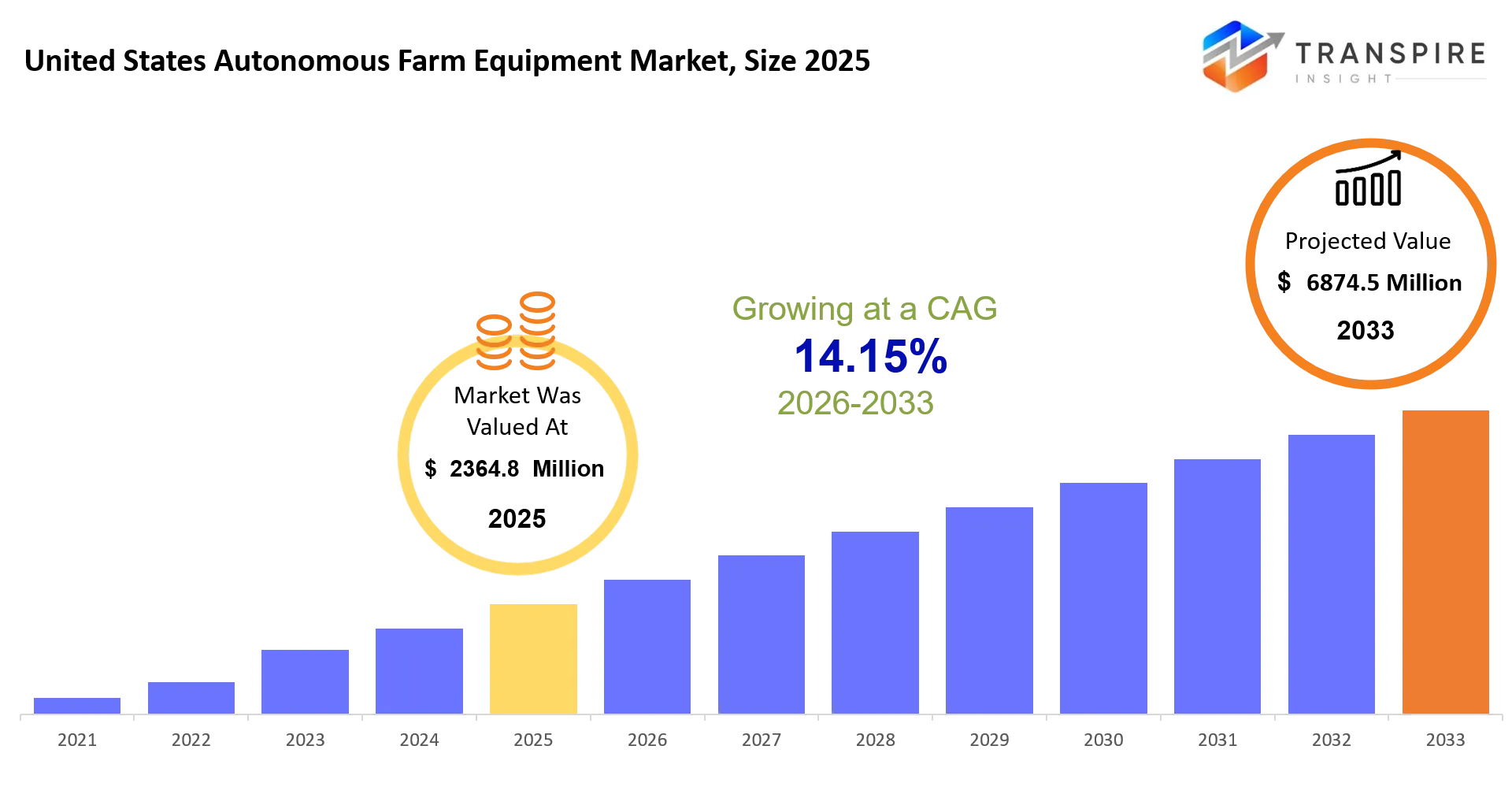
As per Transpire Insight Analysis, the United States Autonomous Farm Equipment Market size is estimated at USD 2364.8 Million in 2025 and is anticipated to reach USD 6874.5 Million by 2033, growing at a CAGR of 14.15% from 2026 to 2033.
The United States autonomous farm equipment market helps farms get through time-sensitive fieldwork with less people on deck, since it automates steering, planting, spraying, harvesting, plus monitoring and material movement in a smooth way. The real value is mostly seen in longer operating windows, tighter field precision, and less reliance on limited agricultural labor. USDA figures indicate farm wages went up 28% from 2000 to 2022 , which basically supports the whole money argument for labor-saving machinery, in practice.
In the last 3–5 years, the scene has moved away from GPS assisted machines toward more integrated autonomy that leans on computer vision, AI, sensors, and remote fleet management. John Deere is pushing autonomous tillage, while CNH is applying AI across tractors, combines, and sprayers, kind of like a full stack approach. COVID-19 supply chain disruptions also made it obvious where the cracks were , so many producers started to care more about productivity and resilience. Now that autonomy is stepping into actual commercial use, better equipment utilization and labor savings are making adoption look smarter financially.
United States Autonomous Farm Equipment Market Size & Forecast:
- United States Autonomous Farm Equipment Market Size 2025: USD 2364.8 Million
- Expected Market Value 2033: USD 6874.5 Million
- Forecast CAGR: 14.15%
- Leading region in 2025:
- Fastest Growing region:
- Key Profile: John Deere, CNH Industrial, AGCO Corporation, Kubota Corporation, Trimble Inc., Raven Industries, Monarch Tractor, Blue River Technology, Naïo Technologies, Sabanto Inc., GUSS Automation, FarmWise Labs, Bear Flag Robotics, Carbon Robotics, DeLava
 l
Key Market Insights
- Midwest basically dominates 2025 activity… with big row-crop farms behind it, plus there’s that precision agriculture infrastructure already in place, and somehow high tractor utilization keeps everything rolling.
- Meanwhile the Western and Southern regions look like they’ll adopt faster, pushed by specialty crops, labor-intensive operations, vineyards, orchards , and controlled irrigation needs, even when the timing is a little different.
- Autonomous tractors are leading equipment adoption, because manufacturers are folding in automated steering, obstacle detection, implement control, and remote supervision in a more integrated way, not just as a bolt-on.
- AI and machine learning are the quickest growing technology layer, with vision systems increasingly making real-time choices about crop status weed pressure and navigation pathways.
- Automated guidance is already covering more than 50% of acreage for several major U.S. crops, which kind of creates that “platform base” for higher autonomy.
- Spraying and weed control are moving toward machine vision, with John Deere stating See & Spray is deployed across 5 million acres in 2025, so yeah it’s not theoretical anymore.
- Large commercial farms are still the main adopters, largely because high annual machine use improves the economics of expensive autonomous technology.
- Electric and battery-electric platforms are also getting sharper attention especially for specialty crops and livestock operations where compact machines can run again and again, pretty reliably.
- Monarch’s autonomous feed-pushing capability shows autonomy is expanding beyond field crops into dairy operations and repeatable livestock tasks.
- And competitive strategy is shifting toward full technology ecosystems, where equipment AI connectivity fleet management precision data and software-based upgrades all work together, kind of as one system.
What are the Key Drivers, Restraints, and Opportunities in the United States Autonomous Farm Equipment Market?
Driver: Labor economics is kinda the most obvious, structural driver.USDA reported that U.S. agricultural labor expenses reached a projected USD 42.09 billion in 2023, 4.4% higher than in 2022 ,and real hired farm worker wages climbed 28% from 2000 to 2022. As labor costs keep going up, autonomous tractors, robotic weeders, automated sprayers, and autonomous livestock gear start to seem more financially appealing, because farms can extend operating hours longer, without adding as much staffing. This shift quietly, boosts equipment sales too, by raising utilization and making the return-on-investment math feel stronger.
Restraint: The big structural problem is still high acquisition and integration costs. Autonomous systems need cameras, positioning hardware, connectivity, software, compatible implements, safety systems, and technical support too, in addition to conventional machinery. Smaller farms and mid-size farms may have trouble defending the upfront capital outlay, since annual machine utilization and local technology-support capacity are often lower than in large commercial operations. USDA research also indicates digital adoption is uneven across crops and technology types, so even when demand exists, infrastructure and economics still limit wider deployment.
Opportunity: Retrofitting with autonomy gives a meaningful expansion path. John Deere already has an Autonomy Precision Upgrade, so growers can upgrade existing equipment rather than doing a full fleet replacement.There is also a kind of momentum behind AI driven specialty crop robotics, with Carbon Robotics saying that LaserWeeder ownership is actively spreading among over 100 growers, plus AI models covering more than 100 crops.
What Has the Impact of Artificial Intelligence Been on the United States Autonomous Farm Equipment Market?
Artificial intelligence has really pushed autonomous agricultural machinery away from simple route-following setups, toward equipment that can somehow interpret what is happening in the field and then decide what to do next, in real time. For example John Deere, uses 360-degree cameras, fast processors, and neural networks to spot obstacles during autonomous tillage, with image processing built to generate safety decisions in roughly 100 milliseconds . Machine vision also helps with targeted crop protection, not just driving. John Deere’s See & Spray technology, then, detects weeds and triggers only the necessary spray nozzles, while in 2025 customer deployments were above 5 million acres, and non-residual herbicide use dropped by almost 50% on average.
CNH takes a broader AI approach across tractors, combines and sprayers to assist steering, optimize inputs, and support real-time operational choices. Carbon Robotics extends machine learning into weed recognition, employing 42 high-resolution cameras plus more than 100 deep-learning crop models, for laser-based weed removal. Their connected platforms also enable remote equipment monitoring, performance metrics, location tracking, and operational warnings. The big catch is still integration expense and field variability , because dependable AI results need a lot of training data, careful sensor calibration, stable connectivity, and compatibility across different crops, implements, ground types , and even weather conditions.
Key Market Trends
- Since 2022, autonomous equipment kinda shifted from those pilot demonstrations into actual commercial deployments in tillage, dairy , spraying , and also specialty crop operations. It feels like everyone just moved a step, you know.
- John Deere customers used See & Spray across about 5 million acres in 2025, and that kind of suggested wider commercial acceptance of machine vision based application technology.
- AI based perception has sort of moved past research mode, because manufacturers are now tying cameras, neural networks, and processors right into the production machinery .
- Carbon Robotics rolled out commercial LaserWeeder in 2022, which expanded automated weed control using AI , cameras , lasers , and crop specific models.
- Electric autonomy has gained momentum too, as Monarch combined a 100% electric tractor with driver optional operation, plus remote fleet management .
- Autonomous tech is also aiming more and more at repeatable livestock chores, with Monarch pushing autonomous feed commercially for dairy operations during 2025.
- Precision agriculture infrastructure has built a stronger footing for autonomy, and automated guidance is already in use across more than 50% of acreage for several major crops.
- Farm equipment strategy has shifted toward retrofit routes, so existing tractors can get autonomy capabilities without needing full fleet replacement, at least not immediately.
- Competitive differentiation is increasingly about software, data, AI models, connectivity, and fleet management rather than mechanical hardware alone .
- And specialty crop automation is growing beyond row cropping, because compact autonomous tractors and robotic systems are targeting vineyards, orchards, berries , plus dairy settings.
United States Autonomous Farm Equipment Market Segmentation
By Equipment Type
Autonomous Tractors: big commercial farms tend to lean toward autonomous tractors for plowing, field preparation, and those repetitive routines that need long operating windows. John Deere and Monarch show noticeably different strategies, with large-scale autonomous tillage on one side and compact electric autonomy on the other, which kinda maps to separate farm profiles. Autonomous Harvesters help with crop collection during those short seasonal stretches, while Autonomous Seeders push better planting consistency and also cut down the day-to-day operator workload. Autonomous Sprayers rely on positioning, sensors, and machine vision for targeted application , and Autonomous Irrigation Systems handle water delivery automatically based on what the field conditions say.
Robotic Weeders: AI-driven weed identification plus precision removal are a big deal for specialty crop work, with Carbon Robotics using cameras, deep-learning models and lasers. Autonomous Drones assist crop scouting and aerial monitoring, while Robotic Milking Systems automate the repetitive dairy chores. Autonomous Utility Vehicles move materials and support farm logistics, kind of like a quiet backbone. Others include a growing mix of autonomous equipment made for more specialized agricultural workflows, and it keeps expanding as the industry matures.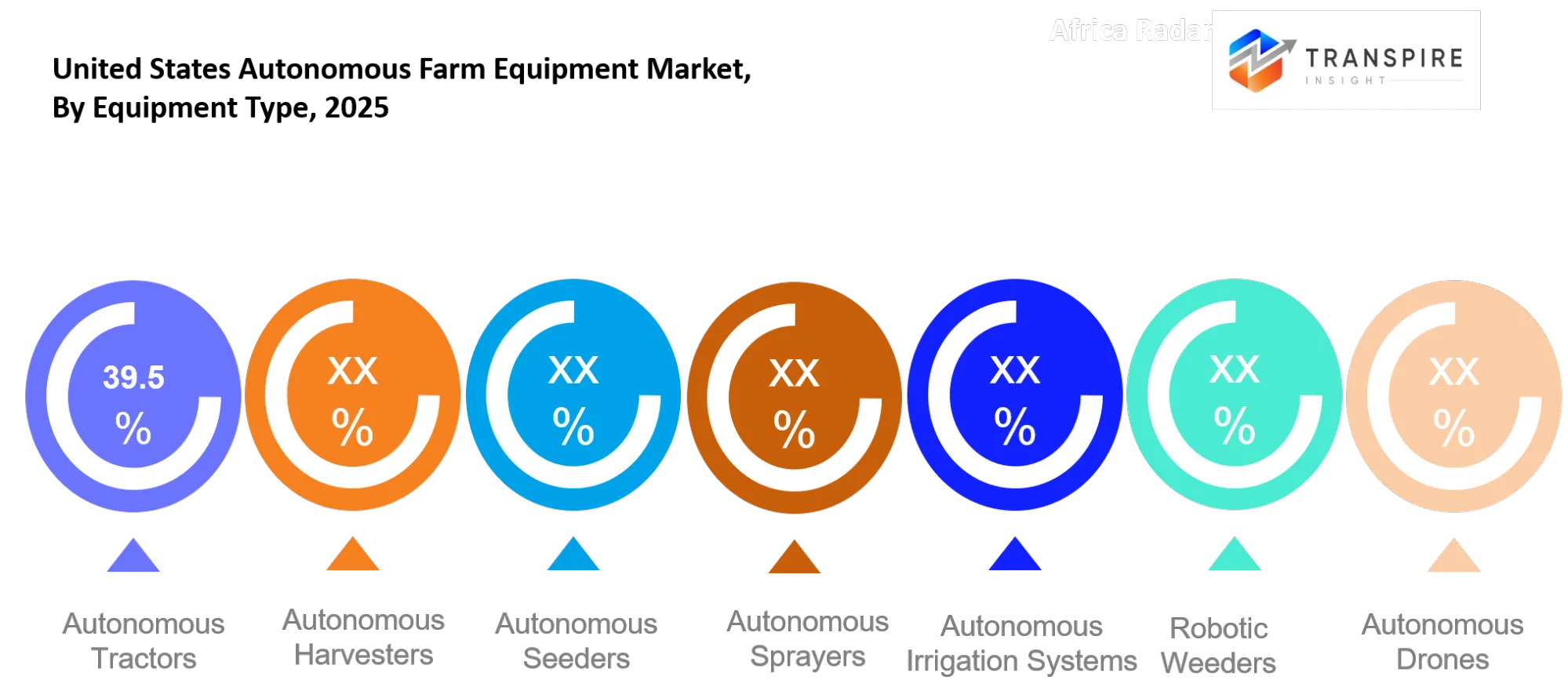
By Technology
GPS guidance, high accuracy positioning gives the base navigation layer for automated field operations, kind of simple and obvious. AI and machine learning support perception crop recognition, weed detection, task planning, and those adaptive machine decisions, you know, like it adjusts. Computer vision helps with real time interpretation of crops, obstacles, and field conditions, while LiDAR adds depth information for steering and obstacle spotting. IoT sensors then grab equipment data, soil and crop details, plus environmental info.
Robotics, in general, robotic systems perform repetitive physical tasks like weeding, milking, crop handling , and such. Autonomous navigation coordinates movement without constant manual steering, and Telematics supplies equipment location diagnostics, utilization, plus remote monitoring. Precision farming platforms tie together field maps, prescriptions, machine information, and analytics into a more coordinated workflow. Other parts in the mix include specialized sensors, processors, communications systems, and autonomy software, all working together in practice.
By Application
Planting: Automated planting boosts row accuracy, seed positioning, and overall operational steadiness, especially when timing is tight. The seasonal window is usually short , so harvesting helps too, because it supports fast crop collection and cuts down on how much you need the big seasonal crews. Crop Monitoring leans on cameras, drones, sensors, and analytics, to spot stress patterns, disease indicators, irrigation trouble signs, and general unevenness across the field. Spraying then benefits from machine vision and directed nozzle control, which makes chemical application a lot more precise .
Irrigation: Automated irrigation systems coordinate water delivery using field observations alongside scheduled needs. Soil Analysis helps with variable rate choices, through sensors, mapping, and direct field measurements . Livestock Management covers automated feeding, milking, watchful monitoring, and even material handling, and the autonomous dairy feed pushing angle is getting a lot more commercial traction lately. Weed Control is a particularly strong robotics use, while Fertilizer Application uses precision prescriptions together with automated equipment to improve where inputs actually land. Others include transport work, mowing tasks, and specialized farm maintenance, kind of “the usual background stuff” that still matters .
By End User
Large Commercial Farms: Bigger operators, usually have the strongest adoption base because high equipment utilization can really bankroll substantial technology investments. Medium Farms are a growing customer group, retrofit systems and service based arrangements lower the entry hurdle. Small Farms lean toward compact autonomous platforms that fit specialty crops, vineyards, orchards, and livestock settings better. Agricultural Cooperatives also help, in the sense that shared technology access and equipment utilization can happen across multiple producers instead of everyone going alone.
Government Farms: Public agricultural operations can bring in autonomous systems for demonstration, research and everyday operational efficiency, more or less. Contract Farming Companies often do well because standardized machinery and repeatable production workflows scale across managed acreage. Research Institutes offer a sort of testing arena for autonomous navigation, robotics, AI, and crop specific deployments. Livestock Farms are a very focused opportunity, for automated feeding, milking, ongoing monitoring, and material handling. Others can include municipal agricultural activities, and specialized growers too.
By Propulsion
Diesel-Powered: Diesel still feels like the established propulsion choice because most existing agricultural fleets are used to high-power engines, and the refueling infrastructure is basically already there. Electric propulsion also shows up for compact machinery, with an aim at lower working emissions and quieter operation, so its more “favorable” in that limited context. Hybrid platforms can mix the usual engine range with electric drive functions, kind of like keep the backbone while adding that smoother assist. Battery-Electric systems are getting more attention for specialty crops, dairy operations, and those repeated short distance tasks, and that’s pushed by improvements in autonomous electric tractor platforms, which is kinda the direction people are leaning toward lately.
Hydrogen-Powered: Hydrogen provides a possible pathway for high-duty-cycle machinery, especially when battery mass or charging time puts the brakes on flexibility. Solar-Assisted platforms can cover low-power monitoring, sensors, and a selected set of auxiliary functions, rather than full scale, high-power field work. Autonomous Electric Platforms bundle the electric drivetrains with computer vision, connectivity, and remote fleet control, and Monarch is one commercial example you can point to. Beyond that there are others, like experimental alternative propulsion architectures, plus specialized low-power autonomous equipment that’s still getting tested.
What are the Key Use Cases Driving the United States Autonomous Farm Equipment Market?
Autonomous tillage, planting, and spraying seems to drive the strongest adoption because big farms get stuck with narrow weather windows and pretty high operator demands during the busiest fieldwork, kind of like clockwork pressure. Autonomous tractors can keep doing the planned operations while farm managers just supervise multiple machines remotely, so machine utilization rises without adding the same amount of labor. John Deere, in particular, frames autonomous tillage around those tight weather windows , the soil setup, and labor productivity outcomes.
Weed control and livestock automation are also getting real traction among specialty-crop growers and dairy farms. Carbon Robotics uses AI-guided laser weeding for high-value crops, while Monarch has commercialized autonomous feed distribution aimed at outdoor dairy operations. In practice, these examples target the repetitive work where labor availability and steady operating behavior directly swing production economics.
Newer use cases include autonomous crop scouting, precision irrigation, autonomous material transport, and multi-machine fleet coordination. Drone imagery together with ground robots can give more frequent crop insight, and connected equipment can coordinate field tasks through centralized farm-management platforms, almost like a shared nervous system. During the forecast period, retrofit autonomy and software-based fleet control may widen adoption beyond only newly purchased machinery.
|
Report Metrics |
Details |
|
Market size value in 2025 |
USD 2364.8 Million |
|
Market size value in 2026 |
USD 2721.6 Million |
|
Revenue forecast in 2033 |
USD 6874.5 Million |
|
Growth rate |
CAGR of 14.15% from 2026 to 2033 |
|
Base year |
2025 |
|
Historical data |
2021 - 2024 |
|
Forecast period |
2026 - 2033 |
|
Report coverage |
Revenue forecast, competitive landscape, growth factors, and trends |
|
Regional scope |
United States |
|
Key company profiled |
John Deere, CNH Industrial, AGCO Corporation, Kubota Corporation, Trimble Inc., Raven Industries, Monarch Tractor, Blue River Technology, Naïo Technologies, Sabanto Inc., GUSS Automation, FarmWise Labs, Bear Flag Robotics, Carbon Robotics, DeLaval . |
|
Customization scope |
Free report customization (country, regional & segment scope). Avail customized purchase options to meet your exact research needs. |
|
Report Segmentation |
By Equipment Type (Autonomous Tractors, Autonomous Harvesters, Autonomous Seeders, Autonomous Sprayers, Autonomous Irrigation Systems, Robotic Weeders, Autonomous Drones, Robotic Milking Systems, Autonomous Utility Vehicles, Others); By Technology (GPS Guidance, AI & Machine Learning, Computer Vision, LiDAR, IoT Sensors, Robotics, Autonomous Navigation, Telematics, Precision Farming Platforms, Others); By Application (Planting, Harvesting, Crop Monitoring, Spraying, Irrigation, Soil Analysis, Livestock Management, Weed Control, Fertilizer Application, Others); By End User (Large Commercial Farms, Medium Farms, Small Farms, Agricultural Cooperatives, Government Farms, Contract Farming Companies, Research Institutes, Livestock Farms, Others); By Propulsion (Diesel-Powered, Electric, Hybrid, Battery-Electric, Hydrogen-Powered, Solar-Assisted, Autonomous Electric Platforms, Others) |
Which Regions are Driving the United States Autonomous Farm Equipment Market Growth?
The Midwest is basically the big dominant regional market, because large row-crop operations bring the acreage, the machinery utilization, and the capital base needed, so people can actually justify autonomous tractors and those precision systems. States like Illinois, Iowa, Indiana, and Minnesota kind of stack the deck, with dense dealer networks, already-in-place GPS guidance adoption, and big corn plus soybean production. Also the region has a really solid equipment manufacturing ecosystem, for example John Deere is headquartered in Illinois, and AGCO keeps major agricultural technology operations going across the United States. So all that together, meaning the larger farms, the precision-agriculture infrastructure that’s already there, and the strong OEM support, kind of sustains the Midwest’s market leadership.
The West looks different as a growth model. Specialty crops, vineyards, orchards and dairy operations, all these generate demand for compact autonomous platforms and machine-vision robotics. California in particular has a strong commercial base because labor intensive crops create very clear economic value for autonomous spraying, weeding, harvesting support, and electric tractors. Monarch’s partnership with Dairy Farmers of America helped widen access to autonomous electric dairy equipment, across a network that represents close to 9,500 U.S. family dairy farmers. And California’s incentive environment helps too, since Monarch’s MK-V and MK-V Dairy tractors are eligible for up to USD 68,750 through the state’s 2025 CORE program.
The South, on the other hand, has the strongest potential for faster growth as autonomy spreads into cotton, rice, livestock, specialty crops, and those large scale field operations. It’s a mix of labor intensive production, plus extensive farm acreage, which means there are openings for autonomous spraying, scouting, tillage, and livestock-management equipment.
Who are the Key Players in the United States Autonomous Farm Equipment Market and How Do They Compete?
Competition is getting more and more technology-driven, with established machinery manufacturers like, uh integrating autonomy into existing tractor and implement platforms, while specialist robotics firms go after certain labor-heavy tasks. Companies such as John Deere, CNH Industrial, and AGCO tend to do well because they already have huge dealer networks, a lot of installed equipment out there, precision-agriculture software, and practical access to farm operating data, which is… kind of the whole point. Meanwhile the newer players usually come in with tighter focus, for example electric tractors, autonomous weeding, retrofit systems and dairy automation. So the main competitive stuff really boils down to technology performance, how well it fits with the fleets people already run, the quality of dealer support, and whether the company can prove, in measurable terms, reduced labor or input savings.
John Deere is essentially building a full-stack autonomy ecosystem using cameras, AI, machine control and the Operations Center, and it said its second-generation autonomy tech showed up at CES 2025. AGCO, via PTx Trimble, is leaning into a retrofit approach so farmers can add autonomy without having to replace every tractor they own, and its OutRun tillage system backs up the company idea of getting to full-farm autonomy by 2030. CNH Industrial, at the same time is pushing electrification through a multi-year technology licensing agreement with Monarch Tractor, and the emphasis is on scalable low-horsepower platforms, which sounds simple but is not, really.
Monarch Tractor differentiates with fully electric, driver-optional tractors plus specialized dairy automation, and its Dairy Farmers of America partnership helps broaden customer reach. Carbon Robotics takes a different lane—more narrow and, frankly more laser focused on AI-powered weed control, rather than going general-purpose across tractors, using computer vision, deep-learning models and laser technology to remove weeds with precision.
Company List
- John Deere
- CNH Industrial
- AGCO Corporation
- Kubota Corporation
- Trimble Inc.
- Raven Industries
- Monarch Tractor
- Blue River Technology
- Naïo Technologies
- Sabanto Inc.
- GUSS Automation
- FarmWise Labs
- Bear Flag Robotics
- Carbon Robotics
- DeLaval
Recent Development News
"In January 2025, John Deere unveiled new autonomous machines and technology. The company introduced second-generation autonomy combining computer vision, AI, and cameras for agricultural equipment, strengthening autonomous tillage and other labor-intensive applications.http://www.deere.com
"In February 2025, Monarch Tractor launched Autodrive technology. The company began commercial rollout of a fully autonomous feature in a driver-optional tractor, initially targeting outdoor dairy feed-pushing operations and expanding autonomous applications in livestock farming.http://www.monarchtractor.com
"In March 2026, AGCO's PTx Trimble won the 2026 Davidson Prize for OutRun Tillage. The recognition highlighted continued development of retrofit autonomous tillage technology and AGCO's progress toward full-farm autonomy by 2030.http://investors.agcocorp.com
What Strategic Insights Define the Future of the United States Autonomous Farm Equipment Market?
The market is kind of structurally moving toward software-defined farm machinery, where autonomous driving and machine vision , plus telematics and AI become those upgradeable layers across existing equipment, not really standalone add-ons as such. Labor economics stays as the main underlying force, but there is a less visible risk, that’s platform concentration , because farmers could end up dependent on a small set of OEM software ecosystems. That dependence can choke interoperability , and it also raises switching costs in a very practical sense.
Another issue is technology substitution. As AI vision gets better fast, along with robotics and retrofit kits , the value of pricey purpose-built autonomous machines might drop before their depreciation cycles are fully done.
A quieter, less mature angle sits in retrofit autonomy for medium sized farms, especially with brand-agnostic systems, like PTx Trimble OutRun and Sabanto's retrofit approach. Market participants should lean into interoperable autonomy platforms and recurring software services, instead of acting like hardware sales alone will carry everything. And OEMs should make open integration capabilities a priority so they can win over mixed-fleet customers through 2033.
United States Autonomous Farm Equipment Market Report Segmentation
By Equipment Type
• Autonomous Tractors
• Autonomous Harvesters
• Autonomous Seeders
• Autonomous Sprayers
• Autonomous Irrigation Systems
• Robotic Weeders
• Autonomous Drones
• Robotic Milking Systems
• Autonomous Utility Vehicles
• Others
By Technology
• GPS Guidance
• AI & Machine Learning
• Computer Vision
• LiDAR
• IoT Sensors
• Robotics
• Autonomous Navigation
• Telematics
• Precision Farming Platforms
• Others
By Application
• Planting
• Harvesting
• Crop Monitoring
• Spraying
• Irrigation
• Soil Analysis
• Livestock Management
• Weed Control
• Fertilizer Application
• Others
By End User
• Large Commercial Farms
• Medium Farms
• Small Farms
• Agricultural Cooperatives
• Government Farms
• Contract Farming Companies
• Research Institutes
• Livestock Farms
• Others
By Propulsion
• Diesel-Powered
• Electric
• Hybrid
• Battery-Electric
• Hydrogen-Powered
• Solar-Assisted
• Autonomous Electric Platforms
• Others
Frequently Asked Questions
Find quick answers to common questions.
The Expected United States Autonomous Farm Equipment Market size for the Market will be USD 6874.5 Million in 2033.
Key segments for the United States Autonomous Farm Equipment Market are By Equipment Type (Autonomous Tractors, Autonomous Harvesters, Autonomous Seeders, Autonomous Sprayers, Autonomous Irrigation Systems, Robotic Weeders, Autonomous Drones, Robotic Milking Systems, Autonomous Utility Vehicles, Others); By Technology (GPS Guidance, AI & Machine Learning, Computer Vision, LiDAR, IoT Sensors, Robotics, Autonomous Navigation, Telematics, Precision Farming Platforms, Others); By Application (Planting, Harvesting, Crop Monitoring, Spraying, Irrigation, Soil Analysis, Livestock Management, Weed Control, Fertilizer Application, Others); By End User (Large Commercial Farms, Medium Farms, Small Farms, Agricultural Cooperatives, Government Farms, Contract Farming Companies, Research Institutes, Livestock Farms, Others); By Propulsion (Diesel-Powered, Electric, Hybrid, Battery-Electric, Hydrogen-Powered, Solar-Assisted, Autonomous Electric Platforms, Others).
Major United States Autonomous Farm Equipment Market players are John Deere, CNH Industrial, AGCO Corporation, Kubota Corporation, Trimble Inc., Raven Industries, Monarch Tractor, Blue River Technology, Naïo Technologies, Sabanto Inc., GUSS Automation, FarmWise Labs, Bear Flag Robotics, Carbon Robotics, DeLaval.
The Current United States Autonomous Farm Equipment Market size is USD 2364.8 Million in 2025.
The United States Autonomous Farm Equipment Market CAGR is 14.15% from 2026 to 2033.
- John Deere
- CNH Industrial
- AGCO Corporation
- Kubota Corporation
- Trimble Inc.
- Raven Industries
- Monarch Tractor
- Blue River Technology
- Naïo Technologies
- Sabanto Inc.
- GUSS Automation
- FarmWise Labs
- Bear Flag Robotics
- Carbon Robotics
- DeLaval
About the Authors

Kartik bhong
I am Kartik Bhong, a Senior Research Analyst at Transpire Insight, specializing in the Packaging, Manufacturing, and Construction industry. My work focuses on analyzing market trends, emerging technologies, industry regulations, and competitive landscapes to deliver accurate, data-driven insights. I am passionate about transforming complex industry information into clear, practical content that helps businesses, professionals, and decision-makers stay informed and make confident strategic decisions. Through continuous research and a strong commitment to accuracy, I strive to create reliable, well-researched content that reflects the latest developments across these dynamic industries and supports the vision of Transpire Insight in delivering valuable market intelligence.

Chakradhar Khansole
Chakradhar serves as the Research Director at Transpire Insight, bringing over 8 years of experience in technology, innovation, and strategic market intelligence. He specializes in transforming complex market data into actionable business insights that enable organizations to make informed, growth-oriented decisions. Recognized for his strategic vision and analytical expertise, Chakradhar leads high-impact research initiatives, delivering comprehensive market assessments, competitive intelligence, and forward-looking industry analysis.
Recently Published Reports
-
Apr 2026
Handling and Lifting Equipment Market
Handling and Lifting Equipment Market Size, Share & Analysis Report By Product (Cranes and Hoists, Forklifts, Conveyor Systems, Aerial Work Platforms, Others), By Application (E-Commerce, Automotive and Railway, Food and Beverages, Aviation, Others), and Geography (North America, Europe, Asia-Pacific, Middle East and Africa, South and Central America), 2021 - 2031
-
Apr 2026
HVAC Equipment Market
HVAC Equipment Market Size, Share & Analysis Report By Heating Equipment Type (Boilers and Furnaces, Heat Pumps, and Unitary Heaters), By Ventilation Equipment (Air Handling Units, Humidifiers and Dehumidifiers, Air Filters, and Fan Coiling Units), By Air Conditioning Equipment (Unitary Air Conditioners, Room Air Conditioners, Packaged Terminal Air Conditioners, and Chillers), By End User (Commercial, Residential, Industrial, and others), and Geography (North America, Europe, Asia-Pacific, Middle East and Africa, South and Central America), 2021 – 2031
-
Apr 2026
Refrigeration Valves Market
Refrigeration Valves Market Size, Share & Analysis Report By Type (Solenoid Valves, Expansion Valves, Check Valves, Service Valves, Others), By Application (Commercial Refrigeration, Industrial Refrigeration, Transport Refrigeration, Residential Refrigeration, Air Conditioning Systems), By End User (Food and Beverage Industry, Pharmaceutical Industry, HVAC Industry, Chemical Industry, Others), and Geography (North America, Europe, Asia-Pacific, Middle East and Africa, South and Central America), 2021 – 2031
-
Apr 2026
E-Commerce Packaging Materials Market
E-Commerce Packaging Materials Market By Material Type (Corrugated Boxes, Paper & Paperboard, Foam & Cushioning Materials, Plastic Packaging, Flexible Packaging, Protective Packaging, Others), By Product(Primary Packaging, Secondary Packaging, Tertiary Packaging), By Packaging Function (Protective Packaging, Branding & Presentation Packaging, Transit & Logistic Packaging, Sustainable Packaging, Tamper Evidence Packaging), By End-User (Retail & Consumer Goods, Electronic Appliances, Food & Beverages, Healthcare & Pharmaceutical, Fashion & Apparel, Home & Furnishing, Others); By Industry Analysis, Size, Share, Growth, Trends, and Forecasts 2021-2033