

Middle East and Africa Agriculture Industry Outlook Market Summary
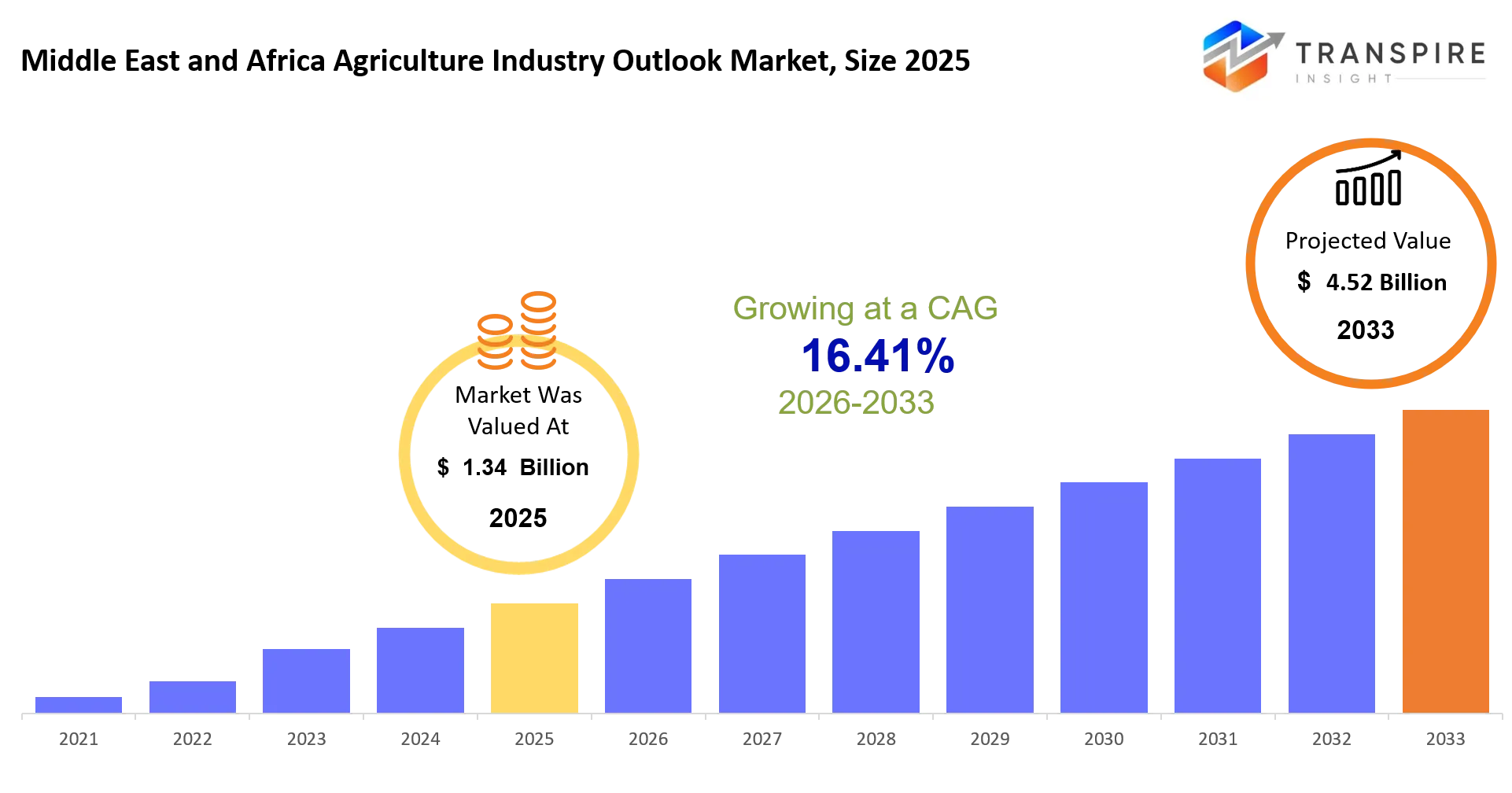
As per Transpire Insight Analysis, the Middle East and Africa Agriculture Industry Outlook Market size is estimated at USD 1.34 Billion in 2025 and is anticipated to reach USD 4.52 Billion by 2033, growing at a CAGR of 16.41% from 2026 to 2033.
The Middle East and Africa Agriculture Industry Outlook Market helps farmers, agribusinesses, and governments by boosting crop output, livestock oversight ,better resource use, and overall food supply stability across mixed weather patterns. It also offers strategic guidance, digital instruments, machinery offerings, and farming technologies that let stakeholders handle production uncertainty and fine tune daily operations, or what people often call field management. In the last 3–5 years, farming across the region has moved away from mostly traditional ways, sort of toward tech-enabled agriculture, because precision farming, smart irrigation, and more data-driven decisions are taking a firmer hold. At the same time, water scarcity ,climate swings, and wider global food supply disruptions have made investors push harder into resilient farm systems. A bunch of governments in the Middle East and Africa rolled out food security programs, which are encouraging farmers to use advanced agricultural solutions. The overall expansion is driven by the need to raise yields, curb resource wastage, and strengthen local food production abilities via modern cultivation methods.
Middle East and Africa Agriculture Industry Outlook Market Size & Forecast:
- Middle East and Africa Agriculture Industry Outlook Market Size 2025: USD 1.34 Billion
- Expected Market Value 2033: USD 4.52 Billion
- Forecast CAGR: 16.41%
- Leading region in 2025:
- Fastest Growing region:
- Key Profile: Bayer CropScience, Syngenta, Corteva Agriscience, BASF, John Deere, AGCO, CNH Industrial, Kubota, Yara International, Nutrien, Cargill, Archer Daniels Midland, Olam Group, Bunge, Netafim
Key Market Insights
- The Middle East & Africa agriculture industry outlook market is slowly but definitely moving toward precision agriculture solutions, as farms start integrating satellite data sensors, and different analytics , for improved productivity and more stable output.
- It’s like everyone is aiming for better yields, but with more careful decisions, even if the process feels kinda fragmented at first.
- In the region, Saudi Arabia , UAE, and South Africa are showing the strongest take-up of agriculture technology, mostly because government-backed food security efforts and modernization programs are pushing things forward.
- Precision farming is also grabbing a meaningful market share because commercial farms use digital platforms to fine tune irrigation , fertilizers, and crop monitoring , nearly in real time.
- Smart irrigation systems are gaining momentum across water-stressed areas, they reduce agricultural water use via automated control technologies that adjust flow based on conditions.
- At the same time, AI based crop analytics is emerging quickly as farmers adopt predictive models for disease detection, yield forecasting, and better resource planning.
- Agricultural drones are also expanding across larger African farms, helping with field mapping, spraying operations, and crop health assessment without so much ground effort.
- For end users, commercial farms still remain the leading segment, mainly due to higher investment capacity , and faster adoption of advanced agricultural equipment.
- Smallholder farmers are adopting mobile-based farming platforms more gradually , often supported by government programs and agriculture technology partnerships that offer training or tools.
- Companies like Bayer CropScience, Syngenta , John Deere, and Netafim keep strengthening their regional footprint using digital farming solutions , plus strategic collaborations with local partners.
- Finally, food security initiatives that were launched between 2020 and 2026 across GCC countries are speeding up investment in controlled farming, greenhouse agriculture , and local production systems , even when funding cycles don’t always line up neatly.
What are the Key Drivers, Restraints, and Opportunities in the Middle East and Africa Agriculture Industry Outlook Market?
The primary driver speeding up the Middle East and Africa Agriculture Industry Outlook Market is really that shift toward technology-supported farming, kind of pushed by food security worries, water shortages , and the climate -related production issues. In places like Saudi Arabia and the UAE, governments have rolled out agricultural modernization programs that basically nudge adoption of smart irrigation, greenhouse based cultivation , and precision agronomy systems. These kinds of investments help raise output while using fewer resources, and in turn they open up fresh revenue paths for technology providers, plus agricultural equipment manufacturers too.
One big restraint is the limited availability of skilled operators, along with uneven digital infrastructure across rural farming zones. A lot of smallholder farmers in Africa struggle to reach advanced machinery, dependable connectivity, and even financing arrangements, so technology uptake gets slowed down and market penetration stays shallow. Also the upfront capital requirements can be quite heavy, which delays modernization efforts for smaller farming businesses, and even if they want to move, it’s just not immediate.
A major opportunity is the expansion of AI-enabled farming platforms, autonomous farm equipment, and climate-resilient agriculture approaches. When countries invest in controlled environment agriculture and in digital farming ecosystems, they create room for tech firms to offer solutions that can scale. Government initiatives paired with agritech companies and agricultural cooperatives can help things move faster, because accessibility and affordability improve across emerging markets, sort of together not separately.
What Has the Impact of Artificial Intelligence Been on the Middle East and Africa Agriculture Industry Outlook Market?
Artificial intelligence is kinda reshaping the Middle East and Africa Agriculture Industry Outlook Market, by making farm decision making feel more streamlined, plus adding automation , and better resource management, in practice. AI enabled platforms look at satellite images, weather swings, soil situation, and crop records to back precision agriculture work. In a lot of commercial farms, machine learning models are being used to tune irrigation timing, anticipate crop diseases, keep track of plant health, and also enhance fertilizer usage . Then there are smart farming setups linked to IoT sensors, they watch over field conditions automatically , and they let farmers react fast when the environment shifts, even if it’s sudden.
On top of that, predictive analytics is getting more and more important for estimating yields, planning equipment upkeep, and improving production flow. AI driven systems allow agricultural teams to spot likely crop failures earlier, cut down on input waste, and improve day to day operational efficiency. Automated machinery, along with robotics, is also helping with labor heavy tasks like planting, harvesting, and crop checks, especially in big scale farming across the region. When these tools are properly integrated into farm management systems, they can boost productivity, and lower operating costs, overall.
But , AI adoption still hits real barriers because implementation expenses can be high, rural connectivity is sometimes limited, and there aren't enough region specific agricultural datasets to train models accurately. Many smallholder farmers basically don’t have strong access to digital infrastructure nor the technical know-how needed, and that slows the broader rollout of advanced AI solutions.
Key Market Trends
- Governments across GCC countries started putting more money into controlled farming projects after 2020 to boost the ability of local food production.
- Precision agriculture then sort of took off, with commercial farms folding in GPS systems, sensors, and analytics platforms, for a more careful handling of resources.
- Smart irrigation devices picked up speed from 2021 up to 2026, because water scarcity basically shoved farmers toward automated conservation approaches.
- On the African side, agricultural drones saw more use across many farms as operators started using aerial viewing, for crop vitality checks and also for precision spraying.
- After 2022, AI-powered farming platforms surfaced, assisting agri companies in sharpening yield projections and disease detection reliability.
- In several Middle Eastern countries, greenhouse agriculture grew, since climate-controlled cultivation made it possible to produce crops all year, rather than seasonally.
- John Deere and AGCO also leaned harder into connected machinery solutions, because many farmers shifted toward automated farming operations.
- Smallholder farmers began using mobile based agricultural services, while digital marketplaces improved access to weather data , pricing details, and advisory support.
- From 2023 onward, partnerships between agritech firms and governments increased, aimed at speeding up digital agriculture take up across developing areas.
- At the same time, sustainable farming practices gained more weight, as growers adopted technologies that cut down water use, reduce fertilizer input, and limit production losses.
Middle East and Africa Agriculture Industry Outlook Market Segmentation
By Agriculture Type
Crop Farming still remains a big part, in the sense that many farmers try to upgrade cereal, vegetable, and commercial crops production throughout the region. At the same time, Livestock Farming helps keep meat and dairy product supply steady , because farms are slowly adopting more reliable feeding systems, using health monitoring tools, and refining breeding practices in a more deliberate way. Horticulture keeps stretching out too, mainly through fruit, vegetable , and high-value crop cultivation, and it’s pretty noticeable in the controlled farming projects that are spreading. Aquaculture is getting more attention as investments rise , especially toward sustainable fish production and other alternative food sources.
Organic Farming continues to grow, with producers switching toward natural cultivation routines and trying to satisfy the demand for agricultural products that feel healthier . Precision Agriculture will also be important here, it supports smarter farm decisions using sensors, satellite information, and analytics platforms, which in turn helps improve how resources are used without waste . Greenhouse Farming is expanding in dry regions, since it lets crops grow more consistently inside controlled environments. Other agriculture activities include specialized farming practices that help diversification, and they also tie into broader regional food security goals , overall.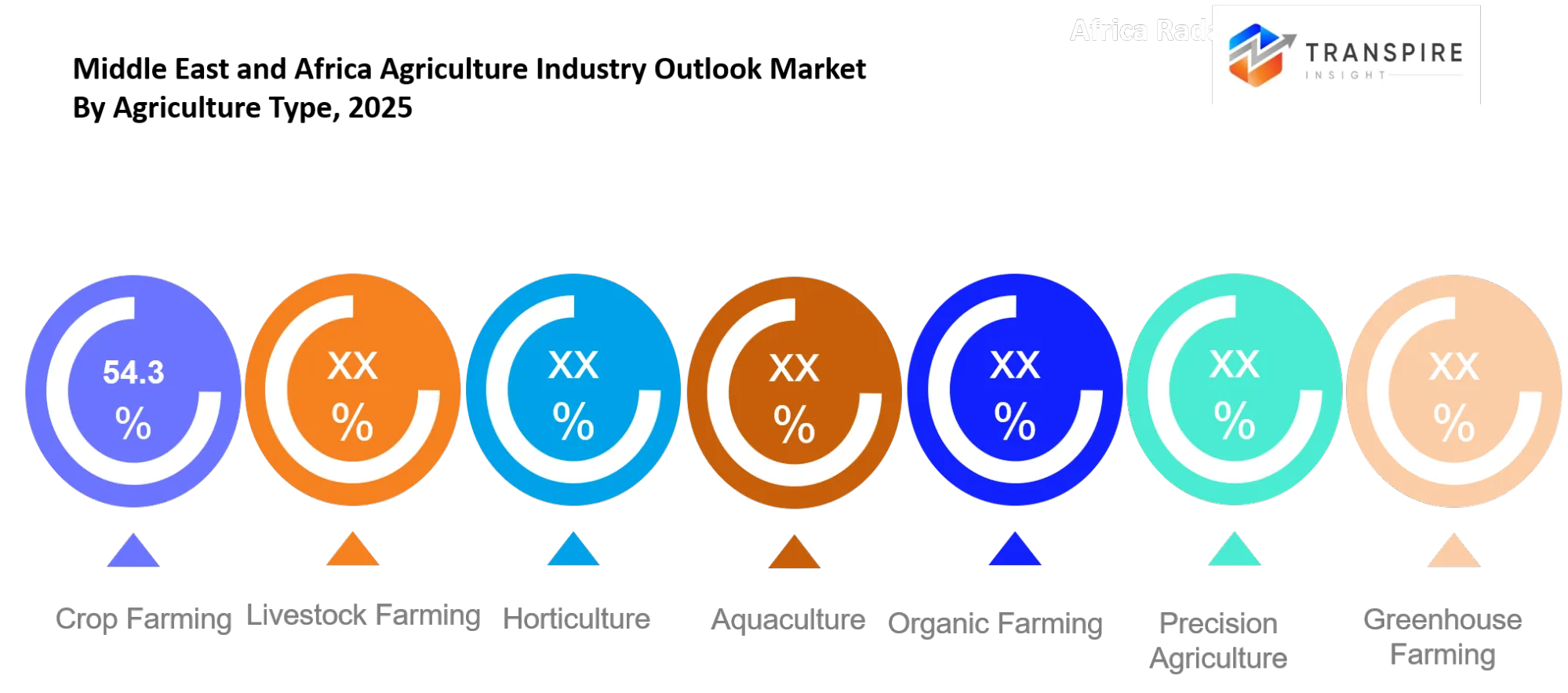
By Product Type
Cereals and Grains actually represent, kinda an important product segment because there are strong consumption patterns and also food security initiatives running across a lot of Middle Eastern and African countries. Fruits & Vegetables are gaining ground too, since greenhouse projects and more advanced cultivation methods help push year round production, even when it’s not the usual season.
Oilseeds & Pulses help with nutritional requirements and also with agri trade activities, while Livestock Products add a lot to the regional protein supply through meat and other animal based goods. Dairy Products keep getting investments as well, tied to modern livestock facilities and better processing systems, so quality and consistency improve.
Cash Crops like cotton, coffee, and other commercial crops back export opportunities in selected African markets. Plantation crops also matter for farm income, with products such as dates, cocoa, and other long term crops. Other product categories include specialty agricultural goods, supported by shifting consumption habits and local production strategies across the region.
By Technology
Precision farming is, kind of, turning into a key technology segment now as farms adopt GPS systems, field sensors and data analytics to boost productivity. Smart irrigation solutions are getting lots of traction because water scarcity is still a big pain point, so farms can manage water usage with automated controls and practical systems. Agricultural drones are also stepping in to help with crop observation, field mapping, and precision spraying work, especially across big farming areas where it’s harder to cover everything by hand. Farm management software supports farmers to arrange production steps, keep an eye on results, and upgrade operational planning.
Then there are IoT based monitoring systems, they improve real time tracking of soil conditions, shifts in weather, and crop wellbeing. With AI based crop analytics farms can do forecasting , spot plant disease faster, and make more reliable agricultural choices using advanced data processing. Autonomous machinery is moving forward too, with automated tractors and other equipment built to reduce labor needs and improve efficiency. Other tools also sit under digital agriculture, like digital farming applications that quietly but strongly support modern farming operations overall.
By End User
Commercial Farms, basically, are a leading end-user group because big agricultural operators are pouring money into advanced machinery, automation systems, and digital farming solutions. Then there are Smallholder Farmers, who make up a big part of the user base across Africa, and their mobile agricultural platforms, budget-friendly tools, plus cooperative support programs, all help raise farming productivity, bit by bit. Agricultural Cooperatives also show up as a key player, supporting farmers with shared access to equipment, technology, guidance, and even market routes. Food Processing Companies on their side, rely on dependable agricultural supply chains for raw materials, sourcing, and overall production actions.
Government Agricultural Agencies are important too since they roll out food security programs, agricultural modernization efforts and farmer support initiatives. Research Institutes add value via innovation, crop development research, and trials for advanced farming methods. Other end users include agricultural service providers as well as organizations that back sustainable farming practices, encourage technology uptake, and push regional agricultural development forward.
By Distribution Channel
Direct Sales still count as an important distribution channel, since agricultural equipment makers together with technology providers often send solutions straight to commercial farms, and to the bigger agricultural businesses as well. Agricultural Cooperatives , meanwhile, assist the smaller farmers by helping them reach seeds , equipment , fertilizers, and even digital services, using a collective buying model which is kind of aggregating demand. Wholesale Markets keep on helping the flow of agri products, by linking producers with buyers across nearby supply networks. Online Platforms are getting more and more noticeable, because digital marketplaces make it simpler to obtain agricultural inputs, plus advisory support.
Retail Suppliers also back local farmers: they provide farming materials, tools, and the key essentials through already established networks. Export Markets open room for agricultural producers, by matching regional output with overseas purchasers, especially when it comes to cash crops and specialty goods. Other distribution channels include government supported programs, agricultural service providers, and digital platforms that improve access to farming resources , and market knowledge in a more seamless way.
What are the Key Use Cases Driving the Middle East and Africa Agriculture Industry Outlook Market?
Crop productivity optimization is kinda the main reason adoption is really happening for advanced agri solutions through the whole region. A lot of commercial farms are leaning on precision agriculture tools, smart irrigation systems and crop analytics platforms , so they can raise yields while at the same time keeping water, fertilizer and labor costs under control. This use case keeps demand high, since agriculture operators want dependable production setups to deal with changing climate conditions and also meet food security targets.
Also, greenhouse farming mixed with livestock management is picking up pace, seen both with commercial producers and government supported agricultural projects. Controlled environment agriculture helps push year round vegetable output in Gulf countries, whereas digital livestock monitoring supports animal health tracking and overall farm efficiency across Africa .
More new ideas are showing up too, like AI based crop forecasting, autonomous farming equipment and IoT enabled monitoring systems. These advancements are getting a lot of attention , mainly because governments and agritech companies are putting money into digital agriculture ecosystems. The idea is to boost resilience, cut down resource waste, and keep sustainable food production going over the forecast period .
|
Report Metrics |
Details |
|
Market size value in 2025 |
USD 1.34 Billion |
|
Market size value in 2026 |
USD 1.56 Billion |
|
Revenue forecast in 2033 |
USD 4.52 Billion |
|
Growth rate |
CAGR of 16.41% from 2026 to 2033 |
|
Base year |
2025 |
|
Historical data |
2021 - 2024 |
|
Forecast period |
2026 - 2033 |
|
Report coverage |
Revenue forecast, competitive landscape, growth factors, and trends |
|
Regional scope |
Middle East and Africa (Saudi Arabia, United Arab Emirates, South Africa, Rest of Middle East and Africa) |
|
Key company profiled |
Bayer CropScience, Syngenta, Corteva Agriscience, BASF, John Deere, AGCO, CNH Industrial, Kubota, Yara International, Nutrien, Cargill, Archer Daniels Midland, Olam Group, Bunge, Netafim |
|
Customization scope |
Free report customization (country, regional & segment scope). Avail customized purchase options to meet your exact research needs. |
|
Report Segmentation |
By Agriculture Type (Crop Farming, Livestock Farming, Horticulture, Aquaculture, Organic Farming, Precision Agriculture, Greenhouse Farming, Others); By Product Type (Cereals & Grains, Fruits & Vegetables, Oilseeds & Pulses, Livestock Products, Dairy Products, Cash Crops, Plantation Crops, Others); By Technology (Precision Farming, Smart Irrigation, Agricultural Drones, Farm Management Software, IoT-Based Monitoring, AI-Based Crop Analytics, Autonomous Machinery, Others); By End User (Commercial Farms, Smallholder Farmers, Agricultural Cooperatives, Food Processing Companies, Government Agricultural Agencies, Research Institutes, Others); By Distribution Channel (Direct Sales, Agricultural Cooperatives, Wholesale Markets, Online Platforms, Retail Suppliers, Export Markets, Others) |
Which Regions are Driving the Middle East and Africa Agriculture Industry Outlook Market Growth?
The Middle East region, in a sense, leads the Middle East and Africa agriculture Industry Outlook market, because of pretty strong government-backed food-security programs, a solid ability to fund projects , and quick uptake of more advanced farming technologies. Saudi Arabia and the UAE are investing quite a lot in greenhouse agriculture, smart irrigation, hydroponics and controlled-environment farming in order to dial down dependence on food imports . The supporting ecosystem is not just one thing , but a set of factors: solid infrastructure, technology partnerships, research initiatives, plus funding programs that nudge commercial farming toward modernization. Strategic national moves around agricultural self-sufficiency keep reinforcing the region’s role as the biggest contributor to market revenue
Africa, however , follows another growth pathway altogether. It is backed by a very large agricultural workforce, broad availability of arable land, and a growing network of smallholder farming. Countries such as South Africa, Kenya, Nigeria, and Egypt are pushing productivity upward through digital platforms, farmer assistance programs , and public-private collaborations. Where the Middle East leans more toward tech-led transformation, African market development leans more heavily on improving access, financing, and day-to-day farm-level efficiency. Steady commitments from development organizations, agritech companies, and government agencies help create a fairly stable base for long-term expansion
The fastest growth momentum is expected from Sub-Saharan Africa, driven by faster digital agriculture adoption, climate-resilient farming programs , and investments in agricultural infrastructure which together speed up modernization
Who are the Key Players in the Middle East and Africa Agriculture Industry Outlook Market and How Do They Compete?
The Middle East and Africa Agriculture Industry Outlook Market has a moderately competitive structure, so you get this mix of global agricultural companies in the same field, together with regional technology providers and some specialized solution developers. For the most part, competition comes down to tech capabilities, product performance, regional partnerships, and the ability to offer integrated farming solutions. A lot of firms are kind of moving past the old style agricultural inputs, by blending seeds, crop protection products, machinery, irrigation systems, and digital platforms, to make what feels like full farming ecosystems.
Bayer CropScience and Syngenta compete using agricultural innovation, digital crop management platforms, and advanced crop protection solutions. Bayer leverages data-driven farming tools and those integrated crop solutions to back productivity gains, while Syngenta leans more on seed technology, crop protection products, and regional collaborations. John Deere also pushes forward with precision farming equipment, connected machinery and automation technologies, which in practice help commercial farms boost efficiency even when conditions shift.
Netafim stands out via smart irrigation technologies that are really built for water-scarce regions, so there are strong adoption opportunities across the Middle Eastern markets. Yara International focuses on crop nutrition solutions, plus sustainable fertilizer technologies, which helps farmers raise yields while also optimizing nutrient usage. These players keep expanding their market presence through regional partnerships, ongoing technology investments, and customized solutions that address specific agricultural challenges across Middle East and African markets .
Company List
• Bayer CropScience
• Syngenta
• Corteva Agriscience
• BASF
• John Deere
• AGCO
• CNH Industrial
• Kubota
• Yara International
• Nutrien
• Cargill
• Archer Daniels Midland (ADM)
• Olam Group
• Bunge
• Netafim
Recent Development News
In January 2026, Netafim launched advanced digital irrigation solutions for precision agriculture applications. The new technology platform improves water management efficiency through automated monitoring and data-based irrigation control, supporting adoption of smart farming systems in water-stressed regions.https://www.netafim.com (Netafim).
In March 2025, John Deere announced new autonomous farming technology solutions designed to improve agricultural equipment efficiency. The technology launch strengthened automation capabilities and expanded precision farming adoption among large-scale agricultural operators.https://www.deere.com (John Deere).
In April 2025, Bayer entered strategic collaborations to expand digital farming solutions through its Climate FieldView platform. The partnership initiatives focused on improving data-driven crop management and supporting farmers with advanced agricultural analytics.https://www.bayer.com (Bayer).
What Strategic Insights Define the Future of the Middle East and Africa Agriculture Industry Outlook Market?
The Middle East and Africa Agriculture Industry Outlook Market seems to be moving, little by little, toward integrated digital farming ecosystems where automation , artificial intelligence and resource-efficient technologies will somehow shape future competitiveness . The main driver behind all this is the insistence to boost agricultural output while dealing with water constraints, climate related risks, and those big food security troubles. There is also a quieter risk, the uneven adoption of advanced technologies. It can happen because the upfront investment costs are still high and the digital infrastructure is limited, so a gap could form between big commercial farms and smaller producers.
At the same time there is an emerging opening, especially around AI-powered advisory platforms that are paired with satellite monitoring and cheaper IoT devices . This feels more practical across many African farming regions. These approaches can upgrade decision-making , without asking for massive infrastructure spending. Market participants should concentrate on technology models that can scale, build regional partnerships, and keep farmer-focused solutions in the foreground so adoption barriers get reduced. In the end that can generate long term value across the different agricultural markets in the region.
Middle East and Africa Agriculture Industry Outlook Market Report Segmentation
By Agriculture Type
• Crop Farming
• Livestock Farming
• Horticulture
• Aquaculture
• Organic Farming
• Precision Agriculture
• Greenhouse Farming
• Others
By Product Type
• Cereals & Grains
• Fruits & Vegetables
• Oilseeds & Pulses
• Livestock Products
• Dairy Products
• Cash Crops
• Plantation Crops
• Others
By Technology
• Precision Farming
• Smart Irrigation
• Agricultural Drones
• Farm Management Software
• IoT-Based Monitoring
• AI-Based Crop Analytics
• Autonomous Machinery
• Others
By End User
• Commercial Farms
• Smallholder Farmers
• Agricultural Cooperatives
• Food Processing Companies
• Government Agricultural Agencies
• Research Institutes
• Others
By Distribution Channel
• Direct Sales
• Agricultural Cooperatives
• Wholesale Markets
• Online Platforms
• Retail Suppliers
• Export Markets
• Others
Frequently Asked Questions
Find quick answers to common questions.
The Expected Middle East and Africa Agriculture Industry Outlook Market size for the Market will be USD 4.52 Billion in 2033.
Key segments for the Middle East and Africa Agriculture Industry Outlook Market are By Agriculture Type (Crop Farming, Livestock Farming, Horticulture, Aquaculture, Organic Farming, Precision Agriculture, Greenhouse Farming, Others); By Product Type (Cereals & Grains, Fruits & Vegetables, Oilseeds & Pulses, Livestock Products, Dairy Products, Cash Crops, Plantation Crops, Others); By Technology (Precision Farming, Smart Irrigation, Agricultural Drones, Farm Management Software, IoT-Based Monitoring, AI-Based Crop Analytics, Autonomous Machinery, Others); By End User (Commercial Farms, Smallholder Farmers, Agricultural Cooperatives, Food Processing Companies, Government Agricultural Agencies, Research Institutes, Others); By Distribution Channel (Direct Sales, Agricultural Cooperatives, Wholesale Markets, Online Platforms, Retail Suppliers, Export Markets, Others).
Major Middle East and Africa Agriculture Industry Outlook Market players are Bayer CropScience, Syngenta, Corteva Agriscience, BASF, John Deere, AGCO, CNH Industrial, Kubota, Yara International, Nutrien, Cargill, Archer Daniels Midland, Olam Group, Bunge, Netafim.
The Current Middle East and Africa Agriculture Industry Outlook Market size is USD 1.34 Billion in 2025.
The Middle East and Africa Agriculture Industry Outlook Market CAGR is 16.41% from 2026 to 2033.
• Bayer CropScience
• Syngenta
• Corteva Agriscience
• BASF
• John Deere
• AGCO
• CNH Industrial
• Kubota
• Yara International
• Nutrien
• Cargill
• Archer Daniels Midland (ADM)
• Olam Group
• Bunge
• Netafim
About the Authors

Chetan Dhatrak
I’m Chetan Dhatrak, a Senior Research Analyst at Transpire Insight, specializing in the Consumer Goods, Foods and Beverages industry. I focus on analyzing market trends, consumer behavior, competitive landscapes, and industry developments to deliver accurate, data-driven insights. My research at Transpire Insight is built on credible sources and in-depth analysis, helping businesses and readers better understand market dynamics, emerging opportunities, and evolving consumer preferences. I’m committed to creating reliable, well-researched content that supports informed decision-making and reflects the latest developments in the consumer goods and food & beverage sectors.

Chakradhar Khansole
Chakradhar serves as the Research Director at Transpire Insight, bringing over 8 years of experience in technology, innovation, and strategic market intelligence. He specializes in transforming complex market data into actionable business insights that enable organizations to make informed, growth-oriented decisions. Recognized for his strategic vision and analytical expertise, Chakradhar leads high-impact research initiatives, delivering comprehensive market assessments, competitive intelligence, and forward-looking industry analysis.
Recently Published Reports
-
Apr 2026
Baby Infant Formula Market
Baby Infant Formula Market Size, Share & Analysis Report By ype (Infant Milk, Follow On Milk, Specialty Baby Milk, Growing-Up Milk), By Ingredient (Carbohydrate, Fat, Protein, Minerals, Vitamins, and Others), By Product Form (Powder, Liquid, and Ready-to-feed), By Distribution Channels (Supermarket/Hypermarket, Specialty Store, Pharmacies, Online Retail, and Others), and Geography (North America, Europe, Asia-Pacific, Middle East and Africa, South and Central America), 2021 - 2031
-
Apr 2026
Edible Insects for Animal Feed Market
Edible Insects for Animal Feed Market Size, Share & Analysis Report By Type (Insect Powder, Insect Meal, Insect Bar, Insect Paste, Insect Oil, and Others), By Insect Type (Beetles, Cricket, Caterpillar, Hymenoptera, Orthoptera, Tree Bugs, and Others), By Application (Livestock, Pet Food, and Aquaculture), By Livestock Type (Poultry, Swine, and Others), and Geography (North America, Europe, Asia-Pacific, Middle East and Africa, South and Central America), 2021 - 2031
-
Apr 2026
Food Industry Disinfection and Bacterial Control Market
Food Industry Disinfection and Bacterial Control Market Size, Share & Analysis Report By Type (Chemical Disinfectants, Physical Disinfectants, and Biocides and Antimicrobials), By Application (Food Processing Equipment Surface Disinfection, Food Preparation Areas Surface Disinfection, Storage Areas Surface Disinfection, Anti-microbial Coatings Food Preservation, and Preservative Solutions Food Preservation), By End User (Meat and Poultry Processing, Dairy Processing, Seafood Processing, Bakery and Confectionery, Restaurants and Commercial Kitchens, and Food Service Providers), By Sales Channel (Online, Offline), and Geography (North America, Europe, Asia-Pacific, Middle East and Africa, South and Central America), 2021 - 2031
-
May 2026
Freeze Dried Food Market
Freeze Dried Food Market Size, Share & Analysis Report By Product Type (Fruits, Vegetables, Freeze-Dried Dairy Products, Freeze-Dried Meat and Seafood, Freeze-Dried Pet Food, and Prepared Meal), By Nature (Organic, and Conventional), By Form (Powdered, Granules, and Diced), By End Use (Breakfast Cereals, Dairy Products, Bakery & Confectionery, Nutritional Bars & Supplements, Powdered Beverages, Snacks, and Retail (Household)), and Geography (North America, Europe, Asia-Pacific, Middle East and Africa, South and Central America), 2021 - 2031