

United States Aromatic Compounds Market Size & Forecast:
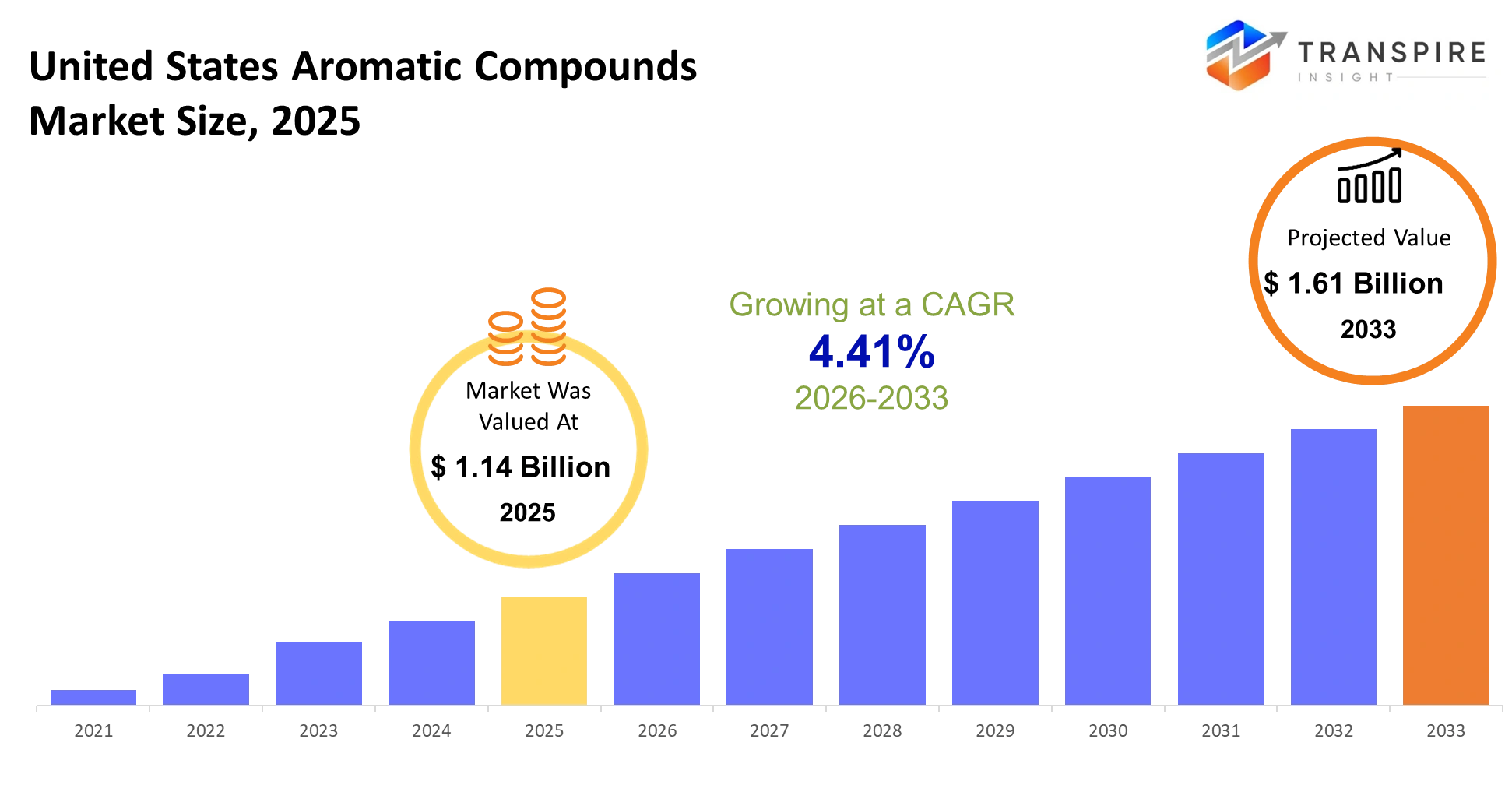
- United States Aromatic Compounds Market Size 2025: USD 1.14 Billion
- United States Aromatic Compounds Market Size 2033: USD 1.61 Billion
- United States Aromatic Compounds Market CAGR: 4.41%
- United States Aromatic Compounds Market Segments: By Type (Benzene, Toluene, Xylene, Naphthalene, Styrene, Others), By Application (Petrochemicals, Plastics, Resins, Solvents, Dyes, Others), By End-User (Chemical Industry, Automotive, Construction, Textile, Industrial, Others), By Form (Liquid, Gas, Bulk, Packaged, Industrial Grade, Others).
To learn more about this report,  Download Free Sample Report
United States Aromatic Compounds Market Summary:
The United States Aromatic Compounds Market size is estimated at USD 1.14 Billion in 2025 and is anticipated to reach USD 1.61 Billion by 2033, growing at a CAGR of 4.41% from 2026 to 2033. The United States market for aromatic compounds kinda sits right in the middle of industrial manufacturing, feeding the chemical building blocks that go into plastics, synthetic fibers, coatings, fuels, pharmaceuticals, detergents, and even packaging materials, (you know the usual stuff). In real life, these compounds help refineries and chemical producers turn crude oil and natural gas liquids into more valuable intermediates, which downstream industries then use to keep everyday manufacturing running and to hit the performance targets for products.
Over the last five years, there’s been a noticeable structural change, more like integrated petrochemical operations linked to shale-based feedstocks. That shift has let U.S. producers improve cost efficiency and also keep domestic supply reliability steadier. During COVID-19 the global trade lanes got disrupted, then later the volatility connected with the Russia-Ukraine conflict showed some supply chain weak points, and well, it also sped up investment in nearby regional production capacity.
As automotive lightweighting grew, electronics manufacturing kept expanding, and specialty packaging demand went up, buyers started putting more emphasis on consistent feedstock access and higher purity materials. So suppliers have been leaning into capacity upgrades and more advanced processing technologies, which in turn supports better margins, and keeps longer-term contract demand from slipping away, even when conditions get messy.
Key Market Insights
- The United States Aromatic Compounds Market kind of benefits from plenty of shale gas feedstocks , which helps production economics and makes the domestic petrochemical industry more competitive , ever since 2021 or so.
- The Gulf Coast manufacturing hubs pretty much dominated the United States Aromatic Compounds Market , with nearly 48% market share in 2025 , largely because of their integrated refinery infrastructure, you know.
- The Midwest emerged as the fastest-growing regional market through 2030. This is supported by expanding automotive chemical use , along with more industrial coatings , and packaging material production plants .
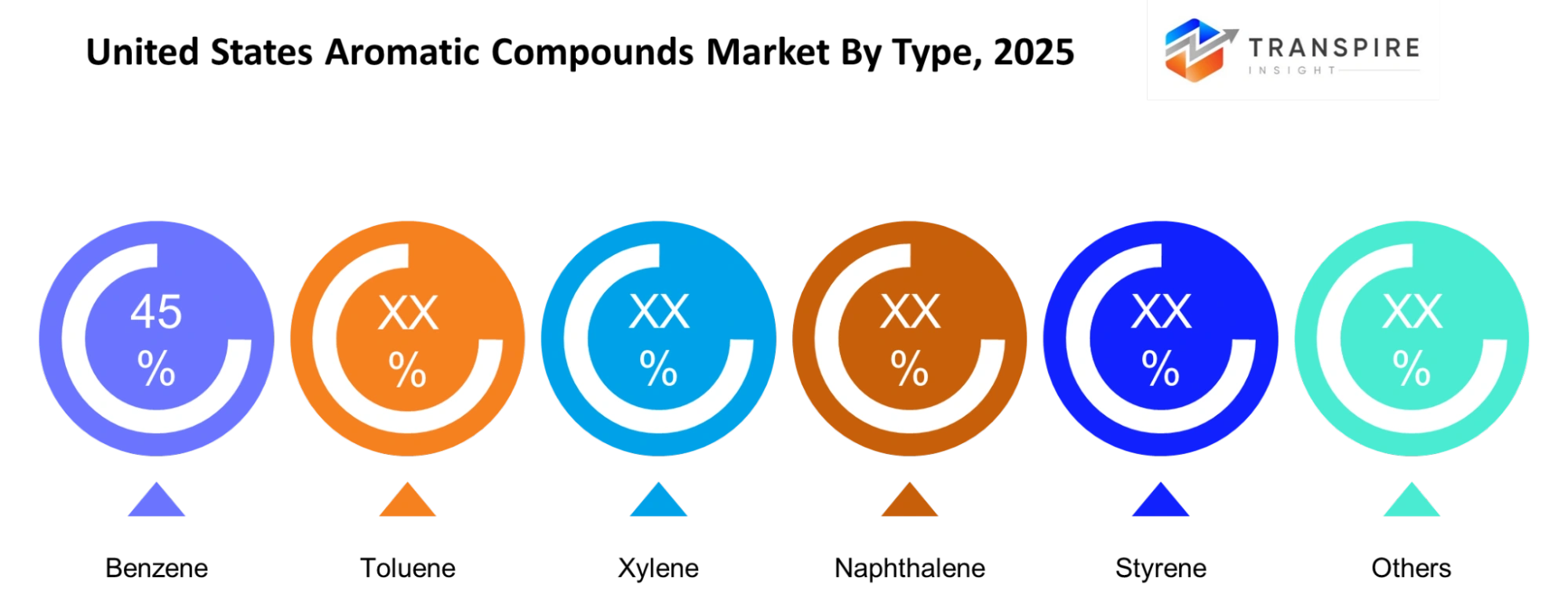
- Benzene held around 34% of the industry share in 2025 because manufacturers increased its use in styrene, nylon and synthetic rubber related applications .
- Toluene stayed the second-largest product segment . It continues to ride on solid solvent demand from paints , adhesives , fuel additives , and also pharmaceutical manufacturing industries across the nation.
- Xylene is projected to see the fastest growth rate through 2030 , as PET resin and polyester fiber manufacturing capacity keeps ramping up across the United States.
- Plastics and polymer manufacturing dominated application demand , taking close to 41% market share in 2025 because packaging output and consumer goods production volumes stayed high .
- Specialty chemicals represent the fastest-growing application segment. That is because electronics, performance coatings, and high-purity industrial materials need more advanced aromatic compound formulations.
- In terms of end users, packaging manufacturers held the leading share in 2025, pushed by higher flexible packaging output and adoption of lightweight industrial materials .
- Automotive and electric vehicle component manufacturers are showing rapid growth as end users , since lightweight composites and engineered plastics basically need aromatic feedstocks.
What are the Key Drivers, Restraints, and Opportunities in the United States Aromatic Compounds Market?
The most powerful force pushing the United States aromatic compounds market forward i s still the growth of domestic petrochemical manufacturing, tied to shale-based feedstock economics. In the past ten years, low-cost natural gas liquids coming from U.S. shale helped lower operating costs for integrated refiners and chemical producers, so domestic aromatic compound production got more competitive versus imports from Asia and Europe. That particular cost edge then encouraged lots of capacity upgrades, mainly along the Gulf Coast for benzene, plus toluene and xylene output. Meanwhile, packaging, automotive plastics, and industrial coatings makers kept asking for dependable regional supply after those pandemic-era logistics disruptions, and the result was that long-term procurement contracts went up. Those agreements, well, supported higher production volumes and also gave producers stronger revenue visibility, in a pretty direct kind of way.
Still, environmental compliance is kind of the market’s most solid wall. Aromatic compounds are closely connected to petroleum refining, and during production and storage they can generate hazardous air pollutants. Federal and state emissions rules push for pricey retrofits, ongoing monitoring systems, and long permitting steps, and honestly these don’t just roll out fast across older refinery assets, not really. Smaller operators often delay expansion anyway, partly because compliance expenses pinch the margins, and partly because permitting uncertainty makes the whole schedule feel a bit shaky, like it can slip. So this limitation knocks down new capacity additions and slows how fast downstream industries can lock in extra domestic supply.
A pretty big growth chance is kind of showing up in high-purity aromatics for EV parts and semiconductor fabrication. People are putting more money into newer battery materials, lighter-weight composite structures, and electronics-grade solvent mixes, so there’s more interest in specialty aromatic derivatives that have tighter performance requirements. On the Gulf Coast, chemical manufacturers are moving capital toward purification methods and also toward integrated lines for making specialty chemicals, and this should help the United States grab more higher-margin industrial business in the next ten years, or so.
What Has the Impact of Artificial Intelligence Been on the United States Aromatic Compounds Market?
Artificial intelligence and advanced digital technologies are reshaping the United States aromatic compounds industry in a kind of gradual way, mostly by making refinery efficiency better, process steadier, and assets more dependable across benzene, toluene, and xylene production facilities. Petrochemical operators are more and more rolling out AI enabled process control systems that continuously check temperature, pressure catalyst activity, and feedstock composition, sort of all at once, in real time. These systems then shift operating settings on their own to push higher aromatic yield while also cutting energy use and limiting off specification material formation. A few Gulf Coast refiners now lean on machine learning models to estimate catalyst wear and equipment failure weeks before the shutdown dangers become obvious, so maintenance teams can line up repairs during planned turnaround cycles rather than dealing with unplanned outages.
Digital twins, and predictive analytics platforms are also helping producers forecast emission levels and fine tune steam cracking operations when feedstock conditions change. What happens in practice is that operational uptime tends to rise, maintenance bills often drop, and energy intensity is reduced across linked petrochemical complexes. Some plants even report observable reductions in unexpected downtime and tighter compliance with federal air emissions requirements thanks to automated monitoring, which honestly makes sense.
Still, AI adoption hits a big wall because many older refinery assets were never built for high frequency digital data collection. Bringing modern analytics into decades old infrastructure takes a lot of capital, involves complicated sensor retrofits, and usually requires specialized engineering expertise that smaller operators simply do not have.
Key Market Trends
- Since 2021 , Gulf Coast producers started ramping up refinery-to-petrochemical connection projects , sort of because buyers wanted shorter supply runs and also more steady aromatic feedstock access, not just in theory but in day-to-day procurement.
- After 2020 , U.S. manufacturers were more aggressive about investments in digital process refinement, which helped lower the chances of unexpected maintenance shutdowns, and then the overall operational efficiency improved across aromatic production sites in general.
- From 2022 to 2025, benzene purchasing started leaning more toward long-term agreements, since packaging and polymer makers wanted some shield against feedstock price swings and sudden cost shocks, even when markets got weird.
- Newer federal air emissions rules pushed refiners to modernize catalytic reforming lines, and that drove greater use of continuous emissions monitoring tools across older parts of the production setup, not only the newest trains.
- Between 2021 and 2024, ExxonMobil and Chevron Phillips Chemical expanded their downstream petrochemical linkages, basically to stabilize margins, and keep supply reliability on firmer ground when demand patterns changed.
- After 2023 , demand for high-purity xylene grades increased , mainly because electric vehicle battery producers and electronics companies expanded domestic component capacity, which then pulled more of those grades into the supply chain.
- Specialty chemical producers also began substituting imported aromatic intermediates with regional procurement terms , after logistics disruptions and container shortages showed up during the pandemic, and it stayed that way long enough to change buying habits.
- Refiners rolled out AI-driven predictive maintenance systems after 2022, and this helped operators cut downtime exposure and better plan catalyst replacement timing across the integrated complexes, even when schedules were tight.
- Competitive behavior shifted too, as producers put more emphasis on low-carbon processing methods , with multiple Gulf Coast plants investing in energy recovery plus emissions reduction setups since 2023, rather than treating it as optional.
United States Aromatic Compounds Market Segmentation
By Type
Benzene still seems to hang onto the top spot in this type of segment, mostly because big scale styrene, nylon, and synthetic rubber production really relies on a stable benzene supply. Toluene keeps a solid market grip thanks to its broad use in solvents, fuel blending, and also as chemical intermediates, and honestly it shows up everywhere. Xylene demand has been climbing too, kind of in step with polyester fiber output and PET packaging production, so it’s not just one narrow lane. Naphthalene and styrene stay smaller in comparison but they’re still kind of important, especially when you look at specialty chemicals and construction related materials.
Feedstock economics, connected to shale based refining operations, continues to steer what gets prioritized across the aromatic lineup. Refiners are also putting more capital into higher purity output and into integrated processing systems, in order to lift profitability and cut down on waste generation, which makes sense. Going forward, competition will probably revolve less around raw commodity scale alone , and more around operational efficiency, emissions compliance, and the ability to deliver specialty-grade product capabilities. Manufacturers that can balance high-volume production with tailored formulations should be in a better position, and they may end up securing more dependable long-term contracts with downstream industrial buyers.
To learn more about this report, Download Free Sample Report
By Application
Petrochemicals still sort of, remain the main application segment , since aromatic compounds are basically crucial intermediate s for plastics, synthetic fibers, industrial chemicals, and performance materials. In practice, plastics and resins take up a lot of usage volume because production keeps expanding , especially for packaging, automotive parts and consumer goods manufacturing. Solvents and dyes keep a fairly steady industrial appetite too, notably across coatings, adhesives, and textile processing.
What’s changed lately is the demand pattern , buyers are now leaning more toward domestic sourcing reliability after those global logistics disruptions showed weaknesses in imported chemical supply chains. Meanwhile, high performance resin use is getting a lift from electric vehicles, electronics, and lightweight industrial materials, so specialty aromatic derivatives are seeing stronger demand, with stricter quality specifications. So going forward, application category growth will probably benefit producers who can supply customized grades, deliver with shorter turnaround times, and maintain consistent purity levels… which advanced manufacturers are increasingly expecting.
By End-User
The chemical industry is still pretty much the biggest end-user slice, since refineries and petrochemical producers end up eating aromatic feedstocks for big scale downstream work. On the other hand, automotive manufacturers are a major consuming crowd too, mostly because they keep leaning into lightweight plastics, engineered composites, and synthetic rubber component parts. Construction keeps doing its thing as well, it feeds demand for insulation materials, coatings, adhesives and sealants that come from aromatic intermediates, or at least rely on them in some way. Meanwhile textile and industrial users are keeping fairly steady purchasing rhythm through synthetic fibers and specialty chemical uses.
What’s kind of changed lately is how end-users buy things, they seem more into longer term procurement agreements, because raw material availability gets all over the place and transportation costs have gone up. That raises operational uncertainty across industrial supply chains, so people want predictability. Also manufacturers are more often choosing vendors that have integrated production networks and emissions-compliant plants, so deliveries can keep moving without interruption. Looking ahead, growth tied to automotive electrification, smarter infrastructure materials, and industrial automation should push demand upward for higher performance aromatic derivatives.
By Form
Liquid form kinda dominates the market, because large scale transportation, blending, and industrial processing systems lean heavily on liquid aromatic compounds for day to day operational efficiency and that flexible handling vibe. Bulk shipments also make up a big chunk of industry volumes, especially when you look at integrated petrochemical complexes and refinery linked distribution networks where logistics are already set up. Industrial grade materials still lead overall consumption , mainly due to their extensive use across manufacturing operations, where high volume throughput stays super critical. Packaged aromatic products remain important too, but more inside specialty chemicals, lab applications, and the smaller scale purchasing channels that serve niche customers. Gas based aromatic processing takes up a more limited role, since infrastructure needs and storage complexity sort of get in the way of wide commercial adoption.
On top of that, market preferences are increasingly drawn toward advanced storage systems, automated transfer technologies, and safer handling protocols, since environmental oversight keeps getting stricter across chemical transportation networks. Looking ahead, future investment will likely go into supply chain modernization, digital inventory tracking and specialized packaging systems aimed at supporting higher purity applications, plus tighter industrial safety standards.
What are the Key Use Cases Driving the United States Aromatic Compounds Market?
Plastic and polymer manufacturing stays one of the biggest use cases for aromatic compounds, but really it depends on how you look at it , because benzene, toluene, and xylene are still the key starting points , for packaging materials , synthetic fibers and a bunch of consumer goods outputs. Packaging manufacturers end up buying a lot, partly because customers keep wanting lightweight yet resilient stuff , especially across food, health services , and e-commerce channels.
In the meantime automotive and construction are widening their usage patterns through engineered plastics, insulation products , paints, coatings, adhesives, and even synthetic rubber components that kind of support the whole build. Electric vehicle builders are leaning more and more on aromatic derived composites for trimming vehicle mass and supporting battery efficiency, though of course infrastructure projects also keep pushing up industrial resin and solvent consumption.
New directions are showing up too, like semiconductor chemicals, battery related materials, and high purity electronics manufacturing, which is a bit more strict. Specialty aromatic derivatives are also getting more attention in advanced recycling methods, where chemical recovery systems take plastic waste and turn it back into reusable petrochemical feedstocks for later industrial production cycles, so it feels like a loop.
|
Report Metrics |
Details |
|
Market size value in 2025 |
USD 1.14 Billion |
|
Market size value in 2026 |
USD 1.19 Billion |
|
Revenue forecast in 2033 |
USD 1.61 Billion |
|
Growth rate |
CAGR of 4.41% from 2026 to 2033 |
|
Base year |
2025 |
|
Historical data |
2021 - 2024 |
|
Forecast period |
2026 - 2033 |
|
Report coverage |
Revenue forecast, competitive landscape, growth factors, and trends |
|
Geographic scope |
United States of America |
|
Key company profiled |
ExxonMobil, Chevron, Shell, BASF, Dow, LyondellBasell, SABIC, INEOS, Reliance Industries, Sinopec, Formosa Plastics, Mitsubishi Chemical, LG Chem, Versalis, TotalEnergies |
|
Customization scope |
Free report customization (country, regional & segment scope). Avail customized purchase options to meet your exact research needs. |
|
Report Segmentation |
By Type (Benzene, Toluene, Xylene, Naphthalene, Styrene, Others), By Application (Petrochemicals, Plastics, Resins, Solvents, Dyes, Others), By End-User (Chemical Industry, Automotive, Construction, Textile, Industrial, Others), By Form (Liquid, Gas, Bulk, Packaged, Industrial Grade, Others) |
Which Regions are Driving the United States Aromatic Compounds Market Growth?
The Gulf Coast region kinda leads the United States aromatic compounds market, mostly because the area blends big refining capacity with integrated petrochemical complexes, and it also has direct access to shale based feedstocks. Texas and Louisiana keep pulling in investment because they already have pipeline infrastructure, export terminals, and industrial permitting frameworks that, in practice, reduce the usual operational bottlenecks for chemical producers. Big players like ExxonMobil and LyondellBasell run wide downstream processing networks, which helps regional supply reliability, stay stronger than you’d expect otherwise. Plus, the logistics are well connected between refineries storage hubs, rail networks, and manufacturing clusters. That whole setup lets the Gulf Coast keep cost advantages across benzene, toluene, and xylene production, without getting slowed down too much.
The Midwest shows up as the second-largest regional contributor, but market stability is more about diversified industrial consumption than some heavy export oriented petrochemical concentration. Automotive manufacturing, industrial coatings, synthetic rubber production, and construction materials keep nudging forward steady demand for aromatic compounds, even when the energy markets swing around in different directions. Chemical buyers in places like Ohio , Illinois, and Michigan increasingly lean toward long term domestic sourcing agreements, partly to lower the transportation risk, and also to make procurement feel more predictable, or at least less twitchy. Growth still stays kinda steady there because mature manufacturing infrastructure, dependable freight networks, and a balanced industrial demand base act like a buffer against sudden cyclical fluctuations, the kind that only really show up when refinery activity changes the picture.
The Southeast is sort of emerging as the fastest growing region because manufacturers are extending packaging, electronics and advanced materials production places across states, like Georgia and North Carolina. In the last few years there have been recent investments in industrial parks, port modernization efforts, and specialty chemical processing capability, which have made the area feel more attractive for aromatic compound suppliers, starting since 2022. After that, demand kind of sped up even more as electric vehicle battery projects and semiconductor based manufacturing increased the need for high purity solvents and engineered material inputs, too. So overall growth across the Southeast is likely to unlock solid chances for specialty chemical producers, logistics providers, and investors who want some exposure to better margin downstream manufacturing uses, between 2026 and 2033.
Who are the Key Players in the United States Aromatic Compounds Market and How Do They Compete?
The United States aromatic compounds market is still sort of moderately consolidated , mostly because the large integrated refiners and petrochemical producers hold a lot of the domestic benzene, toluene and xylene capability. So the competition kinda revolves around feedstock economics, refinery linkages, transport efficiency, and the ability to keep delivering steady high purity supplies to the downstream crowd. Incumbent producers stay busy defending their share with capacity tweaks, digital process automation, and long term supply agreements , not really jumping into aggressive price fighting. At the same time, smaller specialty chemical suppliers are moving into certain higher margin pockets, especially electronics grade solvents and advanced polymer in between products , but the big infrastructure requirements make entry pretty hard in practice.
ExxonMobil kinda has a clear edge because its Gulf Coast operations are vertically integrated, like refining and petrochemical processing are linked, plus the export infrastructure sits in the same web. In practice that means transit costs can stay lower, and supply is more steady too, even when feedstock disruptions pop up , now and then. Chevron Phillips Chemical differentiates through strong olefins and aromatics integration, which lets them balance output across fuel and chemical streams depending on what the market is doing. Both groups keep rolling out digital refinery optimization tools and emissions reduction technologies , aiming to support operating margins and strengthen their regulatory compliance outcomes.
Dow tends to zoom in on specialized downstream uses , especially performance materials and industrial resins that link back to packaging, automotive, and infrastructure. What they basically do to keep customers coming is using tailor made material formulations, plus application specific technical guidance, not just selling commodity-only stuff. LyondellBasell on the other hand leans on a big set of North American production sites and circular feedstock programs, to pull in buyers who want lower-carbon chemical sources. Shell continues to scale its integrated chemicals activities and also its advanced catalyst know-how, which in practice helps boost aromatic yield efficiency, and it also backs long term supply commitments with industrial manufacturers across the United States.
Company List
- ExxonMobil
- Chevron
- Shell
- BASF
- Dow
- LyondellBasell
- SABIC
- INEOS
- Reliance Industries
- Sinopec
- Formosa Plastics
- Mitsubishi Chemical
- LG Chem
- Versalis
- TotalEnergies
Recent Development News
In February 2026, the aroma ingredients market is projected to reach $16.25B by 2026 with major U.S. manufacturing expansion: In 2026, global fragrance and aroma ingredient producers with strong U.S. operations, including BASF-linked supply networks, increased investment in aroma compound production used in perfumes, cosmetics, and industrial fragrances.
Source: https://www.openpr.com
In January 2026, Verdant Specialty Solutions acquires Lubrizol chemical manufacturing & R&D operations in Texas: In early 2026, Verdant Specialty Solutions expanded its North American footprint by acquiring Lubrizol’s chemical manufacturing and R&D operations in Texas, strengthening its specialty and aromatic chemicals capabilities for industrial applications.
Source: https://www.expressnews.com
What Strategic Insights Define the Future of the United States Aromatic Compounds Market?
The United States aromatic compounds market is kind of quietly but steadily moving toward higher-value specialty production, not really that straightforward commodity-scale expansion, over the next five to seven years. Growth will more and more come from advanced applications that link up with electric vehicles semiconductor manufacturing engineered plastics and performance materials, where you basically need tighter purity constraints and dependable domestic sourcing. This shift is getting pulled along by industrial reshoring playbooks automation inside petrochemical sites, and also by procurement pressure that keeps increasing from manufacturers who want shorter, more resilient supply routes.
A less obvious risk sits in long-term feedstock exposure. When the business is heavily tied to shale-linked refining economics it becomes a bit fragile, especially if natural gas liquids no longer look cost-competitive, or if refinery rationalization cuts aromatic output capacity faster than downstream specialty demand grows. There is also concentration risk, since a lot of capacity clusters around Gulf Coast infrastructure, and that can add operational stress during climate-related disruptions or when export paths get slowed down.
One emerging opportunity is circular aromatic feedstocks made from advanced chemical recycling setups. Firms that put money in early purification technologies, build regional specialty production hubs and line up downstream partnerships with electronics and battery manufacturers, will likely end up with stronger pricing leverage and longer industrial terms through 2033.
United States Aromatic Compounds Market Report Segmentation
By Type
- Benzene
- Toluene
- Xylene
- Naphthalene
- Styrene
- Others
By Application
- Petrochemicals
- Plastics
- Resins
- Solvents
- Dyes
- Others
By End-User
- Chemical Industry
- Automotive
- Construction
- Textile
- Industrial
- Others
By Form
- Liquid
- Gas
- Bulk
- Packaged
- Industrial Grade
- Others
Frequently Asked Questions
Find quick answers to common questions.
The approximate United States Aromatic Compounds Market size for the market will be USD 1.61 Billion in 2033.
The key segments of the United States Aromatic Compounds Market are By Type (Benzene, Toluene, Xylene, Naphthalene, Styrene, Others), By Application (Petrochemicals, Plastics, Resins, Solvents, Dyes, Others), By End-User (Chemical Industry, Automotive, Construction, Textile, Industrial, Others), By Form (Liquid, Gas, Bulk, Packaged, Industrial Grade, Others).
Major players in the United States Aromatic Compounds Market are ExxonMobil, Chevron, Shell, BASF, Dow, LyondellBasell, SABIC, INEOS, Reliance Industries, Sinopec, Formosa Plastics, Mitsubishi Chemical, LG Chem, Versalis, TotalEnergies.
The current market size of the United States Aromatic Compounds Market is USD 1.14 Billion in 2025.
The United States Aromatic Compounds Market CAGR is 4.41%.
- ExxonMobil
- Chevron
- Shell
- BASF
- Dow
- LyondellBasell
- SABIC
- INEOS
- Reliance Industries
- Sinopec
- Formosa Plastics
- Mitsubishi Chemical
- LG Chem
- Versalis
- TotalEnergies
Recently Published Reports
-
Apr 2026
Healthcare Polymer Packaging Market
Healthcare Polymer Packaging Market Size, Share & Analysis Report By Packaging Type (Syringes, IV Bottles and Pouches, Clamshells, Blisters, Bottles & Jars, Containers, Tubes, IV Parental Packaging, Others), By Type (Regulated, Non-regulated), By Polymer Type (LDPE (Low-Density Polyethylene), HDPE (High-Density Polyethylene), Homo-polymer (Homo), Random Copolymer (Random), Block Copolymer (Block), PET, Polystyrene, Polyvinyl Chloride, Polyamide/EVOH, Others), and Geography (North America, Europe, Asia-Pacific, Middle East and Africa, South and Central America), 2021 - 2031
-
Apr 2026
Hydrophilic Tape (Waterstop) Market
Hydrophilic Tape (Waterstop) Market Size, Share & Analysis Report By Type (Bentonite-Based Hydrophilic Tape, Rubber-Based Hydrophilic Tape), By Application (Residential Buildings, Commercial Buildings, Infrastructure Projects), and Geography (North America, Europe, Asia-Pacific, Middle East and Africa, South and Central America), 2021 - 2031
-
Apr 2026
Metalens Market
Metalens Market Size, Share & Analysis Report By Type (Visible Light Metalens, and Infrared Metalens), By Application (Consumer Electronics, Automotive Electronics, Industrial, Medical, and Others), and Geography (North America, Europe, Asia-Pacific, Middle East and Africa, South and Central America), 2021 - 2031
-
Apr 2026
PBT Resin Market
PBT Resin Market Size, Share & Analysis Report By Type (Reinforced PBT Resin, Unreinforced PBT Resin), By Processing Method (Injection Molding, Extrusion, Blow Molding, Others), By End-User (Automotive, Electrical & Electronics, Consumer Appliances, Industrial Machinery, Medical Devices, Packaging, Others), and Geography (North America, Europe, Asia-Pacific, Middle East and Africa, South and Central America), 2021 - 2031