

Asia Pacific Linear Alkyl Benzene Market Size & Forecast:
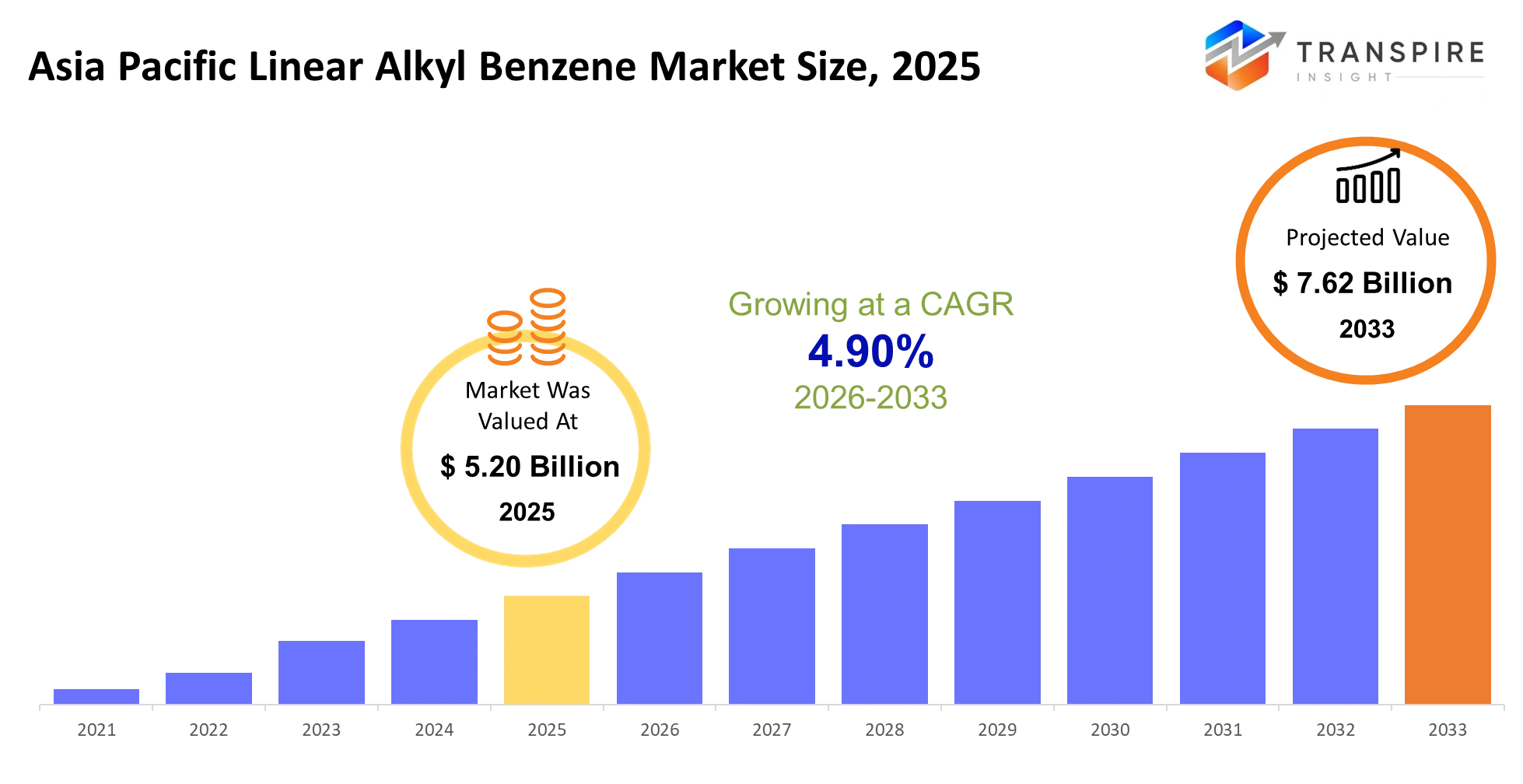
- Asia Pacific Linear Alkyl Benzene Market Size 2025: USD 5.20 Billion
- Asia Pacific Linear Alkyl Benzene Market Size 2033: USD 7.62 Billion
- Asia Pacific Linear Alkyl Benzene Market CAGR: 4.90%
- Asia Pacific Linear Alkyl Benzene Market Segments: By Type (Heavy Linear Alkyl Benzene, Light Linear Alkyl Benzene, Others); By Application (Detergents, Industrial Cleaners, Household Cleaners, Others); By End-User (FMCG Companies, Chemical Industry, Industrial Sector, Cleaning Industry, Others); By Form (Liquid, Powder, Others).
To learn more about this report,  Download Free Sample Report
Asia Pacific Linear Alkyl Benzene Market Summary
The Asia Pacific Linear Alkyl Benzene Market was valued at USD 5.20 Billion in 2025. It is forecast to reach USD 7.62 Billion by 2033. That is a CAGR of 4.90% over the period.
The Asia Pacific Linear Alkyl Benzene (LAB) market delivers the primary chemical intermediate that enables manufacturing of biodegradable detergents which effectively clean grease and oil from residential cleaning products and industrial laundry operations and institutional restroom cleaning procedures. The region has experienced a complete transformation of its petrochemical industry during the past five years which began when India and China started building their integrated petrochemical facilities and expanding their production capacities. The post-pandemic supply chain disruptions together with the extreme fluctuations in crude oil prices resulted in producers losing their ability to obtain benzene and kerosene, which drove them to implement backward integration methods.
The results have affected investment choices because detergent producers and chemical companies established local LAB production facilities to maintain cost control and ensure ongoing product availability for their rapidly developing FMCG and industrial cleaning business operations. The current growth process receives more influence from supply security requirements and rising urban consumption patterns which particularly drive activities in densely populated Southeast Asian and South Asian regions.
Key Market Insights
- China controls the Asia Pacific Linear Alkyl Benzene Market with approximately 35 to 40 percent market share because its manufacturing facilities produce detergents at industrial scale and its plants operate as integrated petrochemical operations.
- India emerges as the fastest-growing regional hub from 2024 until 2032 because both rising FMCG consumption and import substitution strategies drive its development.
- Southeast Asia experiences continuous growth because urban sanitation infrastructure development and industrial cleaning needs show increasing demand.
- The LAS-grade LAB segment leads the market with approximately 60 percent share because its usage in detergents remains dominant.
- Normal paraffin-based LAB holds the second-largest market share because it serves as a common raw material for producing industrial surfactants at lower production costs.
- The segment of High-purity LAB shows the fastest growth because premium detergent formulas and environmental regulations require its use.
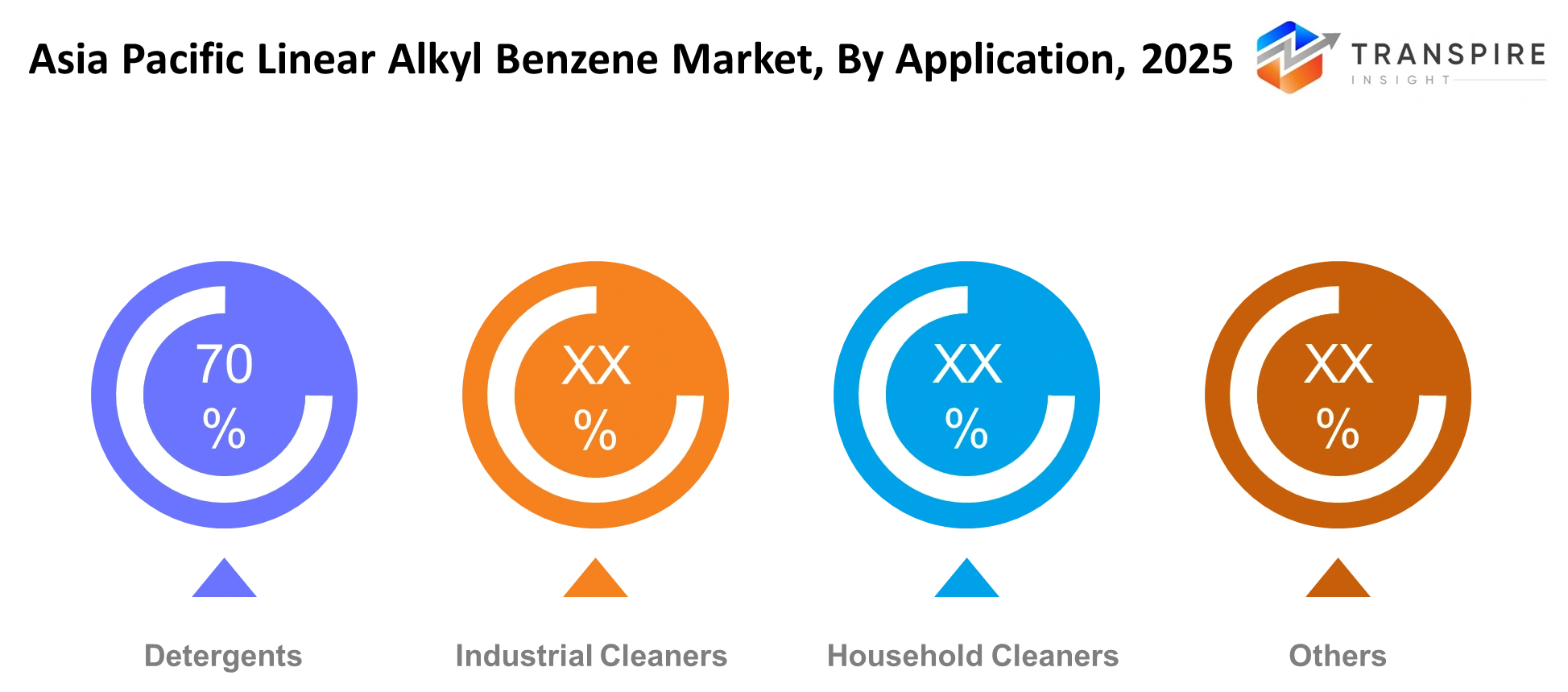
- The Asia Pacific Linear Alkyl Benzene Market shows its highest market share through household detergents which account for almost 70% of the market because urban areas develop and people increase their demand for hygiene products.
- The healthcare and manufacturing industries drive the fastest growth through their need for industrial and institutional cleaning services.
- The FMCG detergent manufacturers maintain their market lead as end users because they account for approximately 65% of the market which shows strong demand for packaged cleaning products.
- The industrial cleaning service sector experiences its fastest growth because factory and commercial facility hygiene requirements increase.
What are the Key Drivers, Restraints, and Opportunities in the Asia Pacific Linear Alkyl Benzene Market?
The Asia Pacific Linear Alkyl Benzene Market experiences its main growth driver through the uninterrupted development of detergent production which connects to the increasing urban population and the growth of formal retail outlets throughout India and China and Southeast Asian countries. After 2020, this growth reached its peak when supply chain problems revealed that the industry relied too much on imported surfactant intermediates, which led both government and private refiners to develop domestic LAB production facilities. The Chinese and Indian integrated petrochemical facilities achieved higher production levels which helped them secure their feedstock supply while reducing their manufacturing process fluctuations. This development leads to stable revenue growth for producers, which allows detergent companies to widen their range of packaged cleaning products.
The most significant restraint exists because LAB production requires both benzene and kerosene, which maintain a strong connection to crude oil price changes and the variations in oil refining capacity. The structural dependency of the system limits organizations to the existing pricing structure because they face production challenges whenever input costs swing between fixed points. The problem remains active because upstream refining facilities need extended time periods and government permission, which becomes particularly difficult in regions with strict environmental protection measures. The expense fluctuations create difficulties that prevent businesses from establishing long-term purchasing agreements, which results in smaller producers experiencing challenges when trying to increase their production capabilities.
A major chance has opened up for bio-based and low-emission alkylation technologies which India and South Korea test through their current pilot projects. The Asia Pacific Linear Alkyl Benzene Market will shift to lower-carbon detergent supply chains if these processes achieve successful commercial implementation, which will benefit export-focused FMCG brands that aim to meet EU and North American sustainability standards.
What Has the Impact of Artificial Intelligence Been on the Asia Pacific Linear Alkyl Benzene Market?
The Asia Pacific Linear Alkyl Benzene Market experiences gradual transformation through artificial intelligence and advanced digital systems which enhance production efficiency and environmental compliance practices in large-scale petrochemical facilities. Modern LAB manufacturing units now utilize AI-based control systems for process monitoring which covers their alkylation reactors and distillation columns and feedstock blending operations. The systems operate through continuous adjustment of their operational settings which enables them to produce output with consistent quality while reducing the need for human operation and maintaining precise control over their energy use and emissions from the combined refinery processes.
Predictive maintenance of essential machinery including heat exchangers and compressors now uses machine learning models for its implementation. The systems analyze vibration and temperature and throughput data to assist operators in identifying potential failures before they take place which results in plant uptime improvements of 8 to 12 percent and decreases unplanned shutdowns that disrupt supply chains throughout the Asia Pacific Linear Alkyl Benzene Market. Emissions forecasting tools help refineries and chemical hubs meet stricter environmental regulations through their ability to simulate emissions from exhaust gas treatment systems.
The implementation of new systems faces challenges because existing plants need to pay high costs for system integration while they operate with incomplete operational systems that depend on outdated technologies. The lack of high-quality operational data that facilities need for real-time monitoring creates operational challenges because it decreases model precision which leads to delays in implementing operational changes that would improve efficiency in their operations.
Key Market Trends
- Since 2021, China has increased its integrated LAB production capacity by more than 20%, which helped the country reduce its need for foreign imports while creating major changes to its regional supply chain networks.
- After the 2022 refinery disruptions, India implemented backward integration to help domestic manufacturers secure feedstock supplies and enhance the consistency of their detergent production.
- The crude oil price changes that occurred after 2020 required producers to develop new procurement methods, which resulted in an increase of long-term supply agreements between LAB producers and petrochemical facilities.
- Since 2021, Southeast Asian detergent manufacturers have increased their local sourcing practices by 15 to 18 percent, which has decreased their dependency on West Asian imports that help maintain price stability.
- The two companies, Reliance Industries and SABIC, increased their investments in alkylation projects after 2023 to meet the rising demand for surfactants from fast-growing FMCG companies in the Asia Pacific region.
- The growing environmental regulations in China and South Korea led companies to adopt cleaner alkylation catalysts, which resulted in lower sulfur emissions from their production facilities.
- FMCG companies increased contract manufacturing partnerships by 25% since 2022, ensuring stable LAB supply for household detergent expansion in urban markets.
- The digital refinery monitoring systems that came into use after 2023 enabled substantial production efficiency increases, which resulted in reduced operational downtime for large-scale LAB facilities.
- Indian and Indonesian export-oriented detergent manufacturers started using premium LAB grades to satisfy the more demanding sustainability standards of both the EU and US markets.
Asia Pacific Linear Alkyl Benzene Market Segmentation
By Type :
The Asia Pacific Linear Alkyl Benzene market shows strong cleaning performance through its Heavy Linear Alkyl Benzene product which manufacturers use for detergent production purposes. The product maintains high demand because it performs better in hard water conditions compared to other options. Light Linear Alkyl Benzene serves applications that require a gentle formulation solution. The other variants design for specific chemical requirements which industrial operations need.
Detergent manufacturing units base their production choices on two factors which include cost efficiency and end-use demand. The market for heavy grade products remains strong because people use these items in both home and industry cleaning applications. Light grade allows product developers to create formulas which need lower density surfactants to achieve controlled cleaning results while maintaining product stability.
By Application :
Detergents hold a leading position in the Asia Pacific Linear Alkyl Benzene Market due to rising laundry product consumption. The industry uses this material to create industrial cleaners which eliminate difficult grease and oil stains. The household cleaning industry requires surfactants which maintain consistent performance throughout their operational period. Commercial facilities use specialty cleaning products to maintain their cleaning requirements.
The growing urban population drives higher detergent consumption throughout multiple regions in the Asia Pacific area. Industrial cleaning requirements increase because manufacturing operations require more maintenance and facility upkeep. The market maintains stable demand for household cleaning products because people want to keep their homes clean.
To learn more about this report, Download Free Sample Report
By End-User :
The Asian Pacific Linear Alkyl Benzene Market serves as a principal market for FMCG companies because they produce detergents at large quantities. The chemical industry uses this substance as its primary essential material. The industrial sector uses this material to perform its cleaning tasks. The cleaning industry depends on this material to create its professional cleaning products and its cleaning service solutions.
FMCG demand stays strong because customers acquire new products for their homes at all times. The chemical producers need to maintain an uninterrupted supply of surfactants which they utilize for their production processes. Industrial users utilize this material for their two purposes maintenance operations and facility cleaning tasks. Cleaning service providers require consistent operation of their systems which enables them to deliver successful cleaning outcomes in both commercial and public spaces.
By Form :
The Asia Pacific Linear Alkyl Benzene Market uses liquid form because it enables manufacturers to create detergents and cleaners through straightforward blending and processing methods. The powder form provides advantages because it enables manufacturers to store and transport products without risk of deterioration. Industries use various other forms to create customized solutions which need specific performance metrics and formula design capabilities.
Manufacturers can use liquid variants to create surfactant systems which function in their production facilities. The manufacturing unit uses powder form material to enable producers to ship products over long distances while maintaining precise quantity control. Different product formats enable manufacturers to create products which meet cost needs and storage requirements and final product performance needs for all their different use cases.
What are the Key Use Cases Driving the Asia Pacific Linear Alkyl Benzene Market?
The primary application of Linear Alkyl Benzene in the Asia Pacific market involves the production of detergents which serve both domestic and institutional cleaning purposes. The major fast-moving consumer goods companies in the market use LAB as an essential component which they need to create biodegradable surfactants because urban hygiene needs have increased in Indian and Chinese and Southeast Asian cities. The constant demand for household cleaning products establishes this category as the main way people use products.
The current market offers industrial and institutional cleaning solutions which find application in hospitals and food processing facilities and manufacturing plants. End users demand from chemical suppliers high-performance detergents which maintain constant foaming ability and complete grease removal performance, which leads suppliers to establish permanent LAB supply agreements with petrochemical manufacturers.
New applications are being developed through specialized cleaning products which serve export-oriented green FMCG products and eco-friendly industrial cleaning solutions. South Korean and Indian producers test low-emission surfactant mixtures which they develop for premium detergent brands that aim to meet EU regulatory standards, which shows how the Asia Pacific Linear Alkyl Benzene Market begins to expand into new cleaning product categories.
|
Report Metrics |
Details |
|
Market size value in 2025 |
USD 5.20 Billion |
|
Market size value in 2026 |
USD 5.45 Billion |
|
Revenue forecast in 2033 |
USD 7.62 Billion |
|
Growth rate |
CAGR of 4.90% from 2026 to 2033 |
|
Base year |
2025 |
|
Historical data |
2021 - 2024 |
|
Forecast period |
2026 - 2033 |
|
Report coverage |
Revenue forecast, competitive landscape, growth factors, and trends |
|
Regional scope |
Asia Pacific (China, India, Japan, South Korea, Australia, Rest of Asia Pacific) |
|
Key company profiled |
Reliance Industries, CEPSA, Sasol, Deten Quimica, Farabi Petrochemicals, ISU Chemical, Fushun Petrochemical, Jin Tung Petrochemical, KPC, Chevron Phillips, PetroChina, Sinopec, Huntsman, Arkema, BASF. |
|
Customization scope |
Free report customization (country, regional & segment scope). Avail customized purchase options to meet your exact research needs. |
|
Report Segmentation |
By Type (Heavy Linear Alkyl Benzene, Light Linear Alkyl Benzene, Others); By Application (Detergents, Industrial Cleaners, Household Cleaners, Others); By End-User (FMCG Companies, Chemical Industry, Industrial Sector, Cleaning Industry, Others); By Form (Liquid, Powder, Others). |
Which Regions are Driving the Asia Pacific Linear Alkyl Benzene Market Growth?
China holds the top position in the Asia Pacific Linear Alkyl Benzene Market because its petrochemical industry operates through complete integration while the country maintains extensive detergent production facilities. The government establishes strong support to build domestic chemical self-sufficiency which leads to ongoing growth of alkylation facilities in coastal industrial areas such as Jiangsu and Shandong. The existing port facilities together with their access to benzene and kerosene feedstock systems create better production results and higher export potential for the company. China functions as the primary supply center for the regional value chain because its extensive network of FMCG production facilities creates consistent demand from downstream partners.
India maintains stable market operations through strong domestic consumption which serves as its primary growth driver instead of relying on exports. The Indian market achieves stability through consistent household detergent demand which results from population growth and improvements in urban sanitation. The regulatory process has developed to match environmental standards and refinery efficiency standards which has led companies to implement their capacity upgrades through progressive steps instead of immediate growth. Domestic businesses such as Reliance Industries have made long-term investments which improve feedstock integration to create reliable supply systems that operate during fluctuations in global crude oil prices.
The current industrial expansion of Southeast Asia results from its recent industrial growth and the establishment of new refinery and petrochemical facilities in Indonesia and Vietnam. The chemical logistics operations have benefited from government industrial corridor development programs and port modernization initiatives since 2022. The increasing demand for fast-moving consumer goods together with the export-oriented detergent manufacturing has led to higher consumption of LAB in emerging industrial areas. The regional industrial growth and better trade links with other regions make this area the most promising market for 2026 through 2033 period.
Who are the Key Players in the Asia Pacific Linear Alkyl Benzene Market and How Do They Compete?
The Asia Pacific Linear Alkyl Benzene Market operates with moderate market consolidation because a few integrated petrochemical companies control most of the market. Brand identity and product uniqueness do not impact market competition as much as production efficiency and refinery accessibility and feedstock integration methods. Existing companies maintain their market positions by obtaining upstream supplies of benzene and kerosene, which enable them to protect their earnings during periods of crude oil price changes. Coastal refining hubs provide logistics benefits that determine regional detergent supply chain export performance across different areas.
Reliance Industries strengthens its position through deep backward integration at its Jamnagar complex, enabling strict control over feedstock costs and consistent supply to FMCG manufacturers in India. SABIC operates its petrochemical plants together with its operational expertise to achieve maximum industrial production capacity, which it exports to Asian markets. Petronas Chemicals uses its integrated Malaysian refining operations to secure domestic feedstock, which enables stable pricing with detergent producers in Southeast Asia through long-term contracts, thus strengthening its position as a reliable regional partner.
Sasol provides licensing services for process technology and develops high-efficiency alkylation methods, which enable industrial clients to achieve better yield results. Chevron Phillips Chemical develops paraffin optimization technologies to create superior production economics, which benefit LAB manufacturers in their downstream operations. Deten Química maintains its market niche through long-term contracts with detergent manufacturers, while entering new markets through partnerships that do not require major production facility increases.
Company List
- Reliance Industries
- CEPSA
- Sasol
- Deten Quimica
- Farabi Petrochemicals
- ISU Chemical
- Fushun Petrochemical
- Jin Tung Petrochemical,
- KPC
- Chevron Phillips
- PetroChina
- Sinopec
- Huntsman
- Arkema
- BASF
Recent Development News
In November 2025, KazMunayGas formed a partnership with Uzbekneftegaz to construct a 50,000-tonne-per-year linear alkyl benzene plant. The joint venture will increase Central Asian LAB production capacity while decreasing import needs and enhancing feedstock processing for detergent and surfactant production throughout the entire Asia-Pacific region.
Source: https://hydrocarbonprocessing.com/
In March 2026, The Egyptian Linear Alkyl Benzene Company (ELAB) announced its highest production level of 141000 tonnes of linear alkyl benzene for the year 2025. The company reached this production milestone because its operational capacity has improved which now enables them to better meet export demands throughout their Asian-Pacific markets.
Source: https://www.dailynewsegypt.com/
What Strategic Insights Define the Future of the Asia Pacific Linear Alkyl Benzene Market?
The Asia Pacific Linear Alkyl Benzene Market now experiences a structural transformation that connects upstream refining operations with downstream detergent production processes because feedstock security needs to be maintained during times when crude oil prices create economic instability. Over the next 5–7 years, production will concentrate further in refinery-linked clusters across China, India, and Southeast Asia, where cost advantages and logistics efficiency reinforce regional dominance.
The industry faces a hidden danger because alternative surfactant chemistries including bio-based systems and alcohol ethoxylate systems introduce substitution pressure which will incrementally decrease LAB's market presence in premium detergent formulations when sustainability regulations advance more quickly than anticipated.
The current situation gives rise to an opportunity for low-carbon alkylation technologies which various companies test through their pilot projects in India and South Korea while industrial decarbonization policies and export-driven FMCG demand provide necessary support. Market participants should make backward integration their main focus while allocating resources to develop cleaner production technologies which will help them establish permanent contracts with global detergent brands that now require carbon disclosure compliance.
Asia Pacific Linear Alkyl Benzene Market Report Segmentation
By Type
- Heavy Linear Alkyl Benzene
- Light Linear Alkyl Benzene
By Application
- Detergents
- Industrial Cleaners
- Household Cleaners
By End-User
- FMCG Companies
- Chemical Industry
- Industrial Sector
- Cleaning Industry
By Form
- Liquid
- Powder
Frequently Asked Questions
Find quick answers to common questions.
The Asia Pacific Linear Alkyl Benzene Market size is USD 7.62 Billion in 2033.
Key segments for the Asia Pacific Linear Alkyl Benzene Market are By Type (Heavy Linear Alkyl Benzene, Light Linear Alkyl Benzene, Others); By Application (Detergents, Industrial Cleaners, Household Cleaners, Others); By End-User (FMCG Companies, Chemical Industry, Industrial Sector, Cleaning Industry, Others); By Form (Liquid, Powder, Others).
Major Asia Pacific Linear Alkyl Benzene Market players are Reliance Industries, CEPSA, Sasol, Deten Quimica, Farabi Petrochemicals, ISU Chemical, Fushun Petrochemical, Jin Tung Petrochemical, KPC, Chevron Phillips, PetroChina, Sinopec, Huntsman, Arkema, BASF.
The Asia Pacific Linear Alkyl Benzene Market size is USD 5.20 Billion in 2025.
The Asia Pacific Linear Alkyl Benzene Market CAGR is 4.90% from 2026 to 2033.
- Reliance Industries
- CEPSA
- Sasol
- Deten Quimica
- Farabi Petrochemicals
- ISU Chemical
- Fushun Petrochemical
- Jin Tung Petrochemical,
- KPC
- Chevron Phillips
- PetroChina
- Sinopec
- Huntsman
- Arkema
- BASF
Recently Published Reports
-
Apr 2026
Healthcare Polymer Packaging Market
Healthcare Polymer Packaging Market Size, Share & Analysis Report By Packaging Type (Syringes, IV Bottles and Pouches, Clamshells, Blisters, Bottles & Jars, Containers, Tubes, IV Parental Packaging, Others), By Type (Regulated, Non-regulated), By Polymer Type (LDPE (Low-Density Polyethylene), HDPE (High-Density Polyethylene), Homo-polymer (Homo), Random Copolymer (Random), Block Copolymer (Block), PET, Polystyrene, Polyvinyl Chloride, Polyamide/EVOH, Others), and Geography (North America, Europe, Asia-Pacific, Middle East and Africa, South and Central America), 2021 - 2031
-
Apr 2026
Hydrophilic Tape (Waterstop) Market
Hydrophilic Tape (Waterstop) Market Size, Share & Analysis Report By Type (Bentonite-Based Hydrophilic Tape, Rubber-Based Hydrophilic Tape), By Application (Residential Buildings, Commercial Buildings, Infrastructure Projects), and Geography (North America, Europe, Asia-Pacific, Middle East and Africa, South and Central America), 2021 - 2031
-
Apr 2026
Metalens Market
Metalens Market Size, Share & Analysis Report By Type (Visible Light Metalens, and Infrared Metalens), By Application (Consumer Electronics, Automotive Electronics, Industrial, Medical, and Others), and Geography (North America, Europe, Asia-Pacific, Middle East and Africa, South and Central America), 2021 - 2031
-
Apr 2026
PBT Resin Market
PBT Resin Market Size, Share & Analysis Report By Type (Reinforced PBT Resin, Unreinforced PBT Resin), By Processing Method (Injection Molding, Extrusion, Blow Molding, Others), By End-User (Automotive, Electrical & Electronics, Consumer Appliances, Industrial Machinery, Medical Devices, Packaging, Others), and Geography (North America, Europe, Asia-Pacific, Middle East and Africa, South and Central America), 2021 - 2031