United States Amphibious Landing Craft Market Size & Forecast:
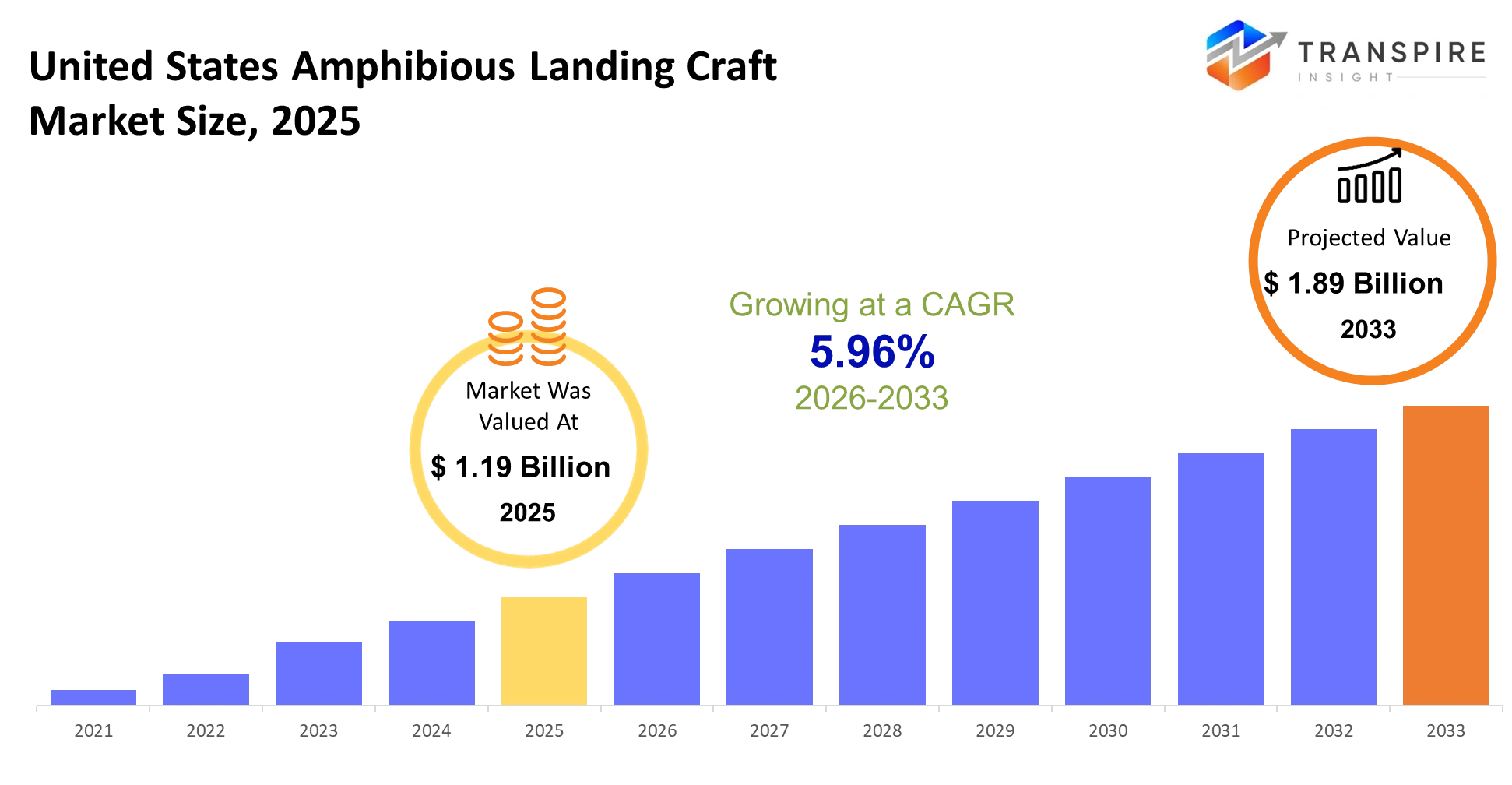
- United States Amphibious Landing Craft Market Size 2025: USD 1.19 Billion
- United States Amphibious Landing Craft Market Size 2033: USD 1.89 Billion
- United States Amphibious Landing Craft Market CAGR: 5.96%
- United States Amphibious Landing Craft Market Segments: By Craft Type (LCAC, LCU, LCM, Amphibious Assault Vehicles, Hovercraft, Others); By Propulsion Type (Diesel-powered, Gas Turbine-powered, Hybrid-powered, Electric-powered, Others); By Application (Troop Transportation, Equipment Transportation, Combat Operations, Humanitarian Missions, Others); By End User (Navy, Marine Corps, Coast Guard, Defense Contractors, Others)
To learn more about this report,  Download Free Sample Report
United States Amphibious Landing Craft Market Summary
The United States Amphibious Landing Craft Market was valued at USD 1.19 Billion in 2025. It is forecast to reach USD 1.89 Billion by 2033. That is a CAGR of 5.96% over the period.
Amphibious landing craft are basically the logistical bridge between sea based assets and shorelines that are contested or just plain limited in infrastructure, where you can’t count on normal port access. They move troops, armored vehicles, engineering kit, and also humanitarian relief supplies, sometimes in conditions where the usual routes are not available. In the United States these vessels sit right in the middle of expeditionary warfare doctrine, rapid response disaster actions , and increasingly distributed maritime logistics. Over the last three to five years, the market has kind of drifted away from older displacement types and toward next generation platforms, with autonomous navigation , better survivability, and modular mission setups that can be swapped depending on the situation.
That change sped up after the Indo-Pacific security environment got tense, and there was renewed attention on littoral operations. Those efforts revealed some operational gaps in the aging fleet capabilities, so the U.S. Navy and Marine Corps leaned harder into modernization programs, like ship-to-shore connector upgrades. On top of that, pandemic era supply chain disruptions slowed procurement timelines, which then pushed more domestic manufacturing reinforcement, plus a wider spread of suppliers. So you end up with a market where buying decisions are increasingly tied to platform resilience and operational flexibility. And that, in turn, gives contractors who are aligned with modernization needs more longer term revenue visibility.
Key Market Insights
- The Gulf Coast region kinda dominates the United States Amphibious Landing Craft Market, bringing in around 38% market share in 2025, largely because naval shipbuilding infrastructure is concentrated there in a very specific way.
- The West Coast meanwhile is the fastest growing regional market through 2032, it is backed by Indo-Pacific deployment strategies and also the upgrades happening at key naval bases.
- Atlantic coastal procurement activity saw about 11% year on year growth in 2025, which signals more funding for amphibious readiness , and not just in small steps either.
- Ship to Shore Connectors (SSC) basically lead the United States Amphibious Landing Craft Market with roughly 42% share in 2025, helped along by the replacement of aging LCAC fleets.
- After that, Landing Craft Utility (LCU) platforms take the second largest market share, mainly because logistics transport work stays pretty consistent, even when budgets shift a bit.
- Autonomous amphibious craft systems feel like the fastest-moving part through 2030, mostly powered by unmanned maritime trials and those efficiency wins that happen during real ops.
- Military assault and tactical deployment still sort of dominate, they make up about 61% of total market demand in 2025 , and that basically shows how mission-critical expeditionary activity stays front and center.
- For disaster response and humanitarian assistance , that’s the fastest-growing angle too, climbing roughly 6.4% per year all the way through 2032.
- Meanwhile littoral logistics missions keep picking up momentum as distributed force strategies reshape how amphibious deployment frameworks work.
- In the United States Amphibious Landing Craft Market, the U.S. The Marine Corps leads the pack , and it captures nearly 47% market share in 2025 , largely because of modernization-driven purchasing programs.
What are the Key Drivers, Restraints, and Opportunities in the United States Amphibious Landing Craft Market?
The United States Amphibious Landing Craft Market is mostly moved by quick modernization of expeditionary warfighting abilities inside the U.S. Navy and Marine Corps, you know. This change got a push after operational gaps showed up during Indo-Pacific force mobility exercises and it also got further sped up by defense budget reallocations toward distributed seaborne operations. Because of that, procurement programs are starting to lean more heavily on Ship-to-Shore Connectors and autonomous landing craft , these things tend to raise payload efficiency and lower the reliance on exposed port infrastructure. In practice this transition helps contract value for shipbuilders and defense contractors too , since revenue gets tied to long-cycle fleet replacement programs, not just the smaller, incremental upgrades.
Still , the market is held back by a kind of structural drag coming from drawn out defense procurement cycles and tight compliance demands under U.S. federal acquisition rules. Those steps stretch the development window and push back actual platform fielding, so near-term revenue realization stays limited even if demand is already there. On top of that, there are heavy lifecycle costs for amphibious craft maintenance and crew training which adds budget pressure inside naval modernization plans , and that slows fleet growth even when the strategic need is obvious.
A key opportunity is kinda showing up through autonomous and semi-autonomous amphibious systems that are integrated with AI navigation and unmanned logistics coordination, and honestly it sounds like a big deal. Pilot efforts carried out across West Coast naval testing corridors show better mission endurance and lower operational risk when you’re dealing with contested littoral zones, which is where things get messy. If this gets scaled up via partnerships with contractors like Huntington Ingalls Industries, and Textron Systems , it could end up redefining deployment efficiency, then basically open a fresh growth phase for the United States Amphibious Landing Craft Market.
What Has the Impact of Artificial Intelligence Been on the United States Amphibious Landing Craft Market?
Artificial intelligence is reshaping operational efficiency and lifecycle management across the United States Amphibious Landing Craft Market, kinda by tucking automation into the vessel control systems and also into compliance workflows. Naval platforms increasingly depend on AI-enabled monitoring tools to keep an eye on propulsion behavior, fuel usage and marine emission control systems , even the scrubber performance systems where they are installed on auxiliary vessels. With these setups in place, the platforms will automatically tune engine loads and spot unusual behavior in real time. that cuts down on manual input quite a bit, and it tends to make operations more steady during long stretches of deployment.
Alongside that, machine learning models are being pushed into predictive maintenance, where sensor feeds from engines, gearboxes, and hull stress points get reviewed to anticipate failures before they actually happen. Defense operators then use those findings to line up repairs inside scheduled maintenance windows, which raises fleet readiness and cuts down unplanned downtime by roughly 10–15 percent . At the same time, AI-based performance optimization tools are used for fuel efficiency modeling and emissions forecasting, so operators can satisfy more strict regulatory requirements while still managing lifecycle costs.
Still, adoption is limited by a lack of high quality maritime training data and by the hard problem of representing amphibious operations in contested littoral settings. There are also connectivity gaps at sea, which limits real time data sharing. That, in turn, weakens the model precision and slows the path to full-scale deployment of autonomous decision systems.
Key Market Trends
- After 2022 the U.S. Navy kind of shifted procurement toward Ship-to-Shore Connector upgrades , and instead of sticking with the older LCAC platforms they leaned into systems that give more payload efficiency.
- Textron Systems together with General Dynamics expanded digital vessel control integration somewhere between 2023 and 2025 , which in practice boosted amphibious mission responsiveness , and it also sharpened navigation precision a bit more than before.
- Huntington Ingalls Industries has been pushing modular shipbuilding more since 2021. That change seems to cut down production cycles, plus it helped speed up delivery for amphibious assault craft , even when demand kept rising.
- In 2024 BAE Systems rolled out enhanced survivability coatings, along with hull reinforcement upgrades. The move basically answers the trend of contested littoral threats becoming more intense over time.
- Then Bollinger Shipyards scaled up Gulf Coast production capacity after 2022 , tied to defense funding shifts. The point was to support quicker U.S. fleet replenishment cycles, and keep the tempo from slipping.
- Austal USA also integrated automation-driven diagnostics into new landing craft programs during 2023–2025. The result was better maintenance forecasting accuracy and more realistic uptime planning.
- The U.S. Department of Defense increased investment in autonomous amphibious prototypes after 2021. They kept prioritizing unmanned logistics support for distributed operations , so units can stay functional even when they’re spread out.
- Overall industry suppliers have been transitioning from mechanical systems to software-defined vessel architectures , letting performance tuning happen continuously across amphibious fleet operations, not just at major checkpoints.
United States Amphibious Landing Craft Market Segmentation
By Craft Type :
LCAC and LCU types back high speed landing and heavy cargo shuttling across coastal stretches. LCM, and amphibious assault vehicles also step in for smaller scale troop transfer , plus equipment delivery that needs to stay closer to the shore. Hovercraft models bring that in between options, with flexible movement over water , and even shallow ground too. In general each craft type keeps naval mobility moving, and meets those shore to ship needs in practice.
There’s a kind of matching here, different craft types, for different mission demands across defense operations. LCAC is more about swift over the horizon deployment, while LCU tends to handle steady hauling of big loads. LCM fits in for medium cargo movement , and the amphibious assault vehicles aim at more direct troop landings. Hovercraft basically adds extra reach for mixed terrain access , and faster reaction work when timing matters.
By Propulsion Type :
On the propulsion side, diesel powered systems stay common because of solid fuel efficiency , and durability during long missions. Gas turbine propulsion is chosen when high speed operations are needed, since it gives stronger thrust. Hybrid setups mix fuel savings with a better performance balance. Electric powered options are getting more attention lately too, mostly for lower noise and less fuel use in modern naval planning.
So each propulsion type really maps to different needs in amphibious work. Diesel engines are good for steady long range movement, while gas turbines push better rapid deployment speed. Hybrid propulsion tries to balance efficiency with power output. Electric propulsion helps with quieter movement in sensitive areas. And other propulsion systems are still being developed, targeting longer endurance and more operational flexibility.
By Application :
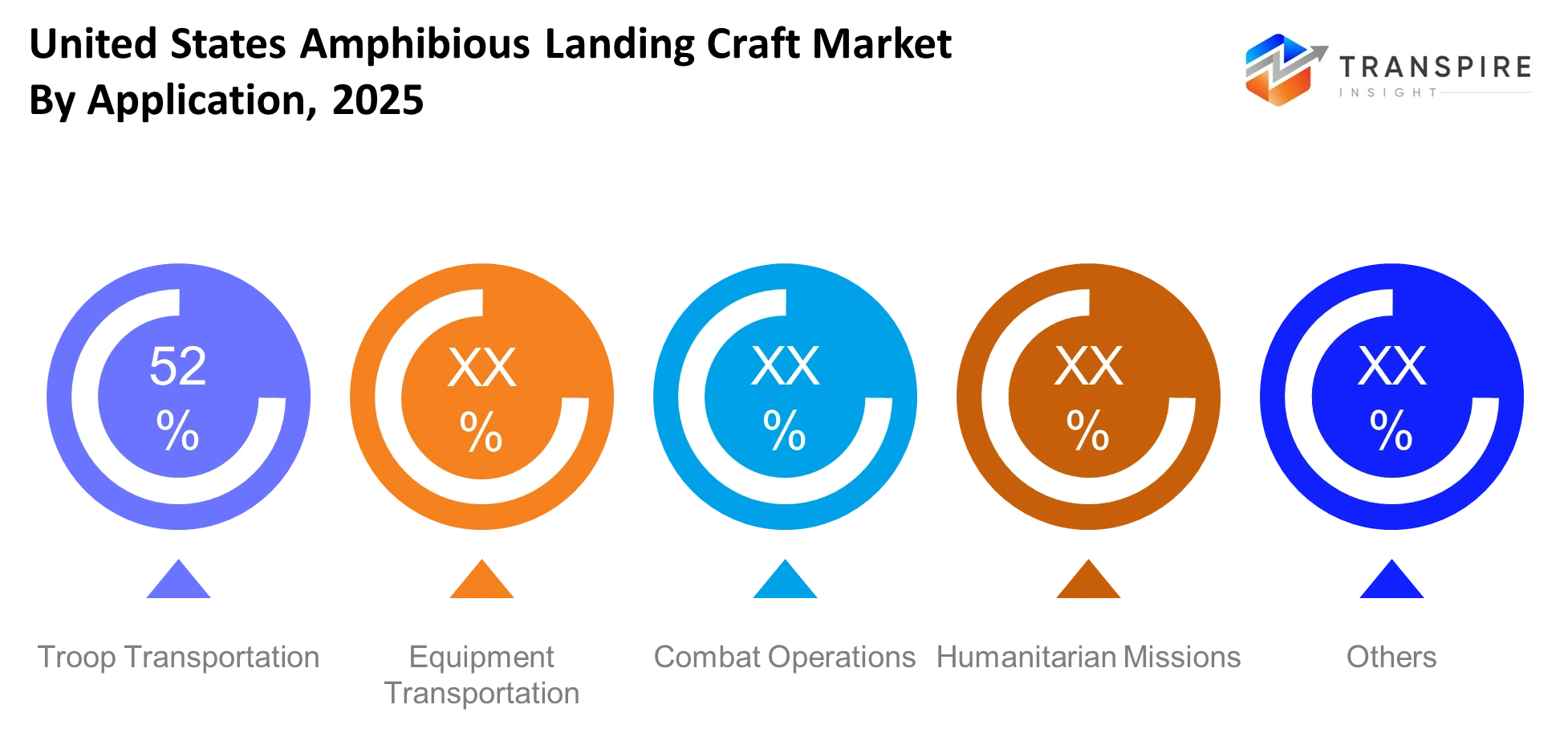
Troop transportation still counts as a key use case, helping with quick deployment of personnel out to the shore zone, in a kind of steady way. Equipment transportation also matters a lot since it keeps military supplies and vehicles moving in a safe manner. When combat happens it typically means direct assistance during a coastal engagement, not just background logistics. Meanwhile humanitarian missions help with disaster relief and evacuation work, especially in flood or other emergency-affected coastal areas.
Where it gets applied shows this operational flexibility of amphibious landing craft. Troop transport basically means fast “ready to launch” positioning, and equipment movement then supports battlefield logistics in a more continuous sense. For combat, the focus leans to tactical coastal entry support. For humanitarian use, evacuation and aid delivery happen in disaster zones. Other uses can include training, surveillance, and various coastal support activities.
To learn more about this report, Download Free Sample Report
By End User :
From the Navy side, amphibious landing craft are used for large scale maritime plus coastal missions. The Marine Corps depends on fast shore landing capability, since combat readiness is a priority. The Coast Guard uses these craft for rescue, patrol, and emergency response tasks. Defense contractors then jump in with design, production, and maintenance work so operational readiness stays intact.
End user groups end up shaping demand patterns across the market. Navy operations emphasize strategic deployment and transport missions. The Marine Corps leans hard on rapid assault and landing functions. The Coast Guard keeps working on safety, rescue, and coastal protection roles. Defense contractors handle technological development, production support, and lifecycle maintenance for the landing craft systems too.
What are the Key Use Cases Driving the United States Amphibious Landing Craft Market?
In the United States Amphibious Landing Craft Market, the main kind of use is still military assault plus ship-to-shore troop and equipment transport. The U.S. The Marine Corps basically leans on these craft to move armored vehicles, people, and supplies from ships at sea over to contested coastlines where real port access is not possible , so it becomes the main demand driver in practice.
On a more secondary track , use is also growing for humanitarian help and disaster relief work, usually missions led by the U.S. Navy, and sometimes the Coast Guard. Those efforts often rely on landing craft utility vessels , to push out emergency supplies, evacuate civilians, and then re-open logistics pathways after hurricanes and coastal flooding events, which helps keep demand up even when it’s not purely combat related.
Looking ahead, there are newer use cases that are starting to form around autonomous resupply missions and unmanned coastal logistics. These are tied to experimental programs run by the Department of Defense , where they test AI-guided amphibious craft for low risk cargo delivery across distributed maritime operations. The idea there is pretty clear, it points toward future adoption of crew-reduced or reduced-manpower missions inside wider naval logistics networks.
|
Report Metrics |
Details |
|
Market size value in 2025 |
USD 1.19 Billion |
|
Market size value in 2026 |
USD 1.26 Billion |
|
Revenue forecast in 2033 |
USD 1.89 Billion |
|
Growth rate |
CAGR of 5.96% from 2026 to 2033 |
|
Base year |
2025 |
|
Historical data |
2021 - 2024 |
|
Forecast period |
2026 - 2033 |
|
Report coverage |
Revenue forecast, competitive landscape, growth factors, and trends |
|
Geographic scope |
United States of America |
|
Key company profiled |
Textron Systems, Huntington Ingalls Industries, BAE Systems, Lockheed Martin, General Dynamics, Northrop Grumman, SAFE Boats International, Griffon Hoverwork, Almaz Shipbuilding, Damen Shipyards, ST Engineering, Austal USA, Marine Alutech, L3Harris Technologies, Leonardo |
|
Customization scope |
Free report customization (country, regional & segment scope). Avail customized purchase options to meet your exact research needs. |
|
Report Segmentation |
By Craft Type (LCAC, LCU, LCM, Amphibious Assault Vehicles, Hovercraft, Others); By Propulsion Type (Diesel-powered, Gas Turbine-powered, Hybrid-powered, Electric-powered, Others); By Application (Troop Transportation, Equipment Transportation, Combat Operations, Humanitarian Missions, Others); By End User (Navy, Marine Corps, Coast Guard, Defense Contractors, Others) |
Which Regions are Driving the United States Amphibious Landing Craft Market Growth?
The Gulf Coast region, well it kind of leads the United States Amphibious Landing Craft Market because there’s this dense bunching of naval shipbuilding yards, plus defense contractors, and older procurement hubs that have been around for a long time. Louisiana and Texas, for example, help large-scale output along by leaning on integrated supply chains , the kind that end up serving both military initiatives and auxiliary vessel programs too. A solid fit with U.S. Navy and Marine Corps contracting keeps a pretty steady stream of orders coming in for landing craft programs. And honestly this whole setup gets extra help from deep-water port access and specialized defense labor clusters, which then cuts down on production delays and helps deliveries show up faster.
Meanwhile the Atlantic Coast is more like a steady, mature contributor, but its logic is different from the production heavy hotspots. In that area, demand is tied to fleet maintenance cycles, training operations, and readiness deployments , not huge manufacturing expansions. Naval bases in Virginia and Maryland keep procurement consistent through long-term sustainment contracts and smaller incremental vessel upgrades. That steadiness is backed up by fairly predictable federal budget cycles , so modernization continues without a big jumpy procurement pattern or sudden volatility.
Then there is the West Coast, which is the fastest moving region, driven by higher Indo-Pacific operating focus and newer investments in naval logistics infrastructure. California shipyards and ports have pushed capacity upward after more funding for distributed maritime operations and amphibious readiness programs post 2022. This change suggests a pivot in how mobility and rapid deployment are handled for the Pacific theater, kind of shifting the emphasis. For investors and new market entrants, the region reads as a strong long-term opening, linked to fleet modernization cycles all the way through 2033.
Who are the Key Players in the United States Amphibious Landing Craft Market and How Do They Compete?
In the United States Amphibious Landing Craft Market the competitive situation is still kind of moderately consolidated, where a small set of defense shipbuilders plus systems integrators controls most of the long-cycle procurement deals. The incumbents stay in front because it’s not easy to enter, what with the strict defense certifications , and all the capital intensive production requirements. So really, rivalry is driven less by price and more by technological muscle, platform dependability, and strict alignment with U.S. Navy mission specs. Lately some disruption is showing up from digital ship design adoption and autonomous vessel trials, and this is slowly changing how contracts get awarded, and also how they’re judged.
Huntington Ingalls Industries leans into large scale naval integration and attempts to keep costs steady with modular shipbuilding. It stands out through strong Navy alignment, plus an integrated yard setup, that supports end to end amphibious vessel construction. They’re also pushing ahead with digital twin ship design systems, which are meant to cut build delays and improve lifecycle forecastability , in a practical way.
Textron Systems competes around high performance landing craft innovation, especially with hovercraft driven mobility systems. Their edge is really tied to propulsion engineering depth and fast deployment platform design. They keep expanding by bringing autonomous capability into the mix, plus working through partnerships with defense research programs.
General Dynamics uses its systems integration know-how across naval platforms. It differentiates by focusing on advanced command-and-control integration during amphibious operations. The direction right now is more upgrading of digital shipboard systems, and also more emphasis on its presence in next generation amphibious logistics programs.
Company List
- Textron Systems
- Huntington Ingalls Industries
- BAE Systems
- Lockheed Martin
- General Dynamics
- Northrop Grumman
- SAFE Boats International
- Griffon Hoverwork
- Almaz Shipbuilding
- Damen Shipyards
- ST Engineering
- Austal USA
- Marine Alutech
- L3Harris Technologies
- Leonardo
Recent Development News
In April 2026, Fincantieri Marine Group kind of grabbed a contract worth around $30 million from the U.S. Navy for Landing Ship Medium (LSM) support, sort of for program work and materials. It will cover the materials procurement along with engineering tasks for the initial four amphibious landing ships, in a broader effort that could eventually scale up to something like 35 vessels. That in turn is meant to reinforce U.S. Navy amphibious logistics and expeditionary sealift capability, basically giving more practical reach for deployments.
Source https://navyleaders.com/
In February 2026, The U.S. Navy , specifically (NAVSEA) put out a Request for Proposal (RFP) for a Vessel Construction Manager tied to the Landing Ship Medium (LSM) program. This part kinda moves things along in the procurement stage for the next generation amphibious landing craft class, and it allows wider scale coordination between shipyard construction, plus it may speed up the deployment timeframes for expeditionary warfare vessels.
Source https://en.wikipedia.org/
What Strategic Insights Define the Future of the United States Amphibious Landing Craft Market?
The United States Amphibious Landing Craft Market is kinda slowly moving toward a digitally enabled, and more autonomy supported fleet setup, driven by distributed maritime operations and that need for fast ship-to-shore mobility in contested areas. Over the next five to seven years, procurement will end up leaning more on platform interoperability , less crew dependence , and overall lifecycle efficiency, rather than just looking at raw vessel tonnage or replacement cycles. This kind of shift is tied to defense modernization plans that push for adaptability across Indo-Pacific deployment pathways and disaster response readiness.
There’s also a less obvious risk, more like a background issue, involving platform concentration among a smaller group of certified shipbuilders, which can make the whole thing more prone to production bottlenecks and schedule slippage if supply chain interruptions happen, or if labor shortages get worse. That same concentration can also bring heightened exposure to single point technical dependencies in key amphibious efforts, even if nobody notices at first.
On the opportunity side, something new is starting to show up: hybrid autonomous logistics corridors, linking naval vessels with unmanned coastal delivery systems, especially around West Coast test ranges and Pacific-forward bases. If it actually scales, it could change amphibious supply chains in a pretty meaningful way, mainly by cutting down the need for crewed presence in high risk zones.
Market participants might want to put money in early modular autonomous integration platforms that can retrofit existing landing craft, so they stay relevant across both legacy fleets, and the next wave of procurement cycles.
United States Amphibious Landing Craft Market Report Segmentation
By Craft Type
- LCAC
- LCU
- LCM
- Amphibious Assault Vehicles
- Hovercraft
By Propulsion Type
- Diesel-powered
- Gas Turbine-powered
- Hybrid-powered
- Electric-powered
By Application
- Troop Transportation
- Equipment Transportation
- Combat Operations
- Humanitarian Missions
By End User
- Navy
- Marine Corps
- Coast Guard
- Defense Contractors
Frequently Asked Questions
Find quick answers to common questions.
The United States Amphibious Landing Craft Market size is USD 1.89 Billion in 2033.
Key segments for the United States Amphibious Landing Craft Market are By Craft Type (LCAC, LCU, LCM, Amphibious Assault Vehicles, Hovercraft, Others); By Propulsion Type (Diesel-powered, Gas Turbine-powered, Hybrid-powered, Electric-powered, Others); By Application (Troop Transportation, Equipment Transportation, Combat Operations, Humanitarian Missions, Others); By End User (Navy, Marine Corps, Coast Guard, Defense Contractors, Others).
Major United States Amphibious Landing Craft Market players are Textron Systems, Huntington Ingalls Industries, BAE Systems, Lockheed Martin, General Dynamics, Northrop Grumman, SAFE Boats International, Griffon Hoverwork, Almaz Shipbuilding, Damen Shipyards, ST Engineering, Austal USA, Marine Alutech, L3Harris Technologies, Leonardo.
The United States Amphibious Landing Craft Market size is USD 1.19 Billion in 2025.
The United States Amphibious Landing Craft Market CAGR is 5.96% from 2026 to 2033.
- Textron Systems
- Huntington Ingalls Industries
- BAE Systems
- Lockheed Martin
- General Dynamics
- Northrop Grumman
- SAFE Boats International
- Griffon Hoverwork
- Almaz Shipbuilding
- Damen Shipyards
- ST Engineering
- Austal USA
- Marine Alutech
- L3Harris Technologies
- Leonardo
Recently Published Reports
-
Apr 2026
Aerospace Fluoropolymers Market
Aerospace Fluoropolymers Market Size, Share & Analysis Report By Type (PTFE, FEP, PFA, ETFE, and Others), By Application (Electrical Insulation, Seals & Gaskets, Coatings, and Others), By End User (Commercial Aviation, Military Aviation, General Aviation, and Others), and Geography (North America, Europe, Asia-Pacific, Middle East and Africa, South and Central America), 2021 - 2031
-
Apr 2026
Airborne SATCOM System Market
Airborne SATCOM System Market Size, Share & Analysis Report By Type (SATCOM Terminals, Transceivers, Airborne Radio, Modems and Routers, SATCOM Radomes, and Other), By Application (Government and Defense and Commercial), and Geography (North America, Europe, Asia-Pacific, Middle East and Africa, South and Central America), 2021 – 2031
-
Apr 2026
Ship Leasing Market
Ship Leasing Market Size, Share & Analysis Report By Vessel Type (Container Ships, Bulk Carriers, Tankers, and Specialized Vessels), By Lease Duration (Short-Term Lease (Less than 1 year), Medium-Term Lease (1-5 years), and Long-Term Lease (More than 5 years)), By Lease Type (Bareboat Charter, Time Charter, Financial Lease, and Others), By End-User Industry (Oil and Gas, Manufacturing and Industrial, Automotive, Agriculture and Food, Retail and Consumer Goods, and Others), and Geography (North America, Europe, Asia-Pacific, Middle East and Africa, South and Central America), 2021 – 2031
-
Apr 2026
Thread Rolling Dies Market
Thread Rolling Dies Market Size, Share & Analysis Report By Type (Flat Thread Rolling Dies, Circular (Cylindrical) Dies, Tangential Thread Rolling Dies, Planetary Thread Rolling Dies, and Other Types), By Material Type (High-Speed Steel (HSS), Carbide, Tool Steel, Alloy Steel, and Other Specialized Alloys), By Distribution Channel (Direct Sales, Distributors and Dealers, and Online Platforms), By Application (Automotive Industry, Aerospace and Defense, Construction and Infrastructure, Industrial Machinery, Electronics and Electrical Components, Medical Devices, and Fastener Production), and Geography (North America, Europe, Asia-Pacific, Middle East and Africa, South and Central America), 2021 – 2031
Our Clients