

United States Aesthetic Dermatology Market Summary
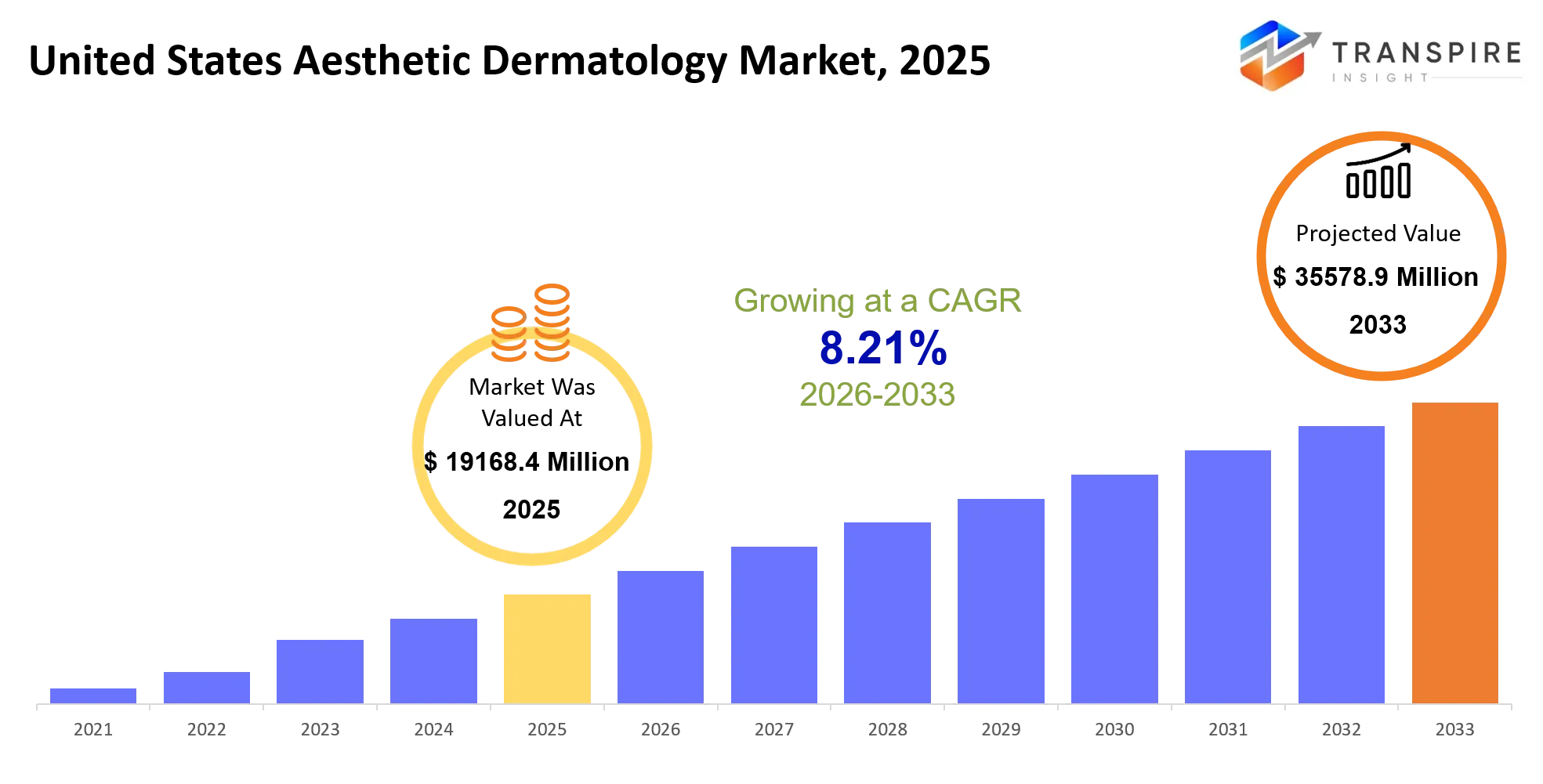
As per Transpire Insight Analysis the United States Aesthetic Dermatology Market size is estimated at USD 19168.4 Million in 2025 and is anticipated to reach USD 35578.9 Million by 2033, growing at a CAGR of 8.21% from 2026 to 2033.
As per Transpire Insight Analysis, the United States aesthetic dermatology market kind of covers the day to day cosmetic and skin-health requirements through minimally invasive actions, injectables, laser sessions, skin resurfacing, tightening methods, and body contouring services, rolled out via clinics, medical spas, and surgical centers. In the last three to five years things moved toward shorter procedures, kind of bundled or combo treatments, and device-assisted therapies that help shrink downtime while still encouraging repeat appointments. One major structural change, is the bigger role of energy-based platforms that are tied into digital treatment planning, plus more tailored protocols. During the COVID-19 period provider operations also got reshuffled, with more virtual consultations, appointment digitization, and postponed elective recovery periods. Right now, revenue growth seems to be driven by higher procedure frequency, premium device uptake, repeat injectable sessions, and wider access via medical spas. The market was valued at USD 19,168.4 million in 2025, and it is expected to climb to USD 35,578.9 million by 2033, which is roughly an 85.6% increase in market value.
United States Aesthetic Dermatology Market Size & Forecast:
- United States Aesthetic Dermatology Market Size 2025: USD 19168.4 Million
- Expected Market Value 2033: USD 35578.9 Million
- Forecast CAGR:8.21%
- Key Profile: AbbVie (Allergan Aesthetics), Galderma, Merz Pharma, Revance Therapeutics, Candela Corporation, Cutera Inc., Cynosure LLC, Alma Lasers, Lumenis Ltd., Bausch Health, Evolus Inc., Sciton Inc., Sientra Inc., Johnson & Johnson MedTech, Sisram Medical
Key Market Insights
- Market size: In 2025 the industry basically touched around USD 19.17 billion and it’s expected to drift up near USD 35.58 billion by 2033.
- Regional leadership: In 2025 the Northeast stayed in the lead, largely because of more affluent patient groups, denser concentrations of specialists and well established aesthetic practices, and yeah that kind of tracks with what you’d assume.
- Regional momentum: The West is also among the quicker accelerators, pushed by faster technology adoption, the ongoing rise of medical spa businesses, and more frequent use of energy-based procedures
- Procedure trends: Botulinum toxin and dermal fillers are still the main headlines, while microneedling, and laser resurfacing keeps gaining traction in everyday clinical work .
- Product shift: Injectables keep contributing strongly to revenue, but energy-based devices are getting more weight as clinics enlarge their treatment catalogs, like a practical expansion.
- End-user structure: Dermatology clinics remain major providers, yet medical spas are stretching their service capacity via easier, minimally invasive options, they seem to do that quite often.
- Patient mix: Female patients keep producing the largest share of treatments, though male participation has been rising across injectables, skin tightening, and hair related aesthetic offerings.
- Technology adoption: AI assisted imaging and care planning, plus digital patient assessment, are smoothing consult workflows and helping clinicians choose procedures in a more customized way.
- Competitive strategy: AbbVie, Galderma, Merz, Revance, Candela, and Cutera are basically moving forward via injectable innovation, device development, portfolio expansion, and provider partnerships, no huge surprise there.
- Revenue outlook: the forecast sort of points to around an 85.6% jump in market value from 2025 to 2033, driven by repeat treatments and also by broader access to services, more widely used ones.
What are the Key Drivers, Restraints, and Opportunities in the United States Aesthetic Dermatology Market?
The most powerful growth lever is really the move from more surgical cosmetic actions toward minimally invasive options with faster recovery. Neuromodulators, dermal fillers, laser platforms , microneedling, and skin tightening systems—these kinds of tools let clinicians repeat procedures, even right around normal outpatient checkups. At the same time, medical spas and dermatology clinics have gained more space to offer these services too, and product innovation has made the results feel more exact, expanding who is eligible in practice as well. When the procedure cadence climbs higher, it also seems natural that recurring consumables move faster, equipment stays booked, and provider revenue tends to track behind it.
But there are still stubborn brakes in the system, mostly the high cost of treatment and, to be fair, pretty thin insurance backing , because most aesthetic services get paid straight by the patient. Premium laser platforms, advanced injectables, and clinical-grade systems require big upfront capital, plus training time , ongoing maintenance, and compliance expenses that really pile up. And on top of that, price sensitivity can nudge elective choices farther out, which in turn can slow adoption of newer technology, especially in smaller practicesSo the overall cost setup basically caps market reach beyond wealthier patient groups and well-funded providers.
For what’s next, there’s a strong chance with AI-assisted imaging and more personalized treatment plans. Digital skin analysis can help standardize consultations , let teams compare treatment options, keep clearer patient documentation, and support procedure design across multi-site clinics. If this gets connected with laser systems and injectable workflows, it may strengthen clinical consistency, and at the same time help boost consultation conversion and repeat-treatment scheduling. Expansion of medical spas, along with technology-minded dermatology networks, gives pretty workable routes for scaling these tools.
What Has the Impact of Artificial Intelligence Been on the United States Aesthetic Dermatology Market?
Artificial intelligence is kind of reshaping aesthetic dermatology , via automated skin checks image analysis , treatment planning, patient documentation, and digital consultation workflows all at once. AI-enabled imaging platforms can look over pigmentation, wrinkles, texture, redness, acne, and other visible skin traits, then sort of help clinicians compare baseline photos with what happens after treatment. Some advanced systems can also lean into treatment guidance by mixing what the images show with a patient history and the selected procedure parameters. In practice, these uses shrink the time spent on manual assessment and, not always but often, lead to more consistent documentation across busy clinics, and even medical spas.
Then machine learning goes in there, to boost the day to day operations, by noticing appointment patterns, care preferences, repeat visit habits, and how people use the products. Predictive analytics can help clinics with treatment room placements, timing the schedule, keeping consumables under control, and highlighting which patients might be solid choices for next follow up procedures. Also digital platforms help with automated reminders and consultation sequences, which tends to raise scheduling efficiency, and sort of lighten the whole administrative burden.
Still, a big constraint stays the quality and standardization of the training data. If lighting changes, camera systems vary, skin characteristics don’t match expectations, imaging protocols drift, or clinical notes are inconsistent, model accuracy can drop. On top of that, high integration costs plus the need for clinician validation slows adoption, especially for smaller independent practices.
Key Market Trends
- Since 2020, medical spas have kinda expanded their part in aesthetic care, sort of increasing access to minimally invasive procedures outside the usual dermatology clinics, and it feels like that role has grown more visible.
- Injectable portfolios have widened too. Manufacturers are competing by rolling out longer-lasting formulations, using differentiated delivery technologies, and offering more, treatment flexibility in general.
- Meanwhile laser platforms have moved toward multifunctional setups, so clinics can tackle resurfacing, pigmentation, vascular concerns hair removal , and skin tightening , all in one go.
- Digital consultation tools have also shifted, from being “nice to have” extras to becoming a routine part of workflow, supporting remote assessments imaging comparisons, treatment documentation, and follow up scheduling.
- Male participation has increased over recent years, especially across neuromodulators, skin tightening, hair related treatments, and facial contouring procedures.
- Combination treatment plans are getting more traction too, since providers pair injectables with lasers, microneedling, radiofrequency, or skincare protocols, depending on the client.
- AI assisted imaging has emerged as a bit of a differentiator. it helps clinics standardize skin assessment, and visualize potential treatment outcomes in a more consistent way.
- Competition seems to be getting heavier as AbbVie, Galderma, Merz, Revance, Candela, and Cutera expand their catalogs through product innovation and technology development.
- Premium clinics, more often now, invest in multifunctional platforms, which can increase equipment utilization and support broader revenue generation from each treatment room.
- Overall medical spa expansion has shifted competitive behavior toward convenient scheduling, consumer focused consultation models, membership programs, and repeat treatment pathways, not just one off visits.
United States Aesthetic Dermatology Market Segmentation
By Procedure Type
Botulinum toxin and dermal fillers kinda count as major procedure groupings, mostly because treatment sessions tend to need not much downtime and patients usually come back again, repetitively. Botulinum toxin goes after dynamic facial lines, whereas dermal fillers help with volume restoration, facial shaping, and that lip enhancement piece. Chemical peels and microdermabrasion come in as more reachable skin-refreshing options across dermatology clinics, beauty clinics ,and medical spas. Laser skin resurfacing is usually aimed at wrinkles, pigmentation, scars, and texture worries, it also seems to push demand for more advanced energy based platforms.
Microneedling has actually expanded in routine clinical use for skin texture and acne-scar problems, and in many protocols it gets paired with topical products or other procedures. Body contouring + skin tightening focus on non-surgical shaping and tissue laxity, while acne scar treatment is often tied to younger patient groups and specialty dermatology practices. Other options include hair-focused aesthetic services and more specialized rejuvenation methods, letting providers sort of grow wider treatment catalogs.
By Product Type
Injectables, basically a huge product lane, rely on neuromodulators and dermal fillers for facial lines, restoring volume , shaping contours, plus general aesthetic boosting. Then you’ve got energy-based gear that kind of helps with laser resurfacing, pigmentation issues, vascular treatment , hair removal, and overall skin rejuvenation. Skincare items also slot into professional care routines with cleansers, retinoid based products, antioxidants, moisturizers, sunscreens , and those post-procedure follow up creams. Chemical peels give a fairly controlled exfoliation for uneven pigmentation, texture improvements, acne, and other surface level skin concerns.
RF devices plus ultrasound devices assist with skin tightening by using controlled energy, while cryolipolysis systems aim at non-surgical body contouring. Dermal implants can offer longer-term volume or structural correction, in only certain aesthetic procedures. Other options include specialized accessories, consumables, imaging systems, and treatment support products, and yeah this adds more revenue channels for clinics and the device manufacturers too.
By End User
Dermatology clinics are still like major treatment hubs because properly trained specialists can do injectables, use laser tools, manage acne scar issues, run skin resurfacing sessions, and then even mix protocols in one go. Cosmetic surgery centers, too , back up higher-level aesthetic services next to non-surgical options, so it becomes easier to do cross selling between surgical steps and minimally invasive care. Hospitals deliver aesthetic dermatology through dedicated units, and often through physician led outpatient programs, which feels more organized for patients. Medical spas meanwhile have basically widened access to certain aesthetic procedures by being in convenient spots, using membership style models, and leaning into service structures that feel consumer friendly.
Most beauty clinics lean heavily on skincare routines , superficial treatments, and a handful of non invasive procedures, whereas ambulatory surgical centers handle work that needs a controlled clinical environment. Academic institutes contribute through clinical research, teaching future physicians, and by assessing new technologies as they come along. Specialty clinics concentrate on sharper needs like acne, pigmentation problems, scarring solutions, hair related aesthetics, and skin rejuvenation, while other provider types fill gaps and help broaden local access.
By Gender
Female patients are a major “treatment group” spanning botulinum toxin, dermal fillers, skin resurfacing, skincare, and body-contouring services, really all of that. Male participation has grown across facial rejuvenation, neuromodulators, skin tightening, hair-related aesthetics, and acne-scar treatment. Unisex treatment programs basically let clinics market standardized procedures to wider adult patient groups, which feels more scalable. Teenagers are usually given selected services for acne, acne scars, and supervised skincare, rather than something extensive cosmetic intervention, and that’s how it tends to be.
Adults create a lot of the actual procedure volume because working-age patients often pick options with limited downtime and flexible scheduling. Geriatric patients back up demand for age-related skin rejuvenation, volume restoration, pigmentation management, and tightening procedures. Other demographic groups then get targeted services based on clinical suitability, treatment targets, and what the provider assesses on-site, which keeps patient profiles diversified, over time.
By Age Group
People with ages between 18–30 years often go looking for acne scar treatment, skincare, microneedling, select injectables, and early stage preventive aesthetic services, even if the names get blurred in conversation. Then the 31–45 year crowd shows up as a very relevant segment, especially for botulinum toxin, dermal fillers, laser resurfacing, skin tightening, and also combination approaches that feel a bit more “all in one”. For 46–60 years, many tend to choose procedures that aim at wrinkles, facial volume loss, pigmentation, texture shifts, and tissue laxity. Folks over 60 years, usually back the demand for rejuvenation oriented treatments, but they still need the right clinical check first.
In general, adolescents lean toward acne centered dermatological care, scar management, and supervised skincare routines. Young adults more and more blend skincare with low invasiveness procedures, because expectations are becoming more custom tailored. The rest of the age groups get offered procedures based on clinical fit, skin status, treatment intentions, and what the provider recommends, and that kind of flexibility supports wider use across dermatology clinics, medical spas, and specialty practices.
What are the Key Use Cases Driving the United States Aesthetic Dermatology Market?
Facial rejuvenation still feels like a big main use case, especially when people talk about botulinum toxin and dermal fillers. Those shorter appointment sessions, the limited down time , and the fact that patients come back again and again for repeat visits, make facial aesthetics a pretty steady revenue driver for dermatology clinics, cosmetic surgery centers, and medical spas. Also, more and more combination protocols seem to tie injectables together with skincare routines, lasers, or skin-tightening procedures, kind of like one blended route instead of separate steps.
Then there is skin resurfacing, acne-scar correction, pigmentation management, and non-surgical skin tightening, these areas keep expanding in what they cover. Dermatology clinics, as well as specialty clinics, increasingly lean on microneedling, chemical peels, laser systems, RF devices, and ultrasound technologies, so they can handle several concerns in one integrated treatment plan. Medical spas also push a wider set of chosen services through convenient scheduling and consumer-friendly treatment programs, even if the mix is not the same everywhere.
Looking ahead, emerging applications include AI-assisted skin assessment, more personalized treatment planning, and digital outcome tracking that is basically always on. Advanced imaging can help keep consultations consistent, and it can make treatment comparisons easier over time. Meanwhile, multifunctional energy platforms may broaden the service catalog without needing completely separate equipment for every indication. Overall, these shifts can boost equipment utilization , and they may also support higher-value treatment pathways through the forecast period.
|
Report Metrics |
Details |
|
Market size value in 2025 |
USD 19168.4 Million |
|
Market size value in 2026 |
USD 20492.8 Million |
|
Revenue forecast in 2033 |
USD 35578.9 Million |
|
Growth rate |
CAGR of 8.21% from 2026 to 2033 |
|
Base year |
2025 |
|
Historical data |
2021 - 2024 |
|
Forecast period |
2026 - 2033 |
|
Report coverage |
Revenue forecast, competitive landscape, growth factors, and trends |
|
Regional scope |
United States |
|
Key company profiled |
AbbVie (Allergan Aesthetics), Galderma, Merz Pharma, Revance Therapeutics, Candela Corporation, Cutera Inc., Cynosure LLC, Alma Lasers, Lumenis Ltd., Bausch Health, Evolus Inc., Sciton Inc., Sientra Inc., Johnson & Johnson MedTech, Sisram Medical |
|
Customization scope |
Free report customization (country, regional & segment scope). Avail customized purchase options to meet your exact research needs. |
|
Report Segmentation |
By Procedure Type (Botulinum Toxin, Dermal Fillers, Chemical Peels, Laser Skin Resurfacing, Microdermabrasion, Microneedling, Body Contouring, Skin Tightening, Acne Scar Treatment, Others); By Product Type (Injectables, Energy-Based Devices, Skincare Products, Chemical Peels, Dermal Implants, RF Devices, Ultrasound Devices, Cryolipolysis Systems, Others); By End User (Dermatology Clinics, Cosmetic Surgery Centers, Hospitals, Medical Spas, Beauty Clinics, Ambulatory Surgical Centers, Academic Institutes, Specialty Clinics, Others); By Gender (Female, Male, Unisex, Teenagers, Adults, Geriatric Patients, Others); By Age Group (18–30 Years, 31–45 Years, 46–60 Years, Above 60 Years, Adolescents, Young Adults, Others) |
Which Regions are Driving the United States Aesthetic Dermatology Market Growth?
The Western United States is expected to stay as the main regional contributor to the U.S. aesthetic dermatology market , mostly backed by California’s big cluster of dermatology, plastic surgery, med spa activity , and technology oriented aesthetic practices. The area also tends to get strong consumer buy-in for injectables , laser options , skin rejuvenation, and those mix and match procedures. On top of that California has major aesthetic companies plus training infrastructure that helps everything move faster. With this kind of dense network made up of experienced physicians, specialized clinics, technology suppliers, and cosmetic treatment centers, the whole ecosystem kinda supports quick uptake of fresh products , devices and so on. And because there is already a solid provider base , manufacturers can lean on it for clinical education , new product launches, and more direct conversations with aesthetic practitioners.
The Northeast is also an important revenue center, but it has a different market shape than the West , since it relies more on affluent consumers , large healthcare institutions , and long established specialist practices. States like New York , Massachusetts, New Jersey, and Pennsylvania offer a steadier customer base for premium injectables, dermatological skincare, laser procedures, and minimally invasive options. Overall the region’s strong medical infrastructure and its preference for physician led care seems to drive consistent adoption, rather than depending mainly on fast med spa scale up.
Meanwhile the Southern United States is set up for the strongest growth push, fueled by population increases, higher disposable income, medical tourism, and the broader access to aesthetic clinics in Texas and Florida.
Who are the Key Players in the United States Aesthetic Dermatology Market and How Do They Compete?
Competition in the United States aesthetic dermatology market still stays pretty fragmented, across injectables, energy based devices, skincare, body contouring, and regenerative approaches, even if a smaller set of companies tends to steer many of the best-known products. Lately, rivalry keeps shifting toward clinical evidence, product distinction, practitioner education, treatment flexibility and the capacity to form long term ties with aesthetic practices, not only toward price. AbbVie’s Allergan Aesthetics leans on a wide catalog including BOTOX Cosmetic, JUVÉDERM, body contouring, skincare, plus professional education, and it pushes multimodal plans that feel coherent in clinic. Its AA Signature framework also ties the products into training and treatment protocols, so the whole “how to use it” story is there, in a way. Then in March 2026 the company launched its Skin Quality Index, which introduces standardized language for what patients and providers actually talk through, and this ends up strengthening a consultative, conversation-led style.
Galderma competes with a science led injectable lineup that brings Restylane hyaluronic acid fillers alongside Sculptra, while also expanding a skincare presence, which gives practitioners a selection of directions for more tailored treatment plans. Within Restylane, it highlights differentiated technologies like NASHA, OBT, and XpresHAn, and it keeps backing that up with clinical research plus practitioner education, to reinforce trust in the products. Revance , after Crown Laboratories’ acquisition of the company in February 2025, was able to plug into a broader skincare and aesthetics platform, which opens the door to pairing Revance’s aesthetic technologies with Crown’s commercial strengths,.
Company List
- AbbVie (Allergan Aesthetics)
- Galderma
- Merz Pharma
- Revance Therapeutics
- Candela Corporation
- Cutera Inc.
- Cynosure LLC
- Alma Lasers
- Lumenis Ltd.
- Bausch Health
- Evolus Inc.
- Sciton Inc.
- Sientra Inc.
- Johnson & Johnson MedTech
- Sisram Medical
Recent Development News
"In February 2025, Crown Laboratories completed its acquisition of Revance Therapeutics. The transaction combined Crown’s skincare capabilities with Revance’s aesthetic and therapeutic portfolio, strengthening the combined company’s ability to compete across injectable aesthetics and science-based skincare.https://crownlaboratories.com/news/crown-laboratories-announces-completion-of-acquisition-of-revance-therapeutics/ (Crown Laboratories)."
"In March 2026, Allergan Aesthetics launched the Skin Quality Index. The research-based framework introduces standardized terminology for discussing skin quality, helping providers and patients communicate more clearly during aesthetic consultations and supporting more structured treatment planning.https://news.abbvie.com/2026-03-16-Allergan-Aesthetics-Redefines-Skin-Quality-Communication-with-Launch-of-Skin-Quality-Index (AbbVie)."
"In April 2026, Galderma launched ALASTIN Signature Practices in partnership with leading aesthetic practices. The new designation is designed to integrate ALASTIN’s regenerative skincare portfolio into treatment planning and patient care, strengthening Galderma’s relationship with U.S. dermatology, plastic surgery, and medical aesthetics providers.https://www.galderma.com/news/galderma-debuts-alastin-signature-practices-partnership-leading-aesthetic-practices-elevate (Galderma)."
What Strategic Insights Define the Future of the United States Aesthetic Dermatology Market?
The United States aesthetic dermatology market is, sort of, moving steadily toward integrated multimodal care models where injectables regenerative products skincare, and energy based procedures get stitched together across longer patient treatment journeys. The core driver feels like the industry is shifting away from standalone appointments toward individualized maintenance plans, and that’s being pushed by more consumer curiosity around natural looking outcomes as well as mix and match combination approaches.
There’s also a quieter risk, not so obvious at first, which is the way the market can end up concentrating around a small number of major manufacturers. If supply gets weird, if regulatory choices change, or if one essential item disappears then providers who lean on a single line up of products can get hit pretty hard.
At the same time, there’s an emerging opportunity in skin-quality focused and regenerative treatments that support the usual volume correction. This matters especially as providers respond to facial changes tied to medication driven weight loss. Galderma’s work with Sculptra and Restylane for patients dealing with medication driven facial volume loss is a good example of that rising appetite, even if the story is still unfolding. So market players should probably focus on diversified portfolios, hands-on practitioner education, and collaborations with fast growing clinic networks rather than banking everything on one headline product.
United States Aesthetic Dermatology Market Report Segmentation
By Procedure Type
• Botulinum Toxin
• Dermal Fillers
• Chemical Peels
• Laser Skin Resurfacing
• Microdermabrasion
• Microneedling
• Body Contouring
• Skin Tightening
• Acne Scar Treatment
• Others
By Product Type
• Injectables
• Energy-Based Devices
• Skincare Products
• Chemical Peels
• Dermal Implants
• RF Devices
• Ultrasound Devices
• Cryolipolysis Systems
• Others
By End User
• Dermatology Clinics
• Cosmetic Surgery Centers
• Hospitals
• Medical Spas
• Beauty Clinics
• Ambulatory Surgical Centers
• Academic Institutes
• Specialty Clinics
• Others
By Gender
• Female
• Male
• Unisex
• Teenagers
• Adults
• Geriatric Patients
• Others
By Age Group
• 18–30 Years
• 31–45 Years
• 46–60 Years
• Above 60 Years
• Adolescents
• Young Adults
• Others
Frequently Asked Questions
Find quick answers to common questions.
The expected United States Aesthetic Dermatology Market size for the market will be USD 35578.9 Million in 2033
Key segments for the United States Aesthetic Dermatology Market are By Procedure Type (Botulinum Toxin, Dermal Fillers, Chemical Peels, Laser Skin Resurfacing, Microdermabrasion, Microneedling, Body Contouring, Skin Tightening, Acne Scar Treatment, Others); By Product Type (Injectables, Energy-Based Devices, Skincare Products, Chemical Peels, Dermal Implants, RF Devices, Ultrasound Devices, Cryolipolysis Systems, Others); By End User (Dermatology Clinics, Cosmetic Surgery Centers, Hospitals, Medical Spas, Beauty Clinics, Ambulatory Surgical Centers, Academic Institutes, Specialty Clinics, Others); By Gender (Female, Male, Unisex, Teenagers, Adults, Geriatric Patients, Others); By Age Group (18–30 Years, 31–45 Years, 46–60 Years, Above 60 Years, Adolescents, Young Adults, Others)
Major United States Aesthetic Dermatology Market players are AbbVie (Allergan Aesthetics), Galderma, Merz Pharma, Revance Therapeutics, Candela Corporation, Cutera Inc., Cynosure LLC, Alma Lasers, Lumenis Ltd., Bausch Health, Evolus Inc., Sciton Inc., Sientra Inc., Johnson & Johnson MedTech, Sisram Medical
The United States Aesthetic Dermatology Market size is USD 19168.4 Million in 2025.
The United States Aesthetic Dermatology Market CAGR is 8.21%from 2026 to 2033.
- AbbVie (Allergan Aesthetics)
- Galderma
- Merz Pharma
- Revance Therapeutics
- Candela Corporation
- Cutera Inc.
- Cynosure LLC
- Alma Lasers
- Lumenis Ltd.
- Bausch Health
- Evolus Inc.
- Sciton Inc.
- Sientra Inc.
- Johnson & Johnson MedTech
- Sisram Medical
About the Authors

Pankaj Ghogare Patil
I am Pankaj Ghogare Patil, a Senior Research Analyst at Transpire Insight, specializing in the Pharmaceutical, Chemicals & Materials, Healthcare IT, and Biotechnology industry. My expertise lies in conducting comprehensive market research, analyzing industry trends, evaluating competitive landscapes, and translating complex data into actionable insights. At Transpire Insight, I closely follow emerging technologies, regulatory developments, and market innovations to create accurate, well-researched, and informative content that helps businesses and professionals make informed decisions. I am committed to producing credible, evidence-based articles that reflect industry best practices while making technical topics accessible and valuable for a broad audience.

Chakradhar Khansole
Chakradhar serves as the Research Director at Transpire Insight, bringing over 8 years of experience in technology, innovation, and strategic market intelligence. He specializes in transforming complex market data into actionable business insights that enable organizations to make informed, growth-oriented decisions. Recognized for his strategic vision and analytical expertise, Chakradhar leads high-impact research initiatives, delivering comprehensive market assessments, competitive intelligence, and forward-looking industry analysis.
Recently Published Reports
-
Apr 2026
AI in Diabetic Retinopathy Market
AI in Diabetic Retinopathy Market Size, Share & Analysis Report By Type (Screening AI Systems, Diagnostic AI Systems, and Predictive AI Models), By Application Segment (Hospitals, Ophthalmology Clinics, Diagnostic Centers, and Research and Development), and Geography (North America, Europe, Asia-Pacific, Middle East and Africa, South and Central America), 2021 - 2031
-
Apr 2026
Psychometric Tests Market
Psychometric Tests Market Size, Share & Analysis Report By Type (Personality Tests, Ability/Aptitude Tests, Skill/Knowledge Tests, and Others), By Application (Talent Acquisition and Talent Management), and Geography (North America, Europe, Asia-Pacific, Middle East and Africa, South and Central America), 2021 – 2031
-
Apr 2026
Rare Biological Sample Collection Market
Rare Biological Sample Collection Market Size, Share & Analysis Report By Type (Isolation Kits & Reagent, Blood Collection Tubes, and Others), By Application (Oncology, Transcriptomics, Pharmacogenomics, and Others), and Geography (North America, Europe, Asia-Pacific, Middle East and Africa, South and Central America), 2021 – 2031
-
Jul 2026
Diabetic Retinopathy Market
Diabetic Retinopathy Market Size, Share & Analysis Report By Type (Proliferative Diabetic Retinopathy, and Diabetic Macular Edema (DME)), By Treatment Type (Anti VEGF Drug, Steroid Implants, Laser Surgeries, and Vitrectomy), and Geography (North America, Europe, Asia-Pacific, Middle East and Africa, South and Central America), 2021 – 2031
Our Clients







