
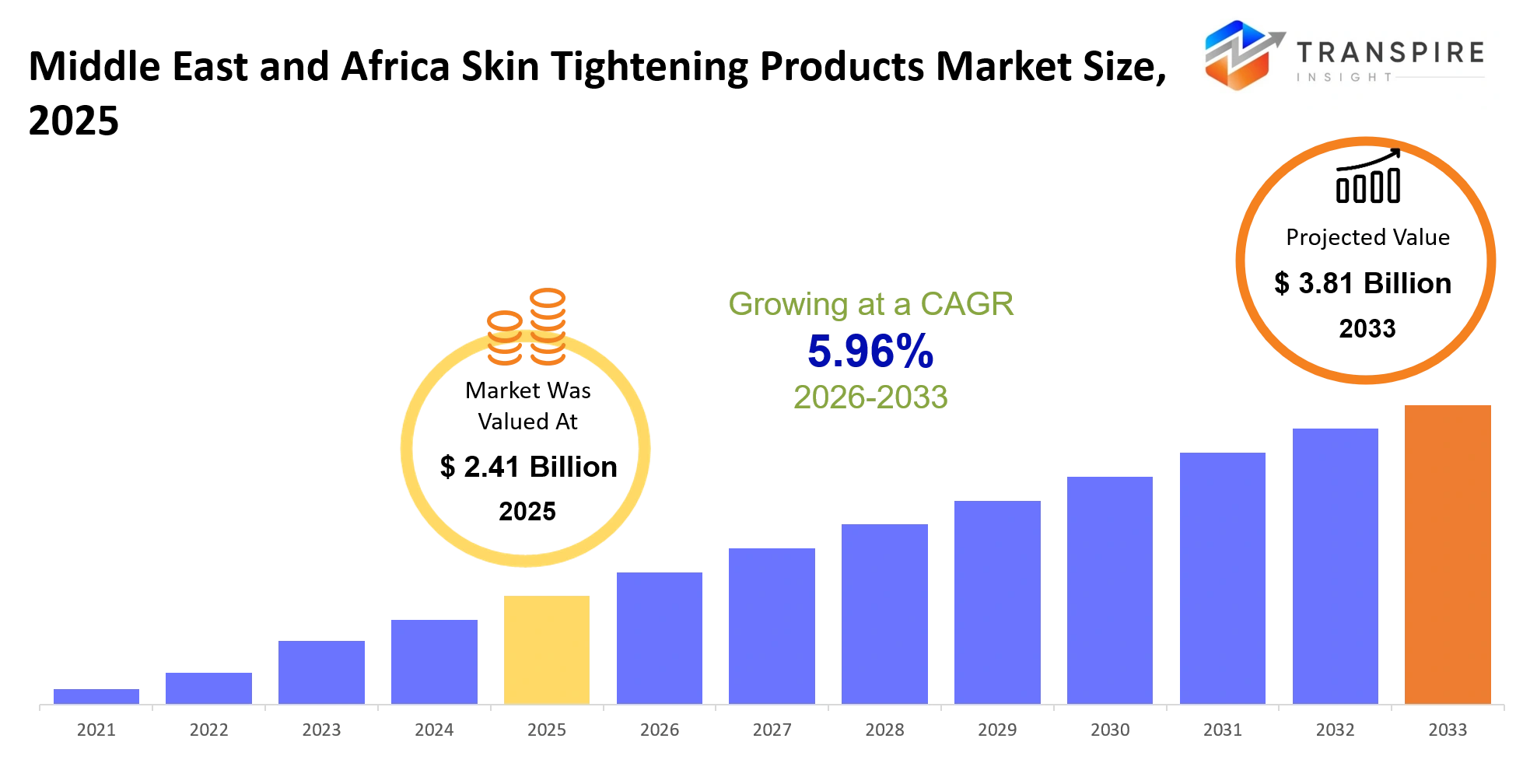
Middle East and Africa Skin Tightening Products Market Size & Forecast:
- Middle East and Africa Skin Tightening Products Market Size 2025: USD 2.41 Billion
- Middle East and Africa Skin Tightening Products Market Size 2033: USD 3.81 Billion
- Middle East and Africa Skin Tightening Products Market CAGR: 5.96%
- Middle East and Africa Skin Tightening Products Market Segments: By Product Type (Creams & Lotions, Serums, Masks, Oils, Gels, Others); By Ingredient (Retinol, Hyaluronic Acid, Peptides, Collagen, Vitamin C, Others); By Distribution Channel (Online Retail, Specialty Stores, Pharmacies, Supermarkets, Others); By End User (Women, Men, Clinics, Others).
To learn more about this report,  Download Free Sample Report
Middle East and Africa Skin Tightening Products Market Summary
The Middle East and Africa Skin Tightening Products Market was valued at USD 2.41 Billion in 2025. It is forecast to reach USD 3.81 Billion by 2033. That is a CAGR of 5.96%over the period.
The Middle East and Africa skin tightening products market is for people who really want non-invasive ways to make skin feel tighter, more elastic, and less prone to that aging look. In other words, it helps with skin laxity, wrinkles, and the usual decline in collagen, but without the big price tag or the recovery time that comes with surgical procedures. Most users blend these products into their daily skincare routine,and then some also rely on professional aesthetic sessions,or even physician- recommended anti-aging plans when they want something more guided.
In the past five years or so, the market kind of moved away from simple “just moisturize and firm” formulas, toward more science-backed options. Now you’ll see more peptides, retinol, collagen stimulators, and even biomimetic ingredients being used. That shift has been sped up by the fast growth of dermatology clinics and aesthetic medicine services across Gulf nations. Then during COVID-19, consumer habits changed too, with more people browsing beauty content online and buying skincare through e-commerce,not only in-store. People are now leaning toward results that feel clinically proven, plus earlier, preventive anti-aging approaches. Because of that, manufacturers are putting money into smarter formulations, and also personalized skincare technologies. Overall this momentum is boosting premium product adoption, helping revenue rise in a steadier way, and opening new chances for both retail brands and professional skincare providers.
Key Market Insights
- The Middle East and Africa Skin Tightening Products Market is kinda gaining momentum, mainly because people are buying more premium anti-aging stuff, especially across GCC nations, and also in busy areas of South Africa.
- It looks like Saudi Arabia and the UAE together are responsible for more than 40% of the regional spending on premium skincare, so yeah that really helps the market revenue stay steady.
- In general, the Gulf region is leading the Middle East and Africa Skin Tightening Products Market, with an estimated 45% share in 2025.
- Meanwhile, Africa is expected to become the fastest growing regional market through 2033, mostly tied to more middle class consumption, and better organized beauty retail networks that are popping up over time.
- When it comes to what people buy, creams and serums are still the main product types, contributing almost 55% of total market revenue in 2025.
- Skin tightening serums are the next biggest category, and they’re being pushed by dermatologist-backed formulas, plus higher active ingredient loads, that sort of thing.
- Looking ahead, peptide-based and retinol-enhanced formulations are anticipated to grow at the quickest pace during the forecast window.
- For usage, facial skin tightening is about 65% of product use, because visible signs of aging are a big concern, and daily routines keep these products in rotation.
- As for where these products get bought, professional dermatology clinics and aesthetic centers are emerging as the fastest-growing channel, particularly across GCC markets.
- Companies like L'Oréal, Estée Lauder, Shiseido, Beiersdorf, Unilever, and Procter & Gamble are pushing innovation, doing clinical validation studies, and working on regional expansion plans, all to strengthen their competitive position.
What are the Key Drivers, Restraints, and Opportunities in the Middle East and Africa Skin Tightening Products Market?
Market growth is mainly pushed by the fast expansion of aesthetic wellness and dermatology in the Gulf Cooperation Council countries, like it feels almost everywhere now. With higher disposable incomes, more normal acceptance of cosmetic procedures, and better access to professional skincare consultations, people are more willing to start preventive anti aging solutions earlier, even when they didn’t plan to. Also, progress in active ingredients such as retinoids, peptides, growth factors and collagen-supporting compounds has made products work better in real use not just in labs. so as a result, premium skin tightening products are getting deeper penetration, and that is helping revenue rise across both retail and clinical channels.
The biggest restraint is still the relatively high cost of advanced skin tightening formulations, plus the professional treatment related products. This is kind of structural, because many premium ingredients, clinical validation steps, and imported skincare brands mean heavy investment up front. On top of that, economic disparities across several African countries make it harder to reach high end options. because of these issues, price-sensitive consumers adopt slower, and market penetration outside major urban centers gets kind of stuck.
A strong opportunity is personalized skincare supported by diagnostic technologies and AI assisted skin analysis. Beauty technology spending is helping brands suggest specific formulations based on skin elasticity, hydration conditions, and aging signals. Places like the UAE and Saudi Arabia are turning into good test zones for digital skincare systems. Firms that merge personalized guidance with clinically proven skin tightening products should be able to open up the next stretch of market expansion.
What Has the Impact of Artificial Intelligence Been on the Middle East and Africa Skin Tightening Products Market?
Artificial intelligence is kind of changing the skin tightening products industry, though in a pretty big way really. It is reshaping product development, boosting consumer engagement, and making treatment personalization feel more precise. More and more beauty brands are using AI skin analysis platforms that take smartphone imaging, then they sort of evaluate wrinkles, elasticity decline, hydration levels, and pigmentation maps. With those outputs, shoppers can often figure out what’s likely to work for them and they feel more sure about buying, which is a confidence boost I guess.
At the same time, machine learning models are helping manufacturers refine formulation development. They analyze big datasets about ingredient interactions and how consumers actually respond. That lets companies move faster through research cycles and spot useful pairings for skin firming and collagen support. Then there is AI-driven customer analytics, those tools help brands estimate purchasing patterns, improve inventory handling, and cut down on product shortages. It’s like planning gets smoother, at least when the data quality holds up.
Also, advanced digital technologies have improved operational efficiency across e-commerce and dermatology networks. Personalized skincare suggestions have increased retention and repeat purchases. Predictive demand forecasting supports supply chain planning that doesn’t swing as wildly. Some brands even say they see stronger conversion rates when customers use AI-enabled beauty consultations, compared with more traditional online shopping, where you just browse and hope.
Still, AI adoption isn’t all smooth. In many markets across Africa, there isn’t widespread access to reliable digital infrastructure, and high-quality consumer skin datasets are still limited. Plus, integration costs can be heavy, data privacy concerns keep coming up, and skin types vary a lot across diverse populations. Those factors make accuracy tricky, and they also affect how easily these AI-powered skincare solutions can scale without losing reliability.
Key Market Trends
- Since 2021, peptide based formulations have kind of grabbed a lot more market share, because people are looking for clinically backed skin firming gains not just the usual claims.
- Premium skincare lines, the ones priced above regular mass market stuff, basically grew by almost 20% across GCC markets from 2022 through 2025, and you can feel that shift.
- Meanwhile, dermatology clinics have been leaning harder into physician recommended skin tightening routines, especially in Saudi Arabia and the UAE, where adoption moved faster than expected.
- By 2025, online beauty sales channels were taking over more than 30% of premium skincare purchases in several Gulf countries, which is pretty big.
- Brands also keep pairing retinol with hyaluronic acid, plus collagen supporting components, to push visible tightening results, because that combo just performs better in real life.
- On top of that, AI powered skin analysis tools started showing up across beauty retailers, and they helped with personalized product suggestions, and also kept customers more engaged, a bit more loyal too.
- Manufacturers meanwhile changed their marketing toward preventative aging solutions for consumers in their late twenties and thirties, instead of waiting until later.
- They also leaned into biotechnology derived ingredients, since brands wanted measurable efficacy and a clearer scientific difference, not just marketing language.
- Regional distributors expanded partnerships with international beauty companies, trying to improve product availability across African markets as well, sort of widening the map.
- And the biggest players increased spending on clinical testing and dermatologist collaborations, just to strengthen credibility, and keep that premium positioning steady.
Middle East and Africa Skin Tightening Products Market Segmentation
By Product Type
The product type segment seems to show that there is this really wide assortment of options out there for boosting skin firmness, elasticity, and how overall the face looks. Creams & lotions take up a big chunk of the market, because using them every day is easy to slip into existing skincare routines and they keep working in the background for skin conditioning. Also, when brands keep innovating and the products stay easy to find across retail channels, it really helps overall adoption keep growing in this category.
Serums get a lot of attention too, mostly because the formulations are more concentrated and they’re aimed right at visible signs of aging and that skin laxity looks. Masks kind of fit in as short-term intense care, and they stay popular with people who want a stronger treatment,even if it’s not everyday. Oils continue to get more acceptance, since their nourishing properties help improve texture and hydration. Meanwhile, Gels tend to attract consumers who want something lighter that absorbs quickly. Others cover specialized formulations for specific skincare requirements, professional treatments,and new beauty trends that are still emerging.

To learn more about this report, Download Free Sample Report
By Ingredient
That ingredient segment kinda pointy highlights active compounds that support skin tightening results, and also sway purchase decisions, a bit. Retinol stays in the lead because its proven anti-aging strengths can help with smoother texture, better firmness, and yes the look of fine lines. There is also strong clinical backing and it’s used pretty broadly across premium skin care lines, which keeps market presence kind of solid.
Meanwhile Hyaluronic Acid stays really appreciated for moisture retention, which helps skin look more plump and elastic, in a simple way. Peptides get a lot of focus too, since newer formulas back collagen production and help skin renewal processes move along. Collagen based ingredients keep drawing shoppers who care about that youthful appearance, while Vitamin C plays a role in brightness and supports defense against environmental stressors. Other options include botanical extracts, antioxidants, and blended ingredient systems created to boost product effectiveness and keep consumer satisfaction high.
By Distribution Channel
The distribution channel segment kinda shows the different buying routes that link consumers with skin tightening products. Online Retail keeps getting bigger, since digital platforms give quick product access, plenty of details, and more customized suggestions. As e-commerce penetration keeps rising in major urban markets, the channel tends to keep a solid sales momentum.
Specialty Stores still matter a lot, mostly because they carry premium brands, provide expert guidance, and keep the skincare selections more curated. Pharmacies also pull in shoppers who want trusted solutions, where professional recommendations back the products, plus an already established credibility. Supermarkets keep producing steady sales too, mainly due to easy access and that normal routine shopping habit, while Others cover direct selling networks, independent retailers, and other distribution routes that expand product availability across different types of consumer groups.
By End User
The end user segment kind of mirrors the varied consumer crowds making use of skin tightening products, both for cosmetic enhancement and for regular skincare upkeep. Women show up as the biggest slice here, mostly because of their active role in anti-aging skincare routines, plus more frequent engagement with premium beauty items. New product launches that keep coming, and the more advanced formulations they bring, help keep demand steady across this whole segment.
Men are taking up a larger share too, as grooming habits keep expanding and as interest in skin health spreads further in everyday life. Clinics really matter as well, since they back professional skincare programs and they often suggest treatment-linked product options, which then encourages people to use these products even after the appointment. The “Others” group also covers consumers with more specialized skincare intentions, along with age-related concerns. With continuous product diversification, adoption should broaden across these end-user categories during the forecast period.
What are the Key Use Cases Driving the Middle East and Africa Skin Tightening Products Market?
The main use case is basically for facial skin firming and smoothing out wrinkles. People typically use serum creams, and concentrated treatments, to boost elasticity around the cheeks, forehead, jawline, and neck. This kind of use ends up taking the largest chunk of demand, since facial aging stays the most noticeable beauty worry for men and women, kind of across the board.
Then there are the secondary applications, like after-procedure skincare or those dermatologist-backed maintenance programs. Aesthetic clinics often suggest skin tightening products right after non-invasive sessions, for example radiofrequency, ultrasound, and laser treatments. The goal is to help keep the treatment results on track, and also make the improvements last longer in what you can visibly see.
More emerging use cases are preventative anti aging routines especially among younger consumers. There are also specialized options for body contouring and skin firming after weight loss. These areas are still smaller overall but they are likely to pick up steam, as personalized skincare technology keeps moving forward, and wellness focused beauty trends keep growing, or at least that’s the expectation.
|
Report Metrics |
Details |
|
Market size value in 2025 |
USD 2.41 Billion |
|
Market size value in 2026 |
USD 2.54 Billion |
|
Revenue forecast in 2033 |
USD 3.81 Billion |
|
Growth rate |
CAGR of 5.96%from 2026 to 2033 |
|
Base year |
2025 |
|
Historical data |
2021 - 2024 |
|
Forecast period |
2026 - 2033 |
|
Report coverage |
Revenue forecast, competitive landscape, growth factors, and trends |
|
Regional scope |
Middle East and Africa (Saudi Arabia, United Arab Emirates, South Africa, Rest of Middle East and Africa) |
|
Key company profiled |
L'Oréal, Estée Lauder, Shiseido, Beiersdorf, Unilever, Procter & Gamble, Amorepacific, Clarins, Johnson & Johnson, Colgate-Palmolive, Oriflame, Avon, Revlon, Mary Kay, Nu Skin. |
|
Customization scope |
Free report customization (country, regional & segment scope). Avail customized purchase options to meet your exact research needs. |
|
Report Segmentation |
By Product Type (Creams & Lotions, Serums, Masks, Oils, Gels, Others); By Ingredient (Retinol, Hyaluronic Acid, Peptides, Collagen, Vitamin C, Others); By Distribution Channel (Online Retail, Specialty Stores, Pharmacies, Supermarkets, Others); By End User (Women, Men, Clinics, Others). |
Which Regions are Driving the Middle East and Africa Skin Tightening Products Market Growth?
The Gulf region is still the big, dominant market really because people spend more, there is a good healthcare base, and the whole aesthetic medicine scene is already mature, you know. Places like Saudi Arabia and the UAE back long networks of dermatology clinics, cosmetic treatment centers, and also premium beauty retailers. When the economy looks decent, consumers feel more confident about paying for preventative anti-aging products. Add a strong brand presence and the fact that international skincare products are easy to find everywhere, and it kind of locks in regional leadership.
South Africa sits as the second-largest contributor to market revenue, though the story is a bit different there. Instead of leaning mostly on the same kind of drivers as the Gulf, growth comes from a broader, more diversified consumer base and retail distribution networks that were set up earlier on. More shoppers are now actively looking for skincare that is recommended by dermatologists, with proven efficacy, not just marketing claims. Beauty retail operations stay stable,and digital commerce keeps expanding which helps the market stay on track.
Then the wider African market is expected to grow the fastest all the way through 2033. Urban areas keep expanding, household incomes improve, and in multiple countries it’s easier to access international beauty brands, so buying habits shift over time. Beauty retailers and distributors ramp up investments in both physical locations and online channels. That ongoing momentum is creating pretty attractive opportunities for manufacturers and investors who want long-term growth, especially beyond the more mature Gulf markets.
Who are the Key Players in the Middle East and Africa Skin Tightening Products Market and How Do They Compete?
Competition still feels moderately concentrated, like a few global beauty groups end up holding a lot of the premium skincare sales pie. In practice, companies mostly go at it via formulation technology, clinical validation, brand confidence, and how far the distribution can actually travel. Also, any product efficacy claims that are backed by scientific research are starting to matter more when people decide what to buy, so innovation keeps turning into a core competitive factor.
L'Oréal makes use of deep dermatological research and a portfolio of premium skincare brands, to cover lots of different consumer segments at once. Their direction is ingredient innovation, digital beauty technologies, and push deeper into those fast-growing premium skincare markets. Estée Lauder on the other hand, leans hard into prestige positioning, luxury skincare collections, and partnerships that end up reinforcing biotechnology-led product development. In 2025, the company broadened research collaboration efforts, aimed at longevity related skincare innovation.
Shiseido highlights advanced skincare science plus proprietary anti-aging technologies. They keep putting money into collagen-supporting advances and skin-regeneration innovations while also enlarging product lines that are clinically supported. Meanwhile, Beiersdorf and Unilever try to mix wide retail accessibility with skincare benefits that are scientifically validated. Their sheer scale gives them stronger reach across regions, while still keeping pricing competitive across many consumer groups, I mean segments.
Company List
- L'Oréal
- Estée Lauder
- Shiseido
- Beiersdorf
- Unilever
- Procter & Gamble (P&G)
- Amorepacific
- Clarins
- Johnson & Johnson
- Colgate-Palmolive
- Oriflame
- Avon
- Revlon
- Mary Kay
- Nu Skin
Recent Development News
In February 2025, Estée Lauder Companies entered a partnership with Serpin Pharma, Inc. The collaboration focuses on developing biotechnology-based anti-inflammatory skincare ingredients designed to address skin aging and longevity, strengthening innovation in the premium skin tightening and anti-aging segment.
Source: http://www.elcompanies.com
In January 2025, Shiseido launched the new ULTIMUNE Power Infusing Serum featuring its patented Power Fermented Camellia+ technology. The product is designed to support skin regeneration and slow visible signs of aging, reinforcing Shiseido’s position in advanced skin-firming and age-management skincare solutions.
Source: http://corp.shiseido.com/
In January 2025, L'Oréal Groupe launched L'Oréal Cell BioPrint and expanded its partnership with NanoEnTek. The AI-enabled skin analysis platform uses advanced proteomics to assess skin aging patterns and recommend personalized skincare solutions, creating new opportunities for targeted skin tightening and anti-aging product adoption.
Source: http://www.loreal.com/
What Strategic Insights Define the Future of the Middle East and Africa Skin Tightening Products Market?
The market is moving, kind of toward a science driven and personalized skincare model where measurable outcomes will increasingly decide whether they win or not commercially. In the last while, advances in biotechnology, AI assisted diagnostics, and dermatologist supported treatment routes are pushing competition away from the usual branding stuff, and more toward clinically demonstrated results. Companies that can show visible skin-firming perks with solid clinical evidence are probably going to grab those premium market lanes.
There is also a less visible risk, stemming from how innovation is getting concentrated among a relatively small set of multinational beauty firms. Smaller brands may find it hard to keep up with research spend, which could reduce competitive diversity and raise the hurdles to entry. Meanwhile, personalized anti aging skincare, backed by AI powered skin assessment tools, is still an emerging opening, but it’s underpenetrated across a lot of the region.
Market players should put their focus on investments in clinically validated formulations, digital skincare ecosystems, and partnerships with dermatology networks. If they blend scientific credibility with tailored consumer experiences, that mix should be one of the more effective approaches for getting long term growth from 2026 to 2033.
Middle East and Africa Skin Tightening Products Market Report Segmentation
By Product Type
- Creams & Lotions
- Serums
- Masks
- Oils
- Gels
- Others
By Ingredient
- Retinol
- Hyaluronic Acid
- Peptides
- Collagen
- Vitamin C
- Others
By Distribution Channel
- Online Retail
- Specialty Stores
- Pharmacies
- Supermarkets
- Others
By End User
- Women
- Men
- Clinics
- Others
Frequently Asked Questions
Find quick answers to common questions.
The expected Middle East and Africa Skin Tightening Products Market size for the market will be USD 3.81 Billion in 2033.
Key segments for the Middle East and Africa Skin Tightening Products Market are By Product Type (Creams & Lotions, Serums, Masks, Oils, Gels, Others); By Ingredient (Retinol, Hyaluronic Acid, Peptides, Collagen, Vitamin C, Others); By Distribution Channel (Online Retail, Specialty Stores, Pharmacies, Supermarkets, Others); By End User (Women, Men, Clinics, Others).
Major Middle East and Africa Skin Tightening Products Market players are L'Oréal, Estée Lauder, Shiseido, Beiersdorf, Unilever, Procter & Gamble, Amorepacific, Clarins, Johnson & Johnson, Colgate-Palmolive, Oriflame, Avon, Revlon, Mary Kay, Nu Skin.
The Middle East and Africa Skin Tightening Products Market size is USD 2.41 Billion in 2025.
The Middle East and Africa Skin Tightening Products Market CAGR is 5.96% from 2026 to 2033.
- L'Oréal
- Estée Lauder
- Shiseido
- Beiersdorf
- Unilever
- Procter & Gamble (P&G)
- Amorepacific
- Clarins
- Johnson & Johnson
- Colgate-Palmolive
- Oriflame
- Avon
- Revlon
- Mary Kay
- Nu Skin
About the Authors

Chetan Dhatrak
I’m Chetan Dhatrak, a Senior Research Analyst at Transpire Insight, specializing in the Consumer Goods, Foods and Beverages industry. I focus on analyzing market trends, consumer behavior, competitive landscapes, and industry developments to deliver accurate, data-driven insights. My research at Transpire Insight is built on credible sources and in-depth analysis, helping businesses and readers better understand market dynamics, emerging opportunities, and evolving consumer preferences. I’m committed to creating reliable, well-researched content that supports informed decision-making and reflects the latest developments in the consumer goods and food & beverage sectors.

Chakradhar Khansole
Chakradhar serves as the Research Director at Transpire Insight, bringing over 8 years of experience in technology, innovation, and strategic market intelligence. He specializes in transforming complex market data into actionable business insights that enable organizations to make informed, growth-oriented decisions. Recognized for his strategic vision and analytical expertise, Chakradhar leads high-impact research initiatives, delivering comprehensive market assessments, competitive intelligence, and forward-looking industry analysis.
Recently Published Reports
-
Apr 2026
Bottled Water Market
Bottled Water Market Size, Share & Analysis Report By Product Type (Still Bottled Water, Carbonated Bottled Water, Functional Bottled Water, and Others), By Packaging (PET, Cans, and Others), By Sales Channel (Supermarkets/Hypermarkets, Convenience Stores/Drug Stores, Grocery Stores/Club Stores, Foodservice, and Others) and Geography (North America, Europe, Asia-Pacific, Middle East and Africa, South and Central America), 2021 - 2032
-
Apr 2026
Color Cosmetic Packaging Market
Color Cosmetic Packaging Market Size, Share & Analysis Report By Application (Mascara Packaging, Liquid Packaging, and Liquid Face), By Type (Tubes & Bottles, Pens & Markers, Compacts & Containers, and Droppers & Pumps), and Geography (North America, Europe, Asia-Pacific, Middle East and Africa, South and Central America), 2021 - 2031
-
Apr 2026
External Microphone For Camera Market
External Microphone For Camera Market Size, Share & Analysis Report By Type (Shotgun Microphone, Lavalier Microphone, and Others), By Application (Digital Camera, Professional Video Camera, and Others), and Geography (North America, Europe, Asia-Pacific, Middle East and Africa, South and Central America), 2021 - 2031
-
Apr 2026
Foot Orthotic Insoles Market
Foot Orthotic Insoles Market Size, Share & Analysis Report By Type (Pre-fabricated, and Custom-made), By Material (Thermoplastic, Composite Carbon Fiber, and Others), By Distribution Channel (Drug Stores, Hospitals & Clinics, and Others), and Geography (North America, Europe, Asia-Pacific, Middle East and Africa, South and Central America), 2021 - 2031