

North America Aesthetic Injectables Market Size & Forecast:
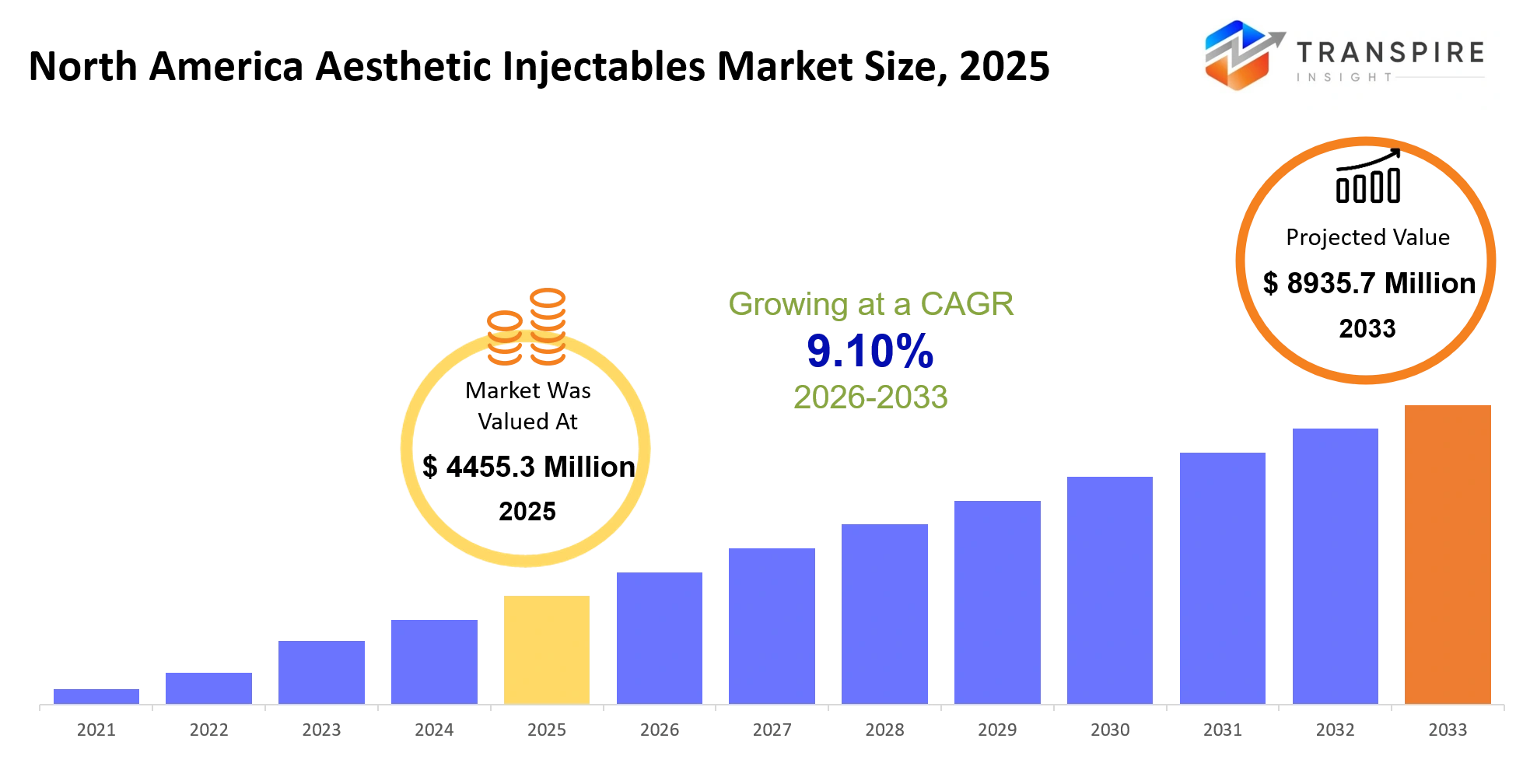
- North America Aesthetic Injectables Market Size 2025: USD 4455.3 Million
- North America Aesthetic Injectables Market Size 2033: USD 8935.7 Million
- North America Aesthetic Injectables Market CAGR: 9.10%
- North America Aesthetic Injectables Market Segments: By Product Type (Botulinum Toxin Injectables, Dermal Fillers, Collagen Stimulators, Fat Dissolving Injectables, Others), By Application (Facial Line Correction, Lip Enhancement, Skin Rejuvenation, Scar Treatment, Others), By End User (Cosmetic Clinics, Dermatology Clinics, Hospitals, Others), By Ingredient Type (Hyaluronic Acid, Calcium Hydroxylapatite, Poly-L-lactic Acid, Others).
To learn more about this report,  Download Free Sample Report
North America Aesthetic Injectables Market Summary:
The North America Aesthetic Injectables Market size is estimated at USD 4455.3 Million in 2025 and is anticipated to reach USD 8935.7 Million by 2033, growing at a CAGR of 9.10% from 2026 to 2033. The North America Aesthetic Injectables Market kinda plays a real role in how people tackle visible aging stuff, like facial volume loss, plus other aesthetic worries, via minimally invasive procedures that tend to mean little downtime compared with surgical options . These kinds of treatments now feel more like a mainstream piece of elective cosmetic care, and they’re backed by dermatology clinics, med spas , and also plastic surgery practices
In the last five years, the market did shift in a more structural way, moving away from mostly “fix it after it shows” corrections and toward preventive and more personalized aesthetic care. Doctors and providers are using advanced injectables more often, doing combination treatment plans, and even leaning on data driven facial assessment tools , so they can sort of dial in tailored results. A big real world push happened during the COVID-19 pandemic , where consumers got extra interest in facial appearance during hours of video calls, and then after restrictions eased, spending moved toward self care and cosmetic procedures again
Right now, a lot of growth comes from wider injectable treatment indications, a broader mix of patient demographics, and recurring treatment cycles that repeat over time. That ends up giving providers a more steady revenue setup, while also making manufacturers more willing to invest in product innovation, practitioner training and those higher end aesthetic solutions
Key Market Insights
- The United States is basically taking the lead in the North America Aesthetic Injectables Market, grabbing about 80% of the regional revenue, mostly because there are huge procedure volumes and yeah, it just keeps compounding.
- Canada sits as the second-largest market, and that makes sense, it is being nudged along by rising aesthetic spending plus more access to advanced injectable solutions that are actually available now.
- Mexico ends up being the fastest-growing regional area through the forecast period, with medical tourism playing a big role, and also with cosmetic clinic infrastructure expanding in a pretty steady way.
- Even so, the big urban metropolitan zones keep pulling a lot of market share, largely due to higher disposable income and easier access to specialized providers, not to mention that people tend to travel less locally.
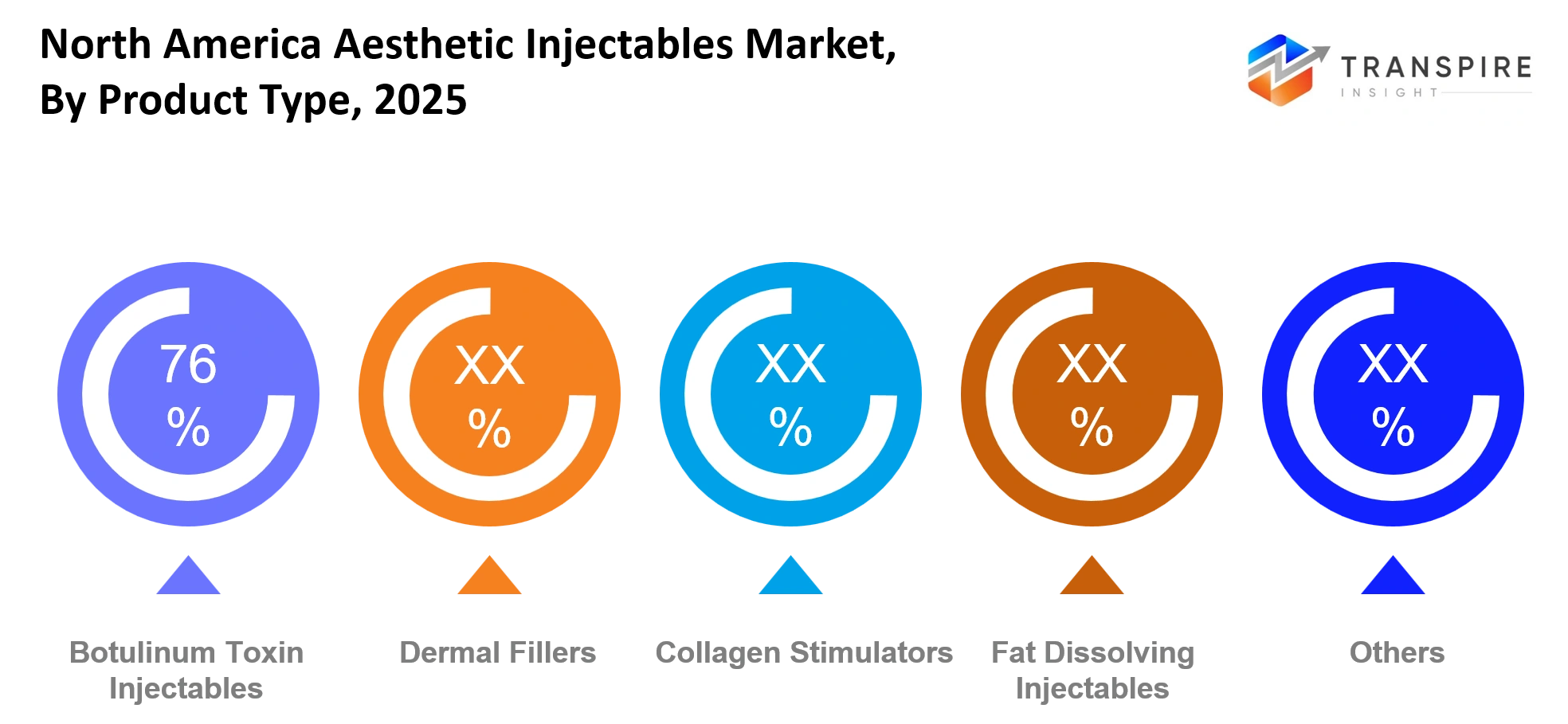
- When it comes to product type, botulinum toxin products dominate the North America Aesthetic Injectables Market, making up more than 55% of total revenue in 2025.
- Dermal fillers take the next spot, supported by continued interest in facial contouring and age-related volume restoration procedures; those really stay in demand.
- Biostimulatory injectables are the fastest-growing segment heading toward 2030, driven by longer-lasting results and the collagen regeneration angle which a lot of patients find appealing.
- Combination injectable treatments are showing up as a noticeable trend, they help make therapy more tailored, and they often improve patient satisfaction outcomes at the same time.
- For applications, facial wrinkle correction is still the main event, capturing over 45% of the North America Aesthetic Injectables Market share.
- Lip enhancement and facial volumization also bring in meaningful revenue, especially across aesthetic clinics and medical spas where consults keep stacking.
- Jawline contouring and non-surgical facial reshaping are the fastest-growing applications, which reflects changing beauty preferences among younger consumers, and honestly the trend moves quickly here.
- Preventive aesthetic treatments among adults aged 25–40 keep generating that emerging demand, especially across major metropolitan markets that are already well-established.
What are the Key Drivers, Restraints, and Opportunities in the North America Aesthetic Injectables Market?
The strongest force pushing the North America Aesthetic Injectables Market along is basically the move away from fully surgical cosmetic procedures toward treatments that are less invasive. Newer botulinum toxin formulations, hyaluronic acid fillers , and facial mapping technologies have helped clinicians work with better precision, shorten the recovery window, and also deliver results that feel more dependable. And because of that tech driven change, the pool of potential patients grows beyond the typical cosmetic surgery crowd. Clinics and medical spas then get more frequent repeat visits, often every few months, which builds a steady rhythm of recurring revenue and lifts patient lifetime value. Plus when providers start using personalized treatment plans and mix injectable therapies, the number of procedures keeps climbing across several age groups.
The biggest market restraint is more structural and it ties back to the need for highly trained, licensed practitioners. Injectable services require deep anatomical understanding, regulatory compliance, and ongoing skill updates so complications stay low and treatment quality stays consistent. Growing this kind of workforce is not a quick thing , it takes years instead of months, so matching rising patient demand is harder in real time. In some areas provider shortages shrink appointment availability and that also limits how far clinics can expand geographically. Overall this pressure reduces the upside , because it slows adoption in less served markets and it can nudge treatment costs higher for consumers.
There is a big opening in regenerative and biostimulatory injectables, they more or less push the body to make collagen on its own instead of just giving that quick, temporary fix. People are leaning toward longer lasting options like poly-L-lactic acid and calcium hydroxylapatite formulas, and that momentum is speeding up across North America. What matters too is that these approaches match what patients usually ask for, natural appearance with less need for frequent tune ups and maintenance visits. And as the clinical proof keeps getting stronger, plus more providers actually adopt these tools, regenerative aesthetics could sort of unlock the market’s next phase of premium revenue growth.
What Has the Impact of Artificial Intelligence Been on the North America Aesthetic Injectables Market?
Artificial intelligence along with advanced digital technologies are slowly but steadily transforming the North America Aesthetic Injectables Market, mostly by reshaping how treatment planning is done, how clinics run day to day, and how predictable patient outcomes feel afterward. AI powered facial assessment platforms can automatically examine facial symmetry, skin quality, volume reduction, and those aging behaviors patterns from high-resolution images. In practice, this kind of automation cuts down the consultation time, makes treatment recommendations more consistent, and lets practitioners craft injection plans that are more finely tuned, with stronger precision overall.
At the same time, machine learning models are raising predictive ability too. Providers run AI algorithms that look at historical treatment records, patient characteristics, and product performance, and then try to forecast how long results will likely last and how to refine injection strategies. The idea is that clinicians can better guess when touch ups will be needed, strengthen patient retention, and also reduce the swing of variability across aesthetic outcomes. On top of that advanced imaging tools and digital simulation software let patients see what might happen before the actual treatment, and this tends to lift conversion rates, plus improve acceptance of the plan.
Operationally, digital workflow platforms help with appointment scheduling, inventory control, and follow up routines. A lot of aesthetic practices are saying they get higher practitioner productivity, better patient satisfaction, and more recurring revenue driven by data informed treatment planning and retention programs. It’s kind of a snowball effect once the process is connected.
Still, a major limitation stays in place: high-quality clinical datasets are not always available. Facial structure, skin features, and even aesthetic preference styles can differ a lot across patient groups, which may reduce algorithm accuracy. It can also make AI based decision support less scalable when clinics operate in varied real world settings, where the diversity is not just a footnote, but the actual reality.
Key Market Trends
- Since 2020, preventive aesthetic treatments among adults aged 25–40 have expanded quite a bit, and there’s been this shift where injectables that used to feel like occasional things are now more like maintenance-based care, or something close to it.
- Between 2021 and 2025, clinics started rolling out AI-powered facial analysis more and more. It helped with precision, but also sort of standardized the consultation workflow across multiple locations, even when the teams weren’t identical in practice.
- Manufacturers also changed their R&D direction, putting more money into longer-duration neurotoxins and biostimulatory fillers. So in a way, the treatment frequency went down, while premium product adoption went up, that part seems pretty consistent.
- Since 2022, a lot of practices moved toward combination treatment protocols. Toxins plus fillers, and then skin rejuvenation therapies too, replaced the older idea of single-product approaches, more or less.
- In the last five years, medical spas gained more market influence, which expanded access points and also changed how consumers buy these aesthetic treatments. It’s like the pathway from interest to purchase got smoother, maybe.
- Some of the biggest players, like AbbVie, Galderma, and Merz Aesthetics, increased spending on practitioner training programs. The goal is basically to build brand loyalty, and keep practitioners aligned with what the companies want.
- Digital patient engagement platforms have shown up as a competitive edge. They can improve retention with automated follow-ups and customized care pathways, so patients stay in the loop longer.
- Competitive behavior has evolved too. Instead of leaning only on flagship brands, manufacturers went after strategic acquisitions, broader product line expansion, and regional partnerships.
- And then there’s regulation, which got more intense. Scrutiny around product safety, counterfeit injectables, and practitioner qualifications increased. This has led to stronger compliance measures across the whole aesthetic ecosystem, which honestly makes sense even if it adds pressure.
North America Aesthetic Injectables Market Segmentation
By Product Type
In the product type category, botulinum toxin injectables seem to take the lead because there is broad clinical acceptance, repeat treatment cycles, and people are simply more familiar with them. They’re used consistently for wrinkle reduction and facial contouring so most aesthetic practices keep strong procedure volumes going, even when demand shifts a bit. Dermal fillers come in as the second-largest segment, and they benefit from a mix of volume restoration, lip enhancement, and facial sculpting, which makes them kind of easy to recommend in many settings.
Collagen stimulators are starting to gain momentum too, since providers are increasingly aiming at longer lasting and more regenerative treatment results. Fat dissolving injectables are a smaller ,but still growing niche, mainly for localized contouring procedures that let patients avoid surgery. Meanwhile other injectable products continue to cover specialized aesthetic indications , depending on what’s being targeted. Growth does not look the same across every group, neurotoxins trend with treatment frequency while collagen stimulators trend with durability. Looking ahead , competition will probably revolve around longer-lasting formulations, better safety profiles, and combination treatment protocols. That should open up room for manufacturers to push premium positioning and also strengthen recurring revenue streams over time.
To learn more about this report, Download Free Sample Report
By Application
Through application, facial line correction is still kinda the leading segment, mostly because injectables for dynamic and static wrinkles are used everywhere. There is also strong patient desire for minimally invasive anti aging procedures, and that keeps the category in front. Lip enhancement keeps a big market place, since people are leaning more toward facial harmony and more individualized cosmetic results.
Skin rejuvenation is moving upward too, since clinics are blending injectables with wider facial revitalization strategies, so it feels more “complete”. Scar treatment is smaller in comparison, but it is getting a boost from regenerative medicine improvements and collagen stimulating products, you know the types. Other uses also show up, like jawline definition and facial contour refinement, and those seem to pull in a younger crowd. Each area is shaped by its own demand drivers , from age related worries to preventive aesthetic moves. Looking ahead, growth is expected to tilt toward more holistic facial treatment plans, so providers and product developers are pushed to build integrated solutions that tackle multiple cosmetic objectives at the same time.
By End-User
From an end-user point of view, cosmetic clinics seem to take the biggest chunk, mostly because they have specialized know-how, wide-ranging treatment options, and pretty active patient engagement. These dedicated aesthetic practices usually pour resources into newer technologies , practitioner training programs, and more tailored planning for each patient, which ends up making their market position more solid. Dermatology clinics come in as the second largest segment, and they lean on clinical credibility especially for people who want medically supervised aesthetic procedures.
Hospitals are smaller players here, and they tend to focus on tougher reconstructive work and other specialized cosmetic needs. Meanwhile, other end users like medical spas keep growing their footprint by delivering more affordable treatment options and easier service formats, so it feels more approachable. Still, the growth rhythm is not the same for every facility, cosmetic clinics often benefit from premium procedures while medical spas tend to pull in newer consumer segments. Looking forward, it’s expected that provider consolidation, multi-location expansion plans, and digital patient management platforms will shift how care is delivered, and also help create clearer competitive differentiation.
By Ingredient Type
In ingredient type segmentation, hyaluronic acid kind of dominates because of its versatility, pretty solid safety profile, and the fact that results are reversible, plus it keeps showing up across a wide range of facial enhancement procedures. There’s also a lot of physician familiarity around it, and patients seem to have that extra confidence, so overall it stays in the lead within the injectable aesthetics world. Calcium hydroxylapatite still has a meaningful spot, largely tied to structural support capabilities and the longer-lasting correction benefits it can offer. Poly-L-lactic acid is also starting to look like one of the fastest-growing options, with the momentum coming from rising interest in collagen stimulation, and gradual improvements that read more natural over time.
Other ingredient categories keep getting used for more specialized treatment needs, however their adoption feels more limited, and the growth patterns vary a lot depending on clinical objectives, how long outcomes are expected to last, and what practitioners prefer in real practice. Market participants are then directing research investments toward ingredients that balance durability, safety, and regenerative effects. For what comes next, development will likely focus on more advanced formulations with extended performance , which creates room for manufacturers to stand out and helps providers offer more customized, longer-lasting aesthetic outcomes.
What are the Key Use Cases Driving the North America Aesthetic Injectables Market?
Facial wrinkle reduction still feels like the main use case for aesthetic injectables across North America, in a lot of places it’s basically the first thing patients come in asking for. Cosmetic clinics as well as dermatology practices do huge volumes of botulinum toxin and filler work because people want visible changes with little recovery time, and results that seem pretty predictable from session to session.
Lip enhancement, and facial volumization too, are picking up momentum. Providers are moving on from the classic anti aging lane, and medical spas plus other more specialized aesthetic centers are starting to push customized contouring treatments. These choices usually aim at facial equilibrium, volume loss, and the very personal beauty preferences of consumers across a wider age span, honestly.
You can also spot emerging applications like regenerative aesthetic procedures, intended to help stimulate natural collagen production, alongside newer scar remodeling treatments that feel a bit more advanced than before. It looks like biostimulatory injectables, and even combination therapy protocols, are being adopted faster over time, so there’s strong future potential. This seems especially true for premium aesthetic practices that care about longer lasting, natural looking effects instead of short term cosmetic correction.
|
Report Metrics |
Details |
|
Market size value in 2025 |
USD 4455.3 Million |
|
Market size value in 2026 |
USD 4856.4 Million |
|
Revenue forecast in 2033 |
USD 8935.7 Million |
|
Growth rate |
CAGR of 9.10% from 2026 to 2033 |
|
Base year |
2025 |
|
Historical data |
2021 - 2024 |
|
Forecast period |
2026 - 2033 |
|
Report coverage |
Revenue forecast, competitive landscape, growth factors, and trends |
|
Country scope |
North America (Canada, The United States, and Mexico) |
|
Key company profiled |
AbbVie, Galderma, Merz Pharma, Revance Therapeutics, Hugel, Medytox, Sinclair Pharma, Teoxane, Evolus, Prollenium Medical Technologies, Ipsen, Candela Medical, Croma Pharma, Suneva Medical, BioPlus. |
|
Customization scope |
Free report customization (country, regional & segment scope). Avail customized purchase options to meet your exact research needs. |
|
Report Segmentation |
By Product Type (Botulinum Toxin Injectables, Dermal Fillers, Collagen Stimulators, Fat Dissolving Injectables, Others), By Application (Facial Line Correction, Lip Enhancement, Skin Rejuvenation, Scar Treatment, Others), By End User (Cosmetic Clinics, Dermatology Clinics, Hospitals, Others), By Ingredient Type (Hyaluronic Acid, Calcium Hydroxylapatite, Poly-L-lactic Acid, Others). |
Which Regions are Driving the North America Aesthetic Injectables Market Growth?
The United States takes up the most dominant share in the North America Aesthetic Injectables Market, mainly because it has such a large patient base, a very advanced healthcare setup and also a fairly mature aesthetic medicine world. A solid regulatory system backs product approvals, still it keeps safety standards fairly strict which , in turn helps build consumer confidence. There are also extensive networks of cosmetic clinics, dermatology centers, and medical spas , so people can reach injectable treatments in both cities and suburbs without too much trouble. Ongoing investment from top manufacturers plus high practitioner uptake kind of feeds a local ecosystem that keeps the U.S. in the lead.
Canada ends up as the second biggest regional market, but the pace and feel of growth isn’t the exact same as in the United States. Healthcare spending stays stable, regulatory attention remains consistent, and the practitioner community is highly trained so the market keeps widening in a steady way. At the same time, customer tastes are shifting toward premium, medically guided aesthetic procedures, so dermatology practices and specialty clinics get more momentum. That kind of predictable demand makes Canada a dependable source for regional earnings, and also for long-term steadiness across the industry.
Mexico is growing the fastest in the region, largely because medical tourism is getting bigger and more money is flowing into private aesthetic healthcare places. A lot of cosmetic treatment centers have been modernizing lately, and the advanced injectable options are now easier to find, this helps access a bit more. Even with that, treatment pricing stays competitive and it keeps drawing domestic as well as international patients looking for aesthetic services. With strong growth momentum through 2033, manufacturers, clinic owners, and investors can still set up early and gain ground in a market that’s becoming more attractive by the year.
Who are the Key Players in the North America Aesthetic Injectables Market and How Do They Compete?
Competition in the North America Aesthetic Injectables Market, stays kind of moderately consolidated, meaning a small set of manufacturers still controls a large chunk of the premium injectables, while newer specialists kind of go after very specific treatment areas. What mostly sets companies apart isnt really price, it is more technology innovation , and yeah that sounds cliché but it matters. Firms basically compete on product endurance, clinical results, safety characteristics, how well they train practitioners, and even brand recognition. Meanwhile, the established names keep defending share by putting money into research and widening their portfolios. Newer entrants on the other hand chase openings in the next generation neurotoxins, and also regenerative aesthetic approaches, where demand is rising a bit faster.
AbbVie has built a solid competitive standing thanks to its Botox franchise, plus a broad aesthetics portfolio that lets providers obtain several treatment options from one supplier. It leans on lots of clinical evidence, practitioner education initiatives , and a kind of integrated set of aesthetic offerings. Galderma meanwhile aims for science led advancement, pairing injectable products with its deeper dermatology know how. Its plan really circles around improving filler technologies, and strengthening physician engagement programs so more patients actually get the treatments. Revance Therapeutics competes through continued product innovation, especially longer lasting neurotoxin formulations that lower how often patients need sessions, and that gives a clearer value argument for both providers and patients.
Merz Aesthetics is about premium treatment results, but you know, with those specialized injectable products and also the deeper provider training initiatives. Basically it helps practitioners feel more confident, so the day to day clinical output stays steady and more consistent. Then Evolus kinda follows a more narrowed angle on neurotoxin aesthetics, relying on carefully targeted commercial partnerships, plus a push for market expansion so they can get in more often with cosmetic practices. Still, both groups are putting money into fresh geographic opportunities, digital engagement tools, and treatment protocols that are differentiated in a practical way—so providers can better hold onto patients, and the whole thing strengthens their competitive positioning too.
Company List
- AbbVie
- Galderma
- Merz Pharma
- Revance Therapeutics
- Hugel
- Medytox
- Sinclair Pharma
- Teoxane
- Evolus
- Prollenium Medical Technologies
- Ipsen
- Candela Medical
- Croma Pharma
- Suneva Medical
- BioPlus
Recent Development News
In January 2026, Galderma Showcases the Latest Scientific Advances Behind the Industry's Broadest Injectable Aesthetics Portfolio: Galderma showcased new scientific advances across its injectable aesthetics portfolio, including developments related to the Restylane franchise. The presentation emphasized ongoing product innovation and clinical evidence supporting the company's North American growth strategy in aesthetic injectables.
Source: https://www.galderma.com
In January 2026, Allergan Aesthetics Unveils New Data Across Facial Injectables and Emerging Portfolio at IMCAS 2026: Allergan Aesthetics, part of AbbVie, presented new clinical data for its facial injectable portfolio and investigational neurotoxin TrenibotulinumtoxinE. The company highlighted rapid-onset injectable treatments currently under regulatory review, reinforcing its investment in next-generation aesthetic injectables for the North American market.
Source: https://news.abbvie.com
What Strategic Insights Define the Future of the North America Aesthetic Injectables Market?
The North America Aesthetic Injectables Market looks like it is leaning toward a more precision aesthetics model where treatment choices are based more on data, a personalized facial look check, and regenerative outcomes, not just standardized cosmetic fixing. What seems to be pushing this shift is the coming together of newer injectable technologies, digital treatment plan tools, and people tending to want results that look natural and stay, for a longer time. In the next five to seven years, value creation could move away from counting procedure numbers only, toward keeping patients coming back, tailoring treatments, and adopting premium product options.
There is also a less obvious risk, market concentration. A relatively small set of injectable manufacturers plus a handful of key raw material suppliers could mean that if supplies get disrupted, or regulations slow things down, or pricing squeezes hit, then the impact on product availability and clinic profitability could be way bigger than you’d expect.
At the same time, a real opportunity is forming around biostimulatory and regenerative injectables, the kind that encourage collagen production and tissue remodeling. Market players should put effort into regenerative product platforms, deeper practitioner training, and AI-enabled treatment planning features so they can stand out earlier, before these tools become common.
North America Aesthetic Injectables Market Report Segmentation
By Product Type
- Botulinum Toxin Injectables
- Dermal Fillers
- Collagen Stimulators
- Fat Dissolving Injectables
- Others
By Application
- Facial Line Correction
- Lip Enhancement
- Skin Rejuvenation
- Scar Treatment
- Others
By End User
- Cosmetic Clinics
- Dermatology Clinics
- Hospitals
- Others
By Ingredient Type
- Hyaluronic Acid
- Calcium Hydroxylapatite
- Poly-L-lactic Acid
- Others
Frequently Asked Questions
Find quick answers to common questions.
The approximate North America Aesthetic Injectables Market size for the market will be USD 8935.7 Million in 2033.
The key segments of the North America Aesthetic Injectables Market are By Product Type (Botulinum Toxin Injectables, Dermal Fillers, Collagen Stimulators, Fat Dissolving Injectables, Others), By Application (Facial Line Correction, Lip Enhancement, Skin Rejuvenation, Scar Treatment, Others), By End User (Cosmetic Clinics, Dermatology Clinics, Hospitals, Others), By Ingredient Type (Hyaluronic Acid, Calcium Hydroxylapatite, Poly-L-lactic Acid, Others).
Major players in the North America Aesthetic Injectables Market are AbbVie, Galderma, Merz Pharma, Revance Therapeutics, Hugel, Medytox, Sinclair Pharma, Teoxane, Evolus, Prollenium Medical Technologies, Ipsen, Candela Medical, Croma Pharma, Suneva Medical, BioPlus.
The current market size of the North America Aesthetic Injectables Market is USD 4455.3 Million in 2025.
The North America Aesthetic Injectables Market CAGR is 9.10%.
- AbbVie
- Galderma
- Merz Pharma
- Revance Therapeutics
- Hugel
- Medytox
- Sinclair Pharma
- Teoxane
- Evolus
- Prollenium Medical Technologies
- Ipsen
- Candela Medical
- Croma Pharma
- Suneva Medical
- BioPlus
About the Authors

Pankaj Ghogare Patil
I am Pankaj Ghogare Patil, a Senior Research Analyst at Transpire Insight, specializing in the Pharmaceutical, Chemicals & Materials, Healthcare IT, and Biotechnology industry. My expertise lies in conducting comprehensive market research, analyzing industry trends, evaluating competitive landscapes, and translating complex data into actionable insights. At Transpire Insight, I closely follow emerging technologies, regulatory developments, and market innovations to create accurate, well-researched, and informative content that helps businesses and professionals make informed decisions. I am committed to producing credible, evidence-based articles that reflect industry best practices while making technical topics accessible and valuable for a broad audience.

Chakradhar Khansole
Chakradhar serves as the Research Director at Transpire Insight, bringing over 8 years of experience in technology, innovation, and strategic market intelligence. He specializes in transforming complex market data into actionable business insights that enable organizations to make informed, growth-oriented decisions. Recognized for his strategic vision and analytical expertise, Chakradhar leads high-impact research initiatives, delivering comprehensive market assessments, competitive intelligence, and forward-looking industry analysis.
Recently Published Reports
-
Jul 2026
Alopecia Treatment Market
Alopecia Treatment Market Size, Share & Analysis Report By Disease Type (Alopecia Areata, Cicatricial Alopecia, Traction Alopecia, Alopecia Totalis, Androgenetic Alopecia, Alopecia Universalis, and Other Disease Types), By Treatment Type (Topical Treatments, Oral Medications, Injectable Therapies, and Hair Transplantation), By Gender (Male, and Female), By Distribution Channel (Hospitals and Clinics, Retail Pharmacies, and Online Retailers), and Geography (North America, Europe, Asia-Pacific, Middle East and Africa, South and Central America), 2021 - 2031
-
Jul 2026
Medical Ultrasound Probe Market
Medical Ultrasound Probe Market Size, Share & Analysis Report By Type (Linear Type, Convex Type, Endocavitary Probe, Phased Array/Cardiac Probe, Transesophageal (TEE) Probe, and Others), By Application (Ophthalmology, Cardiology, Musculoskeletal, Oncology, Obstetrics & Gynecology, General Imaging, and Others), By End User (Hospitals & Clinics, Diagnostic Centers, Ambulatory Surgical Centers, and Others), and Geography (North America, Europe, Asia-Pacific, Middle East and Africa, South and Central America), 2021 – 2031
-
May 2026
Biosimilars Market
Biosimilars Market By Product Type (Monoclonal Antibodies, Recombinant Hormones, Erythropoietin, G-CSF, Others), By Indication (Oncology, Autoimmune Diseases, Blood Disorders, Diabetes, Others), By Manufacturing Type (In-House Manufacturing, Contract Manufacturing), By Distribution Channel (Hospital Pharmacies, Retail Pharmacies, Online Pharmacies), By Industry Analysis, Size, Share, Growth, Trends, and Forecasts 2021-2033
-
Apr 2026
Gastrointestinal Endoscopy Market
Gastrointestinal Endoscopy Market By Type (Rigid Gastrointestinal Endoscope, Flexible Gastrointestinal Endoscopes, Disposable Gastrointestinal Endoscope), By Procedure Type (Colonoscopy, Gastroscopy, Duodenoscopy, Enteroscopy, Flexible Sigmoidoscopy, Others), By Application (Diagnosis, Treatment), By End-Users (Hospitals, Ambulatory Surgical Centers, Specialty Clinics, Laboratories, Others), By Industry Analysis, Size, Share, Growth, Trends, and Forecasts 2021-2033