

North America Collagen Filler Market Size & Forecast:
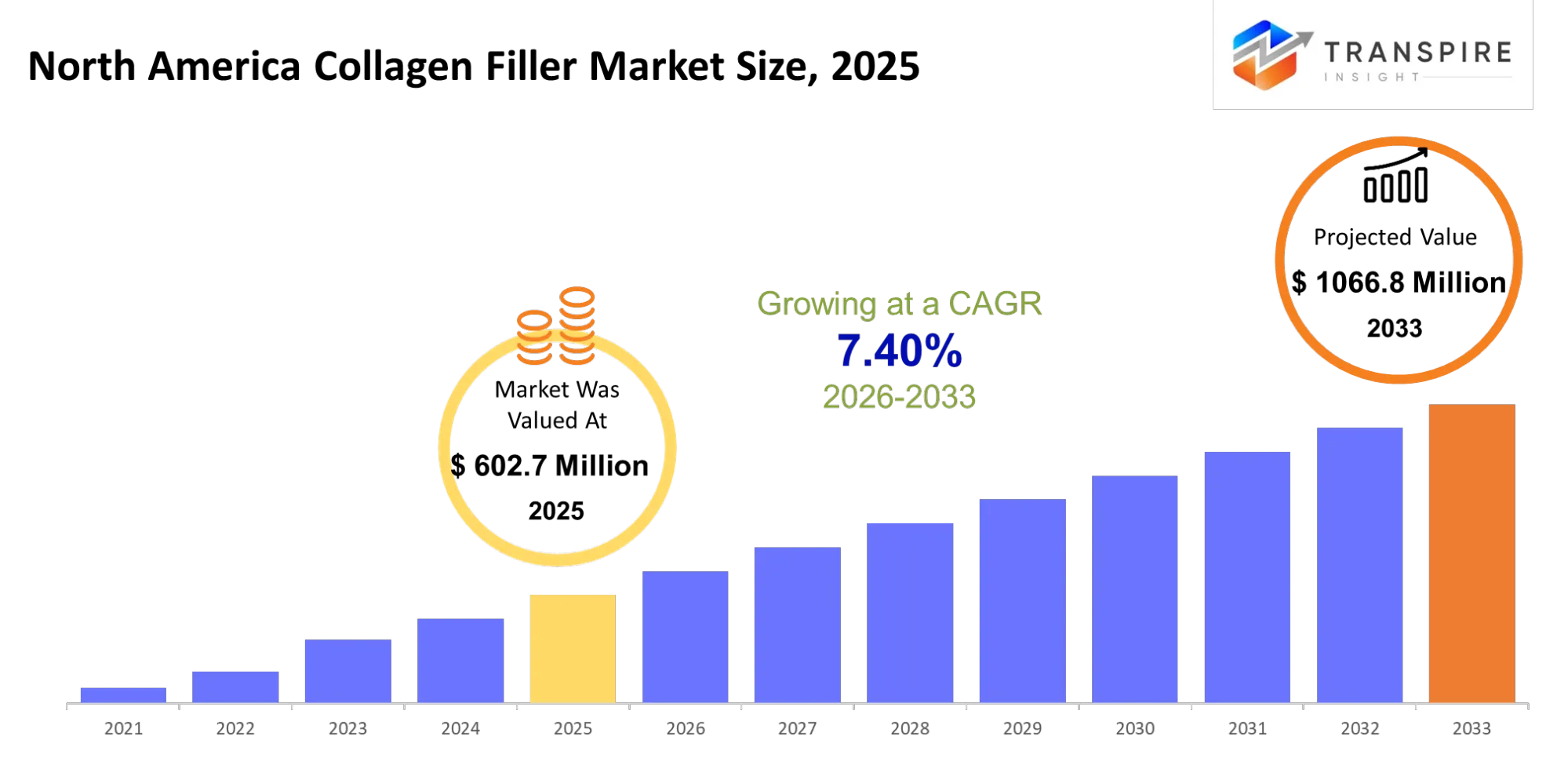
- North America Collagen Filler Market Size 2025: USD 602.7 Million
- North America Collagen Filler Market Size 2033: USD 1066.8 Million
- North America Collagen Filler Market CAGR: 7.40%
- North America Collagen Filler Market Segments: By Product Type (Bovine Collagen Fillers, Human Collagen Fillers, Synthetic Collagen Fillers, Others), By Application (Wrinkle Reduction, Lip Enhancement, Scar Treatment, Facial Contouring, Others), By End User (Cosmetic Clinics, Dermatology Clinics, Hospitals, Others), By Form (Injectable Fillers, Gel Fillers, Combination Fillers, Others).
To learn more about this report,  Download Free Sample Report
North America Collagen Filler Market Summary:
The North America Collagen Filler Market size is estimated at USD 602.7 Million in 2025 and is anticipated to reach USD 1066.8 Million by 2033, growing at a CAGR of 7.40% from 2026 to 2033.The North America Collagen Filler Market plays a pretty practical part in aesthetic medicine, by bringing back facial volume and easing the look of wrinkles, plus it helps with skin contouring for people who want a minimally invasive kind of cosmetic upgrade. In real clinic settings, and also in dermatology practices, collagen based fillers are often used to handle age related tissue loss, while still keeping recovery timelines shorter than what most surgical options would require.
In the last three to five years, things have slowly changed in a more structural way toward biologically derived and regenerative style aesthetic solutions. Doctors tend to lean toward options that do more than just immediate volumizing, they also aim to stimulate natural collagen production, so the effects last longer in practice. Because of that, product development is being reshaped, and the premium pricing models have also been adjusted to match the new expectations.
One big push, and I guess trigger too, was the COVID-19 pandemic. During that period, interest in facial aesthetics increased, especially as video calls became more constant, and people started scrutinizing their self image more. When restrictions lifted, elective procedures came back quickly, so patient demand grew, and treatment adoption spread beyond the usual demographics. Clinics then started broadening their treatment menus. Put together, this mix of regenerative technology adoption, plus more patients choosing procedures, is helping drive higher procedure frequency, stronger product utilization, and continued revenue growth across the regional market.
Key Market Insights
- In 2024 the United States really dominates the North America Collagen Filler Market, it holds more than 80% of the regional market share, even though people sometimes forget how concentrated this is.
- A lot of factors keep the U.S. in front , strong physician adoption, advanced aesthetic infrastructure, and just huge procedure volumes they all reinforce that market leadership.
- Canada is the fastest-growing area in the forecast window, mainly because cosmetic dermatology services are expanding and premium aesthetic spending keeps rising.
- When it comes to source types, bovine collagen fillers are in the lead, they contribute around 45% of total industry revenue in 2024.
- Porcine collagen fillers sit in second place, largely due to broad clinical acceptance and well-established treatment outcomes that clinicians trust.
- Human-derived collagen fillers are expected to be the quickest growing segment all the way through 2030, this is driven by better biocompatibility , and also lower hypersensitivity risks.
- For applications, facial wrinkle correction is still the big winner, taking in nearly 50% of the North America Collagen Filler Market share in 2024.
- Meanwhile lip enhancement and facial contouring keep picking up steam especially with younger consumer demographics, who seem more comfortable with these non-surgical options.
- Scar treatment is showing up as the fastest-growing category, partly because it is being used more often in reconstructive procedures and in aesthetic settings too.
- On the end-user side, dermatology clinics account for the largest market share, and they exceed 40% of industry revenue in 2024.
- Specialized aesthetic centers are also a major part of overall collagen filler demand across the region.
- Medical spas remain the fastest-growing end-user category, helped by easier accessibility and an expanding set of treatment portfolios.
What are the Key Drivers, Restraints, and Opportunities in the North America Collagen Filler Market?
The most powerful force driving the North America Collagen Filler Market is the gradual shift toward procedures that are minimally invasive for aesthetic purposes. This movement sort of picked up speed once new filler formulations came through with better safety profiles, shorter downtime, and outcomes that look more natural , not overly polished. Meanwhile, clinics started offering more than the usual anti aging promise , they pushed into facial contouring , lip enhancement, and scar correction as well. When these improvements kept showing up, total procedure counts rose, and that naturally led to repeat sessions. So providers and manufacturers could rely on recurring revenue, in a steady way, rather than one off activity. With results getting more consistent over time , physicians felt more comfortable recommending collagen based products to a wider patient base, which then strengthened overall market uptake.
Even so, the largest obstacle is still competition from other dermal fillers, especially hyaluronic acid based options that tend to last longer and often mean fewer follow up treatments. This isn’t just a marketing issue, it’s kind of structural. It comes from how the products actually perform, from long standing clinician preferences, and from the deep clinical familiarity practitioners already have with those alternatives. Manufacturers can’t just flip a switch and erase those advantages, not without meaningful spending on research, regulatory clearance, and practitioner education programs. Because of that, some patients and providers still choose competing filler technologies, which limits how far collagen fillers can spread. It also tends to hold back potential revenue expansion in a few related treatment categories.
A pretty major opportunity sits at the overlap between regenerative aesthetics and collagen stimulating technologies ,and honestly it feels like the two things are kinda moving toward each other. If you invest in bioengineered collagen formulations ,plus mix in combination therapies that encourage natural tissue regeneration, you can open up fresh growth avenues. For instance ,clinics are starting to explore treatments that pair collagen fillers with platelet-rich plasma or other regenerative procedures, and this is aimed at supporting longer-term outcomes . As these technologies mature, and they get stronger clinical validation , they may expand the addressable patient base, and then unlock that next phase of premium market growth across North America .
What Has the Impact of Artificial Intelligence Been on the North America Collagen Filler Market?
Artificial intelligence and advanced digital technologies are starting to fiddle with the North America Collagen Filler Market, mostly by refining treatment planning, patient assessment, and how clinics run day to day, kind of everything. With AI powered facial imaging platforms, it’s possible to automatically examine facial balance, dermal quality, volume reduction, and aging cues, so practitioners can then craft injection strategies that feel more precise than before. In practice, these tools can shorten the consult itself and help keep results steadier across different aesthetic locations, even when teams change.
Then there’s machine learning, which adds stronger prediction power. When models process thousands of prior treatment results, along with patient traits and facial anatomy records, they can project how long filler might last, suggest the most suitable injection zones, and also gauge the probability of future touch-ups. This more data guided way of thinking, helps clinics raise patient happiness while also improving retention, so repeat visits and return procedure revenue are more likely to happen.
From an operations viewpoint, digital workflow platforms handle the busywork: appointment timing, treatment notes, inventory tracking, and post-procedure check ins. Clinics that use integrated aesthetic software often see better use of staff and tools, less administrative friction, and higher patient participation through automated aftercare programs, and follow up nudges. On top of that, newer imaging tools back up clearer before and after comparisons which strengthens practitioner decision making, and makes the whole monitoring process feel more reliable overall.
Even with these upsides, AI adoption still hits a noticeable wall. The main issue is that high-quality training data is kind of scattered across clinics, device companies, and wider healthcare setups and it doesn’t really sit in one place. Plus, patient backgrounds shift, imaging standards get changed, and treatment techniques vary—so model accuracy can quietly drop. Because of that, a big clinical validation effort is essential, before these tools are rolled out broadly, across the aesthetic medicine ecosystem.
Key Market Trends
- Since 2020, clinics have sort of drifted away from purely volume driven wrinkle fixing and toward more complete facial rejuvenation blueprints that mix contouring with restoration and collagen prompting, kind of all together.
- Between 2021 and 2025 human derived collagen blends and bioengineered collagen formulations really started to pull ahead as practitioners looked for better biocompatibility and fewer hypersensitivity worries.
- Meanwhile AI powered facial assessment tools that used to stay in the background for niche users moved into the everyday, more mainstream clinic flow, and that helped improve how accurately treatments get mapped out, and how fast consultations run.
- After the pandemic, the patient mix also got broader, with adults under 40 taking up a larger portion of preventative aesthetic procedures and it’s noticeable.
- Manufacturers then started pouring more effort into regenerative aesthetic platforms, combining collagen fillers with tissue repair approaches and more advanced skin revitalization treatments, not just the basic kind.
- After 2022 there were more strategic partnerships between aesthetic brands and dermatology networks which basically sped up adoption and also helped training expand for practitioners across North America.
- Competition also got sharper, companies like AbbVie , Galderma, and Merz Aesthetics expanded their catalogs beyond the classic fillers and leaned into fuller aesthetic ecosystems instead.
- Digital patient engagement platforms became more common too, supporting automated follow ups, ongoing outcome tracking, and better treatment retention rates that actually stick.
- At the same time clinical attention shifted toward natural looking results, so many providers dialed back overcorrection techniques and started using personalized injection protocols, more tailored and less rigid.
- Research spending jumped a lot after 2021 and manufacturers leaned into longer lasting collagen stimulating products that can extend treatment intervals, which is probably one of the biggest practical goals.
North America Collagen Filler Market Segmentation
By Product Type
Product type segmentation kind of mirrors this mix between things clinicians already accept and the newer innovations in biomaterials. For bovine collagen fillers they still sort of lead the way, mainly because physicians already know them well, they are widely obtainable, and the overall treatment costs tend to be more reasonable. Human collagen fillers also matter a lot, forming a noticeable segment, and they’re backed by a more agreeable compatibility profile and a lower likelihood of allergic reactions. Synthetic collagen fillers take up a smaller portion, but they get a lot of attention, mostly due to better durability and greater formulation flexibility too. Then there are other niche products that handle more specialized aesthetic work, as well as reconstructive uses.
The growth trajectory is leaning more and more toward human-derived and advanced synthetic options, since patients and practitioners now put safety first, they also want longer-lasting results, and they care about natural looking outcomes. At the same time regulatory scrutiny plus the need for solid clinical validation acts like a gate, so new companies find it harder to enter, which indirectly strengthens the position of established manufacturers. Looking ahead, development is expected to center on bioengineered collagen technologies that boost how long treatments persist while also reducing unwanted adverse events, and that should open doors to premium pricing, and clearer differentiation across competing product lines.
By Application
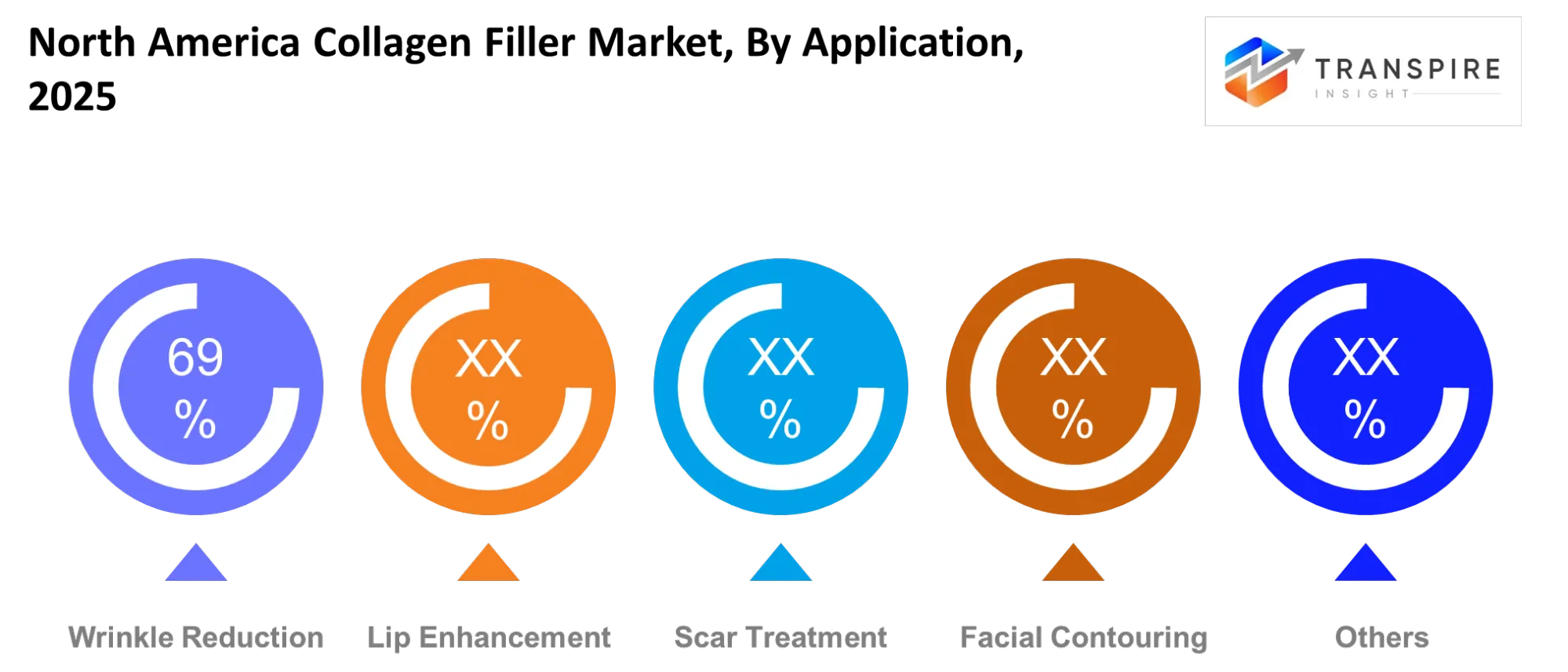
Application trends basically show wrinkle reduction as the dominant segment, mostly because it lines up so directly with the biggest aesthetic treatment population, and that’s kind of hard to ignore. Facial aging stays the main reason people opt for filler procedures, which keeps procedure volumes steady across most cosmetic practices. Lip enhancement keeps moving upward too as aesthetic preferences drift toward facial harmony and a more personal look, not just something generic.
Facial contouring has picked up a lot recently as well, since more clinics are using minimally invasive options, and those tend to give clear visible results without surgery. Scar treatment is also a meaningful growth lane, pulled by both cosmetic goals and reconstructive requirements. Other applications add extra revenue, mainly through niche procedures that target specific needs. Demand patterns are increasingly leaning toward services that pair volume restoration with collagen stimulation, so providers are more likely to broaden what they offer. Looking ahead, there should be more chances from customized care plans, where a single approach addresses several concerns at once, raising the overall procedure value and helping wider adoption among different patient groups.
To learn more about this report, Download Free Sample Report
By End-User
End user segmentation still looks a lot like it is being pulled by specialized know how and the treatment infrastructure in place, I mean it really matters. Cosmetic clinics take the biggest piece of the pie, mostly because they deal with high procedure volumes, they offer dedicated aesthetic services, and they have really strong consumer visibility. Dermatology clinics hold a solid role too , thanks to advanced skin treatment capabilities and physician led care approaches, which feels a bit more rigorous. Hospitals show up mainly for reconstructive work and medically indicated procedures, so the demand base becomes more narrow, more specialized if you will.
Other end users , like medical spas and aesthetic centers, keep growing as access gets easier and as consumer preferences start shifting. Competitive dynamics are leaning more and more toward facilities that blend digital consultation tools, individualized treatment planning, and full aftercare support. Patient expectations around convenience, safety, and outcomes you can actually measure, are now influencing investment choices across almost every provider type. Going forward, growth is expected to further elevate integrated aesthetic centers, where several cosmetic procedures sit under one service model, and that is creating fresh openings for suppliers and investors too.
By Form
Form-based segmentation kind of shows how the delivery method can steer treatment choices and, well, commercial results too. Injectable fillers stay in the lead, mostly because they’re pretty straightforward to administer, there are established clinical protocols already, and you get those immediate aesthetic results. Gel fillers are still a notable option, they bring improved texture traits and they’re more flexible when it comes to using them across different facial zones. Combination fillers are getting more attention lately as practitioners want solutions that can blend volumizing effects with regenerative advantages.
There are other forms, but they sit in smaller niches, still they help keep product diversity alive and they support more specialized treatment approaches. Demand is moving toward formulations that can deliver predictable results, and at the same time cut down on how often treatments are needed, plus keep recovery time shorter. Manufacturers keep pushing investment into formulation science to strengthen stability, extend durability, and improve patient comfort. Looking ahead, the market seems to tilt toward advanced combination products, aiming to integrate collagen restoration with wider skin rejuvenation benefits, which helps with premium positioning and makes providers more willing to adopt these differentiated options.
What are the Key Use Cases Driving the North America Collagen Filler Market?
The main use scenario for collagen fillers still sits mostly in facial wrinkle correction and volume restoration, especially in cosmetic clinics and dermatology practices. In practice this kind of treatment tends to create the most procedure volume, because it tackles the visible signals of aging through minimally invasive methods with limited downtime and, yeah, fairly consistent aesthetic results.
Also, beyond just “facial rejuvenation,” lip enhancement plus facial contouring are getting more momentum, especially among younger patient groups who want a more personalized look, not the same, sort of template thing. Dermatology clinics and more specialized aesthetic centers are using collagen fillers more often to tidy up facial features, improve overall balance, and they’re also supporting wider, whole plan aesthetic regimens.
There are newer angles as well, like scar revision and regenerative aesthetic procedures where collagen fillers are teamed with biologic therapies, such as platelet-rich plasma. Hospitals and advanced aesthetic clinics are exploring these methods for both cosmetic and reconstructive use cases, not only one or the other. As clinical evidence keeps building , collagen based regenerative treatments could become a meaningful growth lane across the entire forecast period.
|
Report Metrics |
Details |
|
Market size value in 2025 |
USD 602.7 Million |
|
Market size value in 2026 |
USD 647.3 Million |
|
Revenue forecast in 2033 |
USD 1066.8 Million |
|
Growth rate |
CAGR of 7.40% from 2026 to 2033 |
|
Base year |
2025 |
|
Historical data |
2021 - 2024 |
|
Forecast period |
2026 - 2033 |
|
Report coverage |
Revenue forecast, competitive landscape, growth factors, and trends |
|
Country scope |
North America (Canada, The United States, and Mexico) |
|
Key company profiled |
AbbVie, Galderma, Merz Pharma, Revance Therapeutics, Sinclair Pharma, Croma Pharma, Suneva Medical, BioPlus, Prollenium Medical Technologies, Teoxane, Candela Medical, Medytox, Evolus, Hugel, Anika Therapeutics |
|
Customization scope |
Free report customization (country, regional & segment scope). Avail customized purchase options to meet your exact research needs. |
|
Report Segmentation |
By Product Type (Bovine Collagen Fillers, Human Collagen Fillers, Synthetic Collagen Fillers, Others), By Application (Wrinkle Reduction, Lip Enhancement, Scar Treatment, Facial Contouring, Others), By End User (Cosmetic Clinics, Dermatology Clinics, Hospitals, Others), By Form (Injectable Fillers, Gel Fillers, Combination Fillers, Others) |
Which Regions are Driving the North America Collagen Filler Market Growth?
The United States shows up as the main or leading region in the North America Collagen Filler Market. Its market leadership comes from a very well formed aesthetic medicine ecosystem, plus reliable reimbursement systems for certain reconstructive procedures, and then of course a big presence of board-certified dermatologists along with plastic surgeons. There is also a lot of clinical research, and fairly early adoption of newer filler technologies, which sort of helps make the environment friendlier for commercialization. Basically, there’s a mature network too—manufacturers, training institutions, specialty clinics, and distribution routes all work together, so the dominant standing stays in place.
Canada sits in second place, and it feels a bit different compared to the United States, mainly because it leans harder into steady healthcare delivery and a more cautious, measured way of adopting new approaches. Predictable market performance is supported by steady consumer spending on aesthetic services and a regulatory framework that’s already well established. Physician oversight remains strong, and the wider acceptance of minimally invasive cosmetic procedures is still growing, especially across major urban centers. So even if the procedure volumes don’t match what you see in the United States, the overall steadiness makes Canada a dependable contributor to regional revenue.
Mexico is kind of emerging as the fastest-growing market, because medical aesthetics infrastructure keeps expanding and there’s more investment going into private cosmetic healthcare facilities, pretty much across the board. Growth really sped up once medical tourism activity started recovering again , and clinics have upgraded their treatment offerings to pull in international patients too. On top of that, the availability of newer collagen-based products keeps rising, and practitioner training is getting more solid which broadens access to these procedures in major metro areas. All that momentum should translate into attractive opportunities for manufacturers, distributors, and investors who are looking for exposure to high-growth aesthetic treatment markets sometime between 2026 and 2033.
Who are the Key Players in the North America Collagen Filler Market and How Do They Compete?
Competition in the North America Collagen Filler Market is kind of moderately concentrated, but not fully, with a small number of big aesthetic medicine players holding most of the commercial reach while smaller or specialized firms go after growth using innovation and more targeted treatment options. In practice, tech development—rather than price—has become the main way companies try to outpace each other. Manufacturers keep putting money into advanced biomaterials, regenerative aesthetics, and even physician training programs, so that product adoption becomes easier. The well established participants tend to defend their market share via portfolio expansion , while smaller companies look for openings in collagen-stimulating formulations and in personalized treatment solutions.
AbbVie basically uses its large aesthetics portfolio to cross sell products through existing physician networks , and it leans on clinic relationships too. They set themselves apart by building treatment ecosystems that mix injectables , facial aesthetics products , and practitioner education. Galderma leans hard into scientific validation and dermatology led innovation, in other words they focus on what can be clinically supported. Solid clinical evidence plus long term outcome study investments help reinforce physician confidence, and this supports patient retention. Both companies keep pushing forward by refining products, rolling out digital consultation tools, and increasing penetration in high value aesthetic clinics.
Merz Aesthetics kind of leans into technology innovation, and also practitioner support programs that help keep treatment consistency steady across different clinics. In practice, it makes them stand out because of service quality more than just product availability, if you know what I mean. Sinclair Pharma is more concentrated on regenerative aesthetics and collagen-stimulating solutions, designed for patients who want outcomes that stay longer. Suneva Medical, on the other hand, focuses on biostimulatory treatments and keeps a narrow but clear niche within advanced facial rejuvenation use cases. Overall these companies are growing by means of strategic partnerships, physician training efforts, and investments in next-generation regenerative technologies, all to match the shift in patient preferences toward natural-looking plus durable aesthetic results.
Company List
- AbbVie
- Galderma
- Merz Pharma
- Revance Therapeutics
- Sinclair Pharma
- Croma Pharma
- Suneva Medical
- BioPlus
- Prollenium Medical Technologies
- Teoxane
- Candela Medical
- Medytox
- Evolus
- Hugel
- Anika Therapeutics
Recent Development News
In April 2026, Merz Aesthetics Received FDA Approval for RADIESSE® in Décolleté Treatment: Merz Aesthetics announced that the U.S. FDA approved RADIESSE® for treating wrinkles in the décolleté area. The collagen-stimulating biostimulator became the first product in its category approved for both facial and body aesthetic applications in the United States. The approval expands Merz’s regenerative aesthetics portfolio and strengthens its position in the North American filler market.
Source: https://www.businesswire.com
In May 2026, CollPlant Reports 2026 Financial Results and Advances Regenerative Aesthetics Programs: CollPlant Biotechnologies released its first-quarter 2026 financial results and provided updates on its collagen-based regenerative aesthetics initiatives. The company highlighted continued investment in recombinant human collagen technologies and ongoing development activities aimed at aesthetic and dermal applications, despite cost-reduction measures and operating losses.
Source: https://www.prnewswire.com
What Strategic Insights Define the Future of the North America Collagen Filler Market?
The North America Collagen Filler Market is kind of drifting toward regenerative aesthetics instead of just doing conventional volume replacement, alone. Over the next five to seven years, competitive advantage will probably hinge on how well firms can nudge natural tissue regrowth forward , and also how they manage to extend the time between treatments, plus deliver more personalized outcomes, using digital evaluation technologies. This whole shift is being pulled by patient demand for results that look natural, and also by providers who want, more differentiated premium style procedures.
There’s another risk though, quieter one, and it’s technology substitution. If biostimulatory injectables keep improving, if hybrid fillers keep getting better, and if next generation regenerative therapies keep expanding, then the usual collagen based products might feel less attractive, especially when clinical outcomes show stronger durability. On top of that, market concentration among a small number of major aesthetics companies may make things harder by tightening distribution routes and slowing physician adoption.
At the same time, there’s an emerging opportunity, bioengineered collagen platforms, paired with regenerative treatments like platelet-rich plasma and cell based aesthetic therapies. Market participants should probably lock in clinical collaborations early and invest in long-term follow up research now, because evidence grounded regenerative solutions are expected to fetch premium pricing and take a chunk of the next wave of aesthetic procedure spending.
North America Collagen Filler Market Report Segmentation
By Product Type
- Bovine Collagen Fillers
- Human Collagen Fillers
- Synthetic Collagen Fillers
- Others
By Application
- Wrinkle Reduction
- Lip Enhancement
- Scar Treatment
- Facial Contouring
- Others
By End User
- Cosmetic Clinics
- Dermatology Clinics
- Hospitals
- Others
By Form
- Injectable Fillers
- Gel Fillers
- Combination Fillers
- Others
Frequently Asked Questions
Find quick answers to common questions.
The approximate North America Collagen Filler Market size for the market will be USD 1066.8 Million in 2033.
The key segments of the North America Collagen Filler Market are By Product Type (Bovine Collagen Fillers, Human Collagen Fillers, Synthetic Collagen Fillers, Others), By Application (Wrinkle Reduction, Lip Enhancement, Scar Treatment, Facial Contouring, Others), By End User (Cosmetic Clinics, Dermatology Clinics, Hospitals, Others), By Form (Injectable Fillers, Gel Fillers, Combination Fillers, Others).
Major players in the North America Collagen Filler Market are AbbVie, Galderma, Merz Pharma, Revance Therapeutics, Sinclair Pharma, Croma Pharma, Suneva Medical, BioPlus, Prollenium Medical Technologies, Teoxane, Candela Medical, Medytox, Evolus, Hugel, Anika Therapeutics.
The current market size of the North America Collagen Filler Market is USD 602.7 Million in 2025.
The North America Collagen Filler Market CAGR is 7.40%.
- AbbVie
- Galderma
- Merz Pharma
- Revance Therapeutics
- Sinclair Pharma
- Croma Pharma
- Suneva Medical
- BioPlus
- Prollenium Medical Technologies
- Teoxane
- Candela Medical
- Medytox
- Evolus
- Hugel
- Anika Therapeutics
About the Authors

Pankaj Ghogare Patil
I am Pankaj Ghogare Patil, a Senior Research Analyst at Transpire Insight, specializing in the Pharmaceutical, Chemicals & Materials, Healthcare IT, and Biotechnology industry. My expertise lies in conducting comprehensive market research, analyzing industry trends, evaluating competitive landscapes, and translating complex data into actionable insights. At Transpire Insight, I closely follow emerging technologies, regulatory developments, and market innovations to create accurate, well-researched, and informative content that helps businesses and professionals make informed decisions. I am committed to producing credible, evidence-based articles that reflect industry best practices while making technical topics accessible and valuable for a broad audience.

Chakradhar Khansole
Chakradhar serves as the Research Director at Transpire Insight, bringing over 8 years of experience in technology, innovation, and strategic market intelligence. He specializes in transforming complex market data into actionable business insights that enable organizations to make informed, growth-oriented decisions. Recognized for his strategic vision and analytical expertise, Chakradhar leads high-impact research initiatives, delivering comprehensive market assessments, competitive intelligence, and forward-looking industry analysis.
Recently Published Reports
-
Jul 2026
Alopecia Treatment Market
Alopecia Treatment Market Size, Share & Analysis Report By Disease Type (Alopecia Areata, Cicatricial Alopecia, Traction Alopecia, Alopecia Totalis, Androgenetic Alopecia, Alopecia Universalis, and Other Disease Types), By Treatment Type (Topical Treatments, Oral Medications, Injectable Therapies, and Hair Transplantation), By Gender (Male, and Female), By Distribution Channel (Hospitals and Clinics, Retail Pharmacies, and Online Retailers), and Geography (North America, Europe, Asia-Pacific, Middle East and Africa, South and Central America), 2021 - 2031
-
Jul 2026
Medical Ultrasound Probe Market
Medical Ultrasound Probe Market Size, Share & Analysis Report By Type (Linear Type, Convex Type, Endocavitary Probe, Phased Array/Cardiac Probe, Transesophageal (TEE) Probe, and Others), By Application (Ophthalmology, Cardiology, Musculoskeletal, Oncology, Obstetrics & Gynecology, General Imaging, and Others), By End User (Hospitals & Clinics, Diagnostic Centers, Ambulatory Surgical Centers, and Others), and Geography (North America, Europe, Asia-Pacific, Middle East and Africa, South and Central America), 2021 – 2031
-
May 2026
Biosimilars Market
Biosimilars Market By Product Type (Monoclonal Antibodies, Recombinant Hormones, Erythropoietin, G-CSF, Others), By Indication (Oncology, Autoimmune Diseases, Blood Disorders, Diabetes, Others), By Manufacturing Type (In-House Manufacturing, Contract Manufacturing), By Distribution Channel (Hospital Pharmacies, Retail Pharmacies, Online Pharmacies), By Industry Analysis, Size, Share, Growth, Trends, and Forecasts 2021-2033
-
Apr 2026
Gastrointestinal Endoscopy Market
Gastrointestinal Endoscopy Market By Type (Rigid Gastrointestinal Endoscope, Flexible Gastrointestinal Endoscopes, Disposable Gastrointestinal Endoscope), By Procedure Type (Colonoscopy, Gastroscopy, Duodenoscopy, Enteroscopy, Flexible Sigmoidoscopy, Others), By Application (Diagnosis, Treatment), By End-Users (Hospitals, Ambulatory Surgical Centers, Specialty Clinics, Laboratories, Others), By Industry Analysis, Size, Share, Growth, Trends, and Forecasts 2021-2033