
United Kingdom Workplace Transformation Market Size & Forecast:
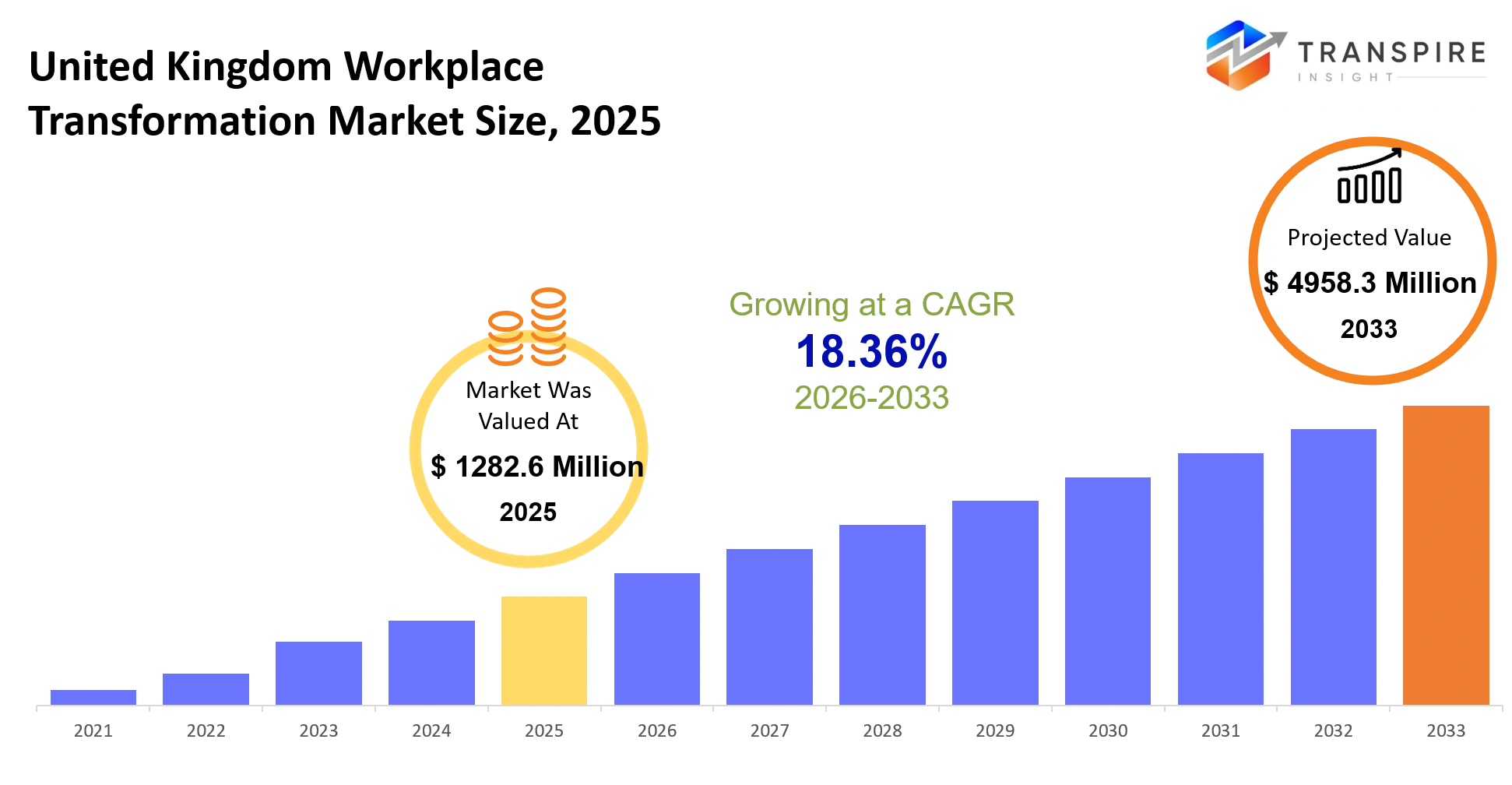
- United Kingdom Workplace Transformation Market Size 2025: USD 1282.6 Million
- United Kingdom Workplace Transformation Market Size 2033: USD 4958.3 Million
- United Kingdom Workplace Transformation Market CAGR: 18.36%
- United Kingdom Workplace Transformation Market Segments: By Solution Type (Digital Workplace Solutions, Smart Office Solutions, Collaboration Tools, Employee Experience Platforms, Remote Work Platforms, Others); By Technology (AI-powered Platforms, Cloud Collaboration, IoT-enabled Workspaces, Virtual Office Systems, Others); By Application (Hybrid Work Management, Employee Productivity, Office Automation, Workforce Analytics, Others); By End User (Large Enterprises, SMEs, IT Companies, BFSI Sector, Others)
To learn more about this report,  Download Free Sample Report
United Kingdom Workplace Transformation Market Summary
The United Kingdom Workplace Transformation Market was valued at USD 1282.6 Million in 2025. It is forecast to reach USD 4958.3.5 Million by 2033. That gives a CAGR of 18.36% over the period.
The United Kingdom Workplace Transformation Market is mainly about enabling organizations to rework the way people operate, align activities, and access business resources between different offices, remote setups, and those hybrid environments in between. In day to day reality, it supports companies in lifting workforce productivity, smoothing the dialogue between teams, reinforcing cybersecurity, and shaping more agile work models that fit with shifting employee expectations along with practical operational limits.
During the last five years, the whole market has been moving quite a bit, sort of like a major structural reshuffle, from legacy office-centric IT arrangements toward cloud based, digital-first workplaces. These are typically backed by collaboration platforms, automation tooling and employee experience technologies, rather than the older patterns. The COVID-19 pandemic acted as a major accelerant, forcing many organizations to deploy remote working infrastructure fast, and then reconsider workplace strategies afterward. That shift changed enterprise technology investment priorities in a fairly lasting way, so it wasn’t just a temporary detour where everything returned to normal.
Right now, market momentum is being driven by the need to connect distributed workforces, modernize legacy systems, and raise operational resilience. As organizations pour funding into digital workplace platforms, managed services, and AI enabled productivity tools, adoption keeps climbing, which opens up fresh revenue avenues for vendors, technology providers, and workplace transformation specialists.
Key Market Insights
- England seems to dominate the United Kingdom Workplace Transformation Market, taking about 72% of the total market share in 2025, mainly because it’s where you find lots of large enterprises clustered. London still stays as the biggest revenue generator center, backed by a solid uptake of digital workplace solutions across financial, technology and professional service sectors .
- Scotland comes out as the fastest-growing regional market during the forecast window, powered by public-sector digitalization efforts plus cloud infrastructure investments.
- Northern England keeps seeing meaningful momentum too, as organizations roll out hybrid workplace plans and modernize their legacy IT environments.
- Cloud-based workplace transformation solutions lead the market, holding nearly 48% share in 2025, largely for scalability reasons and also because the infrastructure costs are typically lower. Collaboration and communication platforms sit as the second-largest segment, with support from enterprise-wide hybrid work deployments.
- From 2025 to 2030 AI-enabled workplace solutions seem like the fastest-moving segment, because companies are leaning deeper into workflow automation and employee productivity analytics, more and more. At the same time managed workplace services are gaining momentum too, since a lot of organizations want specialized know how for digital transformation initiatives, rather than handling everything completely in-house.
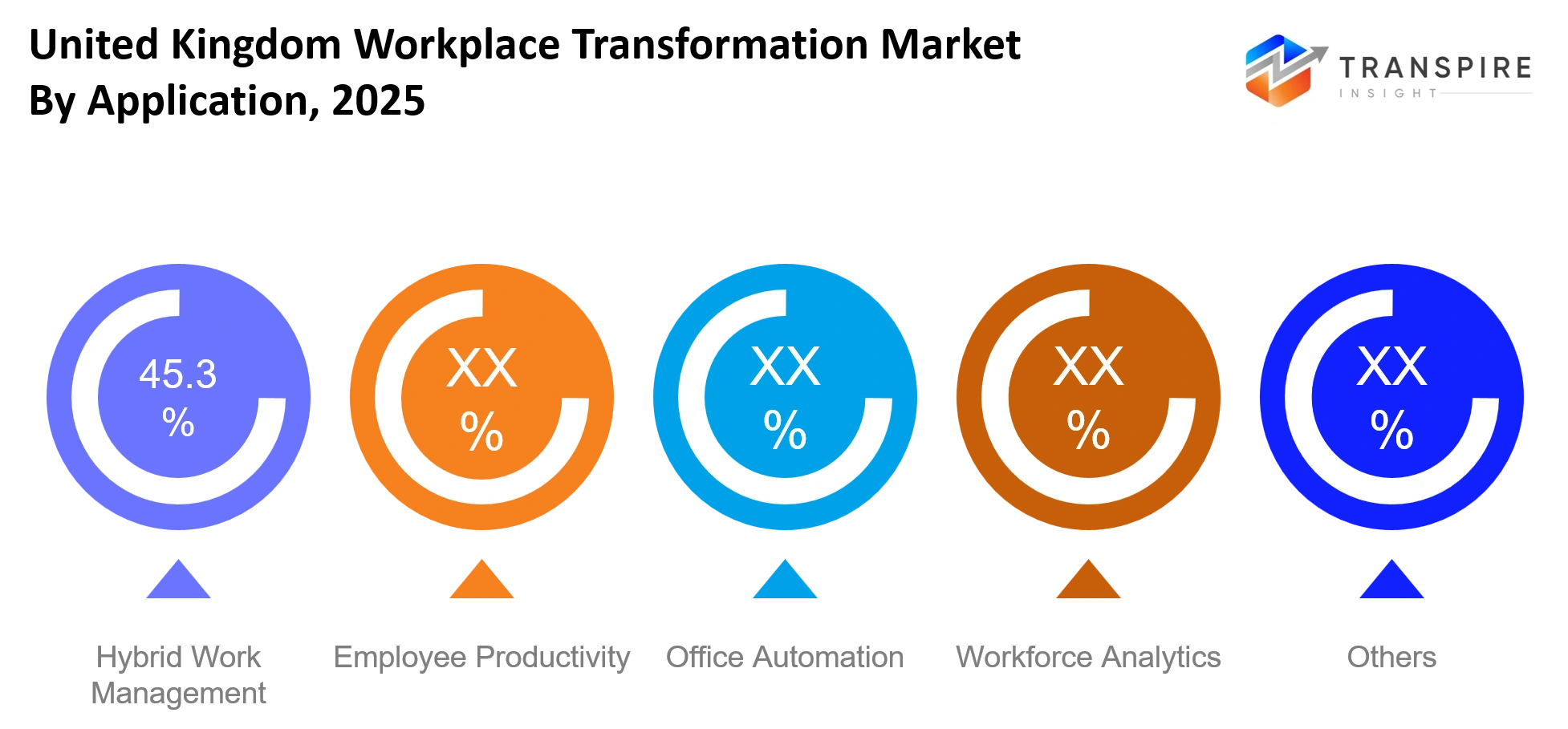
- Hybrid workforce management remains the most dominant application segment, contributing around 35% of the United Kingdom Workplace Transformation Market revenue in 2025. Meanwhile employee experience optimization is kinda emerging as the quickest-growing area, powered by spending on engagement, wellness, and productivity related technologies.
- Digital collaboration applications still end up taking a pretty big share of the market, as companies upgrade their distributed workforce capabilities. Workplace analytics platforms are also gaining traction, largely because decision-makers want better visibility into how people use things and what performance looks like over time.
What are the Key Drivers, Restraints, and Opportunities in the United Kingdom Workplace Transformation Market?
The main engine driving the United Kingdom Workplace Transformation Market is the ongoing shift toward hybrid, distributed work arrangements following the COVID-19 period. What started as a sort of emergency reaction ended up turning into a lasting mode of operating, and in practice it made organizations put money into cloud based collaboration platforms, digital employee experience utilities and also stronger secure remote access infrastructure. At the same time, improvements in artificial intelligence and workplace analytics are letting businesses do more automation on day to day tasks, and that tends to lift workforce productivity as well. All of this tends to pay back in ways you can actually measure, like reduced operating expense, stronger employee involvement, and workflows that move faster, so adoption keeps rising and revenue growth keeps following.
The biggest brake on this market is the complicated nature of blending newer workplace tech with older enterprise systems. A lot of big organizations in banking, government, and healthcare still depend on outdated IT setups, and those setups were never really built for cloud-native environments. Swapping them out or upgrading them means big capital spending, long implementation timelines, and specialized technical know how. Since these obstacles are tied to how companies are structured, and how their technology is arranged, they do not get fixed quickly, even if teams want to. So transformation programs often get pushed back, which then slows down deployments and holds back the market revenue potential.
One notable opening is the spread of AI driven workplace transformation solutions. Tools such as intelligent virtual assistants, predictive workforce analytics, and automated workflow environments are moving from small proof-of-concepts into broader, more full scale rollouts. For instance, companies across London’s financial service sector are investing in generative AI tools to help streamline knowledge management and employee support, functions, kind of. As AI adoption matures and the regulatory frameworks get more clearer, these solutions are supposed to unlock the next phase o f market expansion, by boosting productivity and speeding up the digital workplace modernization, as well.
What Has the Impact of Artificial Intelligence Been on the United Kingdom Workplace Transformation Market?
Artificial intelligence together with advanced digital tech is kinda taking center stage in reshaping workplace transformation across the United Kingdom, by boosting operational efficiency, lifting employee output, and speeding up the decision making process as well. More and more organizations are now rolling out AI based workplace platforms that can take care of daily, repetitive chores, like dealing with documents, arranging schedules, managing workflow approvals and even lending support to employees through smart chatbots. In practice, these tools cut down the manual grind and help staff shift toward more valuable, higher impact tasks.
Then there are machine learning models, they’re being used for workforce analytics and operational planning too. Businesses rely on predictive algorithms to estimate employee turnover, fine tune resource distribution and spot productivity patterns across hybrid work settings. On top of that, AI-driven monitoring systems look at collaboration patterns and workspace utilization data, which helps firms improve office occupancy levels and also reduce facilities that sit underused. Many enterprises say they’re seeing faster completion of tasks, reduced administrative expenses, and stronger employee engagement once these technologies are in place.
Advanced digital workplace solutions make collaboration feel smoother, more alive, mainly because real-time communication platforms, intelligent meeting assistants, and automated knowledge management systems pull everything together. With these features in place teams usually move quicker, reach decisions sooner, and push projects along with less friction. Still, AI adoption isn’t always as easy as it sounds . There are high integration costs, worries about data privacy, and the whole task of linking AI systems with older legacy enterprise infrastructure turns out to be pretty complex, which can definitely slow deployment, especially for small to medium sized organizations. Even with those obstacles AI driven workplace technologies continue to speed up digital transformation and strengthen operational performance across UK enterprises.
Key Market Trends
- Since 2021 UK companies have sort of moved away from those emergency remote work setups, and into longer term hybrid plans, backed by digital collaboration platforms that all work together. Adoption of generative AI really sped up in 2024, and again in 2025, so many organizations started putting AI assistants inside everyday workflows to cut down on admin effort and clerical drudgery.
- Cybersecurity budgets have gone up a lot since 2022, mainly because more distributed people means wider attack surfaces for organizations, and also stricter compliance obligations. Bigger employers are also measuring employee experience using analytics platforms, which sort of replaces older workplace management that only cared about infrastructure performance, like strictly uptime and such.
- Cloud-based workplace ecosystems keep replacing on-premise environments bit by bit, and that has helped with quicker software releases, less routine maintenance, and more operational flexibility. Financial services firms across London have also increased investment in intelligent automation, using AI driven tools to streamline knowledge handling and employee help, support that feels faster and more consistent.
- Technology providers like Microsoft, Google, IBM, Cisco, and Accenture have shifted their competitive energy toward integrated workplace experience platforms, instead of just separate products. More organizations are consolidating software vendors too, they prefer unified collaboration, security, and productivity ecosystems rather than holding on to a patchwork stack of tools that don’t quite connect.
- Since 2023 public-sector digital modernization programs have kind of grown, and with that there are new opening for providers who really focus on workplace transformation, most notably in healthcare, also government agencies. At the same time workforce analytics moved beyond the pilot tries, into wider enterprise deployment, so employers can more or less tune office usage and sharpen their hybrid work policies, a bit better than before.
United Kingdom Workplace Transformation Market Segmentation
By Solution Type
- Digital Workplace Solutions take up a big slice of the market, as companies keep moving their business activities into cloud driven spaces and more connected work setups. You end up with better flow control, safer access to business apps and improved messaging options, which all makes it easier for adoption in different industries. Also, putting money into digital infrastructure will stay a key priority since most organizations want operational efficiency, plus that workforce flexibility sort of thing
- Smart Office Solutions are also getting more attention, mostly by linking connected devices, workspace administration systems, and occupancy monitoring tools. Collaboration Tools keep seeing strong pickup because reliable communication is still, you know, essential for hybrid working. Employee Experience Platforms back workforce engagement, while Remote Work Platforms help teams stay productive even when they are spread out. Beyond that, other offerings handle more specialized workplace needs, along with industry specific operational realities.
By Technology
- AI-powered Platforms are becoming a kind of important part of workplace transformation strategies, honestly. The automation of repetitive tasks, intelligent workflow management and data-driven decision making help organizations boost productivity. As artificial intelligence keeps getting more deeply integrated into workplace systems, it will support more widespread adoption, across enterprise environments.
- Cloud Collaboration technologies still seem to be leading the implementation efforts, partly because flexible access to business applications supports hybrid work structures. IoT-enabled Workspaces improve resource utilization by using connected sensors and smart monitoring systems. Virtual Office Systems also provide digital environments for communication and teamwork, and then other technologies handle the newer workplace needs too, while supporting specialized business operations.
By Application
- Hybrid Work Management remains a big application area as organizations set up long term flexible work policies. For real coordination between remote and people in the office, they need reliable digital platforms and integrated workplace tools, not just “something that works”. Continued funding for the hybrid work infrastructure will back operational consistency and workforce engagement, basically keep everyone aligned.
- Employee Productivity solutions can help streamline everyday tasks and cut down those administrative headaches using digital workflows. Office Automation applications improve efficiency by simplifying routine business processes and reducing the need for manual intervention. Workforce Analytics supports better choices through performance insights, and workplace data too, while other applications focus on specific operational as well as management requirements.
To learn more about this report, Download Free Sample Report
By End User
- Large Enterprises make up a big chunk of the spending on workplace transformation, mainly because workforce management is huge for them, plus they usually carry large technology budgets too. In practice, modernization efforts tend to roll out collaboration platforms across the org, alongside automation systems and these digital workplace solutions that just… keep showing up everywhere. For the next years, long-term digital transformation programs will keep backing adoption inside this segment, even when the timelines stretch.
- SMEs are also stepping up their investment in workplace technologies. Cloud based options help lower implementation costs, and they make everything easier to reach, anywhere, without much friction. IT Companies stay very active in adopting these tools too, since innovation, workforce mobility, and digital collaboration are basically core parts of how they run day to day operations. The BFSI Sector keeps pushing bigger technology investments, aimed at stronger productivity, better security, and tighter regulatory compliance. At the same time, other end users are selecting workplace transformation solutions based on whatever operational priorities match their own industry, more or less.
What are the Key Use Cases Driving the United Kingdom Workplace Transformation Market?
The main, use case pushing people to adopt the United Kingdom Workplace Transformation Market is hybrid workforce management. Big organizations, including financial institutions and professional service firms, depend on digital workplace platforms to coordinate staff between the office and remote spots. When collaboration works smoothly, secure access to business applications stays in place, and communication feels streamlined, then demand for workplace transformation investments tends to jump.
More expanding applications also show up, like boosting employee productivity and doing office automation. IT companies increasingly put workflow automation tools to work, aiming to cut down repetitive work and raise overall operational efficiency. In BFSI, organizations are taking up workforce analytics solutions to keep an eye on performance, back compliance needs, and improve resource allocation, especially in those highly regulated contexts where governance is non negotiable .
Newer use cases are starting to surface too. Things like AI powered employee assistance and predictive workplace analytics are getting trialed . Teams are experimenting with generative AI tools for knowledge management, employee support, and task automation. Meanwhile, smart workplace systems, built around connected sensors, are drawing attention as well, since they can analyze space usage and workplace behavior. This is particularly noticeable among companies modernizing their office infrastructure, to secure long term operational efficiency.
|
Report Metrics |
Details |
|
Market size value in 2025 |
USD 1282.6 Million |
|
Market size value in 2026 |
USD 1523.5 Million |
|
Revenue forecast in 2033 |
USD 4958.3 Million |
|
Growth rate |
CAGR of 18.36% from 2026 to 2033 |
|
Base year |
2025 |
|
Historical data |
2021 - 2024 |
|
Forecast period |
2026 - 2033 |
|
Report coverage |
Revenue forecast, competitive landscape, growth factors, and trends |
|
Regional scope |
United Kingdom |
|
Key company profiled |
Microsoft, Google, Cisco Systems, Zoom, Salesforce, Slack, IBM, VMware, ServiceNow, Oracle, SAP, Citrix, Adobe, Atlassian, Dell Technologies |
|
Customization scope |
Free report customization (country, regional & segment scope). Avail customized purchase options to meet your exact research needs. |
|
Report Segmentation |
By Solution Type (Digital Workplace Solutions, Smart Office Solutions, Collaboration Tools, Employee Experience Platforms, Remote Work Platforms, Others); By Technology (AI-powered Platforms, Cloud Collaboration, IoT-enabled Workspaces, Virtual Office Systems, Others); By Application (Hybrid Work Management, Employee Productivity, Office Automation, Workforce Analytics, Others); By End User (Large Enterprises, SMEs, IT Companies, BFSI Sector, Others) |
Which Regions are Driving the United Kingdom Workplace Transformation Market Growth?
England is still the leading area within the United Kingdom workplace transformation scene, mostly because large enterprises, finance institutions, technology firms, and government bodies are clustered there in big numbers. London, in particular, acts as the main hub for digital workplace investment. This is backed by solid cloud infrastructure, strong connectivity, and an ecosystem that’s mature in technology services. National digital transformation programs and cybersecurity rules push organizations to upgrade their workplace settings, and also their workforce management setups. On top of that, a fairly well-developed web of software providers, consulting firms, and managed services companies keeps reinforcing the regional advantage, kind of steadily, without much interruption.
Scotland comes next as the second-largest regional market, and it feels a bit different from England in practice. There’s a stronger emphasis on public-sector modernization, plus digital transformation efforts that match specific industries. The demand is sustained by ongoing spending from healthcare organizations, educational providers, and energy businesses that want operational efficiency upgrades. Government support for digital innovation, along with workforce development, is consistent enough to keep the adoption environment stable for workplace technology. So even though Scotland has a smaller enterprise base, the mix of public and private sector funding allows it to keep dependable market contributions.
Northern England seems to be coming out as the fastest growing area, as companies push ahead with workplace modernization beyond just the big metropolitan centers. Lately the region has seen more investment in digital infrastructure, regional tech hubs, and also the hybrid work capabilities part, so the chance to adopt these tools keeps widening across a range of sectors. More small and medium sized businesses are jumping in, and that’s driving demand for cloud based collaboration platforms, workplace analytics, and automation solutions too. From 2026 through 2033 this pace should keep building into solid chances for technology vendors, service providers, and investors, all looking to tap into the expanding regional markets.
Who are the Key Players in the United Kingdom Workplace Transformation Market and How Do They Compete?
The competitive landscape of the United Kingdom Workplace Transformation Market is sort of moderately consolidated, where global technology providers share the stage with consulting firms and managed service specialists. In practice, the fight is mostly about technology innovation, platform integration, strong cyber security capabilities, and the ability to deliver a smooth hybrid work experience that doesnt feel chopped up. The established players keep defending their market share via ongoing product development. At the same time specialized vendors show up with more narrow, almost laser-focused solutions, like workforce analytics, employee experience management, and workplace automation . What seems to matter more and more is being able to deliver integrated ecosystems rather than just standalone workplace tools, or I guess “tools by themselves” in the everyday language.
Microsoft differentiates with a pretty tightly connected workplace setup that blends Microsoft 365, Teams, Azure, and AI powered Copilot capabilities. With this, organizations can handle collaboration, productivity, and security through one unified platform. Google competes by leaning hard into cloud native workplace solutions, focusing on accessibility, real time collaboration, and simplified deployment, too. Their continued investment in generative AI features, plus strategic partnerships with enterprise customers, helps the momentum for expansion. This plays out across both big organizations and SMEs, even when budgets are a bit tight.
IBM is pretty much all about transforming workplaces using consulting know how, plus automation platforms, and AI powered business process refinement. Their integration skills are strong enough that teams can modernize tangled legacy systems without too much chaos, which feels like a clear leg up in environments that are heavily regulated, like banking or healthcare. Accenture goes another way, by leaning into huge digital transformation initiatives where tech rollout is tied together with workforce approach and operational redesign, not just the software bit. Cisco stays well positioned thanks to safe collaboration tools and enterprise networking solutions, but they are also pushing further with ideas around hybrid workplace management, cybersecurity, and cloud based collaboration services.
Company List
- Microsoft
- Cisco Systems
- Zoom
- Salesforce
- Slack
- IBM
- VMware
- ServiceNow
- Oracle
- SAP
- Citrix
- Adobe
- Atlassian
- Dell Technologies
Recent Development News
In March 2026, Microsoft kind of announced Wave 3 of Microsoft 365 Copilot and also introduced the Microsoft 365 E7 Frontier Suite, sort of quietly at first. The launch expanded enterprise AI abilities with more advanced agent based productivity instruments, and it accelerated workplace transformation programs across large organizations, in a way that felt immediate..https://blogs.microsoft.com
In April 2025, Zoom sort of launched Custom AI Companion, Zoom Tasks, AI calendar scheduling and additional agentic AI abilities across Zoom Workplace. This release really strengthened AI driven workplace productivity, and collaboration, making it easier for enterprise customers to adopt broader intelligent workplace platforms more widely ..https://preview.zoom.com
In May 2026, ServiceNow kind of expanded, its strategic partnership with Wipro, to scale more agentic AI workflows across IT, HR, procurement and cybersecurity operations. This collaboration boosted enterprise access to AI powered workplace automation a bit faster, and it also reinforced the overall swing toward integrated digital workplace management solutions.https://m.economictimes.com
What Strategic Insights Define the Future of the United Kingdom Workplace Transformation Market?
The United Kingdom Workplace Transformation Market is going toward more intelligent AI led workplace ecosystems where productivity, teamwork, automation, and employee experience all kind of move together, through integrated platforms, not separate tools. I mean, this shift is being pushed by how hybrid work keeps becoming normal for the long run, and by enterprises trying to get more done while also lowering day to day operational mess, using automation plus data led decisions.
There’s also a less obvious risk, not as visible at first, and that’s growing dependence on a small cluster of technology providers. When organizations start consolidating their workplace software around only a few big platforms, vendor concentration can rise. That can raise switching costs, shrink flexibility, and leave companies exposed if a supplier changes pricing, or if service interruptions happen. On top of that, new AI governance rules may bring compliance hurdles, especially for companies rolling out advanced workplace tech across large parts of the business.
One newer chance here is bringing in agentic AI systems, basically tools that can handle routine workflows on their own, take care of employee support requests, and do knowledge retrieval tasks without much manual nudging. Market players should focus on investing in interoperable AI solutions that integrate cleanly with existing enterprise systems. Firms that pair automation capabilities with robust cybersecurity and regulatory compliance guardrails are likely to be better positioned to drive the next wave of growth.
United Kingdom Workplace Transformation Market Report Segmentation
-
By Solution Type
- Digital Workplace Solutions
- Smart Office Solutions
- Collaboration Tools
- Employee Experience Platforms
- Remote Work Platforms
- Others
-
By Technology
- AI-powered Platforms
- Cloud Collaboration
- IoT-enabled Workspaces
- Virtual Office Systems
- Others
-
By Application
- Hybrid Work Management
- Employee Productivity
- Office Automation
- Workforce Analytics
- Others
-
By End User
- Large Enterprises
- SMEs
- IT Companies
- BFSI Sector
- Others
Frequently Asked Questions
Find quick answers to common questions.
The expected United Kingdom Workplace Transformation Market size will be USD 4,958.3 million in 2033.
Key segments for the United Kingdom Workplace Transformation Market are By Asset Type (Real Estate Tokenization, Equity Tokenization, Commodity Tokenization, Art Tokenization, Debt Tokenization, Others); By Technology (Blockchain Platforms, Smart Contracts, AI-enabled Platforms, Hybrid Platforms, Others); By Application (Investment Management, Real Estate Trading, Fundraising, Digital Securities, Others); By End User (Financial Institutions, Real Estate Firms, SMEs, Retail Investors, Others).
Major United Kingdom Workplace Transformation Market players are Microsoft, Google, Cisco Systems, Zoom, Salesforce, Slack, IBM, VMware, ServiceNow, Oracle, SAP, Citrix, Adobe, Atlassian, Dell Technologies.
The United Kingdom Workplace Transformation Market size is USD 1282.6 Million in 2025.
The United Kingdom Workplace Transformation Market CAGR is 18.36% from 2026 to 2033.
- Microsoft
- Cisco Systems
- Zoom
- Salesforce
- Slack
- IBM
- VMware
- ServiceNow
- Oracle
- SAP
- Citrix
- Adobe
- Atlassian
- Dell Technologies
About the Authors

Mayur Shinde
I am Mayur Shinde, a Senior Research Analyst at Transpire Insight, specializing in the Automotive & Transportation and Information & Communication Technology (ICT) Industry. My work focuses on analyzing emerging market trends, technological advancements, competitive landscapes, and industry developments to deliver accurate, data-driven insights. I am passionate about transforming complex market information into clear, actionable content that helps businesses, professionals, and decision-makers stay informed and make confident strategic decisions.

Chakradhar Khansole
Chakradhar serves as the Research Director at Transpire Insight, bringing over 8 years of experience in technology, innovation, and strategic market intelligence. He specializes in transforming complex market data into actionable business insights that enable organizations to make informed, growth-oriented decisions. Recognized for his strategic vision and analytical expertise, Chakradhar leads high-impact research initiatives, delivering comprehensive market assessments, competitive intelligence, and forward-looking industry analysis.
Recently Published Reports
-
Apr 2026
3D Optical Profiler Market
3D Optical Profiler Market Size, Share & Analysis Report By Type (Desktop 3D Optical Profiler, and Portable 3D Optical Profiler), By Technology (Confocal Technology, and White Light Interference), By End-Use Industry (Manufacturing, Research Institutions, Automotive, Aerospace and Defense, Medical Devices, and Other), and Geography (North America, Europe, Asia-Pacific, Middle East and Africa, South and Central America), 2021 - 2031
-
Apr 2026
Depth Sensor Market
Depth Sensor Market Size, Share & Analysis Report By Type (Infrared Depth Sensors, Time-of-Flight (ToF) Sensors, Stereo Vision Sensors, Structured Light Sensors, Ultrasonic Depth Sensors), By Application (Automotive, Robotics, Gaming, Consumer Electronics, Industrial Automation, Healthcare, Security & Surveillance, Others), By End Users (Automotive Manufacturers, Consumer Electronics Companies, Healthcare Providers, Industrial Companies, Security Agencies, Gaming Companies, Robotics Companies, Others), and Geography (North America, Europe, Asia-Pacific, Middle East and Africa, South and Central America), 2021 – 2031
-
Apr 2026
Digital Manufacturing Market
Digital Manufacturing Market Size, Share & Analysis Report By Component (Hardware, Software, and Services), By Technology (Robotics, 3D Printing, Internet of Things (IoT), and Others), By Application (Automotive and Transportation, Aerospace and Defense, Consumer Electronics, Industrial Machinery, and Others), By Process Type (Computer-Based Designing, Computer-Based Simulation, Computer 3D Visualization, Analytics, and Others), and Geography (North America, Europe, Asia-Pacific, Middle East and Africa, South and Central America), 2021 – 2031
-
Apr 2026
Digital Visa Services Market
Digital Visa Services Market Size, Share & Analysis Report By Type (Individual Travelers, Group Travelers), By Application (Tourism, Business Travel, Others), and Geography (North America, Europe, Asia-Pacific, Middle East and Africa, South and Central America), 2021 – 2031