

United Kingdom Waste Management Equipment Market Size & Forecast:
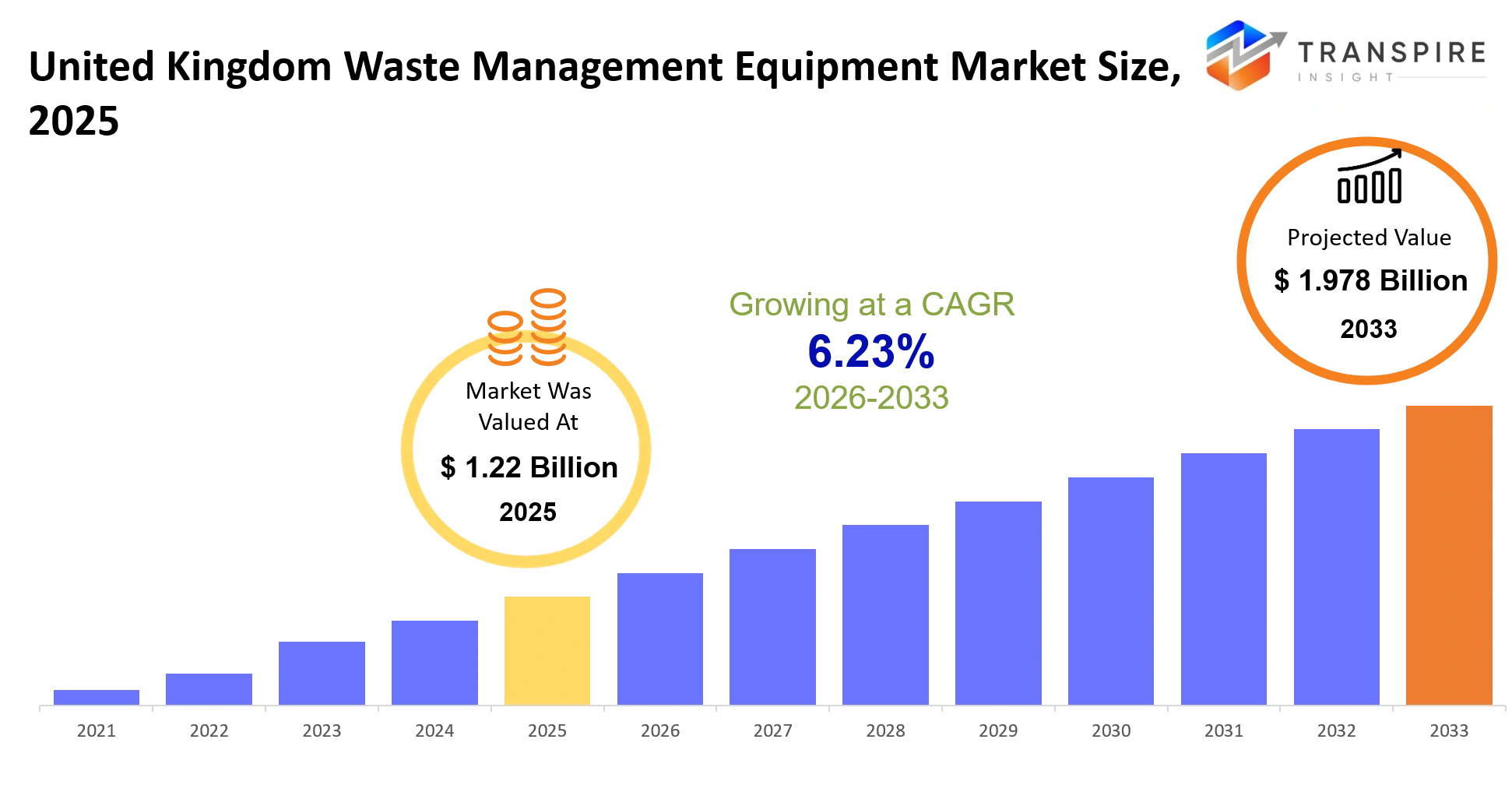
- United Kingdom Waste Management Equipment Market Size 2025: USD 1.22 Billion
- United Kingdom Waste Management Equipment Market Size 2033: USD 1.978 Billion
- United Kingdom Waste Management Equipment Market CAGR: 6.23%
- United Kingdom Waste Management Equipment Market Segments: By Equipment Type (Collection Equipment, Recycling Equipment, Waste Compactors, Shredders, Incinerators, Others); By Waste Type (Municipal, Industrial, Hazardous, Construction, E-Waste, Others); By Technology (Mechanical, Automated, Smart, Others); By End User (Municipalities, Industrial Facilities, Commercial Establishments, Healthcare Facilities, Others).
United Kingdom Waste Management Equipment Market Summary
The United Kingdom Waste Management Equipment Market was valued at USD 1.22 Billion in 2025. It is forecast to reach USD 1.978 Billion by 2033. That is a CAGR of 6.23% over the period.
The UK waste management equipment sector has rather quietly become absolutely essential to how local authorities, industrial producers, and commercial businesses manage community refuse, plant by-products, and hazardous substances. In very practical terms, such systems really do collect waste quite efficiently, separate out recyclables correctly, compress materials for transportation purposes, and occasionally burn highly toxic substances under extremely stringent environmental regulations.
Over the past 5 years or so, the market moved significantly away from those older mechanical sorting systems towards much more automated garbage trucks fitted with sensor technology - and offering real-time monitoring. This change actually picked up speed when landfill restrictions got even tighter all over England and Wales, when recycling targets became far stricter, and when waste operators began facing very real pressure to decrease emissions and improve material recovery percentages. That shift resulted in lots of councils and waste companies scrambling to purchase new equipment, upgrade their collection vehicle fleets, modernize their sorting facilities, and install intelligent technologies to track waste flows much more accurately itself.
The entire regulatory environment also tightened up considerably. Post-Brexit environmental standards remained consistent with EU guidelines - and the government exerted even more influence on our net-zero commitments, resource usage objectives, and the circular economy plan. So waste operators, whether council-owned or private contractors, were under increasing pressure to use much more advanced handling equipment that would improve recovery rates, lower disposal expenses, and meet those much tougher compliance demands - all without putting too great a strain on their already very tight operating budgets indeed.
Key Market Insights
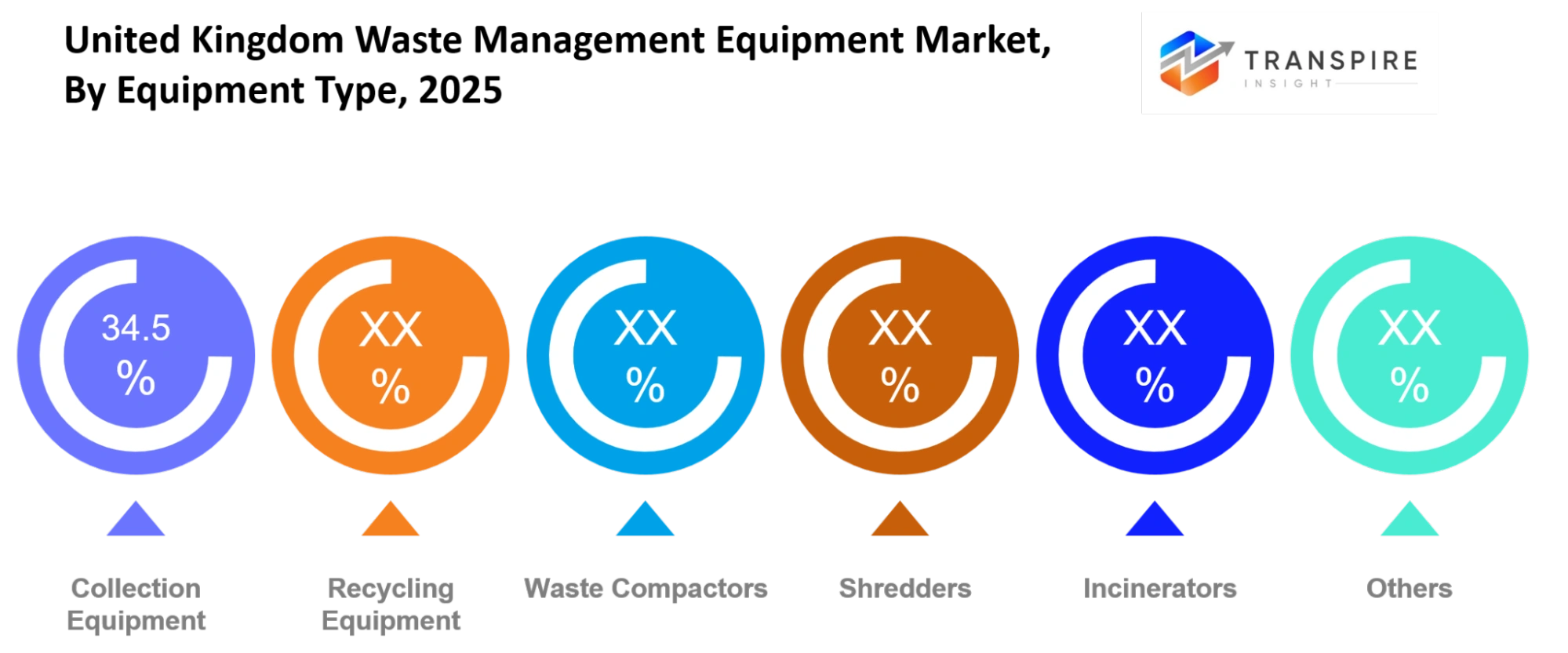
- Collection equipment really took the lead in the UK Waste Management Equipment market - securing approximately 34. 5% market share in 2025 - largely because collecting waste is literally the first step in every municipal and commercial waste stream.
- Recycling equipment came next with roughly 28% share, indicating a significant push towards circular economy practices all over the region.
- Waste compactors and shredders collectively had almost 22% of the market, driven by both the need for volume reduction and material processing. Adoption of smart technologies was actually growing the fastest, with sensor-enabled and automated systems demonstrating double-digit yearly growth as councils completely modernized their operations.
- Municipal waste continued to be the biggest waste type, holding roughly 52% market share, since councils handle domestic waste for the urban population all over England, Scotland, Wales, and Northern Ireland.
- Industrial waste processing equipment secured about 28% share, reflecting consistent demand from manufacturing, food processing, and hospitality sectors. The construction waste, hazardous waste, and e-waste segments combined for around 20%, with e-waste actually showing the quickest growth because of electronic waste recycling laws.
- Mechanical systems were still the norm in 2025, making up roughly 58% of the market, although they did face a slow displacement by automated solutions.
- Automated equipment grew at roughly 8. 5% annually, while smart technology integration showed the highest growth curve at nearly 12% CAGR.
- Municipalities and local councils accounted for nearly 45% of end-user demand, while industrial facilities, commercial businesses, and private waste operators split the remaining market quite evenly.
What are the Key Drivers, Restraints, and Opportunities in the United Kingdom Waste Management Equipment Market?
The main driving force behind the UK's waste management equipment market growth is the increasing landfill restrictions and very strict circular economy requirements enforced by both Westminster and devolved governments. The Environment Act of 2021 truly exposed the difference between outdated disposal-oriented operations and cutting-edge resource recovery systems. This really resulted in fast-paced investment in equipment capable of accurately sorting materials, efficiently compacting waste, and monitoring material flow almost instantly.
Extended Producer Responsibility initiatives are compelling manufacturers to reassess their packaging materials - a change that, in turn, increases the need for specialized equipment to manage these emerging waste streams. Quite a number of waste operators - especially smaller councils and private contractors - are allocating more funds to modern sorting lines and collection vehicles equipped with compaction and tracking technology. Consequently, equipment suppliers are witnessing a greater demand for technology upgrades, automation retrofits, and fully integrated waste management software installations.
However, the biggest structural challenge remains the exorbitant cost of capital equipment for smaller waste operators and rural councils. Many medium-sized local authorities operate somewhat haphazard systems consisting of older mechanical sorters blended with newer automated equipment - a setup that greatly increases operational complexity. Upgrading outdated infrastructure often involves long-term capital projects, budget approvals, and procurement processes that really take their time. That further slows down adoption - particularly among financially strained councils - thus suppressing potential market growth that might have occurred otherwise.
Artificial intelligence-driven waste sorting and contamination detection appears to be the next significant opportunity for growth. UK waste operators are starting to consider computer vision systems for identifying materials with greater precision, and also monitoring contamination rates in real-time. Meanwhile, investments in resource recovery facilities near major cities are creating opportunities for vendors offering AI-enhanced sorting solutions along with predictive maintenance tools - rather than just static equipment sales.
What Has the Impact of Artificial Intelligence Been on the United Kingdom Waste Management Equipment Market?
Artificial intelligence and advanced analytics really are redefining the United Kingdom Waste Management Equipment Market - they're pushing waste processing to happen much faster, even more accurately, and far less reliant on human sorting. In reality, waste operators rely more and more on AI-driven platforms overseeing material sorting tasks, contamination detection, equipment performance monitoring, and predictive maintenance workflows. These systems observe composition rates, sorting accuracy, equipment stress patterns, and material recovery metrics across numerous processing lines at once.
Machine learning models are significantly improving sorting performance throughout waste processing operations. Local councils and private waste companies use computer vision-powered analytics to execute quality control checks on sorted materials, forecast equipment failures, and optimize collection routes depending on current demand signals. Thanks to advanced optical recognition systems, facilities can evaluate thousands of material combinations in real-time, greatly reducing contamination prevention and also decreasing processing delays. Consequently, numerous operators have been able to accelerate throughput rates, lower handling expenses, and enhance recovery yields feeding right back into the circular economy cycle itself.
However, AI adoption does face very real limitations indeed. Integrating AI into existing waste management infrastructure remains quite difficult due to older collection trucks and sorting equipment lacking sensor connectivity. Lots of authorities operate separate systems across various facilities - this really hurts data quality, slows down predictive analytics, and raises total installation costs for AI-based waste processing solutions. Creating training datasets for local waste compositions varies too, leading to reduced model accuracy under different regional conditions.
Key Market Trends
- Since 2021, UK councils have pretty much swapped out older manual sorting systems for semi-automated collection equipment - all to improve your safety, speed, and accuracy. Requirements under the Environment Act really pushed our procurement cycles forward a lot quicker than we'd anticipated.
- Waste-to-energy and incineration technology really gained some interest again after 2022 - mainly because of landfill avoidance mandates and very real energy security worries. Many areas actually accelerated their investments in energy recovery facilities.
- Between 2023 and 2025, operators started getting much more serious about IoT-enabled truck tracking and predictive maintenance platforms. Real-time monitoring really helped us reduce unplanned downtime - and our collection efficiency improved quite noticeably indeed.
- UK waste companies deepened their relationships with equipment vendors so we could modernise our rather outdated infrastructure through lease and shared-investment models, greatly reducing those initial high capital costs.
- Cloud-based waste management software began to gain significant traction after pandemic disruptions highlighted how on-site data systems could limit our day-to-day operational visibility, leading to a big increase in software-as-a-service adoption.
- Private waste contractors increased their use of specialist equipment for e-waste and construction debris quite significantly after regulatory changes made those streams a lot more profitable - and even more closely monitored.
- Major equipment manufacturers like Caterpillar and Liebherr actually embedded digital monitoring into compactors and shredders - changing them from fairly passive tools into truly connected assets.
- UK waste operators started moving towards circular procurement agreements with equipment manufacturers. This change really reduced our ownership burden - and helped us get new technologies much faster, all in line with those ever-changing regulatory requirements.
United Kingdom Waste Management Equipment Market Segmentation
By Equipment Type:
Collection equipment remains the backbone of waste management, handling the initial capture and transport of waste from households, businesses, and commercial sites to processing facilities. These systems include traditional side-loader and rear-loader trucks, bin lifts, and increasingly, semi-automated vehicles with lift-assist technology and IoT tracking. Recycling equipment encompasses sorting systems, balers, shredders for scrap processing, and contamination removal tools that support circular economy operations across the UK.
Waste compactors play a critical role in reducing material volume before transport to landfills or energy recovery facilities, cutting transportation costs and environmental impact significantly. Shredders are essential for processing bulky items, construction debris, and industrial waste into manageable sizes. Incinerators and energy-from-waste systems handle hazardous or non-recyclable materials while generating electricity for local grids. Other specialized equipment includes bagging systems, magnetic separators, and optical sorters that support material recovery and quality assurance across waste processing chains.
By Waste Type:
Municipal solid waste dominates processing volumes across UK councils, requiring robust collection equipment and efficient transfer stations. Industrial waste streams from manufacturing, food processing, and hospitality sectors demand specialized handling to manage different contamination profiles and material compositions. Hazardous waste, including chemical residues and biohazard materials, requires specially equipped vehicles and secure processing facilities meeting strict regulatory standards.
Construction and demolition waste, generated by building sites across England, Wales, Scotland, and Northern Ireland, needs heavy-duty sorting and shredding equipment to recover valuable materials like metals and aggregates. E-waste processing demands specialized equipment with environmental controls to safely extract valuable materials while preventing hazardous substance release. Food and organic waste increasingly gets diverted to anaerobic digestion facilities, supporting both waste diversion goals and renewable energy production targets across the region.
By Technology:
Mechanical systems, including traditional hydraulic sorting tables, belt conveyors, and basic compaction equipment, still handle the majority of waste processing volume across UK facilities. These proven technologies remain cost-effective for standard municipal streams and provide the operational foundation for most councils and waste contractors.
Automated systems increasingly handle higher-volume sorting and processing, using motorized conveyors, pneumatic separation, and ballistic sorters to achieve better material purity and faster throughput than manual methods. Smart technologies, including real-time sensors, IoT connectivity, computer vision systems, and cloud-based monitoring platforms, are reshaping how waste operators track material flows, predict equipment failures, and optimize collection routes. These advanced systems deliver superior contamination detection and enable data-driven decision making across waste operations.
By End User:
Municipalities and local authorities remain the primary equipment users, managing household waste collection for millions of residents across England, Wales, Scotland, and Northern Ireland. Industrial facilities including manufacturing plants, food processing centers, and construction sites generate substantial waste volumes requiring specialized on-site and off-site processing capabilities.
Commercial establishments, such as retail centers, offices, hospitality venues, and logistics hubs, produce mixed waste streams requiring flexible collection and sorting systems. Healthcare facilities need highly specialized equipment to safely handle medical waste, sharps, and contaminated materials under strict biosafety protocols. Waste management contractors operating transfer stations and processing facilities need intermediate equipment that handles multiple waste types and integrates with broader municipal waste systems.
What are the Key Use Cases Driving the United Kingdom Waste Management Equipment Market?
Municipal waste collection remains the biggest use case, with councils and contractors managing household waste from millions of homes. Modern collection vehicles with compaction systems and real-time tracking help communities meet diversion targets and operate more efficiently than legacy equipment.
Commercial waste processing for high-volume retail, hospitality, and logistics centers drives steady demand for customized collection and sorting solutions. Industrial waste handling for manufacturing, food processing, and construction sectors creates specialized requirements for equipment that manages heavy loads, hazardous materials, and contaminated streams. E-waste processing is becoming increasingly important, as electronics recycling regulations create growing demand for specialized shredding and material recovery equipment.
Resource recovery facility operations increasingly include computer vision sorting, AI-powered contamination detection, and predictive equipment maintenance. Waste-to-energy and anaerobic digestion facilities need specialized handling systems to prepare feedstock and manage residues safely. Healthcare facility waste management creates ongoing demand for specialized containers, segregation equipment, and incineration systems that meet strict infection control and environmental standards.
|
Report Metrics |
Details |
|
Market size value in 2025 |
USD 1.22 Billion |
|
Market size value in 2026 |
USD 1.296 Billion |
|
Revenue forecast in 2033 |
USD 1.978 Billion |
|
Growth rate |
CAGR of 6.23% from 2026 to 2033 |
|
Base year |
2025 |
|
Historical data |
2021 - 2024 |
|
Forecast period |
2026 - 2033 |
|
Report coverage |
Revenue forecast, competitive landscape, growth factors, and trends |
|
Regional scope |
United Kingdom |
|
Key companies profiled |
Caterpillar, Komptech, Wastequip, Dover Corporation, Terex, Hitachi Construction Machinery, Liebherr, Machinex, SSI Shredding Systems, CP Manufacturing, Marathon Equipment, McCloskey International, Doppstadt, Eagle Crusher, Blue Group. |
|
Customization scope |
Free report customization (regional & segment scope). Avail customized purchase options to meet your exact research needs. |
|
Report Segmentation |
By Equipment Type (Collection Equipment, Recycling Equipment, Waste Compactors, Shredders, Incinerators, Others); By Waste Type (Municipal, Industrial, Hazardous, Construction, E-Waste, Others); By Technology (Mechanical, Automated, Smart, Others); By End User (Municipalities, Industrial Facilities, Commercial Establishments, Healthcare Facilities, Others). |
Which Regions are Driving the United Kingdom Waste Management Equipment Market Growth?
England dominates the United Kingdom Waste Management Equipment Market, driven by high waste volumes from London's population of 9 million and numerous major commercial centers across the Southeast and Midlands. Strict landfill restrictions across the South East, combined with ambitious recycling targets, force councils and contractors to invest heavily in modern equipment. London and the South East account for roughly 42% of market activity, reflecting dense urban populations and mature waste infrastructure.
Scotland shows steady growth momentum, backed by aggressive circular economy policies and strong local authority support for waste infrastructure. The central belt around Glasgow, Edinburgh, and the surrounding industrial zones generates substantial waste volumes, supporting consistent equipment replacement cycles. Scottish waste operators are increasingly adopting smart technologies and energy-from-waste solutions.
Wales displays the quickest regional growth, with targeted investment in waste infrastructure and resource recovery facilities. Recent devolved policy emphasis on zero waste and circular economy principles is driving procurement across local authorities. Northern Ireland contributes steadily, with Belfast and surrounding areas generating demand for municipal collection equipment and specialized waste processing systems.
Who are the Key Players in the United Kingdom Waste Management Equipment Market and How Do They Compete?
The competitive landscape in the United Kingdom Waste Management Equipment Market is moderately consolidated, with global industrial equipment giants competing alongside specialized waste equipment manufacturers. Competition has shifted from pure pricing toward technology differentiation, automation capabilities, environmental performance, and service quality. Equipment vendors now compete on digital integration, predictive maintenance features, and the ability to support circular economy goals. Long-term service contracts, parts availability, and technical support have become major differentiators.
Caterpillar brings extensive distribution networks and broad machinery expertise, especially in heavy compaction and earthmoving equipment adapted for waste operations. Komptech specializes in waste shredding and sorting equipment with strong European manufacturing capabilities and technical support. Wastequip offers integrated waste collection and disposal solutions with a focus on municipal contracts. Dover Corporation provides diversified environmental equipment through multiple brands and distribution channels.
Terex and Liebherr compete in waste compactors and collection vehicles with emphasis on durability and advanced hydraulics. Hitachi Construction Machinery brings Japanese engineering standards to waste processing equipment. Machinex specializes in resource recovery facilities and advanced sorting systems, while SSI Shredding Systems focuses on high-performance waste shredding technology. CP Manufacturing and Marathon Equipment serve both municipal and private sector markets with specialized sorting and processing equipment. Smaller specialists like Doppstadt, Eagle Crusher, and Blue Group compete through niche capabilities and regional service strength.
Company List
- Caterpillar
- Komptech
- Wastequip
- Dover Corporation
- Terex
- Hitachi Construction Machinery
- Liebherr
- Machinex
- SSI Shredding Systems
- CP Manufacturing
- Marathon Equipment
- McCloskey International
- Doppstadt
- Eagle Crusher
- Blue Group
Recent Development News
In February 2026, Komptech announced expansion of its UK manufacturing facility in response to growing demand for resource recovery equipment. The investment supports local production of sorting and shredding systems for waste operators across Britain.
In March 2026, several UK councils announced joint procurement initiatives for fleet electrification, with major orders for electric collection vehicles featuring IoT-enabled monitoring. These contracts signal accelerating adoption of smart waste management technologies across municipal operations.
In April 2026, the Environment Agency published updated circular economy guidance emphasizing equipment efficiency standards and material recovery targets. The directive is expected to drive additional procurement cycles for upgraded waste processing equipment among waste operators seeking compliance.
What Strategic Insights Define the Future of the United Kingdom Waste Management Equipment Market?
The United Kingdom Waste Management Equipment Market is moving toward increasingly automated, AI-powered, and digitally connected systems that blend collection efficiency, material sorting accuracy, and environmental compliance. This shift is being driven by tightening landfill restrictions, ambitious resource recovery targets, and the government's commitment to circular economy principles. Over the next five to seven years, equipment vendors that deliver faster processing, superior contamination detection, and seamless digital integration will capture stronger market share.
A quieter risk, though, is growing vulnerability to policy shifts and budget constraints. Waste equipment procurement depends heavily on council funding cycles and government grants. Sudden budget cuts or changing priorities could delay replacement cycles and reduce near-term demand growth. Extended Producer Responsibility implementation may also shift cost burdens, affecting investment patterns across the supply chain.
The emerging opportunity lies in integrated circular economy ecosystems combining waste collection, processing, and material marketing into unified platforms. Equipment vendors partnering with digital waste management software providers and material buyers should gain competitive advantage. Manufacturers focusing on modular, retrofit-ready designs that adapt to evolving regulations and market conditions will navigate future uncertainty more effectively. Investment in predictive maintenance capabilities and extended service agreements will create recurring revenue streams beyond traditional equipment sales.
United Kingdom Waste Management Equipment Market Report Segmentation
By Equipment Type
- Collection Equipment
- Recycling Equipment
- Waste Compactors
- Shredders
- Incinerators
- Others
By Waste Type
- Municipal
- Industrial
- Hazardous
- Construction
- E-Waste
- Others
By Technology
- Mechanical
- Automated
- Smart
- Others
By End User
- Municipalities
- Industrial Facilities
- Commercial Establishments
- Healthcare Facilities
- Others
Frequently Asked Questions
Find quick answers to common questions.
The United Kingdom Waste Management Equipment Market size is USD 1.978 Billion in 2033.
Key segments include By Equipment Type (Collection Equipment, Recycling Equipment, Waste Compactors, Shredders, Incinerators, Others); By Waste Type (Municipal, Industrial, Hazardous, Construction, E-Waste, Others); By Technology (Mechanical, Automated, Smart, Others); By End User (Municipalities, Industrial Facilities, Commercial Establishments, Healthcare Facilities, Others).
Major players include Caterpillar, Komptech, Wastequip, Dover Corporation, Terex, Hitachi Construction Machinery, Liebherr, Machinex, SSI Shredding Systems, CP Manufacturing, Marathon Equipment, McCloskey International, Doppstadt, Eagle Crusher, and Blue Group.
The United Kingdom Waste Management Equipment Market size is USD 1.22 Billion in 2025.
The United Kingdom Waste Management Equipment Market CAGR is 6.23% from 2026 to 2033.
- Caterpillar
- Komptech
- Wastequip
- Dover Corporation
- Terex
- Hitachi Construction Machinery
- Liebherr
- Machinex
- SSI Shredding Systems
- CP Manufacturing
- Marathon Equipment
- McCloskey International
- Doppstadt
- Eagle Crusher
- Blue Group
About the Authors

Avinash Kumar
I’m Avinash Kumar, a Senior Research Analyst at Transpire Insight, with expertise in the Electronics and Semiconductor and Energy & Power industry. My work focuses on analyzing emerging technologies, market trends, industry developments, and innovation across these sectors. I specialize in transforming complex technical and market insights into clear, research-backed content that helps professionals, businesses, and decision-makers stay informed. Through continuous industry research and data-driven analysis, I strive to deliver accurate, reliable, and practical perspectives on the latest advancements shaping the semiconductor and energy landscape.

Chakradhar Khansole
Chakradhar serves as the Research Director at Transpire Insight, bringing over 8 years of experience in technology, innovation, and strategic market intelligence. He specializes in transforming complex market data into actionable business insights that enable organizations to make informed, growth-oriented decisions. Recognized for his strategic vision and analytical expertise, Chakradhar leads high-impact research initiatives, delivering comprehensive market assessments, competitive intelligence, and forward-looking industry analysis.
Recently Published Reports
-
Apr 2026
Active Power Filter Market
Active Power Filter Market Size, Share & Analysis Report By Type (Shunt Active Power Filters, Series Active Power Filter, Hybrid Active Power Filter), By Application (Harmonics Mitigation, Reactive Power Compensation, Voltage Regulation, Power Factor Correction), By Phase (Single Phase, Three Phase), By End-User Industry (Manufacturing, Healthcare, Commercial, Automotive, Oil and Gas, Others), and Geography (North America, Europe, Asia-Pacific, Middle East and Africa, South and Central America), 2021 - 2031
-
Apr 2026
Electrical Transformer Market
Electrical Transformer Market Size, Share & Analysis Report By Core (Closed, Shell, and Berry), By Insulation (Gas, Oil, Solid, Air, and Other), By Phase (Single, and Three), By Rating (100 MVA to 500 MVA, 501 MVA to 800 MVA, and 801 MVA to 1200 MVA), and Geography (North America, Europe, Asia-Pacific, Middle East and Africa, South and Central America), 2021 – 2031
-
Apr 2026
Hydraulic Piston Pumps Market
Hydraulic Piston Pumps Market Size, Share & Analysis Report By Type (Axial Piston Pumps, Radial Piston Pumps), By Operating Pressure (Low Pressure, Medium Pressure, High Pressure), By Application (Construction, Mining, Agriculture, Automotive, Oil & Gas, Industrial Machinery, Others), By End-User (OEMs, Aftermarket), and Geography (North America, Europe, Asia-Pacific, Middle East and Africa, South and Central America), 2021 – 2031
-
Apr 2026
Laboratory Gas Generators Market
Laboratory Gas Generators Market Size, Share & Analysis Report By Product (Nitrogen Gas Generator, Hydrogen Gas Generator, Zero Air Gas Generator, Purge Gas Generator, TOC Gas Generators, Others), By Application (Gas Chromatography, Liquid Chromatography-mass Spectrometry (LC-MS), Gas Analyzers, Others), By End-user (Life Science, Chemical & Petrochemical, Food & Beverage, Others), and Geography (North America, Europe, Asia-Pacific, Middle East and Africa, South and Central America), 2021 – 2031