

United Kingdom Veterinary Precision Medicine Market Size & Forecast:
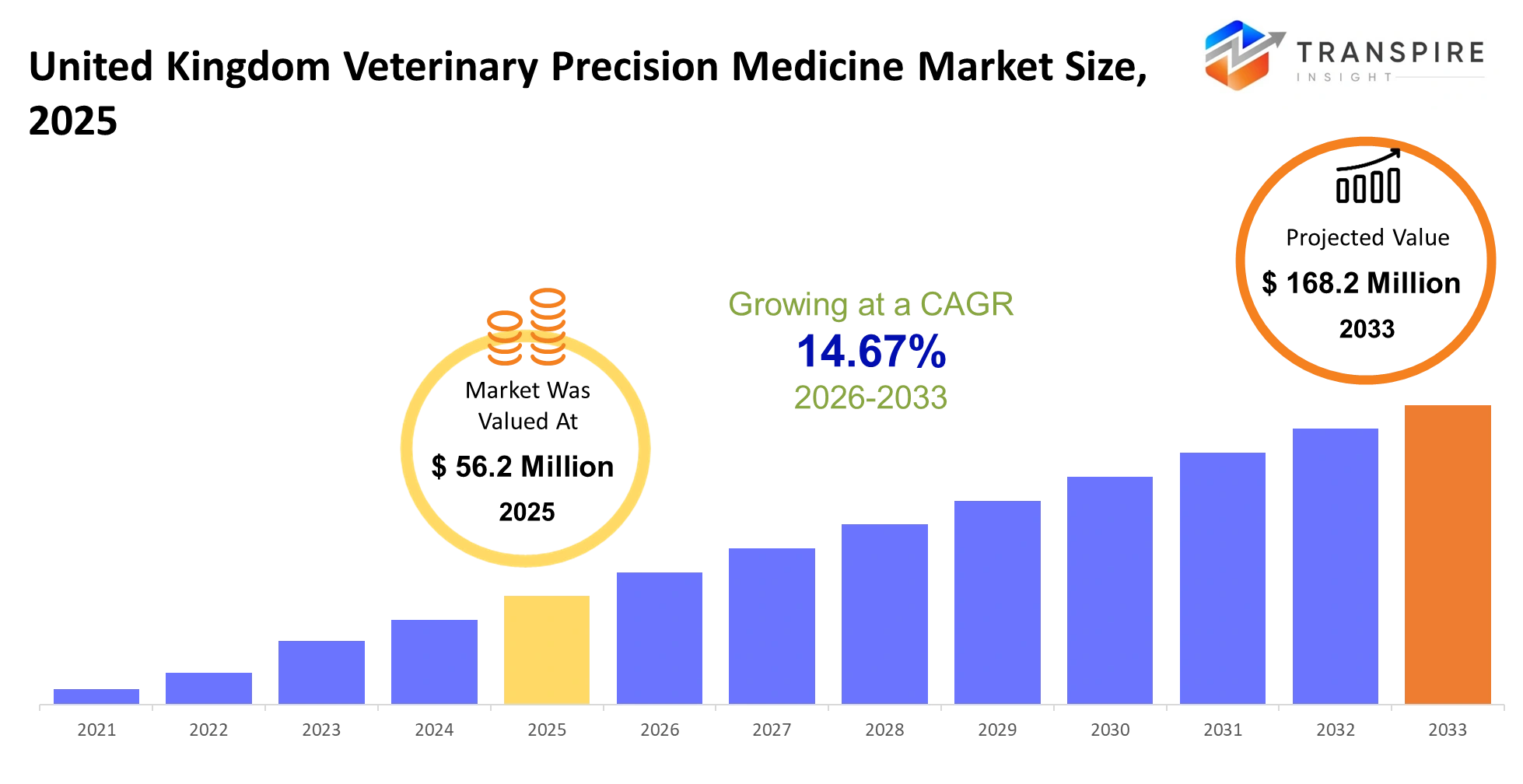
- United Kingdom Veterinary Precision Medicine Market Size 2025: USD 56.2 Million
- United Kingdom Veterinary Precision Medicine Market Size 2033: USD 168.2 Million
- United Kingdom Veterinary Precision Medicine Market CAGR: 14.67%
- United Kingdom Veterinary Precision Medicine Market Segments: By Product Type (Genomic Testing Services, Personalized Veterinary Drugs, Precision Diagnostics, Biomarker Testing, AI-based Veterinary Analytics, Others); By Animal Type (Companion Animals, Livestock Animals, Equine Animals, Exotic Animals, Others); By Application (Cancer Treatment, Infectious Disease Management, Genetic Disorder Diagnosis, Nutrition Planning, Others); By End User (Veterinary Hospitals, Research Institutes, Animal Diagnostic Labs, Pet Care Centers, Others); By Technology (NGS-based Testing, AI-powered Diagnostics, Molecular Diagnostics, Bioinformatics Platforms, Others).
To learn more about this report,  Download Free Sample Report
United Kingdom Veterinary Precision Medicine Market Summary
The United Kingdom Veterinary Precision Medicine Market was valued at USD 56.2 Million in 2025. It is forecast to reach USD 168.2 Million by 2033. That is a CAGR of 14.67% over the period.
The United Kingdom Veterinary Precision Medicine Market kind of helps veterinarians tune up diagnosis and treatment for animals, by leaning on genetic testing, advanced diagnostics, and also data driven tools , so clinical outcomes get better for both pets and livestock. Practically, it pushes clinicians away from those kinda broad, one size fits most treatment paths , toward more aimed therapies, which can cut down on drug overuse and support faster recovery, while still keeping farm productivity steady and companion animal health in good shape.
Over the last few years, the market has been shifting in a more structural way , from conventional symptom based care, to more routine use of genomic sequencing plus integrated digital diagnostic platforms inside veterinary clinics and research centers. A main trigger for this change is stricter antimicrobial resistance policies across the UK, mixed with post pandemic disruptions in veterinary pharmaceutical supply chains. Basically, those pressures have pushed veterinarians to lean harder on precision diagnostics before prescribing any treatments, and that lowered the trial and error style of prescribing. At the same time, it’s accelerated the demand for advanced testing services, and the technology providers that enable them.
Key Market Insights
- The United Kingdom Veterinary Precision Medicine Market is kind of shifting toward diagnostics that are genomics-led, so it improves treatment accuracy for companion animals as well as livestock animals, kinda across the board.
- England is still leading the United Kingdom Veterinary Precision Medicine Market with almost 65% share in 2025, mostly because the veterinary hospital infrastructure there is more advanced.
- Scotland looks like the fastest-growing region during 2025–2030, and that’s being driven by livestock health monitoring programs, plus government-backed animal health innovation initiatives.
- If we talk about what’s selling most, diagnostic kits and genomic testing services take the lead, with roughly 42% share across the United Kingdom Veterinary Precision Medicine Market.
- Then after that, data analytics platforms are basically the second-largest segment, helping with predictive disease modeling in veterinary settings and also improving treatment choices.
- The AI based precision diagnostics part is actually growing the quickest through 2030, largely due to cloud integration and real time clinical decision support.
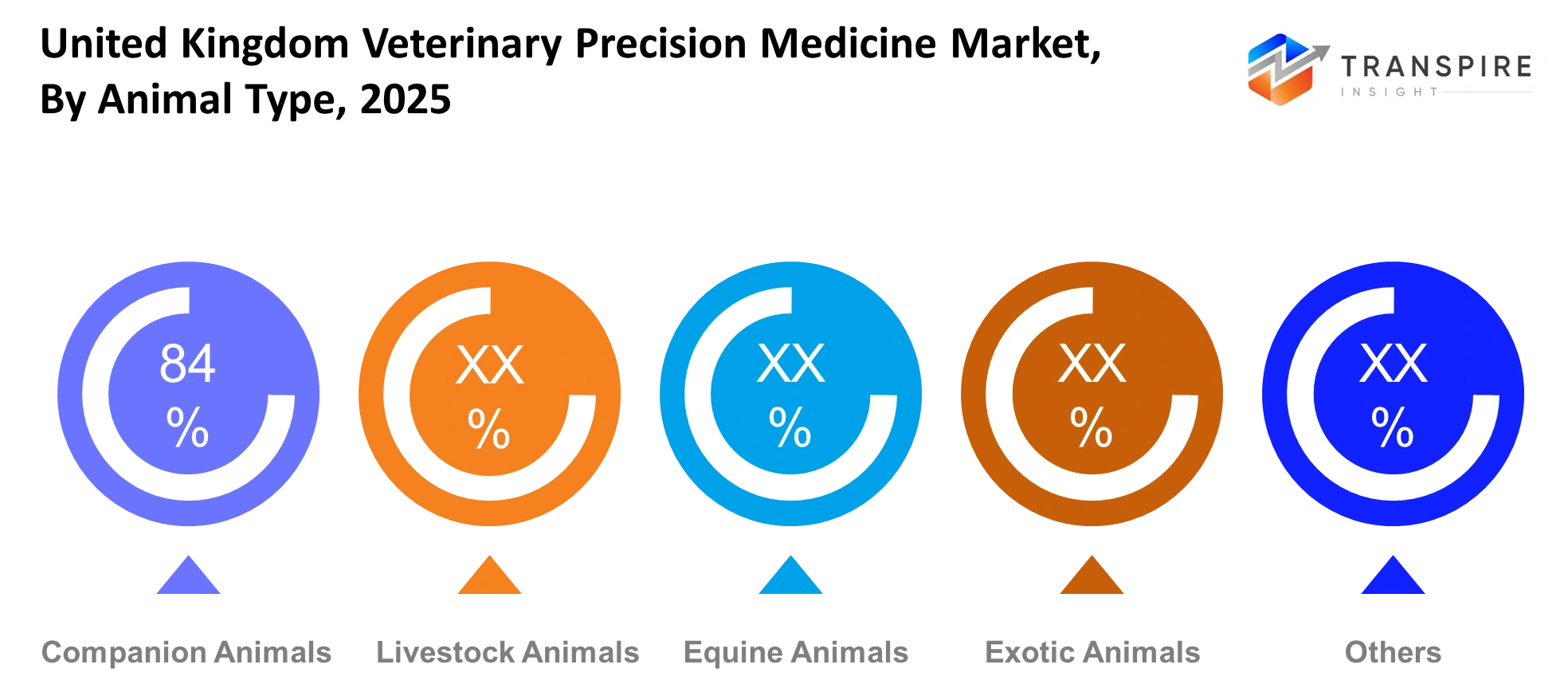
- When it comes to animal types, companion animal healthcare dominates with nearly 58% share, and it’s linked to higher pet ownership and wider adoption of personalized treatment.
- For the applications, livestock disease management is the fastest-growing one, supported by antimicrobial resistance control and that ongoing demand for productivity optimization.
- In terms of channels, veterinary hospitals and clinics take the lead at around 60% share, because adoption of advanced diagnostic workflows is pretty high.
- And finally, veterinary research institutes are the fastest-growing end-user segment, they’re expanding genomic research, and also rolling out more precision treatment protocols.
What are the Key Drivers, Restraints, and Opportunities in the United Kingdom Veterinary Precision Medicine Market?
The primary driver is the rapid merge of genomic sequencing along with more advanced diagnostic technologies into everyday veterinary work. I mean, this shift really got going because of stricter antimicrobial resistance regulations in the UK, which sort of pushed veterinarians to lean on evidence- based prescribing approaches rather than go with broad-spectrum treatments. So, in practice, clinics and labs are bringing in more income from precision diagnostics, repeat testing services,and also data-led treatment planning. At the same time they tend to improve clinical results for both companion animals and livestock, which is the bigger thing people care about.
One key restraint is that precision diagnostic systems are expensive, and they also demand a lot of infrastructure , like sequencing platforms plus specialized bioinformatics tools. A good number of small and mid-sized veterinary practices can’t easily afford the capital, and they also don’t always have the technical know-how to set these systems up. This basically leaves a sort of adoption gap in the structure of the market. Because of that, penetration tends to happen slower outside major city areas, and revenue scaling stays limited, especially in rural regions focused on livestock where budget constraints are still a constant problem.
The most promising opportunity sits in the expansion of AI-enabled veterinary decision-support platforms, integrated with cloud-based diagnostic ecosystems. Investment is ramping up for UK veterinary data infrastructure, especially inside collaborative research hubs that connect universities and animal health companies. That combination opens a pathway toward scalable, real-time precision treatment models, and it could also expand access while unlocking fresh service-based revenue streams.
What Has the Impact of Artificial Intelligence Been on the United Kingdom Veterinary Precision Medicine Market?
Artificial intelligence and advanced digital tools are sort of reshaping the United Kingdom Veterinary Precision Medicine Market, mainly by nudging diagnostic accuracy, treatment planning , and large scale animal health monitoring into a more consistent workflow. In actual veterinary clinics, AI powered imaging systems and diagnostic software are now doing much of the heavy lifting. They automate the analysis of radiology scans, pathology slides, and genomic test outputs, which cuts down on manual interpretation time and lets clinicians make faster, often better, clinical calls. At the same time, these tools tweak laboratory processes too, like they prioritize the higher risk cases and smooth out sample processing, so operational efficiency gets a boost across veterinary hospitals and diagnostic networks.
Then there are machine learning models that are increasingly showing up in predictive roles , especially for livestock health management and companion animal disease forecasting. When they look through historical clinical records, environmental factors, and genomic information, they can support veterinarians in anticipating disease surges, adjusting vaccination timing , and forecasting treatment response with more consistency. In real usage, this commonly translates to shorter diagnostic cycles, tighter treatment precision, and measurable declines in avoidable medication spending plus fewer repeat consultations
Still, adoption is not fully running at full speed. It is held back by the high cost of integrating AI platforms with the existing veterinary infrastructure , and also by the absence of standardized, high quality animal health datasets. On top of that, many systems have trouble talking to each other , especially when it comes to interoperability across diagnostic devices and practice management software. This makes seamless data exchange harder, sometimes slower. Even so, investment in cloud based veterinary analytics and digital pathology platforms is steadily building a stronger base, so wider AI adoption across the sector can happen more easily, eventually
Key Market Trends
- Between 2022 and 2025, veterinary clinics in the United Kingdom seem to have moved more and more away from plain symptom based care, and sort of toward genomic led diagnostics… yeah, like the market got more genomic driven.
- AI assisted imaging started showing up faster after 2023, which helped cut down diagnostic turnaround time in veterinary hospitals. This happened mainly because automated radiology and pathology analysis got better, and also more consistent somehow.
- The antimicrobial resistance rules that came earlier have been chipping away at routine antibiotic prescribing. So since 2021, precision testing has been getting pushed through livestock treatment systems, even if slowly at first.
- After 2023, Zoetis expanded genomic testing collaborations across UK veterinary networks, and that strengthened precision focused workflows for companion animals too.
- From 2022 to 2025, veterinary laboratories also increased spending on cloud based analytics platforms, mainly so they could handle the higher genomic and biomarker testing volumes without getting overwhelmed.
- Meanwhile livestock health monitoring systems leaned more into predictive disease modeling after 2024, and that reduced the delays in outbreak response across big scale UK farming operations.
- IDEXX Laboratories meanwhile, accelerated the digital diagnostic integration in UK clinics from 2023. That improved data sharing between labs and veterinary practitioners, which is obviously a big deal.
- Smaller veterinary practices still mostly lagged behind, largely because equipment costs can be high and integration is complicated. So rural market penetration stayed slower, through 2025.
- Investment in veterinary AI decision support tools rose notably after 2022, letting clinics detect disease earlier and improve treatment precision across different clinical settings.
United Kingdom Veterinary Precision Medicine Market Segmentation
By Product Type:
Genomic testing services, precision diagnostics, biomarker testing , AI based veterinary analytics , and personalized veterinary drugs are starting to reshape animal healthcare delivery in a pretty noticeable way. Genomic testing backs early disease detection and helps clinicians choose treatment by looking at genetic profiles. Precision diagnostics and biomarker tools make clinical choices more precise, while AI analytics will streamline the interpretation of messy, complex veterinary data across hospitals and laboratories , or so it seems in practice.
Genomic testing services are being used more for companion animal care and livestock disease control, especially since stricter antimicrobial rules came in during the last few years. Precision diagnostics now help identify infections and genetic risks faster , which can cut back on trial and error treatments. Biomarker testing is also expanding in research and clinical settings to support targeted therapy planning and better matching of options.
By Animal Type:
Companion animals , livestock animals , equine animals , exotic animals , and others show different adoption rhythms , which is kinda expected. Companion animals lead the market because pet healthcare spending is rising and owners want advanced therapies. Livestock animals are adopting precision monitoring more often , mainly because productivity targets and disease control needs are getting tighter.
Companion animal healthcare keeps expanding with more personalized treatment approaches in veterinary clinics. Livestock precision medicine grows steadily because prevention matters, and regulatory pressure keeps antibiotic use under tighter limits. Equine and exotic animal care are gradually taking up advanced diagnostics , mostly through specialized veterinary centers where the workflows are already set up.
To learn more about this report, Download Free Sample Report
By Application:
Cancer therapy, infectious disease handling, genetic ailment diagnosis, diet arrangement, and a few other needs are big application zones. Infectious disease management stays especially crucial because outbreaks can pop up, fast. Genetic disorder diagnosis is getting more momentum with wider adoption of sequencing tools. Meanwhile cancer treatment uses are also getting better, mainly because targeted diagnostic methods are becoming more refined.
Infectious disease control in particular, has been moving toward early detection and also predictive monitoring systems over the last several years. Genetic disorder screening is now more and more used inside breeding programs as well as clinical veterinary care. Cancer diagnosis in animals is turning out more accurate thanks to upgraded imaging tools and testing based on biomarkers .
By End User:
Veterinary hospitals, research institutes, animal diagnostic laboratories, pet care centers, and similar organizations are basically the main end users. Veterinary hospitals tend to take the lead, because they have the kind of infrastructure that makes adoption easier. Diagnostic laboratories help meet the demand for testing at scale, but research institutes usually push forward new ideas in precision veterinary technologies.
Veterinary hospitals are increasingly using digital diagnostics along with genomic testing systems so clinical outcomes can improve. Diagnostic labs are also working through larger batches of biomarker tests and sequencing based tests. Research institutes are concentrating on building newer precision medicine approaches for companion animals and livestock health applications too .
By Technology:
NGS based testing, AI powered diagnostics , molecular diagnostic methods, bioinformatics platforms and other tools kinda define the technical backbone of the market. For instance , NGS based testing helps with deep genetic research, not just surface level. AI powered diagnostics make clinical decision making faster and more precise, which is useful when time matters. Meanwhile bioinformatics platforms back up large scale data interpretation across veterinary systems, so the whole workflow stays connected.
Adoption of NGS technology seems to be rising in both clinical settings and research labs, mainly for more detailed genetic insights. AI powered diagnostic systems are also cutting down on manual workload , while boosting analysis efficiency. And between molecular diagnostics plus bioinformatics tools , there’s stronger integration between laboratories and veterinary clinics, which supports more data driven treatment choices throughout the sector.
What are the Key Use Cases Driving the United Kingdom Veterinary Precision Medicine Market?
In the United Kingdom Veterinary Precision Medicine Market, the dominant use case is basically personalized diagnosis plus treatment plotting for companion animals. A lot of veterinary hospitals depend on genomic testing and precision diagnostics to catch disease earlier on, and then choose more targeted therapies. This specific use case ends up getting the most demand, since pet health spending keeps rising and antimicrobial stewardship rules are getting stricter, so clinicians lean more toward evidence based, data guided decisions instead of just routine practice.
From there, expanding use cases start showing up in places like infectious disease control in livestock, and also cancer detection in pets. Animal diagnostic labs and veterinary hospitals are increasingly running biomarker testing, along with molecular diagnostics , to keep an eye on herd wellness and to push survival outcomes higher. At the same time research institutes help adoption move forward by validating new precision medicine protocols for real clinical use, not only theory.
What’s emerging next includes predictive illness modeling, plus nutrition tuning based on genetic profiling. Veterinary clinics and research networks are starting to use AI led analytics to guess disease risks ahead of time, and to sharpen preventive care plans. These ideas aren’t common everywhere yet, but they look promising, because the digital veterinary infrastructure across the UK keeps growing, slowly but steadily.
|
Report Metrics |
Details |
|
Market size value in 2025 |
USD 56.2 Million |
|
Market size value in 2026 |
USD 64.5 Million |
|
Revenue forecast in 2033 |
USD 168.2 Million |
|
Growth rate |
CAGR of 14.67% from 2026 to 2033 |
|
Base year |
2025 |
|
Historical data |
2021 - 2024 |
|
Forecast period |
2026 - 2033 |
|
Report coverage |
Revenue forecast, competitive landscape, growth factors, and trends |
|
Regional scope |
Middle East and Africa (Saudi Arabia, United Arab Emirates, South Africa, Rest of Middle East and Africa) |
|
Key company profiled |
Mars Petcare, IDEXX Laboratories, Zoetis, Heska Corporation, Neogen Corporation, Thermo Fisher Scientific, Illumina, Basepaws, Embark Veterinary, Antech Diagnostics, Virbac, PetDx, FidoCure, Boehringer Ingelheim, Ceva Santé Animale. |
|
Customization scope |
Free report customization (country, regional & segment scope). Avail customized purchase options to meet your exact research needs. |
|
Report Segmentation |
By Product Type (Genomic Testing Services, Personalized Veterinary Drugs, Precision Diagnostics, Biomarker Testing, AI-based Veterinary Analytics, Others); By Animal Type (Companion Animals, Livestock Animals, Equine Animals, Exotic Animals, Others); By Application (Cancer Treatment, Infectious Disease Management, Genetic Disorder Diagnosis, Nutrition Planning, Others); By End User (Veterinary Hospitals, Research Institutes, Animal Diagnostic Labs, Pet Care Centers, Others); By Technology (NGS-based Testing, AI-powered Diagnostics, Molecular Diagnostics, Bioinformatics Platforms, Others). |
Which Regions are Driving the United Kingdom Veterinary Precision Medicine Market Growth?
England still takes the leading position in the United Kingdom Veterinary Precision Medicine Market, mostly because it has this pretty advanced veterinary healthcare set-up and, honestly, a high concentration of specialist clinics. There’s also a solid backbone of diagnostic laboratories in place, plus early uptake of genomic testing and AI-assisted veterinary tools. On top of that, the regulatory push to reduce antimicrobial use has nudged clinicians toward precision based treatment routes, which is kind of a big shift. And since England has a dense web of veterinary hospitals, along with ongoing research ties with universities, innovation keeps moving and service uptake stays high .
Scotland brings in a steady, reliable portion of the United Kingdom Veterinary Precision Medicine Market, and it seems to come from its strong livestock farming base and those structured animal health monitoring programs. In a way, it’s less technology heavy than England’s clinical ecosystem. Scotland leans more on preventive herd health management and government-supported veterinary surveillance systems. Because rural veterinary services keep getting investment, plus there are firm disease control frameworks, demand for precision diagnostics stays stable. So, overall Scotland supports market revenue without major spikes or sudden dips .
Wales is starting to look like the fastest growing region in the market, and that’s tied to recent upgrades in veterinary diagnostic infrastructure, along with more funding directed toward rural animal health programs. New livestock disease control initiatives and the modernization of veterinary clinics have sped up the use of molecular diagnostics as well as biomarker testing . And with better digital connectivity in rural areas, AI based veterinary tools are being used more broadly. From an investor standpoint , Wales could be interesting for 2026–2033 because adoption is moving from small pilot efforts toward more general clinical integration, so growth potential seems stronger.
Who are the Key Players in the United Kingdom Veterinary Precision Medicine Market and How Do They Compete?
The United Kingdom Veterinary Precision Medicine Market kind of shows a moderately consolidated structure, where a handful of global animal health and diagnostics firms hold strong positions, but then smaller niche innovators still slip in, mostly via AI tools and specialized testing services. Overall competition seems driven not so much by pricing, but more by tech differentiation, especially genomic testing, AI based diagnostics, and those integrated data platforms that sound simple but really matter in day to day operations. The established companies are basically defending their share by adding more digital capabilities and by strengthening ties with veterinary hospital networks. Meanwhile new entrants are nudging ( and sometimes reshaping ) the way work gets done, using faster, cloud based diagnostic solutions that cut down turnaround time and support better treatment accuracy.
Zoetis leans into technology-led differentiation using advanced genomic testing and precision animal health solutions. It supports its position by folding predictive health tools into companion animal care, so veterinarians can make earlier intervention calls. The company also expands through partnerships with veterinary clinics and research institutions across the UK, which helps it sink its diagnostic systems into routine clinical workflows.
IDEXX Laboratories sort of builds its edge on high-throughput diagnostic platforms and good lab integration abilities. Their setups lets real-time data sharing happen between clinics and diagnostic labs , so the teams can make decisions faster and keep clinical work more efficient, overall. Thermo Fisher Scientific stands out via more advanced molecular diagnostics and sequencing technologies, especially for veterinary research and for specialized testing. They also keep expanding their footprint, by supplying high-precision laboratory instruments to research institutes and diagnostic centers all over the UK, which ends up reinforcing their place in the precision medicine value chain.
Company List
- Mars Petcare
- IDEXX Laboratories
- Zoetis
- Heska Corporation
- Neogen Corporation
- Thermo Fisher Scientific
- Illumina
- Basepaws
- Embark Veterinary
- Antech Diagnostics
- Virbac
- PetDx
- FidoCure
- Boehringer Ingelheim
- Ceva Santé Animale
Recent Development News
In March 2026, Zoetis announced an agreement to acquire Neogen’s animal genomics business for $160 million. The transaction enhances Zoetis’ Precision Animal Health portfolio by integrating advanced genomic technologies and predictive analytics, which are increasingly central to veterinary precision medicine applications across livestock and companion animals, including in the UK market.
Source: https://animalhealthnews.com/
In September 2025, Zomedica entered a strategic distribution partnership with Pioneer Veterinary Products Limited. The agreement expanded UK distribution of Zomedica’s TRUFORMA diagnostic platform, improving availability of point-of-care diagnostic technologies that support earlier and more precise veterinary disease detection across companion and equine animals.
Source: https://www.pharmiweb.com/
What Strategic Insights Define the Future of the United Kingdom Veterinary Precision Medicine Market?
The United Kingdom Veterinary Precision Medicine Market is slowly (and kinda messily) shifting toward fully integrated , data-led animal care systems, where genomic testing, AI assisted decision tools, and cloud clinical platforms basically act like one continuous workflow. This pull is mostly because antimicrobial stewardship rules keep getting stricter, and because people really want better treatment accuracy across both companion animal care and livestock settings. Over the next five to seven years, value creation will likely move away from just standalone diagnostic gadgets, and instead toward connected service ecosystems that keep producing ongoing clinical insights, not just one-off results.
There’s also a risk that’s less obvious day to day. Think about platform concentration , where only a small group of diagnostic providers and software firms might end up steering most of the clinical data paths. In that situation, interoperability can get squeezed, and innovation may end up crawling, especially if proprietary systems start dominating veterinary networks. On top of that, digital readiness doesn’t look even across rural practices, so adoption gaps can form, and those gaps might not show up in the headline growth numbers you see in reports.
A major and emerging opportunity is real time livestock health tracking, using AI tied biosensors that also plug into farm management systems. It’s still early, but it lines up well with UK food security priorities and disease prevention requirements. Market players should focus on interoperable, cloud first solutions that can mesh with the current veterinary infrastructure, and that can scale across both city clinics and rural livestock networks.
United Kingdom Veterinary Precision Medicine Market Report Segmentation
By Product Type
- Genomic Testing Services
- Personalized Veterinary Drugs
- Precision Diagnostics
- Biomarker Testing
- AI-based Veterinary Analytics
By Animal Type
- Companion Animals
- Livestock Animals
- Equine Animals
- Exotic Animals
By Application
- Cancer Treatment
- Infectious Disease Management
- Genetic Disorder Diagnosis
- Nutrition Planning
By End User
- Veterinary Hospitals
- Research Institutes
- Animal Diagnostic Labs
- Pet Care Centers
By Technology
- NGS-based Testing
- AI-powered Diagnostics
- Molecular Diagnostics
- Bioinformatics Platforms
Frequently Asked Questions
Find quick answers to common questions.
The United Kingdom Veterinary Precision Medicine Market size is USD 168.2 Million in 2033.
Key segments for the United Kingdom Veterinary Precision Medicine Market are By Product Type (Genomic Testing Services, Personalized Veterinary Drugs, Precision Diagnostics, Biomarker Testing, AI-based Veterinary Analytics, Others); By Animal Type (Companion Animals, Livestock Animals, Equine Animals, Exotic Animals, Others); By Application (Cancer Treatment, Infectious Disease Management, Genetic Disorder Diagnosis, Nutrition Planning, Others); By End User (Veterinary Hospitals, Research Institutes, Animal Diagnostic Labs, Pet Care Centers, Others); By Technology (NGS-based Testing, AI-powered Diagnostics, Molecular Diagnostics, Bioinformatics Platforms, Others).
Major United Kingdom Veterinary Precision Medicine Market players are Mars Petcare, IDEXX Laboratories, Zoetis, Heska Corporation, Neogen Corporation, Thermo Fisher Scientific, Illumina, Basepaws, Embark Veterinary, Antech Diagnostics, Virbac, PetDx, FidoCure, Boehringer Ingelheim, Ceva Santé Animale.
The United Kingdom Veterinary Precision Medicine Market size is USD 56.2 Million in 2025.
The United Kingdom Veterinary Precision Medicine Market CAGR is 14.67% from 2026 to 2033.
- Mars Petcare
- IDEXX Laboratories
- Zoetis
- Heska Corporation
- Neogen Corporation
- Thermo Fisher Scientific
- Illumina
- Basepaws
- Embark Veterinary
- Antech Diagnostics
- Virbac
- PetDx
- FidoCure
- Boehringer Ingelheim
- Ceva Santé Animale
About the Authors

Pankaj Ghogare Patil
I am Pankaj Ghogare Patil, a Senior Research Analyst at Transpire Insight, specializing in the Pharmaceutical, Chemicals & Materials, Healthcare IT, and Biotechnology industry. My expertise lies in conducting comprehensive market research, analyzing industry trends, evaluating competitive landscapes, and translating complex data into actionable insights. At Transpire Insight, I closely follow emerging technologies, regulatory developments, and market innovations to create accurate, well-researched, and informative content that helps businesses and professionals make informed decisions. I am committed to producing credible, evidence-based articles that reflect industry best practices while making technical topics accessible and valuable for a broad audience.

Chakradhar Khansole
Chakradhar serves as the Research Director at Transpire Insight, bringing over 8 years of experience in technology, innovation, and strategic market intelligence. He specializes in transforming complex market data into actionable business insights that enable organizations to make informed, growth-oriented decisions. Recognized for his strategic vision and analytical expertise, Chakradhar leads high-impact research initiatives, delivering comprehensive market assessments, competitive intelligence, and forward-looking industry analysis.
Recently Published Reports
-
Jul 2026
Alopecia Treatment Market
Alopecia Treatment Market Size, Share & Analysis Report By Disease Type (Alopecia Areata, Cicatricial Alopecia, Traction Alopecia, Alopecia Totalis, Androgenetic Alopecia, Alopecia Universalis, and Other Disease Types), By Treatment Type (Topical Treatments, Oral Medications, Injectable Therapies, and Hair Transplantation), By Gender (Male, and Female), By Distribution Channel (Hospitals and Clinics, Retail Pharmacies, and Online Retailers), and Geography (North America, Europe, Asia-Pacific, Middle East and Africa, South and Central America), 2021 - 2031
-
Jul 2026
Medical Ultrasound Probe Market
Medical Ultrasound Probe Market Size, Share & Analysis Report By Type (Linear Type, Convex Type, Endocavitary Probe, Phased Array/Cardiac Probe, Transesophageal (TEE) Probe, and Others), By Application (Ophthalmology, Cardiology, Musculoskeletal, Oncology, Obstetrics & Gynecology, General Imaging, and Others), By End User (Hospitals & Clinics, Diagnostic Centers, Ambulatory Surgical Centers, and Others), and Geography (North America, Europe, Asia-Pacific, Middle East and Africa, South and Central America), 2021 – 2031
-
May 2026
Biosimilars Market
Biosimilars Market By Product Type (Monoclonal Antibodies, Recombinant Hormones, Erythropoietin, G-CSF, Others), By Indication (Oncology, Autoimmune Diseases, Blood Disorders, Diabetes, Others), By Manufacturing Type (In-House Manufacturing, Contract Manufacturing), By Distribution Channel (Hospital Pharmacies, Retail Pharmacies, Online Pharmacies), By Industry Analysis, Size, Share, Growth, Trends, and Forecasts 2021-2033
-
Apr 2026
Gastrointestinal Endoscopy Market
Gastrointestinal Endoscopy Market By Type (Rigid Gastrointestinal Endoscope, Flexible Gastrointestinal Endoscopes, Disposable Gastrointestinal Endoscope), By Procedure Type (Colonoscopy, Gastroscopy, Duodenoscopy, Enteroscopy, Flexible Sigmoidoscopy, Others), By Application (Diagnosis, Treatment), By End-Users (Hospitals, Ambulatory Surgical Centers, Specialty Clinics, Laboratories, Others), By Industry Analysis, Size, Share, Growth, Trends, and Forecasts 2021-2033