

United Kingdom Sleeping Pods Market Size & Forecast:
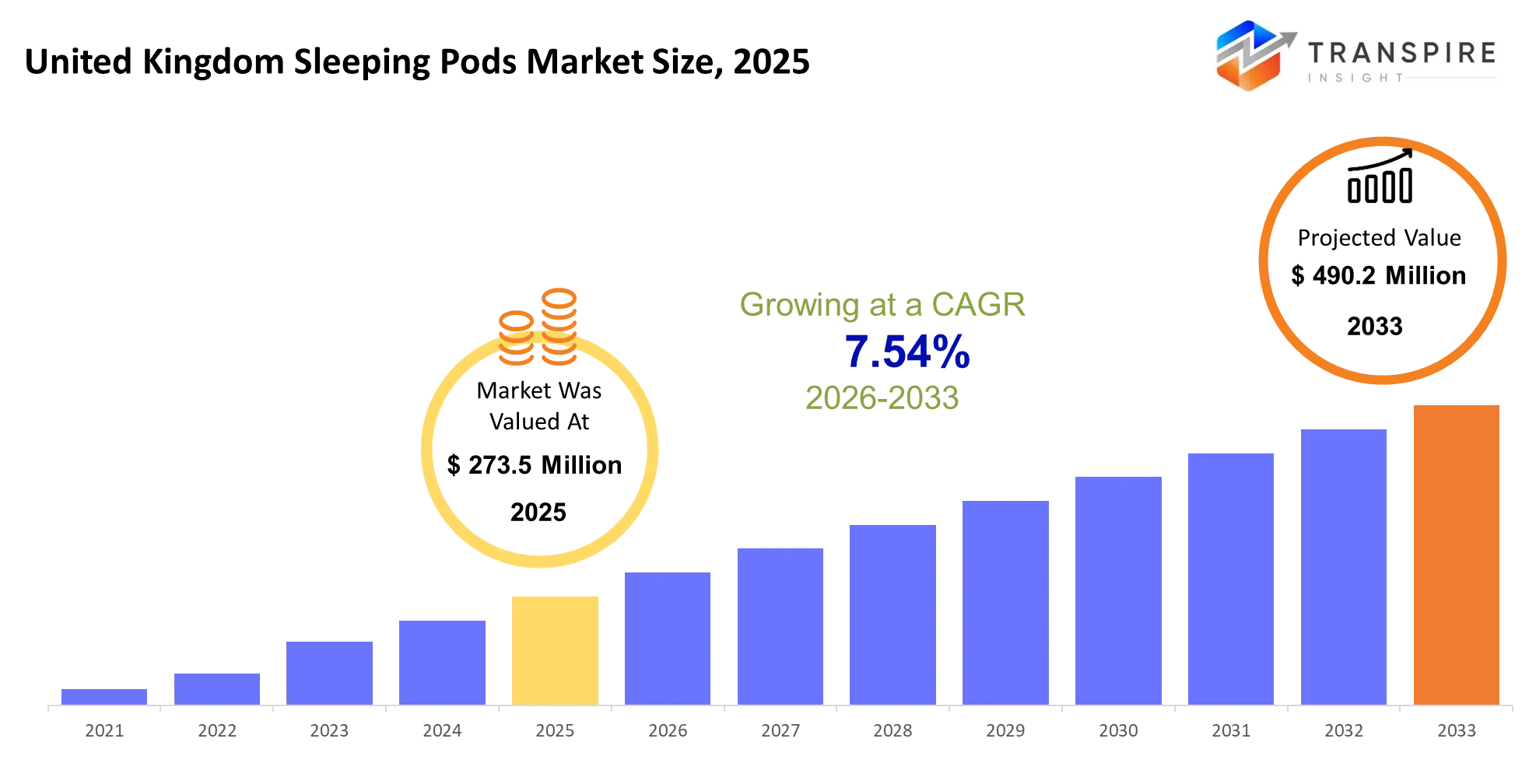
- United Kingdom Sleeping Pods Market Size 2025: USD 273.5 Million
- United Kingdom Sleeping Pods Market Size 2033: USD 490.2 Million
- United Kingdom Sleeping Pods Market CAGR: 7.54%
- United Kingdom Sleeping Pods Market Segments: By Pod Type (Single Sleeping Pods, Double Sleeping Pods, Capsule Pods, Luxury Pods, Smart Pods, Airport Pods, Office Pods, Others); By Application (Airports, Corporate Offices, Hospitals, Hotels, Railway Stations, Universities, Co-working Spaces, Others); By Material (Wooden Pods, Metal Pods, Composite Pods, Soundproof Pods, Eco-friendly Pods, Others); By Technology (IoT-enabled Pods, AI-powered Pods, Smart Lighting Pods, Automated Pods, Others); By End User (Travelers, Corporate Employees, Students, Patients, Tourists, Others)
To learn more about this report,  Download Free Sample Report
United Kingdom Sleeping Pods Market Summary
The United Kingdom Sleeping Pods Market was valued at USD 273.5 Million in 2025. It is forecast to reach USD 490.2 Million by 2033. That is a CAGR of 7.54% over the period.
The United Kingdom sleeping pods market offers compact, short duration rest spaces that are commonly used in airports, railway hubs, construction sites, offshore platforms, and various maritime facilities, where shift work and fatigue management stay pretty much constant hurdles. These modular units let operators make the most of limited space, but still keep worker recovery and operational continuity in a kind of steady loop. Over the last few years, the market has shifted pretty clearly in a more structural way toward smart prefabricated pods, paired with energy efficient systems, digital access controls, and even centralized booking platforms , so they gradually replace older static rest rooms.
One major trigger behind this growing adoption has been post pandemic labor shortages mixed with expanded offshore wind and increased port activity, and that combination put more strain on employers to improve worker welfare and keep people around. At the same time, tougher fatigue and safety expectations in high risk environments have pushed companies to put money into on site rest infrastructure. In other words, these changes have turned sleeping pods into a practical productivity instrument , not just a comfort convenience thing.
Key Market Insights
- The United Kingdom Sleeping Pods Market is kinda being shaped by three strong forces that, pretty directly, nudge how adoption happens and where investment is placed across transport and industrial areas.
- There’s this overall vibe that the market sort of moves with the same beats, but it’s not always in a neat line, or even close to it.
- First, the main driver is the swift expansion of 24/7 operational infrastructure in aviation, rail, and offshore energy sectors.
- This shift got more intense after the post-pandemic recovery phase, when staffing shortages plus longer shift cycles started to stick around.
- So, operators around places like Heathrow-related terminals and larger UK logistics centers began rolling out sleeping pods, partly to cut fatigue-driven delays and keep workforce continuity more steady, yes.
- In practice, this has meant procurement budgets that are higher, and revenue that keeps appearing through service contracts—kind of tied to usage hours rather than a single, one-off installation.
- Next, the biggest restraint is the high upfront installation and integration cost for advanced sleeping pod systems, especially those with smart controls and sanitation automation.
- Because of this, many mid-tier transport operators and smaller industrial sites tend to delay adoption. Basically, capex has to compete with core infrastructure upgrades, so the decision window stays tight, and that makes scaling harder early on.
- The outcome is a structural slowdown: adoption ends up concentrating more around big hubs, which limits wider penetration and dampens near-term scalability.
- Finally, there’s a real opening for modular, AI enabled pod networks that get integrated into smart airport and station ecosystems, in ways that feel more seamless than older setups.
What are the Key Drivers, Restraints, and Opportunities in the United Kingdom Sleeping Pods Market?
The United Kingdom Sleeping Pods Market is being shaped by three strong forces that directly influence adoption patterns and investment decisions across transport and industrial environments.
The primary driver seems to be the rapid expansion of 24/7 operational infrastructure in aviation , rail, and offshore energy sectors, sort of like everything runs a bit more continuously. The momentum really picked up after the post-pandemic recovery phase, when staffing shortages and longer shift cycles didn’t just fade out , they stuck around. Because of that, operators at hubs such as Heathrow-linked terminals and other major UK logistics centers started putting in sleeping pods, to trim down fatigue related delays and help keep the workforce steady. In practice, this has shown up as higher procurement budgets, plus recurring revenue models based on service delivery tied to usage hours, rather than one-off installations.
The biggest restraint is the expensive upfront installation and the integration workload for more advanced sleeping pod systems, mainly the ones with smart controls and sanitation automation. A lot of mid-tier transport operators, and smaller industrial sites, postpone adoption because the capital expenditure has to battle with core infrastructure upgrades. So you get a more structural slowdown , because take-up stays mostly in larger hubs, which makes broader market penetration pretty limited and lowers the near term ability to scale.
A key opportunity lies in modular, AI-enabled pod networks integrated into smart airport and station ecosystems. For example, UK transport modernization programs are increasingly testing app-based rest zones connected to digital ticketing systems. This creates a pathway for dynamic pricing and higher utilization rates, unlocking new revenue streams for operators.
What Has the Impact of Artificial Intelligence Been on the United Kingdom Sleeping Pods Market?
Artificial intelligence plus advanced digital systems are slowly, but really, starting to remake how operational performance works in the United Kingdom Sleeping Pods Market, especially around airports, rail hubs, and for offshore workforce facilities. AI‑driven automation is now being used to handle pod occupancy scheduling , climate control setups, and sanitation cycles , so the units stay available with way less manual input. In busy terminals, algorithm based access control helps optimize turnaround rates by assigning pods using live passenger movement, which cuts down idle time and lifts revenue per installation.
At the same time, predictive features powered by machine learning are making maintenance feel more efficient. Operators pull in sensor data from HVAC systems, lighting units, and hygiene modules to estimate component wear and then plan servicing ahead of failures. As a result, there are noticeable reductions in unplanned downtime and better asset utilization, most clearly in modular pod networks used across transport infrastructure.
On the operational side, these tools improve uptime consistency, lower maintenance related labor expenses, and also support health and safety requirements inside shared rest areas. Airports and industrial operators are saying they see steadier utilization patterns and better cost efficiency as digital monitoring replaces the more manual inspection routines.
Still, there is a big catch, the integration expense for AI enabled infrastructure can be high, and it’s particularly painful when retrofitting older transport facilities. Plus, real time connectivity is often limited in offshore and remote industrial sites, so continuous data transmission becomes difficult. That situation lowers predictive model accuracy and it delays wider adoption overall.
Key Market Trends
- Since 2022, UK airports sort of transitioned from manual operated rest rooms to IoT enabled sleeping pods with automated access, and occupancy tracking systems, running in the background.
- Airline partners like YOTEL and GoSleep moved away from fixed contracts to a usage based leasing model, after 2023, and that apparently made operators more nimble with revenue timing.
- Also, after the post pandemic labor shortages hit UK logistics hubs, the installation of sleeping pods sped up across rail stations between 2023 and 2025, like right away, not slowly.
- More recently, regulatory attention on worker fatigue management in offshore wind activities ramped up, and since 2024, modular rest pods got adopted in maritime facilities more and more.
- Manufacturers leaned into prefabricated pod designs after 2023, which cut the installation time by nearly 30 percent in busy UK transport hubs, pretty noticeably.
- Smart booking integration with airport apps expanded after 2024, so real time pod allocation became possible, and idle occupancy across terminals dropped, at least according to the operators.
- Competition got sharper too, as MetroNaps and Napcabs expanded their European footprint into UK airports, adding pricing pressure from 2023, overall.
United Kingdom Sleeping Pods Market Segmentation
By Pod Type :
Single sleeping pods + capsule pods keep showing up everywhere in transport hubs, mostly because they are compact, and honestly they use space in a more efficient way even where footfall is high. In the UK, airport pods are still expanding across terminals, while smart pods and luxury pods are getting more traction in premium lounges and corporate settings, the kind that want better comfort along with automation features, not just a basic rest spot.
Double pods and office pods seem to grow at a steady pace too, especially in corporate workplaces and co-working sites. The smart pods, meanwhile, bring digital controls plus energy-efficient systems, and that helps push higher utilization rates along with improved operational efficiency across modern infrastructure setups, in the United Kingdom Sleeping Pods Market.
By Application :
Airports stay the main application area because passenger flow never really stops, and the demand for short-duration rest remains steady. Railway stations across major UK cities are also rolling out pods more often, to handle commuter fatigue and to improve the overall travel experience, especially during peak hours, and also when services run longer than expected.
Corporate offices and co-working spaces are adopting them more as workplace wellness becomes a higher priority. Hospitals and universities are introducing pods for staff recovery, and student rest needs as well, while hotels are adding them as a sort of extra service for flexible short-stay demand in urban centers, across the United Kingdom Sleeping Pods Market.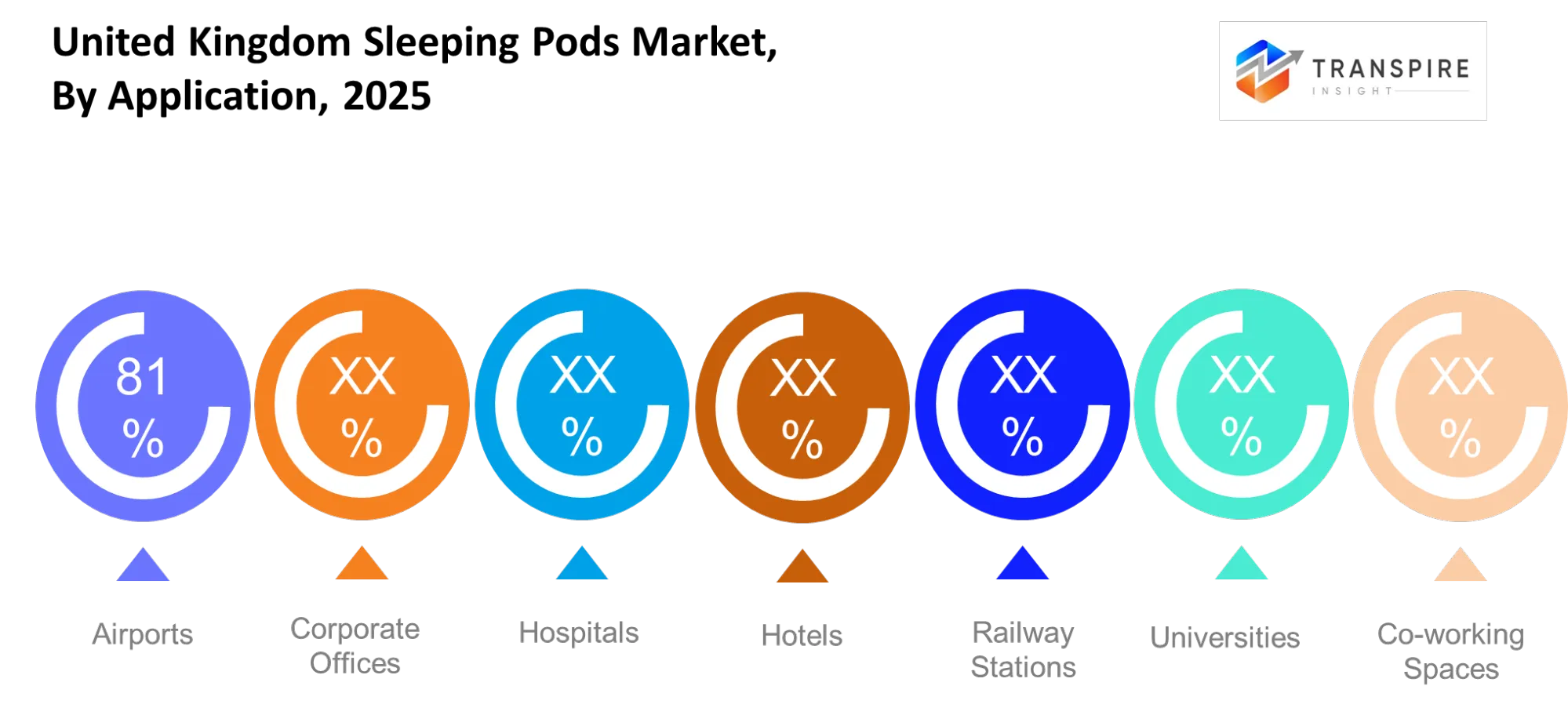
To learn more about this report, Download Free Sample Report
By Material :
Metal pods together with composite pods seem to dominate most installations, mainly because they’re durable , they’re got structural strength and also they are kinda easier to keep up with, especially in places that get hammered day after day like airports, and rail hubs. Soundproof pods are also seeing more interest , mostly where noise reduction is not just a nice-to-have but a real requirement, to help people get better rest quality in busy transport infrastructure areas.
Eco-friendly materials are getting chosen more often too, since operators want energy efficiency and more sustainability aligned goals. Wooden pods, on the other hand, are still mostly stuck to premium or boutique type setups, whereas composite materials keep expanding , because they hit a better balance between cost efficiency and long operational lifespan, across the United Kingdom Sleeping Pods Market.
By Technology :
Now on the technology side, IoT-enabled pods are leading the shift, offering real-time monitoring of occupancy, temperature, and usage patterns in both transport and corporate environments. Automated systems also help in streamlining access control and cleaning cycles, so the overall operations run smoother and there is less need for constant manual supervision in those high-traffic sites.
AI-powered pods plus smart lighting systems are gaining momentum too , especially where predictive maintenance and energy optimization are being treated like top priorities. In practice, these solutions boost uptime performance and lower operational costs, while still supporting efficient space use across modern infrastructure networks in the United Kingdom Sleeping Pods Market.
By End User :
Travelers are considered the biggest end-user group because adoption is high in airports and railway stations, where short rest cycles are, honestly, kind of essential. Corporate employees also add noticeable demand, since companies keep investing in workplace wellness and fatigue reduction infrastructure across office environments, not just in one place.
Students and patients are seeing a steady uptick too, driven by universities and healthcare facilities that are rolling rest solutions into programs for recovery and sharpened focus improvement. Tourists then lean on pods in transit hubs and city areas, which backs that more flexible accommodation needed within the United Kingdom Sleeping Pods Market.
What are the Key Use Cases Driving the United Kingdom Sleeping Pods Market?
In the United Kingdom, the Airports stay like the core use case in the Sleeping Pods Market, because there is nonstop passenger movement and those long layovers that keep showing up, which really drives demand for short duration rest solutions. With heavy traffic levels and not enough lounge capacity, airport teams end up putting in compact pods that make better use of floor space while still pushing passenger comfort and faster terminal flow.
Railway stations and corporate offices are also moving into this trend more and more, since commuter fatigue plus workforce wellness are turning into actual day to day operational goals. Transport operators often deploy pods for shift workers, and some co-working spaces fold them in too, to boost productivity for long hour professionals in urban business districts.
Newer use cases are appearing in hospitals and offshore energy sites, where fatigue management directly links to performance, but also to safety results. In that space, recovery rooms for healthcare staff and even wind farm maintenance bases are starting to adopt modular pods, and this is backed by tougher worker welfare expectations and 24/7 operational needs.
|
Report Metrics |
Details |
|
Market size value in 2025 |
USD 273.5 Million |
|
Market size value in 2026 |
USD 294.7 Million |
|
Revenue forecast in 2033 |
USD 490.2 Million |
|
Growth rate |
CAGR of 7.54% from 2026 to 2033 |
|
Base year |
2025 |
|
Historical data |
2021 - 2024 |
|
Forecast period |
2026 - 2033 |
|
Report coverage |
Revenue forecast, competitive landscape, growth factors, and trends |
|
Regional scope |
Middle East and Africa (Saudi Arabia, United Arab Emirates, South Africa, Rest of Middle East and Africa) |
|
Key company profiled |
GoSleep, NapCabs, MetroNaps, Podtime, Yotel, SnoozeCube, Sleepbox, Kokoon, Panasonic, LG Electronics, Samsung Electronics, 9hours, ZZZleepandGo, Capsule Services, JetQuay |
|
Customization scope |
Free report customization (country, regional & segment scope). Avail customized purchase options to meet your exact research needs. |
|
Report Segmentation |
By Pod Type (Single Sleeping Pods, Double Sleeping Pods, Capsule Pods, Luxury Pods, Smart Pods, Airport Pods, Office Pods, Others); By Application (Airports, Corporate Offices, Hospitals, Hotels, Railway Stations, Universities, Co-working Spaces, Others); By Material (Wooden Pods, Metal Pods, Composite Pods, Soundproof Pods, Eco-friendly Pods, Others); By Technology (IoT-enabled Pods, AI-powered Pods, Smart Lighting Pods, Automated Pods, Others); By End User (Travelers, Corporate Employees, Students, Patients, Tourists, Others) |
Which Regions are Driving the United Kingdom Sleeping Pods Market Growth?
London and the South East of England kinda lead the United Kingdom Sleeping Pods Market, because the transport web is dense, plus passenger throughput is exceptionally high at major airports like Heathrow, and Gatwick. There’s also a strong regulatory push around passenger comfort, and terminal efficiency which keeps driving the ongoing installation of short stay rest options. In addition, the region has this fairly concentrated set of connections between airline operators, airport authorities and hospitality service providers, they keep putting money into space optimization technologies. That kind of coordination means demand stays steady, and it helps companies adopt advanced pod systems earlier.
Northern England and the Midlands are a stable and dependable contributor too, mainly backed by a solid industrial base and a wide span of rail, and logistics networks. But unlike the South East, growth here is less about international passenger flow, and more about workforce efficiency needs across manufacturing, and freight corridors. There are long established rail routes and distribution centers in cities like Manchester, and Birmingham, which back consistent year round utilization of sleeping pods. On top of that, public transport modernization programs keep running, so procurement cycles remain steady in this area.
Scotland is sort of emerging as the fastest growing region, largely due to rapid expansion of offshore wind farms and port improvements along the North Sea shoreline. Investment tied to energy transition infrastructure has created new obligations for worker recovery facilities, especially in remote and higher risk operational places. With government supported renewable energy targets moving forward faster, modular rest units are being placed near Aberdeen and around nearby coastal zones. This momentum basically points to strong long term chances for new market entrants, as industrial offshore activity keeps expanding between 2026 and 2033.
Who are the Key Players in the United Kingdom Sleeping Pods Market and How Do They Compete?
The United Kingdom Sleeping Pods Market has a moderately fragmented competitive structure, in the sense that there is no single dominant provider taking control of large scale deployments across transport and industrial hubs. What really drives the competition is mainly technology integration, contract based service models, and the ability to lock in longer term partnerships with airport and rail operators. Existing firms tend to hold their ground via installed infrastructure and recurring usage agreements, while newer entrants start to mess with pricing patterns by rolling out modular, quickly deployable pod systems, plus digital booking integration.
GoSleep leans into lightweight capsule designs that get integrated with airport lounges, and it leans on a cost efficient deployment model that fits environments where passenger turnover is high. YOTEL differentiates by pushing premium micro hotel pod concepts together with hospitality services, which helps it stay strong in higher end airport terminals thanks to service bundling. MetroNaps competes with workplace focused energy pod systems, then it moves deeper into UK corporate offices through partnerships tied to productivity and wellness programs. Napcabs focuses on standardized modular pods, with solid compliance features, so approvals can come faster in regulated airport settings, and that also helps support expansion into new European linked UK terminals.
Sleepbox kind of drives tech-led differences with IoT-enabled smart pods, that hook in with airport mobile apps, for live booking and occupancy monitoring. Podtime UK goes more into localized setups across regional transport hubs, using flexible lease arrangements to move into mid-tier railway stations , as well as logistics centers. Overall both firms widened their reach via strategic partner ties with airport authorities, plus digital platform integrations and then a bit of selective regional growth across busy UK infrastructure zones.
Company List
- GoSleep
- NapCabs
- MetroNaps
- Podtime
- Yotel
- SnoozeCube
- Sleepbox
- Kokoon
- Panasonic
- LG Electronics
- Samsung Electronics
- 9hours
- ZZZleepandGo
- Capsule Services
- JetQuay
Recent Development News
In September 2025, Criterion Hotels announced the launch of the Zedwell Capsule Hotel Piccadilly Circus in London, introducing approximately 1,000 soundproof sleeping pods within a converted Grade-II listed building. The development significantly expanded UK capsule accommodation capacity and strengthened the country’s position in high-density, pod-based urban hospitality targeting budget and transit travellers. Source https://www.thesun.co.uk/
In October 2025, Sleep Pod (UK charity) expanded its distribution network through partnerships with regional homelessness outreach organisations, delivering 600 emergency sleeping pods across the North of England in a coordinated rollout with local charity hubs. This partnership-based deployment increased adoption of portable sleeping pod units in social support infrastructure across multiple UK regions. Source https://sleeppod.org.uk/
What Strategic Insights Define the Future of the United Kingdom Sleeping Pods Market?
The United Kingdom Sleeping Pods Market is moving toward deeper integration with digital transport ecosystems, where the rest of the infrastructure kind of becomes part of real-time mobility management rather than a lone standalone service. This structural shift is pushed by rising pressure on UK transport operators to boost passenger flow efficiency, while also enabling workforce recovery in 24/7 operational settings. Over the next five to seven years, demand will more and more line up with smart infrastructure upgrades across airports and rail corridors, and then sleeping pods get embedded into broader terminal automation systems.
A less visible risk is technology substitution from upgraded airport lounge expansions and biometric fast-track systems, which can lower layover friction, so it may reduce incremental pod usage growth in premium terminals. Another constraint is a growing dependency on a small cluster of technology-integrated suppliers, and that tends to raise concentration risk for operators.
A key emerging opportunity is integrating sleeping pods with unified travel apps that merge ticketing, lounge entry, and rest booking into one interface, especially in Heathrow linked and HS2 adjacent hubs. Market participants should put emphasis on modular software-connected pod systems, so they can integrate with transport platforms. In this way, operators can secure longer-term service contracts and recurring revenue streams.
United Kingdom Sleeping Pods Market Report Segmentation
By Pod Type
- Single Sleeping Pods
- Double Sleeping Pods
- Capsule Pods
- Luxury Pods
- Smart Pods
- Airport Pods
- Office Pods
By Application
- Airports
- Corporate Offices
- Hospitals
- Hotels
- Railway Stations
- Universities
- Co-working Spaces
By Material
- Wooden Pods
- Metal Pods
- Composite Pods
- Soundproof Pods
- Eco-friendly Pods
By Technology
- IoT-enabled Pods
- AI-powered Pods
- Smart Lighting Pods
- Automated Pods
By End User
- Travelers
- Corporate Employees
- Students
- Patients
- Tourists
Frequently Asked Questions
Find quick answers to common questions.
The United Kingdom Sleeping Pods Market size is USD 490.2 Million in 2033.
Key Segments for the United Kingdom Sleeping Pods Market are By Pod Type (Single Sleeping Pods, Double Sleeping Pods, Capsule Pods, Luxury Pods, Smart Pods, Airport Pods, Office Pods, Others); By Application (Airports, Corporate Offices, Hospitals, Hotels, Railway Stations, Universities, Co-working Spaces, Others); By Material (Wooden Pods, Metal Pods, Composite Pods, Soundproof Pods, Eco-friendly Pods, Others); By Technology (IoT-enabled Pods, AI-powered Pods, Smart Lighting Pods, Automated Pods, Others); By End User (Travelers, Corporate Employees, Students, Patients, Tourists, Others).
Major United Kingdom Sleeping Pods Market Players are GoSleep, NapCabs, MetroNaps, Podtime, Yotel, SnoozeCube, Sleepbox, Kokoon, Panasonic, LG Electronics, Samsung Electronics, 9hours, ZZZleepandGo, Capsule Services, JetQuay.
The Current United Kingdom Sleeping Pods Market size is USD 273.5 Million in 2025.
The United Kingdom Sleeping Pods Market CAGR is 7.54% from 2026 to 2033.
- GoSleep
- NapCabs
- MetroNaps
- Podtime
- Yotel
- SnoozeCube
- Sleepbox
- Kokoon
- Panasonic
- LG Electronics
- Samsung Electronics
- 9hours
- ZZZleepandGo
- Capsule Services
- JetQuay
Recently Published Reports
-
Apr 2026
Bottled Water Market
Bottled Water Market Size, Share & Analysis Report By Product Type (Still Bottled Water, Carbonated Bottled Water, Functional Bottled Water, and Others), By Packaging (PET, Cans, and Others), By Sales Channel (Supermarkets/Hypermarkets, Convenience Stores/Drug Stores, Grocery Stores/Club Stores, Foodservice, and Others) and Geography (North America, Europe, Asia-Pacific, Middle East and Africa, South and Central America), 2021 - 2032
-
Apr 2026
Color Cosmetic Packaging Market
Color Cosmetic Packaging Market Size, Share & Analysis Report By Application (Mascara Packaging, Liquid Packaging, and Liquid Face), By Type (Tubes & Bottles, Pens & Markers, Compacts & Containers, and Droppers & Pumps), and Geography (North America, Europe, Asia-Pacific, Middle East and Africa, South and Central America), 2021 - 2031
-
Apr 2026
External Microphone For Camera Market
External Microphone For Camera Market Size, Share & Analysis Report By Type (Shotgun Microphone, Lavalier Microphone, and Others), By Application (Digital Camera, Professional Video Camera, and Others), and Geography (North America, Europe, Asia-Pacific, Middle East and Africa, South and Central America), 2021 - 2031
-
Apr 2026
Foot Orthotic Insoles Market
Foot Orthotic Insoles Market Size, Share & Analysis Report By Type (Pre-fabricated, and Custom-made), By Material (Thermoplastic, Composite Carbon Fiber, and Others), By Distribution Channel (Drug Stores, Hospitals & Clinics, and Others), and Geography (North America, Europe, Asia-Pacific, Middle East and Africa, South and Central America), 2021 - 2031