
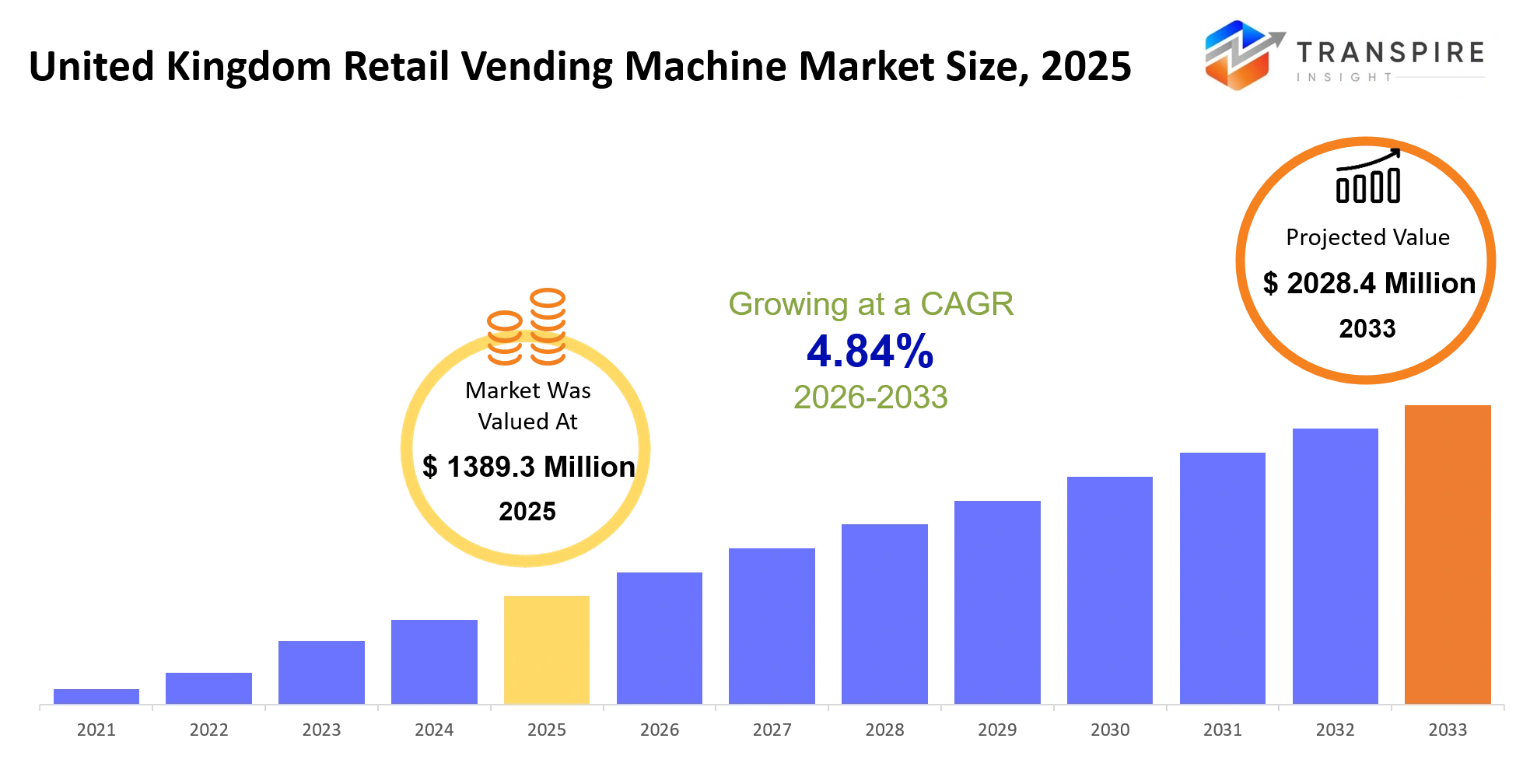
United Kingdom Retail Vending Machine Market Size & Forecast:
- United Kingdom Retail Vending Machine Market Size 2025: USD 1389.3 Million
- United Kingdom Retail Vending Machine Market Size 2033: USD 2028.4 Million
- United Kingdom Retail Vending Machine Market CAGR: 4.84%
- United Kingdom Retail Vending Machine Market Segments: By Machine Type (Beverage Vending Machines, Snack Vending Machines, Smart Vending Machines, Coffee Vending Machines, Frozen Food Vending Machines, Combo Machines, Others); By Payment Mode (Cash Payment, Cashless Payment, QR Code Payment, NFC-enabled Payment, Others); By Application (Shopping Malls, Airports, Offices, Railway Stations, Educational Institutions, Hospitals, Others); By End User (Retail Sector, Transportation Sector, Hospitality Sector, Healthcare Sector, Others).
To learn more about this report,  Download Free Sample Report
United Kingdom Retail Vending Machine Market Summary
The United Kingdom Retail Vending Machine Market was valued at USD 1389.3 Million in 2025. It is forecast to reach USD 2028.4 Million by 2033. That is a CAGR of 4.84% over the period.
In the United Kingdom, retail vending machines are basically compact, always-on retail points that keep feeding people with snacks, beverages, personal care items, and, more and more lately electronics too, in busy public or semi-public places like transit hubs, offices, hospitals, and universities. They help with that real-world issue of instant product availability where staffed retail becomes too expensive, or just turns out operationally clunky, especially during the off-peak stretch. Over the last 3–5 years, the market has moved in a deeper way, from old coin-operated units toward cashless, IoT-enabled smart vending setups that link up with mobile payments and remote inventory visibility.
Honestly this change got a big nudge from the COVID-19 pandemic, since contactless payments became the norm, and people relied less on cashiers. Around the same time, supply chain disruptions in 2021–2022 made operators look harder at real-time stock monitoring, and quicker replenishment approaches that react on the fly. So now, adoption feels more technology-driven, and revenue growth is increasingly connected to data-enabled upselling, better day-to-day operations, and location-aware product choices..
Key Market Insights
- The United Kingdom Retail Vending Machine Market is getting bigger, not just because people want snacks, but mainly because cashless payment systems are being adopted fast across urban retail setups.
- In 2025, smart vending deployments seem to be around 60–65% of the newer installations, and that shift is largely pushed by IoT integration, it’s kind of like the machines are becoming more connected.
- London still leads, with roughly a 35% share, since transit networks are dense and retail footfall zones stay busy.
- Scotland meanwhile looks like the quickest grower, helped by vending expansion programs tied to universities and transport routes.
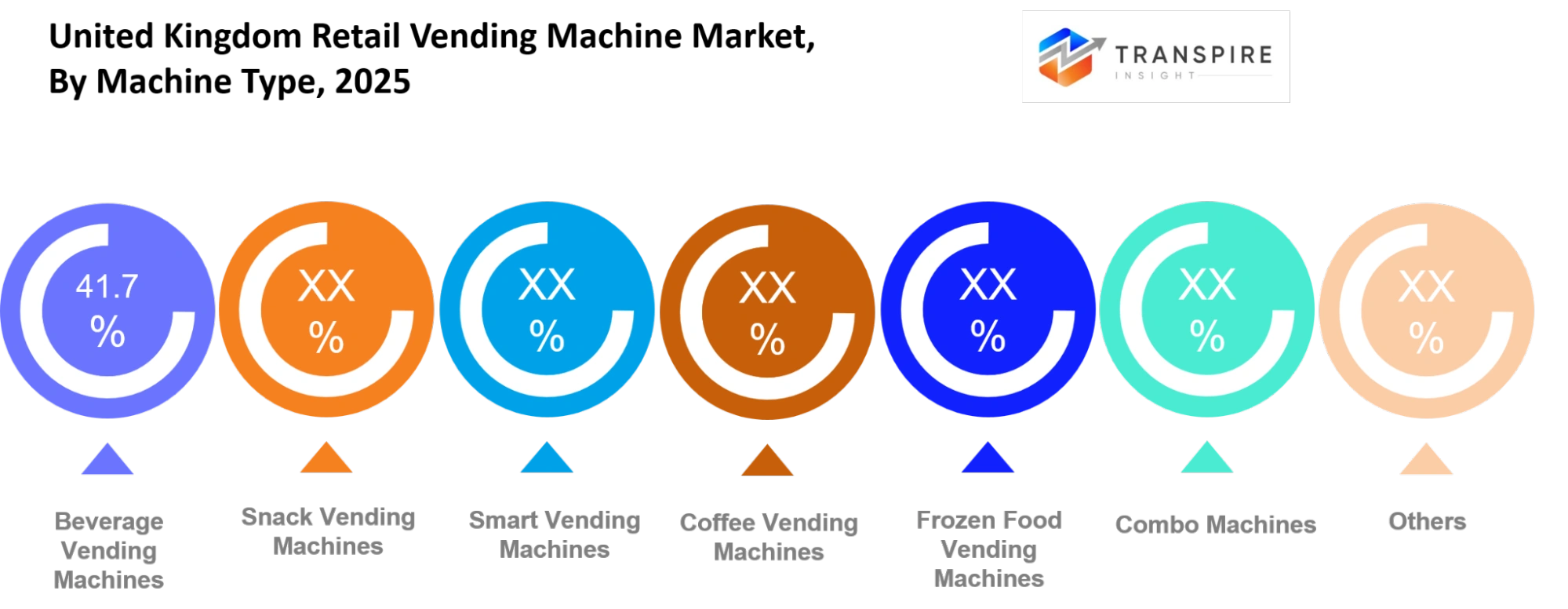
- When it comes to what’s inside the machines, beverage vending is still #1, sitting at about 40% of market share in 2025.
- Snack vending follows right behind, and it benefits from demand that stays steady at workplaces and educational institutions, you know, predictable routine buying.
- On product type, smart vending machines are the fastest-growing category through 2026–2033, sort of eclipsing older setups.
- For end users, corporate offices are leading with close to 38% share, mainly due to workplace automation trends, while healthcare facilities are the fastest-growing end-user segment because they need 24/7 product accessibility, no delays.
- Big names such as Selecta Group and Nayax are also pushing forward, using AI-driven vending analytics and payment innovation to keep improving how transactions work.
What are the Key Drivers, Restraints, and Opportunities in the United Kingdom Retail Vending Machine Market?
The main, driver for the United Kingdom retail vending machine market is mostly this broad shift, toward cashless and more automated retail dealings. It really picked up steam after contactless limits were raised in the UK and people started moving more into mobile wallets, with that tap-based payment habit. Because of that, operators are rolling out “smart vending” setups that lower staffing needs, and at the same time allow real-time inventory visibility, which in turn boosts operational flow and makes each machine bring in more money. You can see it everywhere, like transport stations, hospitals, and corporate campuses, where products have to stay available pretty much nonstop .
One restraint is the pretty hefty upfront price for smart vending infrastructure, especially those IoT-enabled units that come with built-in telemetry plus payment systems. Smaller operators can find it tough to manage the capital outlay and ongoing maintenance, mainly since the machines may need frequent software updates and must stay compliant with secure payment requirements. So penetration drops in lower-density, or rural type areas, and that naturally slows down a more even nationwide rollout.
A real opportunity is AI-driven, more personalized vending moments, where the machine fine-tunes product lineups based on where it is, the time of day, and even the purchasing patterns. Firms like Crane Merchandising Systems are looking into modular vending platforms, meaning flexible components that can handle dynamic pricing and predictive restocking. That kind of ability should open additional income channels in places with heavy foot traffic, like railway networks and smart-city installations.
What Has the Impact of Artificial Intelligence Been on the United Kingdom Retail Vending Machine Market?
Artificial intelligence is kind of re shaping the United Kingdom retail vending machine market, because it is boosting automation and predictive upkeep, and also making customer interactions more fluid, efficient. With AI driven vending systems, they typically rely on computer vision and sensor data. Then they watch inventory levels in real time, so stockouts are less likely and the whole manual restocking rhythm is shorter, less often. As a result, operational uptime tends to be better especially in busy places like airports or business districts. And honestly machine availability does matter a lot, it directly feeds revenue.
On top of that, predictive analytics models are being used to estimate product demand by looking at the time of day, local weather conditions, and the specific consumption habits for each site. That helps operators tweak the product assortment and cut down on spoilage, mostly for perishable lines like fresh food, and dairy too. Some companies, for instance Evoca Group, are rolling in AI based diagnostics so they can spot mechanical issues early, before full failures happen. That improves service continuity, and it can reduce maintenance spend, which is always a win.
Still, adoption is not seamless. The integration piece can be pretty complex, and connectivity can be spotty in certain deployments. This shows up a lot in underground transit systems and at remote facilities. Also there are limitations in training data, which affects how accurately the models can learn localized consumer behavior. Because of that, full scale automation doesn’t always get reached. Even with all of these obstacles, AI keeps improving overall efficiency and it is slowly becoming core to next generation smart vending infrastructure.
Key Market Trends
- After 2022, cashless vending adoption went up, sort of sharply, and by 2025 more than 70% of machines were letting people pay by mobile.
- Nowadays the new installs are mostly IoT-enabled vending machines, which helps inventory tracking feel way more precise across different networks.
- Also, public transport hubs pushed vending deployments up by more than 25% from 2023 through 2025, which is kinda notable.
- Smart vending is even lowering operating costs, estimated around 15–20% per machine each year, depending on the site.
- Beverage vending is still the biggest part, yet healthy snack vending has been growing a lot, especially in corporate setups where companies want “wellness” options.
- On top of that, AI-based predictive restocking boosted product availability rates by close to 30% in city areas.
- And contactless-first habits accelerated right after the 2021–2022 hygiene rules from the pandemic era, so it just stuck.
- Retailers also seem to move away from fixed pricing, leaning into dynamic pricing in premium vending locations.
- Meanwhile sustainability initiatives are driving demand for energy-efficient vending hardware, particularly across the UK.
- Companies like Azkoyen Group, are widening their smart vending portfolios using modular designs and cloud-connected systems, basically a smoother rollout.
United Kingdom Retail Vending Machine Market Segmentation
By Machine Type
In the United Kingdom retail vending machine market, beverage vending machines are in a leading position, not just because of one thing but mostly due to steady demand in offices, transport hubs and public areas. People consume these drinks often and they want quick service, so installation volumes stay fairly stable across most urban zones. Snack vending machines are right behind them, with workplace refreshment expectations and education facilities helping them along. Then smart vending machines are expanding fast, mainly because cashless payment integration plus remote monitoring systems give better operational control and help limit downtime, you know, less interruption
Coffee vending machines keep gaining ground in office groups and transit stations, especially where quick access matters during peak hours. Frozen food vending machines are also picking up momentum in hospitals and other 24 hour spaces, because continuous food access really becomes a kind of requirement. Combo machines let operators offer mixed products in compact footprints, so space utilization becomes more efficient, and it’s sort of practical. Beyond that, other machine types can match niche placement needs across specialized commercial environments, which is why they’re still being used in smaller targeted locations.
To learn more about this report, Download Free Sample Report
By Payment Mode
Cash payments still seem to stay around, at least in a good number of legacy vending systems, mainly in older setups and those low transition spots. Cashless payment is kind of taking the lead, because digital wallets are well adopted and contactless banking cards feel almost everywhere for urban users. Then QR code payments, they keep expanding fast in retail and transit kind of places, where mobile first transactions make things move quicker and feel more convenient. NFC enabled payment also keeps getting traction, especially in premium vending systems, since secure tap based transactions make the whole customer experience smoother.
In the United Kingdom retail vending machine market, cashless payment systems actually account for most of the share, mostly thanks to the digital infrastructure that’s already deep in. QR based options get extra momentum in high footfall areas, because the faster transaction flow cuts down waiting time. NFC enabled methods also fit well for high security zones, like corporate offices and healthcare areas. And the other payment types still matter too, mainly for transitional systems where mixed payment acceptance is still required, for a while.
By Application
Shopping malls somehow keep strong adoption going, mostly because customer traffic stays steady and people still want instant retail access, you know, right away. Airports also matter a lot, not just because passengers are always moving, but because there’s this ongoing push for quick purchase options while traveling. Offices count as a big application space, driven by workplace automation and that convenience-first consumption style. Railway stations hold up strong deployment too, since commuter density is high and fast-service needs are nonnegotiable.
Educational institutions tend to expand gradually because students really do pull on snack and beverage demand. Hospitals keep up continuous vending deployment so essential items are available 24 hours a day, basically. And airports plus railway stations together act like a backbone for vending expansion across city networks. Other application areas just keep growing in smaller steps, depending on localized retail automation needs.
By End User
The retail sector keeps a dominant standing because vending systems are integrated into malls, high street shopping environments and commercial complexes, it’s kind of all connected really. The Transportation sector also follows not far behind, mostly because there is a heavy reliance on automated retail in airports, railways, and transit hubs. Meanwhile, the Hospitality sector leans into vending systems to help with guest convenience, and to cut down on service workload especially in smaller, compact service areas. The healthcare sector shows a noticeably strong pull too, since there’s always steady demand for essential products and a constant, around-the-clock availability expectation.
In the United Kingdom retail vending machine market, the Retail sector still has strong influence driven by high customer interaction points and the need for wide product variety. The Transportation sector is continuing its expansion, and that’s supported by infrastructure modernization plus passenger flow growth. Healthcare sector demonstrates steady growth as hospitals and clinics need uninterrupted access to basics. Other sectors also contribute, though in a more focused way, via targeted vending deployment across specialized commercial and institutional spaces.
What are the Key Use Cases Driving the United Kingdom Retail Vending Machine Market?
In the United Kingdom, the main reason vending machines exist is basically instant retail access for snacks and beverages. You see them most often in places with lots of people moving through, like transit stations and office complexes, it’s all very about footfall. This particular corner of the market brings the strongest demand because it steps in where small-ticket retail shops would normally need staff at a counter, kind of a direct swap for a staffed operation.
After that, there are the secondary uses that keep growing, mainly inside corporate workplaces and schools or universities. In those settings, vending machines are used for packaged meals, coffee, and personal care items. People tend to like the convenience side of things, and the whole time efficiency angle really matters, especially when breaks are short or when it’s off-peak, so there’s less waiting around.
Then you also have the newer, emerging applications, for example pharmacies and healthcare facilities using vending systems for OTC medicines and hygiene products. Smart vending is being trialed too, not just in public spaces, but in residential complexes where automated retail kiosks can deliver 24/7 access to daily essentials.
|
Report Metrics |
Details |
|
Market size value in 2025 |
USD 1389.3 Million |
|
Market size value in 2026 |
USD 1456.7 Million |
|
Revenue forecast in 2033 |
USD 2028.4 Million |
|
Growth rate |
CAGR of 4.84% from 2026 to 2033 |
|
Base year |
2025 |
|
Historical data |
2021 - 2024 |
|
Forecast period |
2026 - 2033 |
|
Report coverage |
Revenue forecast, competitive landscape, growth factors, and trends |
|
Regional scope |
United Kingdom |
|
Key company profiled |
Fuji Electric, Crane Merchandising Systems, SandenVendo, Azkoyen Group, Seaga Manufacturing, Evoca Group, Royal Vendors, Jofemar, Bianchi Industry, Westomatic, Selecta Group, Nayax, Sielaff, FAS International, Cantaloupe. |
|
Customization scope |
Free report customization (country, regional & segment scope). Avail customized purchase options to meet your exact research needs. |
|
Report Segmentation |
By Machine Type (Beverage Vending Machines, Snack Vending Machines, Smart Vending Machines, Coffee Vending Machines, Frozen Food Vending Machines, Combo Machines, Others); By Payment Mode (Cash Payment, Cashless Payment, QR Code Payment, NFC-enabled Payment, Others); By Application (Shopping Malls, Airports, Offices, Railway Stations, Educational Institutions, Hospitals, Others); By End User (Retail Sector, Transportation Sector, Hospitality Sector, Healthcare Sector, Others). |
Which Regions are Driving the United Kingdom Retail Vending Machine Market Growth?
London is still basically the dominant region for the United Kingdom retail vending machine market, because it has a dense transport setup and lots of commuting activity. Underground stations, airports, and busy commercial areas keep vending demand running almost the whole day. Also the push on cashless payments regulations is helping smart vending show up faster across the city. All of this, together, makes sure machines stay in use consistently and revenue density stays high per installation, more or less.
The Midlands keeps a fairly steady second position. That happens thanks to its solid manufacturing base and the cluster of corporate offices. Compared to London, the growth rhythm is driven less by transit infrastructure and more by industrial workplace adoption. Businesses tend to use vending solutions for employee convenience and to reduce reliance on cafeteria services. As a result the demand looks steady, predictable, and it helps operators maintain longer term contracts.
Scotland is growing the fastest, mostly due to expanding university campuses, additional healthcare investments, and newer transport modernization work. Over the last while, infrastructure upgrades have rolled in smart vending systems in rail stations and other public facilities. Government-backed digital transformation efforts have made cashless retail feel more normal, so adoption keeps building. This momentum should also bring in fresh players who want growth chances during 2026–2033, even if it’s a bit uneven.
Who are the Key Players in the United Kingdom Retail Vending Machine Market and How Do They Compete?
The United Kingdom retail vending machine market looks pretty moderately fragmented, and the rivalry is pushed mostly by things like tech integration, service speed, and payment system innovation—like, the usual stuff but implemented differently. Older, more established players still go head to head with tech-first entrants, who show up with cloud-based monitoring, plus AI-enabled vending setups. In practice, the standout advantage doesn’t feel like it’s the machine hardware alone, it’s more about software abilities, remote diagnostics, and how well the whole payment ecosystem gets stitched in.
For example, Fuji Electric tends to lean into advanced machine dependability and energy-efficient design choices that seem tuned for high-traffic zones. Selecta Group, on the other hand, strengthens its position via big service networks, and location-based vending arrangements, spanning offices and transport hubs. Nayax differentiates with cashless payment terminals plus telemetry tools, that make real-time sales visibility possible.
At the same time, SandenVendo and Evoca Group are expanding by using modular product lines and teaming up with facility management firms. What feels strategic right now is less about where the machines sit only, and more about software integration, predictive maintenance features, and getting deployed in unusual settings like hospitals, and residential complexes.
Company List
- Fuji Electric
- Crane Merchandising Systems
- SandenVendo
- Azkoyen Group
- Seaga Manufacturing
- Evoca Group
- Royal Vendors
- Jofemar
- Bianchi Industry
- Westomatic
- Selecta Group
- Nayax
- Sielaff
- FAS International
- Cantaloupe
Recent Development News
In May 2026, Nayax Ltd. expanded its connected vending ecosystem initiative across Europe, strengthening cashless payment and telemetry integration for unattended retail operators including UK vending deployments. This move enhances real-time transaction visibility and supports smart vending machine adoption across transport and workplace locations.
Source: http://uk.finance.yahoo.com
In May 2026, Selecta Group advanced its UK vending transformation strategy by scaling AI-enabled vending and OCS (office coffee service) systems, improving automated retail efficiency and machine uptime across workplace and public deployments. This development supports wider adoption of data-driven replenishment models in the UK market.
Source: https://www.selecta.com
In September 2025, Chai GPTea (UK startup) introduced a next-generation chai vending machine featuring touchscreen ordering and multiple tea blends, expanding product diversification in smart beverage vending across London workplaces. This launch reflects rising demand for premium, automated hot beverage vending formats in the UK retail vending machine sector.
Source: https://www.omrglobal.com
What Strategic Insights Define the Future of the United Kingdom Retail Vending Machine Market?
The United Kingdom retail vending machine market is drifting, kind of slowly, toward this fully digital, data focused unattended retail ecosystem where each machine acts like an intelligent little micro-retail node, not just a static dispenser anymore. The growth feels driven by payment digitization, plus AI enabled inventory optimization and then the more recent push into non-traditional places like healthcare sites and residential areas.
There is also a quieter risk people don’t always mention. More and more operators depend on third party payment rails and cloud infrastructure providers, and that dependency can turn into system outages, or sudden fee escalation pressure, that kind of thing. On the opportunity side though, something bigger is forming. Fully autonomous retail kiosks, linked with AI based demand prediction, especially in transport corridors that are being modernized. Market participants should really lean into software-led vending ecosystems rather than just expanding hardware. Because who controls the data analytics and the customer behavior insights will end up deciding long term competitiveness, and even margin stability, more than raw machine count.
United Kingdom Retail Vending Machine Market Report Segmentation
By Machine Type
- Beverage Vending Machines
- Snack Vending Machines
- Smart Vending Machines
- Coffee Vending Machines
- Frozen Food Vending Machines
- Combo Machines
- Others
By Payment Mode
- Cash Payment
- Cashless Payment
- QR Code Payment
- NFC-enabled Payment
- Others
By Application
- Shopping Malls
- Airports
- Offices
- Railway Stations
- Educational Institutions
- Hospitals
- Others
By End User
- Retail Sector
- Transportation Sector
- Hospitality Sector
- Healthcare Sector
- Others
Frequently Asked Questions
Find quick answers to common questions.
The expected United Kingdom Retail Vending Machine Market size for the market will be USD 2028.4 Million in 2033.
Key segments for the United Kingdom Retail Vending Machine Market are By Machine Type (Beverage Vending Machines, Snack Vending Machines, Smart Vending Machines, Coffee Vending Machines, Frozen Food Vending Machines, Combo Machines, Others); By Payment Mode (Cash Payment, Cashless Payment, QR Code Payment, NFC-enabled Payment, Others); By Application (Shopping Malls, Airports, Offices, Railway Stations, Educational Institutions, Hospitals, Others); By End User (Retail Sector, Transportation Sector, Hospitality Sector, Healthcare Sector, Others).
Major United Kingdom Retail Vending Machine Market players are Fuji Electric, Crane Merchandising Systems, SandenVendo, Azkoyen Group, Seaga Manufacturing, Evoca Group, Royal Vendors, Jofemar, Bianchi Industry, Westomatic, Selecta Group, Nayax, Sielaff, FAS International, Cantaloupe.
The United Kingdom Retail Vending Machine Market size is USD 1389.3 Million in 2025.
The United Kingdom Retail Vending Machine Market CAGR is 4.84% from 2026 to 2033.
- Fuji Electric
- Crane Merchandising Systems
- SandenVendo
- Azkoyen Group
- Seaga Manufacturing
- Evoca Group
- Royal Vendors
- Jofemar
- Bianchi Industry
- Westomatic
- Selecta Group
- Nayax
- Sielaff
- FAS International
- Cantaloupe
About the Authors

Chetan Dhatrak
I’m Chetan Dhatrak, a Senior Research Analyst at Transpire Insight, specializing in the Consumer Goods, Foods and Beverages industry. I focus on analyzing market trends, consumer behavior, competitive landscapes, and industry developments to deliver accurate, data-driven insights. My research at Transpire Insight is built on credible sources and in-depth analysis, helping businesses and readers better understand market dynamics, emerging opportunities, and evolving consumer preferences. I’m committed to creating reliable, well-researched content that supports informed decision-making and reflects the latest developments in the consumer goods and food & beverage sectors.

Chakradhar Khansole
Chakradhar serves as the Research Director at Transpire Insight, bringing over 8 years of experience in technology, innovation, and strategic market intelligence. He specializes in transforming complex market data into actionable business insights that enable organizations to make informed, growth-oriented decisions. Recognized for his strategic vision and analytical expertise, Chakradhar leads high-impact research initiatives, delivering comprehensive market assessments, competitive intelligence, and forward-looking industry analysis.
Recently Published Reports
-
Apr 2026
Bottled Water Market
Bottled Water Market Size, Share & Analysis Report By Product Type (Still Bottled Water, Carbonated Bottled Water, Functional Bottled Water, and Others), By Packaging (PET, Cans, and Others), By Sales Channel (Supermarkets/Hypermarkets, Convenience Stores/Drug Stores, Grocery Stores/Club Stores, Foodservice, and Others) and Geography (North America, Europe, Asia-Pacific, Middle East and Africa, South and Central America), 2021 - 2032
-
Apr 2026
Color Cosmetic Packaging Market
Color Cosmetic Packaging Market Size, Share & Analysis Report By Application (Mascara Packaging, Liquid Packaging, and Liquid Face), By Type (Tubes & Bottles, Pens & Markers, Compacts & Containers, and Droppers & Pumps), and Geography (North America, Europe, Asia-Pacific, Middle East and Africa, South and Central America), 2021 - 2031
-
Apr 2026
External Microphone For Camera Market
External Microphone For Camera Market Size, Share & Analysis Report By Type (Shotgun Microphone, Lavalier Microphone, and Others), By Application (Digital Camera, Professional Video Camera, and Others), and Geography (North America, Europe, Asia-Pacific, Middle East and Africa, South and Central America), 2021 - 2031
-
Apr 2026
Foot Orthotic Insoles Market
Foot Orthotic Insoles Market Size, Share & Analysis Report By Type (Pre-fabricated, and Custom-made), By Material (Thermoplastic, Composite Carbon Fiber, and Others), By Distribution Channel (Drug Stores, Hospitals & Clinics, and Others), and Geography (North America, Europe, Asia-Pacific, Middle East and Africa, South and Central America), 2021 - 2031