
United Kingdom Recombinant Antibodies Market Size & Forecast:
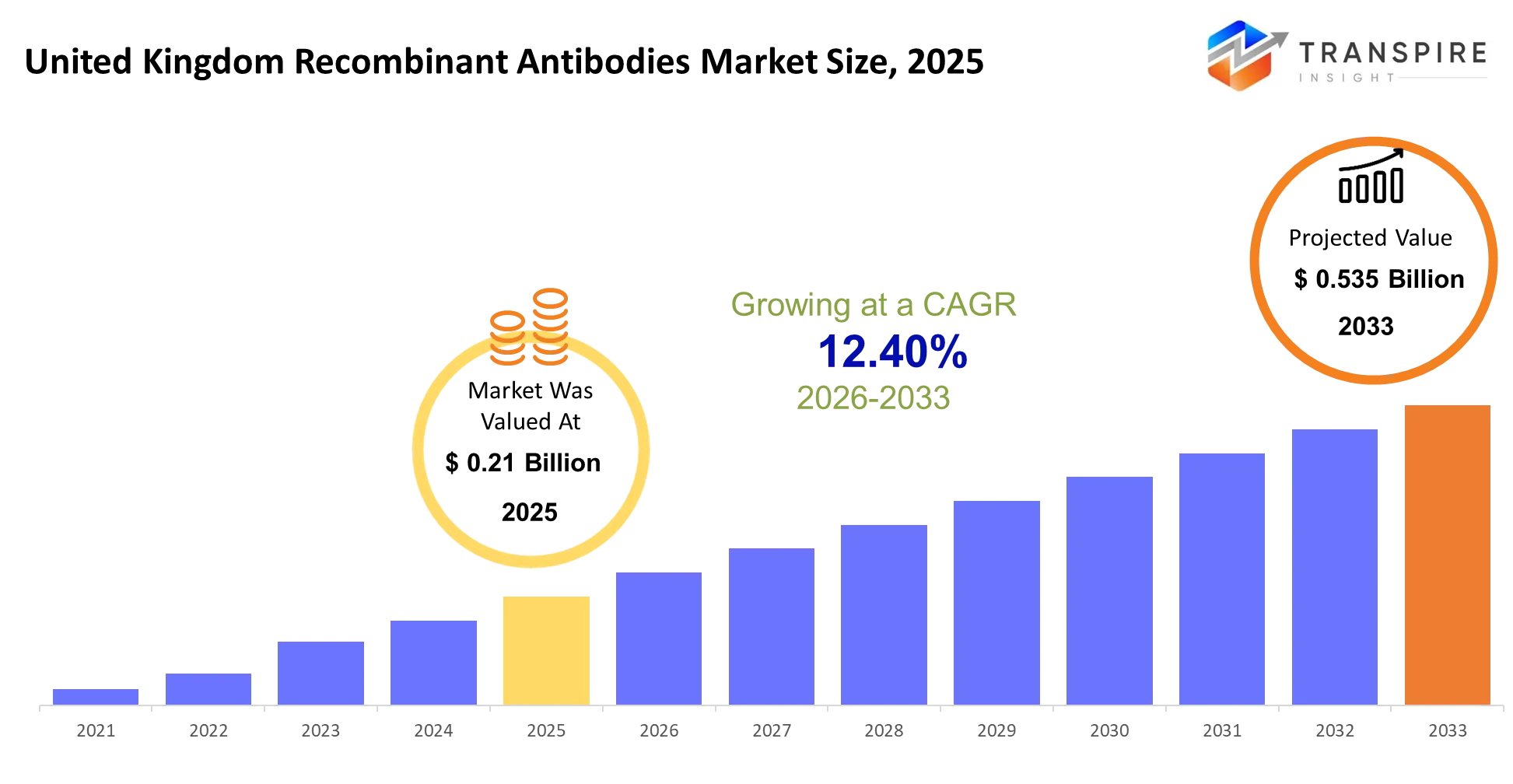
- United Kingdom Recombinant Antibodies Market Size 2025: USD 0.21 Billion
- United Kingdom Recombinant Antibodies Market Size 2033: USD 0.535 Billion
- United Kingdom Recombinant Antibodies Market CAGR: 12.40%
- United Kingdom Recombinant Antibodies Market Segments: By Product Type (Monoclonal Antibodies, Polyclonal Antibodies, Bispecific Antibodies, Recombinant Proteins, Others); By Application (Therapeutics, Diagnostics, Drug Discovery, Research Applications, Others); By Technology (Phage Display, Hybridoma Technology, Single B-cell Technology, Others); By End User (Biotechnology Companies, Pharmaceutical Companies, Research Institutes, Diagnostic Laboratories, Others)
To learn more about this report,  Download Free Sample Report
United Kingdom Recombinant Antibodies Market Summary
The United Kingdom Recombinant Antibodies Market was valued at USD 0.21 Billion in 2025. It is forecast to reach USD 0.535 Billion by 2033. That is a CAGR of 12.40% over the period.
In practice, the UK recombinant antibodies market delivers highly specific binding proteins , often used to detect, block, or measure biological targets across diagnostics, drug discovery and more advanced therapeutic research. These reagents let labs and biopharma groups tighten up assay precision while also speeding up the validation steps for new drug candidates. Over the last five years, the market has been moving away from animal-derived antibodies and instead leaning on recombinant platforms made via phage display and engineered cell systems , which in turn boosts reproducibility and makes batch-to-batch results more consistent.
The COVID-19 pandemic kind of acted as a big trigger, showing the weaknesses in older supply chains while simultaneously pushing demand sharply upward for fast diagnostic use and for research-grade antibodies. Because of that , UK biotech companies and university labs grew their collaborations and started using in-house sourcing strategies more often. This overall transition supports quicker development cycles and also leads to more dependable clinical testing, so adoption has strengthened across both commercial players and public research institutions.
Key Market Insights
- The United Kingdom Recombinant Antibodies Market seems to be leaning more and more into recombinant monoclonal platforms, helping labs with steadier reproducibility, and also cutting down on that annoying batch to batch variability in day-to-day research.
- At the same time demand keeps climbing, largely because biologics pipelines are getting bigger, pushing research teams toward engineered antibodies that let them run validation a bit sooner and improve drug discovery efficiency.
- You can also see automation in antibody screening, plus AI assisted protein engineering, starting to remix the whole development cycle, which in turn shortens the time to market for both diagnostics, and therapeutic uses.
- On the geographic side, the United Kingdom Recombinant Antibodies Market gains momentum from the strong biotech clustering around Cambridge and London, where new ideas are turned into commercialization pathways faster.
- England currently holds the lead in the United Kingdom Recombinant Antibodies Market, with an estimated 60% share, powered by a dense web of biotech and pharmaceutical R&D infrastructure.
- Scotland is kinda the fastest-growing region (forecast 2024–2030) , basically backed by more life sciences investment and those academic–industry partnerships that just keep expanding.
- Recombinant monoclonal antibodies lead the pack with about a 50% share , mostly because they’re high specificity and they’re used a lot in research as well as diagnostics.
- Antibody reagents are the next biggest part of the picture , and they really support routine lab testing plus assay development needs, you know the usual.
- Then engineered and next-generation recombinant formats are the ones growing quickest , fueled by precision medicine use cases and more tailored therapies.
- For applications, research and drug discovery are still the dominant theme , accounting for roughly ~45% of the United Kingdom Recombinant Antibodies Market.
What are the Key Drivers, Restraints, and Opportunities in the United Kingdom Recombinant Antibodies Market?
The United Kingdom Recombinant Antibodies Market is mostly driven by the quick pivot toward precision medicine and biologics-leaning drug discovery. It kinda started when pharmaceutical pipelines drifted away from small molecule drugs toward more precise biologic treatments, and their recombinant antibodies show up with higher specificity, plus they’re more repeatable. Also, when high throughput screening meets recombinant engineering platforms, development timelines get shorter,so drug target validation happens quicker. Because of that, biopharma companies across the UK are buying more recombinant antibody reagents to back oncology and immunology projects, which then boosts steady lab usage and pushes revenue growth.
One big restraint is the steep development and production cost tied to recombinant antibody engineering, especially when you need complex therapeutic-grade formats. This issue is structural really, because it relies on advanced infrastructure, trained specialists, and very strict validation steps, and those things can't be simplified or multiplied overnight. Smaller biotech groups and university labs can end up adopting later, largely because of budget limits and their dependence on shared research facilities. That situation drags out commercialization schedules and makes wider market penetration harder, particularly beyond the main biotech clusters in England.
An emerging opportunity is in AI driven antibody design and synthetic biology platform(s) , though it sort of feels like it’s still early, and yet it’s already starting to shift how discovery gets done. In Cambridge and London, companies plus research institutions are investing more and more in machine learning models that estimate antigen antibody binding with better accuracy than before. For instance, collaborations between UK biotech startups and bigger global life sciences firms are making it possible to run faster in silico screening before any wet lab validation, which cuts down experimental costs and, in turn, opens new scalable routes for recombinant antibody development.
What Has the Impact of Artificial Intelligence Been on the United Kingdom Recombinant Antibodies Market?
The United Kingdom recombinant antibodies sector is kind of being reshaped by artificial intelligence, mainly through how it gets wired into discovery workflows, laboratory automation, and biologics design. Not so much into industrial scrubber setups or maritime systems, which feel a bit off-topic for this market anyway. In real life , AI-driven platforms are now commonly used to come up with antibody candidates by predicting antigen–antibody binding structures. That , in turn , cuts down the number of physical experiments needed during the early stages of research. On top of that, automated lab systems together with machine learning algorithms fine-tune screening pipelines, and that helps boost throughput in high-content assays, which UK biotech firms and research institutions rely on.
Predictive analytics is also being pushed harder into bioinformatics datasets, to forecast antibody stability, affinity and developability. Researchers use those forecasts to select the most promising candidates before they jump into costly wet-lab validation. The practical effect is that operational efficiency climbs, since development timelines get shorter and researchers avoid repeating experiments that might not be necessary. So , R&D costs can drop a bit and commercialization cycles can move faster for therapeutic antibody programs.
Still, adoption hits a structural wall, because there is this gap between computer-based predictions and what biology actually does. Data for new antigens is limited, and model accuracy can slip when it’s used on tricky, complex, or simply rare targets. Also , integrating AI platforms with older laboratory infrastructure can raise implementation expenses and make it harder to scale across smaller research organizations in the UK recombinant antibodies market.
Key Market Trends
- Since 2021 the United Kingdom Recombinant Antibodies Market sort of moved away from animal-derived antibodies, and it started leaning more on recombinant platforms.
- The goal is more reproducible outcomes and also more standardized research outputs, even if people don’t say it directly.
- After 2023 , AI-driven protein modeling tools began showing up in more workflows and they cut down the early stage antibody screening time, which helped labs in the UK find hits faster and more consistently.
- Across 2022–2026 demand trends turned stronger toward oncology and immunology research pipelines, so recombinant antibodies got used more often in precision biologics development programs.
- Then in 2020, during the post-pandemic supply chain disruptions, a lot of teams pushed localized sourcing strategies that reduced dependency on imported antibody reagents across UK research institutions, without quite having to fully restructure everything at once.
- Also outsourcing to CROs expanded quite a bit after 2022. Pharmaceutical firms reallocated discovery workloads, partly to lower internal R&D costs and also to speed up timelines.
- Meanwhile, Cambridge and London biotech clusters seemed to tighten their grip a bit more, mainly by pulling in venture funding, which expanded recombinant antibody innovation and commercialization activity since 2021.
- On the regulatory side, emphasis on reproducibility, plus stricter assay validation standards, drove more adoption of recombinant formats compared with hybridoma-derived antibodies within clinical research workflows.
- And after 2022 , phage display and synthetic library technologies gained momentum, letting teams develop higher-affinity antibodies with fewer experimental back and forth cycles, in a way that feels almost faster than the previous iteration rhythm.
United Kingdom Recombinant Antibodies Market Segmentation
By Product Type :
Monoclonal antibodies hold a leading position because of their high specificity when it comes to target binding, and they also deliver a consistent performance across both research and clinical workflows. Their strong adoption kind of supports drug discovery pipelines, plus diagnostic assay accuracy across biotechnology and pharmaceutical settings that are always busy.
Polyclonal antibodies keep steady usage in cost-sensitive research applications where broad antigen recognition stays useful, even a bit advantageously, depending on what you’re trying to catch. Then bispecific antibodies are gaining traction in advanced therapeutic design, especially oncology programs that need dual-target engagement, and also improved treatment precision across these complex disease pathways where nothing is ever simple.
By Application :
Drug discovery dominates application usage, largely because biologics development keeps ramping up across pharmaceutical pipelines. There is a high dependency on recombinant antibodies too, which helps with target validation, screening efficiency, and biomarker identification during early-stage research environments.
For therapeutics, the application shows strong expansion that’s tied to targeted biologics and immunotherapy development. Diagnostics application strengthens as the demand for precise disease detection tools grows, while research applications stay relatively stable, because academic and institutional experimentation never really stops.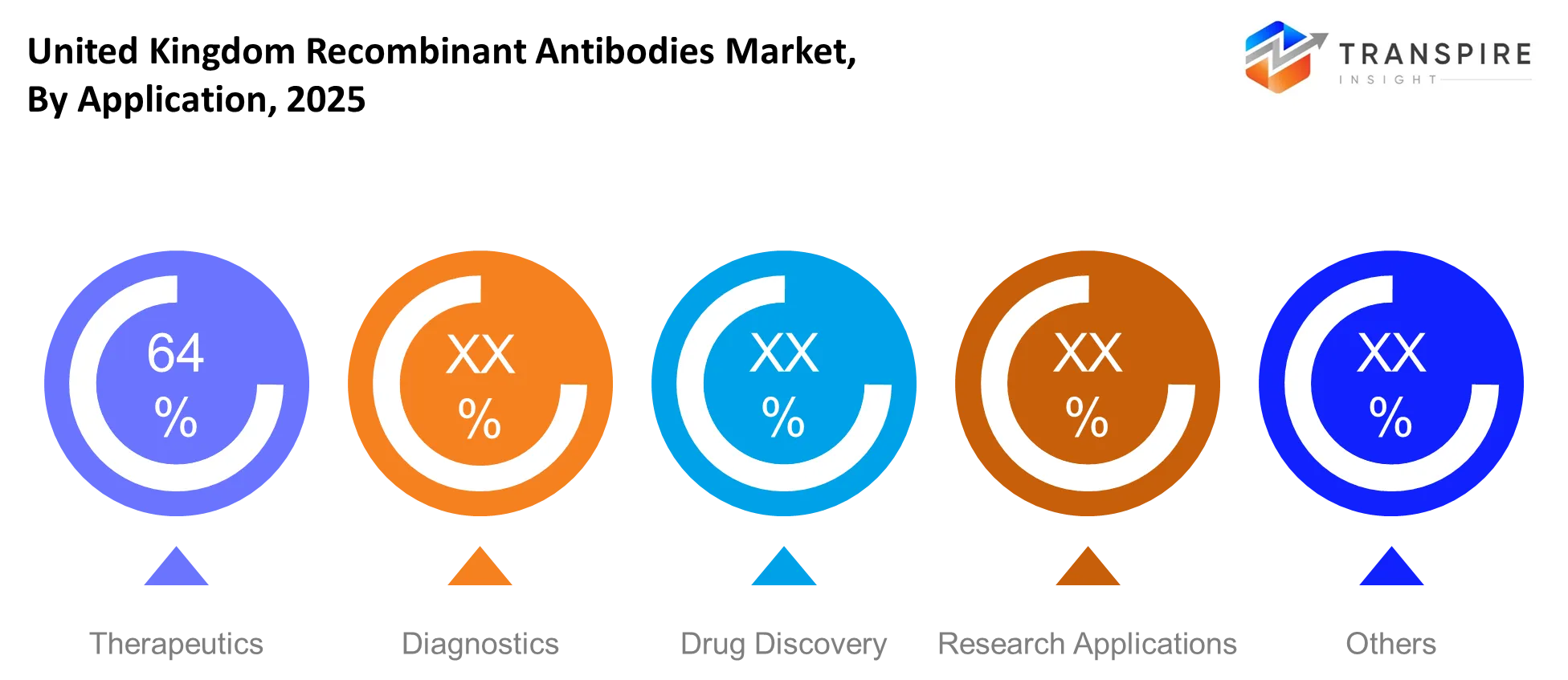
To learn more about this report, Download Free Sample Report
By Technology :
Phage display technology has been leading, mainly because affinity selection gets better and the screening library can be scaled without too much hassle. There is also really strong integration inside standard biotechnology workflows, so antibody engineering moves faster, and the whole cycle of experiments gets cut down across a lot of research facilities.
On the other hand, single B-cell technology keeps getting upgraded, mostly due to improved precision when isolating antibodies, plus less reliance on animal derived systems. Hybridoma technology is still used but it’s trending slowly downward, not because it is useless, more because reproducibility is a bit lower compared to recombinant methods, and that matters in practice.
By End User :
When you look at who buys these things, pharmaceutical companies show up as the main end-user group. That’s linked to big biologics pipelines, and the steady demand for antibody tools that are validated. Biotechnology companies then help push new ideas through early stage antibody development and joint research programs.
Research institutes stay fairly steady, largely because academic work continues and translational projects keep going. Diagnostic laboratories are also adopting more, for high accuracy testing systems, and then contract research organizations bring in an outsourcing model that improves operational efficiency across the broader end-user network.
What are the Key Use Cases Driving the United Kingdom Recombinant Antibodies Market?
In the United Kingdom, drug discovery and target validation are basically the big, main use case in the recombinant antibodies market. Pharmaceutical companies depend on very precise binding tools, so they can map disease pathways better and speed up biologics development, especially in oncology and immunology programs.
There are also other uses that are steadily growing, like clinical diagnostics work and services from contract research organizations. In those settings recombinant antibodies help make assays more accurate, and in many cases the testing feels a bit more reliable, not just more “strong” technically. More and more pharmaceutical and biotech users are taking up these tools as a way to cut down variability in biomarker detection, plus they help keep regulated lab routines in line.
On the side, you can see newer use cases coming in too, for example AI assisted antibody design and personalized medicine. This is happening a lot with bispecific formats and cell therapy research. The idea is to support swifters in silico screening and, at the same time, improve therapeutic targeting in translational studies.
|
Report Metrics |
Details |
|
Market size value in 2025 |
USD 0.21 Billion |
|
Market size value in 2026 |
USD 0.236 Billion |
|
Revenue forecast in 2033 |
USD 0.535 Billion |
|
Growth rate |
CAGR of 12.40% from 2026 to 2033 |
|
Base year |
2025 |
|
Historical data |
2021 - 2024 |
|
Forecast period |
2026 - 2033 |
|
Report coverage |
Revenue forecast, competitive landscape, growth factors, and trends |
|
Regional scope |
Middle East and Africa (Saudi Arabia, United Arab Emirates, South Africa, Rest of Middle East and Africa) |
|
Key company profiled |
Thermo Fisher Scientific, Abcam, Bio-Rad Laboratories, Merck KGaA, GenScript, Creative Biolabs, Cell Signaling Technology, Proteintech, Agilent Technologies, Roche Diagnostics, Novus Biologicals, Sino Biological, PerkinElmer, Danaher Corporation, Lonza |
|
Customization scope |
Free report customization (country, regional & segment scope). Avail customized purchase options to meet your exact research needs. |
|
Report Segmentation |
By Product Type (Monoclonal Antibodies, Polyclonal Antibodies, Bispecific Antibodies, Recombinant Proteins, Others); By Application (Therapeutics, Diagnostics, Drug Discovery, Research Applications, Others); By Technology (Phage Display, Hybridoma Technology, Single B-cell Technology, Others); By End User (Biotechnology Companies, Pharmaceutical Companies, Research Institutes, Diagnostic Laboratories, Others) |
Which Regions are Driving the United Kingdom Recombinant Antibodies Market Growth?
Europe kind of holds that dominant position in the United Kingdom recombinant antibodies market because it has a pretty strong biomedical research setup, plus regulatory standards that feel stricter and they basically push for repeatable biologics. The region also leans on well formed pharmaceutical clusters across the UK, Germany and Switzerland, where advanced lab networks keep antibody innovation going pretty constantly, even if it’s not exactly “no pause” all the time. A lot of support comes from public research funding through councils and EU-aligned frameworks, which has pushed universities and biotech firms to work together more than before. All of that ends up keeping a steady need for recombinant antibodies across drug discovery as well as diagnostic use.
North America stays as a stable contributor mostly due to large scale pharmaceutical investment and the fact that outsourcing to specialized biotech suppliers is pretty consistent. Compared with Europe, where regulation plays a big role in adoption, North America’s edge feels more tied to private sector funding depth and faster commercialization routes. Large companies usually keep long term procurement agreements with research institutions, so demand looks more predictable across time. Because of that, the region can bring in relatively steady revenue, without the kind of wobble that shows up in earlier stage innovation hubs where everything changes quicker.
Asia Pacific is the fastest growing region, largely supported by the rapid build out of biotech manufacturing capabilities in China, India, and South Korea. Since 2023, government led investments into life sciences parks and antibody production infrastructure have really helped local adoption pick up steam. On top of that, clinical trial activity has been increasing, and demand for cost efficient biologics keeps rising which strengthens the growth momentum even more. For new entrants, this region can offer scaling potential through partnerships and localized production approaches over the 2026–2033 period, so there’s a lot of room to grow.
Who are the Key Players in the United Kingdom Recombinant Antibodies Market and How Do They Compete?
Competition in the United Kingdom recombinant antibodies market is sort of moderately consolidated, with a few global life science suppliers holding a meaningful portion while smaller biotech players still show up in more niche discovery work. The incumbents keep trying to defend their positions by doing incremental upgrades to antibody engineering platforms, and also pushing larger recombinant libraries. Meanwhile, new entrants lean heavily on AI-assisted design tooling, plus faster production workflows, and slowly that starts to nudge where differentiation really happens. In practice, it’s mostly the technology capability that drives the race, especially binding specificity, how quickly things get validated, and whether recombinant production can scale without drama.
Abcam kind of leans into niche specialization for high quality research antibodies, and it sharpens this edge via curated recombinant catalog growth, plus stricter validation standards that researchers in academia actually rely on. To expand, the company pursues targeted acquisitions of smaller antibody developers which gives it more depth in oncology and neuroscience research areas. That moves Abcam closer to maintaining a solid position in research-first procurement routes across UK universities, and also biotech labs where buyers want consistency.
Thermo Fisher Scientific plays the longer game using scale and integrated life science offerings, combining recombinant antibody supply with broader laboratory workflow platforms. Its differentiation tends to be the bundling, like reagents together with instruments and analytics software, and that helps reduce the procurement hassle for pharmaceutical clients who do not want to stitch everything themselves. Expansion continues through strengthening its global distribution network, along with acquisitions that boost its biologics and protein research strengths.
Merck KGaA really leans into technology innovation on the antibody production side, especially via more advanced recombinant expression platforms, tied in with its life science division. In a sense they build the edge by pushing high purity reagent offerings, plus tight regulatory compliance alignment, for clinical research use. The growth plan looks like it mixes partnerships with biotech companies, along with scaling manufacturing capacity too, since demand keeps climbing for engineered antibody formats.
Company List
- Thermo Fisher Scientific
- Abcam
- Bio-Rad Laboratories
- Merck KGaA
- GenScript
- Creative Biolabs
- Cell Signaling Technology
- Proteintech
- Agilent Technologies
- Roche Diagnostics
- Novus Biologicals
- Sino Biological
- PerkinElmer
- Danaher Corporation
- Lonza
Recent Development News
In March–April 2026, the UK recombinant antibody sector continued to be shaped by ongoing industry consolidation and platform expansion by established UK-origin antibody firms such as Abcam (Cambridge-based biotech), which operates globally in research antibodies and recombinant protein tools supporting therapeutic antibody discovery workflows.
Source https://en.wikipedia.org/
In March 2026, GlaxoSmithKline plc announced the progression of its monoclonal antibody pipeline through the acquisition-linked development of ozureprubart, a long-acting antibody targeting severe food allergies. The company strengthened its immunology portfolio by securing global rights (excluding China and adjacent territories) to the late-stage antibody candidate through its acquisition of RAPT Therapeutics. Source https://www.thetimes.com/
What Strategic Insights Define the Future of the United Kingdom Recombinant Antibodies Market?
The United Kingdom recombinant antibodies market is moving toward a bit of a structurally technology led ecosystem , where discovery speed and predictive accuracy end up deciding the competitive position. In the next 5–7 years, the uptake will likely be shaped by deeper integration of AI driven antibody design and automated screening platforms, so overall there’s less reliance on the usual hybridoma routines and more value shifts to data enabled biologics development. As this rolls forward, demand should get a boost from pharmaceutical pipelines that are aiming at precision treatments and quicker clinical translation , kind of in a straight line.
There is also a less obvious risk that’s kind of easy to miss, market concentration is increasing among a small set of global suppliers. That can narrow pricing flexibility and it may create dependency concerns for UK research institutions. Meanwhile, there’s substitution pressure too, from other binding options like aptamer based systems, and these could slowly erode certain diagnostic applications if the cost performance balance keeps improving.
On the opportunity side, something more emerging is the spread of fully synthetic antibody libraries, and they’re being paired with machine learning models. This is especially relevant around Cambridge based biotech clusters. Companies that combine computational design with localized high throughput manufacturing will probably grab early traction. Market players should focus on building hybrid strengths that connect AI discovery platforms with scalable production infrastructure , to stay relevant long term in a biologics ecosystem that’s becoming more and more data driven.
United Kingdom Recombinant Antibodies Market Report Segmentation
By Product Type
- Monoclonal Antibodies
- Polyclonal Antibodies
- Bispecific Antibodies
- Recombinant Proteins
By Application
- Therapeutics
- Diagnostics
- Drug Discovery
- Research Applications
By Technology
- Phage Display
- Hybridoma Technology
- Single B-cell Technology
By End User
- Biotechnology Companies
- Pharmaceutical Companies
- Research Institutes
- Diagnostic Laboratories
Frequently Asked Questions
Find quick answers to common questions.
The United Kingdom Recombinant Antibodies Market size is USD 0.535 Billion in 2033.
Key Segments for the United Kingdom Recombinant Antibodies Market are By Product Type (Monoclonal Antibodies, Polyclonal Antibodies, Bispecific Antibodies, Recombinant Proteins, Others); By Application (Therapeutics, Diagnostics, Drug Discovery, Research Applications, Others); By Technology (Phage Display, Hybridoma Technology, Single B-cell Technology, Others); By End User (Biotechnology Companies, Pharmaceutical Companies, Research Institutes, Diagnostic Laboratories, Others).
Major United Kingdom Recombinant Antibodies Market Players are Thermo Fisher Scientific, Abcam, Bio-Rad Laboratories, Merck KGaA, GenScript, Creative Biolabs, Cell Signaling Technology, Proteintech, Agilent Technologies, Roche Diagnostics, Novus Biologicals, Sino Biological, PerkinElmer, Danaher Corporation, Lonza.
The Current United Kingdom Recombinant Antibodies Market size is USD 0.21 Billion in 2025.
The United Kingdom Recombinant Antibodies Market CAGR is 12.40% from 2026 to 2033.
- Thermo Fisher Scientific
- Abcam
- Bio-Rad Laboratories
- Merck KGaA
- GenScript
- Creative Biolabs
- Cell Signaling Technology
- Proteintech
- Agilent Technologies
- Roche Diagnostics
- Novus Biologicals
- Sino Biological
- PerkinElmer
- Danaher Corporation
- Lonza
Recently Published Reports
-
Apr 2026
Cord Blood Banking Services Market
Cord Blood Banking Services Market Size, Share & Analysis Report By Type of Service (Collection, Processing, Storage), By Bank Type (Private Banks, Public Banks, and Hybrid Banks), By Component (Cord Blood, and Cord Tissue), By End User (Hospitals, Research Institutions, Biotechnology Companies, and Others) and Geography (North America, Europe, Asia-Pacific, Middle East and Africa, South and Central America), 2021 - 2031
-
Apr 2026
ELISA Processors Market
ELISA Processors Market Size, Share & Analysis Report By Type (Optical Filter ELISA Analyzer, and Optical Grating ELISA Analyzers), By Mode (Automated ELISA Analyzers, and Semi-Automated ELISA Analyzers), By Applications (Immunology, Vaccine development, Drug Monitoring, and Others), By End Users (Biotechnology Companies, Pharmaceutical Companies, Contract Research Organization, and Diagnostic Laboratories) and Geography (North America, Europe, Asia-Pacific, Middle East and Africa, South and Central America), 2021 - 2031
-
May 2026
Microscope Slide Scanner Market
Microscope Slide Scanner Market Size, Share & Analysis Report By Type (Portable Microscope Slide Scanner, and Desktop Microscope Slide Scanner), By Application (Biological Research, Medicine, Veterinary, and Other) and Geography (North America, Europe, Asia-Pacific, Middle East and Africa, South and Central America), 2021 - 2031
-
Apr 2026
Microwave Cookware Market
Microwave Cookware Market Size, Share & Analysis Report By Material Type (Plastic, Glass, Ceramic, Silicone, and Metal), By Application (Cooking, Reheating, and Defrosting), By End User (Household, Commercial (Restaurants, Hotels, and Cafes), and Food Service Industry), By Sales Channel (Online Retail, Offline Retail (Supermarkets, Hypermarkets, Specialty Stores), and Direct Sales (Company Outlets)) and Geography (North America, Europe, Asia-Pacific, Middle East and Africa, South and Central America), 2021 - 2031