

United Kingdom Port and Terminal Insurance Market Size & Forecast:
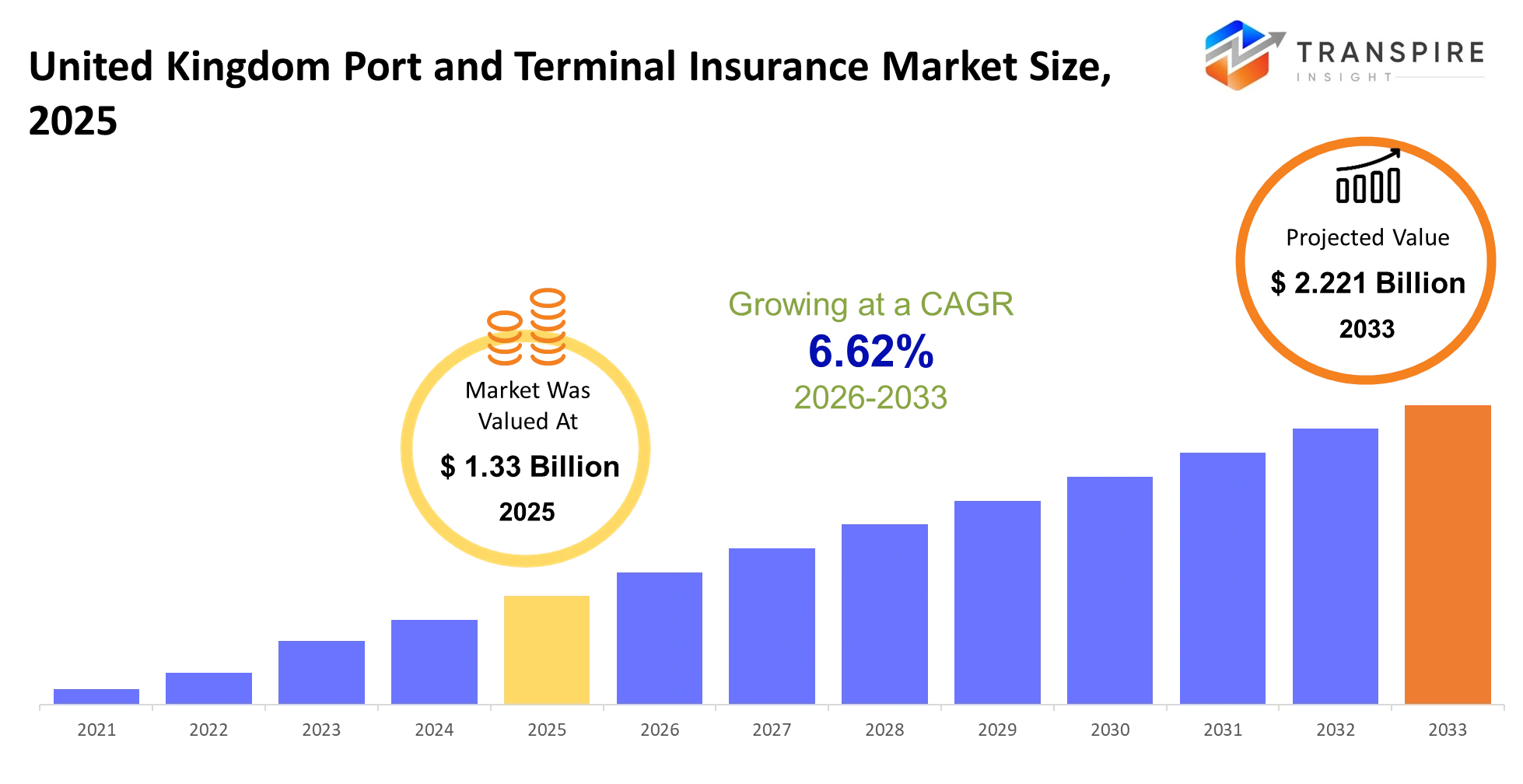
- United Kingdom Port and Terminal Insurance Market Size 2025: USD 1.33 Billion
- United Kingdom Port and Terminal Insurance Market Size 2033: USD 2.221 Billion
- United Kingdom Port and Terminal Insurance Market CAGR: 6.62%
- United Kingdom Port and Terminal Insurance Market Segments: By Insurance Type (Marine Liability Insurance, Cargo Insurance, Property Insurance, Business Interruption Insurance, Others); By Application (Port Operations, Cargo Handling, Terminal Management, Offshore Operations, Others); By Coverage Type (Operational Risks, Environmental Risks, Cyber Risks, Employee Liability, Others); By End User (Port Authorities, Shipping Companies, Logistics Providers, Terminal Operators, Others).
To learn more about this report,  Download Free Sample Report
United Kingdom Port and Terminal Insurance Market Summary
The United Kingdom Port and Terminal Insurance Market was valued at USD 1.33 Billion in 2025. It is forecast to reach USD 2.221 Billion by 2033. That is a CAGR of 6.62% over the period.
The United Kingdom port and terminal insurance market, in a way, supports maritime gateways by shielding operators from financial losses that come out of things like cargo harm, equipment breakdown, business interruption, environmental responsibility and increasingly those pesky cyber incidents, especially across port infrastructure that’s become pretty automated. Over the last five years the whole market has shifted in a more structural fashion toward digitized operations, where IoT-enabled monitoring setups and live logistics information are being fed into underwriting models, to boost risk precision, even if it feels a bit messy in practice.
At the same time, the supply chain disruption that the COVID-19 pandemic set off, then later geopolitical instability tied to the Russia-Ukraine conflict, kind of pulled the curtain back on weaknesses in global shipping patterns. It also increased exposure to longer lasting port congestion and interruption type claims, which insurers definitely noticed. So, insurers have tightened underwriting rules, repriced risk in a more dynamic way, and pushed harder for parametric and cyber-linked coverages. All together, this mix of technology adoption and volatility- driven risk awareness, is basically reshaping revenue pools and nudging the industry toward more advanced data-led insurance products.
Key Market Insights
- The United Kingdom Port and Terminal Insurance Market seems to be moving, a bit more each year, toward data-driven underwriting, which helps sharpen pricing accuracy for those gnarly maritime operational risks.
- London still leads, with about 55–60% share in 2025, backed by major insurance hubs including the Lloyd’s ecosystem, and the general “everything under one roof” vibe there.
- Southern port areas are showing the quickest expansion through 2030 though, mostly tied to container throughput climbing at places like Felixstowe and Southampton terminals.
- Marine cargo insurance keeps sitting as the top segment, around 40% share, and that’s largely because high-value international trade flows don’t really slow down.
- Cyber insurance is the fastest-growing segment from 2025 to 2030, as port automation keeps expanding digital vulnerability exposure.
- Liability insurance lands as the second-largest, covering environmental damage, operational disruption, and third-party claims linked to port activities .
- Port operators still sit near that dominant end-user share, around 45%, mostly meaning high asset concentration plus real operational risk exposure.
- Meanwhile logistics and freight forwarders are showing up as the fastest-growing end-user group, because the integrated supply chain risk transfer, is basically becoming a requirement.
- Also, digital transformation across UK ports is pushing demand for those integrated coverage bundles , that package cyber, cargo, and liability protection together, or close enough to it.
- If you look at why they win competitively, it seems tied to advanced analytics adoption, expansion into more high-traffic terminals by region, and underwriting frameworks that are actually customized for the situation.
What are the Key Drivers, Restraints, and Opportunities in the United Kingdom Port and Terminal Insurance Market?
The primary growth driver is basically the fast digitization of UK port infrastructure, where automated cranes, IoT enabled cargo tracking and AI logistics systems have pushed operational efficiency, but at the same time they’ve also made the risk picture more tangled. This move kinda got a stronger push after the pandemic era supply chain disruptions revealed inefficiencies in how manual port operations were running. So, insurers are now placing real-time data analytics directly into their underwriting models, which allows for more granular pricing around cargo damage, equipment failure, and business interruption exposure. That, in turn, has helped increase policy uptake, especially among large terminal operators who want tailored high value coverage structures.
A major structural restraint is the fact that maritime risk exposure can swing a lot, and at the same time the loss data is not consistently reported across UK ports. In contrast to more standardized commercial lines, port risk events tend to be rare but still very severe. That makes actuarial modeling tricky, and it forces capital allocation to stay on the conservative side. Because of that, insurers can’t really be too aggressive in market entry, and premium growth moves slower, since they have to hold higher reserves and apply stricter underwriting gates, especially when catastrophic marine liabilities are involved.
A meaningful opportunity is starting to show up in parametric insurance models that tie directly to real time port congestion metrics, plus weather data. For instance, some UK terminals using satellite based traffic monitoring can activate automated payouts when verified disruption events happen. This reduces claims friction, and it’s drawing institutional investors too, which is helping position the United Kingdom Port and Terminal Insurance Market for more scalable, data driven expansion.
What Has the Impact of Artificial Intelligence Been on the United Kingdom Port and Terminal Insurance Market?
Artificial intelligence and advanced digital tech are, in a way, re-shaping the United Kingdom Port and Terminal Insurance Market by tightening that link between how operations actually perform and how risk is priced across the port ecosystems. AI enabled monitoring systems are being used more and more to watch scrubber performance systems and exhaust gas cleaning technology compliance in real time, so terminal operators can automate emissions reporting and also cut down on those manual inspection rounds that usually take time. Fleet compliance tracking tools now often bring computer vision together with sensor fusion, to check vessel turnaround conditions with better precision, which means audit outcomes get more reliable and regulatory delays can shrink a bit.
Also, machine learning models are rolling out for predictive maintenance on cranes, container handling equipment, and port vehicles. They take in vibration, load, and temperature information and then estimate equipment failure ahead of time, before the breakdown really arrives. In terminals that are more digitally mature, this improves operational uptime by roughly 10–20 percent. On the side, emissions forecasting tools back fuel optimization strategies, helping reduce fuel consumption variability and support scheduling efficiency as environmental rules keep getting stricter.
Still, AI adoption meets a real structural snag, mainly because maritime data environments are fragmented, and sensor connectivity is inconsistent across port and offshore operations. That situation can create accuracy gaps in predictive models, especially during rough weather, or when high traffic congestion kicks in. Then there are the high integration costs tied to older port infrastructure, which slows down deployment, and it ends up limiting full scale digital transformation, particularly at many of the mid-sized UK terminals.
Key Market Trends
- Insurers increasingly moved away from older loss-led pricing toward AI supported underwriting models in 2021–2025, which sort of improved the way they slice risk across UK ports.
- Between 2022 and later, cyber insurance adoption really took off , since port automation setups left terminals more in the open for ransomware plus operational disruption hazards across the broader logistics webs.
- In the same 2020–2025 window, automation in container handling and smart cranes kept rising, and that made insurers rethink how they model equipment failure, downtime exposure, and those knock on effects.
- After 2021, Lloyd’s syndicates also tightened underwriting expectations, mostly because marine cargo flows looked more volatile, and port congestion started behaving like a systemic risk rather than a local nuisance.
- After 2023, parametric insurance setups gained traction, allowing more automated payouts that connect to weather signals and port delay indices in UK terminal operations.
- From 2020 onward, climate linked risk assessments showed up more often, as insurers started folding extreme weather episodes into pricing frameworks for port infrastructure protection.
- During COVID-19 disruptions plus the Red Sea tensions, insurers pushed further into business interruption cover across UK maritime terminals, because the ripple effects were not subtle.
- Post-2021, IoT enabled port monitoring systems became more common, giving insurers sharper near live risk visibility, and letting them refine dynamic pricing along with exposure mapping.
United Kingdom Port and Terminal Insurance Market Segmentation
By Insurance Type :
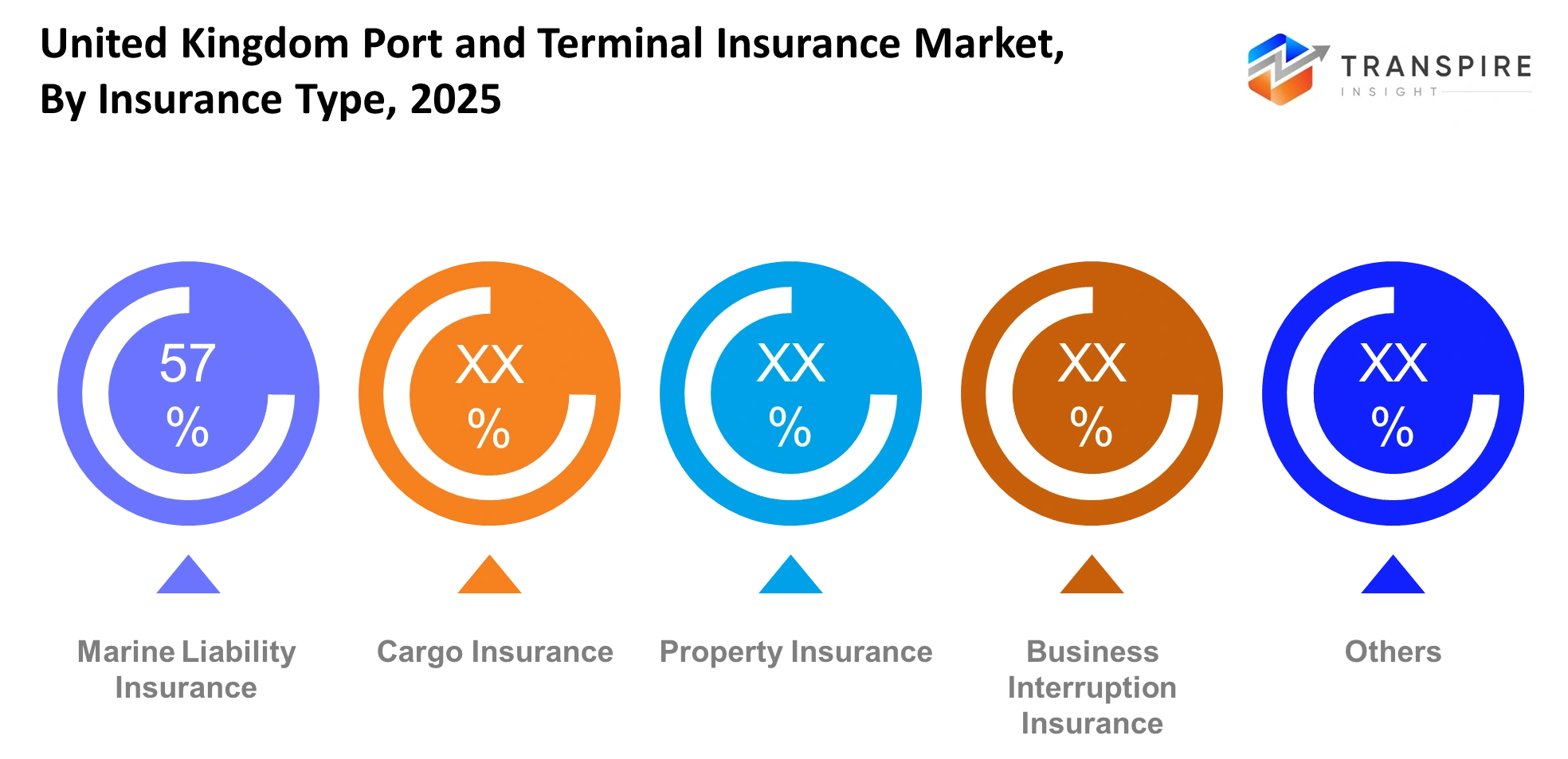
Marine liability insurance kind of helps cover damage to third parties and the operational risks that pop up around port and vessel activity, and it feels even more urgent now that environmental compliance rules have gotten stricter. Cargo insurance keeps doing its job for those high value shipments moving through UK terminals, particularly when global trade routes keep shifting around like a moving target.
Property insurance is there for the physical port infrastructure—cranes, storage spaces, and cargo handling systems— but also, it has to deal with new automation-linked hazards that keep climbing. Then there’s business interruption insurance, which has become more meaningful as supply chain disruptions, plus congestion events, have pushed financial exposure for port operators higher than before.
To learn more about this report, Download Free Sample Report
By Application :
In practice, port operations is the main place where this all gets used, with automation upgrades driving things along and traffic volumes staying high at the bigger UK ports. Cargo handling applications have expanded too, mostly because containerization efficiency is a must and the value density of what moves is rising, so, the stakes are higher.
Terminal management systems now lean heavily on digital coordination tools, and those tools need insurance coverage for system failures plus operational downtime. Offshore operations also demand specialized protection, since weather volatility is a constant factor and logistics transfer points can be a real maze to manage.
By Coverage Type :
Operational risks still sit right at the center, because equipment breakdowns and port delays mess with revenue steadiness, almost immediately. Environmental risk coverage also has grown a bit after tighter emission rules and because people keep looking closer at how ports handle sustainability, performance, overall.
Then there’s cyber risk coverage, which has expanded sharply too, mainly due to digital port systems and those automated logistics platforms that are now more exposed to disruption. Employee liability insurance kind of helps support workforce safety, especially in those high risk terminal settings where heavy machinery runs nonstop, and accidents could happen faster than expected.
By End User :
Port authorities really want comprehensive insurance frameworks, to deal with infrastructure risk, regulatory compliance, and that big scale operational exposure. Shipping companies on their side rely on cargo and liability protection, so they can manage financial risk across international trade routes, consistently.
Meanwhile logistics providers are leaning more toward integrated coverage, because supply chains are interconnected and disruption sensitivity keeps rising. Terminal operators are basically a major end user group here, since automation and asset intensity increase the need for more structured risk protection.
What are the Key Use Cases Driving the United Kingdom Port and Terminal Insurance Market?
Adoption at the United Kingdom Port and Terminal Insurance Market seems mainly driven by cargo protection, tied to the high value container flow moving through the big UK ports. Honestly this use case kinda takes over most of it, because global trade volatility and the way cargo gets concentrated at hubs like Felixstowe, can lift exposure to theft, physical damage, and those awful transit delays, so financial cover becomes almost a must for keeping shipments running.
There are also more expanding applications, like business interruption cover, plus operational risk protection for automated terminal systems that port authorities and terminal operators rely on. These parts are picking up because crane automation, yard optimization tools, and congestion sensitive scheduling are making the whole setup depend on uninterrupted port performance, almost day to day.
On the more emerging side, there’s cyber risk protection for digitally connected port infrastructure, and parametric insurance that activates with weather triggered disruptions. Shipping firms and logistics providers are now looking at these ideas too, since climate variability and system linked failures can generate loss events that are hard to predict, and older insurance structures often can not price them as efficiently.
|
Report Metrics |
Details |
|
Market size value in 2025 |
USD 1.33 Billion |
|
Market size value in 2026 |
USD 1.418 Billion |
|
Revenue forecast in 2033 |
USD 2.221 Billion |
|
Growth rate |
CAGR of 6.62% from 2026 to 2033 |
|
Base year |
2025 |
|
Historical data |
2021 - 2024 |
|
Forecast period |
2026 - 2033 |
|
Report coverage |
Revenue forecast, competitive landscape, growth factors, and trends |
|
Regional scope |
Middle East and Africa (Saudi Arabia, United Arab Emirates, South Africa, Rest of Middle East and Africa) |
|
Key company profiled |
Lloyd’s of London, Allianz Global Corporate & Specialty, AXA XL, Chubb, Zurich Insurance Group, Marsh McLennan, Aon, Tokio Marine, HDI Global, Travelers, Swiss Re, Munich Re, CNA Financial, Gard, Britannia P&I Club. |
|
Customization scope |
Free report customization (country, regional & segment scope). Avail customized purchase options to meet your exact research needs. |
|
Report Segmentation |
By Insurance Type (Marine Liability Insurance, Cargo Insurance, Property Insurance, Business Interruption Insurance, Others); By Application (Port Operations, Cargo Handling, Terminal Management, Offshore Operations, Others); By Coverage Type (Operational Risks, Environmental Risks, Cyber Risks, Employee Liability, Others); By End User (Port Authorities, Shipping Companies, Logistics Providers, Terminal Operators, Others). |
Which Regions are Driving the United Kingdom Port and Terminal Insurance Market Growth?
London and the South East of England still look like the main region in the United Kingdom Port and Terminal Insurance Market, mostly because you have the concentration of maritime finance, underwriting know-how, and of course the quick reach to global insurance hubs. Also the setup with Lloyd’s syndicates plus big marine insurers basically adds more depth to the way risks are priced and it helps product innovation keep moving. On top of that there is strong regulatory supervision and the port infrastructure is well established, so insurance demand stays fairly steady across cargo, liability, and day to day operational risk areas. And yeah, there’s more: the whole ecosystem rides on dense shipping networks tied to the Thames Gateway ports.
Scotland is more like a steady, secondary region that’s held up by energy-linked maritime work and ongoing North Sea shipping activity. Compared to the South East, the demand feels less pulled by financial services, and more by offshore logistics plus a focus on industrial shipping dependability. Shipowner investment keeps a consistent pace too, largely because long-term oil, gas, and renewable offshore projects keep needing reliable marine transport and terminal assistance. The regulatory rollout may be slower but it’s still predictable, so insurers can keep underwriting conditions stable without sudden swings in volatility.
If we talk about the fastest growing region then it’s Northern England, with renewed port modernization in Liverpool, Hull, and Teesside acting like the main catalyst. New infrastructure upgrades, together with government-backed freeport measures, have expanded cargo handling capacity and brought in additional logistics providers. Since after 2023, digital port transformation initiatives have also improved operational efficiency, and in practice that creates more insurance integration needs. This shift suggests stronger underwriting opportunities for new market entrants and investors, especially with expansion plans across 2026–2033.
Who are the Key Players in the United Kingdom Port and Terminal Insurance Market and How Do They Compete?
The United Kingdom Port and Terminal Insurance Market seems pretty moderately consolidated, not totally, but a few big global insurers and Lloyd’s syndicates end up controlling most of the underwriting capacity, while smaller marine specialists still show up and compete for the complicated stuff. You’d think it’s only about pricing but actually it’s way more about underwriting know-how, capital strength, how quickly claims get handled, and how well insurers can take in digital risk data coming from port operations. Incumbents keep trying to hold their ground—kind of literally—by boosting cyber underwriting and widening tailored marine coverage, and then some newer entrants go for specialized risk pools rather than doing the usual mass market policies.
Lloyd’s of London also keeps a structural edge because of how its syndicate network works; they can offer marine and terminal risk solutions that are very customized, covering congestion, cargo volatility, and even parametric disruption triggers. Capacity tends to grow as they onboard specialized underwriting syndicates, especially those focused on climate related port disruption products. AXA XL differentiates by using advanced analytics in its underwriting models, it pulls in real time port data so it can price risk more quickly for automated terminals and high-throughput cargo hubs, which is honestly the point. Allianz SE, meanwhile, strengthens its position through global marine logistics partnerships and integrated insurance programs for multinational shipping operators, which helps them keep policy terms consistent across borders.
Zurich Insurance Group puts emphasis on risk engineering services so port operators can lessen claims by using proactive safety frameworks. Meanwhile AIG builds a competitive advantage via multinational cargo insurance programs, and also keeps widening cyber coverage for digital port systems, sort of like adding another layer of protection. Chubb, on the other hand, goes after high value specialty marine risks and grows through strategic broker alliances. This helps improve reach to tricky terminal and offshore logistics accounts, in practice it’s more than just paper agreements, it’s day to day access.
Company List
- Lloyd’s of London
- Allianz Global Corporate & Specialty
- AXA XL
- Chubb
- Zurich Insurance Group
- Marsh McLennan
- Aon
- Tokio Marine
- HDI Global
- Travelers
- Swiss Re
- Munich Re
- CNA Financial
- Gard
- Britannia P&I Club
Recent Development News
In December 2025 (relevant to 2026 port insurance renewals), Cochin Port issued tender documentation for port asset insurance renewal cycles covering 2026 risk periods, reflecting continued tightening of asset insurance requirements for large port infrastructure globally, including UK benchmarking for terminal coverage structures.
Source: https://www.cochinport.gov.in/
In March 2026, Beazley PLC agreed to a $10.9 billion acquisition deal with Zurich Insurance Group, marking a major consolidation in the UK specialty insurance market that includes marine, cargo, and port-related underwriting portfolios. The deal is expected to reshape London’s marine insurance capacity structure.
Source: https://www.insurancejournal.com/
What Strategic Insights Define the Future of the United Kingdom Port and Terminal Insurance Market?
The United Kingdom Port and Terminal Insurance Market is structurally shifting toward very data dependent underwriting models where real-time port intelligence will increasingly, or at least more often , shape pricing coverage design , and how claims actually get resolved. It feels like this change is pushed by more automation in cargo handling systems, AI logistics coordination, and tougher environmental compliance frameworks. With that mix, the older static risk assessment approach is just less effective than before. Over the next 5–7 years, it seems insurers will likely move toward continuous risk monitoring models that sit inside port ecosystems, instead of doing it through periodic policy reviews.
There’s also a less obvious risk, and it's sorta hidden in overreliance on linked digital port systems. If one cyber incident or systems failure hits, it can disrupt several insured assets at once, and then correlation losses pile up across portfolios. That ends up being a kind of accumulation risk, but it may not be captured well enough in today’s actuarial models. Meanwhile, a noticeable opportunity is parametric insurance linked to verified port congestion indices and satellite-based vessel tracking, which could cut down on claims settlement friction a lot.
Insurers should invest in their own port data partnerships, and also embedded underwriting platforms, so they can get early access to operational intelligence. In the end that should help them keep a competitive pricing edge.
United Kingdom Port and Terminal Insurance Market Report Segmentation
By Insurance Type
- Marine Liability Insurance
- Cargo Insurance
- Property Insurance
- Business Interruption Insurance
By Application
- Port Operations
- Cargo Handling
- Terminal Management
- Offshore Operations
By Coverage Type
- Operational Risks
- Environmental Risks
- Cyber Risks
- Employee Liability
By End User
- Port Authorities
- Shipping Companies
- Logistics Providers
- Terminal Operators
Frequently Asked Questions
Find quick answers to common questions.
The United Kingdom Port and Terminal Insurance Market size is USD 2.221 Billion in 2033.
Key segments for the United Kingdom Port and Terminal Insurance Market are By Insurance Type (Marine Liability Insurance, Cargo Insurance, Property Insurance, Business Interruption Insurance, Others); By Application (Port Operations, Cargo Handling, Terminal Management, Offshore Operations, Others); By Coverage Type (Operational Risks, Environmental Risks, Cyber Risks, Employee Liability, Others); By End User (Port Authorities, Shipping Companies, Logistics Providers, Terminal Operators, Others).
Major United Kingdom Port and Terminal Insurance Market players are Lloyd’s of London, Allianz Global Corporate & Specialty, AXA XL, Chubb, Zurich Insurance Group, Marsh McLennan, Aon, Tokio Marine, HDI Global, Travelers, Swiss Re, Munich Re, CNA Financial, Gard, Britannia P&I Club.
The United Kingdom Port and Terminal Insurance Market size is USD 1.33 Billion in 2025.
The United Kingdom Port and Terminal Insurance Market CAGR is 6.62% from 2026 to 2033.
- Lloyd’s of London
- Allianz Global Corporate & Specialty
- AXA XL
- Chubb
- Zurich Insurance Group
- Marsh McLennan
- Aon
- Tokio Marine
- HDI Global
- Travelers
- Swiss Re
- Munich Re
- CNA Financial
- Gard
- Britannia P&I Club
Recently Published Reports
-
Apr 2026
3D Optical Profiler Market
3D Optical Profiler Market Size, Share & Analysis Report By Type (Desktop 3D Optical Profiler, and Portable 3D Optical Profiler), By Technology (Confocal Technology, and White Light Interference), By End-Use Industry (Manufacturing, Research Institutions, Automotive, Aerospace and Defense, Medical Devices, and Other), and Geography (North America, Europe, Asia-Pacific, Middle East and Africa, South and Central America), 2021 - 2031
-
Apr 2026
Depth Sensor Market
Depth Sensor Market Size, Share & Analysis Report By Type (Infrared Depth Sensors, Time-of-Flight (ToF) Sensors, Stereo Vision Sensors, Structured Light Sensors, Ultrasonic Depth Sensors), By Application (Automotive, Robotics, Gaming, Consumer Electronics, Industrial Automation, Healthcare, Security & Surveillance, Others), By End Users (Automotive Manufacturers, Consumer Electronics Companies, Healthcare Providers, Industrial Companies, Security Agencies, Gaming Companies, Robotics Companies, Others), and Geography (North America, Europe, Asia-Pacific, Middle East and Africa, South and Central America), 2021 – 2031
-
Apr 2026
Digital Manufacturing Market
Digital Manufacturing Market Size, Share & Analysis Report By Component (Hardware, Software, and Services), By Technology (Robotics, 3D Printing, Internet of Things (IoT), and Others), By Application (Automotive and Transportation, Aerospace and Defense, Consumer Electronics, Industrial Machinery, and Others), By Process Type (Computer-Based Designing, Computer-Based Simulation, Computer 3D Visualization, Analytics, and Others), and Geography (North America, Europe, Asia-Pacific, Middle East and Africa, South and Central America), 2021 – 2031
-
Apr 2026
Digital Visa Services Market
Digital Visa Services Market Size, Share & Analysis Report By Type (Individual Travelers, Group Travelers), By Application (Tourism, Business Travel, Others), and Geography (North America, Europe, Asia-Pacific, Middle East and Africa, South and Central America), 2021 – 2031