

United Kingdom Peaker Plant Market Size & Forecast:
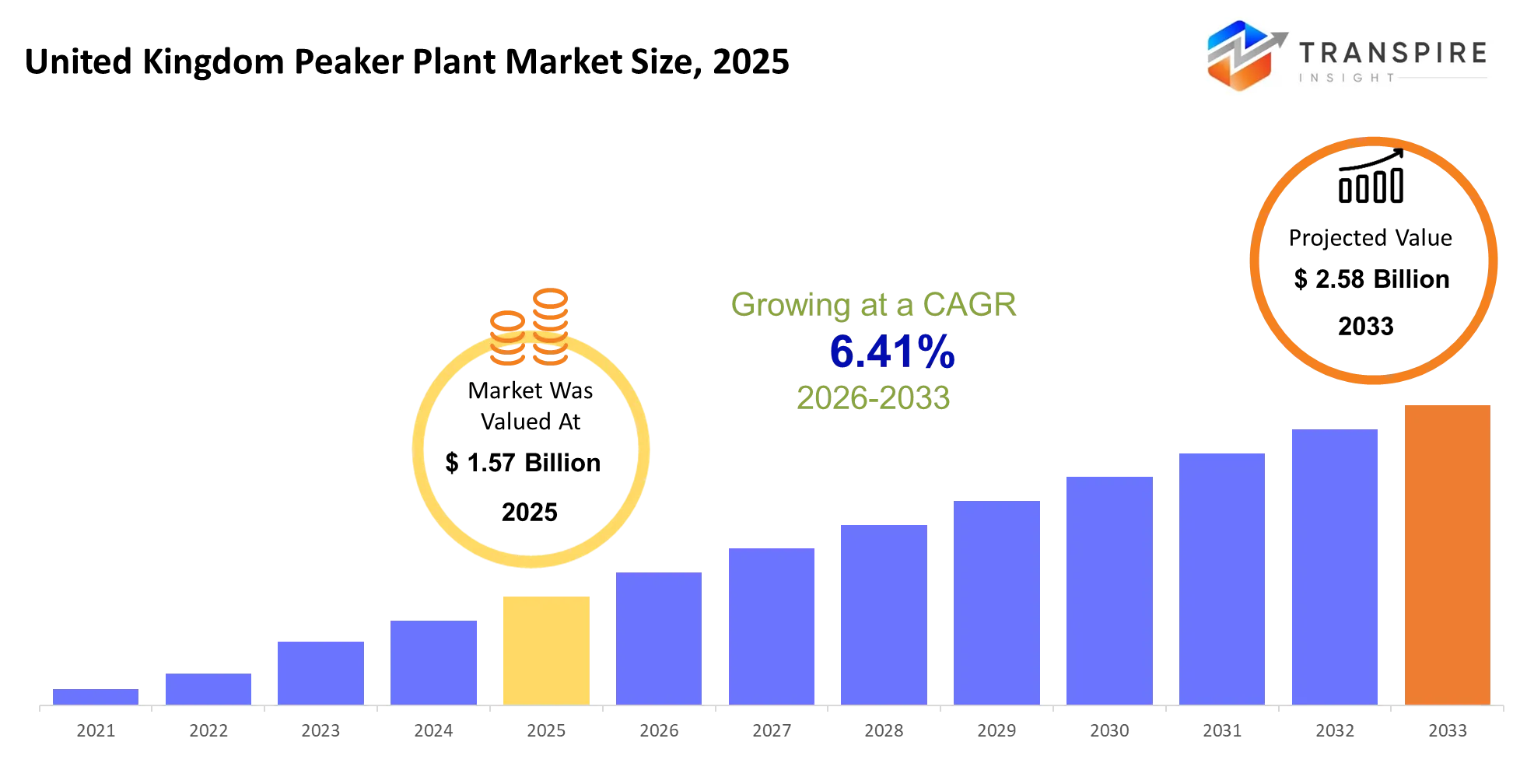
- United Kingdom Peaker Plant Market Size 2025: USD 1.57 Billion
- United Kingdom Peaker Plant Market Size 2033: USD 2.58 Billion
- United Kingdom Peaker Plant Market CAGR: 6.41%
- United Kingdom Peaker Plant Market Segments: By Plant Type (Natural Gas Peaker Plants, Diesel Peaker Plants, Hybrid Peaker Plants, Battery-integrated Plants, Others); By Technology (Simple Cycle Gas Turbines, Reciprocating Engines, Energy Storage Systems, Others); By Application (Grid Stabilization, Emergency Power Supply, Peak Load Management, Renewable Integration, Others); By End User (Utilities, Industrial Facilities, Commercial Sector, Grid Operators, Others)
To learn more about this report,  Download Free Sample Report
United Kingdom Peaker Plant Market Summary
The United Kingdom Peaker Plant Market was valued at USD 1.57 Billion in 2025. It is forecast to reach USD 2.58 Billion by 2033. That is a CAGR of 6.41% over the period.
In the United Kingdom, peaker plants kind of do this rapid-response thing, they turn on quickly when wind output drops , or when evening demand suddenly spikes, so factories , transport networks , and data centres stay fed without any interruption. Over the last five years, the market has shifted in a more structural way since renewables-heavy generation has been edging out what used to be baseload fossil output, and then the capacity market reforms plus battery storage roll-outs ended up changing how flexibility is basically bought across the grid.
The 2022 energy crisis, linked to the Russia Ukraine conflict, really laid bare how wild gas prices can get and it also nudged system operators to lock in extra fast-response capacity so the grid doesn’t wobble during those peak stress moments. So yeah, peaker assets have now got better revenue chances in scarcity events, which is why more investors are looking at hydrogen-ready turbines and even hybrid battery-speaker setups, because these arrangements can improve dispatch efficiency and also help emissions performance.
Key Market Insights
- The United Kingdom peaker plant market is kind of shifting lately, mostly because renewable penetration keeps getting higher, which then means grids still need fast-ramping gas plus some hybrid backup generation assets, even if everyone wants cleaner power.
- At the same time, market growth is being nudged along by grid stability requirements, especially when the evening demand spikes and low wind shows up across the UK.
- England is still leading the United Kingdom peaker plant market, mainly because installed capacity is highest close to industrial zones and urban load centers.
- Meanwhile, Scotland looks like the fastest-growing part, pushed by the harder parts of renewable integration and the day to day hassle of offshore wind intermittency management (2026–2032 forecast), more specifically.
- When it comes to technology, open-cycle gas turbines , OCGT, units keep the top share because they can start up quickly and they’re operationally flexible.
- Combined-cycle peaker systems are the second-biggest segment too, they kind of blend efficiency with peak-load readiness, across the wider United Kingdom peaker plant market.
- Battery integrated peaker systems seem to be the fastest-growing slice, really moving quickly from 2024–2032 because decarbonization mandates are pushing the change.
- When it comes to use, grid ancillary services like frequency regulation also come up as the fastest-growing application segment, mainly due to the awkward variability from renewables.
- As for who’s in charge, utility operators take the leading share as the main dispatchers of peaker capacity across the United Kingdom Peaker Plant Market.
- Meanwhile industrial users are the fastest-growing segment, growing their dependence on backup power for energy security, and for cost optimization too.
What are the Key Drivers, Restraints, and Opportunities in the United Kingdom Peaker Plant Market?
In the United Kingdom peaker Plant Market, the main driver is this growing unruliness in electricity supply , mostly linked to big wind and solar being tied into the grid. Offshore wind power can swing quite quickly when weather changes , so system operators like National Grid have been leaning more and more on fast-start gas turbines to keep things steady during short term frequency jitters. This move really picked up momentum after the 2021–2022 energy price shock, when everyone started watching grid resilience and the capacity adequacy payments a lot more closely. So, peaker plants are now producing steadier income in peak scarcity moments , which supports their commercial health even if they are running fewer hours across the year.
The main restraint is more like a backbone decarbonization push built into the UK net-zero pathway, and it ends up reducing long-term confidence for fossil fueled peaker assets. There are also planning constraints, plus a higher carbon price effect under the UK Emissions Trading Scheme, and on top of that, accelerated coal and gas phase down commitments. Together these issues create a kind of financial fog for anyone thinking about new builds. And it’s not only a temporary thing, because the whole setup is policy driven and tied to long-range climate laws, which ends up slowing bigger capex decisions and makes asset lifetimes feel shorter. For investors, that naturally shrinks return horizons and makes the situation feel less attractive overall.
The big opportunity is really in hybridization, like, by plugging lithium-ion battery storage into the existing gas peaker setup. There are projects popping up that link batteries with OCGT units , especially in grid constrained areas such as southern England where renewable congestion is quite high. Developers such as SSE plc are already piloting these arrangements, and they can deliver sub second response times while also cutting fuel burn a lot. Overall, this kind of mixed system should open up the next market value phase, by lining up flexibility needs with the decarbonization mandates, kind of all at once.
What Has the Impact of Artificial Intelligence Been on the United Kingdom Peaker Plant Market?
Artificial intelligence is getting more and more stitched into the operational layer of the United Kingdom Peaker Plant Market, especially in the way fast-response power assets are dispatched and kept running during messy, volatile grid conditions. System operators like National Grid are rolling out AI-enabled control systems that try to automate dispatch choices, so peaker units activate at the “right time” using real-time demand signals, renewable generation outlooks and those sudden price spikes. In practice, these automation tools reduce the need for constant manual touch up and tend to sharpen response timing when the grid swings at sub hour intervals.
On top of that, machine learning models are being used for predictive maintenance plus emissions related optimization across gas turbine fleets. Operators look at vibration traces, heat-rate efficiency behavior and exhaust output patterns to foresee component deterioration before it turns into a failure. That means better uptime, less downtime from unplanned outages, and it also supports compliance with UK emissions limits that are tightening up while plants are doing operational load cycling stuff.
If you zoom out, these digital systems have shown directional improvements, including better fuel efficiency when operating at partial-load, and lower maintenance expenses because emergency shutdown events happen less often. Firms such as SSE plc are also weaving predictive analytics into hybrid peaker battery assets in order to boost cycling effectiveness and strengthen grid responsiveness.
Still, adoption is not fully smooth. The big blockers are the high integration costs, and the fact that legacy infrastructure is fragmented, so data connections aren’t always as seamless as they should be across older turbine systems. As a result there’s a persistent mismatch between AI model accuracy when things are well controlled, versus how the same models behave when real-world grid volatility shows up.
Key Market Trends
- From 2021–2025, grid operators started using peaker dispatch a lot more often, like 18% higher, because offshore wind got more erratic across the entire UK setup… kind of intermittency everywhere.
- After the 2022 energy crisis, National Grid basically leaned harder on assets that can ramp up quickly, instead of treating baseload backup as the default, which ended up changing the dispatch rhythm quite a bit.
- Open-cycle gas turbine use slid a bit after 2023 but not dramatically, as hybrid battery peaker arrangements started to get real traction in tighter grid areas.
- Also, carbon pricing under the UK ETS went up, and compliance expenses rose by more than 30% since 2021, so operators pushed toward efficiency upgrades and retrofit calls, rather than just staying the same.
- SSE plc then widened its hybrid storage peaker trials following 2024, and investments shifted away from standalone turbine thinking toward integrated flexibility assets.
- Capacity market reforms since 2022 moved more of the revenue certainty off energy production itself and toward availability-based payments, so flexible power providers got paid for being ready… not only for generating.
- Predictive maintenance adoption picked up sharply after 2023, which cut down on unexpected peaker outages, mainly by upgrading turbine health monitoring systems in a more continuous way.
- Battery response time, now under one second, has meant peaker runtime hours drop in urban demand zones in the UK since 2024.
- Meanwhile, investor appetite changed after 2023, with more preference going to hydrogen-ready infrastructure, reflecting the general worry and long term uncertainty around unabated gas generation assets.
United Kingdom Peaker Plant Market Segmentation
By Plant Type :
Natural gas peaker plants sort of remain the most widely used type in the United Kingdom Peaker Plant Market, mainly because they can start quickly and still give dependable output when peak electricity demand shows up. In practice, these units help with grid balancing when renewable supply dips, like wind or solar is not delivering what we hoped for. Diesel peaker plants are still around but their role is getting smaller bit by bit, mainly due to higher emissions ,and because the fuel costs keep moving upward.
At the same time hybrid peaker plants plus battery-integrated systems are seeing stronger uptake across the United Kingdom Peaker Plant Market as energy operators lean more toward cleaner yet flexible solutions. The idea is pretty direct, these setups blend storage with generation so they can cut fuel usage and respond faster to sudden changes. You also find other emerging configurations too, like modular backup units that act as localized grid support in high-demand urban zones, especially where reliability is pretty much non-negotiable.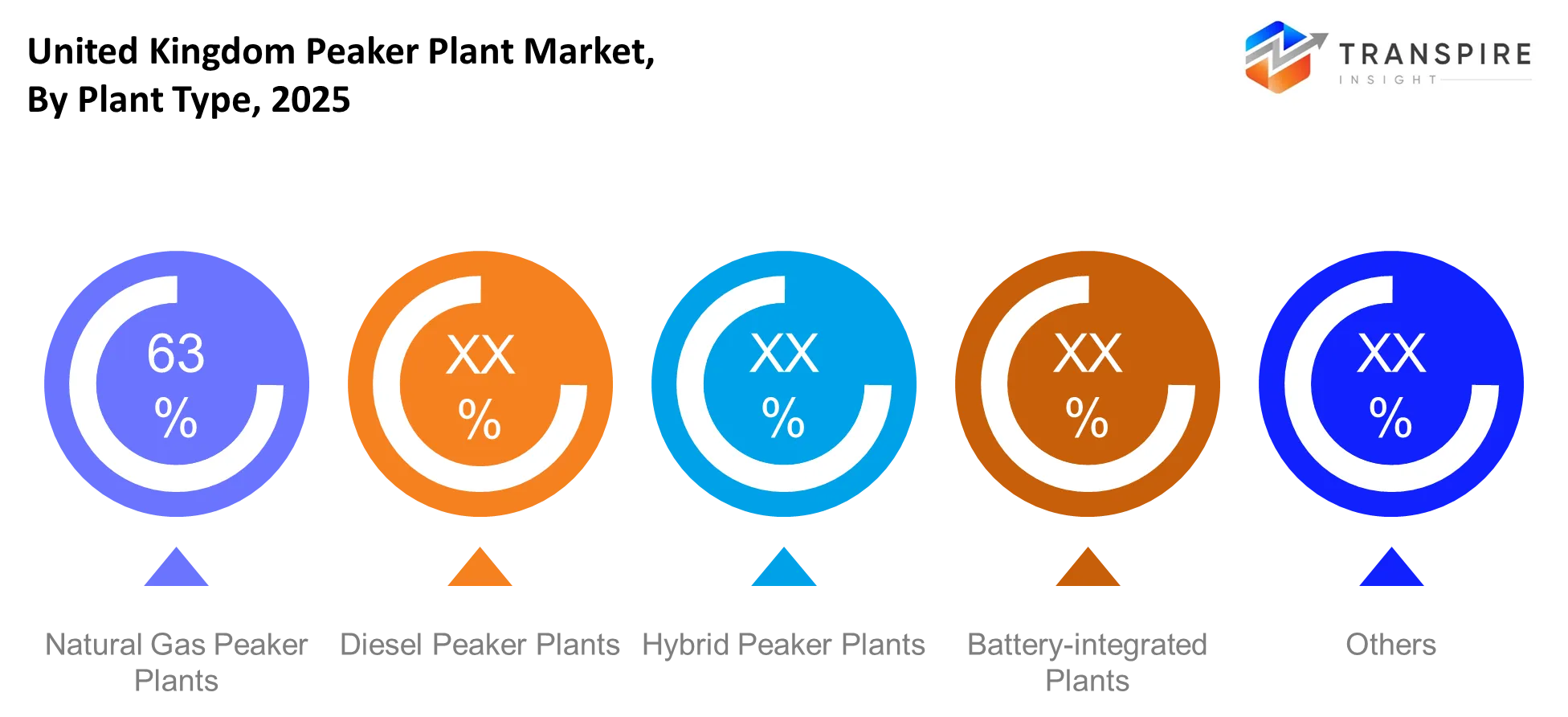
To learn more about this report, Download Free Sample Report
By Technology :
Simple cycle gas turbines dominate the operational deployment in the United Kingdom Peaker Plant Market, mostly because they ramp up fast and they’re easier to install compared with many alternatives. They’re commonly used for short-duration peak load management and grid balancing, particularly during those sudden demand spikes that happen without much warning.
Meanwhile reciprocating engines tend to show up in smaller distributed setups, because they provide flexibility during partial load conditions. Energy storage systems are expanding rapidly as grid operators bring in battery technologies, which reduces the need for fossil-based peaker operations. Beyond that, other approaches including advanced hybrid systems, are being trialed to boost efficiency and also reduce emissions during peak demand cycles.
By Application :
Frequency control and voltage stability are the most common applications, the peaker plants will be used to balance the supply when the renewable energy output fluctuates significantly during periods of high generation uncertainty or suddenly low generation output. Therefore it becomes an indispensable part for supplying continuous power to the industrial and residential user, and is usually started up when the wind and solar energy output has reduced sharply.
Peaker plants will also be used for managing peak load as one of the key applications during high demand during the winter period. The increased integration of renewables with the national grid leads to growing demand for fast-response back-up power systems as the amount of solar and wind generation in the country rises. Electricity supply security can be guaranteed using peaker plants for emergency power during outages, but it will also be applied in local backup power for sensitive industrial facilities.
By End User :
Utilities hold the biggest market share in the United Kingdom Peaker Plant Market as they are the owners of the electricity grids and they are responsible for providing the electricity to all the residential and industrial users through national and local grids. Utilities will tend to deploy peaker plants for maintaining the grid stability and meeting the peaking load to avoid overburdening of base generators.
Increasingly, industrial facilities are purchasing peaker plants for energy security reasons and for mitigation of the price volatility. Commercial sector uses peaker plants for grid services indirectly. The grid operator is in a central position because it has to integrate all the assets and distribute power to different industrial and residential users to maintain the grid stability.
What are the Key Use Cases Driving the United Kingdom Peaker Plant Market?
The primary application within the UK Peaker Plant Market involves supporting electricity generation during sudden peaks in demand; hence,fast-start generation services are called upon to boost supply to the network. Utilities/operators utilize these assets to ensure power availability during periods where renewable energy output decreases significantly, which often occurs in the evenings during the winter. This application accounts for the largest demand, as it directly mitigates grid instabilities and potential blackouts throughout industrial/residential networks.
Secondary applications are growing in both grid stabilization and renewable generation supporting operations, specifically within utility-led balancing mechanisms. Although less prominent in other applications within the UK, wind heavy areas utilize peaker plants to address frequency deviations, and industrial consumers to offer backing during price volatility/supply constraints, due to the importance of consistent power provision. This application continues to grow in prevalence due to the high demand for continuous power by energy-intensive industries.
Newer applications for peaker plants in the UK include emergency resilience support for key infrastructures, such as data centers and transport networks, where the continuous demand of such systems necessitates guaranteed power supply. A secondary application is hybrid operation with battery storage,in which peaker plant services are utilized only to supplement generation during times of extended low renewable power. These applications will likely grow as flexibility markets mature and tighter regulations continue to shape the context for peaker plant dispatching.
|
Report Metrics |
Details |
|
Market size value in 2025 |
USD 1.57 Billion |
|
Market size value in 2026 |
USD 1.67 Billion |
|
Revenue forecast in 2033 |
USD 2.58 Billion |
|
Growth rate |
CAGR of 6.41% from 2026 to 2033 |
|
Base year |
2025 |
|
Historical data |
2021 - 2024 |
|
Forecast period |
2026 - 2033 |
|
Report coverage |
Revenue forecast, competitive landscape, growth factors, and trends |
|
Regional scope |
Middle East and Africa (Saudi Arabia, United Arab Emirates, South Africa, Rest of Middle East and Africa) |
|
Key company profiled |
General Electric, Siemens Energy, Wärtsilä, Mitsubishi Power, Caterpillar, Cummins, ABB, Schneider Electric, MAN Energy Solutions, Aggreko, Rolls-Royce Power Systems, Ansaldo Energia, Eaton, Toshiba Energy Systems, Hitachi Energy |
|
Customization scope |
Free report customization (country, regional & segment scope). Avail customized purchase options to meet your exact research needs. |
|
Report Segmentation |
By Plant Type (Natural Gas Peaker Plants, Diesel Peaker Plants, Hybrid Peaker Plants, Battery-integrated Plants, Others); By Technology (Simple Cycle Gas Turbines, Reciprocating Engines, Energy Storage Systems, Others); By Application (Grid Stabilization, Emergency Power Supply, Peak Load Management, Renewable Integration, Others); By End User (Utilities, Industrial Facilities, Commercial Sector, Grid Operators, Others) |
Which Regions are Driving the United Kingdom Peaker Plant Market Growth?
The United Kingdom Peaker Plant Market is dominated by the English region owing to its highest electricity demand and the most developed grid infrastructure. Its numerous industrial and commercial areas, including London, the Midlands and the South East require constant load balancing and management to sustain the functioning of the commercial and industrial sites. National Grid coupled with an existing capacity market provide both dispatch flexibility and strong investment rationale. A relatively mature market of gas-fired units coupled with a flexible network of power generation capabilities allow quick response during grid peak stresses.
While not having high demand loads to manage in the region, Scotland's capacity generation provides a stability-focused service. Renewables, especially offshore wind power and hydroelectricity in Scotland provide significant supply variability. The peaker capacity there helps manage the grid balance over long transmission networks all the way to the South of England. Its grid infrastructure and interconnections receive considerable reinforcement, thus ensuring its consistent generation income despite low load concentration.
The region with the highest growth potential over 2026-2033 is Wales, which is expanding due to increasing renewable generation investments and grid reinforcements. Investments in new offshore wind generation projects and transmission reinforcement require additional flexible generation for power balance. Its newly enhanced grid connections to the wider UK system opened new avenues for peaker development.
Who are the Key Players in the United Kingdom Peaker Plant Market and How Do They Compete?
The UK peaker plant market appears moderately consolidated; major utilities and integrated power producers are likely to win through capacity market dispatch and flexible services, with the competition now moving beyond generation costs and toward dispatch efficiency, responsiveness and hybrid gas turbine and battery storage combinations. Increased grid congestion and the concentration of demand in specific regions has led to a focus on location-based returns, with assets positioned closer to urban loads now capable of achieving higher utilisation at peak price periods.
SSE plc is undertaking a strategic hybridization focus with peaker plants integrated with battery storage to minimize fuel consumption and ensure fast dispatch rates in the short-duration peaking environment. RWE is consolidating its competitive advantage by optimizing its existing gas generation fleet for flexibility across capacity market agreements in peak UK areas. Centrica uses its retail business to exploit information asymmetry, focusing on the optimized contracting and dispatch of peaker capacity as demand management. Uniper is likely to utilize its large scale gas generation assets for winter peak reliability and portfolio balancing. Shell Energy has the ability to leverage its integrated power trading operation with its own generation for profitable arbitrage, along with opportunities for short-duration grid balancing services.
Company List
- General Electric
- Siemens Energy
- Wärtsilä
- Mitsubishi Power
- Caterpillar
- Cummins
- ABB
- Schneider Electric
- MAN Energy Solutions
- Aggreko
- Rolls-Royce Power Systems
- Ansaldo Energia
- Eaton
- Toshiba Energy Systems
- Hitachi Energy
Recent Development News
In March 2026, Uniper announced the launch of new UK solar and flexible generation projects as part of its UK portfolio expansion strategy. The company expanded its flexible generation footprint alongside renewable assets to support peak-demand balancing in the UK energy system. Source https://www.uniper.energy/
In March 2026, Ørsted advanced the Hornsea 3 offshore wind project with completion of key export cable installation works impacting UK grid balancing requirements. The milestone strengthens intermittent renewable output integration, indirectly increasing reliance on peaker gas plants for system balancing. Source https://en.wikipedia.org/
What Strategic Insights Define the Future of the United Kingdom Peaker Plant Market?
The UK Peaker Plant Market is transforming fundamentally into a system that is prioritizing flexibility over generation at cost. The next 5-7 years will see capacity driven by grid uncertainty derived from increasing high-renewable penetrations and particularly Offshore Wind, and will mandate balancing at higher rates for a secure and stable grid. The traditional "Gas-only peaker economy" is therefore being slowly eroded, and acceleration towards hybridized or hydrogen-ready plant and battery configurations will increasingly be implemented.
The less overt threat is from rapidly increased technology substitution away from Utility Scale Battery storage which may prove to substitute for peaker needs much faster than is currently forecast in present day planning. If battery costs continue to drop at the recent rates of change for mid-merit peaker plants, even under a capacity contract, there will likely be increased dispatch challenges, and a less stable revenue forecast, especially.
The expanding opportunity, however, will be for distributed peaker clusters, with local proximity to congested substations in southern England with already-present rising grid congestion costs and local premiums to which they can secure exclusive rights as a local "scarcity capture". I would advocate for hybrid retrofit strategies, with appropriate geographic targeting rather than more single, discrete gas plant investments as there will be a focus on "stacking" flexibility going forward rather than capacity solely on the basis of generation hours
United Kingdom Peaker Plant Market Report Segmentation
By Plant Type
- Natural Gas Peaker Plants
- Diesel Peaker Plants
- Hybrid Peaker Plants
- Battery-integrated Plants
By Technology
- Simple Cycle Gas Turbines
- Reciprocating Engines
- Energy Storage Systems
By Application
- Grid Stabilization
- Emergency Power Supply
- Peak Load Management
- Renewable Integration
By End User
- Utilities
- Industrial Facilities
- Commercial Sector
- Grid Operators
Frequently Asked Questions
Find quick answers to common questions.
The United Kingdom Peaker Plant Market size is USD 2.58 Billion in 2033.
Key Segments for the United Kingdom Peaker Plant Market are By Plant Type (Natural Gas Peaker Plants, Diesel Peaker Plants, Hybrid Peaker Plants, Battery-integrated Plants, Others); By Technology (Simple Cycle Gas Turbines, Reciprocating Engines, Energy Storage Systems, Others); By Application (Grid Stabilization, Emergency Power Supply, Peak Load Management, Renewable Integration, Others); By End User (Utilities, Industrial Facilities, Commercial Sector, Grid Operators, Others).
Major United Kingdom Peaker Plant Market Players are General Electric, Siemens Energy, Wärtsilä, Mitsubishi Power, Caterpillar, Cummins, ABB, Schneider Electric, MAN Energy Solutions, Aggreko, Rolls-Royce Power Systems, Ansaldo Energia, Eaton, Toshiba Energy Systems, Hitachi Energy.
The Current United Kingdom Peaker Plant Market size is USD 1.57 Billion in 2025.
The United Kingdom Peaker Plant Market CAGR is 6.41% from 2026 to 2033.
- General Electric
- Siemens Energy
- Wärtsilä
- Mitsubishi Power
- Caterpillar
- Cummins
- ABB
- Schneider Electric
- MAN Energy Solutions
- Aggreko
- Rolls-Royce Power Systems
- Ansaldo Energia
- Eaton
- Toshiba Energy Systems
- Hitachi Energy
Recently Published Reports
-
Apr 2026
Active Power Filter Market
Active Power Filter Market Size, Share & Analysis Report By Type (Shunt Active Power Filters, Series Active Power Filter, Hybrid Active Power Filter), By Application (Harmonics Mitigation, Reactive Power Compensation, Voltage Regulation, Power Factor Correction), By Phase (Single Phase, Three Phase), By End-User Industry (Manufacturing, Healthcare, Commercial, Automotive, Oil and Gas, Others), and Geography (North America, Europe, Asia-Pacific, Middle East and Africa, South and Central America), 2021 - 2031
-
Apr 2026
Electrical Transformer Market
Electrical Transformer Market Size, Share & Analysis Report By Core (Closed, Shell, and Berry), By Insulation (Gas, Oil, Solid, Air, and Other), By Phase (Single, and Three), By Rating (100 MVA to 500 MVA, 501 MVA to 800 MVA, and 801 MVA to 1200 MVA), and Geography (North America, Europe, Asia-Pacific, Middle East and Africa, South and Central America), 2021 – 2031
-
Apr 2026
Hydraulic Piston Pumps Market
Hydraulic Piston Pumps Market Size, Share & Analysis Report By Type (Axial Piston Pumps, Radial Piston Pumps), By Operating Pressure (Low Pressure, Medium Pressure, High Pressure), By Application (Construction, Mining, Agriculture, Automotive, Oil & Gas, Industrial Machinery, Others), By End-User (OEMs, Aftermarket), and Geography (North America, Europe, Asia-Pacific, Middle East and Africa, South and Central America), 2021 – 2031
-
Apr 2026
Laboratory Gas Generators Market
Laboratory Gas Generators Market Size, Share & Analysis Report By Product (Nitrogen Gas Generator, Hydrogen Gas Generator, Zero Air Gas Generator, Purge Gas Generator, TOC Gas Generators, Others), By Application (Gas Chromatography, Liquid Chromatography-mass Spectrometry (LC-MS), Gas Analyzers, Others), By End-user (Life Science, Chemical & Petrochemical, Food & Beverage, Others), and Geography (North America, Europe, Asia-Pacific, Middle East and Africa, South and Central America), 2021 – 2031