

United Kingdom Ornamental Fish Market Summary
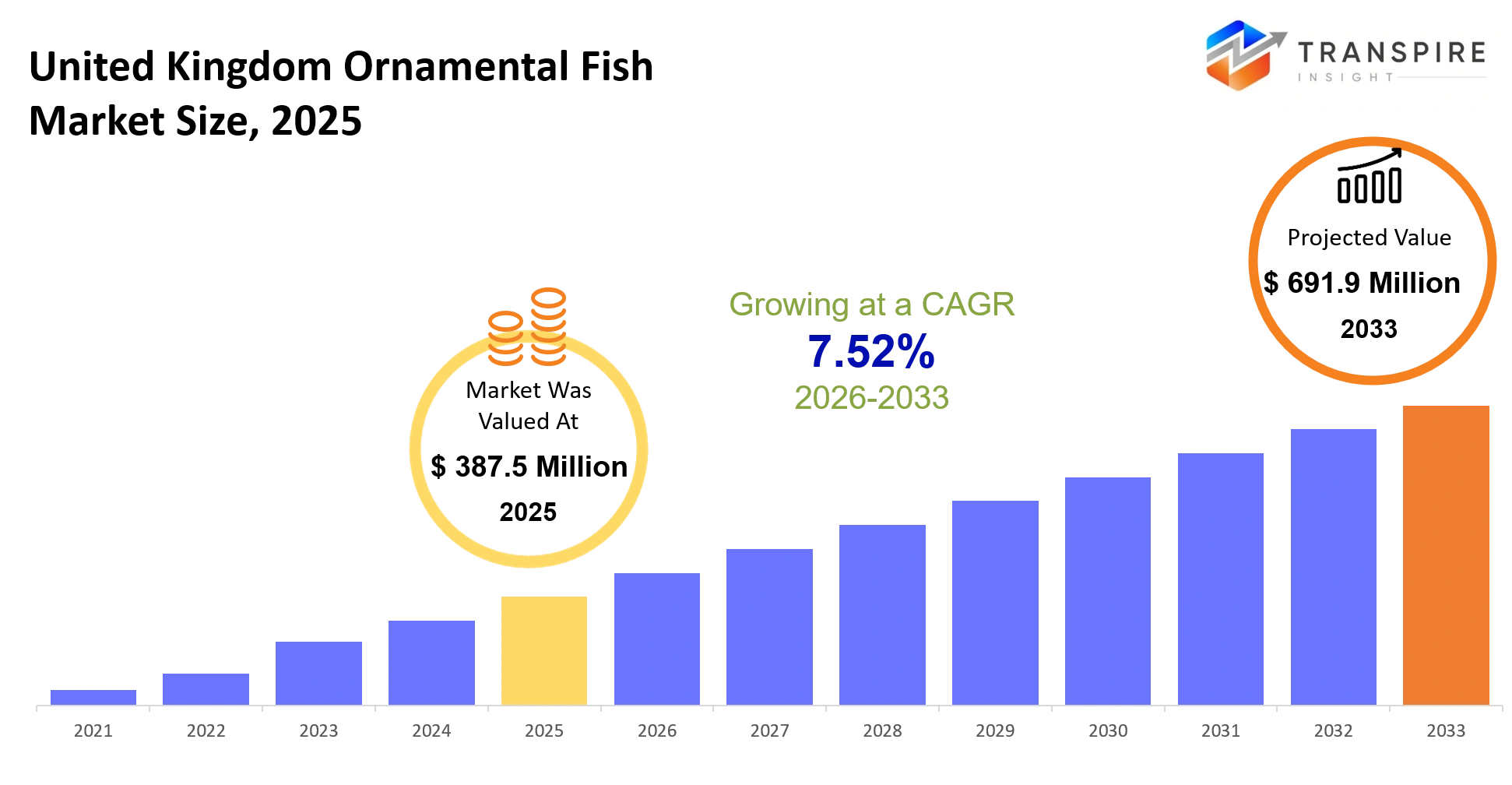
As per Transpire Insight Analysis the United Kingdom Ornamental Fish Market size is estimated at USD 387.5 Million in 2025 and is anticipated to reach USD 691.9 Million by 2033, growing at a CAGR of 7.52% from 2026 to 2033.
The United Kingdom ornamental fish market kinda supports the supply of freshwater and marine species for home aquariums, commercial displays, hospitality venues, educational institutions, and specialist retailers , well you know. Beyond the fun value , the whole scene sustains a kind of chain with breeders, importers, aquarium equipment suppliers, and aquatic health service providers , they all rely on consistent livestock quality and responsible care practices. When ornamental fish are doing well overall, it also boosts demand for filtration systems, aquarium accessories, feeds and maintenance services, so it turns into ongoing income across the broader aquatic ecosystem.
In the last three to five years, things have gradually moved toward captive-bred species and traceable sourcing , mostly because sustainability standards and animal welfare expectations got stronger. After the COVID-19 pandemic, global logistics disruptions showed how fragile live fish imports can be, so businesses tried diversifying their sources and increased domestic breeding. That shift improved supply reliability while also allowing premium pricing for certified, responsibly bred livestock . Meanwhile digital retail platforms and specialized aquarium services have opened access, meaning suppliers can reach a bigger customer group and earn more through premium fish, customized aquarium setups, and longer-term upkeep agreements.
United Kingdom Ornamental Fish Market Size & Forecast:
- United Kingdom Ornamental Fish Market Size 2025: USD 387.5 Million
- Expected Market Value 2033: USD 691.9 Million
- Forecast CAGR: 7.52%
- Leading region in 2025: England
- Fastest Growing region: Scotland
- Key Profile: Pets at Home, Maidenhead Aquatics, Tetra, Tropical Marine Centre, Aqua One, API, Interpet, JBL, Fluval, OASE, Aquarian, Hikari, Aquael, Sera, Eheim
Key Market Insights
- England kinda dominated the market with about 72% market share in 2025, backed by dense specialist retail networks and already-established aquarium hobby communities , you know.
- Scotland is projected to be the fastest-growing regional market over 2025–2032, mainly because premium pet retail keeps expanding , and aquarium tourism activities are getting more momentum as well.
- Freshwater ornamental fish stayed the leading product segment , with nearly 68% share in 2025. This was helped by lower maintenance costs and the fact that species availability is broader than before.
- Aquarium accessories and aquatic plants landed as the second-largest segment, since bundled aquarium solutions have been pushing up average transaction values across retail channels, little by little .
- Marine ornamental fish are expected to post the fastest growth through 2032, supported by premium home aquariums and also commercial display installations.
- Household aquariums accounted for roughly 76% market share in 2025, as premium aquarium ownership moved beyond the classic hobbyists.
- Commercial aquarium installations will register the fastest growth across the forecast window , driven by hotels , offices , healthcare facilities and entertainment venues , basically.
- Individual consumers represented around 79% of end-user revenue in 2025, which suggests people kept spending on premium livestock and aquarium maintenance related products.
- Hospitality and commercial establishments are set to emerge as the fastest-growing end-user category through 2032, fueled by continued investments in customer experience, and more immersive displays.
What are the Key Drivers, Restraints, and Opportunities in the United Kingdom Ornamental Fish Market?
The main force behind the ornamental fish industry is, like, the move toward nicer premium home aquariums, that’s powered by digital commerce and also by higher everyday spending on specialized pet care. In other words online access is getting smoother, and shoppers are buying into the whole setup, not just the live specimens. Stuff like improved e-commerce livestock logistics, better water management tech , and a broader captive breeding capacity have lowered those “why is this so hard to buy” barriers. Retailers now tend to sell full aquarium packages, rather than only separate items. With that setup the average order values grow, plus there are more follow up purchases for things like feed , filtration media , and ongoing maintenance services. Revenue keeps stretching out, because people stay involved for a long time through aquarium ownership, instead of doing a one time livestock buy then disappearing.
Still, the biggest structural drag is dependence on imported live fish and aquatic plants. Import permits, biosecurity checks, and transportation obligations can’t really be made simple fast, since they’re meant to protect local aquatic ecosystems from invasive species and disease outbreaks. Then when logistics hiccup, specialist species go missing from shelves pretty quickly. On top of that, higher freight costs squeeze retailer margins and they also slow down when products finally reach customers. From a Transpire Insight review of regional procurement notices and launch timing, supply chain concentration looks like the main execution risk. So the outcome is basically that premium product sales get held back during stretches when supply is constrained, even if demand is still there.
The best opportunity, i think, is in pushing captive breeding a bit more along with digital livestock traceability, and even smart aquarium ecosystems. putting money into automated breeding systems plus DNA health monitoring can raise survival rates too while also cutting down on import dependence. then, premium hospitality projects and commercial aquarium installations bring in extra income, beyond what individual households usually ask for. Finally, companies that blend traceable livestock with subscription maintenance services will likely lock in customers longer, and they can capture more total market value over time.
What Has the Impact of Artificial Intelligence Been on the United Kingdom Ornamental Fish Market?
Artificial intelligence and digital technologies are, sort of, reshaping ornamental fish farming, their distribution, and aquarium management all over the United Kingdom. AI driven monitoring systems keep checking water temperature pH dissolved oxygen and ammonia, plus they watch fish behaviour, using connected sensors and computer vision. When something shifts out of bounds, automated alerts help breeders and retailers react early , before the health situation gets worse, which in turn means fewer animals lost and more steadiness in day to day operations. Machine learning models also lend a hand with stock decisions by predicting seasonal purchasing trends, so suppliers can line up imports with domestic breeding output and avoid having too much inventory sitting around. Predictive analytics tune feeding routines, filtration performance, and even energy consumption, so costs drop while survival rates rise, and aquariums stay steadier. Digital traceability platforms further support livestock paperwork too, and they make biosecurity and import compliance less painful, which builds trust with retailers and commercial buyers alike. Overall, these tools support stronger operational efficiency and better use of resources across breeding units and specialist shops.
Still, uptake is uneven, because advanced monitoring platforms usually need a noticeable upfront outlay and dependable historical records to make predictions actually work well. Smaller breeders often don’t have enough money or the digital setup required to bring AI solutions fully online, and data quality can vary a lot between different aquatic environments , which then restricts prediction accuracy especially for rare or sensitive ornamental species.
Key Market Trends
- Captive bred decorative fish came to take up more of the premium sales mix in 2025 , so there was less push relying on those shaky overseas livestock imports.
- Smart aquarium controllers, with mobile monitoring , seemed to get much more used from 2023 through 2025, making automated water quality management feel way more routine.
- Online specialists retailers grew their delivery reach nationwide after 2021, which broadened access to premium aquatic livestock beyond the big city areas, kind of out of nowhere but still.
- Sustainable sourcing standards tightened across 2024–2025 , and that made retailers lean harder toward certified breeders, plus clearer supply chain visibility.
- Commercial aquarium setups in hotels, healthcare places and offices picked up steam over the 2025–2032 forecast stretch , generating that recurring maintenance revenue , again and again.
- For premium marine aquarium gear, sales looked stronger after 2023 , aided by better filtration tech and automated lighting systems that just run themselves.
- Tropical Marine Centre also expanded programs for responsibly sourced livestock, which helped lock in a more competitive position in specialist aquatic distribution.
- Water treatment and biological filtration technologies moved forward during 2024 , improving livestock survival outcomes and trimming down on maintenance effort.
- Digital livestock traceability platforms showed up as a competitive edge, letting suppliers tighten compliance and build customer trust across premium market segments.
United Kingdom Ornamental Fish Market Segmentation
By Fish Type :
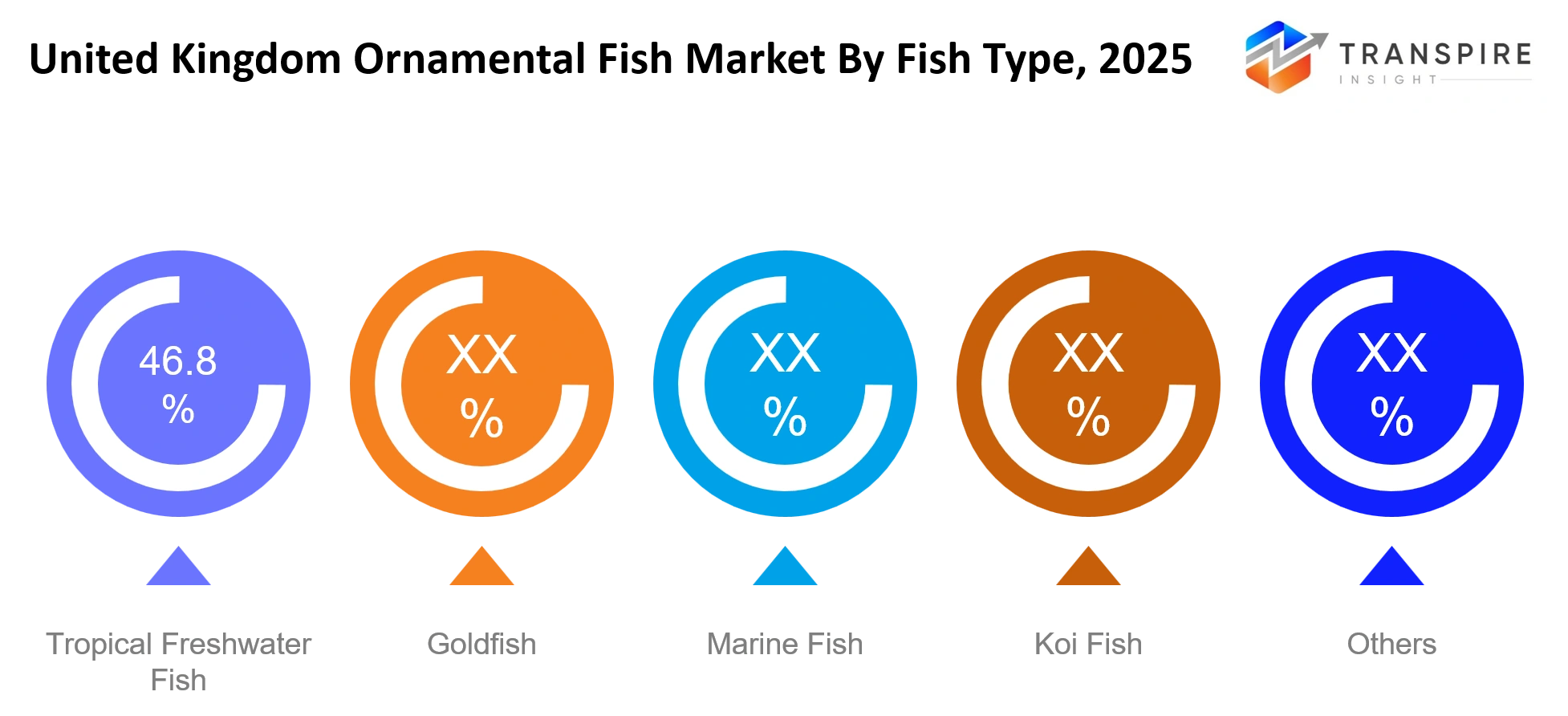
Tropical freshwater fish kind of take the biggest portion because there is broad species availability, maintenance cost is pretty affordable, and they usually fit with typical aquarium systems which helps keep sales moving across both households and commercial buyers. Goldfish still pull steady demand since they are a common entry-level choice for people setting up their first tanks, and also in schools or educational displays where the care is simple so first-time purchasers feel comfortable. Marine fish bring in more revenue per sale because the higher end aquarium installations tend to need specialized livestock plus advanced equipment, so the whole setup is more premium and not as casual. Koi fish keep drawing extra spending for decorative ponds, landscaping work, and hospitality spaces that want these premium outdoor water features that look nicer than plain tubs or small fountains.
Other ornamental species support the smaller, more niche demand from collectors and specialist aquarium retailers who are after unique varieties. The overall product variety helps breeders and distributors handle different customer preferences, and it doesn’t feel like they must lean on only one category. Stronger premium breeding programs help improve livestock quality and survival rates, which then builds long-term trust from customers. When demand stays balanced across several types of fish, it supports more steady business performance all the way through the value chain.
By Product :
Live fish end up making the biggest revenue share because livestock is still the core purchase, across both entry level and high-end aquarium setups . Fish feed comes right after that in terms of importance, through recurring buys that keep income pretty steady for retailers and makers. Aquarium accessories keep growing too, since buyers go for more advanced filtration, lighting , decorative elements, and monitoring systems to push better aquarium performance . Water treatment goods get even broader adoption, because proper aquatic conditions directly help fish survival, and they also make long term upkeep feel less painful.
Then you also have breeding supplies , aquarium plants and those maintenance tools which lift the average basket size. Premium product bundles basically nudge customers toward full aquarium solutions, rather than just grabbing single items. Product innovation keeps fueling those higher value sales inside specialist retail channels. And larger product ranges help reduce how much companies rely on seasonal livestock demand, overall.
By Distribution Channel :
Specialty stores stay as the main distribution channel, more or less, because you get expert guidance, strong livestock quality, and a broader species mix that really pulls in the more experienced aquarium people. Pet stores still do well , mainly due to easy access to the more common fish types and the essential aquarium stuff. Online retail keeps growing too, since reliable livestock transport, clearer digital product details and home delivery make the whole buying process a bit more convenient. Supermarkets only capture a smaller slice of demand, by concentrating on entry-level aquarium products and a few carefully picked add ons.
Other distribution ways, like regional sellers, still help by supporting sales through independent breeders, aquatic exhibitions, and nearby suppliers. Digital platforms let businesses reach buyers who are outside the usual retail locations. On top of that, better inventory management helps products show up more often across several channels. In general, mixing the channels together improves market resilience, like it makes the whole thing less fragile.
By End User :
Households are seen generating the largest share, because owning a home aquarium kind of keeps the whole loop going, like , continual buys of livestock, feed, equipment , and those maintenance things. On the other hand, commercial spaces push more investment into decorative aquariums, mainly to improve the overall customer experience across hotels, offices, healthcare locations, and restaurants as well. Meanwhile, public aquariums keep rolling out expanded educational exhibits , plus conservation programs, so that demand grows for premium aquatic species and also for specialized life support systems. Because the buying behavior stays steady, supplier revenue also repeats throughout the year.
Other end users are things like educational institutions, research centers, and community projects that maintain aquarium displays for teaching, and for general public engagement. Long term maintenance contracts add solid chances for business, not only during the initial installation. Premium service offerings then bring in extra income streams for specialist providers. With this sort of end user diversification, the sector ends up leaning less on household spending alone.
By Price Range :
Mid-range products seem to be the biggest sales group because kind of balanced pricing, and dependable quality, pull in the widest set of customers. Economy products still matter a lot especially for beginners buying starter aquariums and basic care supplies. Premium offerings keep growing, including luxury aquarium setups, rare decorative species, and more sophisticated automation setups. When shoppers make higher-value purchases, retailers often gain better margins, and this also helps specialized breeding programs, that kind of thing.
The other price levels usually cover promotional pushes, seasonal bundle deals, and customized aquarium solutions. With proper product segmentation, suppliers can align options to different budgets, without lowering the overall standard of the products. Premiumization helps raise average selling prices across specialized retailers. And flexible pricing strategies make it easier to stay competitive during shifting economic conditions.
By Application :
Home aquariums are still pretty much the big one, because residential people keep investing in full aquarium setups, livestock , and the extra ongoing maintenance stuff. Decorative ponds also stay strong , especially with koi fish, aquatic plants, filtration equipment, and those landscaping upgrades that show up in both private yards and more commercial locations. Commercial displays are gaining more momentum too, since hospitality, healthcare, and corporate offices are putting in aquariums to make the inside spaces feel better and to create smoother visitor experiences. This mix of uses helps keep revenue steady across different customer groups.
Beyond that, there are educational displays, exhibitions, and research projects that need more specialized aquatic species along with the right equipment. Advanced monitoring technology also helps aquarium performance, while cutting down on the day to day headaches. Sustainable breeding, and responsible sourcing, give the business more solid long term chances, across essentially every application category. With such broad coverage, the whole industry gets room to keep expanding.
What are the Key Use Cases Driving the United Kingdom Ornamental Fish Market?
The strongest use case kinda comes from home aquariums, where ornamental fish still seem to be the go to option for residential indoor displays. People buy fish , plus feed and filtration systems, even water treatment products, so they can keep a longer term setup running. So yeah, this application becomes the largest driver behind recurring market revenue.
Commercial displays in hotels, corporate offices, healthcare facilities, and premium retail spots keep picking up speed as companies pour money into interior spaces that look more alive. Educational institutions and public aquariums are also expanding their aquatic exhibits , mainly to help teaching, conservation efforts, and visitor wow factor. That keeps pushing demand for specialist species and professional maintenance services.
New opportunities are showing up too, like aquascaping competitions, and custom designed smart aquariums with automated monitoring systems for high end residential , and commercial projects. Growth will also come from sustainable captive breeding programs that supply certified ornamental species , which helps with regulatory compliance, better livestock traceability, and more reliable domestic supply over the forecast period.
|
Report Metrics |
Details |
|
Market size value in 2025 |
USD 387.5 Million |
|
Market size value in 2026 |
USD 416.6 Million |
|
Revenue forecast in 2033 |
USD 691.9 Million |
|
Growth rate |
CAGR of 7.52% from 2026 to 2033 |
|
Base year |
2025 |
|
Historical data |
2021 - 2024 |
|
Forecast period |
2026 - 2033 |
|
Report coverage |
Revenue forecast, competitive landscape, growth factors, and trends |
|
Regional scope |
United Kingdom (England, Scotland, Wales, Northern Ireland) |
|
Key company profiled |
Pets at Home, Maidenhead Aquatics, Tetra, Tropical Marine Centre, Aqua One, API, Interpet, JBL, Fluval, OASE, Aquarian, Hikari, Aquael, Sera, Eheim . |
|
Customization scope |
Free report customization (country, regional & segment scope). Avail customized purchase options to meet your exact research needs. |
|
Report Segmentation |
By Fish Type (Tropical Freshwater Fish, Goldfish, Marine Fish, Koi Fish, Others); By Product (Live Fish, Fish Feed, Aquarium Accessories, Water Treatments, Others); By Distribution Channel (Pet Stores, Specialty Stores, Online Retail, Supermarkets, Others); By End User (Households, Commercial Facilities, Aquariums, Others); By Price Range (Economy, Mid-Range, Premium, Others); By Application (Home Aquariums, Decorative Ponds, Commercial Displays, Others) |
Which Regions are Driving the United Kingdom Ornamental Fish Market Growth?
In 2025 England accounted for about 72% of market revenue ,so it is definitely the main regional market. Strong animal health rules, well established import procedures, and a far more advanced transport setup help keep the movement of live ornamental fish and aquarium products moving efficiently. There is also a broad ecosystem of breeders, specialist aquatic retailers, distributors, and aquarium service providers. That overall web actually makes a dependable supply chain across the biggest cities. If the industry keeps investing in premium pet retail and growing domestic breeding capacity, regional leadership should keep going through the whole forecast period.
Scotland comes in as the second-largest regional market , mostly because buying habits put more weight on premium aquarium ownership and specialist aquatic retailers. This is more the case than relying on high-volume distribution. Regulatory oversight stays steady, households keep spending in a resilient way on companion animals, and independent aquatic businesses continue to see consistent investment. Because of that, revenue generation is dependable. Local firms are still expanding add-on services like aquarium installation and maintenance, and those bring in recurring income. On top of that, reliable commercial demand from hospitality and public attractions further supports long term regional results.
Wales is expected to see the quickest, sort of fastest growth from 2026 to 2033, as investment in independent pet shops and domestic aquatic breeding keeps expanding. Better logistics links and more solid take-up of online retail means customers have wider access , across the region, to special livestock and aquarium goods. People are also showing increasing curiosity in sustainable fish raised in captivity, and that has basically pushed nearby suppliers to beef up their production skills. This whole bit of momentum is likely to open up really attractive openings for fresh distributors, fish breeders and even tech providers aiming for regional growth through the 2026–2033 stretch.
Who are the Key Players in the United Kingdom Ornamental Fish Market and How Do They Compete?
Competition in the ornamental fish industry still feels kind of disjointed, with specialist breeders, aquatic retailers, equipment makers, and distributors, each kind of leaning toward their own customer group. In general, service standards, livestock wellbeing, product breadth, and technical help tend to matter more than just price. The established players keep defending their positions by pushing wider portfolios plus better customer care, and the newcomers, more niche-minded, often pull buyers in using premium species, more responsible sourcing, and quicker digital sales routes.
Tropical Marine Centre stands out by using responsibly sourced marine livestock, backed by strong distribution reach, plus practical technical guidance for retailers, so customer confidence stays higher and supply remains reliable. NT Labs centers on aquatic health treatments and water quality products, and these are supported through ongoing product development, which helps retailers sell the whole fish care setup rather than only one item. Interpet meanwhile keeps expanding its catalogue with newer aquarium equipment and water management technologies, aimed at improving long term aquarium stability.
Aqua One competes using more integrated aquarium systems, where filtration, lighting, and accessories are bundled together, which lets retailers offer a full first time setup solution to new customers. J&K Aquatics builds a stronger regional footprint by bringing specialist livestock, more tailored customer support, and premium aquarium installation services, which then encourages repeat purchases and longer maintenance commitments.
Company List
- Pets at Home
- Maidenhead Aquatics
- Tetra
- Tropical Marine Centre
- Aqua One
- API
- Interpet
- JBL
- Fluval
- OASE
- Aquarian
- Hikari
- Aquael
- Sera
- Eheim
Recent Development News
In April 2026, Ornamental Aquatic Trade Association launched a free Sustainable Sourcing Tool for importers, wholesalers, and retailers to support responsible livestock purchasing decisions. The launch strengthened traceability and sustainability practices across the UK ornamental fish supply chain. Source https://ornamentalfish.org/
In February 2025, Tropical Marine Centre formed a strategic partnership with Coral Spawning Lab to launch the Bio CSL range of coral spawning and propagation systems. The collaboration expanded advanced coral aquaculture technology for research facilities and commercial reef restoration, supporting innovation within the ornamental aquatics sector.
Source https://tropicalmarinecentre.com/
What Strategic Insights Define the Future of the United Kingdom Ornamental Fish Market?
Over the next five to seven years, the market will probably drift toward a more resilient, value-leaning setup, as domestic breeding capacity ramps up, digital commerce expands , and traceable supply channels start to cut down the reliance on imported livestock. Premium aquarium systems, certified aquatic species, and tech-enabled maintenance services should end up generating stronger repeat income than plain volume- driven sales by themselves. There is also a quieter risk though, from supply concentration where dependence on only a few overseas breeding hubs can suddenly disrupt availability of specialist species , if trade rules shift, disease outbreaks flare up, or transport constraints tighten.
At the same time, an interesting opportunity may build from AI-enabled aquarium monitoring and certified captive-bred livestock, helped along by tighter sustainability requirements and more commercial installation projects. In practice, market players should put money into local breeding partnerships, digital traceability platforms, and service-first business models that blend livestock, equipment, and longer-term maintenance agreements. That mix can strengthen resilience and also help the bottom line over the long run.
United Kingdom Ornamental Fish Market Report Segmentation
By Fish Type
- Tropical Freshwater Fish
- Goldfish
- Marine Fish
- Koi Fish
By Product
- Live Fish
- Fish Feed
- Aquarium Accessories
- Water Treatments
By Distribution Channel
- Pet Stores
- Specialty Stores
- Online Retail
- Supermarkets
By End User
- Households
- Commercial Facilities
- Aquariums
By Price Range
- Economy
- Mid-Range
- Premium
By Application
- Home Aquariums
- Decorative Ponds
- Commercial Displays
Frequently Asked Questions
Find quick answers to common questions.
The expected United Kingdom Ornamental Fish Market size for the market will be USD 691.9 Million in 2033.
Key segments for the United Kingdom Ornamental Fish Market are By Fish Type (Tropical Freshwater Fish, Goldfish, Marine Fish, Koi Fish, Others); By Product (Live Fish, Fish Feed, Aquarium Accessories, Water Treatments, Others); By Distribution Channel (Pet Stores, Specialty Stores, Online Retail, Supermarkets, Others); By End User (Households, Commercial Facilities, Aquariums, Others); By Price Range (Economy, Mid-Range, Premium, Others); By Application (Home Aquariums, Decorative Ponds, Commercial Displays, Others).
Major United Kingdom Ornamental Fish Market players are Pets at Home, Maidenhead Aquatics, Tetra, Tropical Marine Centre, Aqua One, API, Interpet, JBL, Fluval, OASE, Aquarian, Hikari, Aquael, Sera, Eheim.
The United Kingdom Ornamental Fish Market size is USD 387.5 Million in 2025.
The United Kingdom Ornamental Fish Market CAGR is 7.52% from 2026 to 2033.
- Pets at Home
- Maidenhead Aquatics
- Tetra
- Tropical Marine Centre
- Aqua One
- API
- Interpet
- JBL
- Fluval
- OASE
- Aquarian
- Hikari
- Aquael
- Sera
- Eheim
About the Authors

Chetan Dhatrak
I’m Chetan Dhatrak, a Senior Research Analyst at Transpire Insight, specializing in the Consumer Goods, Foods and Beverages industry. I focus on analyzing market trends, consumer behavior, competitive landscapes, and industry developments to deliver accurate, data-driven insights. My research at Transpire Insight is built on credible sources and in-depth analysis, helping businesses and readers better understand market dynamics, emerging opportunities, and evolving consumer preferences. I’m committed to creating reliable, well-researched content that supports informed decision-making and reflects the latest developments in the consumer goods and food & beverage sectors.

Chakradhar Khansole
Chakradhar serves as the Research Director at Transpire Insight, bringing over 8 years of experience in technology, innovation, and strategic market intelligence. He specializes in transforming complex market data into actionable business insights that enable organizations to make informed, growth-oriented decisions. Recognized for his strategic vision and analytical expertise, Chakradhar leads high-impact research initiatives, delivering comprehensive market assessments, competitive intelligence, and forward-looking industry analysis.
Recently Published Reports
-
Apr 2026
Baby Infant Formula Market
Baby Infant Formula Market Size, Share & Analysis Report By ype (Infant Milk, Follow On Milk, Specialty Baby Milk, Growing-Up Milk), By Ingredient (Carbohydrate, Fat, Protein, Minerals, Vitamins, and Others), By Product Form (Powder, Liquid, and Ready-to-feed), By Distribution Channels (Supermarket/Hypermarket, Specialty Store, Pharmacies, Online Retail, and Others), and Geography (North America, Europe, Asia-Pacific, Middle East and Africa, South and Central America), 2021 - 2031
-
Apr 2026
Edible Insects for Animal Feed Market
Edible Insects for Animal Feed Market Size, Share & Analysis Report By Type (Insect Powder, Insect Meal, Insect Bar, Insect Paste, Insect Oil, and Others), By Insect Type (Beetles, Cricket, Caterpillar, Hymenoptera, Orthoptera, Tree Bugs, and Others), By Application (Livestock, Pet Food, and Aquaculture), By Livestock Type (Poultry, Swine, and Others), and Geography (North America, Europe, Asia-Pacific, Middle East and Africa, South and Central America), 2021 - 2031
-
Apr 2026
Food Industry Disinfection and Bacterial Control Market
Food Industry Disinfection and Bacterial Control Market Size, Share & Analysis Report By Type (Chemical Disinfectants, Physical Disinfectants, and Biocides and Antimicrobials), By Application (Food Processing Equipment Surface Disinfection, Food Preparation Areas Surface Disinfection, Storage Areas Surface Disinfection, Anti-microbial Coatings Food Preservation, and Preservative Solutions Food Preservation), By End User (Meat and Poultry Processing, Dairy Processing, Seafood Processing, Bakery and Confectionery, Restaurants and Commercial Kitchens, and Food Service Providers), By Sales Channel (Online, Offline), and Geography (North America, Europe, Asia-Pacific, Middle East and Africa, South and Central America), 2021 - 2031
-
May 2026
Freeze Dried Food Market
Freeze Dried Food Market Size, Share & Analysis Report By Product Type (Fruits, Vegetables, Freeze-Dried Dairy Products, Freeze-Dried Meat and Seafood, Freeze-Dried Pet Food, and Prepared Meal), By Nature (Organic, and Conventional), By Form (Powdered, Granules, and Diced), By End Use (Breakfast Cereals, Dairy Products, Bakery & Confectionery, Nutritional Bars & Supplements, Powdered Beverages, Snacks, and Retail (Household)), and Geography (North America, Europe, Asia-Pacific, Middle East and Africa, South and Central America), 2021 - 2031