

United Kingdom Online Gambling Market Size & Forecast:
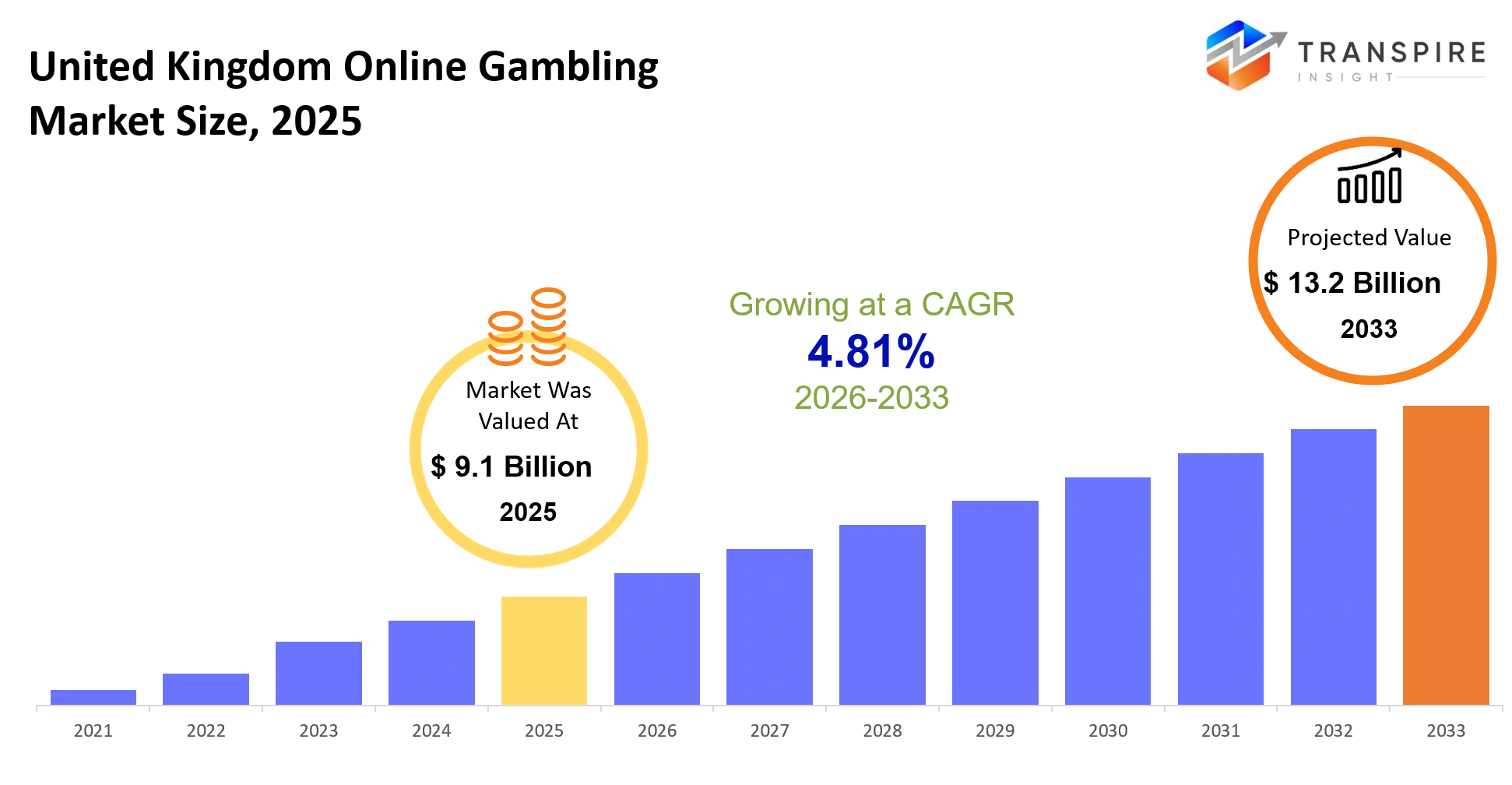
- United Kingdom Online Gambling Market Size 2025: USD 9.1 Billion
- United Kingdom Online Gambling Market Size 2033: USD 13.2 Billion
- United Kingdom Online Gambling Market CAGR: 4.81%
- United Kingdom Online Gambling Market Segments: By Gambling Type (Sports Betting, Online Casino, Poker, Bingo, Lottery, Fantasy Sports, Others); By Platform (Mobile Gambling, Desktop Gambling, VR Gambling, Live Dealer Platforms, Others); By Payment Mode (Credit Cards, E-wallets, Bank Transfers, Cryptocurrency Payments, Others); By End User (Casual Players, Professional Gamblers, Millennials, Gen Z Users, Others)
To learn more about this report,  Download Free Sample Report
United Kingdom Online Gambling Market Summary
The United Kingdom Online Gambling Market was valued at USD 9.1 billion in 2025. It is forecast to reach USD 13.2 billion by 2033. That is a CAGR of 4.81% over the period.
In the United Kingdom, the online gambling market basically gives customers a straightforward path to betting, casino gaming, poker, bingo, and sports wagering all through digital channels, so you don’t really need those in-person places anymore. At the same time, the entertainment menu keeps expanding, and operators get even further reach, like more visibility and more odds to pull in spend. Over the last five years, the whole market has shifted in a major, structural way toward mobile-first involvement, where businesses keep investing in app-based experiences, real-time wagering features, and user screens that feel more personal.
The COVID-19 pandemic sort of acted like a turbo boost, though. Lockdown measures disrupted normal gambling habits and routines, and honestly, why was it easier for people to move away from retail betting shops, and well, ll everything just slid online. After that behavior shift, operators also had to modernize their digital backbone and widen what they actually offer. Right now, growth seems linked to how well the industry can hang on to users it acquired digitally, but also how it can keep them around longer with live betting, embedded payment tools, and customer experiences driven by data. That’s how operators end up making more revenue per user, while also improving long-term retention across multiple gaming categories.
Key Market Insights
- In 2025, England seems to dominate the United Kingdom Online Gambling Market, pulling in around 80% of the industry revenue— mainly because the player base is so huge. It’s kind of a simple story, but it holds up.
- Scotland is then showing up as the fastest-growing regional area during the forecast period, supported by people betting more on mobile and using digital platforms even more often.
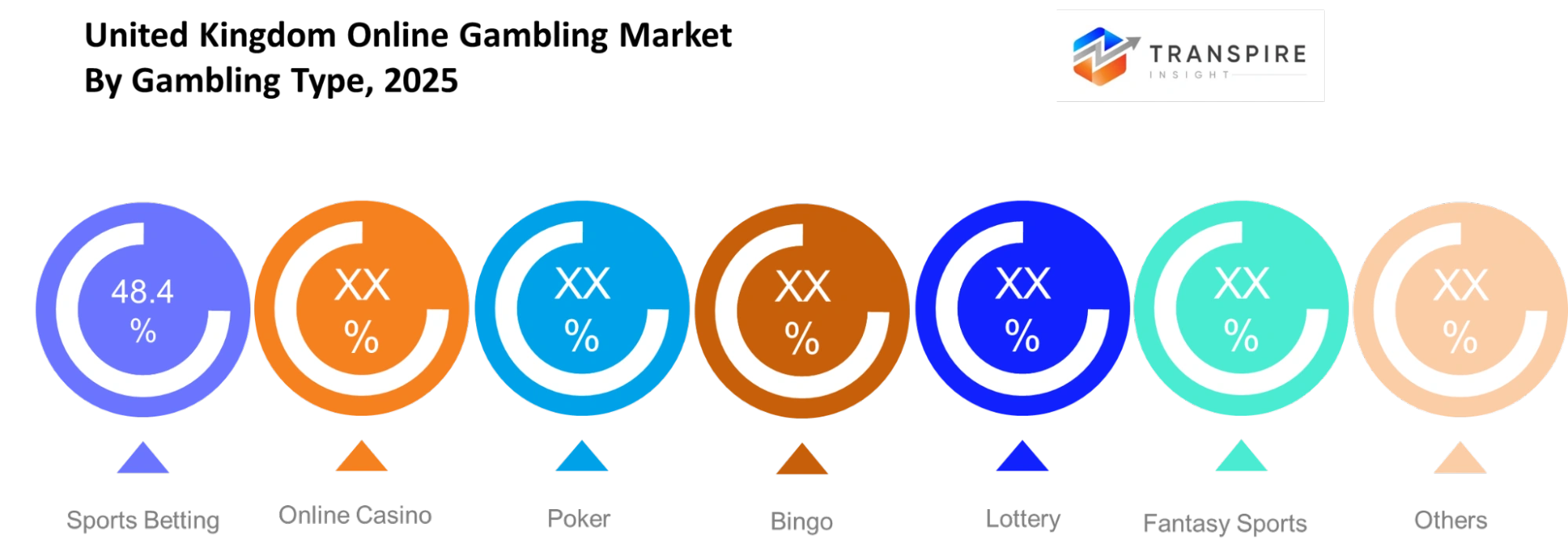
- Sports betting, more or less, takes the lead with nearly 40% of the market share in 2025. That growth is tied to steady consumer interest in football, horse racing, and live events, where “real-time” hype matters a lot.
- Online casino gaming sits in the second position, taking a large chunk of the pie, and it does well thanks to immersive experiences, personalized promotions, and better player retention rates.
- Live dealer casino games are moving the quickest through 2032. This part is fueled by real-time interaction, improved streaming technology, and those premium user experiences that keep people coming back.
- Mobile gambling remains the most dominant channel, with over 65% share in 2025, since many consumers increasingly prefer convenient smartphone-based gaming platforms, instead of more old-school setups.
- Live in-play betting is emerging as the fastest-growing application too, with real-time analytics, instant wagering options, and interactive features that feel responsive.
- As for demographics, the 25–44 age group leads the United Kingdom Online Gambling Market, holding roughly 50% market share, which reflects strong digital engagement habits.
- And female players are becoming a noticeably faster-growing end-user category. Operators are expanding casual gaming, bingo, and personalized entertainment offerings, which makes it easier to attract and keep new audiences.
What are the Key Drivers, Restraints, and Opportunities in the United Kingdom Online Gambling Market?
The biggest driving force behind growth in the United Kingdom’s online gambling market is, well, the broad adoption of mobile-first gambling platforms; it just keeps snowballing. That shift started to really pick up speed when operators poured real money into smartphone apps, live betting interfaces, and payment systems that are already connected. With stronger mobile connectivity and safer digital wallets, the whole flow feels more natural, and honestly a bit less frictions, so players can drop bets almost immediately from wherever they’re standing.
In the end, this pattern usually lifts betting frequency, extends user time-on-platform, and helps operators bring in more per customer, mainly through customized promos and live betting features, which are kinda sticky.
At the same time, tightening regulatory oversight is still the main structural roadblock to broader market expansion. The UK regulatory approach keeps introducing tougher affordability checks, additional restrictions around advertising, and heavier responsible gambling duties. Of course, those measures are meant to safeguard consumers, but they also add compliance overhead and, it turns out, make it harder to reach fresh audiences. Since the rules are linked to long-term public policy aims, operators can’t just turn off or counter the impact. So the result is slower onboarding for new users, plus less upside revenue from higher-value player segments.
Artificial intelligence-driven personalization is kinda a big opportunity for the next phase of market growth. With advanced analytics, it can sort promotions, recommend games, and even back responsible gambling interventions based on what people do over time. When operators put more money intoAI-enabledd platforms, they can lift customer retention while still staying aligned with regulatory expectations, you know. In the end, this opens a road toward sustainable progress and more precise competitive differentiation across the market as a whole.
What Has the Impact of Artificial Intelligence Been on the United Kingdom Online Gambling Market?
Artificial intelligence and advanced digital technologies are getting kind of central in the United Kingdom's online gambling industry operational strategy, more and more. In practice,e operators lean oAI-drivenen automation to handle customer onboarding, identity verification, fraud screening, and also responsible gambling oversight. These automated tools can watch player behavior in real time, flag unusual transactions fast, and reduce manual compliance work. That makes it easier for operators to process high volumes of user activity with less friction and quicker throughput, even when the workload is heavy.
Machine learning models are also strengthening predictive abilities across gaming platforms. Rather than only reacting, these systems review betting patterns, player engagement measurements, and older transaction records to foresee customer churn, locate high-value users, and adjust promotional messaging. Predictive analytics helps operators improve retention and distribute marketing budgets in a more focused way. On top of that, AI recommendation engines customize game suggestions and betting offers, which tends to lift user interaction and can support higher revenue per active customer.
Overall, these developments kind of help speed up compliance reporting, lower the losses that come from fraud, improve customer lifetime value, and keep the day-to-day ops running more smoothly. Still, AI adoption has a real constraint, though. Advanced models need access to huge amounts of solid behavioral data, and at the same time, privacy rules and responsible gambling requirements keep changing. Put together, that can limit what data is actually available, and then model accuracy might drop or wobble a bit; meanwhile,e the implementation costs for operators can climb as well.
Key Market Trends
- Since 2020, mobile betting has kinda taken over the desktop scene, with smartphones now making up most of the online wagering sessions, and you can see it every day. UK regulators rolled out tougher affordability checks between 2022 and 2025, so operators had to redesign their onboarding flows and also the customer verification side, slightly faster than they planned. Live in-play betting started grabbing more share after streaming tech improved real-time performance, cutting down latency and turning the whole thing into a more interactive type of wager.
- AI-driven player analytics have sort of grown up, too, moving from simple marketing support into compliance solutions, which let operators spot risky gambling behavior earlier than before. Big names like Flutter Entertainment and Entain plc also ramped up spending on their own technology platforms, mainly to not depend so much on outside providers and their tools. Digital wallets and instant payment methods expanded heavily after 2021, which eased transaction friction and helped deposits get completed sooner.
- Customer acquisition approaches changed as well, going from wide advertising blasts toward data-led retention programs, especially once marketing rules got stricter. Live dealer casino games moved from being a smaller, “only for some” option to a mainstream product category, largely because video streaming infrastructure got better.
- On top of that, consolidation activity increased, with operators pursuing acquisitions and strategic partnerships so they could strengthen both market position and tech capabilities. By 2025, responsible gambling technologies will have turned into a real differentiator, with automated monitoring systems getting pulled into core platform operations more and more, almost like a default feature.
United Kingdom Online Gambling Market Segmentation
By Gambling Type:
Sports Betting is kind of a big deal, mostly because people stay really interested in football, horse racing, cricket, and a bunch of other matchups. It feels like the easy access to live betting features plus real-time odds has made more folks appear across different digital spaces. Since there are so many sporting schedules all year round, wagering stays pretty consistent, and it also nudges players to return.
Online Casino keeps drawing in a huge crowd, largely through slots, table games, and live dealer sessions. Poker still keeps a loyal fan base,e too, mostly because many players like that skill-based gameplay and the whole tournament vibe. Bingo is still active for people who want a bit of social momentum and simpler game formats. Lottery platforms, on the other hand, do well because of plain convenience, especially when it comes to buying digital tickets. Fantasy Sports is also picking up more attention through sports-centered involvement and data-powered contests. There are also other choices, including newer gaming formats that broaden the entertainment options and help diversify the market in a wider sense.
To learn more about this report, Download Free Sample Report
By Platform:
Mobile Gambling pops up as the main platform category, mostly because phones give pretty instant entry to betting and gaming apps. With better mobile connectivity, solid payment integration, and user interfaces that feel kinda natural, people just tend to stay more interested. Operators keep putting time into mobile optimization so things feel smoother and faster, longer sessions too, and honestly, the whole customer experience feels more “there”.
Desktop Gambling is still quite relevant, especially for folks who want bigger screens and more detailed game environments. Live Dealer Platforms have also grown quickly, largely because streaming tech is noticeably higher quality now, and the interactive gameplay features really pull people in. VR Gambling is moving along as well, since more players adopt the hardware, and because immersive gaming experiences become easier to reach and more common over time. Of course, there are other options too, like alternative digital channels that support wider platform access and flexible participation when people want it.
By Payment Mode:
Credit Cards still look like a fairly familiar payment choice, even if there’s been more regulatory scrutiny, and consumer preferences keep shifting around. Most people already have a banking relationship, and the whole buy–sell transaction part feels straightforward enough, so it just keeps getting used across a bunch of gaming categories. There’s also that secure payment infrastructure angle, which helps confidence stay steady for digital transactions, you know, even when things feel a bit more monitored.
E-wallets, meanwhile, have been gaining real traction because the processing seems faster and the day-to-day convenience is higher. Bank Transfers keep working for folks who want something direct and dependable, with no extra steps tacked on. Cryptocurrency Payments bring in a smaller but slowly growing audience, mainly players who prefer an alternative payment route, and they also like the added privacy capabilities. Then there are Other options, which can mean emerging payment technologies that widen flexibility, and they also line up with the way customer expectations keep evolving inside digital gaming, sort of.
By End User:
Casual Players, yeah, they’re basically a big chunk of participation. Mostly because their play style is tuned more for entertainment than anything too heavy, and sometimes they even throw in a wager. There are also accessible mobile apps, plus a bunch of different games, so people just keep coming back. This doesn’t really stick to just one age group, either; it crosses over pretty well. With broad product availability, the segment stays active in a pretty regular way, like steady market movement, you know.
Professional Gamblers bring value in a slightly different mode. They usually bet consistently, and they get more invested, especially when it comes to sports analysis and gaming tactics. Millennials still matter here a lot, mainly due to strong digital adoption and just general comfort with online entertainment. Gen Z Users, they’re joining in more recently through mobile-first experiences. They also prefer digital payments, and they seem to enjoy interactive game formats. Then there are Others, kind of smaller niche categories that add extra variety to the customer mix, and that helps the long term market development stay healthier.
What are the Key Use Cases Driving the United Kingdom Online Gambling Market?
Sports betting still seems like the main reason the market is actually getting adopted across the United Kingdom. People are pretty locked in on football, horse racing, tennis, and a few other big sporting moments,s so wagering keeps happening pretty steadily throughout the whole year. On top of that, live betting kind of pushes things forward since users can place bets while matches are still in progress.
Online casino gaming and live dealer experiences are also drifting outward from the older betting crowd. Mobile casino applications, for example, are drawing millennials because it feels easy and on the go, while live dealer platforms fit users who want a more interactive gaming vibe. Better streaming tech, plus gaming features that are tailored to the player, are still helping with broader uptake.
Newer angles are starting to appear, too, including virtual reality gaming moments and artificial intelligence personalization tools. Some early investment has gone into immersive casino surroundings and smarter recommendation systems, and now that’s opening up fresh ways to stay engaged. For now, with these things still early, the outlook looks solid as digital infrastructure improves and consumers keep warming up over the forecast period
|
Report Metrics |
Details |
|
Market size value in 2025 |
USD 9.1 Billion |
|
Market size value in 2026 |
USD 9.2 Billion |
|
Revenue forecast in 2033 |
USD 13.2 Billion |
|
Growth rate |
CAGR of 4.81% from 2026 to 2033 |
|
Base year |
2025 |
|
Historical data |
2021 - 2024 |
|
Forecast period |
2026 - 2033 |
|
Report coverage |
Revenue forecast, competitive landscape, growth factors, and trends |
|
Regional scope |
United Kingdom |
|
Key company profiled |
Flutter Entertainment, Entain, Bet365, Kindred Group, 888 Holdings, DraftKings, FanDuel, William Hill, LeoVegas, Betsson, Evolution Gaming, Playtech, Microgaming, Caesars Entertainment, Bally’s |
|
Customization scope |
Free report customization (country, regional & segment scope). Avail customized purchase options to meet your exact research needs. |
|
Report Segmentation |
By Gambling Type (Sports Betting, Online Casino, Poker, Bingo, Lottery, Fantasy Sports, Others); By Platform (Mobile Gambling, Desktop Gambling, VR Gambling, Live Dealer Platforms, Others); By Payment Mode (Credit Cards, E-wallets, Bank Transfers, Cryptocurrency Payments, Others); By End User (Casual Players, Professional Gamblers, Millennials, Gen Z Users, Others) |
Which Regions are Driving the United Kingdom Online Gambling Market Growth?
England kind of keeps the dominant position in the United Kingdom online gambling market, mostly because it has a large population, solid digital infrastructure, and also because licensed operators are kind of concentrated there. There is a more mature regulatory framework, run by the UK Gambling Commission, and it gives a cleaner environment, where consumer protection and industry activity can both operate. On top of that, major sports leagues, a lot of media attention, and the fact that online payment systems are now widely adopted, all help people keep participating over time. Plus, there’s this fairly well-developed ecosystem involving tech providers, payment processors, marketing firms, and gaming operators, and that stuff keeps reinforcing the market leadership.
Scotland is basically the second-largest regional market, but it’s a little different from England, more focused on steady long-term participation rather than raw scale. Reliable broadband access, high smartphone usage, and consistent consumer spending help keep revenue generation stable across betting and gaming platforms. Market momentum also seems to come from the fact that operator presence is already established, and they keep investing in digital services. So even with a smaller customer base, Scotland can still stay a notable contributor to overall market performance.
Wales, meanwhile, is emerging as the fastest-growing region. Operators are rolling out more localized digital offerings and pushing stronger mobile-first engagement strategies. Over the last few years, cashless payment solutions have become more common, and high-speed connectivity has become more broadly available, so platform access has improved. People also tend to use more personalized gaming experiences and live betting features, which makes participation rise. If growth continues across Wale,s it should open attractive opportunities for operators, technology providers, and investors looking for expansion prospects between 202 and 2033.
Who are the Key Players in the United Kingdom Online Gambling Market and How Do They Compete?
Competition within the United Kingdom online gambling market is pretty much moderately consolidated, with a handful of large operators controlling a significant chunk of market revenue while smaller firms push ahead via specialized products and somewhat different customer experiences. Technology, brand recognition, regulatory compliance capabilities, and customer retention systems end up being the main things people compete on. Established operators keep defending market share by improving platforms and rolling out responsible gambling technologies, but newer entrants often aim at niche betting templates, plus newer gaming features, and very targeted customer segments. Regulatory rules also create high entry barriers, so scale and compliance know-how become pretty key competitive strengths.
Flutter Entertainment stands out with a wide mix of brand names that cover several betting and gaming categories. It invests in proprietary technology platforms, deeper customer analytics, and live betting features to build a more fluid user experience. Expansion looks like platform modernization, cross-brand integration, and selective acquisitions that reinforce their digital capabilities. Entain plc leans into technology advances using data-driven personalization, artificial intelligence tools, and responsible gaming systems, which in turn support regulatory compliance while also improving customer engagement.
Bet365 competes by staying on top of product development, and it keeps a strong emphasis on homegrown technology. Large live betting markets, real-time data integration, and mobile flows that feel streamlined set it apart from a lot of competitors. 888 Holdings centers on casino and poker offerings, supported by proprietary gaming technology and customer relationship management tools. Kindred Group expands through responsibility
Company List
- Flutter Entertainment
- Entain
- Bet365
- Kindred Group
- 888 Holdings
- DraftKings
- FanDuel
- William Hill
- LeoVegas
- Betsson
- Evolution Gaming
- Playtech
- Microgaming
- Caesars Entertainment
- Bally’s
Recent Development News
"In April 2026, Banijay Group completed the acquisition of Tipico Group. The transaction strengthened Banijay’s position in European sports betting and online gaming while expanding market scale and operational synergies.https://live.euronext.com
"In January 2026, Bragg Gaming extended its Player Account Management partnership agreement with Entain for BetCity in the Netherlands. The extension supported platform continuity, online casino operations, and migration planning while strengthening Entain’s digital gaming infrastructure.https://g3newswire.com
What Strategic Insights Define the Future of the United Kingdom Online Gambling Market?
Over the next five to seven years, the United Kingdom online gambling market is shifting toward something more technology-led, and honestly, much more compliance-minded. In the future, growth won’t hinge as much on raw customer acquisition numbers. Instead, it will lean heavily on platform intelligence, customized gaming journeys, and the ability to keep operating while regulations keep getting tighter and tighter. Artificial intelligence,e along with real-time analytics and stronger customer monitoring systems are likely to sit right at the middle of how operators try to stay competitive—because they want to raise engagement while also still honoring responsible gambling duties.
There’s also a risk that’s not as easy to see, which is market concentration. As compliance costs climb, technology spending grows, and regulatory expectations keep expanding, smaller operators might find it harder to keep pace. That can end up with a few bigger firms having more influence, and less room for the rest of the market. If that happens, it may dampen innovation and add more competitive roadblocks across the whole industry.
On the other hand, there’s a newer opening, which is the use of predictive artificial intelligence for more personal player experiences and earlier, proactive responsible gambling support. Operators and investors should probably focus on building proprietary data analytics strength, plus scalable compliance technologies. If they adopt these systems early, they can improve customer retention, boost day-to-day operational efficiency, and build longer-lasting competitive value in a more regulated environment.
United Kingdom Online Gambling Market Report Segmentation
-
By Gambling Type
- Sports Betting
- Online Casino
- Poker
- Bingo
- Lottery
- Fantasy Sports
- Others
-
By Platform
- Mobile Gambling
- Desktop Gambling
- VR Gambling
- Live Dealer Platforms
- Others
-
By Payment Mode
- Credit Cards
- E-wallets
- Bank Transfers
- Cryptocurrency Payments
- Others
-
By End User
- Casual Players
- Professional Gamblers
- Millennials
- Gen Z Users
- Others
Frequently Asked Questions
Find quick answers to common questions.
The expected United Kingdom Online Gambling Market size for the market will be USD 13.2 billion in 2033.
By Gambling Type (Sports Betting, Online Casino, Poker, Bingo, Lottery, Fantasy Sports, Others); By Platform (Mobile Gambling, Desktop Gambling, VR Gambling, Live Dealer Platforms, Others); By Payment Mode (Credit Cards, E-wallets, Bank Transfers, Cryptocurrency Payments, Others); By End User (Casual Players, Professional Gamblers, Millennials, Gen Z Users, Others)
Major United Kingdom Online Gambling Market players are Flutter Entertainment, Entain, Bet365, Kindred Group, 888 Holdings, DraftKings, FanDuel, William Hill, LeoVegas, Betsson, Evolution Gaming, Playtech, Microgaming, Caesars Entertainment, Bally’s
The United Kingdom Online Gambling Market size is USD 9.1 billion in 2025.
The United Kingdom Online Gambling Market CAGR is 4.81% from 2026 to 2033.
- Flutter Entertainment
- Entain
- Bet365
- Kindred Group
- 888 Holdings
- DraftKings
- FanDuel
- William Hill
- LeoVegas
- Betsson
- Evolution Gaming
- Playtech
- Microgaming
- Caesars Entertainment
- Bally’s
About the Authors

Mayur Shinde
I am Mayur Shinde, a Senior Research Analyst at Transpire Insight, specializing in the Automotive & Transportation and Information & Communication Technology (ICT) Industry. My work focuses on analyzing emerging market trends, technological advancements, competitive landscapes, and industry developments to deliver accurate, data-driven insights. I am passionate about transforming complex market information into clear, actionable content that helps businesses, professionals, and decision-makers stay informed and make confident strategic decisions.

Chakradhar Khansole
Chakradhar serves as the Research Director at Transpire Insight, bringing over 8 years of experience in technology, innovation, and strategic market intelligence. He specializes in transforming complex market data into actionable business insights that enable organizations to make informed, growth-oriented decisions. Recognized for his strategic vision and analytical expertise, Chakradhar leads high-impact research initiatives, delivering comprehensive market assessments, competitive intelligence, and forward-looking industry analysis.
Recently Published Reports
-
Apr 2026
3D Optical Profiler Market
3D Optical Profiler Market Size, Share & Analysis Report By Type (Desktop 3D Optical Profiler, and Portable 3D Optical Profiler), By Technology (Confocal Technology, and White Light Interference), By End-Use Industry (Manufacturing, Research Institutions, Automotive, Aerospace and Defense, Medical Devices, and Other), and Geography (North America, Europe, Asia-Pacific, Middle East and Africa, South and Central America), 2021 - 2031
-
Apr 2026
Depth Sensor Market
Depth Sensor Market Size, Share & Analysis Report By Type (Infrared Depth Sensors, Time-of-Flight (ToF) Sensors, Stereo Vision Sensors, Structured Light Sensors, Ultrasonic Depth Sensors), By Application (Automotive, Robotics, Gaming, Consumer Electronics, Industrial Automation, Healthcare, Security & Surveillance, Others), By End Users (Automotive Manufacturers, Consumer Electronics Companies, Healthcare Providers, Industrial Companies, Security Agencies, Gaming Companies, Robotics Companies, Others), and Geography (North America, Europe, Asia-Pacific, Middle East and Africa, South and Central America), 2021 – 2031
-
Apr 2026
Digital Manufacturing Market
Digital Manufacturing Market Size, Share & Analysis Report By Component (Hardware, Software, and Services), By Technology (Robotics, 3D Printing, Internet of Things (IoT), and Others), By Application (Automotive and Transportation, Aerospace and Defense, Consumer Electronics, Industrial Machinery, and Others), By Process Type (Computer-Based Designing, Computer-Based Simulation, Computer 3D Visualization, Analytics, and Others), and Geography (North America, Europe, Asia-Pacific, Middle East and Africa, South and Central America), 2021 – 2031
-
Apr 2026
Digital Visa Services Market
Digital Visa Services Market Size, Share & Analysis Report By Type (Individual Travelers, Group Travelers), By Application (Tourism, Business Travel, Others), and Geography (North America, Europe, Asia-Pacific, Middle East and Africa, South and Central America), 2021 – 2031