
Global Power Sports Market Size & Forecast:
- Global Power Sports Market Size 2025: USD 28.91 Billion
- Global Power Sports Market Size 2033: USD 40.89 Billion
- Global Power Sports Market CAGR: 4.43%
- Global Power Sports Market Segments: By Type (All-terrain Vehicles, Snowmobiles, Personal Watercraft, Motorcycles, Utility Terrain Vehicles, Side-by-side Vehicles, Others); By Application (Recreational Activities, Adventure Sports, Commercial Use, Racing Sports, Tourism Activities, Others); By End-User (Individual Consumers, Rental Operators, Sports Clubs, Tourism Companies, Others); By Fuel Type (Gasoline-powered, Electric-powered, Hybrid-powered, Others).

To learn more about this report,  Download Free Sample Report
Global Power Sports Market Summary:
According to statistics, the global Power Sports Market is valued at USD 28.91 billion in 2025 and is forecast to see considerable growth up until 2033, as recreational mobility moves towards consumer spending with an emphasis on experience. This market caters to practical use cases of outdoor and utility vehicles like all-terrain vehicles, utility-terrain vehicles, motorcycles, snowmobiles, and personal watercraft involved in adventure tourism, agricultural activity, trail riding, search and rescue operations, and recreational activities. Within the past three to five years, there has been a significant change within the industry, moving from entirely fuel-powered recreational vehicles towards connected and electric vehicles due to increased emission standards and new consumer preferences. The primary factor contributing to this trend was the spike in adventure tourism and outdoor recreation post-pandemic era, particularly within the regions of North America and Europe.
Global Power Sports Market Insights:
- ATV and UTV segments represent almost 45% of market revenue, with firms like Polaris Inc. developing innovative portfolios of off-road vehicles with GPS tracking, ride analysis, and safety systems.
- Electrification of Power Sports vehicles has grown by over 12%, with manufacturers like BRP Inc. and Yamaha Motor Co., Ltd. manufacturing electric bikes and motorcycles for regulatory compliance purposes.
- North America represents more than 40% of worldwide demand because of its high recreational activities culture, whereas consumers have a preference for multi-functional vehicles that could be used for recreation and utility purposes.
- The increase in adventure tourism-related sales by 20% over recent years has prompted Honda Motor Co., Ltd. to develop touring motorcycles with rider assistance systems and connectivity.
- Premium motorcycles account for close to a third of total motorcycle sales due to an increasing consumer shift towards performance and lifestyle-focused recreation.
- Digitization among younger consumers is on the rise, compelling firms like Harley-Davidson Inc. to focus more on direct-to-customer online customization and subscription services.
- The demand for personal watercrafts has increased by more than 15% after the pandemic outbreak because of the surge in domestic leisure travel; hence, new fuel-efficient and light personal watercrafts have been developed by the industry.
- Smart vehicle technology adoption has become widespread; around 35% of newly launched premium vehicles come equipped with smartphone compatibility and cloud-based maintenance support.
- There is high demand for utility-based side-by-side vehicles in agriculture, forestry, and search and rescue activities, which will motivate Kawasaki Motors, Ltd. to manufacture more heavy-duty off-road side-by-side vehicles that have improved towing and terrain management capabilities.
- The increasing awareness of sustainability among customers is affecting product development, resulting in companies utilizing recyclable material, electric drive train systems, and fuel-efficient engines.
What are the Key Drivers, Restraints, and Opportunities in the Global Power Sports Market?
Drivers
The Power Sports industry is propelled by the fast growth in outdoor recreational economies and the changing trend towards experience-based spending. In the last couple of years, post-pandemic travel trends have fueled adventure tourism, trail riding, and recreational vehicle use on the continents of North America and Europe. As a result, the sales of ATVs, UTVs, touring motorcycles, and PWCs have witnessed a spike because people preferred spending more time outdoors and engaging in short-distance recreational activities. Suppliers and manufacturers have profited from the rise in sales, high-end accessories, financial services, and repeated after-market earnings.
Restraints
The main constraint hampering the growth of the market is the exorbitant price of buying and maintaining the power sport vehicles. Fuel prices, insurance, cost of replacing the batteries for electric-powered vehicles, and the need for seasonal storage keep hindering adoption by middle-class buyers. Moreover, the market is weather-dependent, which implies that demand for the vehicles is highly seasonal in various countries around the world. Noise emission laws and off-road use pose constraints as well.
Opportunities
One such future opportunity is the electrification of powersports vehicles and the creation of business in new markets in Asia Pacific. There is an increasing trend for companies to develop electric motorcycles and battery-operated all-terrain vehicles. Some manufacturers are even building smart mobility vehicles with diagnostic functions and fast charging capability, providing a whole new stream of income through urban recreational tourism and commercial applications.
What Has the Impact of Artificial Intelligence Been on the Global Power Sports Market?
The use of artificial intelligence in the Power Sports industry is changing the dynamics by using intelligent vehicular systems and connectivity solutions along with operational management driven by information. The Power Sports industry is increasingly leveraging AI technology in their ATVs, motorcycles, snowmobiles, and personal watercraft vehicles to enable automatic adjustments in vehicle performance depending on weather and road conditions. Smart rider assistance systems are used to enhance the functioning of traction control, suspension, braking, and batteries.
Predictive maintenance through artificial intelligence technology is also being used in fleet management. The connected car will monitor the condition of the vehicle engine, tire inflation levels, battery condition, and other critical parts' wear to predict any necessary services before the part breaks down. This will prevent sudden breakdowns and increase customer satisfaction, along with generating ongoing business opportunities for vehicle manufacturers and dealerships. Robotics and machine vision systems using artificial intelligence are improving manufacturing efficiency. In February 2025, An important case is the one that took place when some of the major players in power sports introduced an AI-based connectivity solution for electric recreational vehicles to enhance battery optimization and remote monitoring. But the high cost of software integration and non-compatibility of the system with legacy vehicles have hindered the adoption of AI by regional manufacturers.
Global Power Sports Market Trends:
- There has been a transition in the market for power sports that have traditionally been recreational towards those that are more sustainable, intelligent, and experience-based. The consumer has been motivated to buy products that incorporate sustainable use, digital engagement, and multi-functional recreational use as opposed to buying only during specific seasons.
- There has been a gradual change in electric-powered sports vehicles from specialized models to becoming a major product development consideration. There has been significant development in electric motorcycles, ATVs, and side-by-side vehicles in response to environmental regulations.
- The trend has seen the consumer’s tastes change from recreational use vehicles to models that are used for agricultural, rescue missions, trails, and adventure tourism purposes.
- The consumer has become more interested in connected technologies, which require smartphones to monitor and record information about rides.
- The industry has seen an evident shift from dealership-only sales channels to a hybrid digital retail format that enables consumers to research, design, secure financing, and service their vehicles online prior to buying.
- Young riders are preferring subscription access, renting opportunities, and sharing the recreational experience instead of vehicle ownership, especially in cities and tourism-based locations.
- During the time after the COVID-19 crisis, there has been a consistent rise in outdoor recreation among domestic consumers, causing a steady demand for vehicles for short-haul adventures such as off-road vehicles, tour bikes, and personal watercraft.
- There has been a move on the part of manufacturers towards lightweight designs and energy-efficient powertrains.
- Technologies such as artificial intelligence and predictive diagnosis are gaining prominence within high-end vehicles, facilitating automatic maintenance warnings, terrain customization, and assistive functions.
- Connoisseurs purchasing recreational vehicles are increasingly inclined towards adopting features that ensure safety and security such as adaptive suspension technology, collision detection, and intelligent brakes as opposed to performance-oriented designs that were previously preferred.
- The Asia-Pacific region is moving away from being a small-scale market for recreation towards an active motorsport tourism market and off-roading facilities construction.
Global Power Sports Market Segmentation:
By Type
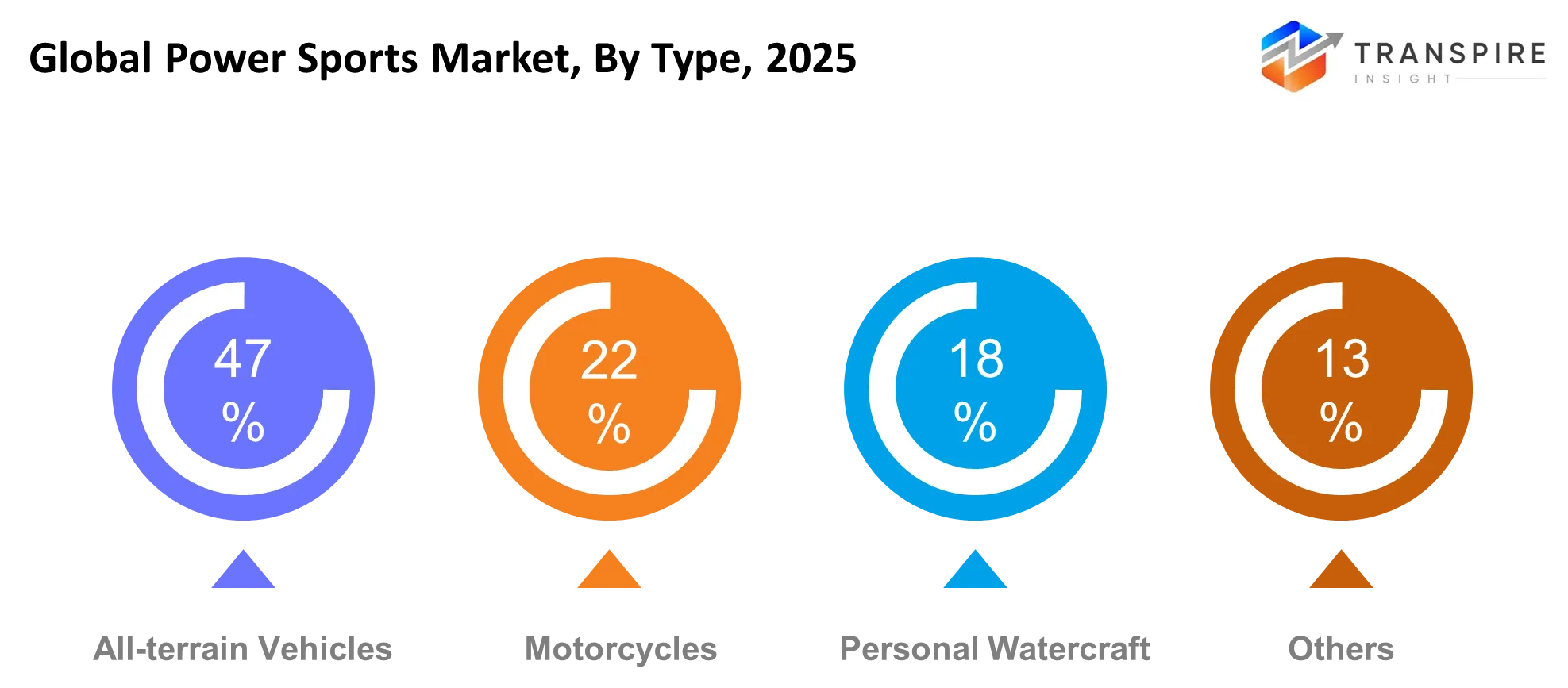
With regard to types of vehicles, motorcycles retain their supremacy in the market of Power Sports due to their wide customer base, affordable cost of ownership in comparison to other recreational vehicle types, and expanding role in such categories as lifestyle touring and adventure tourism. The growth of this category will be driven by the emergence of luxury touring, connected rider-assistance features, and urban recreational mobility solutions. UTVs and SSVs attract increasing popularity thanks to their dual utility in recreation, agriculture, rescue, and industrial applications. ATVs will retain their reputation as recreational and utility devices, whereas personal watercraft will benefit from the development of marine tourism and coastal recreation infrastructure. Snowmobiles demonstrate a steady, though geographically limited, demand linked to winter tourism economies in North America and Europe. It is highly probable that electric motorcycles and connected utility vehicles will play a significant role in future market dynamics.
To learn more about this report, Download Free Sample Report
By Application
In terms of application, recreational activities will still be the largest category since outdoor recreational activity and adventure-related spending have increased worldwide in recent years. Adventure sports have gained considerable traction among youth looking for experience-based tourism as well as off-road adventures, thus driving the production of high-performance and technology-enabled cars. The number of applications related to commercial use is on the rise because the adoption of utility vehicles in industries such as agriculture, forestry, surveillance and emergency services is increasing at a consistent pace. Racing activities play a role in driving innovation in car performances, lightweight structures, and safety systems, while tourism-based activities emerge as a key driver due to increased spending on off-road, marine, and motorsports tourism.
By End-User
On the consumer side, consumers play a greater role than ever before due to the importance of personal ownership in the culture of recreation. Consumer behavior is evolving towards premium customized and performance-oriented recreational use, along with connectivity. Rental facilities will become even more significant in light of the fact that tourists and part-time recreationalists choose rental options to own, especially in places such as coastal and adventure destinations. Sports clubs and motorsports organizations will continue their support of high-end sport bikes, as well as ATVs and off-road vehicles for racing. Additionally, there is increasing investment by tour organizations into fleets of vehicles in line with growing trends in adventure and experience travel.
By Fuel Type
In terms of fuels used, cars running on gasoline dominate the current market owing to their infrastructure support, power generation, and suitability for use in off-road terrain. Electric-driven recreational automobiles, on the other hand, appear to be experiencing one of the quickest changes due to the need for manufacturers to meet regulatory requirements and consumers' growing demand for quieter and less maintenance-intensive cars. Hybrids are gradually catching up as they provide an extended drive range while reducing dependence on fuel. In particular, electric motorcycles and side-by-sides are gaining popularity among younger people and tourism companies concerned about the environment as they seek green recreational means. In the coming years, improved batteries, charging stations, and light engines will boost adoption of electric sports vehicles.Top of Form
What are the Key Use Cases Driving the Global Power Sports Market?
Recreational outdoor mobility via motorcycles, ATVs, and Side-by-sides for purposes of trail riding and tour-based vacationing are some of the main use-cases currently fueling growth in the Power Sports segment. The individual consumer is the biggest target group with adventure-oriented lifestyles and recreational off-road activities becoming more prevalent in North America and Europe.
There are other applications being increasingly utilized in industry and tourism. UTVs are now being extensively employed in agriculture, forestry, rescue operations, and industrial sites due to their efficiency in navigating rugged terrain. In addition, tourism businesses are employing personal watercraft and off-road vehicle segments in order to provide guided adventure tours and recreation experiences.
The future use cases that can be identified include electrified and connected power sports segments. These include electric motorcycles and intelligent off-road vehicles, which are expected to drive growth within eco-tourism, urban recreation parks, and rental applications thanks to enhanced efficiency and convenience factors.
|
Report Metrics |
Details |
|
Market size value in 2025 |
USD 28.91 Billion |
|
Market size value in 2026 |
USD 30.19 Billion |
|
Revenue forecast in 2033 |
USD 40.89 Billion |
|
Growth rate |
CAGR of 4.43% from 2026 to 2033 |
|
Base year |
2025 |
|
Historical data |
2021 - 2024 |
|
Forecast period |
2026 - 2033 |
|
Report coverage |
Market trends, drivers, restraints, opportunities, AI impact, competitive landscape, regional analysis, consumer behavior, technology outlook, and strategic developments |
|
Regional scope |
North America, Europe, Asia-Pacific, Latin America, Middle East & Africa |
|
Key company profiled |
Polaris, BRP, Yamaha Motor, Honda, Kawasaki, Suzuki, Arctic Cat, Harley-Davidson, Can-Am, Sea-Doo, KTM, CFMOTO, Textron Off Road, Zero Motorcycles, Husqvarna |
|
Customization scope |
Customized regional analysis, company profiling, segment-specific insights, competitive benchmarking, and future opportunity assessment |
|
Report Segmentation |
By Type (All-terrain Vehicles, Snowmobiles, Personal Watercraft, Motorcycles, Utility Terrain Vehicles, Side-by-side Vehicles, Others); By Application (Recreational Activities, Adventure Sports, Commercial Use, Racing Sports, Tourism Activities, Others); By End-User (Individual Consumers, Rental Operators, Sports Clubs, Tourism Companies, Others); By Fuel Type (Gasoline-powered, Electric-powered, Hybrid-powered, Others) |
Which Regions are Driving the Global Power Sports Market Growth?
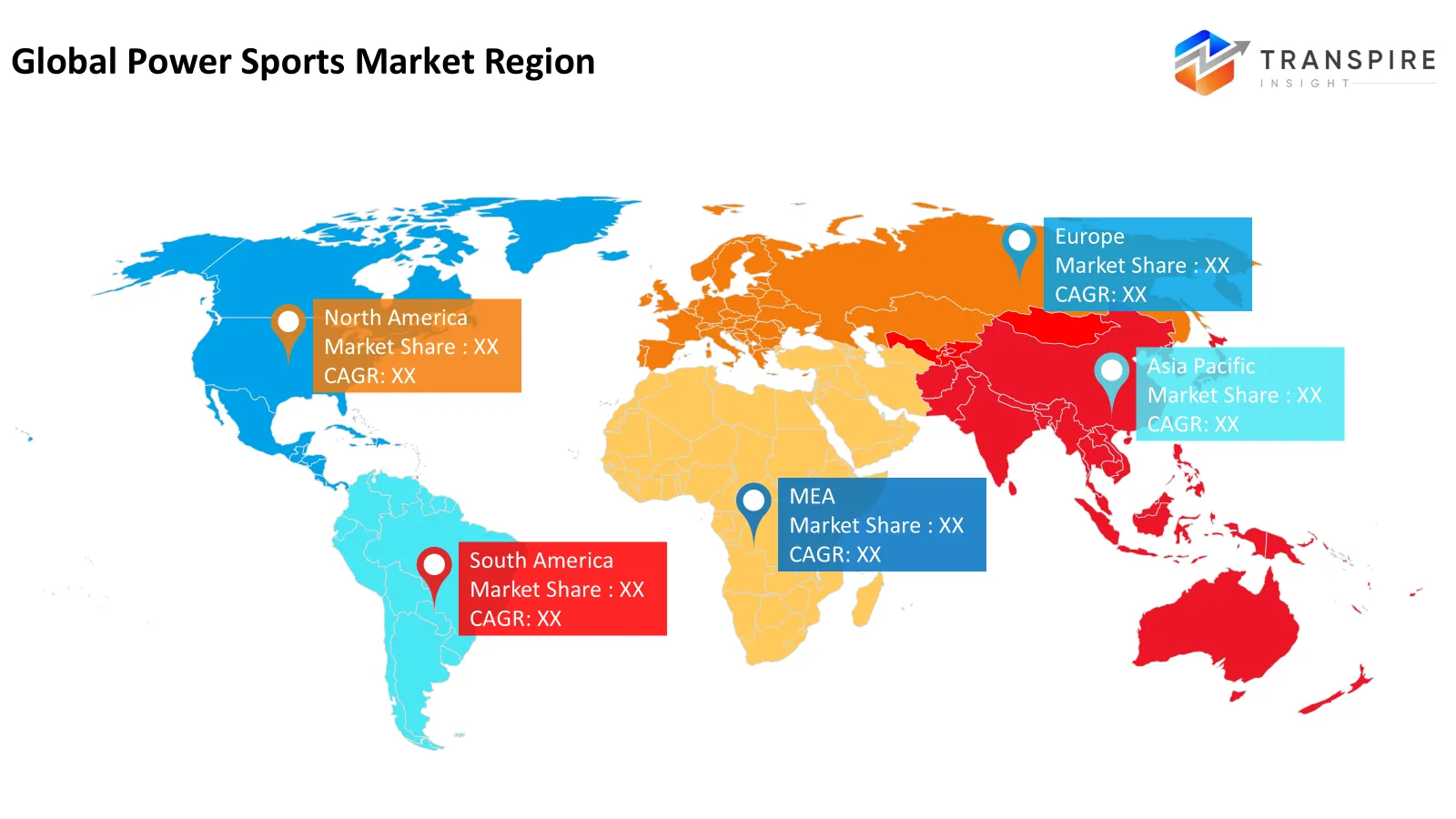
North America continues to be the leading region in the Global Power Sports Market because of its well-developed off-road activity environment, trail network and active participation by consumers in the sport. Both the USA and Canada provide a steady demand for products like ATVs, SXS, snowmobiles and tourers, and have the necessary dealer network and recreational funding system. In October 2025, According to the Q3 2025 earnings report by Polaris Inc., released sales in North America rose up to USD 1.586 billion, accounting for 86% of the total company sales, and off-road vehicle retail sales grew 9%.
The second-largest market consists of Europe, where growth is propelled by sustainable regulations, demand for high-end motorcycles, and organized adventure tours, as opposed to vehicles bought on account of practicality. Unlike North America, the development of Europe has a greater connection to the shift towards electric mobility and sustainable recreational facilities. European countries such as Germany, France, Italy, and others enjoy stable demand because of winter sport tours and motorcycling tours as well as government incentives towards low-emission transport. In August 2025, global statistics for the automotive sector pointed to an increase of 27% in the sale of electric cars during the year-to-date period in Europe.
The Asia-Pacific region is becoming the fastest-growing region due to rising disposable incomes, investments in tourism, and the growing popularity of motorsports influencing the dynamics of the demand for recreation mobility. The market has seen rapid changes over the past few years due to increased investments in adventure tourism, marine recreation, and off-road trips made by nations like China, India, Australia, and Southeast Asia. In November 2025, As per reports, automobile sales in India rose by over 40 percent compared to last year.
To learn more about this report, Download Free Sample Report
Who are the Key Players in the Global Power Sports Market and how do they Compete?
Competition in the market is characterized not only by pricing but also by innovations in the field of product development, electrification, recreational ecosystem development, and effective dealership networks. Competition in the market is determined by differentiation based on the performance and unique features of each vehicle, technological advancements such as connectivity and digital technology applications, the rider's experience and unique requirements, and specialization in off-road recreation, touring, mobility in the aquatic environment, and utility transportation. Increasingly, manufacturers are developing innovations to attract younger buyers and environmentally conscious consumers to the market.
As for Polaris Inc., its competitive advantage is the company's innovations in the field of off-road and utility terrain vehicles. It specializes in advanced technologies such as connectivity and intelligent safety systems for riding and commercial utility use. Polaris Inc. expands its business through the use of partnerships for the production of electric off-road vehicles, development of dealerships around the world, and fleets of utility vehicles. As for BRP Inc., it develops its business through a premium recreational strategy, concentrating mainly on high-performance snowmobiles, personal watercraft, and side-by-side recreational vehicles for adventure tourism.
Honda Motor Co., Ltd. and Yamaha Motor Co., Ltd. differentiate themselves via efficient mass production, engineering with reliability at its core, and diverse ranges of motorcycles that go from economy to high-end touring models. The differentiation strategy for both companies is centered on offering motorcycles that are affordable yet include rider-friendly features and fuel-saving technology. In turn, Harley-Davidson, Inc. concentrates on brand-based lifestyle marketing and high-end touring motorcycles, venturing into electric motorcycles and creating online communities for riders in pursuit of the young buyer base.
Key Global Power Sports Market Companies
- Polaris
- BRP
- Yamaha Motor
- Honda
- Kawasaki
- Suzuki
- Arctic Cat
- Harley-Davidson
- Can-Am
- Sea-Doo
- KTM
- CFMOTO
- Textron Off Road
- Zero Motorcycles
- Husqvarna
Recent Development News:
- In February 2026, Polaris Inc. successfully separated the Indian Motorcycle business and sold a majority interest in Indian Motorcycle to Carolwood LP. This enabled Polaris Inc. to concentrate on their core businesses, which included off-road vehicles and utility vehicles. https://ir.polaris.com
- In May 2026, Dust Moto, an electric off-road company, was bought by LiveWire for the purpose of getting into the business of producing electric dirt bikes. This purchase has hastened LiveWire’s efforts in the electric off-road industry. https://www.autocarindia.com
- In September 2025, The company introduced the 2026 Can-Am Outlander Electric and the latest Defender side-by-side vehicles at the Club BRP 2026 event. Through the product introduction, the company emphasized its strategy towards electrification and broadened its connected utility recreation line of products. https://brp.gcs-web.com
What Strategic Insights Define the Future of the Global Power Sports Market?
The direction for the Global Power Sports Market is heading towards more connected, electric, and experience-focused mobility solutions instead of owning standalone recreational vehicles. Companies that can integrate electrification, artificial intelligence-powered car intelligence, subscriptions, and tourism would benefit most from the industry changes. Another trend that we see is a transition from season-specific recreational uses to all-year commercial/utility activities especially in the adventure travel, agricultural, and outdoors markets.
Some of the potential risks include stricter regulatory environment in terms of emissions, environmental impacts, and noise pollution associated with off-road driving. However, some of the opportunities are related to electrified off-road systems and rental adventure experiences throughout the APAC region and other eco-friendly tourism locations where a younger consumer base prefers to rent their recreational equipment.
From a strategic standpoint, businesses should focus on developing lighter electric cars, establishing rider digital ecosystems, and collaboration with travel providers in order to develop a recurring revenue stream beyond just selling vehicles.
Global Power Sports Market Segmentation
By Type
- All-terrain Vehicles
- Snowmobiles
- Personal Watercraft
- Motorcycles
- Utility Terrain Vehicles
- Side-by-side Vehicles
- Others
By Application
- Recreational Activities
- Adventure Sports
- Commercial Use
- Racing Sports
- Tourism Activities
- Others
By End-User
- Individual Consumers
- Rental Operators
- Sports Clubs
- Tourism Companies
- Others
By Fuel Type
- Gasoline-powered
- Electric-powered
- Hybrid-powered
- Others
Regional Outlook
North America
- United States
- Canada
- Mexico
Europe
- Germany
- United Kingdom
- France
- Spain
- Italy
- Rest of Europe
Asia Pacific
- Japan
- China
- Australia & New Zealand
- South Korea
- India
- Rest of Asia Pacific
South America
- Brazil
- Argentina
- Rest of South America
Middle East & Africa
- Saudi Arabia
- United Arab Emirates
- South Africa
- Rest of the Middle East & Africa
Frequently Asked Questions
Find quick answers to common questions.
The expected global power sports market size for the market will be USD 40.89 Billion in 2033.
Key segments for the global power sports market are By Type (All-terrain Vehicles, Snowmobiles, Personal Watercraft, Motorcycles, Utility Terrain Vehicles, Side-by-side Vehicles, Others); By Application (Recreational Activities, Adventure Sports, Commercial Use, Racing Sports, Tourism Activities, Others); By End-User (Individual Consumers, Rental Operators, Sports Clubs, Tourism Companies, Others); By Fuel Type (Gasoline-powered, Electric-powered, Hybrid-powered, Others).
Major global power sports market players are Polaris, BRP, Yamaha Motor, Honda, Kawasaki, Suzuki, Arctic Cat, Harley-Davidson, Can-Am, Sea-Doo, KTM, CFMOTO, Textron Off Road, Zero Motorcycles, Husqvarna.
The global power sports market size is USD 28.91 Billion in 2025.
The global power sports market CAGR is 4.43% from 2026 to 2033.
- Polaris
- BRP
- Yamaha Motor
- Honda
- Kawasaki
- Suzuki
- Arctic Cat
- Harley-Davidson
- Can-Am
- Sea-Doo
- KTM
- CFMOTO
- Textron Off Road
- Zero Motorcycles
- Husqvarna
About the Authors

Mayur Shinde
I am Mayur Shinde, a Senior Research Analyst at Transpire Insight, specializing in the Automotive & Transportation and Information & Communication Technology (ICT) Industry. My work focuses on analyzing emerging market trends, technological advancements, competitive landscapes, and industry developments to deliver accurate, data-driven insights. I am passionate about transforming complex market information into clear, actionable content that helps businesses, professionals, and decision-makers stay informed and make confident strategic decisions.

Chakradhar Khansole
Chakradhar serves as the Research Director at Transpire Insight, bringing over 8 years of experience in technology, innovation, and strategic market intelligence. He specializes in transforming complex market data into actionable business insights that enable organizations to make informed, growth-oriented decisions. Recognized for his strategic vision and analytical expertise, Chakradhar leads high-impact research initiatives, delivering comprehensive market assessments, competitive intelligence, and forward-looking industry analysis.
Recently Published Reports
-
Apr 2026
ATV & UTV Market
ATV & UTV Market Size, Share & Analysis Report By Type (ATV, and UTV), By Variants (Less Than 400 CC, 400 CC To 800 CC, and More Than 800 CC), and Geography (North America, Europe, Asia-Pacific, Middle East and Africa, South and Central America), 2021 - 2031
-
Apr 2026
Automotive Central Gateway Module Market
Automotive Central Gateway Module Market Size, Share & Analysis Report By Type (Ethernet Central Gateway Module, CAN Central Gateway Module, LIN Central Gateway Module, and FlexRay), By Application (Powertrain Control, Body Control, Infotainment System, Advanced Driver Assistance Systems (ADAS), and Others), By End User (Passenger Vehicles, and Commercial Vehicles), and Geography (North America, Europe, Asia-Pacific, Middle East and Africa, South and Central America), 2021 - 2031
-
Apr 2026
Automotive Engine Oil Filter Market
Automotive Engine Oil Filter Market Size, Share & Analysis Report By Filter Type (Fuel Filter, Engine Oil Filter, Hydraulic Oil Filter, and Others), By Filter Media (Cellulose, Synthetic, and Micro), By Sales Channel (OEMs, and Aftermarket), By Vehicle Type (Passenger Cars, Light Commercial Vehicles, Heavy Duty Trucks, Buses and Coaches, and Off-road Vehicles), and Geography (North America, Europe, Asia-Pacific, Middle East and Africa, South and Central America), 2021 - 2031
-
Apr 2026
Automotive Parts Aluminium Die Casting Market
Automotive Parts Aluminium Die Casting Market Size, Share & Analysis Report By Production Process (Pressure Die Casting, Vacuum Die Casting, Squeeze Die Casting, Gravity Die Casting), By Application (Body Parts, Engine Parts, Transmission Parts, Battery And Related Components, Other Application Types), and Geography (North America, Europe, Asia-Pacific, Middle East and Africa, South and Central America), 2021 - 2031
Our Clients