
United Kingdom Near Field Communication Market Summary
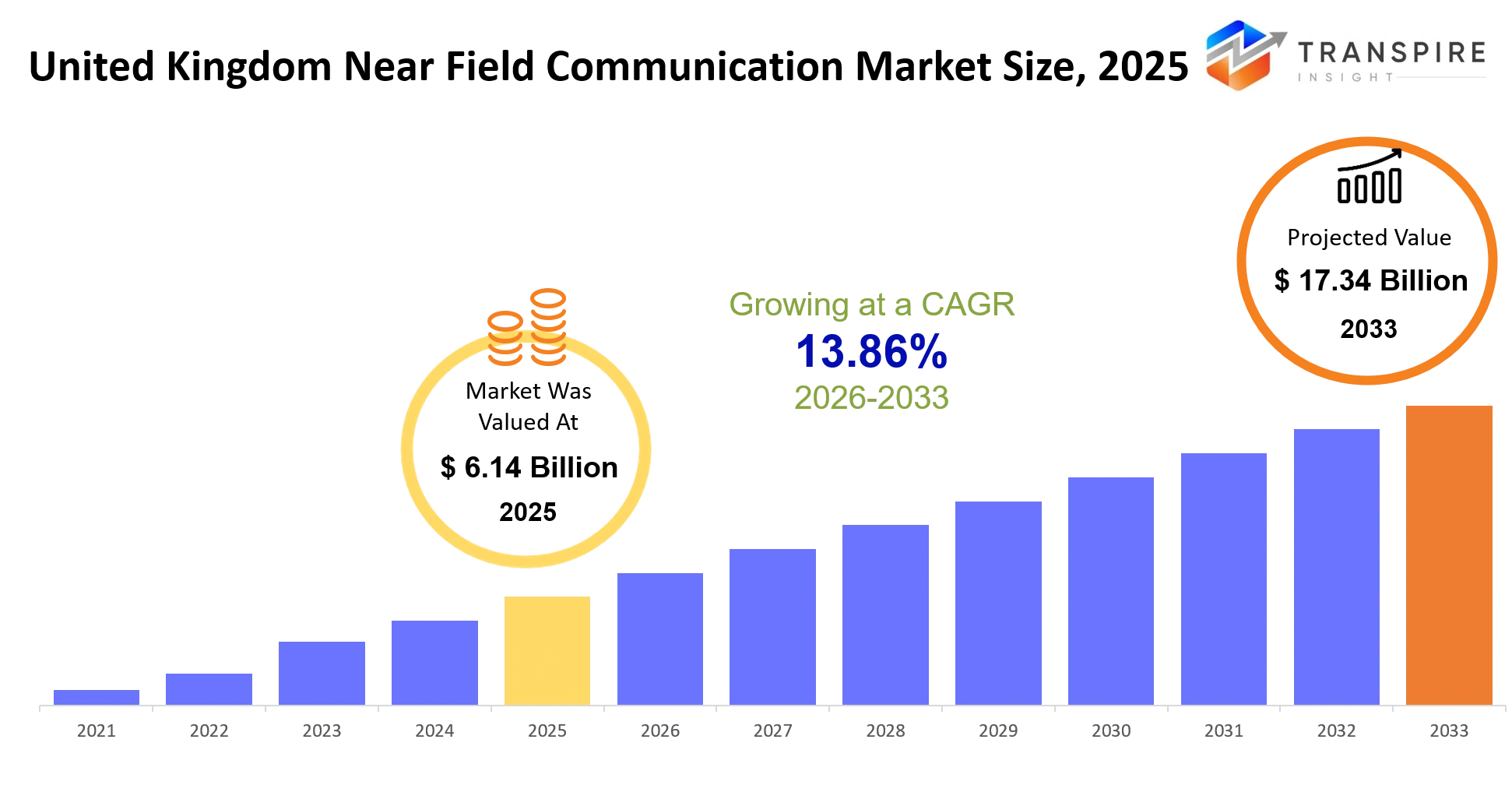
As per Transpire Insight Analysis the United Kingdom Near Field Communication Market size is estimated at USD 6.14 Billion in 2025 and is anticipated to reach USD 17.34 Billion by 2033, growing at a CAGR of 13.86% from 2026 to 2033.
The United Kingdom Near Field Communication Market makes it possible to run secure , short distance wireless links that actually support contactless payments, door access, ticketing, identity checks, asset monitoring, and device pairing, across retail, transport, healthcare, production, and public services. Instead of relying on physical credentials, and also dialing back the manual back and forth, NFC tends to speed up exchanges, lift operational efficiency, and help everyday users feel more comfortable, all while backing secure digital surroundings. Companies keep bringing NFC into customer engagement plans and into connected workplace setups, so that daily tasks feel less complicated, almost like they just run themselves.
In the past three to five years, the whole market vibe moved away from payments only, and it leaned more toward digital identity , plus enterprise access scenarios. That change picked up momentum during the COVID-19 pandemic, because people were pushing for contactless touchpoints in both commercial and public environments, so organizations had to rethink authentication and how services get delivered. With mobile phones, wrist wearables, and connected infrastructure increasingly carrying NFC support, more opportunities open up to automate processes, cut operational drag, and capture interaction data in near real time. This wider usefulness broadens deployment into several industries, which in turn strengthens ongoing technology spending and creates steadier money routes for solution providers and system integrators.
United Kingdom Near Field Communication Market Size & Forecast:
- United Kingdom Near Field Communication Market Size 2025: USD 6.14 Billion
- Expected Market Value 2033: USD 17.34 Billion
- Forecast CAGR: 13.86%
- Leading region in 2025: England
- Fastest Growing region: Scotland
- Key Profile: NXP Semiconductors, Broadcom, Qualcomm, STMicroelectronics, Sony, Samsung Electronics, Apple, Google, Infineon Technologies, HID Global, Identiv, Thales, Ingenico, Zebra Technologies, Texas Instruments
Key Market Insights
- In 2025, England sort of dominated the United Kingdom Near Field Communication market, taking up roughly 82% market share, all of this backed by tight retail coverage and financial technology adoption that is pretty widespread.
- Scotland meanwhile is projected to move the quickest during the 2025–2032 stretch, mainly because smart transport upgrades and public digital infrastructure spending keep expanding.
- When it comes to products, NFC-enabled smartphones, plus other mobile devices, led the pack with around 48% market share in 2025, pushed by broad wallet integration and authentication capabilities that are used everywhere.
- NFC readers and payment terminals sat in the second spot, since merchants kept swapping out older payment setups across multiple industries, not just one.
- As for the growth angle, wearables and IoT-enabled NFC devices are expected to show the fastest growth rate through 2032, with connected healthcare and industrial use cases broadening over time, kind of gradually.
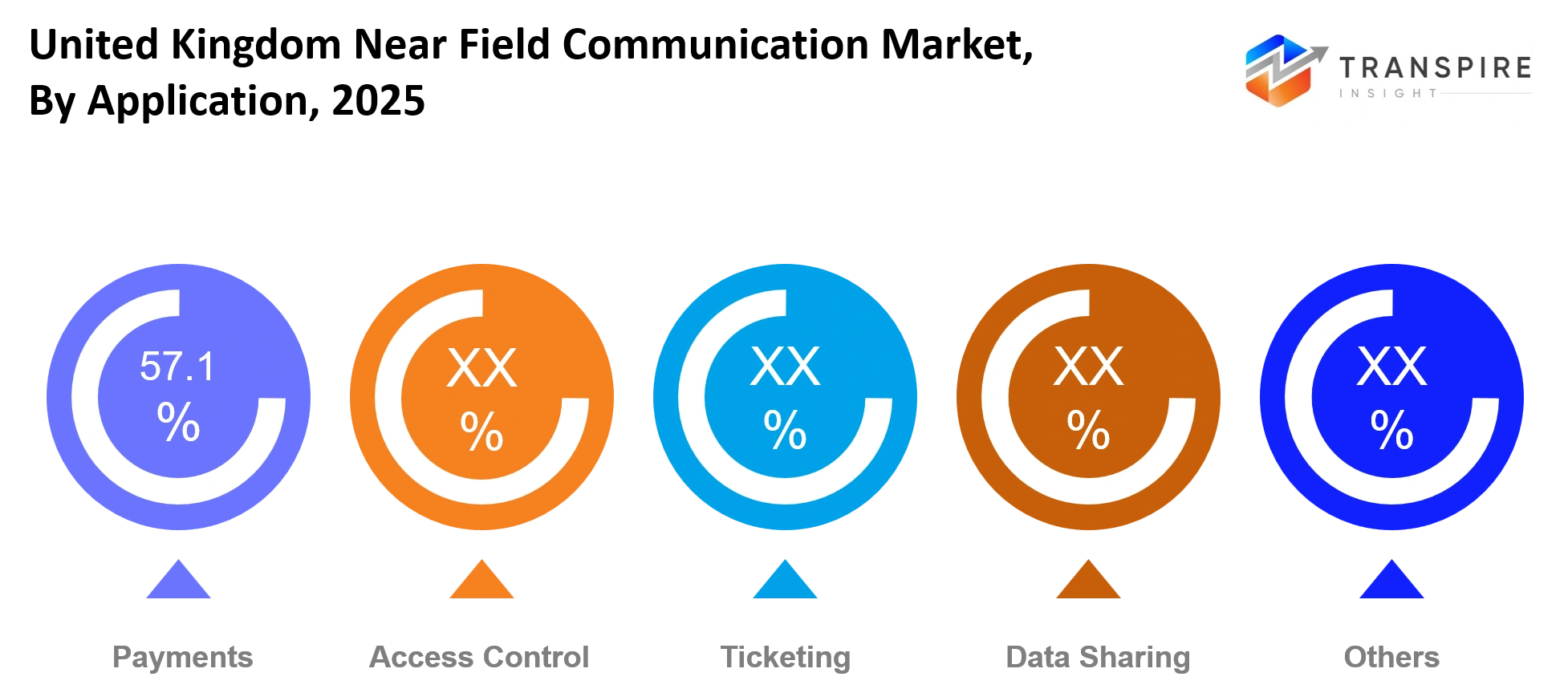
- Looking at applications, contactless payments held the largest share at about 46% in 2025, supported by retail modernization efforts and the digitization of financial services.
- Secure access control, plus digital identity checks, are forecast to grow the quickest among applications because enterprise security needs are getting more complex and layered through 2032.
- For end users, retail stayed out in front with nearly 34% market share, showing continued spending on smoother checkout flows and customer engagement technologies.
- Healthcare is expected to be the fastest-growing end-user category through 2032, because hospitals increasingly roll out NFC for patient identification and asset tracking—basically to manage operations with less friction.
What are the Key Drivers, Restraints, and Opportunities in the United Kingdom Near Field Communication Market?
The main force pushing market growth is that people are leaning more and more into digital-first commerce and more careful identity verification, in a secure way. Financial institutions, retailers, and public agencies have been putting real money into this, especially after contactless purchase limits went up, and once online service delivery turned into a kind of strategic need. With quicker checkout, less everyday transaction friction ,and stronger authentication in the mix, adoption tends to spread into transport , healthcare, and enterprise settings. In practice this keeps flowing into more hardware sales , more software tie-ins, and more recurring platform revenue for the technology suppliers.
The biggest structural snag is still interoperability, plus the overall cybersecurity complexity that comes with older systems. Banks, retailers, healthcare providers, and public agencies use different stacks, and they cannot usually modernize them all at the same time. Certification rules, security testing cycles, and system integration work tend to stretch rollout timelines by several months for bigger initiatives. Quite a few orgs delay swapping out infrastructure because migration expenses stay heavy, which makes near-term implementation volumes softer, and also pushes commercial revenue later. From the Transpire Insight take on regional procurement notices and product launch timelines , the concentration in the supply chain is still the dominant execution risk.
There’s a big opportunity in bringing NFC together with digital identity platforms, AI driven authentication, and the Internet of Things ecosystem(s). In practice, smart hospitals , connected factories, and intelligent transport systems are now asking for safer device verification, but they don’t really want to rely on physical credentials anymore. At the same time, investing in smart city infrastructure and enterprise digital transformation gives a pretty good runway for deployment. The vendors that can provide interoperable platforms—especially ones with cloud based credential management, stronger security controls, and analytics features—should be able to win more durable contracts across both public entities and private organizations.
What Has the Impact of Artificial Intelligence Been on the United Kingdom Near Field Communication Market?
Artificial intelligence is kind of changing NFC-enabled ecosystems a lot, mostly by upgrading the way they watch transactions , spot fraud, handle credentials, and support day to day operational decisions. In practice payment providers , retailers , and enterprise security teams are starting to mix AI with contactless communication platforms. The goal is to recognize odd user patterns quickly, automate authentication rules in a smoother way, and keep compliance stronger, all without making customers feel that the experience got interrupted. On the machine learning side, models also inspect transaction volumes, device usage, and how the infrastructure is actually doing, then they try to predict demand, tweak where payment terminals should be placed, and schedule maintenance ahead of time so failures don’t suddenly mess up operations.
All these digital capabilities tend to boost network availability, lower the amount of manual security checking, and help transactions move faster across retail stores, transport hubs, hospitals, and corporate campuses. The analytics that are assisted by AI help organizations manage infrastructure in a more disciplined manner, while also reducing down time and improving how quickly customers can be processed during busy hours. This “smart automation” also keeps fraud monitoring going continuously, which helps cut down false positives while strengthening risk management across the connected devices.
Even so, the advantages don’t erase the reality that broad deployment still hits practical limits. The costs to integrate with older payment systems and enterprise platforms can be high, and that slows modernization plans, especially for small and medium-sized organizations. AI performance also leans heavily on clean operational data, but fragmented infrastructure and inconsistent connectivity can make model accuracy wobble, especially in complicated real world conditions. So these constraints still end up moderating how fast full scale intelligent NFC deployment rolls out.
Key Market Trends
- Between 2022 and 2025, contactless payment deployments sort of moved away from only retail, and then started showing up in multiple industries too, which also seemed to encourage wider enterprise technology spending.
- After 2023, digital identity applications ramped up fast, mainly because financial institutions and public services kept strengthening secure authentication, and it all kind of clicks together.
- By 2025, NFC-enabled wearables really started gaining traction, and they opened up fresh possibilities for healthcare monitoring, access management, and also connected workplace solutions, not just “nice to have” features.
- Since 2023, smart transportation projects accelerated adoption, by combining NFC ticketing with mobile applications and multimodal travel platforms, it felt a bit seamless.
- Retailers in 2024 increasingly traded standalone payment terminals for integrated omnichannel systems, which improved checkout efficiency, and helped sharpen customer analytics at the same time.
- NXP Semiconductors and Infineon Technologies also increased their investment in secure NFC chip architectures. These architectures support advanced encryption and industrial IoT use cases, so it’s more than just basic connectivity.
- Enterprise access control solutions saw stronger rollouts after 2024, as many organizations migrated away from physical credentials toward smartphone-based authentication.
- Between 2023 and 2025, financial technology providers broadened partnerships with banks and merchants, to further reinforce contactless payment ecosystems, across the board.
- Healthcare providers pushed ahead with NFC-enabled patient identification and medical asset tracking deployments, which reduced manual handling and gave better operational visibility by 2025, in practice not theory.
United Kingdom Near Field Communication Market Segmentation
By Component :
Hardware holds a pretty significant position because NFC chips, readers antennas, and embedded modules plus payment terminals actually make up the physical backbone of each deployment. Ongoing upgrades across payment infrastructure, smart access setups, healthcare equipment, and industrial devices keep hardware spending steady. And when connected devices expand across commercial facilities , there’s also long-term replacement demand coming along. In practice reliable hardware performance stays essential so communication is secure and not interrupted, like at all.
Software, on the other hand, keeps gaining weight since organizations want secure authentication, encryption, transaction handling, analytics, and device administration. The service side usually includes consulting, integration, maintenance, security updates, and technical support , which helps organizations deploy NFC solutions with fewer day to day headaches. Cloud based management platforms also make software updates easier while improving operational visibility. Plus there are supporting components , like middleware and security tools , that improve compatibility across different devices and enterprise systems.
By Device Type :
Smartphones, for sure, are still the foremost device category, mainly because mobile wallets , digital identity apps, and secure authentication features have already sort of blended into daily business routines as well as consumer life. A solid spread of NFC-capable smartphones helps nudge wider adoption across retail outlets, healthcare settings, transit systems, and financial services. Device makers keep pushing to expand what NFC can do, with tighter defenses and a smoother user experience. At the business level, there is also a practical payoff: simpler mobile entry plus easier verification, you know, less friction overall.
POS terminals stay another big slice too, since merchants keep swapping older payment hardware for contactless alternatives. Wearables are growing as well , showing up in healthcare, fitness tracking, workplace entry, and payment use cases, because these smaller gadgets make things easier when you’re moving around all day. Tablets meanwhile fit field services, retail operations, and healthcare locations, where portable payment and identification tools really improve throughput. Beyond that, other specialized devices chip in for industrial automation and smart infrastructure initiatives, those kinds of projects where connectivity matters a lot.
By Application :
Payments keep showing up as the largest share since contactless transactions cut the waiting time a bit, and at the same time make things more convenient plus safer for transactions, in general. Retail shops, restaurants, public services and financial institutions still roll out NFC payment capabilities inside day-to-day operations, too. Digital wallets also give a boost to adoption, because they reduce the need for physical cards. With secure processing in place, customers tend to feel more confident in different transaction settings.
Access control keeps spreading, and organizations are swapping physical credentials for digital authentication across offices, hospitals, factories and public facilities. Ticketing applications kind of streamline passenger flow through public transportation networks while lowering manual checks, and verification steps. Data sharing allows secure information exchange between compatible devices during business routines , healthcare activities, and consumer interactions as well. Other use cases continue to appear in smart manufacturing, logistics, and connected public infrastructure, where possible.
By End User :
Retail still feels like the biggest end-user space, since contactless checkout, customer loyalty plans, and inventory handling really depend on rapid and secure communication tech. Lately, modern retail outlets keep putting money into digital payment infrastructure, not only to make the shopping moment better but also to boost daily operational efficiency, sort of in one move. When it plugs in well with mobile apps, there’s more added value for the whole business side. And with ongoing tech revisions, transaction dependability gets a bit more steady too.
BFSI orgs commonly roll out NFC for secure payments, customer verification, and for delivering financial services across both physical counters and digital touch points. In healthcare, providers tend to use NFC for patient recognition, tracking medical resources, and for safer access to records while everything happens inside hospitals, clinics, and similar settings. Transportation players are expanding digital ticketing platforms, mainly to increase passenger comfort and to speed up operations. Government teams, along with other sectors, keep adding secure identification tools and public service apps, these help push digital transformation goals forward.
By Operating Mode :
In Reader/Writer mode the leading position kinda sticks, because payment terminals, information kiosks, healthcare devices, and industrial systems rely on dependable reading and writing ability. Good deployment across commercial environments helps keep investment going for infrastructure that works together, and not just for a short sprint. When performance stays consistent it makes communication go smoother between NFC enabled devices. Since the broader industry keeps adopting it, this operating mode stays really relevant.
Then there is Card Emulation, which supports secure mobile payments and digital identity use cases, since smartphones and wearable devices can act like virtual cards instead of plain hardware. Peer-to-Peer mode gives direct dialogue between compatible devices, for secure data exchange and even file transfer, during everyday business and consumer activities. The other operating modes handle more specialized industrial, healthcare, and enterprise needs, where tailored communication approaches improve operational flexibility, a bit more than the generic setup.
By Deployment :
On premise deployment is still drawing organizations that really want more direct control over sensitive data, regulatory compliance, and internal security handling. A lot of financial institutions, healthcare providers, and government agencies lean toward local infrastructure for those critical, day to day operations. And honestly, existing enterprise spending also makes it easy to keep using on premise environments. Having strong control over system speed and performance is still one of the biggest upsides, even if people debate the tradeoffs.
At the same time cloud deployment keeps expanding, mostly because centralized management reduces the burden, infrastructure requirements go down, and software updates arrive faster. Hybrid deployment basically tries to mix the two, keeping local security on one side while using cloud flexibility on the other, so organizations can juggle performance, scalability, and regulatory rules. There are also other deployment models that fit more specialized operational settings where unique business needs demand tailored infrastructure. With flexible deployment options available, adoption can keep growing across different industries, without forcing everyone into the same setup.
What are the Key Use Cases Driving the United Kingdom Near Field Communication Market?
Contactless payments are still the main, sort of backing use case for market momentum across the United Kingdom. Retail chains, supermarkets, eateries, and financial institutions buy NFC-capable payment terminals , plus mobile payment solutions to cut down the transaction time while also making things easier for customers. The ongoing lift in digital payment adoption, together with pretty widespread smartphone usage, keeps supporting continued spending on payment infrastructure.
Access control and digital ticketing are growing at a steady pace in both the commercial world and public sectors. In healthcare, providers roll out NFC-enabled identification systems to tighten patient verification and help with medical asset management. In transport, operators are using contactless ticket validation to shorten boarding times , and to help passengers flow in a calmer way. Also, government organizations are starting to use secure credential solutions for entry to controlled facilities.
Digital identity verification and industrial asset authentication are newer examples, with real long term upside. Manufacturers are testing NFC-enabled product traceability , aiming to improve supply chain visibility. Meanwhile, smart city initiatives are trying to secure citizen services through mobile credentials. Overall, continued investment in connected infrastructure should help unlock wider commercial adoption throughout the forecast timeframe.
|
Report Metrics |
Details |
|
Market size value in 2025 |
USD 6.14 Billion |
|
Market size value in 2026 |
USD 6.99 Billion |
|
Revenue forecast in 2033 |
USD 17.34 Billion |
|
Growth rate |
CAGR of 13.86% from 2026 to 2033 |
|
Base year |
2025 |
|
Historical data |
2021 - 2024 |
|
Forecast period |
2026 - 2033 |
|
Report coverage |
Revenue forecast, competitive landscape, growth factors, and trends |
|
Regional scope |
United Kingdom (England, Scotland, Wales, Northern Ireland) |
|
Key company profiled |
NXP Semiconductors, Broadcom, Qualcomm, STMicroelectronics, Sony, Samsung Electronics, Apple, Google, Infineon Technologies, HID Global, Identiv, Thales, Ingenico, Zebra Technologies, Texas Instruments. |
|
Customization scope |
Free report customization (country, regional & segment scope). Avail customized purchase options to meet your exact research needs. |
|
Report Segmentation |
By Component (Hardware, Software, Services, Others); By Device Type (Smartphones, Tablets, Wearables, POS Terminals, Others); By Application (Payments, Access Control, Ticketing, Data Sharing, Others); By End User (Retail, BFSI, Healthcare, Transportation, Government, Others); By Operating Mode (Reader/Writer, Card Emulation, Peer-to-Peer, Others); By Deployment (On-Premise, Cloud, Hybrid, Others). |
Which Regions are Driving the United Kingdom Near Field Communication Market Growth?
England is basically around 82% of the United Kingdom Near Field Communication Market, so yeah it ends up as the main regional player. A lot of money side structures help digital payments too, and the transport network is pretty extensive, plus digital public services are being taken up fast enough , all of that has pushed NFC into lots of industries. There is also a tightly packed set of banks and similar institutions, tech companies , payment solution providers, semiconductor suppliers and system integrators , which keeps the local ecosystem kind of humming. And because there’s ongoing spending in smart retail, healthcare digitization, and connected public infrastructure , the region should keep leading across the forecast window.
Scotland sits as the second-largest regional market. The big reason is that public sector technology programs and relatively stable digital infrastructure give more steady chances to deploy, not so much that sudden expansion feels. There’s a predictable regulatory environment, plus universities are doing solid research , and investment in financial technology stays fairly consistent. Because of that, healthcare, banking, and transportation keep seeing long-term adoption. On top of that, industrial modernization projects support demand for reliable secure authentication and touch-based access solutions. So even if Scotland’s investment profile looks a bit different from England’s, these structural strengths still make it a dependable contributor to overall market revenue.
Wales is expected to see the quickest expansion in the 2026–2033 timeframe, as smart infrastructure programs, digital public services, and transport modernization take on more investment. The recent rollout of connected public transport systems ,plus digital government initiatives, has already opened up new openings for NFC enabled ticketing, secure identification, and access control management. At the same time, stronger collaboration between local authorities and technology providers is speeding up commercial adoption across public ,and private sectors. This push should also bring attractive pathways for technology vendors, software developers and infrastructure investors, who want to expand through rising regional programs, somewhere between 2026 and 2033.
Who are the Key Players in the United Kingdom Near Field Communication Market and How Do They Compete?
Competition is still kind of moderately consolidated , because big global semiconductor firms, mobile platform providers, and payment technology companies end up vying on tech muscle, not only on price. The way they innovate in secure chip layout, encryption methods, software integration, and how well everything fits with digital identity platforms basically sets who is ahead and who is behind. Meanwhile, the more established tech suppliers keep adding to their product line, while niche software developers and security outfits bring in focused tools that fit enterprise needs and also public sector requirements.
NXP Semiconductors really leans into newer NFC chip breakthroughs, giving secure controllers that stay strong in performance for payments, automotive, and industrial workloads. Their continuous push into next-generation semiconductor tech, plus frequent cooperation with device manufacturers, helps keep product differentiation more visible. **Infineon Technologies** goes after competitive space through secure authentication technologies and security features that are built into the hardware, so it supports financial services, healthcare, and government use cases. Their steady broadening of secure semiconductor offerings also helps reinforce long-term customer ties across industries that are heavily regulated.
Apple seems to stand apart with that tight “togetherness” between NFC hardware, mobile operating systems, and digital wallet services, so the whole experience feels pretty seamless when you move across consumer devices. Google then pushes the Android based NFC features forward, not just by tweaking the plumbing, but by improving digital payment functionality and enterprise authentication options, also while it keeps working on stronger collaboration with financial institutions as well as app developers. Visa meanwhile broadens how far contactless payment technologies can go, using partnerships with banks, merchants, and payment processors, which helps deployments show up across retail, transit, and public service networks, and still keeps room for further ecosystem growth.
Company List
- NXP Semiconductors
- Broadcom
- Qualcomm
- STMicroelectronics
- Sony
- Samsung Electronics
- Apple
- Infineon Technologies
- HID Global
- Identiv
- Thales
- Ingenico
- Zebra Technologies
- Texas Instruments
Recent Development News
In April 2026, Apple finalized interoperability commitments with the UK Competition and Markets Authority to expand developer access to selected iOS features as part of the Digital Markets programme. The commitments support future work on broader NFC access and are expected to encourage greater competition and innovation in digital wallet services.
Source: https://www.gov.uk/
In May 2025, NXP Semiconductors launched the NTAG X DNA secure connected NFC tag with Secure Unique NFC authentication. The product strengthens secure authentication for healthcare, industrial, smart home, and Digital Product Passport applications, expanding commercial opportunities for NFC-enabled solutions.
Source: https://www.nxp.com/
What Strategic Insights Define the Future of the United Kingdom Near Field Communication Market?
The United Kingdom Near Field Communication Market is expected to drift toward becoming a sort of core layer of secure digital infrastructure, not only staying focused on contactless payments . Over the next five to seven years, growth will get a boost from a more widespread roll out of digital identity, connected healthcare, industrial automation, and smart public services, all of which really need speedy and reliable short range interaction. There’s also a quieter worry, the rising concentration of advanced semiconductor fabrication and secure chip supply , which can end up stretching procurement timetables and nudging deployment expenses higher during stretches of global turbulence.
At the same time , an opportunity is becoming more visible via digital identity frameworks and smart city initiatives that blend NFC with mobile credentials, plus trusted authentication services. For companies in the market, it may help to put money into interoperable platforms, tighten collaborations with software and cloud providers, and build offerings that keep pace with changing cybersecurity expectations and regulatory obligations , before big scale public and enterprise buying starts to accelerate.
United Kingdom Near Field Communication Market Report Segmentation
By Component
- Hardware
- Software
- Services
By Device Type
- Smartphones
- Tablets
- Wearables
- POS Terminals
By Application
- Payments
- Access Control
- Ticketing
- Data Sharing
By End User
- Retail
- BFSI
- Healthcare
- Transportation
- Government
By Operating Mode
- Reader/Writer
- Card Emulation
- Peer-to-Peer
By Deployment
- On-Premise
- Cloud
- Hybrid
Frequently Asked Questions
Find quick answers to common questions.
The expected United Kingdom Near Field Communication Market size for the market will be USD 17.34 Billion in 2033.
Key segments for the United Kingdom Near Field Communication Market are By Component (Hardware, Software, Services, Others); By Device Type (Smartphones, Tablets, Wearables, POS Terminals, Others); By Application (Payments, Access Control, Ticketing, Data Sharing, Others); By End User (Retail, BFSI, Healthcare, Transportation, Government, Others); By Operating Mode (Reader/Writer, Card Emulation, Peer-to-Peer, Others); By Deployment (On-Premise, Cloud, Hybrid, Others).
Major United Kingdom Near Field Communication Market players are NXP Semiconductors, Broadcom, Qualcomm, STMicroelectronics, Sony, Samsung Electronics, Apple, Google, Infineon Technologies, HID Global, Identiv, Thales, Ingenico, Zebra Technologies, Texas Instruments.
The United Kingdom Near Field Communication Market size is USD 6.14 Billion in 2025.
The United Kingdom Near Field Communication Market CAGR is 13.86% from 2026 to 2033.
- NXP Semiconductors
- Broadcom
- Qualcomm
- STMicroelectronics
- Sony
- Samsung Electronics
- Apple
- Infineon Technologies
- HID Global
- Identiv
- Thales
- Ingenico
- Zebra Technologies
- Texas Instruments
About the Authors

Mayur Shinde
I am Mayur Shinde, a Senior Research Analyst at Transpire Insight, specializing in the Automotive & Transportation and Information & Communication Technology (ICT) Industry. My work focuses on analyzing emerging market trends, technological advancements, competitive landscapes, and industry developments to deliver accurate, data-driven insights. I am passionate about transforming complex market information into clear, actionable content that helps businesses, professionals, and decision-makers stay informed and make confident strategic decisions.

Chakradhar Khansole
Chakradhar serves as the Research Director at Transpire Insight, bringing over 8 years of experience in technology, innovation, and strategic market intelligence. He specializes in transforming complex market data into actionable business insights that enable organizations to make informed, growth-oriented decisions. Recognized for his strategic vision and analytical expertise, Chakradhar leads high-impact research initiatives, delivering comprehensive market assessments, competitive intelligence, and forward-looking industry analysis.
Recently Published Reports
-
Apr 2026
3D Optical Profiler Market
3D Optical Profiler Market Size, Share & Analysis Report By Type (Desktop 3D Optical Profiler, and Portable 3D Optical Profiler), By Technology (Confocal Technology, and White Light Interference), By End-Use Industry (Manufacturing, Research Institutions, Automotive, Aerospace and Defense, Medical Devices, and Other), and Geography (North America, Europe, Asia-Pacific, Middle East and Africa, South and Central America), 2021 - 2031
-
Apr 2026
Depth Sensor Market
Depth Sensor Market Size, Share & Analysis Report By Type (Infrared Depth Sensors, Time-of-Flight (ToF) Sensors, Stereo Vision Sensors, Structured Light Sensors, Ultrasonic Depth Sensors), By Application (Automotive, Robotics, Gaming, Consumer Electronics, Industrial Automation, Healthcare, Security & Surveillance, Others), By End Users (Automotive Manufacturers, Consumer Electronics Companies, Healthcare Providers, Industrial Companies, Security Agencies, Gaming Companies, Robotics Companies, Others), and Geography (North America, Europe, Asia-Pacific, Middle East and Africa, South and Central America), 2021 – 2031
-
Apr 2026
Digital Manufacturing Market
Digital Manufacturing Market Size, Share & Analysis Report By Component (Hardware, Software, and Services), By Technology (Robotics, 3D Printing, Internet of Things (IoT), and Others), By Application (Automotive and Transportation, Aerospace and Defense, Consumer Electronics, Industrial Machinery, and Others), By Process Type (Computer-Based Designing, Computer-Based Simulation, Computer 3D Visualization, Analytics, and Others), and Geography (North America, Europe, Asia-Pacific, Middle East and Africa, South and Central America), 2021 – 2031
-
Apr 2026
Digital Visa Services Market
Digital Visa Services Market Size, Share & Analysis Report By Type (Individual Travelers, Group Travelers), By Application (Tourism, Business Travel, Others), and Geography (North America, Europe, Asia-Pacific, Middle East and Africa, South and Central America), 2021 – 2031