
France Near Field Communication Market Size & Forecast:
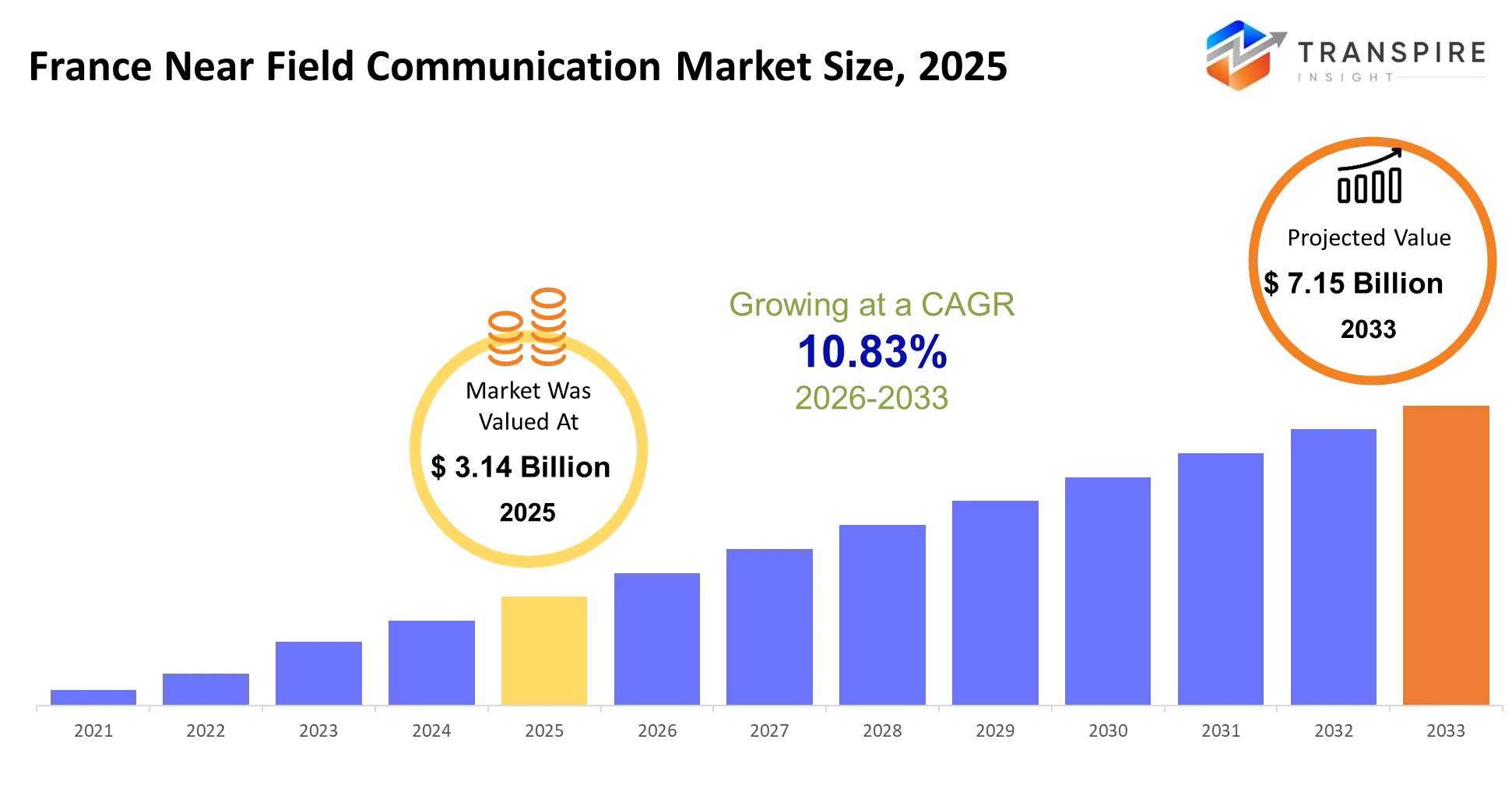
- France Near Field Communication Market Size 2025: USD 3.14 Billion
- France Near Field Communication Market Size 2033: USD 7.15 Billion
- France Near Field Communication Market CAGR: 10.83%
- France Near Field Communication Market Segments: By Type (NFC Chips, NFC Tags, NFC Readers, Others); By Application (Payments, Access Control, Data Sharing, Ticketing, Others); By End-User (Retail, BFSI, Transport, Healthcare, Others); By Device (Smartphones, Wearables, POS Devices, Others)
To learn more about this report,  Download Free Sample Report
France Near Field Communication Market Summary
The France Near Field Communication Market was valued at USD 3.14 Billion in 2025. It is forecast to reach USD 7.15 Billion by 2033. That is a CAGR of 7.57% over the period.
In France, near field communication (kinda) enables seamless contactless data exchange, that then supports everyday chores like mobile payments, transit check-in, smart access gating, and those connected retail moments. It trims down the need for physical cards and manual confirmation, and in practice it boosts speed, gives better traceability, and makes the whole user experience feel less annoying across urban infrastructure, banking, and industrial authentication setups. Over the last 3–5 years, the landscape sort of moved away from isolated NFC rollouts, toward integrated digital identity ecosystems where NFC is tucked into smartphones, wearables, and IoT-enabled point-of-sale terminals.
One big structural change has been the merging of NFC with secure digital wallets and cloud based authentication platforms, not just standalone chips. Growth also got a push from the COVID-19 pandemic which helped normalize contactless payments and hygiene-friendly interaction patterns, plus the EU’s push for digital payment modernization. So now enterprises and public service operators are leaning into NFC enabled systems to cut friction, meet security compliance more cleanly, and handle high-volume customer interactions in transport, retail, and government services without too much headache.
Key Market Insights
- Île-de-France still leads the France NFC scene, holding roughly 37% share because transaction density stays high, and the smart transport deployment is more advanced.
- Southern France is expected to be the quicker mover though, with a near 13.5% through 2033, and that’s helped by tourism linked contactless buying and hospitality payments.
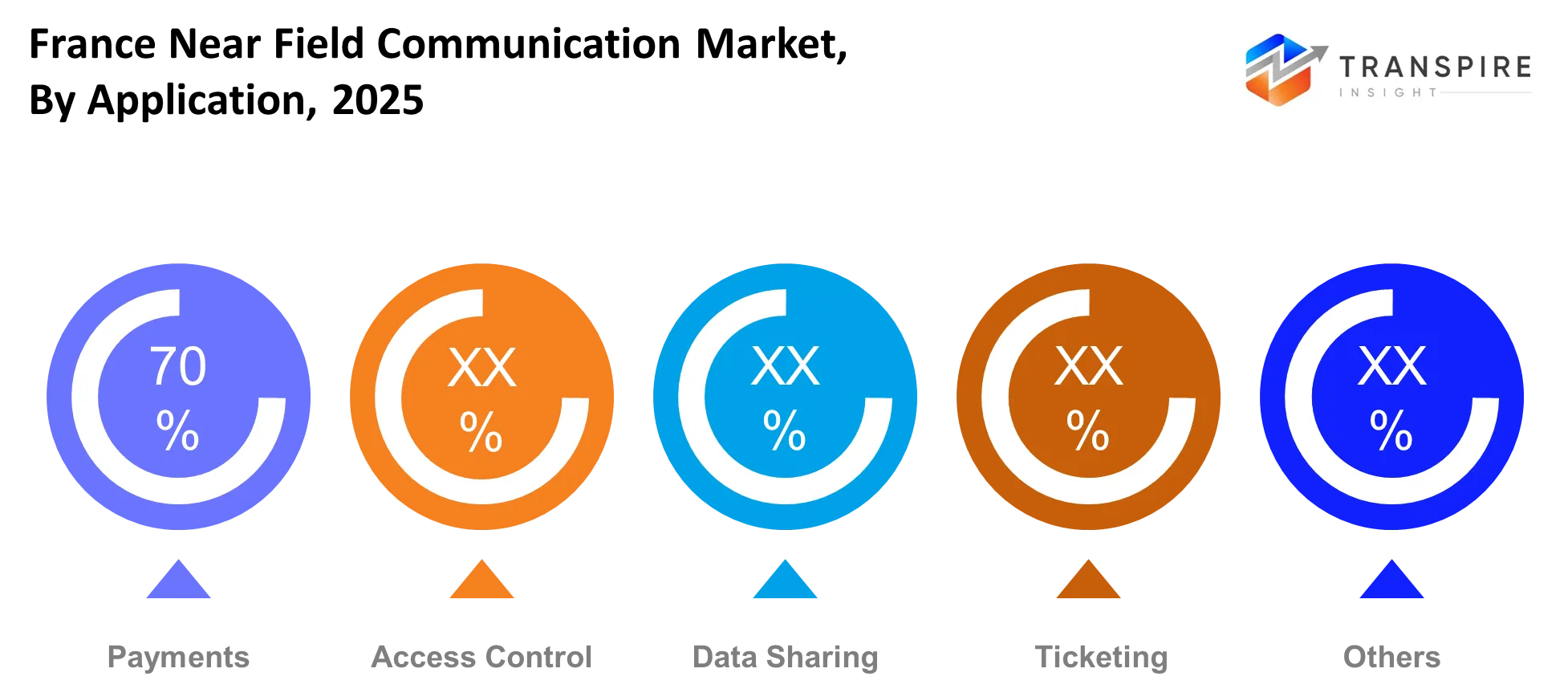
- Now, for what’s actually driving the market, payment applications take about 48% of the overall share.
- This seems tied to secure tap to pay integration, spanning banking institutions plus fintech platforms.
- Access control, and digital identity verification solutions sit at around 24% share, and it feels pushed by corporate security refreshes , and also by government digital ID initiatives.
- On the device side, wearable NFC solutions are projected to grow at over 16% CAGR through 2033 as smart watches and fitness bands become more mainstream with buyers.
- For end users, retail and BFSI remain on top with about 42% share, mainly due to frequent transactions and the growing demand for fraud prevention.
- And, interestingly, transportation authorities look like the fastest-growing end user segment, with nearly 15% annual growth, since NFC enabled ticketing keeps replacing paper tickets, and even older magnetic systems.
What are the Key Drivers, Restraints, and Opportunities in the France Near Field Communication Market?
The main motor for the France Near Field Communication Market feels like, well, the accelerated drift toward cashless and contactless payment infrastructure across retail, transit, and public services. After the pandemic the pace got faster, because hygiene- minded payment habits, sort of nudged banks and merchants to upgrade POS terminals quickly and also enhance mobile wallet compatibility , not to mention the NFC bits in day to day use. On top of that, EU digital payment standardization is giving regulatory backup , which in turn boosts transaction volumes and pushes deeper NFC integration at the device level, especially in smartphones and various IoT endpoints
One big drag on the market is the fragmented legacy setup, mainly among smaller merchants and regional service providers. Quite a lot of systems still depend on older card readers or mixed payment arrangements , so a complete NFC shift ends up being expensive and kind of operationally tangled . As a result, uniform adoption moves slower, and a dual-system situation forms— which then reduces the efficiency lift and can delay revenue optimization for solution providers across the board
A notable opening is the way NFC could plug into digital identity frameworks and IoT-enabled smart city environments. France is putting more money into secure digital ID ecosystems for transport, healthcare, and administrative services. That gives NFC a route to step past pure payments into broader identity verification platforms , especially with Paris smart mobility initiatives and EU-backed digital infrastructure programs . In the long run, this could unlock stronger enterprise and government demand, even beyond the first wave of payment use cases
What Has the Impact of Artificial Intelligence Been on the France Near Field Communication Market?
In France, artificial intelligence is slowly but steadily enhancing NFC-enabled ecosystems, sort of making them more secure , more efficient and yes, a bit more “intelligent” in the day to day work. For payment and access control, AI-based fraud detection models look at behavioral patterns almost immediately, then they flag what looks like anomalous NFC transactions—so, fewer unauthorized attempts slip through, and the authentication accuracy gets better across banking and retail networks. In transport, machine learning is also getting involved to help optimize passenger flow, and to automate ticket validation analytics so operators can tune capacity planning, more or less, based on how people actually use the system.
At the same time predictive capabilities are becoming a key thing for infrastructure maintenance. NFC terminals and readers produce operational data, and AI systems use that information to anticipate hardware failure, adjust replacement schedules in a smarter way, and cut down downtime in busy places like metro stations and retail POS networks. The result is higher uptime and lower maintenance expenses for service providers, which sounds simple but is actually pretty consequential.
Still, adoption is held back by integration complexity, plus some data consistency headaches. A lot of NFC systems run across fragmented hardware ecosystems, and the data formats don’t match up cleanly, so the training quality of AI models can get limited. Also, doing real time AI processing at edge devices stays expensive, especially for small and medium merchants, and that’s slowing the broad deployment even if the efficiency benefits are fairly clear.
Key Market Trends
- In France, NFC payments sort of moved from “nice to have” optional feature to default standard in more than 70% of the urban retail terminals by 2025, you know, that kind of shift.
- Public transport meanwhile went from paper tickets into NFC based mobile ticketing, which helped bring down boarding time quite a bit, and also reduced operational friction in a noticeable way.
- Banks then pushed faster migration toward tokenized NFC transactions after 2023, mostly because the EU payment security upgrades increased the authentication requirements, and that wasn’t exactly optional.
- After 2024 wearable NFC devices grew really quick, driven by fitness use cases plus smart watch integration across the consumer tech ecosystem, sort of like a chain reaction.
- Retailers also stepped up NFC adoption after 2022 supply chain disruptions, they basically realized they needed quicker touchless checkout systems, for real.
- On the government side, identity programs integrated NFC chips into digital ID cards, to improve authentication and also reduce fraud exposure, at least that’s the intention.
- Tourism heavy regions experienced faster NFC rollout, because visitors wanted multilingual, frictionless payment experiences, and the demand kept rising.
- Competition got sharper too, since semiconductor firms expanded secure element chip production for mobile plus IoT NFC integration.
- And finally, cloud based NFC authentication platforms started gaining traction, often replacing standalone verification systems for enterprise settings, even when teams didn’t want to change too much at first.
France Near Field Communication Market Segmentation
By Type
NFC Chips hold the dominant position in the France Near Field Communication market, mainly because they get integrated a lot into smartphones, payment cards, and IoT enabled devices. This part really rides on wide scale rollouts in secure payment authentication systems and digital identity frameworks that banks and transport infrastructure rely on. Semiconductor manufacturers are basically pushing chip level innovation, with emphasis on encryption strength plus multi protocol compatibility. And even the high replacement cycles in consumer electronics , keeps the demand more or less steady, and ongoing.
NFC Tags also show steady adoption, mostly because of logistics tracking, retail inventory management and product authentication use cases. NFC Readers keep a consistent pull in POS terminals, access control systems, and industrial verification points, where reliability during checks matters. In the “Others” segment you typically find embedded NFC modules used for specialized industrial automation settings. During the forecast period, NFC Chips will keep leading because of that deep embedding in mobile ecosystems, while NFC Tags will likely grow faster in supply chain digitization and smart packaging applications.
By Application
Payments kinda represent the dominant application in the France Near Field Communication Market, mostly because contactless stuff is everywhere now, in retail, banking and even public transport systems. There is also pretty strong integration with mobile wallets and bank-issued cards which helps push high transaction volumes, across urban centers. Financial institutions keep choosing NFC enabled infrastructure upgrades, partly to satisfy security compliance, and also to lower cash dependency. So yeah this overall structural shift keeps fueling a steady need for secure payment authentication systems, on a continuous basis.
Access Control is seeing steady growth too, and it’s backed by enterprise security modernization plus government identity programs. Data Sharing is expanding through peer to peer device connectivity, especially where retail engagement matters, and for event management, along with smart advertising systems. Ticketing keeps picking up in public transport networks and entertainment venues because it improves efficiency and cuts operational costs. The “Others” category covers newer authentication methods, plus IoT pairing, which is still kind of emerging. Over time, payments will remain the top use case, but ticketing and access control are expected to grow faster, driven by institutional digital transformation, and these changes feel like they are stacking up.
To learn more about this report, Download Free Sample Report
By End-User
Retail actually is holding the lead in the France Near Field Communication market, mostly because of high frequency of transactions and fast take up of contactless checkout. Big retail chains, plus supermarkets have pushed out NFC enabled POS terminals across stores, mainly to make payments quicker and the customer flow smoother. Loyalty programs tied in with mobile wallets also makes adoption feel more natural, like, right there in physical locations. Retailers keep investing in omnichannel payment systems to make sure in store use and online integration stay in sync , or at least close enough.
BFSI shows a more steady kind of growth, it’s because of secure payment authentication and fraud prevention rules that banks must meet across their networks. Transport also expands quickly, driven by nationwide use of NFC based ticketing in metro and regional rail routes. Healthcare keeps climbing too, enabled by patient identification and equipment tracking applications inside hospitals. The “Others” bucket includes government and institutional rollouts, often centered on identity verification systems. During the forecast period, transport and healthcare should grow at a faster pace, because digitization of public services and infrastructure modernization keeps accelerating , even when budgets are tight.
By Device
Smartphones pretty much dominate the France Near Field Communication market , sort of because they turn into the main go to platforms for mobile payments , digital wallets , and also identity verification systems. With high smartphone penetration, plus NFC chips showing up in both mid range and premium phones, adoption stays steady. The operating system environments from big technology providers keep pushing NFC, using secure payment APIs , and authentication layers that feel more protected. On top of that, the continuing upgrades in mobile hardware help the whole device level dominance last for the long run.
Wearables are also growing, driven by more people adopting smartwatches and fitness trackers that come with embedded NFC payment functions. POS devices still hold solid, stable demand because retail and hospitality payment infrastructure keeps expanding. The “Others” bucket covers industrial terminals and embedded IoT devices used for authentication plus machine pairing. Over the forecast period, wearables are projected to grow the quickest, since consumers are leaning toward device agnostic, hands free payment experiences and even more integrated digital identity options.
What are the Key Use Cases Driving the France Near Field Communication Market?
In France the main use case is contactless payment, where NFC makes it possible to do quick and secure transactions via smartphones , cards and even wearables. This particular application seems to pull the most demand because most shops accept it, plus there is solid integration with banking systems and digital wallet ecosystems.
Other expanding uses show up in public transportation ticketing, also in corporate access control systems. Basically urban mobility operators and companies are adopting NFC based authentication more and more, to cut down day to day operational friction, and to make things easier for people, especially on metro lines and around office spaces.
Newer use cases are starting to appear too, like digital identity verification, and IoT device pairing. Government driven identity initiatives and smart city programs are testing NFC for safer citizen authentication, while connected devices use it for smoother onboarding and more reliable data exchange.
|
Report Metrics |
Details |
|
Market size value in 2025 |
USD 3.14 Billion |
|
Market size value in 2026 |
USD 3.48 Billion |
|
Revenue forecast in 2033 |
USD 7.15 Billion |
|
Growth rate |
CAGR of 10.83% from 2026 to 2033 |
|
Base year |
2025 |
|
Historical data |
2021 - 2024 |
|
Forecast period |
2026 - 2033 |
|
Report coverage |
Revenue forecast, competitive landscape, growth factors, and trends |
|
Regional scope |
France |
|
Key company profiled |
NXP, Sony, Samsung, Broadcom, Infineon, STMicroelectronics, Qualcomm, Apple, Google, Huawei, Texas Instruments, Renesas, Toshiba, Identiv, HID Global |
|
Customization scope |
Free report customization (country, regional & segment scope). Avail customized purchase options to meet your exact research needs. |
|
Report Segmentation |
By Type (NFC Chips, NFC Tags, NFC Readers, Others); By Application (Payments, Access Control, Data Sharing, Ticketing, Others); By End-User (Retail, BFSI, Transport, Healthcare, Others); By Device (Smartphones, Wearables, POS Devices, Others) |
Which Regions are Driving the France Near Field Communication Market Growth?
Île-de-France still leads the France Near Field Communication Market more or less because of the dense cluster of banking headquarters , transit infrastructure, and basically the bulk of retail transactions focused on Paris . You can see an advantage from early deployment of contactless metro ticketing across the RATP networks and, also, a broad embedding of NFC-enabled payment terminals in high- footfall commercial areas. On top of that, tight regulatory enforcement around digital payment security standards has pushed a more uniform rollout across banks, and public service operators. A fairly mature fintech ecosystem keeps it reinforced too, by continuously blending NFC into mobile wallets and authentication platforms , not just payments.
Auvergne-Rhône-Alpes takes the steady second position, mainly thanks to its diversified industrial base and a strong footprint of corporate campuses in Lyon and Grenoble. Unlike the capital zone , expansion is less tied to transit density and more powered by enterprise-grade adoption for manufacturing access control and secure workplace authentication . Long investment cycles coming from automotive and semiconductor players help keep deployments consistent for NFC-enabled identity systems. Because of this structure, the region can contribute continuously, with fewer swings than what you often see in the biggest urban hubs with high transaction volumes.
Provence-Alpes-Côte d’Azur is the fastest-growing region , driven by quick growth in tourism-linked digital payments and hospitality modernization programs along the Mediterranean corridor. More recently, new investments in smart city infrastructure across Nice and Marseille have rolled out NFC-based ticketing and visitor payment systems at scale . Local governments have also pushed contactless upgrades pretty aggressively, to handle seasonal visitor surges.
Who are the Key Players in the France Near Field Communication Market and How Do They Compete?
The France Near Field Communication Market is somewhat consolidated, with chip manufacturers, consumer tech giants, and secure identity specialists, all kinds going after differentiation, not really prices. The incumbents keep pretty strong control because of embedded chip ecosystems and long term device integration contracts, even as rivalry gets sharper around security performance, interoperability, and that whole ecosystem lock-in thing across mobile as well as IoT platforms. Getting in is still hard, mainly due to certification requirements, plus that deep integration with banking and government systems.
NXP Semiconductors boosts its stance via secure NFC controller chip innovation, concentrating on payment-grade encryption and broad embedding into mobile device architectures. STMicroelectronics stands out with Europe based semiconductor manufacturing, and also through long partnerships with automotive and industrial IoT players deploying NFC for access systems. Infineon Technologies pushes ahead using hardware security modules and cryptographic NFC offerings, which back banking authentication and identity verification scenarios. Apple and Google then drive ecosystem control through their mobile wallet platforms, embedding NFC deeply inside digital payments and identity frameworks, so the software hardware lock-in becomes strong enough to discourage switching. Also, HID Global keeps to a niche, leaning into secure identity cards and enterprise access control, and it grows by landing government and corporate security contracts throughout Europe.
Company List
- NXP
- Sony
- Samsung
- Broadcom
- Infineon
- STMicroelectronics
- Qualcomm
- Apple
- Huawei
- Texas Instruments
- Renesas
- Toshiba
- Identiv
- HID Global
Recent Development News
In February 2026, NFC Forum announced its latest technology roadmap update. The roadmap introduced advancements in security, testing standards, and higher data-rate capabilities aimed at improving interoperability across payment, mobility, and IoT ecosystems. The update strengthens NFC adoption in secure authentication and digital wallet expansion across global markets, including France.http://nfc-forum.org
In February 2026, STMicroelectronics completed the acquisition of NXP Semiconductors’ MEMS business. The deal expanded STMicroelectronics’ sensor and semiconductor portfolio, strengthening its position in automotive and industrial secure connectivity systems that support NFC-enabled authentication and device integration across Europe.https://newsroom.st.com
What Strategic Insights Define the Future of the France Near Field Communication Market?
The France Near Field Communication Market is slowly moving, maybe not that smoothly, toward deeper convergence with digital identity systems and those embedded financial ecosystems, where NFC becomes like a default authentication layer across payments, mobility, and government services. This is mostly pushed by the rising need for a more unified identity verification across real world and online environments, and it also gets momentum from EU-wide digital security frameworks that are meant to standardize trust.
But there is a risk that feels quieter, less visible, platform concentration. In practice, a small set of mobile operating system providers keeps taking more control over NFC access rules, and that could reduce ecosystem openness, and also curb innovation flexibility. Another opportunity, that people might overlook, comes from NFC enabled machine-to-machine authentication for IoT driven smart infrastructure, especially in transport as well as energy systems.
For the market participants, the priority should be interoperability first architecture, and they should invest in cross platform security certification strategies. This helps you avoid getting locked into a single ecosystem gatekeeper, while also positioning for expansion into identity-centric digital infrastructure programs across France over the next decade.
France Near Field Communication Market Report Segmentation
By Type
- NFC Chips
- NFC Tags
- NFC Readers
- Others
By Application
- Payments
- Access Control
- Data Sharing
- Ticketing
- Others
By End-User
- Retail
- BFSI
- Transport
- Healthcare
- Others
By Device
- Smartphones
- Wearables
- POS Devices
- Others
Frequently Asked Questions
Find quick answers to common questions.
The expected France Near Field Communication Market size for the market will be USD 7.15 Billion in 2033.
Key segments for the France Near Field Communication Market are By Type (NFC Chips, NFC Tags, NFC Readers, Others); By Application (Payments, Access Control, Data Sharing, Ticketing, Others); By End-User (Retail, BFSI, Transport, Healthcare, Others); By Device (Smartphones, Wearables, POS Devices, Others).
Major France Near Field Communication Market players are NXP, Sony, Samsung, Broadcom, Infineon, STMicroelectronics, Qualcomm, Apple, Google, Huawei, Texas Instruments, Renesas, Toshiba, Identiv, HID Global.
The France Near Field Communication Market size is USD 3.14 Billion in 2025.
The France Near Field Communication Market CAGR is 10.83% from 2026 to 2033.
- NXP
- Sony
- Samsung
- Broadcom
- Infineon
- STMicroelectronics
- Qualcomm
- Apple
- Huawei
- Texas Instruments
- Renesas
- Toshiba
- Identiv
- HID Global
Recently Published Reports
-
Apr 2026
3D Optical Profiler Market
3D Optical Profiler Market Size, Share & Analysis Report By Type (Desktop 3D Optical Profiler, and Portable 3D Optical Profiler), By Technology (Confocal Technology, and White Light Interference), By End-Use Industry (Manufacturing, Research Institutions, Automotive, Aerospace and Defense, Medical Devices, and Other), and Geography (North America, Europe, Asia-Pacific, Middle East and Africa, South and Central America), 2021 - 2031
-
Apr 2026
Depth Sensor Market
Depth Sensor Market Size, Share & Analysis Report By Type (Infrared Depth Sensors, Time-of-Flight (ToF) Sensors, Stereo Vision Sensors, Structured Light Sensors, Ultrasonic Depth Sensors), By Application (Automotive, Robotics, Gaming, Consumer Electronics, Industrial Automation, Healthcare, Security & Surveillance, Others), By End Users (Automotive Manufacturers, Consumer Electronics Companies, Healthcare Providers, Industrial Companies, Security Agencies, Gaming Companies, Robotics Companies, Others), and Geography (North America, Europe, Asia-Pacific, Middle East and Africa, South and Central America), 2021 – 2031
-
Apr 2026
Digital Manufacturing Market
Digital Manufacturing Market Size, Share & Analysis Report By Component (Hardware, Software, and Services), By Technology (Robotics, 3D Printing, Internet of Things (IoT), and Others), By Application (Automotive and Transportation, Aerospace and Defense, Consumer Electronics, Industrial Machinery, and Others), By Process Type (Computer-Based Designing, Computer-Based Simulation, Computer 3D Visualization, Analytics, and Others), and Geography (North America, Europe, Asia-Pacific, Middle East and Africa, South and Central America), 2021 – 2031
-
Apr 2026
Digital Visa Services Market
Digital Visa Services Market Size, Share & Analysis Report By Type (Individual Travelers, Group Travelers), By Application (Tourism, Business Travel, Others), and Geography (North America, Europe, Asia-Pacific, Middle East and Africa, South and Central America), 2021 – 2031