
France Near Field Communication (NFC) Tags Smart Label Market Size & Forecast:
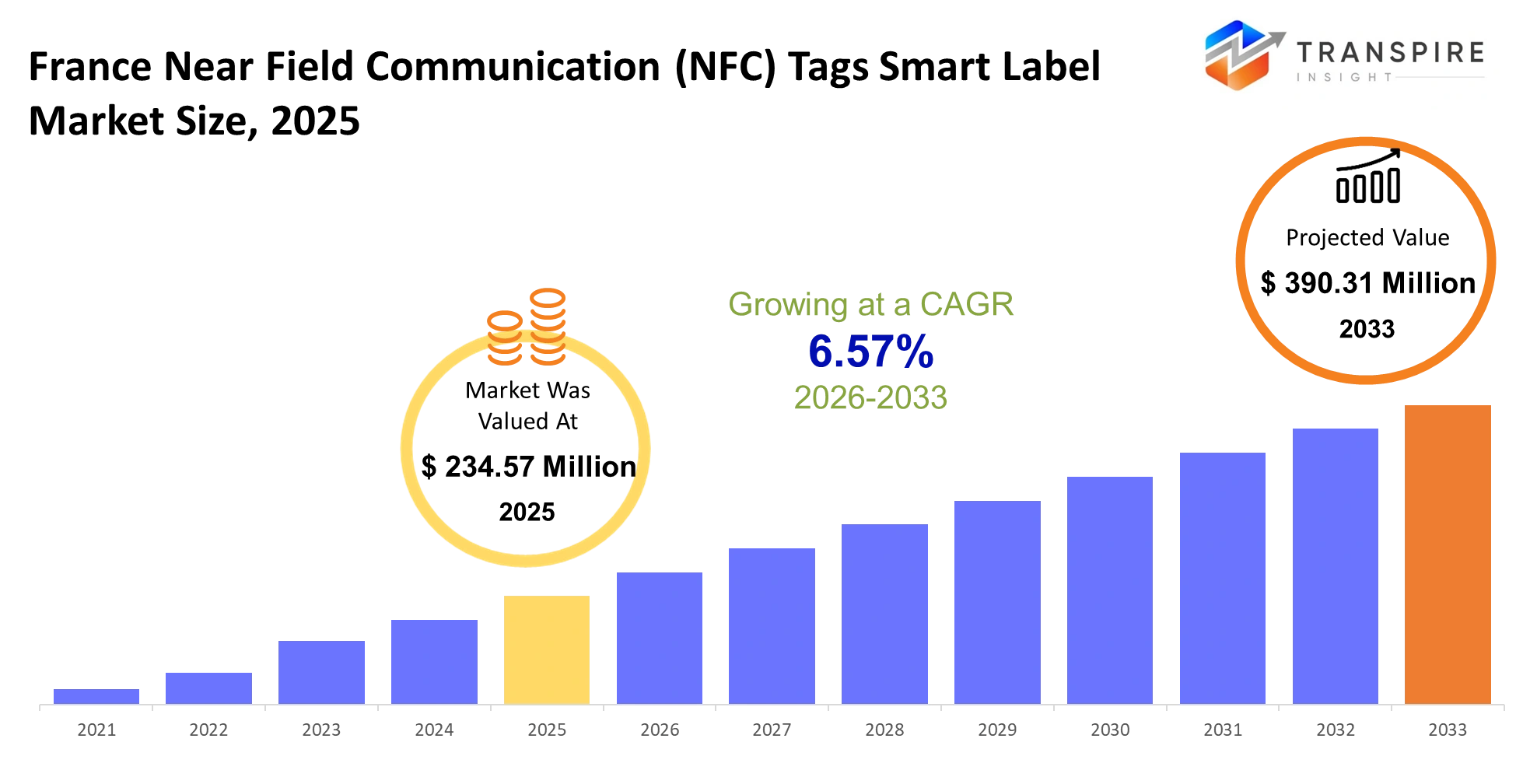
- France Near Field Communication (NFC) Tags Smart Label Market Size 2025: USD 234.57 Million
- France Near Field Communication (NFC) Tags Smart Label Market Size 2033: USD 390.31 Million
- France Near Field Communication (NFC) Tags Smart Label Market CAGR: 6.57%
- France Near Field Communication (NFC) Tags Smart Label Market Segments: By Type (Passive NFC, Active NFC, Smart Labels, Others); By Application (Retail Tracking, Payments, Authentication, Smart Packaging, Others); By End-User (Retailers, Logistics, BFSI, Healthcare, Electronics, Others); By Frequency (LF, HF, UHF, Others).
To learn more about this report,  Download Free Sample Report
France Near Field Communication (NFC) Tags Smart Label Market Summary
The France Near Field Communication (NFC) Tags Smart Label Market was valued at USD 234.57 Million in 2025. It is forecast to reach USD 390.31 Million by 2033. That is a CAGR of 6.57% over the period.
In France, NFC smart labels are getting used more and more to tie physical products with digital details, which allows instant check and verification, traceability, and some real customer touchpoints just by tapping a smartphone. In logistics and retail places, these kinds of tags deal with problems that show up day to day , like stopping fakes, closing those inventory visibility gaps, and reducing the messy manual tracking work. Over the last 3–5 years the market kinda moved from simple passive identification to connected packaging that carries a lot more data, powered by cloud-linked supply chain platforms. That shift feels more like a structural move toward real-time product intelligence systems, not just a minor upgrade.
One big reason that really pushed adoption was the post-pandemic supply chain disruption, because it made the weaknesses obvious , especially around inventory accuracy and product traceability across European distribution networks. So, as a consequence, companies in France increasingly blended NFC-enabled smart labels into their packaging workflows, in order to cut shrinkage, improve compliance visibility and also enable direct consumer engagement. This ends up supporting revenue opportunities too, through better product authentication services and even digital marketing layers that are placed right into physical goods.
Key Market Insights
- France Near Field Communication NFC Tags Smart Label market is kinda gaining momentum, mostly because retail is getting more digital, and in 2025 more than 40% of premium FMCG packaging is using it, or at least that’s what reports say.
- Industrial logistics looks like the biggest driver too, as enterprises move away from old barcode setups, toward NFC based real-time traceability plus anti counterfeiting verification style models, you know.
- Smart packaging still sits on top as the main product slice, mainly since it fits smoothly across cosmetics, pharmaceuticals, and luxury goods supply chains.
- Meanwhile NFC inlays inside adhesive labels are the fastest moving part through 2033, largely due to scale manufacturing and that lower deployment cost factor, which helps rollout across many SKUs.
- On the applications side retail product authentication holds the largest share, pushed by luxury brands trying to reduce counterfeit losses across European markets.
- At the same time consumer engagement is the one expanding quickest, especially when QR and NFC are combined in hybrid campaigns that enable more interactive marketing moments.
- Key end users include retail and logistics firms, though pharmaceutical organizations are the ones with the fastest adoption climb, largely tied to compliance obligations and similar rules.
- Competitive progress is being shaped by players like NXP Semiconductors STMicroelectronics Avery Dennison Infineon Technologies Zebra Technologies and Thales Group through chip advancements and smart packaging collaborations, so the pace stays pretty active.
What are the Key Drivers, Restraints, and Opportunities in the France Near Field Communication (NFC) Tags Smart Label Market?
In France's NFC smart label market, the main driver is the quick integration of digital traceability systems across retail, pharmaceutical, and logistics channels, it feels like everything is converging at once. This change is mostly set in motion by tougher EU-level product authentication plus anti counterfeit frameworks, so companies end up using NFC enabled labeling for end to end visibility. The direct outcome is noticeably more adoption for high value goods, where brands can push extra revenue via product verification services, consumer interaction platforms, and also by cutting down losses caused by counterfeit infiltration.
One key restraint is the rather high integration complexity inside older packaging and supply chain setups. A lot of mid sized manufacturers work with split ERP and inventory architectures, they are not really natively compatible with NFC based data ecosystems. Because of that, rollout timelines get slower, and upfront implementation costs rise, which kind of suppresses adoption in the short term even if the longer run efficiencies look strong. It also tends to create uneven market reach between big enterprises and smaller local producers, which is annoying in practice.
A big opportunity shows up when NFC blends with cloud analytics along with blockchain traceability platforms. In France, the luxury goods segment is strong, so it forms a good setting for advanced smart labeling ecosystems, especially for wine, cosmetics, and designer product exports. As NFC tags start acting like data gateways rather than just simple identifiers, enterprises can benefit from predictive inventory control, dynamic pricing schemes, and direct to consumer digital engagement layers.
What Has the Impact of Artificial Intelligence Been on the France Near Field Communication (NFC) Tags Smart Label Market?
Artificial intelligence is getting more and more involved in boosting the practical worth of NFC-enabled smart labeling systems in France, sort of turning raw tag contacts into useful supply chain intelligence, and not just keeping things “recorded”. In logistics and retail ecosystems, AI models are studying tap-frequency traces, shipment movement rhythms, and inventory scan events to help automate tracking routines and cut down the need for constant human rechecking in the warehouse. As a result, operational precision gets better in busy distribution hubs, and labeling mistakes that used to mess up inventory reconciliation are happening less.
Right now, predictive models are also being used to estimate how fast stock may run down, tune replenishment schedules, and spot anomalies in how products move across retail chains. In pharmaceutical supply chains, machine learning helps with compliance monitoring by flagging unusual handling behaviors that could be early hints of temperature breaches or distribution delays. Taken together, these tools support clearer gains in inventory turnover efficiency, less wastage, and stronger demand forecasting accuracy overall.
Still, AI use in NFC smart labeling is not completely smooth, because data integration is pretty fragmented across different enterprise platforms. A lot of organizations struggle to bring together live tag information with older ERP environments, which then limits both the model quality and the ability to scale. On top of that, the data that’s captured at point-of-scan places can be inconsistent, so predictive results become less dependable, especially in retail areas where digitization is not as high, and the capture process is more uneven.
Key Market Trends
- NFC-enabled packaging adoption jumped quite a lot after 2023, and French luxury brands started folding digital authentication layers into their physical product lines, kind of like “ prove it right there” without much fuss.
- In France, pharmaceutical companies also pushed NFC tracking harder in 2025 to satisfy tougher EU serialization rules and compliance reporting, so yeah it was not only optional anymore.
- Then retail began swapping barcodes for NFC setups more and more, which helped inventory accuracy, and cut down checkout plus logistics mistakes during 2024–2026. Like noticeably.
- Hybrid NFC-QR smart labels started gaining traction in 2025, because they let consumers use two paths, dual-channel engagement and also better marketing analytics, the numbers look cleaner.
- At the same time, counterfeiting worries in luxury goods pushed brands toward NFC authentication systems especially for wine and cosmetics exports from France , where verification matters more.
- Manufacturers went on and adopted cloud-linked NFC ecosystems, to get real-time supply chain visibility and predictive inventory management capabilities, basically staying ahead instead of reacting late.
- Avery Dennison along with STMicroelectronics ramped up NFC inlay production capacity across Europe, as demand for smart packaging kept climbing and moving faster than expected.
- Sustainability regulations in France also encouraged a reduction of paper based tracking systems, which sped up the shift toward digital labels across logistics networks.
- And finally, when NFC got integrated with AI analytics platforms, warehouse efficiency improved since it supported automated anomaly detection and demand forecasting refinements, all in one flow.
France Near Field Communication (NFC) Tags Smart Label Market Segmentation
By Type
Passive NFC still holds the dominant place in the France NFC Tags Smart Label Market , mainly because it works with low cost, no battery in sight, and it plugs into packaging and logistics setups without much hassle. Big retail players and FMCG brands often choose passive tags, not only for tracking but also for authentication, because they can roll out lots of units at once, without making the package design more complicated. There is also the point that manufacturing can stay standardized, and the compatibility with current NFC enabled smartphones is pretty solid, so the adoption feels smoother in consumer facing areas. Even so, the demand is still mostly clustered in high volume uses where saving money matters more than advanced features.
Active NFC is smaller though, it tends to show up in higher value industrial and logistics scenarios, where continuous data transfer is actually needed. Smart labels are climbing faster, as companies move toward connected packaging systems that pair NFC chips with cloud analytics, so product visibility becomes more real time and less guesswork. The “Others” group, including hybrid and sensor enabled tags, is slowly growing too, especially in pilot programs in pharmaceuticals and cold chain monitoring. Over the forecast period, smart labels should pick up even more share, since traceability and digital engagement are getting top priority. That pushes development teams toward more integrated, data heavy tagging options, rather than just using them for simple identification, and nothing else.
By Application
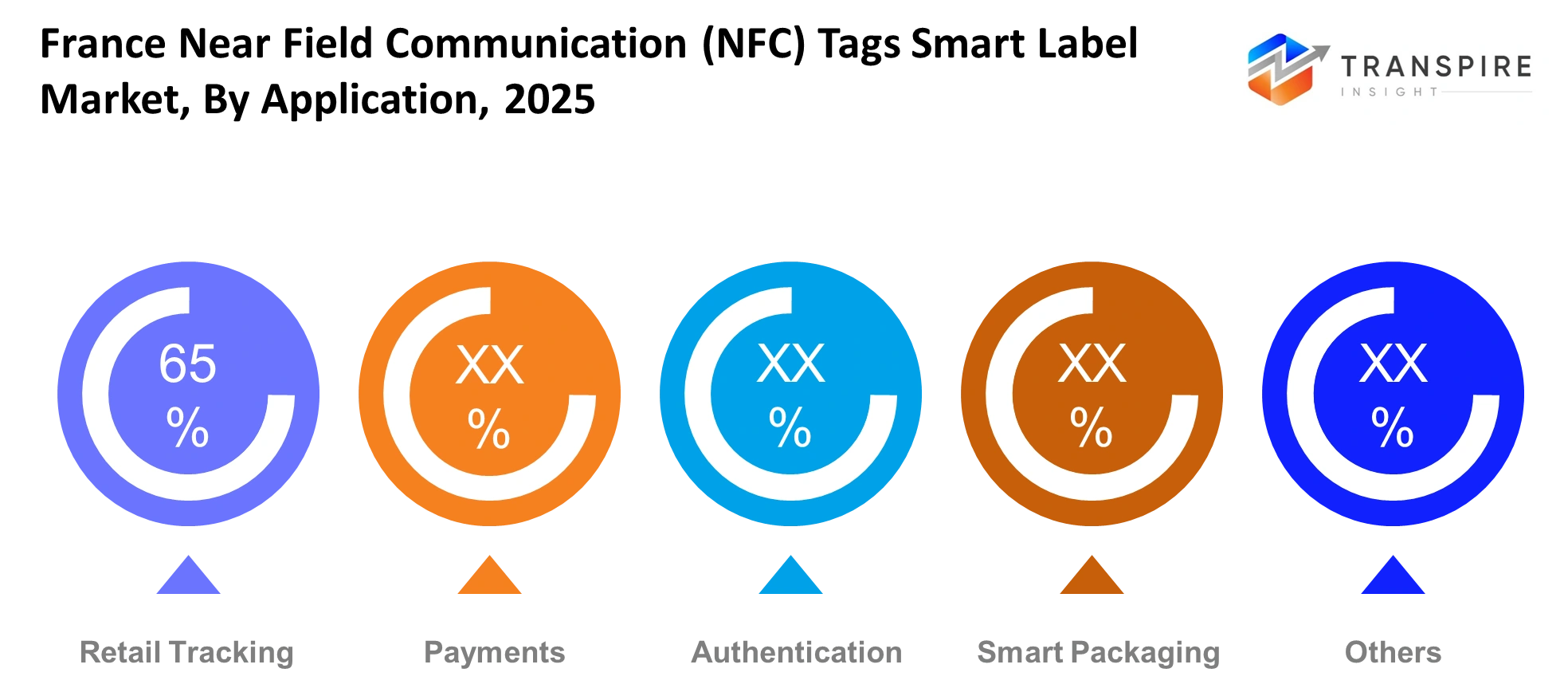
Retail tracking mostly takes the lead in the France NFC Tags Smart Label Market, mostly because retailers rely on NFC tags for better inventory accuracy, lower shrinkage, and real time shelf monitoring. Big supermarket groups and luxury retailers deploy NFC enabled labeling to boost supply chain visibility and keep product authenticity intact across distribution routes, and yes even during tricky logistics windows. This part of the market is also pushed by omnichannel retailing, meaning physical and digital inventory systems must stay constantly aligned, otherwise you get stock mismatches, and fulfillment delays that feel sudden.
At the same time, smart packaging keeps showing up as a fast growing application, with brands putting NFC tags right into the packaging for consumer interaction, product confirmation, and post purchase services. Authentication is gaining momentum too, especially in luxury items, cosmetics, and pharmaceuticals, where stopping counterfeits is both a compliance need and a revenue priority. Payments, though, still stays fairly niche, but it can enable contactless micro transactions in closed loop setups. In the longer run, smart packaging plus authentication are expected to outpace traditional retail tracking in growth speed, since many brands move from purely operational needs toward consumer facing digital interaction frameworks.
To learn more about this report, Download Free Sample Report
By End-User
Retailers show up as the leading end user cluster in the France NFC Tags Smart Label Market, mainly because they’re taking them up very fast across inventory handling, product verification, and also customer interaction use cases. Big retail groups and luxury brands count on NFC driven labels to lower the risk of fake goods, and at the same time boost the in store digital feel. What’s also helping them is the tight fit with e-commerce systems, because when physical stock and online catalog data sync together, you get better day to day efficiency, plus more chances to catch revenue.
Logistics providers build a solid secondary layer, since supply chain sightlines and shipment tracing are becoming kinda the core of smoother European trade. In the healthcare space, uptake is really moving ahead, pushed by compliance needs around drug traceability and cold chain temperature monitoring. For BFSI, adoption is still somewhat restrained, though the labels help with secure asset marking and document authentication in a few specific finance workflows. Electronics makers also increasingly install NFC labels for warranty follow up, and anti tamper protection, so issues are easier to spot earlier. Looking ahead, healthcare and logistics should climb at a quicker pace than retail, largely because regulation keeps tightening and demand grows for end to end traceability frameworks.
By Frequency
High Frequency (HF) kinda takes the lead in the France NFC Tags Smart Label Market, mainly because it is the core standard for NFC-enabled smartphones, so it supports smooth consumer interactions, verification, and payment based applications. HF tags are already very common in retail and smart packaging spaces, where a direct tap style engagement is needed. And because device manufacturers, plus global standards groups, keep backing this, the HF side stays in the driver seat across France’s more consumer facing industries.
Ultra-High Frequency (UHF) is now picking up pace in logistics and industrial monitoring, since it offers a longer read distance and is well suited for bulk scans in warehouses and distribution hubs. Low Frequency (LF) still feels more like a niche lane, used for specialized access control and asset traceability, where short-range protection is the main thing. The “Others” group covers newer multi-frequency hybrid tags, made for interoperability across different platforms and systems. During the forecast window, UHF should expand faster than HF, especially in backend logistics applications , while HF is expected to keep its strength in consumer engagement , as well as smart packaging style scenarios.
What are the Key Use Cases Driving the France Near Field Communication (NFC) Tags Smart Label Market?
In France, the dominant use case is product authentication for luxury goods and pharmaceuticals, where NFC smart labels kinda help verify the origin , stop counterfeiting, and generally make consumers feel more confident at the point of purchase. These high-value exports, like wine, cosmetics and designer fashion, rely on this same mechanism quite a lot , because brands need secure digital identity layers that stay connected to the physical item, somehow.
Then there are secondary things that are growing, especially in retail logistics and warehouse tracking . NFC tags are improving inventory accuracy, and they also reduce those manual scanning blunders that happen too often. A lot of FMCG businesses and e-commerce fulfillment operators are moving toward these labels, not only to speed up stock visibility but also to support last-mile traceability , more or less.
More emerging use cases are around interactive consumer engagement and warranty lifecycle management. Brands are embedding NFC tags to give after-sales services, digital manuals , and also tailored promotional moments. This is particularly common in premium automotive and electronics sectors, because customers expect a smoother kind of experience.
|
Report Metrics |
Details |
|
Market size value in 2025 |
USD 234.57 Million |
|
Market size value in 2026 |
USD 249.98 Million |
|
Revenue forecast in 2033 |
USD 390.31 Million |
|
Growth rate |
CAGR of 6.57% from 2026 to 2033 |
|
Base year |
2025 |
|
Historical data |
2021 - 2024 |
|
Forecast period |
2026 - 2033 |
|
Report coverage |
Revenue forecast, competitive landscape, growth factors, and trends |
|
Regional scope |
France |
|
Key company profiled |
NXP, Avery Dennison, Smartrac, HID, STMicroelectronics, Infineon, Identiv, Zebra, Checkpoint, Alien Tech, Thinfilm, Sony, Samsung, Broadcom, Impinj. |
|
Customization scope |
Free report customization (country, regional & segment scope). Avail customized purchase options to meet your exact research needs. |
|
Report Segmentation |
By Type (Passive NFC, Active NFC, Smart Labels, Others); By Application (Retail Tracking, Payments, Authentication, Smart Packaging, Others); By End-User (Retailers, Logistics, BFSI, Healthcare, Electronics, Others); By Frequency (LF, HF, UHF, Others). |
Which Regions are Driving the France Near Field Communication (NFC) Tags Smart Label Market Growth?
Île-de-France comes out on top in the France NFC smart label market, mostly because it has this dense clustering of luxury brands, the headquarters of big multi national retailers, and pretty advanced digital commerce infrastructure . In a way, Paris based enterprises seem to push adoption first, not only for early marketing reasons, but because they deal with sharper counterfeiting exposure in fashion and cosmetics export flows. There’s also a practical advantage from stricter enforcement around product traceability and sustainability style labeling, so adoption isn’t only “optional” it kind of becomes standard. Add to that, logistics is tightly connected with major airports and distribution nodes, and that really helps NFC roll out quickly across premium supply chains.
Auvergne-Rhône-Alpes sits as a fairly steady second tier region, driven by its strong industrial manufacturing fabric and pharmaceutical production clusters around Lyon . Unlike Île-de-France where demand is more luxury led, this area leans on structured industrial compliance and those longer enterprise investment cycles. Pharmaceutical exporters and chemical producers tend to favor consistent serialization and end to end traceability systems. The result is demand that feels stable , even if it’s less jumpy than the Paris side, and it’s supported by older , well established logistics corridors reaching Switzerland, Italy, and broader EU markets.
Hauts-de-France looks like the fastest growing region, and it’s tied to port modernization plus cross border logistics expansion connected with Belgium and Northern Europe. More recently, investments in automated warehousing and digital freight corridors have pushed NFC integration deeper into packaging and transport operations. That transition is starting to change how visible the supply chain is, especially for high volume industrial goods. For investors and tech providers, the region has strong upside because logistics digitization is expected to keep deepening through 2026–2033.
Who are the Key Players in the France Near Field Communication (NFC) Tags Smart Label Market and How Do They Compete?
The competitive landscape is kinda moderately consolidated, with global semiconductor firms and smart packaging specialists in the lead for high-value NFC technology supply. At the same time, fragmented regional label converters do the downstream customization, sort of taking the last mile, so to speak. In practice, competition gets pushed mainly by chip performance, tag durability, how well things integrate with cloud systems, and whether mass production can be done in a cost efficient way. Incumbents tend to be strengthening their positions through ecosystem partnerships not just standalone product competition, especially across retail and pharmaceutical traceability networks.
Companies like NXP Semiconductors and STMicroelectronics compete with NFC chip innovation, putting emphasis on higher memory capacity and also energy efficient passive tag behavior. Their edge is largely from deep integration with mobile device ecosystems, which helps deliver smooth consumer-level authentication experiences. They are also expanding via semiconductor supply agreements with European packaging integrators, and yeah the timing matters.
Avery Dennison and Checkpoint Systems specialize in smart label manufacturing and retail deployment solutions. They differentiate through scalable label conversion infrastructure as well as anti theft retail systems. Their growth strategy leans on partnerships with FMCG and luxury brands for end-to-end packaging integration, even when the requirements feel a little unusual.
Zebra Technologies and HID Global are more focused on enterprise logistics, plus identity solutions. They keep expanding through warehouse automation ecosystems and RFID-NFC hybrid deployments. Their main competitive advantage sits in software hardware integration across supply chain visibility platforms, where the whole stack needs to feel coordinated.
Company List
- NXP
- Avery Dennison
- Smartrac
- HID
- STMicroelectronics
- Infineon
- Identiv
- Zebra
- Checkpoint
- Alien Tech
- Thinfilm
- Sony
- Samsung
- Broadcom
- Impinj
Recent Development News
In February 2026, Avery Dennison announced the expansion of its NFC inlay portfolio using Pragmatic Semiconductor’s flexible chip technology. The launch supports digital product passports and product authentication use cases, strengthening smart label adoption across European retail and healthcare supply chains, including France.
Source: http://www.labelsandlabeling.com
In February 2026, Avery Dennison introduced its NFC Connect product line powered by Pragmatic Semiconductor’s FlexIC technology for mass-market NFC smart labels. The development improves scalability and sustainability of NFC tags used in packaging, enabling wider deployment in France’s luxury and FMCG traceability systems.
Source: http://rfid.averydennison.com
What Strategic Insights Define the Future of the France Near Field Communication (NFC) Tags Smart Label Market?
In France, the NFC smart label market is kind of moving, structurally, toward fully connected product ecosystems where each physical item turns into a data node inside retail and industrial supply chains. It is being pushed by a sort of meeting point between regulatory traceability duties, and consumer expectations for clearer product insight, especially around luxury and pharmaceutical exports. In the next 5–7 years, NFC tags will more and more behave like gateways into AI focused product intelligence platforms, not just lone identifiers.
A less obvious worry is technology substitution, like advanced computer vision paired with blockchain-only authentication systems, which could end up lowering how much some segments depend on physical tagging . At the same time, there’s another emerging chance, the integration of NFC with digital product passports that are mandated under EU sustainability rules, and that could noticeably widen adoption among mid tier manufacturers.
For market players , the next step should be ecosystem partnerships that bring together chip manufacturing, label fabrication, and cloud analytics. Because standalone NFC solutions will tend to feel less competitive once traceability becomes fully integrated in these environments.
France Near Field Communication (NFC) Tags Smart Label Market Report Segmentation
By Type
- Passive NFC
- Active NFC
- Smart Labels
- Others
By Application
- Retail Tracking
- Payments
- Authentication
- Smart Packaging
- Others
By End-User
- Retailers
- Logistics
- BFSI
- Healthcare
- Electronics
- Others
By Frequency
- LF (Low Frequency)
- HF (High Frequency)
- UHF (Ultra-High Frequency)
- Others
Frequently Asked Questions
Find quick answers to common questions.
The approximate France Near Field Communication (NFC) Tags Smart Label Market size for the market will be USD 390.31 Million in 2033.
Key segments for the France Near Field Communication (NFC) Tags Smart Label Market are By Type (Passive NFC, Active NFC, Smart Labels, Others); By Application (Retail Tracking, Payments, Authentication, Smart Packaging, Others); By End-User (Retailers, Logistics, BFSI, Healthcare, Electronics, Others); By Frequency (LF, HF, UHF, Others).
Major France Near Field Communication (NFC) Tags Smart Label Market players are NXP, Avery Dennison, Smartrac, HID, STMicroelectronics, Infineon, Identiv, Zebra, Checkpoint, Alien Tech, Thinfilm, Sony, Samsung, Broadcom, Impinj.
The France Near Field Communication (NFC) Tags Smart Label Market size is USD 234.57 Million in 2025.
The France Near Field Communication (NFC) Tags Smart Label Market CAGR is 6.57% from 2026 to 2033.
- NXP
- Avery Dennison
- Smartrac
- HID
- STMicroelectronics
- Infineon
- Identiv
- Zebra
- Checkpoint
- Alien Tech
- Thinfilm
- Sony
- Samsung
- Broadcom
- Impinj
Recently Published Reports
-
Apr 2026
3D Optical Profiler Market
3D Optical Profiler Market Size, Share & Analysis Report By Type (Desktop 3D Optical Profiler, and Portable 3D Optical Profiler), By Technology (Confocal Technology, and White Light Interference), By End-Use Industry (Manufacturing, Research Institutions, Automotive, Aerospace and Defense, Medical Devices, and Other), and Geography (North America, Europe, Asia-Pacific, Middle East and Africa, South and Central America), 2021 - 2031
-
Apr 2026
Depth Sensor Market
Depth Sensor Market Size, Share & Analysis Report By Type (Infrared Depth Sensors, Time-of-Flight (ToF) Sensors, Stereo Vision Sensors, Structured Light Sensors, Ultrasonic Depth Sensors), By Application (Automotive, Robotics, Gaming, Consumer Electronics, Industrial Automation, Healthcare, Security & Surveillance, Others), By End Users (Automotive Manufacturers, Consumer Electronics Companies, Healthcare Providers, Industrial Companies, Security Agencies, Gaming Companies, Robotics Companies, Others), and Geography (North America, Europe, Asia-Pacific, Middle East and Africa, South and Central America), 2021 – 2031
-
Apr 2026
Digital Manufacturing Market
Digital Manufacturing Market Size, Share & Analysis Report By Component (Hardware, Software, and Services), By Technology (Robotics, 3D Printing, Internet of Things (IoT), and Others), By Application (Automotive and Transportation, Aerospace and Defense, Consumer Electronics, Industrial Machinery, and Others), By Process Type (Computer-Based Designing, Computer-Based Simulation, Computer 3D Visualization, Analytics, and Others), and Geography (North America, Europe, Asia-Pacific, Middle East and Africa, South and Central America), 2021 – 2031
-
Apr 2026
Digital Visa Services Market
Digital Visa Services Market Size, Share & Analysis Report By Type (Individual Travelers, Group Travelers), By Application (Tourism, Business Travel, Others), and Geography (North America, Europe, Asia-Pacific, Middle East and Africa, South and Central America), 2021 – 2031