

United Kingdom Mini Chainsaw Market Summary
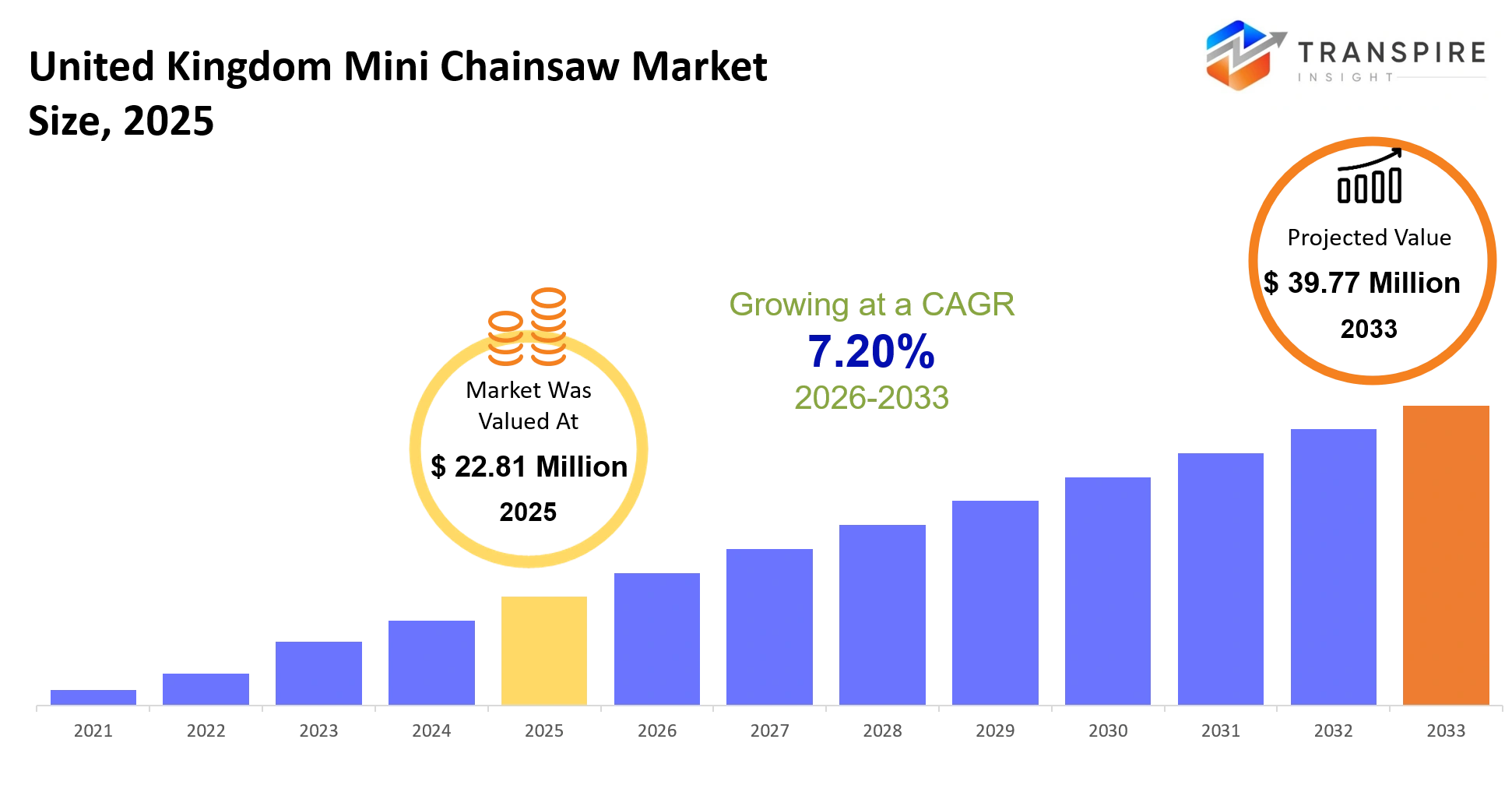
As per Transpire Insight Analysis the United Kingdom Mini Chainsaw Market size is estimated at USD 22.81 Million in 2025 and is anticipated to reach USD 39.77 Million by 2033, growing at a CAGR of 7.20% from 2026 to 2033.
The United Kingdom mini chainsaw market supports fast and kinda precise cutting jobs where full sized chainsaws are a bit too bulky, so homeowners, landscapers, arborists, and maintenance crews can trim branches, clear garden waste, and handle lighter wood-cutting tasks with better control, and often with less physical effort. In the last three to five years, the scene has moved away from corded gear and petrol-powered tools toward compact cordless options powered by high performance lithium-ion batteries. That switch made things more portable, less fussy on maintenance, and it also broadened where people actually use these tools, both in homes and at commercial sites. After the pandemic, supply chain disruptions, plus shifts in trade conditions, put more focus on whether products are there when needed, how local inventory is managed, and how suppliers can be diversified. And as battery performance keeps improving, together with motor efficiency, more users are swapping out manual cutting tools for mini chainsaws that shorten labour time and lift productivity. In the end manufacturers and retailers can pull in higher value sales by offering feature-rich product lines that work with the same battery system.
United Kingdom Mini Chainsaw Market Size & Forecast:
- United Kingdom Mini Chainsaw Market Size 2025: USD 22.81 Million
- Expected Market Value 2033: USD 39.77 Million
- Forecast CAGR: 7.20%
- Leading region in 2025: England
- Fastest Growing region: Scotland
- Key Profile: STIHL, Husqvarna, Makita, DeWalt, Bosch, Greenworks, WORX, Black+Decker, Ryobi, Oregon Tool, Milwaukee Tool, Einhell, EGO Power+, Hyundai Power Products, Cobra Garden
Key Market Insights
- England kinda dominated the market, with roughly 72% market share in 2025, helped by dense residential landscaping work and these already established retail distribution networks, you know.
- Scotland should be the fastest-growing regional market over 2025–2032, mainly because forestry maintenance programs and rural property investments keep pushing equipment purchases, faster than elsewhere.
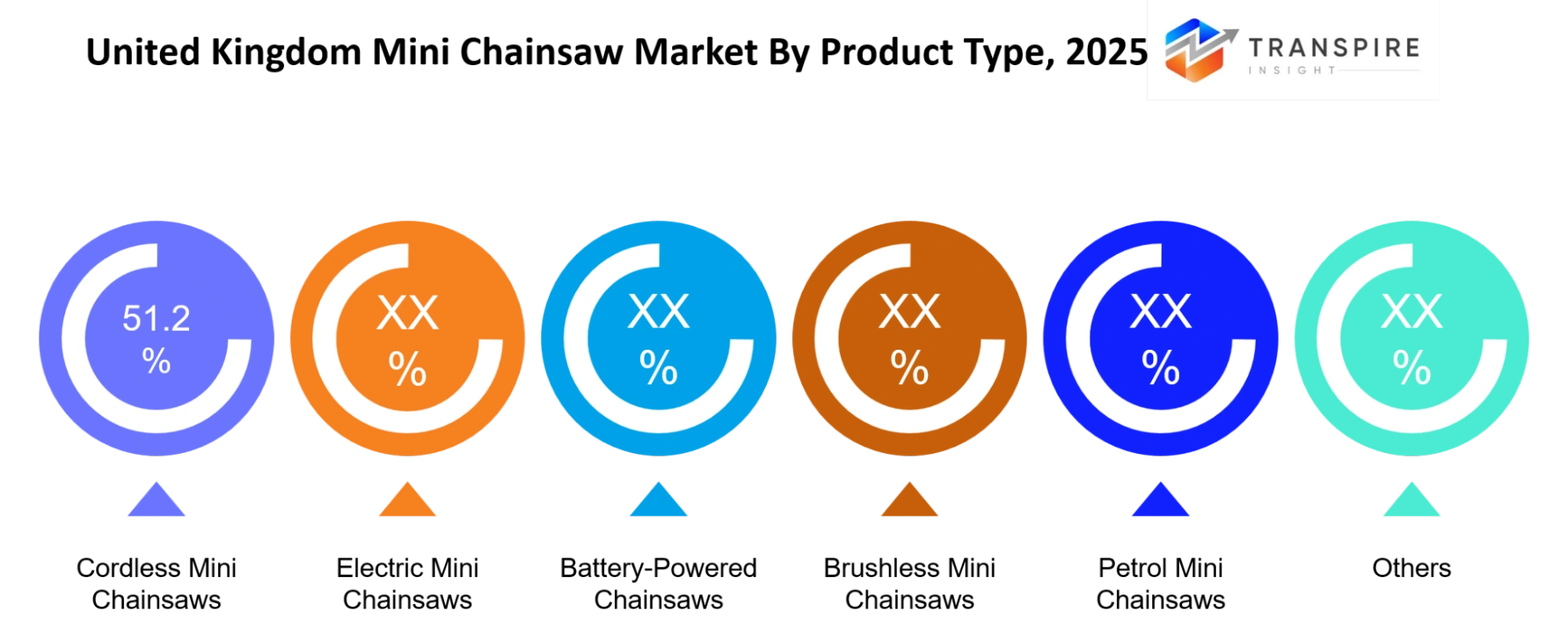
- Cordless mini chainsaws basically led the product segment in 2025 with close to 68% share, since better batteries mean longer runtime , and also less upkeep expenses.
- Brushless motor mini chainsaws were the second biggest segment, and they picked up more share by offering higher durability, plus stronger cutting efficiency for professional users.
- Smart models that work with batteries should become the fastest-growing segment by 2032, as makers roll out more interchangeable power-tool ecosystems, and connected battery platforms too.
- For applications, residential gardening took the lead with about 57% market share in 2025. That’s because people do routine tree pruning, handle storm cleanup, and manage seasonal property upkeep pretty regularly.
- Professional landscaping is still expected to grow the quickest through the forecast period, since contractors swap out manual cutting tools for compact powered alternatives, bit by bit. \
- On the end-user side, household consumers held the top position in 2025 at nearly 61% share, because compact tools are easier to handle and also keep ownership costs lower.
- Commercial landscaping companies are expected to become the fastest-growing end-user category through 2032, as labor productivity turns into a stronger procurement priority, for sure.
What are the Key Drivers, Restraints, and Opportunities in the United Kingdom Mini Chainsaw Market?
The strongest growth driver is the quick shift from petrol-powered equipment into these compact cordless platforms, kinda, basically. Better lithium ion batteries, tighter emission expectations, and lower day-to-day operating costs pushed the change. Now users do routine pruning with lighter gear that starts instantly and feels like it needs less servicing. Contractors too, manage downtime better by moving to interchangeable battery systems across multiple tools. That practical edge makes job cycles shorter, boosts the equipment replacement rate, and helps manufacturers bring in more money via premium battery ecosystems.
The biggest structural restraint is reliance on imported batteries, electronic parts, and precision motors. To diversify supply, firms need years of supplier vetting plus manufacturing investment. On top of that, price swings keep messing with procurement planning for distributors and retailers. Smaller brands often can’t hold steady inventory when supply gets disrupted, so product launches slip and promotional campaigns get limited. From a Transpire Insight review of regional procurement announcements and launch timing, supply chain concentration stays the main execution risk. So, market entry gets slower, and value-sensitive customer segments postpone purchasing decisions.
The next opportunity seems to sit in connected battery platforms and smart upkeep technologies, more or less, because embedded diagnostics, Bluetooth connectivity and digital fleet management are slowly moving into smaller outdoor power equipment. Commercial landscaping businesses are starting to really value predictive maintenance and battery health monitoring, not just “repair when it breaks”. Manufacturers that blend software, compatible accessories, and subscription based support service, can likely keep customers longer while also building a steady recurring revenue stream beyond the very first equipment sale.
What Has the Impact of Artificial Intelligence Been on the United Kingdom Mini Chainsaw Market?
Artificial intelligence and digital technologies are improving day by day, it’s like they’re quietly, but steadily helping operations across the United Kingdom mini chainsaw market. They do it by supporting smarter manufacturing, inventory planning, and equipment lifecycle management in ways that feel pretty practical. More and more manufacturers are using AI-enabled production monitoring to catch assembly defects earlier, sort of optimize quality control, and trim down material waste before the products even leave the factory floor. At the same time digital control systems make compliance reporting easier and they also tighten up production scheduling, especially across battery-powered equipment lines.
Then there’s machine learning, which looks at seasonal buying behaviour, weather forecasts, and retailer sales records, to sharpen demand estimates for compact chainsaws and related accessories. Predictive analytics also helps track battery performance, by estimating charging cycles, component wear, and likely replacement intervals. In the end these tools reduce surprise break downs, they improve inventory availability, and they help distributors keep up better with order fulfilment during busy gardening seasons. Manufacturers get extra advantages too, including smoother procurement planning and lower warehouse carrying costs, which is kind of a big deal for margins.
Still, for all these improvements AI adoption is not even across the board. The cost of putting everything in place can be high, which limits investment among smaller manufacturers and distributors. Plus, the results depend on large quantities of reliable operational data, and many businesses simply don’t have enough of it yet. And limited integration between older production systems and newer digital platforms slows things down too, so deployments drag out, and the full operational benefits of artificial intelligence end up arriving later for much of the broader cordless chainsaw industry.
Key Market Trends
- Lithium ion cordless stuff pushed past 70% of fresh premium launches by 2025 , sort of quietly swapping out petrol driven alternatives across both home and professional landscaping use cases.
- Brushless motor uptake moved faster from 2023 to 2025 , with contractors choosing more enduring service life and better cutting performance rather than sticking with the entry level pieces.
- After 2024 , interchangeable battery ecosystems grew really quickly , which nudged people into buying again inside one brand’s power tool family, and that kind of boosted customer retention.
- In the pricier models, connected battery management showed up more and more , letting commercial fleet operators track runtime and get maintenance warnings by 2025.
- Retailers also leaned harder into direct to consumer online sales from 2023 onward, so product access improved across the country and there was less need to rely on specialist dealers.
- Manufacturers went after a wider range of components following the recent supply hiccups , cutting procurement risk and making inventory more steady across United Kingdom distribution channels.
- Between 2024 and 2026 , professional landscaping contractors started using compact cutting devices more often , mainly to raise labour productivity on city upkeep jobs.
- More premium safety extras, like electronic chain brakes and overload protection, started appearing in a bigger share of new product releases after 2024.
- Big names such as STIHL, Husqvarna Group and Makita Corporation increased investment into battery platforms, in order to lock in stronger long term competitiveness.
United Kingdom Mini Chainsaw Market Segmentation
By Product Type:
Cordless Mini Chainsaws were basically out front because of the whole lightweight build , the battery response felt better, and the portability part was just easy enough for home users and for professional maintenance crews too. Battery-Powered Chainsaws also held a solid spot, mainly due to the longer run time plus fast charging, so daily cutting jobs could continue without any fuel fuss, which is kind of nice. Brushless Mini Chainsaws picked up broader traction because the motor did its job more efficiently, there was less upkeep required, and they tended to last longer , especially for people who use them quite often.
Electric Mini Chainsaws kept getting bought by users who like power that doesn't stop for work done in one place, like regular garden maintenance and similar tasks. Petrol Mini Chainsaws still kept their demand in tougher outdoor situations where longer operating hours really mattered , even if the maintenance side is a bit higher. Others were mostly compact special-purpose devices meant for specific cutting needs , which gives extra options across different price tiers and performance styles .
By Bar Length:
Below 4 Inch models pulled in buyers who wanted near full control during light pruning, indoor work, and those very precise trimming moments. Their small dimensions helped with handling ,and even lowered operator fatigue during the same cut routine again and again. More and more hobbyists showed up, and that actually supported pretty steady sales across city homes.
For the 4–6 Inch slice it really took the lead since the cutting capability felt balanced, so people used it for garden care, landscaping ,and the everyday branch removal. Past 6 Inch versions aimed at heavier outdoor tasks where thicker branches ask for more cutting depth. The rest covered specialized bar arrangements—those that were made for odd upkeep cases and professional usage, with certain operational demands that were, well, not optional.
By Application:
Gardening generated the biggest share , sort of, because regular tree trimming, hedge maintenance, and seasonal garden care needed compact and very efficient cutting equipment. Landscaping came right after that , since contractors tended to like portable tools that cut down on physical effort while they also improved day to day productivity. DIY activities kept rising too, as home improvement projects pushed more people toward user-friendly power tools, which seemed kind of less intimidating over time.
Forestry created steady demand for light upkeep and branch clearing, not so much for large-scale timber harvesting. Agriculture also backed equipment buying for orchard management, fence maintenance, and routine farm operations across the whole year. Others included municipal maintenance and upkeep for recreational areas, where compact cutting tools helped improve operational efficiency in practice.
By Distribution Channel:
Online sales grew quite fast, mostly due to more broad product availability , competitive pricing, and customer reviews which helped people decide what to buy. At the same time, digital platforms made it easier to reach premium brands in both cities and smaller countryside areas. With logistics networks getting stronger, delivery times got shorter and that kind of momentum encouraged repeat purchases too
Retail stores stayed important since many buyers like to inspect the item in person before they commit. Specialty stores also did well, especially with professional clients who wanted technical guidance, hands on demonstrations, and after-sales support. Direct sales and others kept moving forward as well, serving commercial buyers through business connections and tailored procurement arrangements
By End User:
Residential users basically had the biggest market share, since compact cutting equipment made everyday property upkeep a lot simpler, and you know the seasonal garden work too. It was easy to manage, there was less upkeep overall, and the cordless convenience kind of helped people swap out older manual tools. Affordability of the product then helped in a broader household take up across different income groups, so it wasn’t just one group really.
Commercial users saw strong growth too, because landscaping firms and maintenance contractors were leaning into labour efficiency and getting projects finished faster. Industrial demand stayed pretty stable for facility care and light operational jobs that still need portable cutting equipment. Then there were the other categories , like public sector organisations and institutional maintenance teams, with more specialized operational needs and all that.
By Battery Capacity:
Under 2000 mAh batteries stayed basically suitable for those occasional, household trimming jobs where a shorter runtime just fits the usual maintenance rhythm. The lower weight made things feel easier on the hands during quick cutting sessions, and it also supported entry level product demand. Price aware buyers kept choosing this group for plain, everyday applications.
For the 2000–4000 mAh segment it grabbed the biggest share, mostly because it delivered a steady work time while still staying light enough for both residential and professional use. Over 4000 mAh batteries pulled in by commercial operators who need longer runs between charging, and also faster daily output. There were also other variants, like customized battery configurations for specialized equipment, plus emerging high performance product platforms.
What are the Key Use Cases Driving the United Kingdom Mini Chainsaw Market?
Residential garden maintenance is still the biggest use case, mostly because compact cutting tools make branch trimming, shrub handling, and storm debris cleanup feel a lot faster and safer. People who own homes, property management teams, and even professional gardening services are buying these tools to reduce the amount of manual work, while finishing everyday outdoor chores with better efficiency, basically.
On the commercial side, landscaping work and agricultural maintenance are climbing steadily. Contractors in landscaping use compact equipment to keep parks, housing developments, and commercial sites in shape. They like the fact that mobility is high, and operation is quick, so their daily output stays on track. Orchard managers and small farms also lean on lighter cutting tools for seasonal pruning , and for fence upkeep too, without having to drag along bigger machines.
Utility vegetation management and railway corridor maintenance are also showing up as newer, but promising applications. Contractors who must keep safe clearance around power lines and transport infrastructure are looking at compact cutting equipment for light vegetation control. And since more money is being directed into public infrastructure upkeep, adoption across these specialized workplaces should grow over time.
|
Report Metrics |
Details |
|
Market size value in 2025 |
USD 22.81 Million |
|
Market size value in 2026 |
USD 24.45 Million |
|
Revenue forecast in 2033 |
USD 39.77 Million |
|
Growth rate |
CAGR of 7.20% from 2026 to 2033 |
|
Base year |
2025 |
|
Historical data |
2021 - 2024 |
|
Forecast period |
2026 - 2033 |
|
Report coverage |
Revenue forecast, competitive landscape, growth factors, and trends |
|
Regional scope |
United Kingdom (England, Scotland, Wales, Northern Ireland) |
|
Key company profiled |
STIHL, Husqvarna, Makita, DeWalt, Bosch, Greenworks, WORX, Black+Decker, Ryobi, Oregon Tool, Milwaukee Tool, Einhell, EGO Power+, Hyundai Power Products, Cobra Garden . |
|
Customization scope |
Free report customization (country, regional & segment scope). Avail customized purchase options to meet your exact research needs. |
|
Report Segmentation |
By Product Type (Cordless Mini Chainsaws, Electric Mini Chainsaws, Battery-Powered Chainsaws, Brushless Mini Chainsaws, Petrol Mini Chainsaws, Others); By Bar Length (Below 4 Inch, 4–6 Inch, Above 6 Inch, Others); By Application (Gardening, Landscaping, Forestry, DIY, Agriculture, Others); By Distribution Channel (Online, Retail Stores, Specialty Stores, Direct Sales, Others); By End User (Residential, Commercial, Industrial, Others); By Battery Capacity (Below 2000 mAh, 2000–4000 mAh, Above 4000 mAh, Others) |
Which Regions are Driving the United Kingdom Mini Chainsaw Market Growth?
England stayed the main regional market , sitting at about 72% of all revenue . A pretty steady mix of strong local council maintenance programs , plus mature retail infrastructure , and well-defined product safety rules helped keep equipment adoption consistent across both residential and commercial sides . With national distribution centers , established dealer networks, and solid supplier ties, product availability stayed dependable across the region . And all that continuing housing upkeep, ongoing professional landscaping demand , and the steady tilt toward battery powered outdoor equipment will , well, help lock in regional leadership for the rest of the forecast period , even if things shift a bit .
Scotland came in as the second biggest regional market , mostly because forestry work , rural property handling, and estate upkeep create a demand rhythm that’s a little different from England . Environmental regulations that stay fairly stable, along with long-term woodland management programmes, support predictable equipment replacement cycles , not just seasonal buying that happens when the calendar says so . Meanwhile, continued investment in rural infrastructure and land management services boosts buying confidence for commercial customers . And dependable procurement from contractors as well as agricultural businesses is expected to keep turning into fairly stable revenue during the next few years .
Wales is expected to see the quickest growth over the 2026–2033 stretch, as public investment into green infrastructure and countryside upkeep keeps expanding. More focus on vegetation control around transport routes and utility networks has prompted a broader take-up of compact, cordless gear. At the same time extra backing for sustainable land stewardship projects has helped spur more buying by local contractors , and maintenance service providers too. All of this momentum should lead to fairly compelling chances for manufacturers, distributors, and even fresh entrants who are aiming to push into growing regional customer circles.
Who are the Key Players in the United Kingdom Mini Chainsaw Market and How Do They Compete?
STIHL sorta centers on cordless tech innovation by growing compatible battery platforms across many outdoor tools , and this is how they build longer term customer loyalty, kinda because the power systems can be swapped. Meanwhile Husqvarna Group sets itself apart with advanced safety features and efficient brushless motors, plus connected digital solutions, and they keep putting money into premium battery driven equipment. Makita Corporation strengthens its market position using professional level cordless platforms, where batteries can be shared between construction and outdoor machinery, so commercial buyers get more value.
DeWalt expands its competitive space by rolling out higher capacity battery setups along with tough products aimed at contractors who want better output and longer runtime, basically. Bosch builds a competitive edge via smart electronic features, careful precision engineering, and ongoing investment in connected power tool technologies , all meant to improve the user experience whether it’s residential use or professional work.
Company List
- STIHL
- Husqvarna
- Makita
- DeWalt
- Bosch
- Greenworks
- WORX
- Black+Decker
- Ryobi
- Oregon Tool
- Milwaukee Tool
- Einhell
- EGO Power+
- Hyundai Power Products
- Cobra Garden
Recent Development News
In April 2026, STIHL launched its "Try Before You Buy" initiative for AP System battery-powered tools through participating dealers in the United Kingdom. The programme allows professional users to test cordless chainsaws and other battery equipment before purchase, supporting wider adoption of battery-powered products in the landscaping and grounds maintenance sector.Source https://www.bali.org.uk/
In 2026, STIHL released its 2026 product catalogue, introducing an expanded lineup of battery-powered chainsaws, cordless pruners, and related outdoor power equipment. The broader portfolio reflects continued investment in cordless technology and supports replacement demand as users transition from petrol-powered equipment. Sourcehttps://www.stihl.in/en/
What Strategic Insights Define the Future of the United Kingdom Mini Chainsaw Market?
The United Kingdom mini chainsaw market will, over the next five to seven years, drift toward a more integrated cordless tool ecosystem, kinda like one system that kinda talks to itself, driven by better battery performance, digital tool management, and professional fleet standardization rather than just swapping one product for another . A quieter sort of risk will still be there, from ongoing dependence on imported battery cells and electronic parts, where concentration of supply and trade disruptions could bring price pressure , and also cap availability even if the sales story looks solid.
At the same time an opportunity is quietly building in utility vegetation management and transport infrastructure maintenance, because compact battery-powered equipment fits tighter operational safety requirements and those lower-noise expectations that keep getting stricter. Businesses that build partnerships with infrastructure contractors and public maintenance agencies should get an early edge. If they invest in localized inventory, compatible battery platforms, and service networks, they’ll improve resilience while also supporting longer-term customer staying power and more dependable revenue across several end-user categories.
United Kingdom Mini Chainsaw Market Report Segmentation
By Product Type
- Cordless Mini Chainsaws
- Electric Mini Chainsaws
- Battery-Powered Chainsaws
- Brushless Mini Chainsaws
- Petrol Mini Chainsaws
By Bar Length
- Below 4 Inch
- 4–6 Inch
- Above 6 Inch
By Application
- Gardening
- Landscaping
- Forestry
- DIY
- Agriculture
By Distribution Channel
- Online
- Retail Stores
- Specialty Stores
- Direct Sales
By End User
- Residential
- Commercial
- Industrial
By Battery Capacity
- Below 2000 mAh
- 2000–4000 mAh
- Above 4000 mAh
Frequently Asked Questions
Find quick answers to common questions.
The expected United Kingdom Mini Chainsaw Market size for the market will be USD 39.77 Million in 2033.
Key segments for the United Kingdom Mini Chainsaw Market are By Product Type (Cordless Mini Chainsaws, Electric Mini Chainsaws, Battery-Powered Chainsaws, Brushless Mini Chainsaws, Petrol Mini Chainsaws, Others); By Bar Length (Below 4 Inch, 4–6 Inch, Above 6 Inch, Others); By Application (Gardening, Landscaping, Forestry, DIY, Agriculture, Others); By Distribution Channel (Online, Retail Stores, Specialty Stores, Direct Sales, Others); By End User (Residential, Commercial, Industrial, Others); By Battery Capacity (Below 2000 mAh, 2000–4000 mAh, Above 4000 mAh, Others).
Major United Kingdom Mini Chainsaw Market players are STIHL, Husqvarna, Makita, DeWalt, Bosch, Greenworks, WORX, Black+Decker, Ryobi, Oregon Tool, Milwaukee Tool, Einhell, EGO Power+, Hyundai Power Products, Cobra Garden.
The United Kingdom Mini Chainsaw Market size is USD 22.81 Million in 2025.
The United Kingdom Mini Chainsaw Market CAGR is 7.20% from 2026 to 2033.
- STIHL
- Husqvarna
- Makita
- DeWalt
- Bosch
- Greenworks
- WORX
- Black+Decker
- Ryobi
- Oregon Tool
- Milwaukee Tool
- Einhell
- EGO Power+
- Hyundai Power Products
- Cobra Garden
About the Authors

Kartik bhong
I am Kartik Bhong, a Senior Research Analyst at Transpire Insight, specializing in the Packaging, Manufacturing, and Construction industry. My work focuses on analyzing market trends, emerging technologies, industry regulations, and competitive landscapes to deliver accurate, data-driven insights. I am passionate about transforming complex industry information into clear, practical content that helps businesses, professionals, and decision-makers stay informed and make confident strategic decisions. Through continuous research and a strong commitment to accuracy, I strive to create reliable, well-researched content that reflects the latest developments across these dynamic industries and supports the vision of Transpire Insight in delivering valuable market intelligence.

Chakradhar Khansole
Chakradhar serves as the Research Director at Transpire Insight, bringing over 8 years of experience in technology, innovation, and strategic market intelligence. He specializes in transforming complex market data into actionable business insights that enable organizations to make informed, growth-oriented decisions. Recognized for his strategic vision and analytical expertise, Chakradhar leads high-impact research initiatives, delivering comprehensive market assessments, competitive intelligence, and forward-looking industry analysis.
Recently Published Reports
-
Apr 2026
Handling and Lifting Equipment Market
Handling and Lifting Equipment Market Size, Share & Analysis Report By Product (Cranes and Hoists, Forklifts, Conveyor Systems, Aerial Work Platforms, Others), By Application (E-Commerce, Automotive and Railway, Food and Beverages, Aviation, Others), and Geography (North America, Europe, Asia-Pacific, Middle East and Africa, South and Central America), 2021 - 2031
-
Apr 2026
HVAC Equipment Market
HVAC Equipment Market Size, Share & Analysis Report By Heating Equipment Type (Boilers and Furnaces, Heat Pumps, and Unitary Heaters), By Ventilation Equipment (Air Handling Units, Humidifiers and Dehumidifiers, Air Filters, and Fan Coiling Units), By Air Conditioning Equipment (Unitary Air Conditioners, Room Air Conditioners, Packaged Terminal Air Conditioners, and Chillers), By End User (Commercial, Residential, Industrial, and others), and Geography (North America, Europe, Asia-Pacific, Middle East and Africa, South and Central America), 2021 – 2031
-
Apr 2026
Refrigeration Valves Market
Refrigeration Valves Market Size, Share & Analysis Report By Type (Solenoid Valves, Expansion Valves, Check Valves, Service Valves, Others), By Application (Commercial Refrigeration, Industrial Refrigeration, Transport Refrigeration, Residential Refrigeration, Air Conditioning Systems), By End User (Food and Beverage Industry, Pharmaceutical Industry, HVAC Industry, Chemical Industry, Others), and Geography (North America, Europe, Asia-Pacific, Middle East and Africa, South and Central America), 2021 – 2031
-
Apr 2026
E-Commerce Packaging Materials Market
E-Commerce Packaging Materials Market By Material Type (Corrugated Boxes, Paper & Paperboard, Foam & Cushioning Materials, Plastic Packaging, Flexible Packaging, Protective Packaging, Others), By Product(Primary Packaging, Secondary Packaging, Tertiary Packaging), By Packaging Function (Protective Packaging, Branding & Presentation Packaging, Transit & Logistic Packaging, Sustainable Packaging, Tamper Evidence Packaging), By End-User (Retail & Consumer Goods, Electronic Appliances, Food & Beverages, Healthcare & Pharmaceutical, Fashion & Apparel, Home & Furnishing, Others); By Industry Analysis, Size, Share, Growth, Trends, and Forecasts 2021-2033