
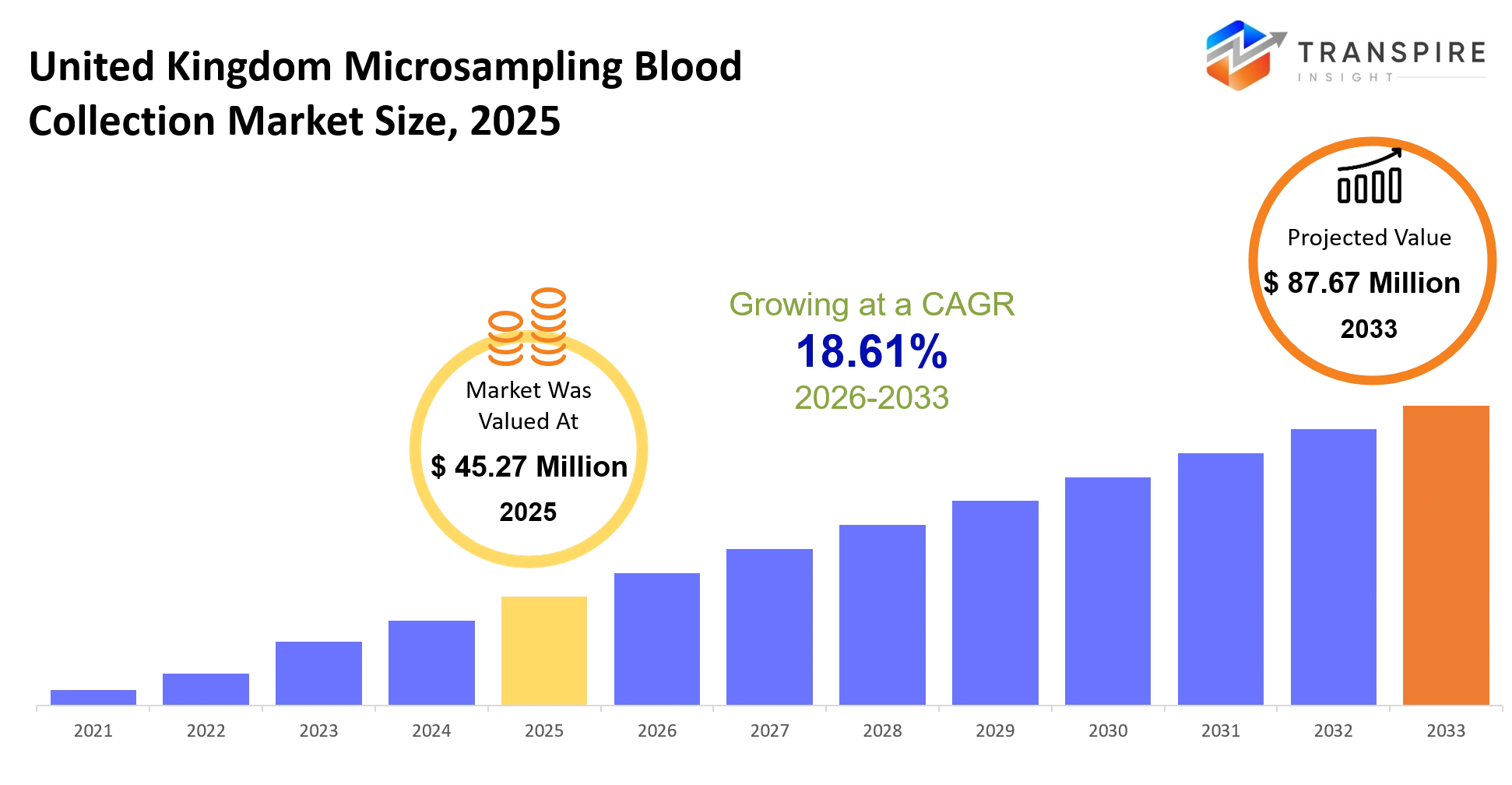
United Kingdom Microsampling Blood Collection Market Size & Forecast:
- United Kingdom Microsampling Blood Collection Market Size 2025: USD 45.27 Million
- United Kingdom Microsampling Blood Collection Market Size 2033: USD 87.67 Million
- United Kingdom Microsampling Blood Collection Market CAGR: 18.61%
- United Kingdom Microsampling Blood Collection Market Segments: By Product Type (Volumetric Absorptive Microsampling Devices, Capillary Blood Collection Tubes, Dried Blood Spot Cards, Lancets, Collection Kits, Others); By Application (Therapeutic Drug Monitoring, Clinical Trials, Infectious Disease Testing, Neonatal Screening, Chronic Disease Monitoring, Others); By End User (Hospitals, Diagnostic Laboratories, Research Institutes, Pharmaceutical Companies, Home Healthcare, Others); By Technology (Manual Collection Systems, Automated Collection Systems, AI-enabled Diagnostics, Others)
To learn more about this report,  Download Free Sample Report
United Kingdom Microsampling Blood Collection Market Summary
The United Kingdom Microsampling Blood Collection Market was valued at USD 45.27 Million in 2025. It is forecast to reach USD 87.67 Million by 2033. That is a CAGR of 18.61% over the period.
In practice, the United Kingdom microsampling blood collection market kind of lets patients and researchers capture high-quality blood samples with small-volume tools like finger-prick kits , plus volumetric microsamplers too, so they can rely less on hospital based venous draws. It also helps remote monitoring for long term conditions, which is honestly a big deal. Over the past 3 to 5 years , the market seems to have moved in a more structural way, away from centralized laboratory collection and toward decentralized and home based sampling. This change is pushed by wider uptake of volumetric absorptive microsampling and dried blood spot technologies, because they make transport easier and help stabilize samples without needing cold chain dependence, which most people don’t want to deal with.
One key catalyst that sped things up was the COVID-19 pandemic, because hospital capacity got strained and routine phlebotomy services were disrupted across the UK. That's what nudged clinical trials and patient monitoring toward remote collection models, even when teams didn’t plan for it. So, in turn , pharmaceutical sponsors and healthcare providers are now weaving microsampling into decentralized clinical trials and chronic disease programs. They do it because it reduces patient load, boosts adherence, and trims the operational expenses that usually cling to traditional blood collection pathways.
Key Market Insights
- England kinda dominates the United Kingdom Microsampling Blood Collection Market at about 55–60% share, mostly because the clinical research setup feels more mature and there are strong hospital networks behind it .
- Scotland looks like the fastest grower during 2024–2030, and it’s mainly pushed by expanding digital health programs plus more remote monitoring being picked up, sooner than expected.
- London still stays a major innovation center, especially for clinical trials, biopharma collaborations and the early rollout of microsampling blood collection tech.
- Dried blood spot cards (DBS) are the leading segment , largely tied to cost efficiency and how commonly they’re used in newborn screening programs.
- Microsampling kits sit as the second-largest slice, and they get used a lot in hospital diagnostics plus in pharmaceutical sample collection routines.
- Volumetric absorptive microsampling devices are the fastest-growing segment through 2030, because they tend to bring better accuracy and they’re more readily accepted by regulators, overall.
- When it comes to market type, clinical diagnostics takes the lead with roughly 45–50% share, driven by routine disease monitoring demands.
- For applications, decentralized clinical trials are the fastest-moving area, supported by pharma outsourcing and remote patient recruitment models that keep expanding.
- Therapeutic drug monitoring is steadily increasing too, helping with more precise dosing and more patient-specific treatment tuning across UK healthcare systems.
- As for end users, hospitals and diagnostic laboratories hold the dominant share at around 50% , mostly due to their established testing infrastructure.
What are the Key Drivers, Restraints, and Opportunities in the United Kingdom Microsampling Blood Collection Market?
The United Kingdom Microsampling Blood Collection Market is mostly pushed forward by a quick move toward decentralized, and kind of patient- centered healthcare delivery. The whole shift got more noticeable after COVID-19 disruptions , because it showed the weak points of hospital-based phlebotomy and then sped up regulatory comfort with remote sampling for clinical trials and longer-term monitoring of chronic conditions. Since pharmaceutical sponsors increasingly lean into decentralized clinical trial , or DCT models, microsampling technologies end up boosting revenue directly by cutting down on how much they depend on sites, shortening recruitment timelines, and also keeping participants around longer with at-home sampling solutions. In other words, microsampling has become part of the routine trial blueprint, not just some optional “extra”, you know.
One major restraint holding back the United Kingdom Microsampling Blood Collection Market is that there still isn’t full standardization across analytical validation protocols for microsample processing. So, labs may interpret results a bit differently, especially in pharmacokinetic and biomarker studies, which makes broad clinical uptake slower, particularly in therapy areas under heavy regulation. And because regulatory alignment plus cross-lab consistency takes long validation cycles, adoption stays somewhat split into pieces. That fragmentation delays the full revenue picture for technology providers and also limits how well these tools integrate into certain NHS-linked workflows.
The strongest emerging opportunity feels like its in the mashup of digital health platforms and microsampling devices, for real time diagnostic ecosystems, not just stand alone tools. Companies like Tasso Inc are already pushing wearable and minimally invasive collection systems that sync straight to telehealth platforms, kind of like a seamless loop. As UK health systems roll out remote monitoring more and more for diabetes and cardiovascular disease management, this convergence supports steady patient data capture, which then unlocks fresher subscription based diagnostic service models. In the longer view it also expands long term market monetization potential.
What Has the Impact of Artificial Intelligence Been on the United Kingdom Microsampling Blood Collection Market?
Artificial intelligence and advanced digital technologies are slowly, but really, reshaping the United Kingdom Micro sampling Blood Collection Market. Mostly it's about improving how samples are taken, traced, and interpreted across decentralized care delivery and clinical research workflows. In practice, AI enabled laboratory information management systems automate sample tracing from collection to analysis, which cuts down on manual keying mistakes, and also strengthens chain of custody compliance for clinical trials. At the same time, smart devices that are paired with micro sampling kits now rely on embedded sensors and connected platforms, so sample conditions can be watched in real time. That helps maintain stability during transport, and it makes later testing more dependable.
There is also machine learning being used for more than tracking. For example, some teams apply models to estimate how device capability might drift over time, and to plan maintenance windows for instruments that handle micro samples. In pharmaceutical trial settings, these predictive layers help estimate sample volume demand and tune logistics routes, so turnaround time improves and the usual operational bottlenecks in decentralized clinical trial networks get smaller. Early rollout efforts across UK biotech research hubs suggest noticeable efficiency gains. This includes lower sample rejection levels and faster processing timelines, which then can support trial cost efficiency and, indirectly, patient retention.
Still, there is a major constraint that keeps coming up, namely the expensive integration effort and the fragmented data infrastructure across NHS linked laboratories and private research organizations. A lot of micro sampling platforms keep running in silos with limited interoperability. That situation narrows scalability, especially for AI models that depend on large and harmonized datasets to deliver higher accuracy and strong real world validation.
Key Market Trends
- From 2020 to 2025, UK clinical trials sort of moved away from routine hospital venipuncture, toward home based microsampling kit(s) that get baked into decentralized study setups.
- After COVID 19, UK ethics committees started accepting these approaches a bit more, and that helped volumetric absorptive microsampling show up more often in pharmacokinetic work.
- Also, pharmaceutical sponsors became more likely to team up with firms like Tasso Inc. and Neoteryx , aiming to cut down on site visits, and at the same time nudge better patient adherence.
- Dried blood spot use didn’t disappear, but it slipped slightly, because volumetric microsampling kept winning out for better precision and stronger regulatory comfort, especially from 2022 onward.
- Meanwhile, Siemens Healthineers and Abbott Laboratories pushed further with automated analytical platforms in UK labs, which improved how fast microsample processing workflows could run.
- Capitainer, and a few other European innovators, introduced newer self sampling devices, so there was less need for trained phlebotomists across outpatient care.
- Still, data integration was kind of a persistent snag, since NHS laboratories kept fragmented systems, which capped how far AI driven microsampling analytics could scale through 2024.
- Demand also leaned more toward remote chronic disease monitoring, especially diabetes and cardiovascular care, and that expanded microsampling in primary healthcare settings.
United Kingdom Microsampling Blood Collection Market Segmentation
By Product Type:
Volumetric absorptive microsampling devices are getting more popular in clinical research, mostly because they help keep a stable sample volume, and accuracy stays better during transport and all those slightly messy handling conditions. These little devices also support decentralized testing models and lower the need for repeated hospital visits. Adoption should keep climbing as pharmaceutical companies keep pushing patient friendly collection approaches and smoother, faster sample processing workflows.
Capillary blood collection tubes and dried blood spot cards still back a lot of routine testing across hospitals and labs. DBS cards remain pretty common in screening programs, while capillary tubes are more often picked for small-volume diagnostics. Collection kits are also growing in home-based care, where patients manage the sampling themselves, so monitoring of long-term health conditions becomes easier.
By Application:
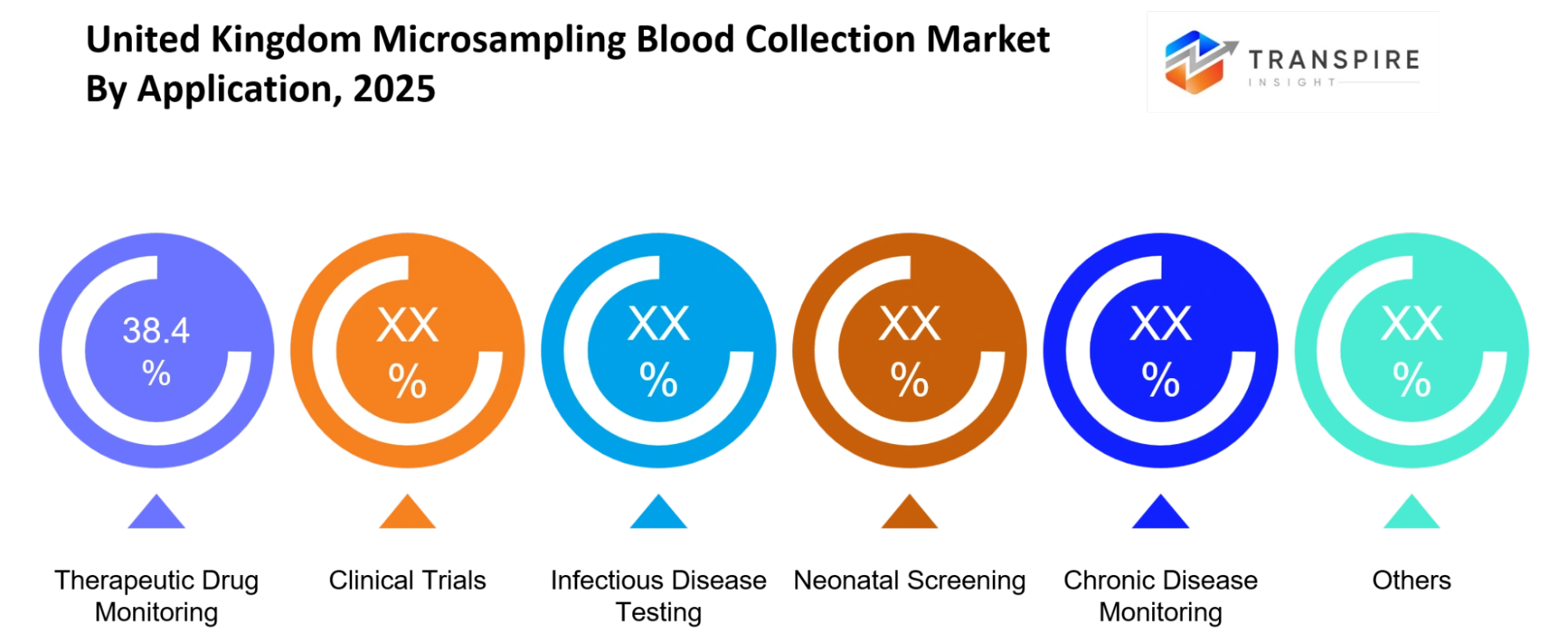
Therapeutic drug monitoring is rising too, driven by the need for precise dosing in long-running treatments, especially in oncology and immunology settings. Microsampling methods allow more frequent testing, without causing much discomfort. Clinical trials are leaning on these tools to cut down site visits, and also to raise participation rates across decentralized study models.
Chronic disease monitoring keeps expanding as healthcare systems move toward home-based care for diabetes and cardiovascular cases. Neonatal screening still leans on dried blood spot methods for early detection programs. Infectious disease testing is using microsampling for quicker sample pickup during outbreak response, and for community level surveillance programs as well.
To learn more about this report, Download Free Sample Report
By End User:
Hospitals and diagnostic laboratories still end up being the main users, largely because of their structured testing routines and the sample handling systems they already have in place. In those places, microsampling gets used to cut down patient load, and yes, to speed up turnaround times too. Research institutes are following along more and more, especially for smaller scale studies and biomarker discovery work, where you often need a flexible sampling approach rather than one rigid plan.
Pharmaceutical companies are also taking it up, not only to back decentralized clinical trials but also to lower how much they depend on physical site visits. Meanwhile, home healthcare keeps growing, since patients often like self-collection methods for routine monitoring. That change helps keep the overall healthcare burden lower, and it improves access to regular testing for people dealing with chronic disease.
By Technology:
Manual collection systems still kind of lead the way, mostly because they are cheap enough and pretty easy to use in basic diagnostic settings. You see them in outpatient care pretty often, and also across community testing programs. Still, the limits in efficiency are causing a slower but steady shift toward more structured collection methods , ones that are also supported by tech.
Automated collection systems are increasing inside laboratories, partly to improve sample tracking and also to reduce human error. At the same time, AI-enabled diagnostics are starting to help with predictive analysis of sample quality, plus workflow optimization. These tools boost consistency, cut down processing delays, and they help make testing more scalable across both clinical and research environments, overall.
What are the Key Use Cases Driving the United Kingdom Microsampling Blood Collection Market?
Clinical diagnostics in hospitals , and diagnostic laboratories is really the core use case in the United Kingdom microsampling blood collection market, mostly driven by chronic disease monitoring for diabetes and cardiovascular conditions that need frequent, low volume sampling, with as little patient disruption as possible.
Clinical trials and pharmaceutical research are growing too, since more companies are adopting decentralized study models , and home health providers help with self collection kits for routine checkups. Meanwhile infectious disease testing units are leaning on microsampling to push test turnaround times , and also improve community level surveillance effectiveness across the UK.
Newer use cases are showing up like wearable integrated microsampling devices for continuous health tracking, and AI supported remote monitoring platforms. Together these can help people spot disease trends earlier ,and it also strengthens population health screening programs under the UKs shifting digital health frameworks, which is kind of where things are heading , right now.
|
Report Metrics |
Details |
|
Market size value in 2025 |
USD 45.27 Million |
|
Market size value in 2026 |
USD 49.17 Million |
|
Revenue forecast in 2033 |
USD 87.67 Million |
|
Growth rate |
CAGR of 18.61% from 2026 to 2033 |
|
Base year |
2025 |
|
Historical data |
2021 - 2024 |
|
Forecast period |
2026 - 2033 |
|
Report coverage |
Revenue forecast, competitive landscape, growth factors, and trends |
|
Regional scope |
Middle East and Africa (Saudi Arabia, United Arab Emirates, South Africa, Rest of Middle East and Africa) |
|
Key company profiled |
Neoteryx, Becton Dickinson, Capitainer, Trajan Scientific, Seventh Sense Biosystems, Roche Diagnostics, Thermo Fisher Scientific, Greiner Bio-One, Tasso Inc., YourBio Health, Q2 Solutions, Labcorp, Quest Diagnostics, PerkinElmer, Shimadzu |
|
Customization scope |
Free report customization (country, regional & segment scope). Avail customized purchase options to meet your exact research needs. |
|
Report Segmentation |
By Product Type (Volumetric Absorptive Microsampling Devices, Capillary Blood Collection Tubes, Dried Blood Spot Cards, Lancets, Collection Kits, Others); By Application (Therapeutic Drug Monitoring, Clinical Trials, Infectious Disease Testing, Neonatal Screening, Chronic Disease Monitoring, Others); By End User (Hospitals, Diagnostic Laboratories, Research Institutes, Pharmaceutical Companies, Home Healthcare, Others); By Technology (Manual Collection Systems, Automated Collection Systems, AI-enabled Diagnostics, Others) |
Which Regions are Driving the United Kingdom Microsampling Blood Collection Market Growth?
England kind of leads the United Kingdom microsampling blood collection market mostly because there is a dense concentration of pharmaceutical headquarters , clinical research organizations, and pretty advanced hospital networks. London, Cambridge and Oxford kind of line up as a life sciences corridor that helps early adoption of decentralized clinical trial models. Being close to regulatory bodies like the MHRA helps trials move faster, and also makes it easier to integrate new sampling technologies. On top of that, a solid NHS setup keeps a microsampling routine in both diagnostics and research programs, not just in pilots.
Scotland, on the other hand, feels more like a stable secondary region. It is backed by NHS Scotland and has a long history of funding for academic medical research. Edinburgh and Glasgow really contribute through genomics research programs, plus university-led clinical studies that depend on consistent sample collection methods. Growth here seems shaped less by heavy commercial trial density and more by steady institutional support. Also, because rural healthcare delivery is a bit harder, providers lean toward low-volume sampling approaches that reduce patient travel time, which is kind of practical.
Northern Ireland is probably the fastest-growing region. Lately there have been investments in digital health infrastructure, and the area is working more with Ireland’s biotech ecosystem across the border. Telehealth expansion has improved access to remote diagnostic testing, especially in areas that are underserved. There are also government-backed innovation programs, which are pushing portable microsampling kits into community healthcare settings. Looking at 2026–2033, that momentum basically makes the region an attractive entry point for medtech firms that want early-stage adoption, plus scalable pilot deployments.
Who are the Key Players in the United Kingdom Microsampling Blood Collection Market and How Do They Compete?
The United Kingdom microsampling blood collection market still looks pretty moderately fragmented, in the sense that well known diagnostics firms share space with newer microsampling specialists. Bigger incumbents tend to defend their share using integrated lab ecosystems and solid regulatory, compliance muscle, though. In parallel, the newer groups push adoption by pitching patient-first, low volume collection formats, more like a simple experience. Overall competition is mostly steered by differences in tech and how smoothly the workflow fits together, because buyers seem to care more about sample accuracy, “ease of home use”, and how well things mesh with decentralized clinical trial platforms, not just raw pricing.
For example, Becton Dickinson is building momentum by slotting capillary collection systems into broader diagnostic workflows that already run across NHS-linked laboratories. The claim is basically end-to-end compatibility with high-throughput lab automation, which should help cut down processing friction when hospital networks scale microsampling adoption. Abbott Laboratories is leaning on assay led integration, where microsampling inputs are connected directly with its well established diagnostic platforms, so continuity stays intact for chronic disease monitoring programs. Siemens Healthineers, meanwhile, leans on high precision analytical instruments, aiming to raise microsample throughput and improve standardization inside centralized labs.
Specialized players like Tasso Inc. and Neoteryx compete by leaning hard on user centric design , offering minimally invasive, and also volumetric microsampling tools that are adapted for home collection and the decentralizing of clinical trials. Capitainer moves forward via precision driven dried blood sampling tech, which aims for exact volume capture, so it boosts analytical dependability especially in pharmacokinetic work. Together they scale by partnering with pharmaceutical sponsors and contract research organizations, and they end up embedding their devices into decentralized trial workflows, rather than leaning on old school hospital procurement channels, every single time.
Company List
- Neoteryx
- Becton Dickinson
- Capitainer
- Trajan Scientific
- Seventh Sense Biosystems
- Roche Diagnostics
- Thermo Fisher Scientific
- Greiner Bio-One
- Tasso Inc.
- YourBio Health
- Q2 Solutions
- Labcorp
- Quest Diagnostics
- PerkinElmer
- Shimadzu
Recent Development News
In March 2026, Salvivo secured Innovate UK A4I funding for a breakthrough saliva sampling device project with the National Physical Laboratory. The initiative aims to establish metrology protocols for dried saliva diagnostics, supporting next-generation minimally invasive microsampling platforms and strengthening pathways toward NHS adoption and pharmaceutical biomarker testing applications.Source https://www.bioindustry.org/
In February 2026, Attomarker announced the launch of an acceleration funding round. The UK-based diagnostics company raised capital to advance commercial rollout and further clinical validation of its multiplex immune profiling tests, which rely on small-volume blood samples for rapid patient immune classification and decentralized diagnostic use.
Source https://attomarker.com/
What Strategic Insights Define the Future of the United Kingdom Microsampling Blood Collection Market?
The United Kingdom microsampling blood collection market is kind of moving toward a more decentralized structure where at-home diagnostics and trial linked sampling start to feel normal, not just some add on thing. You can see this path because remote clinical trial frameworks keep getting used more and more, and at the same time there is ongoing pressure on the NHS to cut outpatient traffic while still keeping up the same diagnostic cadence for people with long term, chronic conditions. Over the next five to seven years, microsampling is expected to go from a fairly niche clinical gadget into a kind of core infrastructure layer for both pharmaceutical development and everyday disease management.
There is also a less obvious risk, maybe the kind that doesn’t get mentioned first, and it comes from how dependent the whole system is on analytical standardization across scattered laboratory setups. If interoperability between NHS labs, private diagnostic providers, and trial sponsors stays uneven, then data inconsistency could end up dragging regulatory acceptance of microsample based endpoints, plus it could cap scalability even if demand signals are strong.
On the other side, there is a real opportunity in integrated digital diagnostics platforms that pair microsampling devices with real time data transmission for ongoing health monitoring. This is especially relevant now because UK healthcare systems are expanding predictive care models, particularly for diabetes and cardiovascular risk management. Market participants should really focus on partnerships with NHS digital transformation programs and CROs, so microsampling gets embedded into standardized clinical pathways instead of being treated as an optional testing approach.
United Kingdom Microsampling Blood Collection Market Report Segmentation
By Product Type
- Volumetric Absorptive Microsampling Devices
- Capillary Blood Collection Tubes
- Dried Blood Spot Cards
- Lancets
- Collection Kits
By Application
- Therapeutic Drug Monitoring
- Clinical Trials
- Infectious Disease Testing
- Neonatal Screening
- Chronic Disease Monitoring
By End User
- Hospitals
- Diagnostic Laboratories
- Research Institutes
- Pharmaceutical Companies
- Home Healthcare
By Technology
- Manual Collection Systems
- Automated Collection Systems
- AI-enabled Diagnostics
Frequently Asked Questions
Find quick answers to common questions.
The United Kingdom Microsampling Blood Collection Market size is USD 87.67 Million in 2033.
Key segments for the United Kingdom Microsampling Blood Collection Market are By Product Type (Volumetric Absorptive Microsampling Devices, Capillary Blood Collection Tubes, Dried Blood Spot Cards, Lancets, Collection Kits, Others); By Application (Therapeutic Drug Monitoring, Clinical Trials, Infectious Disease Testing, Neonatal Screening, Chronic Disease Monitoring, Others); By End User (Hospitals, Diagnostic Laboratories, Research Institutes, Pharmaceutical Companies, Home Healthcare, Others); By Technology (Manual Collection Systems, Automated Collection Systems, AI-enabled Diagnostics, Others).
Major United Kingdom Microsampling Blood Collection Market players are Neoteryx, Becton Dickinson, Capitainer, Trajan Scientific, Seventh Sense Biosystems, Roche Diagnostics, Thermo Fisher Scientific, Greiner Bio-One, Tasso Inc., YourBio Health, Q2 Solutions, Labcorp, Quest Diagnostics, PerkinElmer, Shimadzu.
The United Kingdom Microsampling Blood Collection Market size is USD 45.27 Million in 2025.
The United Kingdom Microsampling Blood Collection Market CAGR is 18.61% from 2026 to 2033.
- Neoteryx
- Becton Dickinson
- Capitainer
- Trajan Scientific
- Seventh Sense Biosystems
- Roche Diagnostics
- Thermo Fisher Scientific
- Greiner Bio-One
- Tasso Inc.
- YourBio Health
- Q2 Solutions
- Labcorp
- Quest Diagnostics
- PerkinElmer
- Shimadzu
About the Authors

Pankaj Ghogare Patil
I am Pankaj Ghogare Patil, a Senior Research Analyst at Transpire Insight, specializing in the Pharmaceutical, Chemicals & Materials, Healthcare IT, and Biotechnology industry. My expertise lies in conducting comprehensive market research, analyzing industry trends, evaluating competitive landscapes, and translating complex data into actionable insights. At Transpire Insight, I closely follow emerging technologies, regulatory developments, and market innovations to create accurate, well-researched, and informative content that helps businesses and professionals make informed decisions. I am committed to producing credible, evidence-based articles that reflect industry best practices while making technical topics accessible and valuable for a broad audience.

Chakradhar Khansole
Chakradhar serves as the Research Director at Transpire Insight, bringing over 8 years of experience in technology, innovation, and strategic market intelligence. He specializes in transforming complex market data into actionable business insights that enable organizations to make informed, growth-oriented decisions. Recognized for his strategic vision and analytical expertise, Chakradhar leads high-impact research initiatives, delivering comprehensive market assessments, competitive intelligence, and forward-looking industry analysis.
Recently Published Reports
-
Apr 2026
AI in Diabetic Retinopathy Market
AI in Diabetic Retinopathy Market Size, Share & Analysis Report By Type (Screening AI Systems, Diagnostic AI Systems, and Predictive AI Models), By Application Segment (Hospitals, Ophthalmology Clinics, Diagnostic Centers, and Research and Development), and Geography (North America, Europe, Asia-Pacific, Middle East and Africa, South and Central America), 2021 - 2031
-
Apr 2026
Psychometric Tests Market
Psychometric Tests Market Size, Share & Analysis Report By Type (Personality Tests, Ability/Aptitude Tests, Skill/Knowledge Tests, and Others), By Application (Talent Acquisition and Talent Management), and Geography (North America, Europe, Asia-Pacific, Middle East and Africa, South and Central America), 2021 – 2031
-
Apr 2026
Rare Biological Sample Collection Market
Rare Biological Sample Collection Market Size, Share & Analysis Report By Type (Isolation Kits & Reagent, Blood Collection Tubes, and Others), By Application (Oncology, Transcriptomics, Pharmacogenomics, and Others), and Geography (North America, Europe, Asia-Pacific, Middle East and Africa, South and Central America), 2021 – 2031
-
Jul 2026
Diabetic Retinopathy Market
Diabetic Retinopathy Market Size, Share & Analysis Report By Type (Proliferative Diabetic Retinopathy, and Diabetic Macular Edema (DME)), By Treatment Type (Anti VEGF Drug, Steroid Implants, Laser Surgeries, and Vitrectomy), and Geography (North America, Europe, Asia-Pacific, Middle East and Africa, South and Central America), 2021 – 2031
Our Clients







