

United Kingdom Microbiome Skincare Products Market Summary
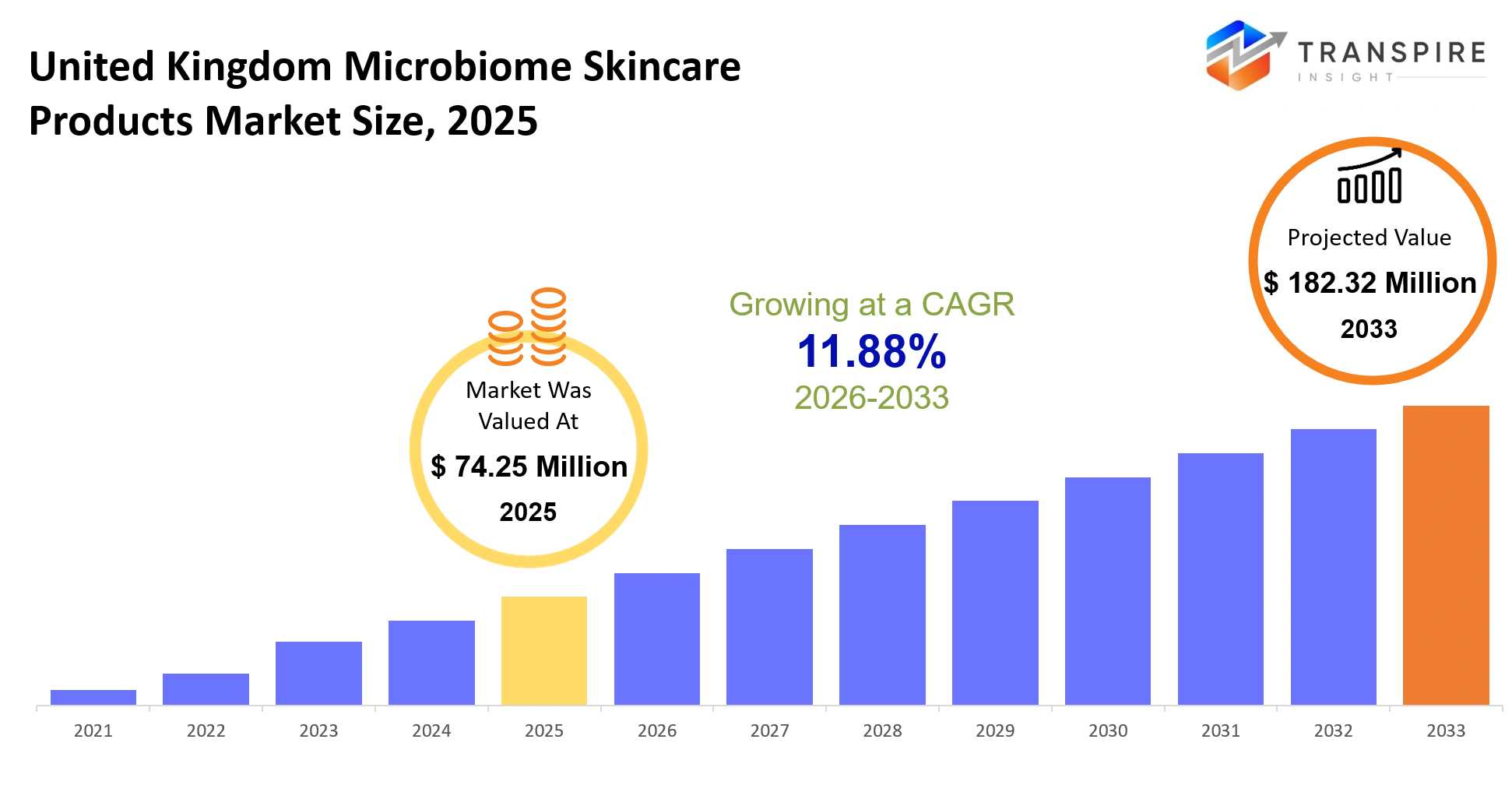
As per Transpire Insight Analysis the United Kingdom Microbiome Skincare Products Market size is estimated at USD 74.25 Million in 2025 and is anticipated to reach USD 182.32 Million by 2033, growing at a CAGR of 11.88% from 2026 to 2033.
In the United Kingdom, the microbiome skincare products market kind of deals with a real, day to day issue for shoppers as well as skincare brands, sort of, it helps keep the skin’s natural microbial balance in check, which can mean less irritation, better barrier support, and often a more steady long-term skin situation. A lot of formulas now include probiotics, prebiotics, postbiotics, and other microbiome friendly components, and honestly they’ve slowly turned into a usual part of routines, especially for people dealing with sensitive skin, acne-prone skin, or eczema-prone skin, where older style products might disturb the skin ecosystem a bit, or just nudge it the wrong way.
In the last three to five years, things have moved away from general “natural skincare” messaging towards microbiome science with proof behind it, backed by clinical testing, plus ingredient innovation. During the COVID-19 period this change sped up, because people were doing more handwashing, wearing masks, and paying a stronger kind of attention to skin health. In that way barrier wear and tear came up more often, even kinda in conversation. So manufacturers started pushing new formulations meant to re-stabilize that microbial balance, and yeah it made sense.That whole shift has also made brands lean into premium positioning, helped retailers feel more confident, increased dermatologist-led recommendations, and opened up higher value paths for companies investing in scientific confirmation and more distinctive, clearly differentiated formulas.
United Kingdom Microbiome Skincare Products Market Size & Forecast:
- United Kingdom Microbiome Skincare Products Market Size 2025: USD 74.25 Million
- Expected Market Value 2033: USD 182.32 Million
- Forecast CAGR: 11.88%
- Leading region in 2025: England
- Fastest Growing region: Scotland
- Key Profile: Gallinée, Aurelia London, The Nue Co., La Roche-Posay, L'Oréal, Unilever, Esse Skincare, Tula Skincare, Clinique, Drunk Elephant, Mother Dirt, Glowbiotics, Codex Labs, Bybi Beauty, AOBiome
Key Market Insights
- In 2025 England basically dominated the United Kingdom Microbiome Skincare Products Market with around 72% market share, and this was backed by premium retail networks, plus dermatology led product adoption. It’s kind of like everything points in that same direction, really.
- Scotland meanwhile is expected to become the fastest-growing regional market over 2026–2032, mostly because specialist skincare retailers are expanding, and there are more biotechnology collaborations happening too.
- When it comes to product types, probiotic skincare products were leading the industry in 2025, capturing close to 38% of the market share. This happened partly due to wider commercial availability, along with a stronger clinical positioning.
- Prebiotic skincare formulations sat as the second-largest segment, mainly because brands are increasingly mixing barrier support components with microbiome focused formulations. So not just one angle, more like layered benefits.
- Looking ahead, postbiotic skincare products are set to show the fastest growth through 2032, driven by formulation stability and also expanding dermatological evidence.
- For applications, facial skincare held the largest slice in 2025 at roughly 61% market share, which mirrors premium consumer spend on daily barrier repair routines. Sensitive skin treatment, though, will likely expand the quickest during the forecast period as clinically tested formulas move into mainstream retail channels.
- By end user, individual consumers were the clear front runner in 2025 with nearly 83% market share, supported by premium skincare buying across both online and pharmacy channels.
- And for the end user category that’s likely to grow fastest through 2032, dermatology clinics plus aesthetic practices should remain on top, helped by physician recommended microbiome based treatment protocols.
What are the Key Drivers, Restraints, and Opportunities in the United Kingdom Microbiome Skincare Products Market?
Microbiome science has become this kind of strongest engine pushing industry expansion, like really fast. Over the last stretch, skin microbiome sequencing got better, dermatological evidence looks stronger than before, and premium formulation technologies keep improving, so procurement choices across pharmacies, clinics, and prestige retailers now look different. In practice, brands don't just say things for the sake of marketing anymore— they try to back product claims using clinical validation, not just promotional phrasing. That shift seems to help in a few ways, like pricing power going up, premium product acceptance rising, and repeat purchases growing. So manufacturers can pull stronger revenue per customer, while retailers feel more comfortable about stocking the lines.
Still, clinical validation is the biggest structural restraint, not gonna lie. Going for microbiome-friendly formulations often turns into a pretty long road of efficacy testing, plus ingredient compatibility checks, and then a pile of regulatory documentation too, so commercialization timelines end up getting stretched out, a bit. Smaller brands sometimes end up stuck trying to finance those steps, while also keeping prices at a level that still feels reasonably competitive. Also, judging from Transpire Insight review of regional procurement announcements and launch schedules, supply chain concentration stays the main execution risk. There are limited specialist ingredient suppliers too, which can raise sourcing costs and delay launches, and that then suppresses market revenue for emerging brands, even when demand is there.
Artificial intelligence enabled formulation research, and precision skin care, really feels like the best long term opening. Machine learning platforms can sift through possible ingredient pairings that match certain microbial profiles ,and at the same time they cut down the time those research cycles used to take. If skin diagnostic tools and digital dermatology services keep growing, then the UK will have a smoother path toward personalized microbiome skincare suggestions. And as biotech collaborations stretch further, while consumer data platforms also get more mature, manufacturers can dial up clearer product distinction. That should help them push innovation faster, keep the premium market standing stronger, kind of overall.
What Has the Impact of Artificial Intelligence Been on the United Kingdom Microbiome Skincare Products Market?
Artificial intelligence is kind of reshaping microbiome skincare development , because it speeds up formulation design, lab testing, and a lot of the commercial decisions. Manufacturers rely on AI to read microbiome sequencing data, judge ingredient compatibilities, and run automated research workflows that used to need tons of lab time, personnel, and budgets. Meanwhile, digital quality management systems are getting better at how the production is watched, how ingredients are traced, and how the regulatory paperwork gets handled through each manufacturing step, kind of end to end.
Also, machine learning models can forecast ingredient demand, guide inventory planning, and even predict how a formulation might turn out before any real physical tests begin. With these kinds of tools in place, development cycles commonly get shorter , and the rollout planning for new skincare releases becomes more dependable, less guesswork overall. Also, AI-backed analytics can pick up consumer response signals across online channels , so brands can position products better and adjust the whole portfolio with fewer surprises. A few companies even mention real improvements, like faster research throughput, less back and forth during formulation, and lower overall product development spending thanks to digital experimentation.
On top of that, digital technologies support operational efficiency by refining supply scheduling, limiting formulation dead ends, and enabling faster market entry for microbiome-focused items. Still , broad adoption has practical friction points. Implementation can be expensive, the microbiome datasets are often fragmented, and there aren’t enough standardized biological reference models, so prediction quality can drop across different skin types or changing environmental conditions. Until bigger and broader clinical datasets exist, AI will likely complement laboratory validation instead of fully swapping out conventional microbiome research.
Key Market Trends
- Since 2022, many brands have kind of moved away from probiotic-only talk, and toward clinically validated microbiome platforms, backed by dermatological testing and peer-reviewed research evidence , not just general claims.
- In 2023 through 2025, biotechnology partnerships picked up pace, which helped speed up ingredient discovery a bit, while also enabling more targeted microbiome-friendly skincare formulations, you know the kind that feels more precise.
- In 2024, premium pharmacy distribution grew across the United Kingdom , so access improved for dermatologist-recommended microbiome skincare portfolios.
- At the same time, digital skin analysis tools are gradually supporting more personalized product recommendations, and that has been lifting conversion rates for premium skincare brands heading toward 2032.
- Postbiotic ingredients have also got real commercial momentum since 2023. The reason is simpler formulation stability, which makes manufacturing easier and also helps stretch product shelf life.
- More companies are investing in microbiome sequencing technologies, mainly to refine formulation accuracy and strengthen competitive differentiation inside premium skincare portfolios.
- Ingredient transparency has turned into an even stronger buying factor since 2022, so manufacturers are more willing to publish scientific validation for microbiome compatibility assertions.
- L'Oréal, Unilever , and La Roche-Posay also increased their microbiome research spending, which seems to support innovation pipelines and speed up the arrival of premium products.
- Finally , contract manufacturers have upgraded biotechnology capabilities since 2024, and that can reduce formulation development timelines for emerging microbiome skincare brands.
United Kingdom Microbiome Skincare Products Market Segmentation
By Product Type:
Creams seem to stay in a leading spot because daily skincare rituals still prefer items that reinforce the skin barrier , while also helping keep the microbial balance in check. Their richer textures, longer lasting comfort, and good tolerance for sensitive skin mean creams are an easy choice for everyday use across many age groups. Also , strong shelf presence and a steady stream of premium releases should keep creams at the front of product sales. Ingredient experimentation will keep going too, so brands can roll out more advanced, high value formulations with extra skin benefits , kind of like a modern upgrade.
Serums keep getting attention, mostly because they carry concentrated activities that aim for specific outcomes like skin repair, hydration boost, and barrier support. Cleansers have sort of moved past the plain job of rinsing away residue—now they often use mild formulas that spare beneficial skin microorganisms during normal, day to day use. Moisturizers remain essential as well , since barrier safeguarding and hydration are still big drivers behind what people buy. Masks and other specialty products should open more doors through weekly care rituals and curated, premium skincare lines.

By Ingredient:
Probiotics stay as the leading ingredient category, mostly because early commercial adoption plus solid scientific recognition have helped build real consumer trust. Product developers keep coming with new formulations that back healthy skin conditions while also boosting comfort, especially for sensitive skin. Ongoing research activity will likely improve product performance, and this should also encourage more general commercial use. Ingredient suppliers that are already well established further help keep product development consistent across premium brands, even when teams change.
Prebiotics have basically carved out a firm spot too, by supporting beneficial microorganisms that are already on the skin, rather than bringing in live bacteria. Postbiotics, on the other hand, should move into wider adoption more quickly since stable formulations make manufacturing, storage, and transportation simpler… while still holding on to product effectiveness. The other ingredient categories still push innovation as well, through botanical extracts , fermented compounds, and newer biotechnology materials that really complement microbiome-oriented skincare.
By Distribution Channel:
Online retail can drive leads and sales because direct-to-consumer platforms sort of widen product availability , plus they deliver learning content and more tailored purchasing experiences. Digital channels also let premium brands roll out new items without leaning only on old school retail networks. Subscription models, along with focused marketing efforts, should keep boosting online performance. Also customer reviews and ingredient transparency keep steering buying decisions across digital channels, generally speaking
Pharmacies still count as a key sales route , mainly because professional recommendations add a lot of reassurance for clinically developed skincare lines. Specialty stores help maintain a higher-end presence by providing expert support and a well curated product assortment. Supermarkets keep carving out more shelf space for selected microbiome-friendly skincare ranges, while other retail styles open extra pathways via wellness shops and independent beauty retailers
By Skin Type:
Sensitive skin counts as the biggest slice, mostly because barrier-support formulations help calm irritation, redness, and that general discomfort that shows up when the skin microbiota gets disrupted. Right now, clinical guidance plus dermatologist-backed products keep boosting interest in this part. Having solid scientific validation should nudge people toward premium buys while also backing steady, long term loyalty. And honestly, ongoing innovation really helps product effectiveness when it comes to the everyday skincare routine.
Dry skin is still a key category too, since hydration along with barrier repair keep driving how formulas get built. The oily and combination segments tend to lean on products that stay balanced, so the skin keeps a healthy microbial state without too much cleansing, or, well, over-cleansing. The other skin types open up further chances for specialized product development, designed to target individual needs across different groups of consumers, in a way that actually feels specific.
By End User:
Women take the biggest slice, mostly because premium skincare routines, preventive skincare habits, and wider product portfolios keep people buying more often. Premium beauty brands still roll out microbiome–focused collections, meant for several skincare concerns at once, or at least that’s how they’re being framed. Product innovation plus more personalized skincare recommendations will likely keep boosting purchasing frequency across the usual established customer groups, even when budgets get tight. The clinical angle also helps maintain those premium pricing plans.
Men are showing a steady uptick too, as streamlined skincare routines and functional formulations keep getting broader commercial acceptance. Unisex products keep getting attention, not just because of inclusive branding, but also because versatile formulations seem to work across a larger audience. There are also other end-user segments, which opens doors for more specialized skincare collections, these can be built around age, lifestyle, and particular skin conditions.
By Application:
Hydration still takes the lead as the main use because a balanced, healthy moisture level keeps the skin barrier doing its job, plus it helps keep microbial stability in check. Even with everything else, daily skincare routines keep putting the focus on products that give longer lasting hydration, along with microbiome friendly components. Product developers will push this area forward using clinically validated blends and those more premium ingredient pairings. Also, strong repeat purchases keep backing consistent revenue generation which is honestly pretty important.
Skin repair keeps growing too, probably because when the skin barrier is damaged, it needs targeted formulations that nudge recovery along, while still protecting the microbial balance. Anti aging products remain a big category because they blend microbiome science with collagen supporting ingredients, and some advanced skincare technologies that work together. Acne care and the rest of the related applications should keep opening up growth opportunities via more personalized treatment options, backed by scientific research, and product innovation.
What are the Key Use Cases Driving the United Kingdom Microbiome Skincare Products Market?
Hydration still ends up being the leading use case, mostly because microbiome-friendly moisturizers and creams help keep the skin barrier function stable through everyday skincare habits. Premium beauty retailers , pharmacies, and dermatology clinics end up generating most purchases ,as consumers want products that are clinically supported and feel comfortable long term, not just a quick cosmetic effect that fades too fast.
Skin repair and acne care are getting bigger in real time, especially within sensitive and oily skin categories. Dermatology clinics are more often recommending microbiome-supporting formulations after aesthetic procedures, and online retail is pulling in younger buyers who want focused solutions, backed by ingredient transparency and clinical evidence, you know, the kind people can actually check.
There are also early-stage opportunities showing up around personalized microbiome skincare, built using digital skin analysis and microbiome profiling. Preventive skin care programs aimed at aging populations and workplace wellness initiatives look promising too, since biotechnology investment , clinical research and evolving product standards are gradually setting up better conditions for wider commercial adoption across the forecast period.
|
Report Metrics |
Details |
|
Market size value in 2025 |
USD 74.25 Million |
|
Market size value in 2026 |
USD 83.07 Million |
|
Revenue forecast in 2033 |
USD 182.32 Million |
|
Growth rate |
CAGR of 11.88% from 2026 to 2033 |
|
Base year |
2025 |
|
Historical data |
2021 - 2024 |
|
Forecast period |
2026 - 2033 |
|
Report coverage |
Revenue forecast, competitive landscape, growth factors, and trends |
|
Regional scope |
United Kingdom (England, Scotland, Wales, Northern Ireland) |
|
Key company profiled |
Gallinée, Aurelia London, The Nue Co., La Roche-Posay, L'Oréal, Unilever, Esse Skincare, Tula Skincare, Clinique, Drunk Elephant, Mother Dirt, Glowbiotics, Codex Labs, Bybi Beauty, AOBiome . |
|
Customization scope |
Free report customization (country, regional & segment scope). Avail customized purchase options to meet your exact research needs. |
|
Report Segmentation |
By Product Type (Creams, Serums, Cleansers, Moisturizers, Masks, Others); By Ingredient (Probiotics, Prebiotics, Postbiotics, Others); By Distribution Channel (Online, Pharmacies, Specialty Stores, Supermarkets, Others); By Skin Type (Dry, Oily, Sensitive, Combination, Others); By End User (Women, Men, Unisex, Others); By Application (Anti-Aging, Acne Care, Hydration, Skin Repair, Others) |
Which Regions are Driving the United Kingdom Microbiome Skincare Products Market Growth?
England is basically around 72% of the UK microbiome skincare products market, though of course the exact number shifts a bit. The presence of tight regulatory control for cosmetics, plus more advanced dermatology services , and a big premium retail network all together makes commercialization feel pretty smooth. On top of that, biotechnology firms , skincare manufacturers, joint research efforts , and ingredient specialists keep pushing new formats and help with distribution. If the industry keeps putting money into clinical proof , premium store expansion, and ongoing formulation work , England should stay in front across the forecast horizon.
Scotland sits in the second spot. This is often because biotech research and innovation alliances seem to matter more than the big retail concentration model. There’s also fairly steady public backing for the life sciences, research funding that doesn’t swing too wildly, and connections between universities and skincare developers . That combination gives a dependable setup for fresh product launches. Even with a smaller population , strong consumer spending at the premium end and active healthcare research keep sales performance steady. So overall, the structure is balanced enough to create dependable revenue, while still allowing slow but sure growth in niche specialist skincare areas.
Wales is set to see the quickest kind of growth in 2026–2033, mostly thanks to more funding in life sciences, digital healthcare, plus biotechnology innovation. With extra backing for research commercialization and tighter links, between local companies and academic centers the pace of microbiome product development has really sped up. At the same time, wider access to online premium skincare platforms, and specialist pharmacy distribution has helped keep momentum moving across the whole region. Put together, this mix should unlock good chances for fresh brands, biotech investors and formulation specialists wanting to expand during that 2026–2033 window.
Who are the Key Players in the United Kingdom Microbiome Skincare Products Market and How Do They Compete?
Competition still looks kind of moderately fragmented, where multinational skincare companies sit next to specialist microbiome-focused brands. A lot of the competitive edge comes from scientific proof, formulation know-how, ingredient standard, and how premium the brand is, not really price by itself. Established makers keep adding research muscle, but new entrants bring in more narrowly defined microbiome skincare, aiming at specific needs using distinct ingredient systems that feel, sort of, purpose-built.
L'Oréal pours a lot of effort into microbiome research along with advanced formulation science, so their new product pipeline is backed by broad scientific checking and global research capacity. Unilever, on the other hand, leans into biotechnology partnerships plus wide-scale consumer distribution, which helps microbiome focused offerings land in both premium setups and mainstream retail shelves. Gallinée sticks to microbiome friendly skincare only, and they stand out because their range revolves around probiotic, prebiotic, and postbiotic formulations, all carried by a very clear scientific identity.
La Roche-Posay improves its competitive position with dermatologist supported products aimed at sensitive skin, backed by clinical evidence and pharmacy channel strength. Aurelia London leans toward premium probiotic skincare, relying on natural materials and innovation-led product drops, made for people who want clinically inspired, luxury type care. Ongoing investment in biotech collaborations, digital consumer interaction, and the extension of premium portfolios should keep steering differentiation during the forecast window.
Company List
- Gallinée
- Aurelia London
- The Nue Co.
- La Roche-Posay
- L'Oréal
- Unilever
- Esse Skincare
- Tula Skincare
- Clinique
- Drunk Elephant
- Mother Dirt
- Glowbiotics
- Codex Labs
- Bybi Beauty
- AOBiome
Recent Development News
In April 2026, L'Oréal launched La Roche-Posay Effaclar Microbiome Science, expanding its microbiome-based skincare portfolio with formulations designed to support skin barrier balance and acne-prone skin. The launch strengthened the company's science-led positioning in premium dermatological skincare and intensified competition in microbiome-focused product innovation. Source https://www.loreal.com/
In September 2025, Unilever entered a strategic partnership with Microbiotica to apply microbiome science and artificial intelligence in developing consumer health and personal care products. The collaboration expanded access to microbiome research capabilities that can accelerate innovation across skincare and wellness portfolios. Source https://www.unilever.com/
What Strategic Insights Define the Future of the United Kingdom Microbiome Skincare Products Market?
The United Kingdom Microbiome Skincare Products market is kinda moving toward a science-led model, where clinical validation , biotech partnerships and precision formulation will end up being the main edge for the next five to seven years. Basically, progress in microbiome research, plus stronger links between dermatology and biotechnology , will nudge product development away from wide, general skincare claims, and toward solutions that are more evidence based with outcomes you can actually measure. There is also a less obvious risk too, it’s the relatively small number of specialist ingredient suppliers and microbiome technology providers. That can lead to supply concentration, reduce formulation flexibility, and even slow down launches if something disrupts operations. At the same time though, personalized microbiome skincare , backed by digital skin diagnostics and microbiome profiling, is a real opportunity, especially as the clinical data quality gets better over time. Firms that put money early into proprietary research, keep their ingredient sourcing diversified , and build strategic collaborations with biotechnology companies and dermatology networks , should end up capturing more long term value , and also improve their resilience in the market.
United Kingdom Microbiome Skincare Products Market Report Segmentation
By Product Type
- Creams
- Serums
- Cleansers
- Moisturizers
- Masks
By Ingredient
- Probiotics
- Prebiotics
- Postbiotics
By Distribution Channel
- Online
- Pharmacies
- Specialty Stores
- Supermarkets
By Skin Type
- Dry
- Oily
- Sensitive
- Combination
By End User
- Women
- Men
- Unisex
By Application
- Anti-Aging
- Acne Care
- Hydration
- Skin Repair
Frequently Asked Questions
Find quick answers to common questions.
The expected United Kingdom Microbiome Skincare Products Market size for the market will be USD 182.32 Million in 2033.
Key segments for the United Kingdom Microbiome Skincare Products Market are By Product Type (Creams, Serums, Cleansers, Moisturizers, Masks, Others); By Ingredient (Probiotics, Prebiotics, Postbiotics, Others); By Distribution Channel (Online, Pharmacies, Specialty Stores, Supermarkets, Others); By Skin Type (Dry, Oily, Sensitive, Combination, Others); By End User (Women, Men, Unisex, Others); By Application (Anti-Aging, Acne Care, Hydration, Skin Repair, Others).
Major United Kingdom Microbiome Skincare Products Market players are Gallinée, Aurelia London, The Nue Co., La Roche-Posay, L'Oréal, Unilever, Esse Skincare, Tula Skincare, Clinique, Drunk Elephant, Mother Dirt, Glowbiotics, Codex Labs, Bybi Beauty, AOBiome.
The United Kingdom Microbiome Skincare Products Market size is USD 74.25 Million in 2025.
The United Kingdom Microbiome Skincare Products Market CAGR is 11.88% from 2026 to 2033.
- Gallinée
- Aurelia London
- The Nue Co.
- La Roche-Posay
- L'Oréal
- Unilever
- Esse Skincare
- Tula Skincare
- Clinique
- Drunk Elephant
- Mother Dirt
- Glowbiotics
- Codex Labs
- Bybi Beauty
- AOBiome
About the Authors

Chetan Dhatrak
I’m Chetan Dhatrak, a Senior Research Analyst at Transpire Insight, specializing in the Consumer Goods, Foods and Beverages industry. I focus on analyzing market trends, consumer behavior, competitive landscapes, and industry developments to deliver accurate, data-driven insights. My research at Transpire Insight is built on credible sources and in-depth analysis, helping businesses and readers better understand market dynamics, emerging opportunities, and evolving consumer preferences. I’m committed to creating reliable, well-researched content that supports informed decision-making and reflects the latest developments in the consumer goods and food & beverage sectors.

Chakradhar Khansole
Chakradhar serves as the Research Director at Transpire Insight, bringing over 8 years of experience in technology, innovation, and strategic market intelligence. He specializes in transforming complex market data into actionable business insights that enable organizations to make informed, growth-oriented decisions. Recognized for his strategic vision and analytical expertise, Chakradhar leads high-impact research initiatives, delivering comprehensive market assessments, competitive intelligence, and forward-looking industry analysis.
Recently Published Reports
-
Apr 2026
Bottled Water Market
Bottled Water Market Size, Share & Analysis Report By Product Type (Still Bottled Water, Carbonated Bottled Water, Functional Bottled Water, and Others), By Packaging (PET, Cans, and Others), By Sales Channel (Supermarkets/Hypermarkets, Convenience Stores/Drug Stores, Grocery Stores/Club Stores, Foodservice, and Others) and Geography (North America, Europe, Asia-Pacific, Middle East and Africa, South and Central America), 2021 - 2032
-
Apr 2026
Color Cosmetic Packaging Market
Color Cosmetic Packaging Market Size, Share & Analysis Report By Application (Mascara Packaging, Liquid Packaging, and Liquid Face), By Type (Tubes & Bottles, Pens & Markers, Compacts & Containers, and Droppers & Pumps), and Geography (North America, Europe, Asia-Pacific, Middle East and Africa, South and Central America), 2021 - 2031
-
Apr 2026
External Microphone For Camera Market
External Microphone For Camera Market Size, Share & Analysis Report By Type (Shotgun Microphone, Lavalier Microphone, and Others), By Application (Digital Camera, Professional Video Camera, and Others), and Geography (North America, Europe, Asia-Pacific, Middle East and Africa, South and Central America), 2021 - 2031
-
Apr 2026
Foot Orthotic Insoles Market
Foot Orthotic Insoles Market Size, Share & Analysis Report By Type (Pre-fabricated, and Custom-made), By Material (Thermoplastic, Composite Carbon Fiber, and Others), By Distribution Channel (Drug Stores, Hospitals & Clinics, and Others), and Geography (North America, Europe, Asia-Pacific, Middle East and Africa, South and Central America), 2021 - 2031