
United Kingdom Interactive Kiosk Market Size & Forecast:
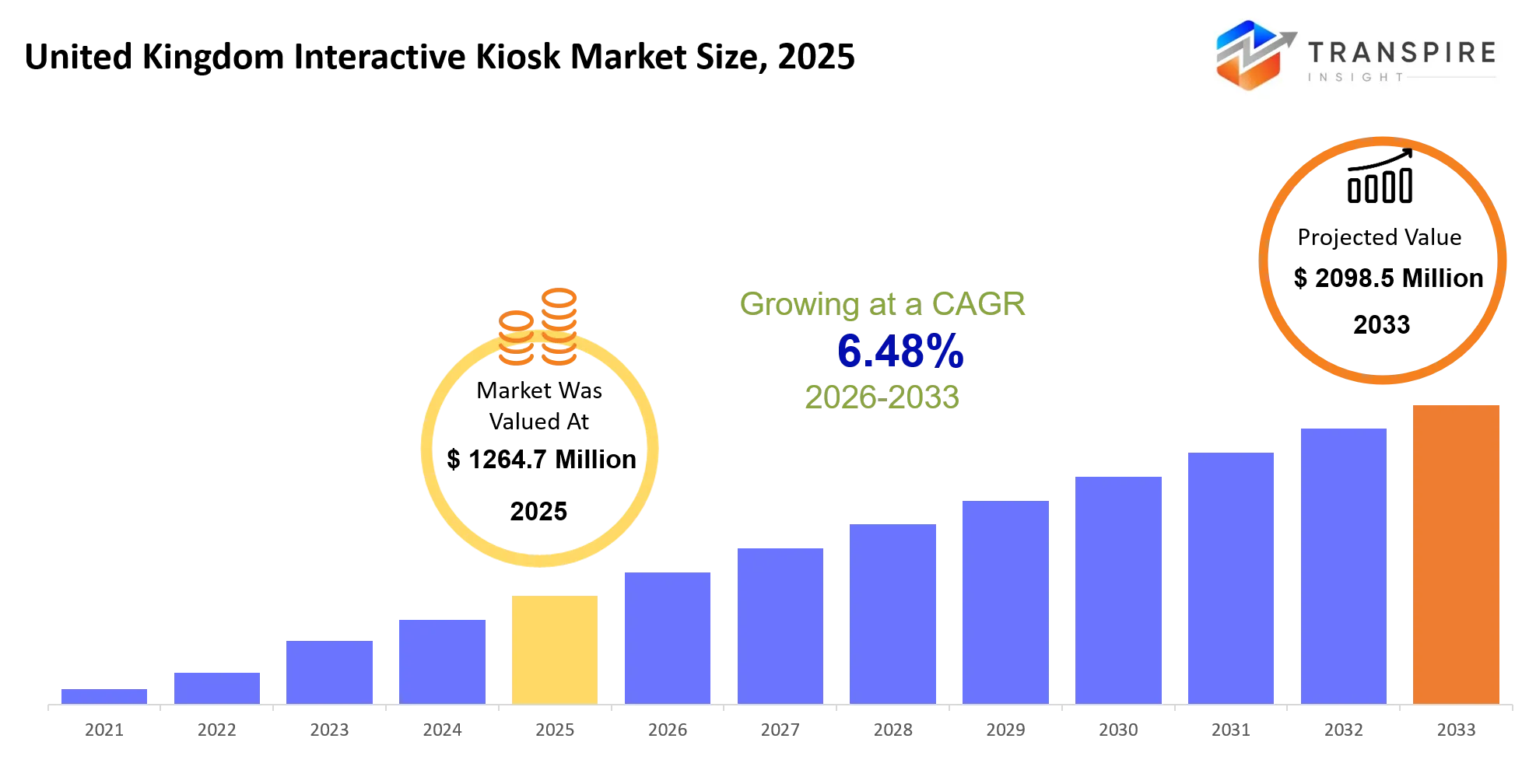
- United Kingdom Interactive Kiosk Market Size 2025: USD 1264.7 Million
- United Kingdom Interactive Kiosk Market Size 2033: USD 2098.5 Million
- United Kingdom Interactive Kiosk Market CAGR: 6.48%
- United Kingdom Interactive Kiosk Market Segments: By Product Type (Self-service Kiosks, Information Kiosks, Ticketing Kiosks, Banking Kiosks, Healthcare Kiosks, Retail Kiosks, Smart Kiosks, Others); By Technology (Touchscreen Kiosks, AI-enabled Kiosks, Cloud-connected Kiosks, IoT-enabled Kiosks, Voice-enabled Kiosks, Others); By Application (Retail Stores, Airports, Hospitals, Banking Services, Government Services, Educational Institutions, Others); By End User (Retail Sector, Healthcare Sector, BFSI, Transportation Sector, Government Sector, Others)
To learn more about this report,  Download Free Sample Report
United Kingdom Interactive Kiosk Market Summary
The United Kingdom Interactive Kiosk Market was valued at USD 1264.7 Million in 2025. It is forecast to reach USD 2098.5 Million by 2033. That is a CAGR of 6.48% over the period.
In practice, the United Kingdom Interactive Kiosk Market helps people move through day to day transactions on their own, without staff stepping in too much, for example ticket booking, self-check-in at transport hubs, pay bills, or even do automated retail ordering. These setups ease the queue squeeze in airports, railway stations , retail stores, and public service centres, and at the same time they make service delivery quicker. For operators, this also supports day-to-day operations, especially as labour costs keep climbing.
Over the last 3–5 years, the scene has gone from fairly basic touchscreen terminals to cloud-connected , software powered kiosks that work alongside contactless payments and real-time data systems. A notable structural turn is the shift toward AI-enabled and remotely managed kiosks, which makes it possible to keep centralized oversight and push content changes faster. The COVID-19 pandemic became a key trigger , basically, it sped up demand for contactless self-service interfaces across transport and retail, mostly because hygiene expectations rose and staffing disruptions happened. So, as a consequence, many operators now put money into kiosks not only for user comfort, but to support business continuity and lessen reliance on manual service points.
Key Market Insights
- UK Interactive Kiosk Market is growing again, because self service digitisation is spreading pretty broadly, across transport, retail, and even public infrastructure systems it seems.
- A lot of the deployments now lean on cloud based kiosk management platforms, which makes updates happen in real time and also cuts on site maintenance costs , quite a bit.
- Contactless payment integration has also helped, and in UK retail it boosted kiosk adoption by around 28% from 2022 into 2025, depending on the source but the direction is clear.
- In terms of where kiosks actually sit, transport hubs are close to 35–40% of total installations across the United Kingdom Interactive Kiosk Market ecosystem.
- Retail self checkout kiosks are basically the second biggest slice, mainly because labour cost optimisation matters, and people keep expecting faster checkout, so the kiosks keep getting selected.
- Healthcare kiosks are moving the quickest too, with projected double digit installation growth through 2033, which is kind of a big deal overall.
- Big names like NCR Corporation, Diebold Nixdorf, and Samsung Electronics tend to dominate, largely thanks to strong hardware software integration capabilities.
- LG Electronics and Advantech are also ramping up AI enabled kiosk hardware portfolios for UK deployments, not just in theory but across actual rollouts.
- Meanwhile Meridian Kiosks and Olea Kiosks are putting emphasis on modular kiosk design, especially for transport and government services.
- Overall competitiveness is shaped by UX innovation, remote diagnostics , and how well kiosks integrate with digital payment ecosystems, which in practice can decide win or lose.
What are the Key Drivers, Restraints, and Opportunities in the United Kingdom Interactive Kiosk Market?
The main force behind the United Kingdom Interactive Kiosk Market is the fast move toward sort of automated public and commercial service delivery. This move really picked up speed when transport operators, retailers, and government agencies started swapping out manual counters for self-service setups, to cut down on those annoying operational bottlenecks and the labour dependency. On top of that, linking kiosks with digital payment networks plus cloud-style management platforms has made adoption feel easier, so organisations can expand the service side without piling on more staff costs, which then supports revenue efficiency and also speeds up the customer flow, more or less directly.
One big restraint though is the heavy upfront installation cost, and the integration complexity across older infrastructure. A lot of public sector locations and smaller retail teams still depend on older IT frameworks, and they are not exactly friendly with modern kiosk software, so they end up needing costly middleware, or sometimes a full system refresh. That kind of situation stretches procurement timelines, and it delays wider rollouts, especially in municipal settings where budgets are tight, and in practice it tends to limit near-term revenue growth.
As for opportunities, the most likely one is AI-led smart kiosks rolling out across transport and healthcare landscapes. Airports, rail routes, and NHS-connected service hubs are already trialling kiosks that do facial recognition check-ins, multilingual assistance, and even predictive maintenance alerts. And as 5G coverage expands across UK cities, these kiosks can shift into properly connected service nodes, which opens new revenue routes via data analytics, more tailored advertising, and subscription-based kiosk-as-a-service arrangements.
What Has the Impact of Artificial Intelligence Been on the United Kingdom Interactive Kiosk Market?
Artificial intelligence is kind of reshaping what kiosks do in the United Kingdom, not just in theory but day to day, by allowing smarter user interaction , predictive maintenance, and real-time operational optimisation. These modern kiosks increasingly rely on AI powered natural language processing to field multilingual customer questions in transport hubs and retail areas, and it helps lower the need for human help. That usually speeds things up during busy periods too, like when everyone is rushing.
At the same time, facial recognition plus computer vision are showing up in secure access kiosks at airports and corporate sites. The idea is to streamline identity verification , so people spend less time queued up and more time moving on. It’s almost like the whole check-in moment becomes smoother, even if the processes behind it are more complicated.
From the operations angle, machine learning models look at usage trends and patterns to foresee hardware failures. Then operators can arrange maintenance before a breakdown happens , which in practice reduces downtime across high-traffic deployments like railway ticket kiosks and self service retail checkouts. There’s also performance tuning, because AI can dynamically tweak interface layouts depending on how users behave. That tends to lift transaction completion rates, and keeps the experience consistent.
Still, there’s a main snag that doesn’t fully go away, which is the high integration cost and the uneven quality of data in the real world. A lot of kiosk locations run with patchy connectivity, especially in rural transport stations. That limits how well AI models can keep learning, and it restricts real time processing too. On top of that, older kiosk infrastructure often doesn’t have enough computing capacity for advanced edge AI. So even when demand for automation is strong, wider rollout moves more slowly than expected.
Key Market Trends
- Cloud connected kiosks sort of took over from standalone setups across UK rail and airport networks after the 2022 digital transformation programs started rolling.
- It was like contactless first design became the default in retail kiosks , mostly because the post pandemic hygiene rules for public service points got tightened up.
- The transport sector dominates, with around 38% installation share in the United Kingdom Interactive Kiosk Market, mainly due to all those high passenger numbers.
- Meanwhile healthcare kiosks are growing pretty fast, especially for patient registration and automated appointment scheduling type systems.
- AI driven personalization then pushed transaction completion rates up by almost 22% in top UK retail rollouts since 2023, which is pretty noticeable.
- NCR Corporation and Diebold Nixdorf also expanded their UK presence by rolling out refreshed self checkout setups and payment integrated kiosk systems.
- Remote diagnostics adoption, cut down kiosk maintenance downtime by as much as 30% in bigger transport infrastructure deployments.
- Modular kiosk hardware design is getting more traction too, so upgrades can happen quicker, without doing a full system replacement every time.
- Digital signage integration added more chances for cross selling revenue in retail kiosk deployments, sort of like bonus leverage.
- And cybersecurity enhancements became mandatory, because data protection compliance expectations keep rising for public kiosks , and everyone has to keep up.
United Kingdom Interactive Kiosk Market Segmentation
By Product Type
Self-service Kiosks, Information Kiosks, Ticketing Kiosks, Banking Kiosks, Healthcare Kiosks, Retail Kiosks, Smart Kiosks , and Others sort of sketch out the product landscape for the United Kingdom Interactive Kiosk Market. Self-service Kiosks take a big chunk, mainly because they are everywhere across retail, transportation, and public service sites where fast transactions really matter. Information Kiosks get used to support visitor guidance, navigation, and that kind of customer engagement you see across airports, shopping centres, and government facilities .
Ticketing Kiosks still seem to land strong in railway stations and entertainment venues, while Banking Kiosks help users with account services, payments, and cash related operations. Healthcare Kiosks back up patient registration and appointment management, which allows healthcare facilities to raise operational efficiency without as much hassle. Retail Kiosks boost customer convenience through self-checkout plus access to product details. Smart Kiosks keep pulling in interest due to advanced connectivity, data analytics, and interactive tools that make user experiences smoother and more responsive.
Other kiosk varieties cover niche needs, like for education, hospitality, and other commercial spaces. Going forward, product development will keep circling around convenience, automation, and digital service delivery across multiple sectors, more and more as demand shifts over time.
By Technology
Touchscreen Kiosks, AI-enabled Kiosks, Cloud connected Kiosks , IoT-enabled Kiosks, Voice-enabled Kiosks, and Others kind of shape the technology structure of the United Kingdom Interactive Kiosk Market. Still, Touchscreen Kiosks stay the most widely deployed option, mainly because people already feel comfortable with them, and they’re fairly easy to operate across a lot of different service setups. Meanwhile AI-enabled Kiosks help with customer engagement using personalized suggestions, automated help, and smarter analytics that actually listen and learn, so to speak.
Cloud-connected Kiosks back up centralized control, plus smoother software upgrades, and remote monitoring too, which ends up cutting down operational headaches. IoT-enabled Kiosks, in a similar vein, strengthen real time communication between devices, so operators can watch performance, service health, and status in a more organized way. Then there are Voice-enabled Kiosks , which broaden accessibility and enable hands-free interaction in public spaces where speed matters and convenience is not optional.
Other technologies cover specific day-to-day needs and the newer digital service patterns that keep appearing. Overall, technology adoption keeps drifting toward connected, intelligent platforms that boost functionality and support data-driven decisions. Future investments will likely focus on improving user participation, increasing system dependability, and further improving operational efficiency.
By Application
Retail Stores, Airports , Hospitals, Banking Services, Government Services, Educational Institutions , and Others basically show up as the main application areas for the United Kingdom Interactive Kiosk Market. Retail Stores seem to drive a lot of the deployment work, especially with self checkout setups, product info stations, and even digital ordering features, all to make the experience more comfortable for customers. Airports also lean on kiosks for passenger check-in, ticket validation, and travel information services, which should help cut down on those waiting moments. Hospitals use kiosk systems for patient registration, appointment scheduling, and various administrative workflows, which together make the overall service process more efficient.
Banking Services keep using kiosks for account management, bill payments, and transaction support, not only within the usual branch operations. Government Services, in turn, benefit from automated information delivery and access to citizen services, which tends to ease the administrative workload. Educational Institutions use kiosks for campus wayfinding, attendance management, and information sharing across student and staff groups. Other uses cover hospitality, entertainment, and commercial environments that are looking for smoother, faster customer interaction solutions. Overall application growth will probably stay tied to digital transformation efforts, and to that ongoing demand for quicker service delivery, especially as expectations keep rising.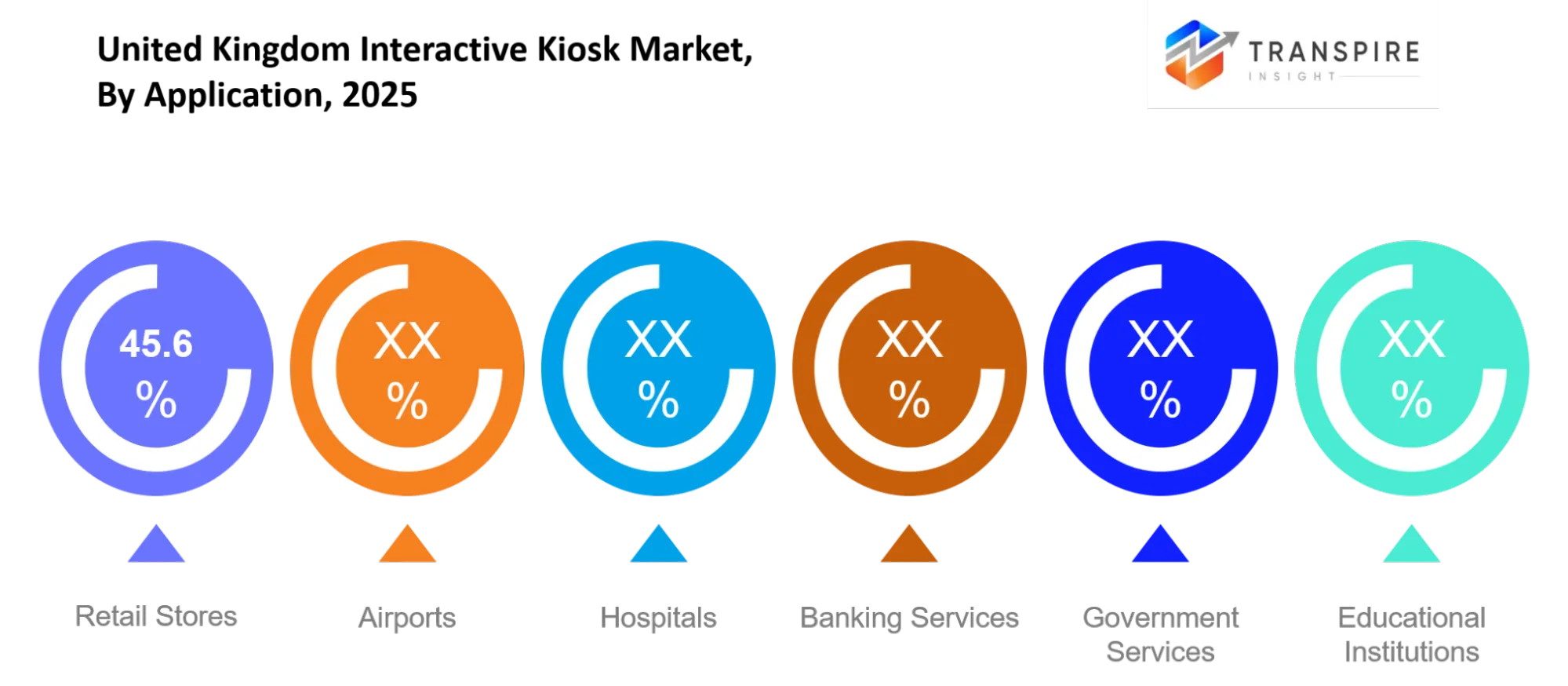
To learn more about this report, Download Free Sample Report
By End User
Retail Sector, Healthcare Sector, BFSI , Transportation Sector, Government Sector , and Others basically define how end users are set up in the United Kingdom Interactive Kiosk Market. The Retail Sector stays a major user group because more investment keeps rolling into self-service technologies, which help operational efficiency and also shape better customer experiences. In the Healthcare Sector, kiosks are used in a way that streamlines patient-facing steps and cuts down the administrative workload inside medical facilities. BFSI organizations deploy kiosk solutions for customer transactions, account services, and even branch automation, like a direct way to modernize everyday operations.
Meanwhile, the Transportation Sector keeps solid demand going across airports, railway stations, and transit networks, mainly to make passenger management smoother and service access easier. The Government Sector keeps expanding kiosk use for public information, citizen engagement, and administrative support functions. Other end users show up too, such as educational institutions, hospitality businesses, and entertainment venues, they look for practical self-service solutions that are fast and consistent. Overall, end-user adoption should keep growing , since organizations are emphasizing automation, wider service accessibility, and cost-aware digital interaction channels.
What are the Key Use Cases Driving the United Kingdom Interactive Kiosk Market?
The main sort of use case is self-service ticketing and check-in across transport hubs like airports, rail stations, and metro systems. These kiosks kind of reduce congestion, they speed up passenger flow, and they let operations run 24/7 without adding extra staffing pressure, which is… honestly the whole point.
Retail self checkout and automatic ordering systems are growing fast, especially in supermarkets and quick service restaurants, where they cut down line times and make each transaction more efficient. This is often tied to labour optimisation approaches in big retail chains, so the link is pretty direct.
Newer use cases also show up in healthcare for patient onboarding kiosks and in government service automation platforms. Hospitals and NHS related facilities are using kiosks more often for registration, appointment scheduling and digital triage. That seems to indicate strong long term adoption potential, and people are probably not slowing down anytime soon.
|
Report Metrics |
Details |
|
Market size value in 2025 |
USD 1264.7 Million |
|
Market size value in 2026 |
USD 1352.3 Million |
|
Revenue forecast in 2033 |
USD 2098.5 Million |
|
Growth rate |
CAGR of6.48% from 2026 to 2033 |
|
Base year |
2025 |
|
Historical data |
2021 - 2024 |
|
Forecast period |
2026 - 2033 |
|
Report coverage |
Revenue forecast, competitive landscape, growth factors, and trends |
|
Regional scope |
United Kingdom |
|
Key company profiled |
NCR Corporation, Diebold Nixdorf, Kiosk Information Systems, Glory Global Solutions, Olea Kiosks, Samsung Electronics, LG Electronics, Advantech, Meridian Kiosks, Frank Mayer, Pyramid Computer, Embross, SlabbKiosks, Source Technologies, REDYREF |
|
Customization scope |
Free report customization (country, regional & segment scope). Avail customized purchase options to meet your exact research needs. |
|
Report Segmentation |
By Product Type (Self-service Kiosks, Information Kiosks, Ticketing Kiosks, Banking Kiosks, Healthcare Kiosks, Retail Kiosks, Smart Kiosks, Others); By Technology (Touchscreen Kiosks, AI-enabled Kiosks, Cloud-connected Kiosks, IoT-enabled Kiosks, Voice-enabled Kiosks, Others); By Application (Retail Stores, Airports, Hospitals, Banking Services, Government Services, Educational Institutions, Others); By End User (Retail Sector, Healthcare Sector, BFSI, Transportation Sector, Government Sector, Others) |
Which Regions are Driving the United Kingdom Interactive Kiosk Market Growth?
London and the South East kind of dominate the United Kingdom Interactive Kiosk Market, mainly because of the dense transport network and the very high passenger flow, you know that constant movement. Heathrow Airport is a big deal here, along with the big rail terminals, and also the financial district nodes, so kiosk placements keep happening in a steady way. Plus there is strong digital infrastructure already in place, and smart city ideas were adopted early, which basically locks in the lead. Also the high level of commercial activity means there are regular upgrade cycles for the kiosk setups, like on a predictable schedule.
The Midlands and Northern England look more like a stable secondary zone, with steady uptake of kiosks across retail parks, manufacturing hubs, and regional transport corridors. Here it’s not as much about sheer passenger density, more about practical cost-efficiency upgrades, and incremental rollouts that make sense for budgets. In cities such as Manchester and Birmingham, public sector digitisation programs help the process move forward gradually but it stays consistent. The investment mood is conservative, but it is also reliable, not overly risky.
Scotland is arguably the fastest-growing region, because there are major upgrades to transport infrastructure, and tourism demand keeps pushing. Lately, investments tied to railway modernization and airport expansion have pushed kiosk installations up quite a lot. On top of that, government-supported digital inclusion initiatives are speeding self-service in public services. All that momentum also creates solid entry openings for kiosk vendors, especially those aiming at regional infrastructure contracts, stretching through 2033.
Who are the Key Players in the United Kingdom Interactive Kiosk Market and How Do They Compete?
The competitive landscape of the United Kingdom Interactive Kiosk Market is kind of moderately consolidated , you know, with a blend of global electronics giants and more focused kiosk manufacturers battling it out via software integration, physical endurance, and those service automation features. The whole competition vibe is sliding away from pure hardware pricing toward AI-enabled functionality, remote oversight, and smoother system interoperability with payment rails and cloud platforms.
NCR Corporation seems to keep leaning into integrated self-checkout ecosystems, and it is also reinforcing its position in UK retail and banking kiosks by using end-to-end service platforms. Diebold Nixdorf leans on secure transaction systems and what you might call an ATM-kiosk hybrid approach, which is already broadly deployed across banking and transit locations.
Kiosk Information Systems is aiming at modular kiosk deployments, so clients can get upgrades without a total rebuild, especially across retail and hospitality. Meridian Kiosks, meanwhile, is expanding through customised hardware designs meant for government and healthcare use cases. Advantech tries to stay ahead with rugged industrial kiosk platforms plus edge computing integration for high-reliability environments, which is where they feel most comfortable.
Company List
• NCR Corporation
• Diebold Nixdorf
• Kiosk Information Systems
• Glory Global Solutions
• Olea Kiosks
• Samsung Electronics
• LG Electronics
• Advantech
• Meridian Kiosks
• Frank Mayer
• Pyramid Computer
• Embross
• SlabbKiosks
• Source Technologies
• REDYREF
Recent Development News
“In May 2025, Diebold Nixdorf announced a multi-year contract to deploy over 3,000 floor-standing interactive kiosks for a global retail client.” This expansion strengthens large-scale self-checkout infrastructure and improves transaction efficiency in high-traffic retail environments across Europe, including UK supermarket chains adopting similar systems.https://www.wiseguyreports.com
“In June 2025, Zebra Technologies announced a strategic partnership with Meridian Kiosks.” The collaboration integrates scanning, labeling, and printing technologies into next-generation kiosks, enhancing checkout automation and inventory visibility in retail and transport deployments across the UK and other European markets.https://www.wiseguyreports.com
“In March 2025, NCR Corporation announced a strategic partnership with Kiosk Information Systems.” The joint initiative focuses on RFID-enabled self-service library kiosks with contactless payment capability, improving automation and service efficiency across public sector deployments including UK municipal library systems.https://www.wiseguyreports.com
What Strategic Insights Define the Future of the United Kingdom Interactive Kiosk Market?
The United Kingdom Interactive Kiosk Market is sort of moving, toward a fully connected software-defined service setup where kiosks act like data-driven customer interaction points more than standalone terminals. Over time, growth will hinge more on AI integration, plus working smoothly with digital payment ecosystems, and then pushing further into healthcare, and public administration too. There is also a risk that is less obvious, tech substitution, where mobile-first service apps might quietly lower reliance on physical kiosks in some retail categories, especially in urban areas that already have high smartphone penetration and strong behavior shift.
At the same time, there’s an opportunity that is starting to stand out: kiosk-as-a-service expansion, backed by 5G connectivity and edge computing. This can make real-time analytics actually practical, while also supporting subscription-based deployments for operators. The vendors that can blend hardware reliability with cloud intelligence will likely get a more durable edge, not just temporary wins. A strategic recommendation then becomes pretty clear, shift away from selling only products and toward lifecycle-managed kiosk ecosystems. That means handling maintenance, software updates, and data services as a bundled ongoing arrangement, so recurring revenue stays in place for longer.
United Kingdom Interactive Kiosk Market Report Segmentation
By Product Type
- Self-service Kiosks
- Information Kiosks
- Ticketing Kiosks
- Banking Kiosks
- Healthcare Kiosks
- Retail Kiosks
- Smart Kiosks
- Others
By Technology
- Touchscreen Kiosks
- AI-enabled Kiosks
- Cloud-connected Kiosks
- IoT-enabled Kiosks
- Voice-enabled Kiosks
- Others
By Application
- Retail Stores
- Airports
- Hospitals
- Banking Services
- Government Services
- Educational Institutions
- Others
By End User
- Retail Sector
- Healthcare Sector
- BFSI
- Transportation Sector
- Government Sector
- Others
Frequently Asked Questions
Find quick answers to common questions.
The Expected United Kingdom Interactive Kiosk Market size for the Market will be USD 2098.5 Million in 2033.
Key segments for the United Kingdom Interactive Kiosk Market are By Product Type (Self-service Kiosks, Information Kiosks, Ticketing Kiosks, Banking Kiosks, Healthcare Kiosks, Retail Kiosks, Smart Kiosks, Others); By Technology (Touchscreen Kiosks, AI-enabled Kiosks, Cloud-connected Kiosks, IoT-enabled Kiosks, Voice-enabled Kiosks, Others); By Application (Retail Stores, Airports, Hospitals, Banking Services, Government Services, Educational Institutions, Others); By End User (Retail Sector, Healthcare Sector, BFSI, Transportation Sector, Government Sector, Others).
Major United Kingdom Interactive Kiosk Market players are NCR Corporation, Diebold Nixdorf, Kiosk Information Systems, Glory Global Solutions, Olea Kiosks, Samsung Electronics, LG Electronics, Advantech, Meridian Kiosks, Frank Mayer, Pyramid Computer, Embross, SlabbKiosks, Source Technologies, REDYREF.
The Current United Kingdom Interactive Kiosk Market size is USD 1264.7 Million in 2025.
The United Kingdom Interactive Kiosk Market CAGR is 6.48% from 2026 to 2033.
• NCR Corporation
• Diebold Nixdorf
• Kiosk Information Systems
• Glory Global Solutions
• Olea Kiosks
• Samsung Electronics
• LG Electronics
• Advantech
• Meridian Kiosks
• Frank Mayer
• Pyramid Computer
• Embross
• SlabbKiosks
• Source Technologies
• REDYREF
About the Authors

Avinash Kumar
I’m Avinash Kumar, a Senior Research Analyst at Transpire Insight, with expertise in the Electronics and Semiconductor and Energy & Power industry. My work focuses on analyzing emerging technologies, market trends, industry developments, and innovation across these sectors. I specialize in transforming complex technical and market insights into clear, research-backed content that helps professionals, businesses, and decision-makers stay informed. Through continuous industry research and data-driven analysis, I strive to deliver accurate, reliable, and practical perspectives on the latest advancements shaping the semiconductor and energy landscape.

Chakradhar Khansole
Chakradhar serves as the Research Director at Transpire Insight, bringing over 8 years of experience in technology, innovation, and strategic market intelligence. He specializes in transforming complex market data into actionable business insights that enable organizations to make informed, growth-oriented decisions. Recognized for his strategic vision and analytical expertise, Chakradhar leads high-impact research initiatives, delivering comprehensive market assessments, competitive intelligence, and forward-looking industry analysis.
Recently Published Reports
-
Apr 2026
Fiber Optic Faceplates Market
Fiber Optic Faceplates Market Size, Share & Analysis Report By Type (< 300 mm2, 300-350 mm2, and > 350 mm2, By Application (Night Vision, Holographic Imaging, Medical, and Others), and Geography (North America, Europe, Asia-Pacific, Middle East and Africa, South and Central America), 2021 - 2031
-
Apr 2026
High Temperature Superconductors Market
High Temperature Superconductors Market Size, Share & Analysis Report By Type (1G HTS, and 2G HTS), By Application (Power Cable, Fault Current Limiter, and Transformer), and Geography (North America, Europe, Asia-Pacific, Middle East and Africa, South and Central America), 2021 - 2031
-
Apr 2026
Industrial Plugs and Socket Market
Industrial Plugs and Socket Market Size, Share & Analysis Report By Type (Industrial Plugs, Industrial Sockets), By Current (Up to 32 A, 32 to 125 A, Above 125 A), By Protection (Dustproof and Splash Proof, Waterproof, Explosion Proof), By End User (Heavy Industries, Oil and Gas, Chemicals and Pharmaceuticals, Power Generation, Others), and Geography (North America, Europe, Asia-Pacific, Middle East and Africa, South and Central America), 2021 - 2031
-
Apr 2026
InGaAs Avalanche Photodiodes Market
InGaAs Avalanche Photodiodes Market Size, Share & Analysis Report By Type (1100 - 1700 nm, and 1000 - 1600 nm), By Application (Missile Warning System, Muzzle Flash Detection, Wafer Defect Inspection, Laser Rangefinders, and Others), and Geography (North America, Europe, Asia-Pacific, Middle East and Africa, South and Central America), 2021 - 2031