
Asia Pacific Singapore Interactive Kiosk Market Size & Forecast:
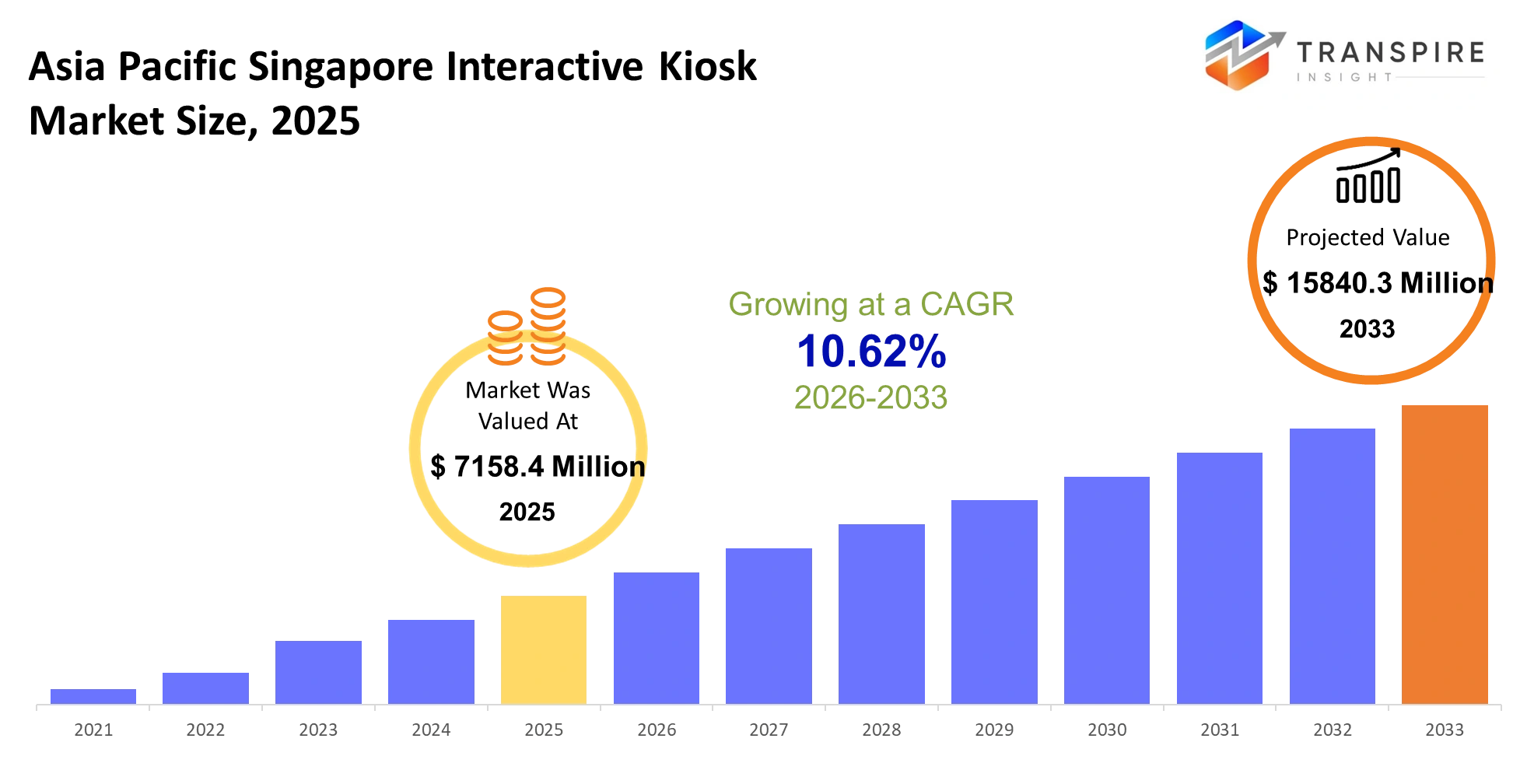
- Asia Pacific Singapore Interactive Kiosk Market Size 2025: USD 7158.4 Million
- Asia Pacific Singapore Interactive Kiosk Market Size 2033: USD 15840.3 Million
- Asia Pacific Singapore Interactive Kiosk Market CAGR: 10.62%
- Asia Pacific Singapore Interactive Kiosk Market Segments: By Type (Self-service Kiosks, Information Kiosks, Payment Kiosks, Others); By Application (Retail, Banking, Transportation, Healthcare, Hospitality, Others); By End-User (Retailers, Banks, Transport Operators, Hospitals, Government, Others); By Component (Hardware, Software, Services, Others)
To learn more about this report,  Download Free Sample Report
Asia Pacific Singapore Interactive Kiosk Market Summary
The Asia Pacific Singapore Interactive Kiosk Market was valued at USD 7158.4 Million in 2025. It is forecast to reach USD 15840.3 Million by 2033. That is a CAGR of 10.62% over the period.
The interactive kiosk market in Singapore serving the Asia Pacific region enables people to check in at transport hubs and retail payment terminals and use digital wayfinding systems and smart information access solutions in commercial buildings and healthcare facilities and public infrastructure systems. The systems decrease queue requirements which results in better service delivery to customers who need less staff support and faster service.
The market has evolved from using standalone touchscreen units during the past three to five years toward adopting cloud-based AI systems which provide analytics and remote monitoring and contactless interface capabilities. The COVID-19 pandemic created an urgent need for organizations to redesign their customer interaction points because health safety requirements needed to be implemented. Singapore's Smart Nation initiatives plus public sector digitalization programs created a strong need for transportation and civic space deployment. The combination of policy support and operational necessity is driving broader kiosk adoption which creates new revenue opportunities through software sales and hardware installations.
Key Market Insights
- The Singapore Interactive Kiosk Market controls 42% of the market share during 2025 because the country is upgrading its entire digital infrastructure.
- The urban smart mobility investments which Southeast Asia is making today will drive the region's growth at over 10% until 2030.
- Public digitalization programs which operate at transit hubs continuously enhance the future development prospects of the Asia Pacific Singapore Interactive Kiosk Market.
- Hardware-based kiosks lead with 48% market share, supported by large-scale deployment across airports, malls, and public service centers.
- Software integration services represent the second-largest segment, which generates approximately 29% of total industry revenue in 2025.
- The new growth area which combines artificial intelligence with cloud-based kiosk systems will experience substantial expansion from 2026 until 2030.
- The Interactive Kiosk Market in Asia Pacific Singapore currently sees contactless payment technology as the leading force driving product development.
- Retail and quick-service applications dominate, capturing nearly 38% of deployment volume due to operational efficiency requirements.
- Digital system improvements at airports and metro stations drive the rapid expansion of transportation and smart mobility kiosks.
- The healthcare industry now experiences increasing demand for self-registration systems which enable automated outpatient service delivery in urban centers.
What are the Key Drivers, Restraints, and Opportunities in the Asia Pacific Singapore Interactive Kiosk Market?
The primary driver which propels the Singapore interactive kiosk market within the Asia Pacific region operates through Singapore's commitment to its smart infrastructure development initiatives. The implementation of digital transformation initiatives which receive government support has mandated organizations to install automated self-service systems at transport terminals and healthcare facilities and public service centers instead of maintaining manual service counters. The shift toward contactless customer service developed momentum when the pandemic demonstrated how traditional labor-based customer service systems could not function and customers needed contactless service delivery. The combined effects of decreased kiosk hardware costs and simplified operational procedures through cloud-based management software have resulted in faster installation time intervals. The software subscriptions and analytics services and maintenance contracts create ongoing revenue growth which extends beyond the initial hardware purchases.
The most significant barrier remains the high integration complexity associated with legacy enterprise systems. Many organizations across banking, healthcare, and public administration still rely on fragmented backend infrastructure that cannot easily connect with modern interactive kiosk platforms. The core systems must undergo replacement which creates a structural challenge because it requires organizations to establish multi-year capital budgets and obtain regulatory permissions and undergo cybersecurity testing. The result is slower procurement cycles, delayed implementation timelines, and suppressed revenue opportunities for kiosk solution providers.
AI-enabled intelligent kiosks which use predictive analytics and multilingual conversation systems present a major growth opportunity for business development. Singapore develops smart retail districts and autonomous transit systems which provide excellent opportunities for advanced system implementations. The deployment of AI-based wayfinding systems together with personalized service kiosks in commercial mixed-use areas will create substantial revenue growth in the software-driven market.
What Has the Impact of Artificial Intelligence Been on the Asia Pacific Singapore Interactive Kiosk Market?
The interactive kiosk ecosystem in Singapore receives transformation through artificial intelligence together with advanced digital technologies which create more flexible self-service systems that deliver higher efficiency and smarter operational performance. The AI-based monitoring systems now handle performance diagnostics through their continuous assessment of transaction speeds and touchscreen responsiveness and payment processing reliability and user interaction patterns. The system enables operators to identify system irregularities together with automated system modifications and remote troubleshooting capabilities which they can use to resolve problems before they lead to complete service disruptions. The automated control systems have successfully decreased service interruptions in high-traffic transport terminals and retail environments which resulted in improved transaction processing efficiency and higher daily kiosk use.
Predictive maintenance capabilities receive enhancement through machine learning technology. The predictive models use historical usage data together with component wear cycles and environmental operating conditions to predict hardware failures which include display degradation and scanner malfunctions and payment module errors before breakdowns occur. The operators achieved 15 to 20 percent reduction in unplanned maintenance incidents through this solution while achieving longer equipment lifespan. AI-powered analytics enhance content distribution together with interface performance which leads to better customer interaction and reduced system downtime.
The enhancements provide better uptime reliability and reduced maintenance expenses and improved operational performance throughout extensive kiosk systems. The present adoption process encounters major obstacles because of the complicated nature of integration work. The existing systems operate through multiple disconnected outdated backend systems which create obstacles for developing precise predictive models and implementing automated processes because both require complete system upgrades and data unification.
Key Market Trends
- The deployment trend since 2021 shows that more than 60 percent of new systems now use cloud-managed solutions because operators need to manage their systems from one location and receive their software updates more quickly.
- The demand for contactless interactions increased sharply after 2020 which led manufacturers such as Samsung Electronics to develop more NFC-enabled kiosk systems for their commercial product deployments.
- Since 2023, buyers now prefer subscription-based service contracts instead of buying hardware because managed kiosk solutions have become popular throughout Singapore's transportation network.
- The implementation of AI-driven predictive diagnostics started to gain traction in 2022 because it helped large kiosk networks achieve unplanned downtime reductions between 15 and 20 percent.
- Public-sector procurement increasingly favors modular systems which show a clear trend away from fixed-purpose kiosks and toward multifunctional systems that emerged after Singapore improved its digital infrastructure.
- Competition has intensified as players like NCR Corporation and Fujitsu accelerated software-first product roadmaps after 2024.
- Supply chain disruptions during 2021-2022 forced operators to establish multiple sources for their components because they needed to decrease reliance on single-region display and semiconductor suppliers.
- Multilingual AI interfaces gained adoption from 2023 onward as operators targeted smoother engagement across Singapore's diverse commuter and retail customer base.
- The financial and government kiosk systems now require stricter authentication methods together with encrypted transaction systems because regulatory bodies have increased their focus on cybersecurity compliance.
Asia Pacific Singapore Interactive Kiosk Market Segmentation
By Type :
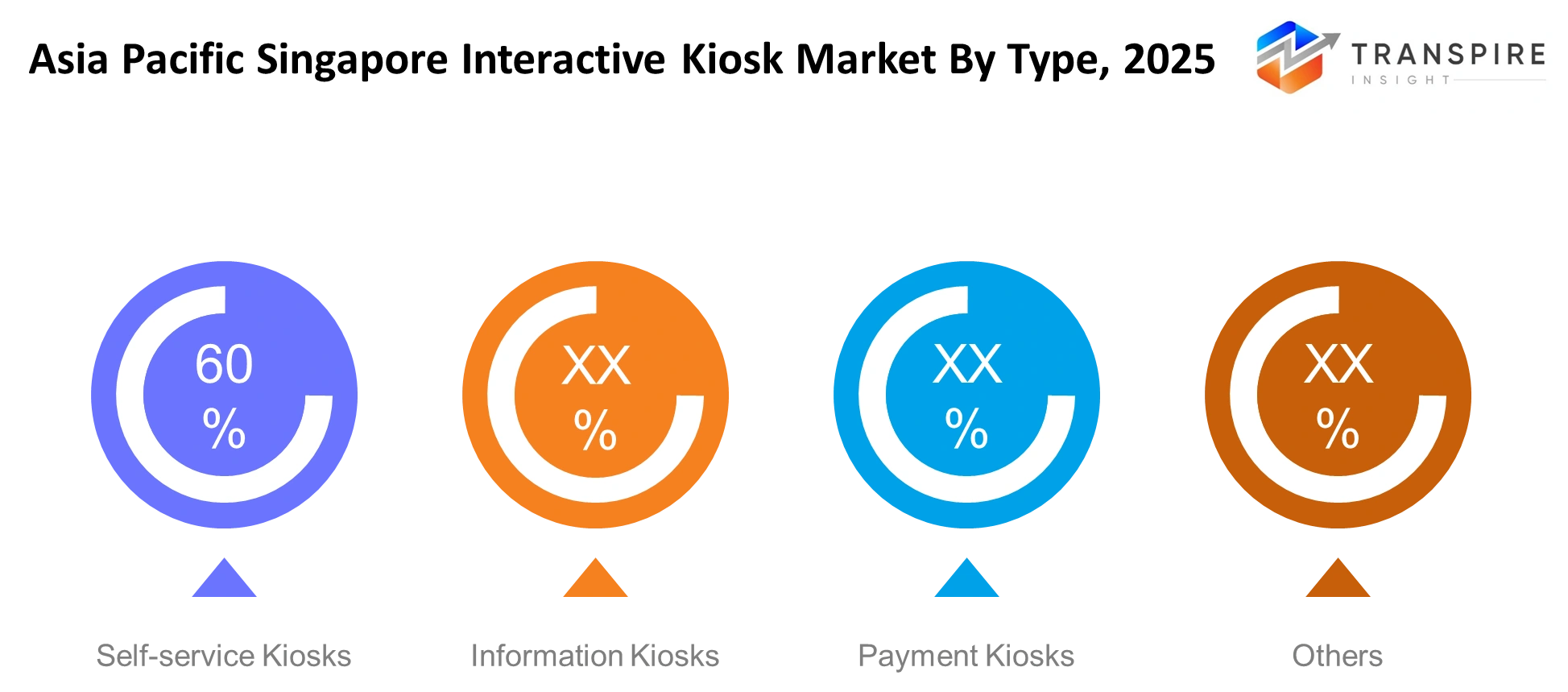
The Asia Pacific Singapore Interactive Kiosk Market includes several kiosk types designed to meet different operational needs across industries. Self-service kiosks enable customers to conduct fast transactions because customers can order products and check information and register for services without waiting for staff support. The systems attract business interest because companies need to deliver services faster while creating seamless experiences for their customers. Public spaces now use information kiosks which display touch-enabled digital interfaces to provide directions and event information and service updates and general assistance.
Payment kiosks enable secure financial transactions which include bill payments and ticket purchases and account services. The systems decrease manual processing time while they enhance precise transaction execution. Other kiosk types include specialized systems created for check-ins, visitor management, surveys, and feedback collection. The business environment in Singapore shows increasing demand for automation solutions and digital convenience through its growing popularity of these categories.
To learn more about this report, Download Free Sample Report
By Application :
Retail stores in Asia Pacific Singapore Interactive Kiosk Market serve as the biggest market segment because stores use digital solutions to make shopping easier for customers. The Interactive kiosks help users to find products and complete their purchases and access loyalty programs and view promotional materials. Kiosks enable banking services to grow because they provide account management and deposit services and statement printing and customer support which decreases customer waiting times in branches. Kiosks operate as ticketing and route information and boarding pass and passenger update systems which serve airports and bus terminals and metro stations.
The healthcare industry uses kiosks to enable patient registration and appointment scheduling and digital information sharing. The systems enable hospitality businesses to implement self-check-in and provide concierge services and manage reservation systems. The other systems are used in educational institutions and public administration offices because they provide digital service access which helps to improve operational efficiency and user experience.
By End-User :
The need for digital customer engagement together with operational efficiency requirements creates a major end-user market segment for retailers. Businesses can achieve faster service delivery because interactive kiosks decrease staff demands during their busiest operating times. Basic banking services operate through these systems which enable customers to access services beyond traditional counter hours while branch operations gain efficiency. Kiosks serve as ticketing systems which transit operators use to provide route information and assist customers in crowded transit terminals.
Hospitals use these systems to enhance their administrative functions through streamlined registration and payment processing systems. Government offices use kiosk systems to provide citizen services which enable form submissions and public information access and queue management. Educational institutions and entertainment venues use digital self-service systems to enhance access to their services.
By Component :
The Asia Pacific Singapore Interactive Kiosk Market relies on hardware components which establish its physical infrastructure through displays touchscreens processors scanners printers and payment terminals. The ongoing development of screen strength together with improved processing speed and compact system construction makes it possible to use these technologies in both indoor and outdoor environments. Businesses increasingly prefer hardware solutions that offer long operational life with minimal maintenance needs.
Software plays an equal role because it enables kiosk operations through interface development and security implementation and system connection. Custom software helps businesses deliver user-friendly experiences tailored to specific operational goals. The company provides installation and maintenance services together with technical support and system upgrades to maintain system performance over time. The organizations require dependable digital infrastructure for their daily activities which makes strong service support an essential requirement.
What are the Key Use Cases Driving the Asia Pacific Singapore Interactive Kiosk Market?
The interactive kiosk systems in Singapore show their most common application through self-service transactions which are used in retail stores and public transportation systems. Airports and metro stations and shopping malls and quick-service restaurants use these systems because they help reduce wait times and increase transaction speed and handle customer surges while needing fewer employees at service points.
The fields of healthcare and public service work are experiencing rapid growth. Hospitals use self-registration and appointment management systems to improve patient flow while government service centers use digital kiosks to process documentation requests and provide citizen services.
New applications are being developed in smart mixed-use developments and autonomous mobility infrastructure. The AI-enabled wayfinding kiosks with real-time personalization have started to gain traction in commercial business districts while interactive information terminals that connect with smart building systems will become essential elements of Singapore's future urban development projects during the upcoming forecast period.
|
Report Metrics |
Details |
|
Market size value in 2025 |
USD 7158.4 Million |
|
Market size value in 2026 |
USD 7815.8 Million |
|
Revenue forecast in 2033 |
USD 15840.3 Million |
|
Growth rate |
CAGR of 10.62% from 2026 to 2033 |
|
Base year |
2025 |
|
Historical data |
2021 - 2024 |
|
Forecast period |
2026 - 2033 |
|
Report coverage |
Revenue forecast, competitive landscape, growth factors, and trends |
|
Regional scope |
Asia Pacific (China, India, Japan, South Korea, Australia, Rest of Asia Pacific) |
|
Key company profiled |
NCR Corporation, Diebold Nixdorf, Kiosk Information Systems, Glory, Toshiba, Fujitsu, Samsung, LG, Advantech, Zebra Technologies, Olea Kiosks, Meridian Kiosks, RedyRef, SlabbKiosks, Frank Mayer |
|
Customization scope |
Free report customization (country, regional & segment scope). Avail customized purchase options to meet your exact research needs. |
|
Report Segmentation |
By Type (Self-service Kiosks, Information Kiosks, Payment Kiosks, Others); By Application (Retail, Banking, Transportation, Healthcare, Hospitality, Others); By End-User (Retailers, Banks, Transport Operators, Hospitals, Government, Others); By Component (Hardware, Software, Services, Others) |
Which Regions are Driving the Asia Pacific Singapore Interactive Kiosk Market Growth?
The interactive kiosk market in Asia Pacific reaches its highest point in Singapore because the country establishes both a strong public digitalization policy and its world-class urban infrastructure and extensive business network. The Smart Nation initiatives which the government supports have expedited development throughout essential transportation centers and various public and private service areas. The country operates with three advantages which include its established vendor network for technology and its payment systems and its consumer base which understands self-service technology. The integrated ecosystem enables kiosk operators to expand their operations while maintaining high revenue from software and maintenance services.
Japan and South Korea together with the developed markets of Asia Pacific form the second largest regional economic power because their technological capacity remains steady without any centralized policy support. The digital rollout in Singapore operates through public-sector digital initiatives while private businesses in these markets invest for the long term to develop automated systems which improve customer experiences. The retail banking and transport industries maintain their existing kiosk systems because their economic conditions allow them to operate on regular replacement schedules. Solution providers who specialize in system upgrades and AI integration and lifecycle management services will find consistent revenue opportunities through this process.
Southeast Asia outside Singapore is becoming the fastest developing regional market because cities in the region build new urban infrastructure and implement digital service upgrades. The countries of Indonesia, Thailand, and Vietnam have boosted their financial support for developing smart transit networks and automated airport systems and digital public service infrastructure. The new deployment opportunities emerged because operators wanted to establish self-service technologies that could handle different needs. The market expansion between 2026 and 2033 will provide investors with growth opportunities because modular kiosk platforms which serve various infrastructure development stages will experience strong demand.
Who are the Key Players in the Asia Pacific Singapore Interactive Kiosk Market and How Do They Compete?
The Asia Pacific Singapore interactive kiosk market shows moderate fragmentation because global technology companies compete with specialized self-service businesses and local systems integration companies. Competition has shifted away from basic hardware pricing toward software capability, system integration depth, and long-term service support. Established players use AI analytics and remote fleet monitoring and cybersecurity protection to defend their market share while new companies focus on niche markets with their affordable modular systems. The primary basis of competition now centers on technology differentiation and the ability to integrate seamlessly with complex enterprise infrastructure.
The software-focused kiosk systems developed by NCR Corporation enable payment processing and cloud service management and predictive maintenance capabilities as their core operational components. The company excels at linking self-service equipment with business transaction systems which makes it appealing to retail businesses and financial institutions that handle high volumes of transactions. The secure transaction framework of Diebold Nixdorf together with its compliance capabilities enables the company to grow through banking system modernization initiatives and digital banking partnerships throughout the Asia Pacific region.
Samsung Electronics uses its display technology expertise and touchscreen design capabilities to create high-reliability systems which meet the needs of both transit and commercial operations. Fujitsu focuses on AI-enhanced public service and healthcare kiosks, where multilingual processing and backend interoperability create a strong competitive edge. KIOSK Information Systems grows its business through customized modular solutions, which allow operators to achieve faster regional implementation of their specific needs instead of using standard global solutions.
Company List
- NCR Corporation
- Diebold Nixdorf
- Kiosk Information Systems
- Glory
- Toshiba
- Fujitsu
- Samsung
- LG
- Advantech
- Zebra Technologies
- Olea Kiosks
- Meridian Kiosks
- RedyRef
- SlabbKiosks
- Frank Mayer
Recent Development News
In May 2026, Concierge expanded its deployment and announced market scaling following the operation of more than 30 self-service kiosks at Changi Airport. The company reported over half a million passenger interactions in 2025, demonstrating large-scale operational success that reinforces Singapore’s position as a leading Asia Pacific hub for intelligent airport kiosk solutions. Source https://www.businesswire.com/
In September 2025, Singapore Police Force launched its Report Lodging Co-Pilot (R-COP) at self-help kiosks. The AI-powered kiosk system was deployed across seven police division headquarters to automate report filing and improve citizen-service efficiency, marking a significant public-sector interactive kiosk upgrade in Singapore’s digital services market.
Source https://www.police.gov.sg/
What Strategic Insights Define the Future of the Asia Pacific Singapore Interactive Kiosk Market?
The Singapore interactive kiosk market in the Asia Pacific region will develop its system base during the next five to seven years through software-defined systems which deliver intelligent service capabilities instead of using standalone hardware systems. The underlying force behind this transition is the convergence of smart city infrastructure, AI-powered automation, and enterprise demand for centralized operational visibility. Organizations will increase their revenue growth through recurring software licensing and predictive analytics and managed service contracts because they want to gain more value from their products than through purchasing single-time equipment.
The primary danger exists when platforms become dependent on a small set of software and cloud integration companies for their operations. The kiosk ecosystems will become more dependent on their proprietary operating systems which will create vendor lock-in problems for operators who need to handle their systems and fight against rising operational costs which will restrict their system expansion.
Southeast Asia presents a growing opportunity to combine conversational AI kiosks with smart mixed-use districts which will benefit high-density commercial areas that need digital assistance in multiple languages. Market participants should begin their most successful approach by developing their investment strategy into open-architecture systems which allow third-party product connections. The new system will enable organizations to adjust their enterprise software requirements more quickly while decreasing their reliance on proprietary systems from specific vendors.
Asia Pacific Singapore Interactive Kiosk Market Report Segmentation
By Type
- Self-service Kiosks
- Information Kiosks
- Payment Kiosks
By Application
- Retail
- Banking
- Transportation
- Healthcare
- Hospitality
By End-User
- Retailers
- Banks
- Transport Operators
- Hospitals
- Government
By Component
- Hardware
- Software
- Services
Frequently Asked Questions
Find quick answers to common questions.
The Asia Pacific Singapore Interactive Kiosk Market size is USD 15840.3 Million in 2033.
Key segments for the Asia Pacific Singapore Interactive Kiosk Market are By Type (Self-service Kiosks, Information Kiosks, Payment Kiosks, Others); By Application (Retail, Banking, Transportation, Healthcare, Hospitality, Others); By End-User (Retailers, Banks, Transport Operators, Hospitals, Government, Others); By Component (Hardware, Software, Services, Others).
Major Asia Pacific Singapore Interactive Kiosk Market players are NCR Corporation, Diebold Nixdorf, Kiosk Information Systems, Glory, Toshiba, Fujitsu, Samsung, LG, Advantech, Zebra Technologies, Olea Kiosks, Meridian Kiosks, RedyRef, SlabbKiosks, Frank Mayer.
The Asia Pacific Singapore Interactive Kiosk Market size is USD 7158.4 Million in 2025.
The Asia Pacific Singapore Interactive Kiosk Market CAGR is 10.62% from 2026 to 2033.
- NCR Corporation
- Diebold Nixdorf
- Kiosk Information Systems
- Glory
- Toshiba
- Fujitsu
- Samsung
- LG
- Advantech
- Zebra Technologies
- Olea Kiosks
- Meridian Kiosks
- RedyRef
- SlabbKiosks
- Frank Mayer
Recently Published Reports
-
Apr 2026
Fiber Optic Faceplates Market
Fiber Optic Faceplates Market Size, Share & Analysis Report By Type (< 300 mm2, 300-350 mm2, and > 350 mm2, By Application (Night Vision, Holographic Imaging, Medical, and Others), and Geography (North America, Europe, Asia-Pacific, Middle East and Africa, South and Central America), 2021 - 2031
-
Apr 2026
High Temperature Superconductors Market
High Temperature Superconductors Market Size, Share & Analysis Report By Type (1G HTS, and 2G HTS), By Application (Power Cable, Fault Current Limiter, and Transformer), and Geography (North America, Europe, Asia-Pacific, Middle East and Africa, South and Central America), 2021 - 2031
-
Apr 2026
Industrial Plugs and Socket Market
Industrial Plugs and Socket Market Size, Share & Analysis Report By Type (Industrial Plugs, Industrial Sockets), By Current (Up to 32 A, 32 to 125 A, Above 125 A), By Protection (Dustproof and Splash Proof, Waterproof, Explosion Proof), By End User (Heavy Industries, Oil and Gas, Chemicals and Pharmaceuticals, Power Generation, Others), and Geography (North America, Europe, Asia-Pacific, Middle East and Africa, South and Central America), 2021 - 2031
-
Apr 2026
InGaAs Avalanche Photodiodes Market
InGaAs Avalanche Photodiodes Market Size, Share & Analysis Report By Type (1100 - 1700 nm, and 1000 - 1600 nm), By Application (Missile Warning System, Muzzle Flash Detection, Wafer Defect Inspection, Laser Rangefinders, and Others), and Geography (North America, Europe, Asia-Pacific, Middle East and Africa, South and Central America), 2021 - 2031