

United Kingdom Intelligent Traffic Management System Market Size & Forecast:
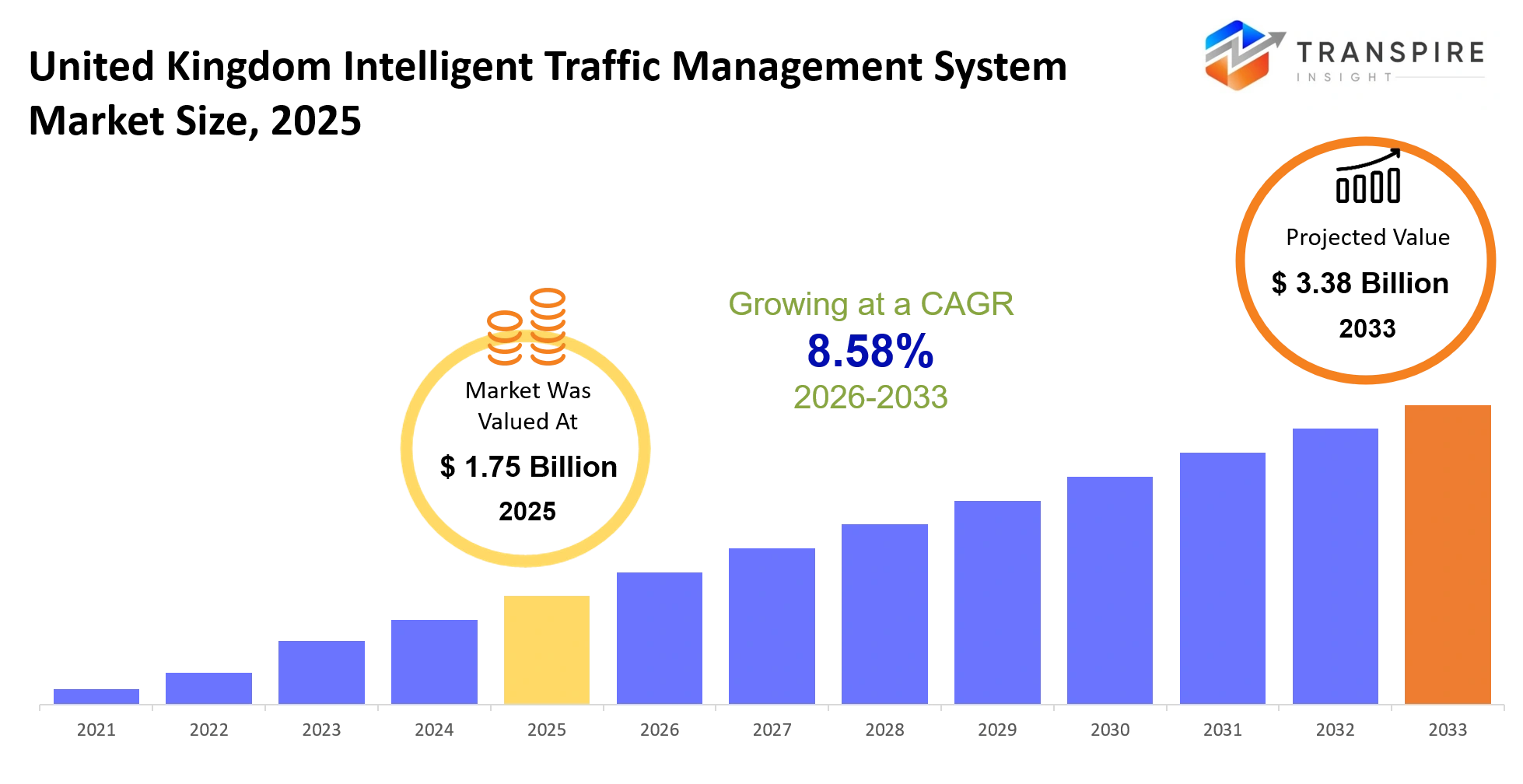
- United Kingdom Intelligent Traffic Management System Market Size 2025: USD 1.75 Billion
- United Kingdom Intelligent Traffic Management System Market Size 2033: USD 3.38 Billion
- United Kingdom Intelligent Traffic Management System Market CAGR: 8.58%
- United Kingdom Intelligent Traffic Management System Market Segments: By Component (Traffic Monitoring Systems, Adaptive Traffic Signals, Smart Cameras, Traffic Sensors, Analytics Platforms, Incident Detection Systems, Others); By Technology (AI-based Traffic Management, IoT-enabled Systems, Cloud-based Platforms, Big Data Analytics, Smart Signal Systems, Others); By Application (Urban Traffic Management, Highway Traffic Management, Smart Parking, Toll Management, Public Transportation, Others); By End User (Government Authorities, Smart Cities, Transportation Agencies, Highway Operators, Others).
To learn more about this report,  Download Free Sample Report
United Kingdom Intelligent Traffic Management System Market Summary
The United Kingdom Intelligent Traffic Management System Market was valued at USD 1.75 Billion in 2025. It is forecast to reach USD 3.38 Billion by 2033. That is a CAGR of 8.58% over the period.
In the United Kingdom, intelligent traffic management systems kinda coordinate road signals, sensors, and linked data platforms to keep urban mobility moving, even when cities are jammed up, in ports, and along logistics corridors. It’s not just about how long the lights stay red or green, these systems chew through real time vehicle, pedestrian, and freight information to cut down on choke points, prioritise emergency routes , and also back low emission zones.
Over the past five years , the market has shifted away from fixed rule traffic control toward AI enabled, cloud based optimisation. This is driven by IoT roadside sensors and camera analytics, and the whole thing reacts instead of sitting still. A big trigger was the post pandemic rebound in city traffic, mixed with tougher air quality policies, like more low emission and congestion control zones in major cities. So local authorities end up needing adaptive setups that can respond on the fly to the demand that keeps changing.
So now investment is leaning more toward interoperable platforms that improve throughput while still meeting emissions requirements, and that also help with long term infrastructure planning.
Key Market Insights
- London pretty much dominates the United Kingdom Intelligent Traffic Management System Market , roughly 38% share, mostly because traffic is really dense and they keep rolling out smart mobility infrastructure which is kind of like everywhere.
- In Southeast England you see solid adoption, mostly tied to people commuting, plus commuter congestion, and all those smart corridor development drives going on.
- Northern areas like Manchester and Birmingham are showing the fastest momentum all the way through 2026, in large part from smart city funding and transport modernisation programs that get renewed again and again.
- On the side of products, software platforms are leading the United Kingdom Intelligent Traffic Management System Market with nearly 42% share, mainly due to real-time analytics needs and the big push for AI traffic optimisation.
- Hardware solutions, including sensors and smart signals , stay as the second biggest segment, helping the physical infrastructure upgrades actually get done.
- Meanwhile cloud based traffic management services are the fastest-growing segment, because scalable rollout feels easier and the operating costs can be lower , through 2032.
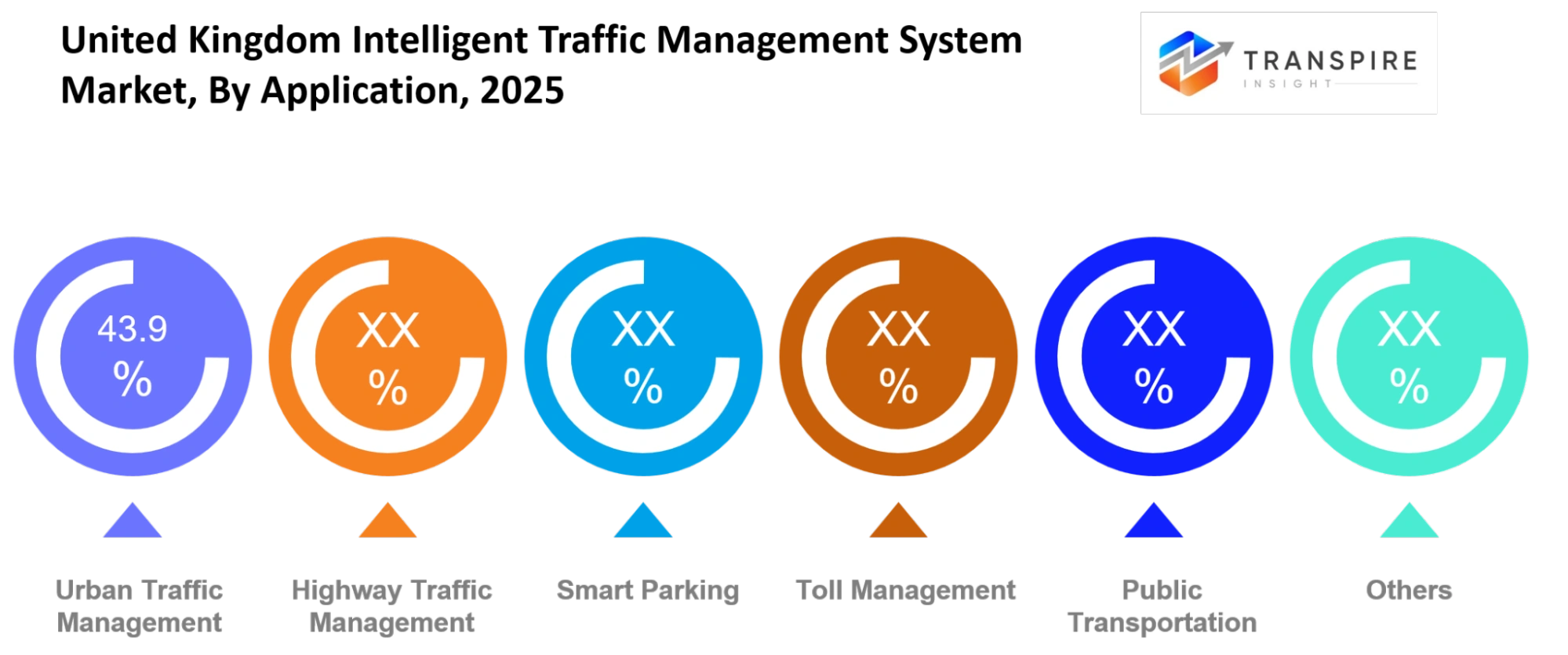
- For applications, urban traffic signal control takes the top spot at about 45% share. This signals high congestion management demands, especially in big metropolitan zones.
- Congestion prediction along with dynamic routing shows up as the quickest to grow, supported by AI integration and connected vehicle ecosystems.
- Incident detection systems are gaining traction too, since road safety is becoming more strict , and emergency response optimisation wants better detection.
- And when it comes to who’s buying, Government transport authorities lead the market with almost 50% share, because public infrastructure control mandates pretty much require it.
What are the Key Drivers, Restraints, and Opportunities in the United Kingdom Intelligent Traffic Management System Market?
In the United Kingdom Intelligent Traffic Management System Market, the main driver seems to be the fast merge of AI-enabled traffic control platforms across big urban corridors. Honestly this change got moving because congestion costs kept rising in cities like London and Birmingham, and then after 2020 the transport recovery pressure really showed where the older signal setups were kinda weak, or just not so efficient. So, transport authorities are now pushing procurement of real-time adaptive systems that tweak signal timing in the moment, cut down on needless idle congestion, and also help meet low-emission zoning requirements. That, in turn, bumps up vendor revenue via longer term software licensing, infrastructure enhancements and managed service agreements that often link to city-wide rollout efforts.
The main restraint though is still the fragmented legacy infrastructure across local councils, which makes interoperability messy and slows down data standardisation. A lot of regions still run outdated fixed-time signalling setups that they cannot blend smoothly with cloud based platforms. Because of that kind of structural limitation, the upgrade costs climb, procurement timelines stretch out, and the full scale deployment gets delayed. For solution providers, this means near term revenue growth is kind of held back in the United Kingdom Intelligent Traffic Management System Market.
A fairly visible opportunity is starting to show up from vehicle-to-everything, or V2X, communication trials tied to connected vehicle corridors in Southeast England. Pilot efforts on smart motorways, using real-time vehicle information plus roadside sensing, are building the conditions for predictive, almost self-improving traffic networks. If they scale across the country, it could open an extra revenue stream built around subscription mobility intelligence services, plus platform style tools for cross-city data integration.
What Has the Impact of Artificial Intelligence Been on the United Kingdom Intelligent Traffic Management System Market?
Artificial intelligence is doing a lot to remake the United Kingdom Intelligent Traffic Management System Market, kinda turning fixed traffic infrastructure into more adaptive, self optimizing urban mobility networks, you know. In practice, AI driven platforms are now used to automate signal coordination, spot congestion, and handle compliance monitoring across low emission and regulated traffic zones. Transport authorities often lean on computer vision systems, plus edge based analytics, to follow vehicle flow in real time, so there’s less need for manual meddling and enforcement ends up being more efficient in those crowded city stretches.
Then there’s the predictive angle too, where machine learning models sift through historical traffic patterns, weather inputs, and event triggered surges to forecast congestion hot spots and adjust route distribution early, before the jams really start. These solutions are also getting woven into fleet management and emissions control monitoring for public transport operators. In that setup AI helps flag maintenance needs sooner, cut downtime, and stay within the stricter air quality rules that keep coming in. In a handful of UK pilot deployments, the tools have shown measurable drop in signal idle time, and also better fleet utilization efficiency, which then supports lower operating expenses and smoother throughput overall.
Still, one big catch remains. The cost to integrate AI systems with fragmented legacy road infrastructure is high, and that slows things down. Many local authorities run incompatible signalling equipment, so data continuity breaks, and model accuracy takes a hit. As a result, it’s harder to roll out at full scale, and performance gains don’t stay consistent across the entire United Kingdom Intelligent Traffic Management System Market.
Key Market Trends
- Since 2021, UK councils have kind of shifted away from fixed time signals toward more adaptive AI setups, and yeah this has cut congestion lags along several major urban corridors by boosting real-time responsiveness, in ways that feel quicker than before.
- Between 2022 and 2025, cloud based deployment models basically replaced on-premise traffic platforms, which helped with faster scaling of the United Kingdom Intelligent Traffic Management System Market across multiple cities, without all the heavy setup time.
- London’s transport authority also expanded congestion-zone enforcement by leaning more on automated number plate recognition systems, and that strengthened real-time compliance monitoring too, especially after the stricter emission rules came in 2023.
- By 2024, the integration of IoT roadside sensors increased a lot, letting continuous traffic-flow analytics run more smoothly, and it reduced the need for manual observation teams, quite a bit.
- Demand for predictive congestion modelling jumped sharply after post-pandemic traffic surges in 2022, and that showed the weak points in older traffic planning tools across the nation.
- Key players like Siemens Mobility and Thales Group expanded AI driven traffic platforms in the UK via partnerships with municipal smart city programs, since 2023 has been a sort of turning point.
- From 2023 to 2026, V2X pilot projects in Southeast England have moved focus toward connected corridor development, to test real-time vehicle-to-infrastructure communication more directly.
- Procurement strategies changed after 2022 too, with local authorities placing more weight on interoperable systems over standalone hardware, which reshaped competitive dynamics in the United Kingdom Intelligent Traffic Management System Market.
- Also, rising adoption of edge computing since 2024 improved signal decision speed at intersections, cutting latency in high-density traffic zones across metropolitan UK regions, noticeably overall.
United Kingdom Intelligent Traffic Management System Market Segmentation
By Component :
Traffic monitoring systems are used across most UK cities to help track vehicle movement and, in a way, reduce traffic jams through constant watching of road conditions. Adaptive traffic signals tweak the timing based on live traffic, which usually makes each junction work better. Smart cameras and traffic sensors back up real-time detection of congestion, accidents and even violations, this then boosts enforcement and safety results in day to day situations.
Analytics platforms crunch huge amounts of mobility data to steer planning choices while incident detection systems spot disruptions fast and help cut down response time for authorities. Each piece kind of fits with the others to improve overall road performance and reduce waiting times across urban routes and highway corridors too.
By Technology :
AI-based traffic management systems enable a more automated sort of judgement, by changing traffic patterns according to what is happening right now. IoT-enabled setups link roadside devices, sensors and vehicles so they can keep exchanging continuous data across different networks. Cloud-based platforms let local authorities handle traffic operations remotely and roll the capability out across multiple regions.
Big data analytics can also reveal longer term congestion trends and support infrastructure planning, not just short-term fixes. Smart signal systems enhance intersection control by reacting to real-time inputs, rather than fixed schedules. Overall these technologies improve efficiency and lessen the need for manual traffic control procedures across the United Kingdom Intelligent Traffic Management System Market.
By Application :
Urban traffic management is very widely used to cut congestion in crowded city areas, by tweaking signal timing and the movement of vehicles. On the highway side, traffic management boosts the flow on major routes, and also cuts down delays that come from accidents, mostly by using real time monitoring. Smart parking systems help people find vacant spaces, so they don’t endlessly circle around.
Toll management systems help with fast toll collecting and basically traffic regulation on busy stretches. Public transportation applications make bus and transit schedules work better, using live traffic information. Together these kinds of apps support better mobility performance and can shrink trip duration across UK transport routes.
To learn more about this report, Download Free Sample Report
By End User :
Government authorities have a key part to play when it comes to rolling out intelligent traffic systems to deal with congestion and raise road safety. Smart city programs connect digital traffic solutions with broader urban development schemes, aiming at higher mobility efficiency. Transportation agencies then use these systems for route planning, monitoring, and service optimization.
Highway operators lean on intelligent systems to coordinate traffic flow and to reduce delays along major corridors. Other parties also step in, like regional councils and infrastructure bodies, who back localized traffic control and continuous monitoring. In the end all end users help with better coordination, and with easing congestion pressure across transport networks.
What are the Key Use Cases Driving the United Kingdom Intelligent Traffic Management System Market?
Urban congestion control is still the main , kind of core use case that keeps the United Kingdom Intelligent Traffic Management System Market moving, with real time signal optimisation and traffic monitoring being used in most major cities. More commuter density , plus tougher emissions rules, keeps pushing demand for solutions that are constantly tuning traffic flow and cutting down intersection idle time.
On top of that, the expansion looks like highway incident management and public transport prioritisation, which is kind of a nice combo. Highway authorities pull in live data feeds to catch accidents quicker, so they can keep things flowing calmer on important freight corridors. Public transport operators then layer in adaptive routing tools, aiming to make buses more on time and limit delays during the busiest peak travel hours, most times.
Newer use cases are mostly about predictive mobility planning and connected vehicle coordination. Local transport bodies are starting to trial AI based forecasting tools that can see congestion before it actually forms, and early vehicle to infrastructure pilots help enable automated messaging between vehicles and roadside systems, for safer traffic flow management.
|
Report Metrics |
Details |
|
Market size value in 2025 |
USD 1.75 Billion |
|
Market size value in 2026 |
USD 1.90 Billion |
|
Revenue forecast in 2033 |
USD 3.38 Billion |
|
Growth rate |
CAGR of 8.58% from 2026 to 2033 |
|
Base year |
2025 |
|
Historical data |
2021 - 2024 |
|
Forecast period |
2026 - 2033 |
|
Report coverage |
Revenue forecast, competitive landscape, growth factors, and trends |
|
Regional scope |
Middle East and Africa (Saudi Arabia, United Arab Emirates, South Africa, Rest of Middle East and Africa) |
|
Key company profiled |
Siemens Mobility, Kapsch TrafficCom, Cubic Corporation, Thales Group, Swarco, IBM, Cisco Systems, Huawei, Hitachi, Indra Sistemas, Q-Free, TransCore, NEC Corporation, Jenoptik, Iteris. |
|
Customization scope |
Free report customization (country, regional & segment scope). Avail customized purchase options to meet your exact research needs. |
|
Report Segmentation |
By Component (Traffic Monitoring Systems, Adaptive Traffic Signals, Smart Cameras, Traffic Sensors, Analytics Platforms, Incident Detection Systems, Others); By Technology (AI-based Traffic Management, IoT-enabled Systems, Cloud-based Platforms, Big Data Analytics, Smart Signal Systems, Others); By Application (Urban Traffic Management, Highway Traffic Management, Smart Parking, Toll Management, Public Transportation, Others); By End User (Government Authorities, Smart Cities, Transportation Agencies, Highway Operators, Others). |
Which Regions are Driving the United Kingdom Intelligent Traffic Management System Market Growth?
London, and the whole Greater Southeast area, are basically leading the United Kingdom Intelligent Traffic Management System Market , because the urban mobility demand is incredibly dense, and also because policy enforcement is really strict. The rules for congestion control, and the expansion of low-emission zones, sort of nudge the authorities toward real-time adaptive traffic services. Plus the digital infrastructure is already fairly advanced, and those early smart city rollouts help keep the system being upgraded continuously. There’s also a big commuting crowd, and a lot of freight movement running through London corridors, which means there’s constant pressure to optimize. Altogether, this whole environment basically keeps long-term funding flowing into intelligent traffic platforms, and integrated control systems, long after the initial deployments.
Meanwhile the Midlands region, which includes Birmingham and the nearby industrial towns, contributes in a steady way, due to its manufacturing strength and the more structured transport planning. Compared with London, the growth here is not so much because of overwhelming traffic jams, it’s more about predictable freight flows and industrial logistics efficiency requirements. Local authorities tend to concentrate on improving highway links and trimming down waiting times in goods transport. Stable support from transport modernization programs keeps things consistent, so traffic monitoring, and incident management tools, get deployed in a reliable rhythm. That’s why the contribution stays balanced, and it helps overall market revenue in a fairly steady manner.
Northern England feels like the fastest-growing area, sort of backed by new smart city funding plus the big highway overhaul programs in places like Manchester and Leeds. Since after 2023, government-backed digital transport schemes have sped up the rollout of AI- driven traffic management systems. At the same time better money for regional connection projects has helped those tools take hold not just inside the cities but also on intercity corridors. All this quick turn suggests solid momentum for tech vendors and infrastructure investors between 2026 and 2033, in particular for scale-ready cloud traffic solutions.
Who are the Key Players in the United Kingdom Intelligent Traffic Management System Market and How Do They Compete?
The United Kingdom Intelligent Traffic Management System Market looks pretty moderately consolidated, as only a few bigger global transport technology providers end up taking most of the attention in major city deployments. At the same time, smaller specialist firms still show up, but they usually play in niche analytics, and integration roles, sort of like a smaller slice. What really pushes competition here is less about cost by itself , and more about technology capability plus system interoperability. Transport authorities often care about long-term scalability and how well the solution can blend with legacy infrastructure, even when everything is not perfectly modern. Incumbents keep defending their position, by upgrading their platforms toward AI-enabled and cloud-based architectures. Meanwhile newer entrants tend to concentrate on software-driven optimization layers, which can be layered onto what’s already there, without doing a full infrastructure replacement.
Siemens Mobility and Thales Group both focus on full stack traffic ecosystems that tie together signalling hardware, digital control platforms, and predictive analytics tools. Siemens Mobility strengthens its stance by using integrated rail road coordination systems, deployed across multimodal UK transport corridors. Thales Group, on the other hand, leans into secure communication layers and transport cybersecurity features, and these are pretty attractive for government-led smart city programs. Kapsch TrafficCom builds leverage through tolling and congestion pricing systems. It also expands via long-term contracts with highway authorities and motorway operators, which is kind of their steady move.
Cubic Transportation Systems is really about mobility payment integration and data based passenger flow analytics, kind of linking traffic management to how people actually use public transport. SWARCO on the other hand keeps expanding via smart signal infrastructure and adaptive traffic light systems, rolled out across mid sized UK cities where they can. Together they end up reinforcing their presence through local council style partnerships and those phased modernization projects at the city level, so the change doesn’t hit all at once. That also lets them swap out the older legacy traffic systems with modular, scalable solutions, in a more gradual way than a full stop replacement.
Company List
- Siemens Mobility
- Kapsch TrafficCom
- Cubic Corporation
- Thales Group
- Swarco
- IBM
- Cisco Systems
- Huawei
- Hitachi
- Indra Sistemas
- Q-Free
- TransCore
- NEC Corporation
- Jenoptik
- Iteris
Recent Development News
In July 2025, Modaxo announced the launch of Intelliscape. The initiative consolidated intelligent transport systems assets acquired from SEA into a dedicated mobility and traffic management business, strengthening the UK’s long-term intelligent infrastructure capabilities and expanding digital road and rail traffic optimisation solutions.
Source: https://www.globenewswire.com/
In March 2026, Solar Gates entered a strategic partnership with Berlex. The collaboration introduced the R6+ cloud-connected portable intelligent traffic signal system in the UK, enabling remote, app-based monitoring and control of traffic lights and improving flexibility for temporary traffic management deployments across roadworks and urban corridors.
Source: https://www.solargates.co.uk/
What Strategic Insights Define the Future of the United Kingdom Intelligent Traffic Management System Market?
The United Kingdom Intelligent Traffic Management System Market is kind of slowly, you know, shifting toward fully integrated AI orchestrated mobility networks where traffic signals, vehicle information, and roadside infrastructure systems act like one single digital layer. You can see this trend being pushed by stricter urban emissions rules and also by the need for cities to handle increasing movement demand without just… expanding physical road capacity. Over the next 5 to 7 years, adoption will keep moving away from those isolated smart intersections, and more toward citywide predictive traffic ecosystems that depend on constant data exchange, or at least very near constant.
There’s also a risk that is a bit less visible, and it’s about uneven digital readiness across local authorities. When that happens, system performance can end up fragmented, even once something is deployed. Then the real impact on national-scale platforms is less than expected, and vendor scalability can get slowed down even if the news and headline investment flows look strong. On top of that, it tends to increase reliance on a small circle of integrators, which creates a longer term concentration problem for procurement organizations.
At the same time, an opportunity is growing in the scaling of connected corridor infrastructure, especially along freight heavy routes that link major ports and industrial centers in the Southeast and Midlands. These corridors are starting to combine real time logistics insights with traffic data, so freight prioritisation improves and delivery variability drops a bit. Market players should aim for interoperable, modular platforms that can connect with older legacy systems while also enabling phased upgrades, because that approach usually improves the chances of landing long term contracts and reduces deployment friction.
United Kingdom Intelligent Traffic Management System Market Report Segmentation
By Component
- Traffic Monitoring Systems
- Adaptive Traffic Signals
- Smart Cameras
- Traffic Sensors
- Analytics Platforms
- Incident Detection Systems
By Technology
- AI-based Traffic Management
- IoT-enabled Systems
- Cloud-based Platforms
- Big Data Analytics
- Smart Signal Systems
By Application
- Urban Traffic Management
- Highway Traffic Management
- Smart Parking
- Toll Management
- Public Transportation
By End User
- Government Authorities
- Smart Cities
- Transportation Agencies
- Highway Operators
Frequently Asked Questions
Find quick answers to common questions.
The United Kingdom Intelligent Traffic Management System Market size is USD 3.38 Billion in 2033.
Key segments for the United Kingdom Intelligent Traffic Management System Market are By Component (Traffic Monitoring Systems, Adaptive Traffic Signals, Smart Cameras, Traffic Sensors, Analytics Platforms, Incident Detection Systems, Others); By Technology (AI-based Traffic Management, IoT-enabled Systems, Cloud-based Platforms, Big Data Analytics, Smart Signal Systems, Others); By Application (Urban Traffic Management, Highway Traffic Management, Smart Parking, Toll Management, Public Transportation, Others); By End User (Government Authorities, Smart Cities, Transportation Agencies, Highway Operators, Others).
Major United Kingdom Intelligent Traffic Management System Market players are Siemens Mobility, Kapsch TrafficCom, Cubic Corporation, Thales Group, Swarco, IBM, Cisco Systems, Huawei, Hitachi, Indra Sistemas, Q-Free, TransCore, NEC Corporation, Jenoptik, Iteris.
The United Kingdom Intelligent Traffic Management System Market size is USD 1.75 Billion in 2025.
The United Kingdom Intelligent Traffic Management System Market CAGR is 8.58% from 2026 to 2033.
- Siemens Mobility
- Kapsch TrafficCom
- Cubic Corporation
- Thales Group
- Swarco
- IBM
- Cisco Systems
- Huawei
- Hitachi
- Indra Sistemas
- Q-Free
- TransCore
- NEC Corporation
- Jenoptik
- Iteris
About the Authors

Mayur Shinde
I am Mayur Shinde, a Senior Research Analyst at Transpire Insight, specializing in the Automotive & Transportation and Information & Communication Technology (ICT) Industry. My work focuses on analyzing emerging market trends, technological advancements, competitive landscapes, and industry developments to deliver accurate, data-driven insights. I am passionate about transforming complex market information into clear, actionable content that helps businesses, professionals, and decision-makers stay informed and make confident strategic decisions.

Chakradhar Khansole
Chakradhar serves as the Research Director at Transpire Insight, bringing over 8 years of experience in technology, innovation, and strategic market intelligence. He specializes in transforming complex market data into actionable business insights that enable organizations to make informed, growth-oriented decisions. Recognized for his strategic vision and analytical expertise, Chakradhar leads high-impact research initiatives, delivering comprehensive market assessments, competitive intelligence, and forward-looking industry analysis.
Recently Published Reports
-
Apr 2026
ATV & UTV Market
ATV & UTV Market Size, Share & Analysis Report By Type (ATV, and UTV), By Variants (Less Than 400 CC, 400 CC To 800 CC, and More Than 800 CC), and Geography (North America, Europe, Asia-Pacific, Middle East and Africa, South and Central America), 2021 - 2031
-
Apr 2026
Automotive Central Gateway Module Market
Automotive Central Gateway Module Market Size, Share & Analysis Report By Type (Ethernet Central Gateway Module, CAN Central Gateway Module, LIN Central Gateway Module, and FlexRay), By Application (Powertrain Control, Body Control, Infotainment System, Advanced Driver Assistance Systems (ADAS), and Others), By End User (Passenger Vehicles, and Commercial Vehicles), and Geography (North America, Europe, Asia-Pacific, Middle East and Africa, South and Central America), 2021 - 2031
-
Apr 2026
Automotive Engine Oil Filter Market
Automotive Engine Oil Filter Market Size, Share & Analysis Report By Filter Type (Fuel Filter, Engine Oil Filter, Hydraulic Oil Filter, and Others), By Filter Media (Cellulose, Synthetic, and Micro), By Sales Channel (OEMs, and Aftermarket), By Vehicle Type (Passenger Cars, Light Commercial Vehicles, Heavy Duty Trucks, Buses and Coaches, and Off-road Vehicles), and Geography (North America, Europe, Asia-Pacific, Middle East and Africa, South and Central America), 2021 - 2031
-
Apr 2026
Automotive Parts Aluminium Die Casting Market
Automotive Parts Aluminium Die Casting Market Size, Share & Analysis Report By Production Process (Pressure Die Casting, Vacuum Die Casting, Squeeze Die Casting, Gravity Die Casting), By Application (Body Parts, Engine Parts, Transmission Parts, Battery And Related Components, Other Application Types), and Geography (North America, Europe, Asia-Pacific, Middle East and Africa, South and Central America), 2021 - 2031
Our Clients



