

United Kingdom Industrial Trolley Market Size & Forecast:
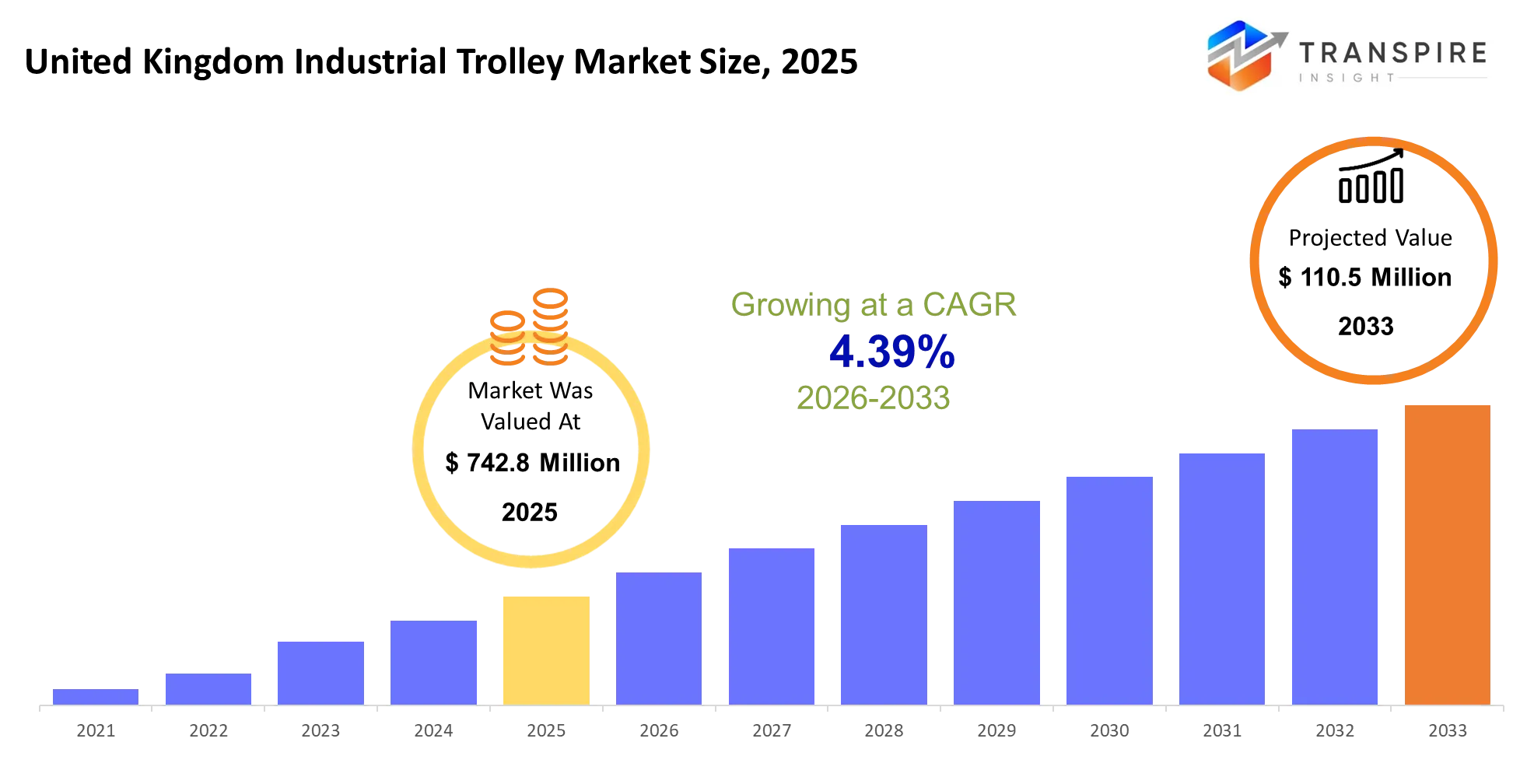
- United Kingdom Industrial Trolley Market Size 2025: USD 742.8 Million
- United Kingdom Industrial Trolley Market Size 2033: USD 110.5 Million
- United Kingdom Industrial Trolley Market CAGR: 4.39%
- United Kingdom Industrial Trolley Market Segments: By Product Type (Platform Trolleys, Cage Trolleys, Hand Trolleys, Shelf Trolleys, Electric Trolleys, Folding Trolleys, Others); By Material (Steel Trolleys, Aluminum Trolleys, Plastic Trolleys, Stainless Steel Trolleys, Others); By Application (Warehousing, Manufacturing, Logistics, Retail, Healthcare, Others); By End User (Industrial Facilities, Warehouses, Hospitals, Retail Stores, Airports, Others)
To learn more about this report,  Download Free Sample Report
United Kingdom Industrial Trolley Market Summary
The United Kingdom Industrial Trolley Market was valued at USD 742.8 Million in 2025. It is forecast to reach USD 110.5 Million by 2033. That is a CAGR of 4.39% over the period.
In the United Kingdom, industrial trolleys are like essential material handling tools, used to move components, tools and packaged goods around warehouses, manufacturing floors, maintenance depots, and even port facilities, so that operations keep moving with much less physical strain on workers. Over the last five years, the market has been leaning away from plain welded carts toward more ergonomic modular designs with better load control, stronger braking systems, and in some cases sensor assisted tracking for inventory movement.
A big structural change is the use of lightweight alloys and semi automated mobility solutions, which really lines up with this wider warehouse modernization. This change got sped up by COVID-19 supply chain disruptions and Brexit driven restructuring of logistics networks, where firms had to expand domestic warehousing and push throughput efficiency. So naturally, more investment is going into equipment that lasts longer and boosts productivity, because companies are now prioritizing speed, safety, and operational continuity rather than just chasing the lowest upfront cost.
Key Market Insights
- Platform trolleys kind of lead the United Kingdom Industrial Trolley Market, with roughly 40% share, mostly because they’re used pretty much everywhere in warehousing and manufacturing workflows.
- Utility trolleys and shelf trolleys are next in line, at almost 25%, and they stay popular for flexible material handling across various industrial sites, yes.
- Smart and automated trolley systems are actually the fastest-growing kind of segment, growing quickly through 2026–2032, as digital warehouse adoption keeps spreading and getting more common.
- Warehousing and logistics seem to dominate the market, taking close to 50% share, largely tied to the constant need for high-volume goods movement.
- And e-commerce fulfilment centres are showing the quickest growth, because automation and rapid order processing are reshaping how industrial trolley demand patterns are formed.
- Manufacturing is still the leading end user segment, about 45% share, and it leans a lot on durable trolley systems for production efficiency.
- E-commerce, plus third party logistics providers, are growing the quickest, mostly because distribution networks keep getting expanded across the UK, and it seems pretty steady.
- A lot of companies focus on ergonomic design innovation and heavy-duty product upgrades, to help strengthen competitiveness within industrial trolley solutions, more or less.
- Strategic partnerships with logistics operators are also pushing product integration across warehouse automation ecosystems, in the UK market.
- And then regional distribution expansion, along with localized manufacturing, helps firms cut lead times and improve supply chain responsiveness.
What are the Key Drivers, Restraints, and Opportunities in the United Kingdom Industrial Trolley Market?
The United Kingdom Industrial Trolley Market is mainly pushed by fast warehouse modernization, across logistics, manufacturing and retail distribution networks. One big trigger is the continued growth of e-commerce fulfillment infrastructure, which has basically made operators rethink how internal material flows work, so they can get more output per hour, and also cut down handling time. So, demand is going more toward high-capacity, ergonomic trolley solutions that lower labour fatigue while also lifting picking effectiveness, which then helps higher order processing volumes and it tends to speed up procurement cycles in big distribution centres.
Still, there’s a structural restraint, mostly because small and mid sized enterprises show high capital sensitivity. A lot of operators keep using refurbished or lower specification trolleys, simply because budgets are tight and ROI timeframes look uncertain. That slows down the replacement rhythm and it basically holds back revenue growth, especially in secondary industrial clusters, outside the main logistics hubs. Since material handling equipment is often treated like long-life assets, upgrade adoption stays slow, and not even, which then caps short term market scalability.
On the opportunity side, a stronger trend is showing up through smart tracking and sensor-enabled trolley systems inside automated warehouses, particularly around Greater London and the Midlands distribution corridors. The investments in semi-automated intralogistics include RFID asset tracking plus AI assisted warehouse orchestration, and that is shaping a clear need for more intelligent mobility equipment. This kind of change lets the United Kingdom Industrial Trolley Market move beyond older mechanical approaches, and toward data-enabled operational efficiency setups, opening new revenue streams for advanced manufacturers.
What Has the Impact of Artificial Intelligence Been on the United Kingdom Industrial Trolley Market?
Artificial intelligence along with digital systems is kinda reshaping the United Kingdom Industrial Trolley Market, by moving material-handling equipment from passive tools to watched and performance-optimized assets, inside smart warehouses. In newer logistics hubs, AI-enabled fleet management platforms can monitor trolley movement via RFID plus IoT sensor nodes , and that makes compliance tracking more automated for load limits, path efficiency, and also utilization rates. So you end up needing less human-style supervision, and coordination gets smoother across high volume distribution centres, especially when it comes to e-commerce fulfilment setups.
At the same time predictive analytics is getting used to anticipate upkeep requirements by looking at wheel wear patterns, load stress cycles and usage frequency. Machine learning models then flag failure likelihood early, before a breakdown shows up, and that boosts equipment uptime by an estimated 10–20% in digitally connected warehouse systems. A similar optimization approach is being carried into broader industrial equipment ecosystems, like cleaning operations and emissions-control work, where performance monitoring systems improve operational steadiness and resource efficiency, at the end of the day.
These kinds of tools also help with cost efficiency, since they cut unplanned downtime and stretch the equipment life cycle. That directly lowers replacement spend and supports better asset ROI. Still, adoption isn’t fully smooth because the integration costs are high, and retrofitting legacy warehouse infrastructure with sensor based setups can be pretty complex. Plus, large industrial facilities often have limited real time connectivity, which harms data continuity. And then there is the training-data issue, because when standardized training datasets are missing, model accuracy can drop across different operational conditions .
Key Market Trends
- Between 2020 and 2025, UK warehouses kind of moved from basic welded trolleys to modular ergonomic setups, and this did improve handling efficiency by about 15–20% , in practice.
- Since 2021, the expansion of e-commerce basically pushed logistics operators into redesigning intralogistics routes, so the demand went up for high-capacity fleet of trolleys across fulfilment centres, too.
- Post-Brexit supply chain restructuring in 2022 then sped up domestic warehousing investments, which lowered the reliance on imported handling gear, and also made local procurement cycles feel a bit faster.
- From 2023 onward, RFID enabled trolley tracking systems started getting traction, letting teams see assets in real time across huge distribution hubs, while also cutting down equipment loss rates.
- Manufacturers such as AJ Products and Fetra increasingly rolled out lighter aluminium constructions, swapping out heavier steel based trolley solutions, mainly to help with maneuverability and safety.
- Between 2022 and 2026, automation tied trolley systems began linking with warehouse management software, and that helped raise picking accuracy and workflow synchronization.
- Energy efficiency priorities in industrial sites shifted purchasing toward low-friction wheel technologies, and this reduced the manual push force needed by as much as 25% .
- After 2024 , competitive strategies turned toward lifecycle based pricing models, with suppliers offering maintenance-linked contracts rather than only one time equipment sales.
United Kingdom Industrial Trolley Market Segmentation
By Product Type :
Platform trolleys still get used in warehouses and factories quite a lot, mostly because their basic layout is simple, and the load capacity stays pretty steady. Lately, though, demand keeps moving toward ergonomic, modular kinds of design , you know, ones that cut down manual effort and make the flow of goods across crowded workspaces feel smoother. Electric trolleys are also slowly showing up more often, because many facilities want less labour strain and faster internal transport during high-volume operations.
Cage trolleys and shelf trolleys remain a common choice when secure handling and organised storage are needed while items are being moved. Folding trolleys are getting more attention in compact places where space management matters, and they fit into tight layouts without too much fuss. Over time, manufacturers have been working on durability plus better wheel performance, so the day to day operation feels steadier, and the equipment lasts longer across different industrial settings.
By Material :
Steel trolleys are still the main option, largely because they bring high strength and can take heavier loads in manufacturing and logistics. Demand is fairly stable too, since a lot of industries prefer durability and a long service life more than short term cost savings, especially where the trolley is used again and again in heavy-duty routines.
Aluminum trolleys are gaining acceptance because they are lighter, and they’re easier to handle which can raise worker efficiency in fast-moving warehouses. Plastic trolleys, on the other hand, tend to be used for light-duty tasks where corrosion resistance matters but cost control does too. Stainless steel trolleys are preferred in hygiene-sensitive sectors, because they support cleaner movement and more controlled material transfer.
By Application :
Warehousing still seems like the main use, since distribution centres basically need a constant sort of movement of goods between storage zones and dispatch areas. Lately growth in e-commerce has really pushed demand for more efficient internal transport systems, the kind that cut down delays and speed up order processing especially in large facilities where everything is moving at once.
Manufacturing and logistics also come in strong, because production lines plus transport networks depend on a smooth material flow, no hiccups. In retail setups trolleys are used for moving stock around and re-filling shelves, while in healthcare settings they support safe and organised transport of equipment and supplies, so the staff can find things faster.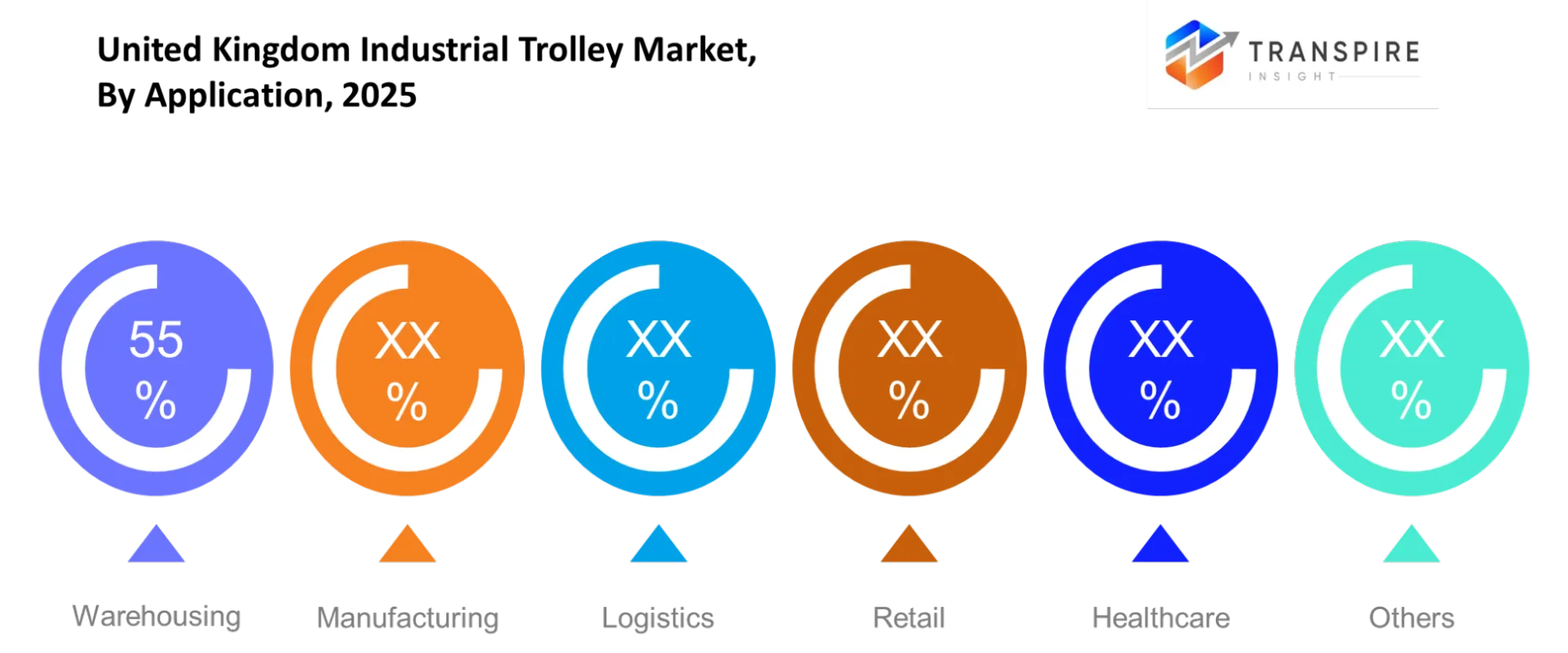
To learn more about this report, Download Free Sample Report
By End User :
Industrial facilities make up the biggest end-user group, since continuous production means there is always a need for reliable material handling solutions for tools and components. This demand keeps rising alongside modernization of factory layouts, with more emphasis on operational efficiency and better everyday throughput.
After that, warehouses and retail stores follow, mostly because distribution needs stay high and inventory turnover keeps climbing. Hospitals lean on trolleys for the safe movement of medical supplies, and airports use them for baggage plus equipment handling, helping keep passenger and operational flow moving smoothly across terminals.
What are the Key Use Cases Driving the United Kingdom Industrial Trolley Market?
Warehousing and distribution centres still sort of take the lead in the United Kingdom Industrial Trolley Market, because moving high-volume goods really needs steady, short-range transport between storage areas, packing stations and the dispatch points, you know. At the same time, rapid e-commerce fulfillment growth has upped the pressure, so operators are leaning more on tough trolleys that help pick faster and also ease the physical stress from manual handling, maybe less strain overall.
Manufacturing sites and retail back-of-house stockrooms are also moving in that direction, as production lines and the store replenishment rhythms become quicker and more time-critical. Logistics providers, meanwhile, use specialised trolley setups to speed up sorting and cross docking work. This helps them meet tighter delivery timetables and improves overall throughput efficiency, across those busy transport hubs.
Newer use cases are starting to show up too, like hospital logistics and airport ground operations, where equipment, medical supplies, and even baggage need regulated movement and controlled handling. On top of that, the rising attention to workplace safety requirements and operational traceability is pushing some early take-up of smart-enabled trolley systems in big compliance focused facilities.
|
Report Metrics |
Details |
|
Market size value in 2025 |
USD 742.8 Million |
|
Market size value in 2026 |
USD 81.8 Million |
|
Revenue forecast in 2033 |
USD 110.5 Million |
|
Growth rate |
CAGR of 4.39% from 2026 to 2033 |
|
Base year |
2025 |
|
Historical data |
2021 - 2024 |
|
Forecast period |
2026 - 2033 |
|
Report coverage |
Revenue forecast, competitive landscape, growth factors, and trends |
|
Regional scope |
Middle East and Africa (Saudi Arabia, United Arab Emirates, South Africa, Rest of Middle East and Africa) |
|
Key company profiled |
Bishamon, Prestar, Magliner, Stanley Handling, Armorgard, Rubbermaid Commercial Products, The Durham Manufacturing Company, Wesco Industrial Products, Harper Trucks, Troax Group, Luxor, Treston, Hytrol Conveyor, Breg Products, Pucel Enterprises |
|
Customization scope |
Free report customization (country, regional & segment scope). Avail customized purchase options to meet your exact research needs. |
|
Report Segmentation |
By Product Type (Platform Trolleys, Cage Trolleys, Hand Trolleys, Shelf Trolleys, Electric Trolleys, Folding Trolleys, Others); By Material (Steel Trolleys, Aluminum Trolleys, Plastic Trolleys, Stainless Steel Trolleys, Others); By Application (Warehousing, Manufacturing, Logistics, Retail, Healthcare, Others); By End User (Industrial Facilities, Warehouses, Hospitals, Retail Stores, Airports, Others) |
Which Regions are Driving the United Kingdom Industrial Trolley Market Growth?
England is basically leading the United Kingdom Industrial Trolley Market, largely because there’s a dense cluster of logistics hubs, really advanced warehousing pockets, and good port connections. Big gateways like Felixstowe and Southampton keep freight moving on a near constant basis ,and that naturally pulls in steady demand for material handling equipment. Then you have the mature e-commerce system, which still needs high-speed internal logistics across those large fulfilment centres. Add in ongoing infrastructure spending, plus workplace safety rules that are enforced pretty strictly, and you get equipment replacement cycles that stay active,along with consistent purchasing.
Scotland acts more like a steady contributor, backed by a diversified industrial landscape and a fairly consistent level of infrastructure investment. Manufacturing tied to engineering work, energy services, and offshore support operations keeps asking for durable trolley systems. It’s not quite the same as England’s heavy, high-volume logistics reliance, because Scotland’s needs are more shaped by long-life industrial use, and the maintenance routines that go with it. Over time, more alignment on workplace safety regulation, together with industrial modernization efforts, helps keep equipment upgrades fairly predictable across different sites.
Wales is showing the fastest growth momentum, mostly due to recent industrial regeneration efforts, and also targeted funding for logistics infrastructure. Port upgrades, plus improved transport corridors, have tightened the links between industrial zones and export channels. Regional development programs backed by the government have helped encourage new warehouse set ups, along with light manufacturing expansion. This shift looks like it’s opening up fresh supplier opportunities between 2026 and 2033, particularly for companies trying to serve newly built logistics and industrial facilities.
Who are the Key Players in the United Kingdom Industrial Trolley Market and How Do They Compete?
The competitive landscape in the United Kingdom Industrial Trolley Market still looks pretty fragmented, with European manufacturers, UK based distributors, and smaller niche fabricators all going at the same time across overlapping industrial segments. Lately the competition feels like it has slid away from pure pricing, toward ergonomic design, durability , and faster fulfilment for warehouse operators. Service agreements, customization for load specific needs, and after sales upkeep are now a big differentiator. Even the distributors are not just selling trolleys , they are competing on logistics coverage and the ability to ship replacement parts quickly, which ends up affecting operational uptime for end users, in a very real way.
AJ Products seems to lean into ergonomic workplace systems, they offer modular trolley designs that aim to improve handling efficiency and cut down physical strain in warehouse settings. Fetra tends to win with precision engineered transport equipment, with a clear focus on long service life and structural reliability for heavy duty industrial use. Bishamon differentiates through hydraulic assisted handling solutions, these help keep loads steadier and can reduce the manual effort, especially where material movement happens all day.
Stanley Black & Decker brings its wide industrial distribution web into play, supplying durable mobility and tool adjacent equipment to enterprise clients across the UK. Global Industrial has been pushing forward by using an e-commerce led procurement model, basically making bulk purchasing easier for logistics operators and warehouse managers. Ergonomic Handling Ltd concentrates on customised trolley systems for industrial layouts that are tight on space, supporting specialised workflow needs inside UK facilities.
Company List
- Bishamon
- Prestar
- Magliner
- Stanley Handling
- Armorgard
- Rubbermaid Commercial Products
- The Durham Manufacturing Company
- Wesco Industrial Products
- Harper Trucks
- Troax Group
- Luxor
- Treston
- Hytrol Conveyor
- Breg Products
- Pucel Enterprises
Recent Development News
In March 2026, Crown Lift Trucks UK (Crown Equipment Corporation) reported that its WJ 50 Series electric pallet trucks were nominated for the 2026 IFOY Award. The nomination highlights continued innovation in warehouse mobility and electric material handling equipment used across UK logistics operations. Source https://www.crown.com/
In April 2026, the UK Lifting & Handling Equipment Manufacturing industry published its latest industry report showing continued expansion of the sector, with revenues reaching £4.8bn in 2026 and strong demand from warehouse and industrial logistics equipment segments including trolleys and conveyors. Sourcehttps://www.ibisworld.com/
What Strategic Insights Define the Future of the United Kingdom Industrial Trolley Market?
The United Kingdom Industrial Trolley Market is kind of structurally moving toward higher automation compatibility and digitally tracked material handling systems, pushed mostly by warehouse modernization plus those tighter operational efficiency targets across logistics networks. Over the next five to seven years, procurement will lean more and more toward connected, ergonomic mobility solutions that slot into warehouse management systems, which helps with throughput visibility and it also improves labor productivity in high-density distribution hubs
There’s also a risk that is less obvious, like a technology substitution shift from autonomous mobile robots, where these robots could slowly lower the need for manual trolley systems in large scale automated warehouses. Since robotics costs keep dropping some high-volume operations might postpone trolley upgrades or re-allocate spend away from conventional equipment. That would mean demand cycles become kind of uneven and hard to forecast. Another constraint comes from rising input costs for steel and aluminum, which squeezes margins for manufacturers that still rely on traditional fabrication models
Still there is a pretty strong emerging opportunity in hybrid warehouse setups across the Midlands logistics corridors, where semi-automation remains in place and people still need mobility tools that come with digital tracking. Firms that bring sensor-enabled trolleys plus predictive maintenance features into the mix should get an early edge. Manufacturers may want to focus on partnerships with warehouse automation providers, and build modular retrofit-ready designs that match how smart facility infrastructure keeps evolving over time
United Kingdom Industrial Trolley Market Report Segmentation
By Product Type
- Platform Trolleys
- Cage Trolleys
- Hand Trolleys
- Shelf Trolleys
- Electric Trolleys
- Folding Trolleys
By Material
- Steel Trolleys
- Aluminum Trolleys
- Plastic Trolleys
- Stainless Steel Trolleys
By Application
- Warehousing
- Manufacturing
- Logistics
- Retail
- Healthcare
By End User
- Industrial Facilities
- Warehouses
- Hospitals
- Retail Stores
- Airports
Frequently Asked Questions
Find quick answers to common questions.
The United Kingdom Industrial Trolley Market size is USD 110.5 Million in 2033.
Key Segments for the United Kingdom Industrial Trolley Market are By Product Type (Platform Trolleys, Cage Trolleys, Hand Trolleys, Shelf Trolleys, Electric Trolleys, Folding Trolleys, Others); By Material (Steel Trolleys, Aluminum Trolleys, Plastic Trolleys, Stainless Steel Trolleys, Others); By Application (Warehousing, Manufacturing, Logistics, Retail, Healthcare, Others); By End User (Industrial Facilities, Warehouses, Hospitals, Retail Stores, Airports, Others).
Major United Kingdom Industrial Trolley Market Players are Bishamon, Prestar, Magliner, Stanley Handling, Armorgard, Rubbermaid Commercial Products, The Durham Manufacturing Company, Wesco Industrial Products, Harper Trucks, Troax Group, Luxor, Treston, Hytrol Conveyor, Breg Products, Pucel Enterprises.
The Current United Kingdom Industrial Trolley Market size is USD 742.8 Million in 2025.
The United Kingdom Industrial Trolley Market CAGR is 4.39% from 2026 to 2033.
- Bishamon
- Prestar
- Magliner
- Stanley Handling
- Armorgard
- Rubbermaid Commercial Products
- The Durham Manufacturing Company
- Wesco Industrial Products
- Harper Trucks
- Troax Group
- Luxor
- Treston
- Hytrol Conveyor
- Breg Products
- Pucel Enterprises
Recently Published Reports
-
Apr 2026
Handling and Lifting Equipment Market
Handling and Lifting Equipment Market Size, Share & Analysis Report By Product (Cranes and Hoists, Forklifts, Conveyor Systems, Aerial Work Platforms, Others), By Application (E-Commerce, Automotive and Railway, Food and Beverages, Aviation, Others), and Geography (North America, Europe, Asia-Pacific, Middle East and Africa, South and Central America), 2021 - 2031
-
Apr 2026
HVAC Equipment Market
HVAC Equipment Market Size, Share & Analysis Report By Heating Equipment Type (Boilers and Furnaces, Heat Pumps, and Unitary Heaters), By Ventilation Equipment (Air Handling Units, Humidifiers and Dehumidifiers, Air Filters, and Fan Coiling Units), By Air Conditioning Equipment (Unitary Air Conditioners, Room Air Conditioners, Packaged Terminal Air Conditioners, and Chillers), By End User (Commercial, Residential, Industrial, and others), and Geography (North America, Europe, Asia-Pacific, Middle East and Africa, South and Central America), 2021 – 2031
-
Apr 2026
Refrigeration Valves Market
Refrigeration Valves Market Size, Share & Analysis Report By Type (Solenoid Valves, Expansion Valves, Check Valves, Service Valves, Others), By Application (Commercial Refrigeration, Industrial Refrigeration, Transport Refrigeration, Residential Refrigeration, Air Conditioning Systems), By End User (Food and Beverage Industry, Pharmaceutical Industry, HVAC Industry, Chemical Industry, Others), and Geography (North America, Europe, Asia-Pacific, Middle East and Africa, South and Central America), 2021 – 2031
-
Apr 2026
E-Commerce Packaging Materials Market
E-Commerce Packaging Materials Market By Material Type (Corrugated Boxes, Paper & Paperboard, Foam & Cushioning Materials, Plastic Packaging, Flexible Packaging, Protective Packaging, Others), By Product(Primary Packaging, Secondary Packaging, Tertiary Packaging), By Packaging Function (Protective Packaging, Branding & Presentation Packaging, Transit & Logistic Packaging, Sustainable Packaging, Tamper Evidence Packaging), By End-User (Retail & Consumer Goods, Electronic Appliances, Food & Beverages, Healthcare & Pharmaceutical, Fashion & Apparel, Home & Furnishing, Others); By Industry Analysis, Size, Share, Growth, Trends, and Forecasts 2021-2033