

United Kingdom Industrial Hemp Market Size & Forecast:
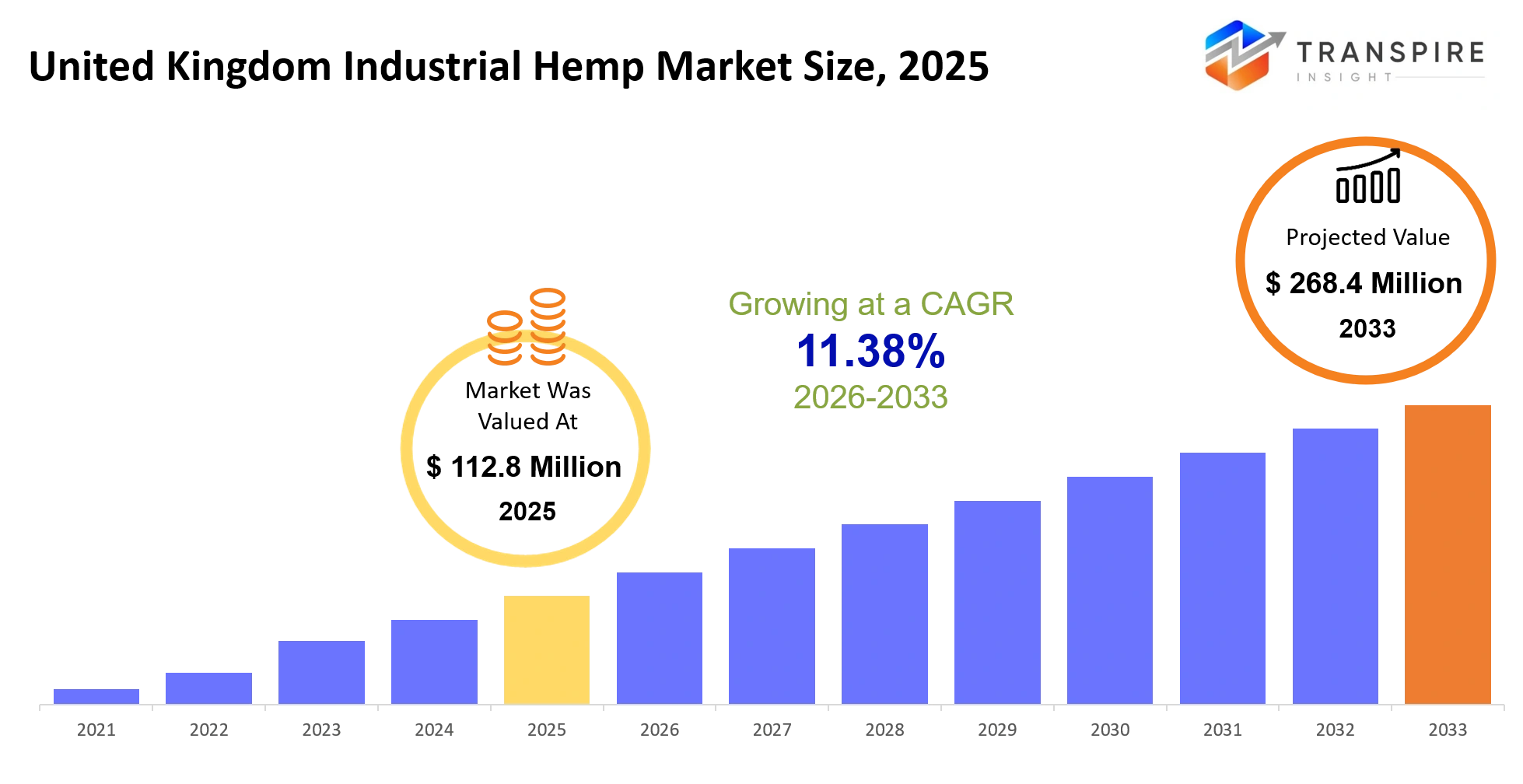
- United Kingdom Industrial Hemp Market Size 2025: USD 112.8 Million
- United Kingdom Industrial Hemp Market Size 2033: USD 268.4 Million
- United Kingdom Industrial Hemp Market CAGR: 11.38%
- United Kingdom Industrial Hemp Market Segments: By Product Type (Hemp Seeds, Hemp Oil, Hemp Fiber, Hemp Protein, Hemp-based CBD Products, Hemp Textiles, Hemp Biomass, Others); By Application (Food & Beverages, Personal Care Products, Textiles, Construction Materials, Pharmaceuticals, Animal Feed, Others); By End User (Food Industry, Textile Industry, Healthcare Industry, Cosmetics Industry, Agriculture Sector, Others); By Distribution Channel (Online Retail, Specialty Stores, Direct Sales, Supermarkets, Others).
To learn more about this report,  Download Free Sample Report
United Kingdom Industrial Hemp Market Summary
The United Kingdom Industrial Hemp Market was valued at USD 112.8 Million in 2025. It is forecast to reach USD 268.4 Millionby 2033. That is a CAGR of 11.38% over the period.
The United Kingdom’s industrial hemp market does something pretty practical across construction, food processing, personal care, textiles, and bio-based manufacturing, mainly by putting forward renewable raw materials that can swap out carbon-heavy inputs. Hemp fibers are, more and more, show up in insulation panels and composite materials, while hemp seeds and selected extracts help feed nutritional products and wellness formulations. Over the last five years the market kind of moved from a small niche agricultural activity into a more organized industrial supply chain, and it’s tied to decarbonization goals plus stronger domestic manufacturing resilience.
One big structural shift has been how policy conversations around hemp cultivation have grown, including licensing reform, and commercial use cases, with support coming from research institutions and industry groups. In 2025, the Industrial Hemp Innovations Hub launched and that event sped up collaboration between growers, manufacturers, and policymakers. With construction firms hunting for low-carbon materials, and manufacturers looking to diversify their supply chains away from imported synthetic inputs, industrial hemp adoption is turning into more solid commercial contracts, bigger cultivation areas and better value-added processing revenues.
Key Market Insights
- England kind of dominates the United Kingdom Industrial Hemp Market, roughly around 55%+ share, mainly because of wider cultivation acreage and stronger processing setup, honestly.
- Scotland meanwhile is showing the quickest ramp-up through 2033, backed by net-zero building efforts and added investments into hemp insulation production. It’s sort of like everything is lining up at once
- Hemp fiber still stays the top product segment, making up about 40% of overall revenue. That’s mostly tied to construction needs and industrial composite uses, where it fits well.
- Hemp seed products take the second-biggest slice too. The push here comes from food manufacturing, protein ingredient supply chains, and functional nutrition kind of applications.
- Hemp-derived construction materials are also projected to post the fastest growth between 2026 and 2033, as low-carbon building rules keep tightening and encouraging adoption.
- Building materials plus insulation together account for nearly 35% of industrial hemp consumption, since carbon-cutting targets keep showing up in construction project requirements
- CBD and wellness applications are one of the most rapidly evolving parts, largely because regulatory progress on novel food reviews has moved things forward.
- Construction and manufacturing companies remain the largest end-user group, claiming more than 30% of commercial hemp demand, which is pretty significant
- Tilray Brands, Canopy Growth, Aurora Cannabis, HempFlax, and Ecofibre are expanding too, using product diversification along with downstream processing investments.
- And finally, strategic partnerships between growers, universities and manufacturers are helping commercialize hemp-based insulation, textiles, and industrial biomaterials, at a faster pace than before.
What are the Key Drivers, Restraints, and Opportunities in the United Kingdom Industrial Hemp Market?
A primary driver of market growth is the UKs push toward low carbon construction and maybe sustainable industrial manufacturing. Developers, as well as material suppliers, are getting steadily more pressure to cut embodied carbon in buildings, which is why there’s real commercial pull for hemp insulation, hempcrete,and fiber based composites. This momentum has also been matched by public plus private investment in industrial hemp research including innovation hubs and crop development programs that help build up domestic supply strength. So, processors are in practice locking in longer term contracts with construction firms, and that ends up giving stronger revenue visibility across most of the value chain.
The biggest restraint still sits in the UK licensing and regulatory framework its not exactly smooth. Industrial hemp cultivation continues under strict controls, and that alone brings a lot of uncertainty for growers and processors who want to plan long horizon investments. Licensing rules, since they involve several regulatory authorities and controlled crop classifications, just move slowly. That kind of structure barrier narrows acreage expansion, it also discourages investment in processing infrastructure, and it delays commercialization pathways that would otherwise support higher market revenue totals.
One major opportunity is advanced hemp based construction materials plus precision bred hemp varieties. Newer funding initiatives for hemp genetics research and crop optimization could meaningfully boost fiber quality and improve agricultural yields. And if scale up happens without major setbacks, domestic producers could reduce dependence on imported raw materials while feeding the rising demand coming from construction, packaging, and bio composite industries.
What Has the Impact of Artificial Intelligence Been on the United Kingdom Industrial Hemp Market?
Artificial intelligence is, honestly, starting to reshape industrial hemp cultivation, and also processing efficiency, and supply chain management across the United Kingdom in a pretty noticeable way. Farmers and agricultural operators are rolling out AI driven crop monitoring systems that sort through satellite imagery, drone data, and soil conditions, then use all that to fine tune their planting routines. They also pick smarter irrigation options and sometimes even set when to start harvesting windows. It helps growers push for better biomass yields while also cutting down fertilizer and water inputs, kind of a quieter win. At the same time machine learning is being used to anticipate how crops will perform based on weather patterns and in-field conditions, which then helps with production scheduling and inventory management.
Inside processing facilities, digital automation platforms are kinda watching fiber quality moisture readings, and extraction efficiency all at once, in real time. Then predictive analytics, you know, helps with equipment upkeep planning so maintenance lands before breakdowns happen, which lowers that surprise downtime thing and boosts the overall throughput. Manufacturers producing hemp insulation and bio-based materials are also moving toward data-driven production controls, keeping output steady and cutting back on scrap. That combination tends to improve profitability across a range of industrial uses.
There’s also a regulatory side to this where the tech can help with compliance, tracking cultivation records, THC limits and supply chain paperwork. Still, the adoption doesn’t seem nearly as broad as you might expect because the integration costs can be kind of high and the industry data is pretty fragmented too. Many hemp operators are still small-to-medium companies, with limited digital infrastructure, so rolling out a large scale AI program feels financially difficult, even if the long term productivity improvements look kinda promising.
Key Market Trends
- In the UK, hemp licenses went up from six in 2013, to 136 by 2023, so it looks like more commercial interest is coming in (not just small pilots, you know).
- Construction firms are now, more often than before, naming hemp insulation materials in specs so they can chase embodied carbon reduction targets in commercial builds.
- By 2024 and 2025, research institutions seemed to move away from crop trials and toward full industrial commercialization tracks, like the next stage that actually turns into production.
- During 2025, hemp insulation manufacturing also grew, helped by fresh processing investments, and some cross-border partnerships that kind of fill in the gaps.
- In 2025 too, government backed hemp innovation hubs showed up, which makes the connections tighter between farmers, processors, and the policymakers, at least in practice.
- On the CBD side, product regulation advanced toward formal authorization steps, and that changed how wellness suppliers plan to compete, because timing and compliance matter more.
- Then in 2026, precision breeding programs received funding to develop UK-specific hemp varieties with higher productivity, rather than relying only on existing stock.
- Manufacturers are also leaning more toward domestic hemp sourcing, aiming to cut supply chain volatility, and reduce the import dependency part.
- Scottish hemp cultivation projects expanded via net zero building initiatives and regional industrial partnerships, so it’s not just one county doing experiments.
- And investors, lately, seem to aim for downstream processing and bio material manufacturing, more than standalone cultivation businesses, which is a bit of a shift in what gets funded.
United Kingdom Industrial Hemp Market Segmentation
By Product Type
Hemp Seeds kinda hold the leading position because food manufacturers more and more use hemp seeds in protein rich snacks, bakery goods and nutritional formulations. They have strong nutritional value, with protein fiber, plus essential fatty acids… and that helps a lot with wide commercial adoption across food processing operations in the United Kingdom, honestly. Hemp Oil keeps the second-largest spot mostly due to growing use in dietary supplements, wellness items, and personal care formulations. Hemp Fiber is also a notable chunk, since construction companies and industrial manufacturers are looking for renewable raw materials for insulation, composites, and more sustainable product creation.
Hemp Seeds are expected to stay in front, pushed by continued use in functional food uses and by the fact consumers keep leaning toward plant-based nutrition. Hemp based CBD Products are projected to grow the quickest too, mainly because product innovation and regulatory developments open up fresh commercial chances. Hemp Protein, Hemp Textiles, and Hemp Biomass keep supporting market expansion through use cases spanning nutrition, manufacturing, and industrial processing. The other product categories should also gain, as diversification of hemp-derived commercial products increases and value-added processing keeps moving forward.
By Application
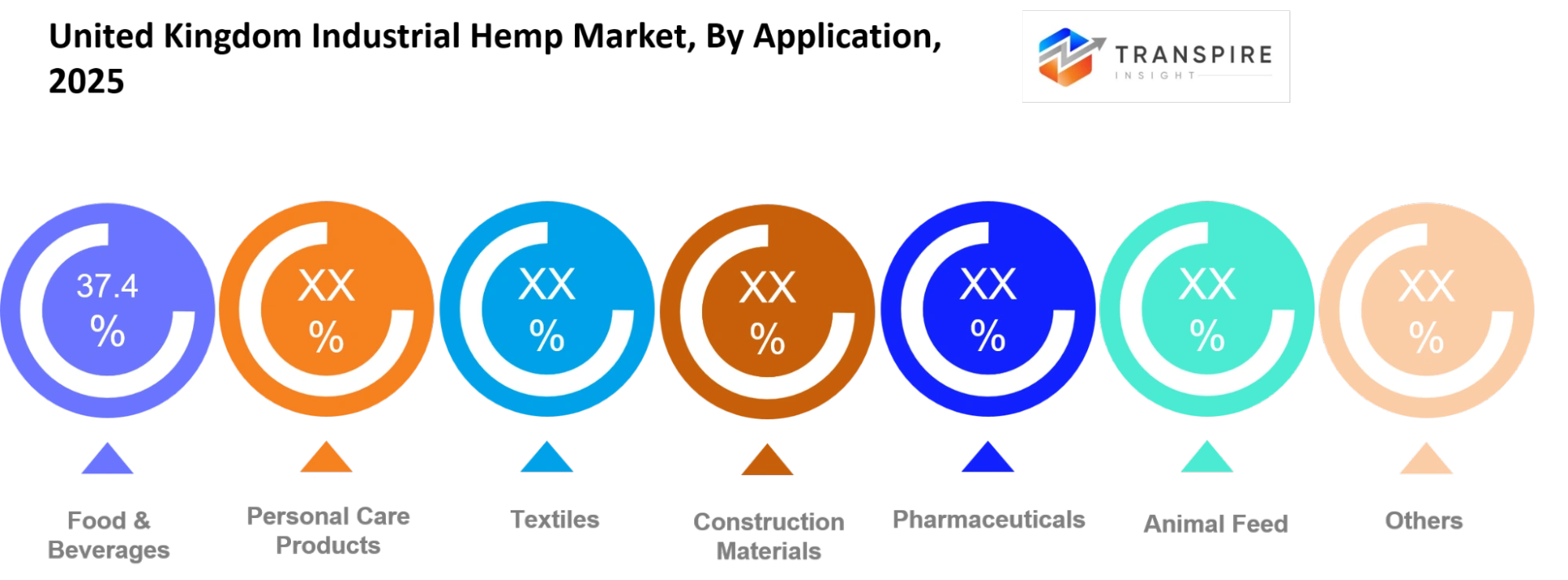
Food & Beverages hold the dominant position, partly because hemp-derived ingredients offer nutritional benefits that basically help with product innovation across snacks, beverages protein supplements, and those health-focused foods people keep looking for. Food manufacturers keep folding hemp seeds protein, and oil into new portfolios, mainly to meet shifting dietary preferences. Personal Care Products sit in the second-largest slot too, driven by wider use of hemp extracts and oils for skincare, haircare and general wellness formulations, kind of a steady ramp. Textiles also contribute a noticeable portion, mainly because people want stronger fiber materials that are more environmentally responsive.
Food & Beverages should remain at the lead, because manufacturers keep rolling out plant based product lines and functional nutrition solutions. Construction Materials are projected to grow quickest driven by more frequent use of hemp insulation, hempcrete and other lower carbon building inputs. Pharmaceuticals should keep increasing in application potential backed by continuing research and product development that uses hemp derived compounds. Animal Feed and other applications will help the market move forward as industrial utilization broadens, plus product diversification takes hold across more categories.
To learn more about this report, Download Free Sample Report
By End User
The Food Industry kind of holds the dominant position, because food makers are the largest buyers when it comes to hemp seeds, oils, and protein components. Product innovation across nutritional foods supplements, and plant-based mixes keeps pushing that real demand from this sector, still strong and not slowing down much. The Textile Industry keeps the second-largest spot due to the rising use of hemp fiber in fabrics, industrial textiles and this broader sustainable material production. The Healthcare Industry also takes a decent slice, mostly through well-being oriented products and hemp-derived formulations that are showing up more often, in everyday conversations.
Looking forward, the Food Industry is expected to stay in front, because nutritional product development and functional food manufacturing keep getting bigger and bigger.
The Cosmetics Industry is projected to grow the quickest as well, mostly since beauty and personal care brands are increasingly weaving hemp-derived components into their premium lines. Meanwhile, the Agriculture Sector helps move things along by expanding cultivation and managing raw material supply work, at a steady pace. Other end users will add to future revenue, driven by emerging industrial and commercial applications that are slowly turning into something bigger over time.
By Distribution Channel
Online Retail sits in the leading role because digital platforms make it easier to reach a broad selection of hemp derived products for both regular consumers and commercial buyers, kinda straightforward really. With better product visibility, a wider geographic footprint, plus direct engagement, online channels can push solid sales numbers quite consistently. Then Specialty Stores come in as the second biggest, mainly driven by product know how, more pointed customer support, and a deliberate tilt toward health wellness and those natural product choices. Direct Sales take up a meaningful slice too, largely from business to business transactions, and also from long term supply agreements that keep things steady.
Online Retail is likely to hold that top spot, especially as e commerce keeps spreading further across food, wellness, and personal care categories. Direct Sales are forecast to grow the quickest because manufacturers and processors are increasingly looking for closer, direct ties with industrial customers and commercial buyers. Supermarkets will keep expanding shelf presence for hemp based food and wellness goods which helps the market feel more reachable for everyone. Meanwhile, other distribution channels should improve as products diversify, and as broader commercial acceptance grows across several industries at once.
What are the Key Use Cases Driving the United Kingdom Industrial Hemp Market?
The largest commercial use case still kind of stays with construction materials. Hemp fiber gets processed into insulation panels, hempcrete, and composite building products, which help developers cut down embodied carbon while still meeting their sustainability targets. i think this area keeps driving the strongest demand, because it blends good environmental performance with long-term commercial scalability, even if it’s a slow build.
Past construction, food and nutrition uses keep getting larger. Hemp seeds, oils, protein powders, and functional ingredients are now showing up more often in health oriented food items. At the same time personal care manufacturers are using hemp derived ingredients in skincare and wellness formulations, so processors can tap into extra revenue streams there too.
Some emerging applications are showing up as well, like bio composites for automotive manufacturing, biodegradable packaging materials, and more advanced textile production. These areas are relatively small, but they are drawing investment as manufacturers look for alternatives to petroleum based raw materials and imported synthetic fibers.
|
Report Metrics |
Details |
|
Market size value in 2025 |
USD 112.8 Million |
|
Market size value in 2026 |
USD 126.2 Million |
|
Revenue forecast in 2033 |
USD 268.4 Million |
|
Growth rate |
CAGR of 11.38% from 2026 to 2033 |
|
Base year |
2025 |
|
Historical data |
2021 - 2024 |
|
Forecast period |
2026 - 2033 |
|
Report coverage |
Revenue forecast, competitive landscape, growth factors, and trends |
|
Regional scope |
United Kingdom |
|
Key company profiled |
Curaleaf, Canopy Growth, Aurora Cannabis, British Hemp Co, HempFlax, Ecofibre, Tilray Brands, Green Thumb Industries, Elixinol, IND HEMP, Dun Agro Hemp Group, Botanical Genetics, HemPoland, Kazmira, PanXchange. |
|
Customization scope |
Free report customization (country, regional & segment scope). Avail customized purchase options to meet your exact research needs. |
|
Report Segmentation |
By Product Type (Hemp Seeds, Hemp Oil, Hemp Fiber, Hemp Protein, Hemp-based CBD Products, Hemp Textiles, Hemp Biomass, Others); By Application (Food & Beverages, Personal Care Products, Textiles, Construction Materials, Pharmaceuticals, Animal Feed, Others); By End User (Food Industry, Textile Industry, Healthcare Industry, Cosmetics Industry, Agriculture Sector, Others); By Distribution Channel (Online Retail, Specialty Stores, Direct Sales, Supermarkets, Others). |
Which Regions are Driving the United Kingdom Industrial Hemp Market Growth?
England is still kinda the main player in the United Kingdom industrial hemp market. it stays ahead because it has more agricultural land to work with, stronger processing capability, and it is closer to the big construction and manufacturing centers too. there has also been more back and forth between industry groups and policymakers in England compared with a lot of other parts of the UK. so all of that ends up helping cultivation, processing, and end use adoption across several industrial sectors.
Scotland, is next as the second largest contributor, but it is doing things a bit differently. instead of leaning mostly on raw agricultural scale, Scotland has worked industrial hemp into broader net-zero, sustainable construction initiatives. regional manufacturers are putting more investment into hemp insulation production, plus circular building material ecosystems. in other words, it is turning into a more specialized market, more about higher value applications, than just chasing bigger crop volume.
Wales is starting to move faster than the others. the Industrial Hemp Innovations Hub is helping, and research activity is also growing which creates new momentum for cultivation, processing, and commercialization. academic institutions, farmers, and policymakers are working together more often to untangle supply chain bottlenecks and licensing issues. for investors, and for new companies, Wales should look like a particularly inviting environment for innovation driven expansion between 2026 and 2033.
Who are the Key Players in the United Kingdom Industrial Hemp Market and How Do They Compete?
The competition still looks kind of moderately fragmented, with international cannabis and hemp firms operating next to specialized European fiber processors, and then there are also domestic hemp businesses too. Competitive advantage is relying more and more on vertical integration, processing know how, regulatory know edge and the ability to reach downstream markets, not just cultivation scale by itself. Firms that can manage several stages of the value chain tend to earn better margins, and they also stay more resilient when regulatory uncertainty starts shifting around.
HempFlax stands out because of its fiber processing competence, plus some strategic investments in hemp based building materials. Its partnership led expansion into insulation manufacturing sorta improves its access to Europe’s construction sector, and that also helps it capture more downstream value, rather than stopping early.
British Hemp Co is leaning into domestic sourcing, and it uses locally produced hemp for food ingredients. That model seems to appeal to UK buyers who want traceability in the supply chain, and they prefer locally grown agricultural products.
Tilray Brands keeps pushing forward through acquisitions, and also by using its healthcare distribution strengths. The acquisition push helps reinforce patient access channels, and it broadens its UK footprint at the same time.
Canopy Growth and Aurora Cannabis are working off international research strengths, product development experience, and regulatory know how, so they can compete across cannabinoid and wellness categories. And meanwhile Ecofibre focuses on differentiated hemp derived ingredients, plus technology driven product formulations aimed at specialized industrial applications.
Company List
- Curaleaf
- Canopy Growth
- Aurora Cannabis
- British Hemp Co
- HempFlax
- Ecofibre
- Tilray Brands
- Green Thumb Industries
- Elixinol
- IND HEMP
- Dun Agro Hemp Group
- Botanical Genetics
- HemPoland
- Kazmira
- PanXchange
Recent Development News
In July 2025, the Industrial Hemp Innovations Hub was launched at Aberystwyth University and began supporting the newly reactivated All-Party Parliamentary Group for Industrial Hemp. The initiative strengthened research collaboration, policy engagement, and commercialization efforts across the UK hemp sector.
Source: https://hemptoday.net
In November 2025, HempFlax Group and C-biotech acquired a German hemp insulation manufacturing facility from Kingspan through a joint venture. The acquisition expanded European hemp insulation production capacity and strengthened supply chains serving sustainable construction markets.
Source: https://www.thermo-hanf.de/en/about/company/
In April 2026, Tilray Brands acquired the UK-based Lyphe Group medical cannabis clinic and digital pharmacy platform. The transaction created a vertically integrated patient-care and distribution platform that strengthens Tilray's position in the UK cannabinoid market.
Source: https://www.reddit.com
What Strategic Insights Define the Future of the United Kingdom Industrial Hemp Market?
The United Kingdom industrial hemp market is sort of structurally moving toward integrated bio-economy supply chains where cultivation, processing, manufacturing, and end use industries run as connected ecosystems instead of isolated businesses. The strongest force behind this shift is the meeting of low-carbon construction expectations, domestic manufacturing needs and agricultural diversification plans. A quieter risk is regulatory unevenness. Even with political backing rising, the longer uncertainty keeps hanging around for licensing cultivation permissions and CBD authorization frameworks it could make investors hesitant about long-term capital, and it may also cap how much processing capacity can be expanded.
At the same time, there’s an emerging chance in precision-bred hemp varieties made for UK growing conditions, those could noticeably lift yields and make processing economics feel better. Market players should focus on partnerships that link growers, research organizations, processors, and end-users. Firms that lock in downstream demand through construction materials, industrial composites, or advanced bio-material agreements will likely earn more value than companies that only focus on raw hemp production.
United Kingdom Industrial Hemp Market Report Segmentation
By Product Type
- Hemp Seeds
- Hemp Oil
- Hemp Fiber
- Hemp Protein
- Hemp-based CBD Products
- Hemp Textiles
- Hemp Biomass
- Others
By Application
- Food & Beverages
- Personal Care Products
- Textiles
- Construction Materials
- Pharmaceuticals
- Animal Feed
- Others
By End User
- Food Industry
- Textile Industry
- Healthcare Industry
- Cosmetics Industry
- Agriculture Sector
- Others
By Distribution Channel
- Online Retail
- Specialty Stores
- Direct Sales
- Supermarkets
- Others
Frequently Asked Questions
Find quick answers to common questions.
The expected United Kingdom Industrial Hemp Market size for the market will be USD 268.4 Million in 2033.
Key segments for the United Kingdom Industrial Hemp Market are By Product Type (Hemp Seeds, Hemp Oil, Hemp Fiber, Hemp Protein, Hemp-based CBD Products, Hemp Textiles, Hemp Biomass, Others); By Application (Food & Beverages, Personal Care Products, Textiles, Construction Materials, Pharmaceuticals, Animal Feed, Others); By End User (Food Industry, Textile Industry, Healthcare Industry, Cosmetics Industry, Agriculture Sector, Others); By Distribution Channel (Online Retail, Specialty Stores, Direct Sales, Supermarkets, Others).
Major United Kingdom Industrial Hemp Market players are Curaleaf, Canopy Growth, Aurora Cannabis, British Hemp Co, HempFlax, Ecofibre, Tilray Brands, Green Thumb Industries, Elixinol, IND HEMP, Dun Agro Hemp Group, Botanical Genetics, HemPoland, Kazmira, PanXchange.
The United Kingdom Industrial Hemp Market size is USD 112.8 Million in 2025.
The United Kingdom Industrial Hemp Market CAGR is 11.38% from 2026 to 2033.
- Curaleaf
- Canopy Growth
- Aurora Cannabis
- British Hemp Co
- HempFlax
- Ecofibre
- Tilray Brands
- Green Thumb Industries
- Elixinol
- IND HEMP
- Dun Agro Hemp Group
- Botanical Genetics
- HemPoland
- Kazmira
- PanXchange
About the Authors

Chetan Dhatrak
I’m Chetan Dhatrak, a Senior Research Analyst at Transpire Insight, specializing in the Consumer Goods, Foods and Beverages industry. I focus on analyzing market trends, consumer behavior, competitive landscapes, and industry developments to deliver accurate, data-driven insights. My research at Transpire Insight is built on credible sources and in-depth analysis, helping businesses and readers better understand market dynamics, emerging opportunities, and evolving consumer preferences. I’m committed to creating reliable, well-researched content that supports informed decision-making and reflects the latest developments in the consumer goods and food & beverage sectors.

Chakradhar Khansole
Chakradhar serves as the Research Director at Transpire Insight, bringing over 8 years of experience in technology, innovation, and strategic market intelligence. He specializes in transforming complex market data into actionable business insights that enable organizations to make informed, growth-oriented decisions. Recognized for his strategic vision and analytical expertise, Chakradhar leads high-impact research initiatives, delivering comprehensive market assessments, competitive intelligence, and forward-looking industry analysis.
Recently Published Reports
-
Apr 2026
Baby Infant Formula Market
Baby Infant Formula Market Size, Share & Analysis Report By ype (Infant Milk, Follow On Milk, Specialty Baby Milk, Growing-Up Milk), By Ingredient (Carbohydrate, Fat, Protein, Minerals, Vitamins, and Others), By Product Form (Powder, Liquid, and Ready-to-feed), By Distribution Channels (Supermarket/Hypermarket, Specialty Store, Pharmacies, Online Retail, and Others), and Geography (North America, Europe, Asia-Pacific, Middle East and Africa, South and Central America), 2021 - 2031
-
Apr 2026
Edible Insects for Animal Feed Market
Edible Insects for Animal Feed Market Size, Share & Analysis Report By Type (Insect Powder, Insect Meal, Insect Bar, Insect Paste, Insect Oil, and Others), By Insect Type (Beetles, Cricket, Caterpillar, Hymenoptera, Orthoptera, Tree Bugs, and Others), By Application (Livestock, Pet Food, and Aquaculture), By Livestock Type (Poultry, Swine, and Others), and Geography (North America, Europe, Asia-Pacific, Middle East and Africa, South and Central America), 2021 - 2031
-
Apr 2026
Food Industry Disinfection and Bacterial Control Market
Food Industry Disinfection and Bacterial Control Market Size, Share & Analysis Report By Type (Chemical Disinfectants, Physical Disinfectants, and Biocides and Antimicrobials), By Application (Food Processing Equipment Surface Disinfection, Food Preparation Areas Surface Disinfection, Storage Areas Surface Disinfection, Anti-microbial Coatings Food Preservation, and Preservative Solutions Food Preservation), By End User (Meat and Poultry Processing, Dairy Processing, Seafood Processing, Bakery and Confectionery, Restaurants and Commercial Kitchens, and Food Service Providers), By Sales Channel (Online, Offline), and Geography (North America, Europe, Asia-Pacific, Middle East and Africa, South and Central America), 2021 - 2031
-
May 2026
Freeze Dried Food Market
Freeze Dried Food Market Size, Share & Analysis Report By Product Type (Fruits, Vegetables, Freeze-Dried Dairy Products, Freeze-Dried Meat and Seafood, Freeze-Dried Pet Food, and Prepared Meal), By Nature (Organic, and Conventional), By Form (Powdered, Granules, and Diced), By End Use (Breakfast Cereals, Dairy Products, Bakery & Confectionery, Nutritional Bars & Supplements, Powdered Beverages, Snacks, and Retail (Household)), and Geography (North America, Europe, Asia-Pacific, Middle East and Africa, South and Central America), 2021 - 2031