

United Kingdom Healthcare Insurance Market Size & Forecast:
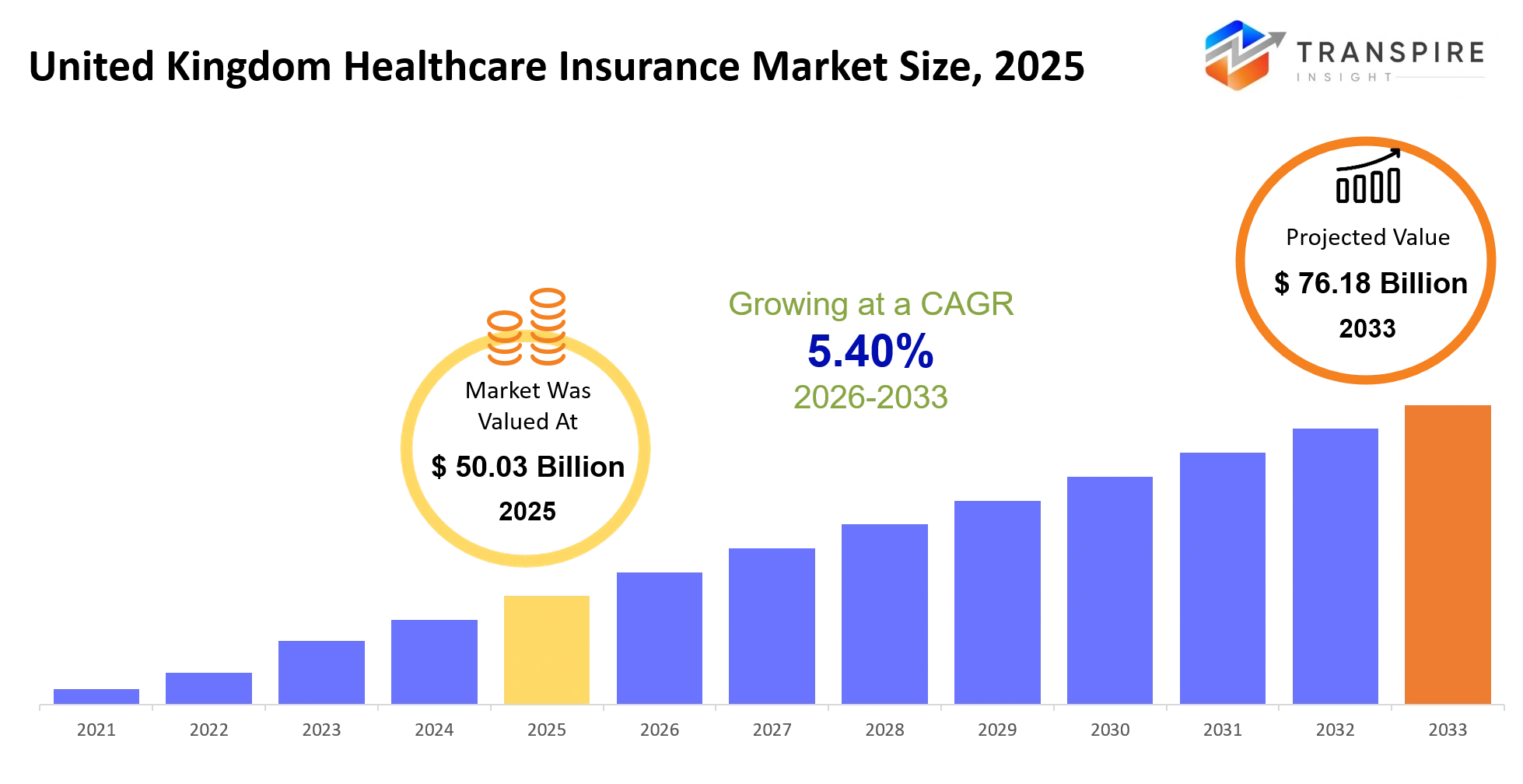
- United Kingdom Healthcare Insurance Market Size 2025: USD 50.03 Billion
- United Kingdom Healthcare Insurance Market Size 2033: USD 76.18 Billion
- United Kingdom Healthcare Insurance Market CAGR: 5.40%
- United Kingdom Healthcare Insurance Market Segments: By Insurance Type (Private Health Insurance, Critical Illness Insurance, Dental Insurance, Vision Insurance, Medical Reimbursement Plans, Family Health Insurance, Group Health Insurance, Others); By Coverage Type (Inpatient Coverage, Outpatient Coverage, Maternity Coverage, Chronic Disease Coverage, Accident Coverage, Others); By End User (Individuals, Families, Corporate Employees, Senior Citizens, Students, Others); By Distribution Channel (Direct Sales, Insurance Brokers, Bancassurance, Online Platforms, Others).
To learn more about this report,  Download Free Sample Report
United Kingdom Healthcare Insurance Market Summary
The United Kingdom Healthcare Insurance Market was valued at USD 50.03 Billion in 2025. It is forecast to reach USD 76.18 Billion by 2033. That is a CAGR of 5.40% over the period.
The United Kingdom Healthcare Insurance Market kind of plays a critical role in helping people and employers get quicker diagnostics, elective procedures, specialist consultations, and treatment pathways that can sit alongside publicly funded healthcare services. In practice it often cuts down on waiting times, gives more care flexibility, and backs workforce health management for companies, even when resources feel tight.
Over the last five years the market has shifted in a more structural way from the old reimbursement only style of coverage toward digitally enabled health ecosystems that blend virtual consultations, preventive care programs, mental health services, and more personalized wellness benefits. A big trigger for this change was the COVID-19 pandemic which showed how limited healthcare capacity can get, and it sped up the adoption of private healthcare solutions, at a faster pace than before.
Right now the market growth is kinda being propelled by the ongoing pressure on public healthcare waiting lists, and also by employers paying extra attention to keeping employees onboard plus boosting productivity. Because more and more businesses view health benefits as a strategic workforce investment, insurers are rolling out additional corporate options, and along with that value-added services. This in turn tends to increase policy uptake, supports the growth of premium revenue streams, and encourages insurers to craft more flexible, tech-anchored coverage models across the United Kingdom, without really getting stuck in the usual traditional approach.
Key Market Insights
- England is basically dominating the United Kingdom Healthcare Insurance Market, it will bring in something like around 80% of the total premium revenue in 2025, mostly because of its big population base, and yeah that’s the headline reason.
- Scotland shows up as the second-largest regional market, it’s backed by solid employer-sponsored health insurance involvement, plus private healthcare infrastructure that keeps getting wider and more modern, over time.
- Private Medical Insurance (PMI) still leads overall, with more than 65% market share in 2025. This is usually tied to the desire for quicker treatment pathways and quicker specialist access, people really like that.
- Corporate healthcare insurance sits in the next spot, it’s supported by employer spending on workforce health, and employee retention plans that seem more common every year.
- Digital health-integrated insurance plans are the fastest-growing part, and the forecast through 2030 looks meaningful due to how much virtual care adoption is increasing.
- When it comes to what people actually use, inpatient and elective treatment coverage takes the lead, it makes up close to 45% of policy utilization in 2025 across insured populations.
- Mental health services and preventive healthcare options are growing the quickest, and this seems driven by shifting employee benefit priorities as well as digital health solutions that make it easier to engage.
- The push for integrated wellness programs keeps reshaping service offerings across the wider United Kingdom healthcare insurance industry, it’s not just one product anymore.
- On the customer side, corporate policyholders dominate, and they account for around 60% of healthcare insurance premiums in 2025.
- Small and medium-sized enterprises (SMEs) are the fastest-growing end-user group, they’re adopting health benefits as a way to attract, and keep talent, and it’s becoming a kind of standard move.
What are the Key Drivers, Restraints, and Opportunities in the United Kingdom Healthcare Insurance Market?
One of the strongest forces pushing the United Kingdom Healthcare Insurance Market forward, is the steady pressure on publicly funded care services, especially those long waiting periods for diagnostics and elective procedures. This problem got more obvious after the COVID-19 pandemic, when a big treatment backlog built up across the whole system. Because of that, employers started leaning on private healthcare insurance more often, partly to keep workforce output steady, and also to trim down employee absence that happens when care is delayed. At the same time, many individuals moved toward private coverage, because they want quicker entry to specialists and procedures. In the end, this shift has expanded policy enrollment quite a bit, and it has boosted premium revenues across both corporate and individual insurance parts.
Still, the biggest roadblock for further market growth is the high expense of private healthcare coverage. It’s a sort of structural issue, because it connects directly to medical inflation, rising treatment costs, and shortages in the healthcare workforce. Insurers have to keep recalibrating premiums to absorb these cost pressures, which makes affordability tougher for lower income households and smaller businesses. So penetration tends to happen slower outside of higher income groups, and mainly larger corporate clients, and that keeps revenue growth from spreading as broadly across the market segments.
There’s a big chance to scale up in digitally integrated healthcare insurance models, kinda like the whole thing is moving online, more and more. Insurers are now putting money into telehealth platforms, remote monitoring tools, and preventive care services that can lower treatment costs but also make patient outcomes better. At the same time, the growth of AI enabled health management solutions and virtual care ecosystems opens up ways to draw in younger policyholders , improve retention, and build fresh revenue streams via more tailored healthcare offerings, which is actually pretty important here.
What Has the Impact of Artificial Intelligence Been on the United Kingdom Healthcare Insurance Market?
Artificial intelligence along with advanced digital technologies are kinda reshaping the United Kingdom Healthcare Insurance Market, mainly by boosting operational efficiency, risk assessment, and also customer engagement. In practice insurers are using AI -driven automation more often, not just to handle claims but to verify medical records, spot fraud, and deal with those recurring customer service requests. When automated claims systems are put in place, processing can drop from several days down to maybe just hours, which tends to cut administrative expenses, and at the same time makes the policyholder experience feel smoother.
Then there are machine learning models, they are improving predictive strengths across the whole healthcare insurance value chain. Insurers pull together clinical data, behavioral signals, and utilization trends, to forecast healthcare costs, flag members who are more likely to face chronic conditions, and suggest preventive actions that are more focused. In other words these predictive tools help insurers curb claims spending more effectively while still backing better health outcomes. On top of that, advanced analytics platforms can sharpen underwriting decisions, by surfacing risk patterns that older, traditional assessment approaches might not notice.
Operationally the impact shows up in several places too: faster claims settlement, reduced fraud related losses, stronger customer retention, and also pricing strategies that are more exact. Plus digital health integrations, like telemedicine platforms and remote monitoring solutions, add extra policy value, because they enable earlier intervention and can reduce avoidable treatment costs.
Still, AI adoption has a real constraint, and it is kinda stubborn. Pulling together different healthcare, claims, and customer data systems is complicated, time consuming, and expensive. Data quality inconsistencies, plus regulatory requirements around patient privacy, can also limit model accuracy and slow down the wider rollout across the insurance sector.
Key Market Trends
- Since 2020, employer sponsored health insurance adoption has, kinda, sped up as many companies try to deal with workforce productivity losses tied to long treatment waiting times.
- Telemedicine also kind of shifted from being just an extra perk to a more central policy feature from 2020 to 2025, and that changed how insurers plan their service approach.
- Mental health coverage expanded notably after the pandemic, with insurers rolling out counseling and therapy streams, plus digital wellbeing programs that feel more targeted than before, even when it’s the same basic idea.
- Big names like Bupa and AXA Health increased their investment in digital platforms to help claims run smoother, and to keep customers engaged, without as much friction.
- After 2022, AI powered claims assessment really gained traction, this reduced administrative workload and sped up settlement timeframes across several major insurance providers.
- Preventive healthcare benefits basically moved out of being optional add ons and into these more deliberate retention tools, since employers tried to curb long term healthcare expenditures or at least keep them from creeping up too much.
- Between 2021 and 2025, insurers paired more often with telehealth providers, and it created integrated care pathways that kind of go beyond the usual insurance coverage boundary , but in a way that feels more continuous.
- Also, smaller businesses adopted group healthcare plans at higher rates than before 2020 , which seems to point toward stronger competition for skilled employees .
- Data driven underwriting models replaced wider risk assessments and that helped insurers design more individualized pricing and coverage structures.
- Overall, competitive differentiation seems to depend less on policy coverage by itself and more on digital health ecosystems, wellness services, and customer experience.
United Kingdom Healthcare Insurance Market Segmentation
By Insurance Type:
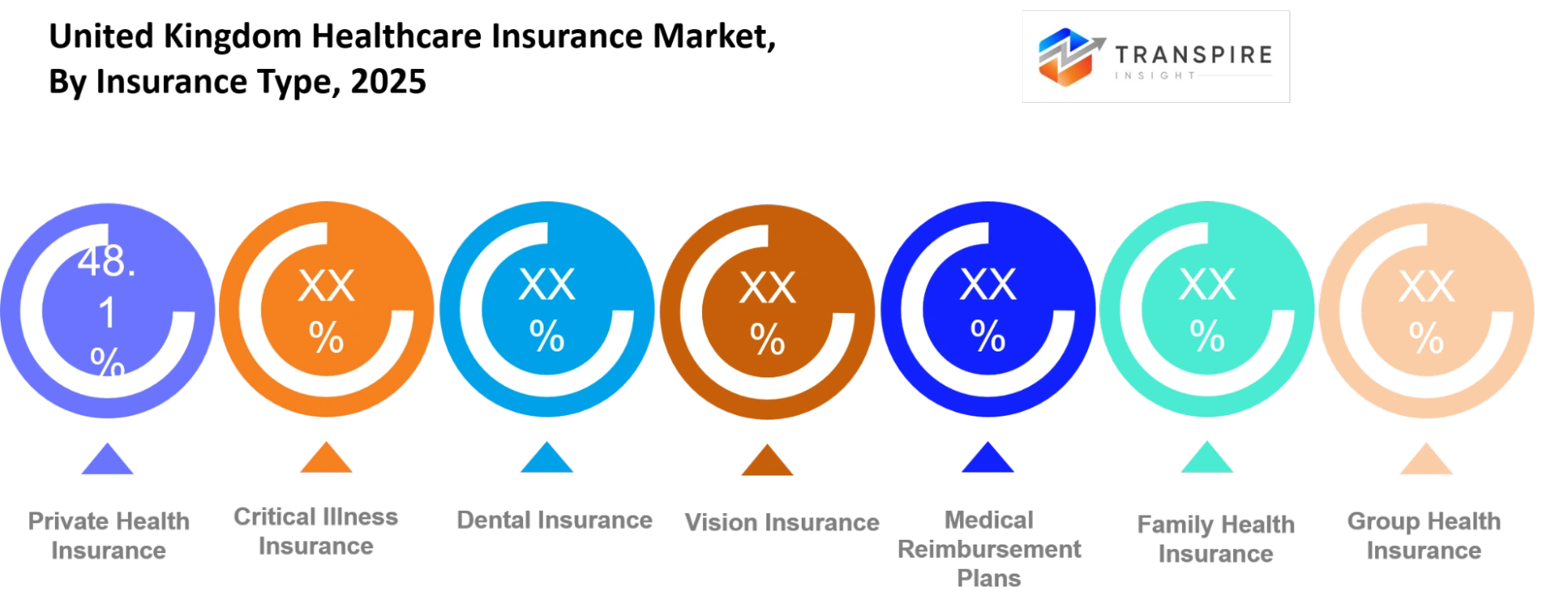
Private Health Insurance is a major chunk of the United Kingdom Healthcare Insurance Market, it really offers access to private medical treatment, shorter wait times, and more choices in hospitals. Demand keeps moving up, especially for people who want faster care and a little more control over how treatment happens. This segment also backs specialist appointments, diagnostic tests, and elective procedures outside the public system, so it can feel a bit more direct.
Critical Illness Insurance provides financial backing when the policyholder gets diagnosed with specific, very serious medical conditions. After that you usually see Dental Insurance which tends to cover preventive care along with corrective dental work, not just cleanings but also the more involved stuff, and Vision Insurance that helps with eye exams, glasses, and contact lenses. Medical Reimbursement Plans kind of work the other way around though, they help you recover qualifying healthcare costs, so the overall spending stays more workable, and honestly less stressful.
Family Health Insurance includes multiple family members under one policy, which can create cost efficiency and a simpler way to manage coverage. Group Health Insurance is also common, employers use it to deliver healthcare benefits to employees, and that supports well-being, plus it can improve retention. Other types exist too, like more niche plans that are shaped around specific healthcare needs or customer preferences.
To learn more about this report, Download Free Sample Report
By Coverage Type:
Inpatient Coverage covers most medical expenses tied to hospital admissions, operations, room charges , and the treatment you get while you’re actually staying in the hospital. It stays pretty important, because hospital based care is often where the big healthcare costs show up. With this type of coverage, the financial pressure from major medical procedures and those longer hospital stays can feel a lot lighter, in a practical way.
Outpatient Coverage is more about medical services that don’t involve hospitalization. Think consultations, diagnostic tests, therapies, and follow up care. People seem to care more about preventive healthcare these days, plus regular health checks, so the demand for outpatient benefits keeps growing. A lot of policyholders also like the convenience of getting routine care without having major out of pocket spending.
Then there is Maternity Coverage, which addresses healthcare costs related to pregnancy , childbirth, and postnatal care. Chronic Disease Coverage supports ongoing treatment for long term health conditions, while Accident Coverage helps with financial protection if something unexpected happens—like injuries—and the medical expenses that follow. Other coverage categories can include specialized benefits, designed around particular healthcare needs and newer consumer expectations.
By End User:
People i ndividuals are a big chunk of the United Kingdom Healthcare Insurance Market, and this is pretty much pushed by folks getting more aware of personal health management , plus wanting quicker access to private care. A lot of consumers buy insurance so they can get medical attention faster, and so they have more say over treatment options. This group also rides along with the rising mindset around healthcare security, and also the whole idea of financial readiness.
Families, on the other hand, tend to look for healthcare insurance options that cover more than one person, but still under a single plan, so it feels simpler. Usually the coverage includes preventive care, regular check ups, and then medical treatments, which makes it easier for households to manage the healthcare costs without everything getting messy. And the demand keeps growing because many families want reliable and comprehensive access for children, dependents , and other household members.
Corporate employees usually get healthcare insurance via employer sponsored programs, which is often linked to better employee wellbeing and higher workplace satisfaction. Senior citizens are another clear end user group, they often need coverage that fits age related health needs. Students typically look for affordable healthcare protection while they are studying. Besides these, there are other end users like specialized groups, with their own distinct healthcare requirements and insurance preferences, so the market stays pretty varied.
By Distribution Channel:
Direct Sales is basically when insurance providers sell policies straight to customers, mostly via dedicated sales teams, and other channels run by the same company. In a way this helps insurers keep a closer customer relationship, plus it gives more tailored policy guidance. When the interaction is more direct, customers often grasp coverage options, and even the policy benefits, a bit better.
Insurance Brokers do something different, they compare offerings from several providers, and they help customers pick something that truly fits. Then there’s Bancassurance which lets banks distribute health insurance products across their established customer networks, so it feels easier and it also broadens market reach. Together these routes still support wide accessibility across many consumer groups.
Online Platforms have been building real momentum lately, mainly because more people use digital services and they seem to like convenient comparison and purchasing. Through these channels customers can review options, get quotations, and finish transactions without much friction. There are also alternative sales networks, those help expand the market, and improve insurance accessibility for different customer segments too.
What are the Key Use Cases Driving the United Kingdom Healthcare Insurance Market?
In the United Kingdom Healthcare Insurance Market, the main thing that really drives adoption is the ability to get faster medical treatment via private healthcare facilities. When people face long waits for specific procedures in public healthcare systems, working professionals, and corporate employees start looking around for quicker routes—specialist consultations, diagnostic testing, and even elective treatments. That ongoing need stays as the biggest chunk of demand across the market, kind of consistently.
But it’s not only about the core treatment angle. Increasingly, healthcare insurance is being taken up for preventive care, outpatient check ins, and chronic disease management too. Families as well as employers are moving toward plans that enable regular health assessments and structured treatment programs. So, in practice this can help lower long term healthcare expenses, while also supporting workforce productivity and better overall health results.
There are also newer use cases showing up. Think digital health services, virtual consultations, and personalized wellness programs that get woven into insurance offerings. Insurers are also boosting their support for mental health services, along with remote patient monitoring, especially as workplace health requirements keep shifting and as people want more continuous access to care, outside the usual clinical setting.
|
Report Metrics |
Details |
|
Market size value in 2025 |
USD 50.03 Billion |
|
Market size value in 2026 |
USD 52.73 Billion |
|
Revenue forecast in 2033 |
USD 76.18 Billion |
|
Growth rate |
CAGR of 5.40% from 2026 to 2033 |
|
Base year |
2025 |
|
Historical data |
2021 - 2024 |
|
Forecast period |
2026 - 2033 |
|
Report coverage |
Revenue forecast, competitive landscape, growth factors, and trends |
|
Regional scope |
Middle East and Africa (Saudi Arabia, United Arab Emirates, South Africa, Rest of Middle East and Africa) |
|
Key company profiled |
Bupa, AXA Health, Aviva, Vitality, Cigna, Allianz, UnitedHealth Group, Aetna, Prudential, Zurich Insurance, Legal & General, HCF, Medibank, Niva Bupa, HDFC ERGO. |
|
Customization scope |
Free report customization (country, regional & segment scope). Avail customized purchase options to meet your exact research needs. |
|
Report Segmentation |
By Insurance Type (Private Health Insurance, Critical Illness Insurance, Dental Insurance, Vision Insurance, Medical Reimbursement Plans, Family Health Insurance, Group Health Insurance, Others); By Coverage Type (Inpatient Coverage, Outpatient Coverage, Maternity Coverage, Chronic Disease Coverage, Accident Coverage, Others); By End User (Individuals, Families, Corporate Employees, Senior Citizens, Students, Others); By Distribution Channel (Direct Sales, Insurance Brokers, Bancassurance, Online Platforms, Others). |
Which Regions are Driving the United Kingdom Healthcare Insurance Market Growth?
England still kind of leads the United Kingdom healthcare insurance market, mainly because it has a big population base, a dense concentration of private healthcare providers, and there’s a solid footprint of the major insurers there. People keep pushing for faster access to specialist treatment, so uptake keeps rising especially across the larger urban centers. There’s also this fairly well-developed patchwork of private hospitals, diagnostic services, and healthcare professionals, which really helps with market penetration. On top of that, employer-sponsored health plans plus a growing sense of consumer awareness, both help keep the regional edge strong.
Scotland comes in as the second-largest contributor and it feels a bit different from England. It tends to lean more toward long-term healthcare planning, and it shows more stable patterns when it comes to insurance adoption. Demand stays supported by consistent household spending and an already established healthcare infrastructure. Insurers, meanwhile, can rely on a fairly predictable regulatory environment, plus steady employer participation for health benefits. Taken together these elements bring dependable revenue generation and help market stability hold up over time.
Wales is starting to look like the fastest-growing region, mostly because ongoing access concerns are nudging more people toward private coverage ideas. Investments in healthcare facilities recently, and the ongoing expansion of digital health services, have made insured care options seem more attractive. Insurers are also widening product availability and working harder on online distribution channels, so they can reach consumers who have been underserved. This kind of momentum opens doors for new market participants, and also supports investment expansion during the 2026–2033 period.
Who are the Key Players in the United Kingdom Healthcare Insurance Market and How Do They Compete?
The United Kingdom Healthcare Insurance Market shows a sort of moderate consolidation, where a few big insurers hold most of the share and specialist providers sort of compete using narrower, focused offerings along with service quality. You can see that competition is not just about price, but more about provider networks and digital healthcare access, claims efficiency, and how the customer experience feels in day to day use. The established players keep defending their position via product innovation and broader healthcare ecosystems, while newer and niche participants go after certain customer segments with personalized coverage and wellness driven services.
Bupa manages to stand out with an extensive network of private healthcare facilities and integrated care services that tie insurance directly to treatment delivery. This kind of arrangement helps improve patient access and also care coordination, in a way that feels smoother overall. AXA Health leans into digital health tools, virtual consultations, and employer focused health solutions aimed at workforce wellbeing. By continuing to invest in digital engagement, they tend to strengthen retention and keep services more accessible. Aviva competes by pairing healthcare insurance with wider financial and protection products, which creates cross-selling options and deeper customer relationships, kind of all in one.
Vitality operates using a wellness based model that rewards healthier behavior with incentives and engagement programs. That approach creates a distinct value proposition compared with traditional insurers who usually stick to a more standard setup. WPA, on the other hand, concentrates on flexible and customer oriented health plans, attracting people and businesses that want tailored coverage rather than one size fits all. These companies keep expanding through strategic partnerships with healthcare providers, upgraded digital capabilities, and the rollout of specialized products meant for changing healthcare needs.
Company List
- Bupa
- AXA Health
- Aviva
- Vitality
- Cigna
- Allianz
- UnitedHealth Group
- Aetna
- Prudential
- Zurich Insurance
- Legal & General
- HCF
- Medibank
- Niva Bupa
- HDFC ERGO
Recent Development News
In April 2026, Bupa UK Insurance entered a four-year strategic partnership with Spire Healthcare. The agreement expands access for Bupa health insurance members to Spire’s hospital network and includes plans for new oncology, musculoskeletal, and gynaecology specialist centres, strengthening private healthcare capacity and enhancing member access to specialist treatment across the UK.
Source: https://www.spirehealthcare.com/
In May 2026, One Call, Applied Systems Europe, and Verisk partnered to launch Zen Insurance, a new digital-first insurer in the UK. The collaboration uses integrated policy management and insurer-connectivity technology to deliver a fully digital insurance experience, accelerating innovation and operational efficiency in the UK insurance market.
Source: https://www1.appliedsystems.com/
What Strategic Insights Define the Future of the United Kingdom Healthcare Insurance Market?
The United Kingdom Healthcare Insurance Market seems to be drifting, a bit, toward a more integrated healthcare model where insurance, preventative care, digital health services, and wellness management start to work like one connected ecosystem. The real engine behind this shift is basically consumer demand for quicker, more tailored healthcare access, and also the growing pressure on public healthcare resources. In the next five to seven years, insurers that manage to pair coverage with ongoing health management services should have a better shot at getting long-term returns.
There’s another risk, but it’s less obvious. Claims costs are climbing, partly from medical inflation and partly because more people are using private healthcare services. So yes, policy growth can look strong on the surface, yet it may also hide stress on insurer margins, especially for organizations that depend heavily on fixed-premium arrangements. Meanwhile, a newer opening is quietly forming around data-informed preventive healthcare, like remote monitoring and predictive health analytics, which could lower later-stage treatment costs.
Market players should really focus on partnerships with healthcare technology providers and clinical networks. The goal would be to shape outcome-driven insurance models that strengthen customer stickiness, while also keeping future claims spending under control.
United Kingdom Healthcare Insurance Market Report Segmentation
By Insurance Type
- Private Health Insurance
- Critical Illness Insurance
- Dental Insurance
- Vision Insurance
- Medical Reimbursement Plans
- Family Health Insurance
- Group Health Insurance
By Coverage Type
- Inpatient Coverage
- Outpatient Coverage
- Maternity Coverage
- Chronic Disease Coverage
- Accident Coverage
By End User
- Individuals
- Families
- Corporate Employees
- Senior Citizens
- Students
By Distribution Channel
- Direct Sales
- Insurance Brokers
- Bancassurance
- Online Platforms
Frequently Asked Questions
Find quick answers to common questions.
The United Kingdom Healthcare Insurance Market size is USD 76.18 Billion in 2033.
Key segments for the United Kingdom Healthcare Insurance Market are By Insurance Type (Private Health Insurance, Critical Illness Insurance, Dental Insurance, Vision Insurance, Medical Reimbursement Plans, Family Health Insurance, Group Health Insurance, Others); By Coverage Type (Inpatient Coverage, Outpatient Coverage, Maternity Coverage, Chronic Disease Coverage, Accident Coverage, Others); By End User (Individuals, Families, Corporate Employees, Senior Citizens, Students, Others); By Distribution Channel (Direct Sales, Insurance Brokers, Bancassurance, Online Platforms, Others).
Major United Kingdom Healthcare Insurance Market players are Bupa, AXA Health, Aviva, Vitality, Cigna, Allianz, UnitedHealth Group, Aetna, Prudential, Zurich Insurance, Legal & General, HCF, Medibank, Niva Bupa, HDFC ERGO.
The United Kingdom Healthcare Insurance Market size is USD 50.03 Billion in 2025.
The United Kingdom Healthcare Insurance Market CAGR is 5.40% from 2026 to 2033.
- Bupa
- AXA Health
- Aviva
- Vitality
- Cigna
- Allianz
- UnitedHealth Group
- Aetna
- Prudential
- Zurich Insurance
- Legal & General
- HCF
- Medibank
- Niva Bupa
- HDFC ERGO
About the Authors

Pankaj Ghogare Patil
I am Pankaj Ghogare Patil, a Senior Research Analyst at Transpire Insight, specializing in the Pharmaceutical, Chemicals & Materials, Healthcare IT, and Biotechnology industry. My expertise lies in conducting comprehensive market research, analyzing industry trends, evaluating competitive landscapes, and translating complex data into actionable insights. At Transpire Insight, I closely follow emerging technologies, regulatory developments, and market innovations to create accurate, well-researched, and informative content that helps businesses and professionals make informed decisions. I am committed to producing credible, evidence-based articles that reflect industry best practices while making technical topics accessible and valuable for a broad audience.

Chakradhar Khansole
Chakradhar serves as the Research Director at Transpire Insight, bringing over 8 years of experience in technology, innovation, and strategic market intelligence. He specializes in transforming complex market data into actionable business insights that enable organizations to make informed, growth-oriented decisions. Recognized for his strategic vision and analytical expertise, Chakradhar leads high-impact research initiatives, delivering comprehensive market assessments, competitive intelligence, and forward-looking industry analysis.
Recently Published Reports
-
Apr 2026
AI in Diabetic Retinopathy Market
AI in Diabetic Retinopathy Market Size, Share & Analysis Report By Type (Screening AI Systems, Diagnostic AI Systems, and Predictive AI Models), By Application Segment (Hospitals, Ophthalmology Clinics, Diagnostic Centers, and Research and Development), and Geography (North America, Europe, Asia-Pacific, Middle East and Africa, South and Central America), 2021 - 2031
-
Apr 2026
Psychometric Tests Market
Psychometric Tests Market Size, Share & Analysis Report By Type (Personality Tests, Ability/Aptitude Tests, Skill/Knowledge Tests, and Others), By Application (Talent Acquisition and Talent Management), and Geography (North America, Europe, Asia-Pacific, Middle East and Africa, South and Central America), 2021 – 2031
-
Apr 2026
Rare Biological Sample Collection Market
Rare Biological Sample Collection Market Size, Share & Analysis Report By Type (Isolation Kits & Reagent, Blood Collection Tubes, and Others), By Application (Oncology, Transcriptomics, Pharmacogenomics, and Others), and Geography (North America, Europe, Asia-Pacific, Middle East and Africa, South and Central America), 2021 – 2031
-
Jul 2026
Diabetic Retinopathy Market
Diabetic Retinopathy Market Size, Share & Analysis Report By Type (Proliferative Diabetic Retinopathy, and Diabetic Macular Edema (DME)), By Treatment Type (Anti VEGF Drug, Steroid Implants, Laser Surgeries, and Vitrectomy), and Geography (North America, Europe, Asia-Pacific, Middle East and Africa, South and Central America), 2021 – 2031
Our Clients







