
United Kingdom Greeting Cards Market Size & Forecast:
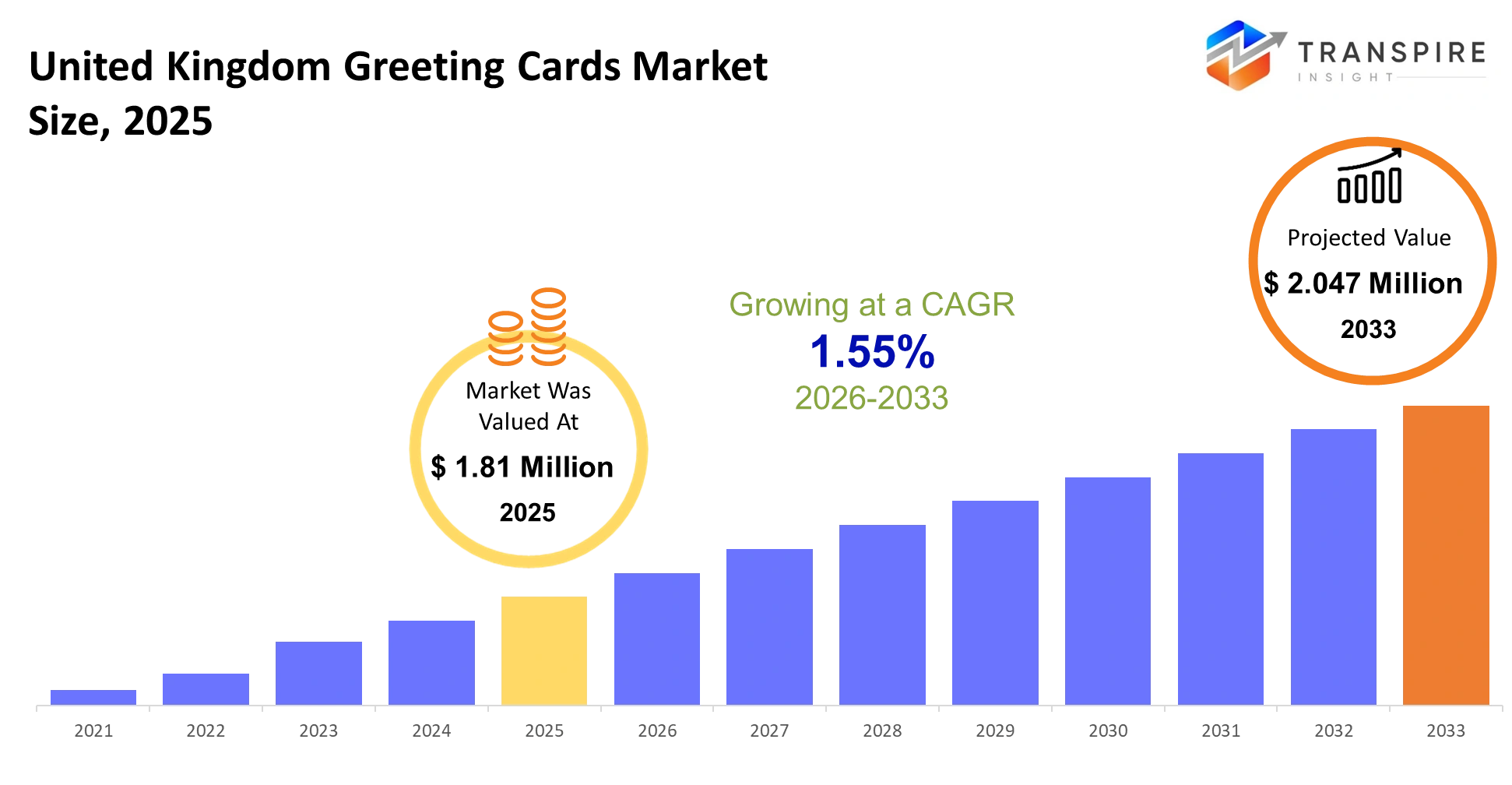
- United Kingdom Greeting Cards Market Size 2025: USD 1.81 Million
- United Kingdom Greeting Cards Market Size 2033: USD 2.047 Million
- United Kingdom Greeting Cards Market CAGR: 1.55%
- United Kingdom Greeting Cards Market Segments: By Card Type (Birthday, Seasonal, Thank You, Anniversary, Wedding, Sympathy, Business, Others); By Distribution Channel (Supermarkets, Specialty Stores, Online, Gift Shops, Others)
United Kingdom Greeting Cards Market Summary
As per Transpire Insight Analysis, the United Kingdom Greeting Cards Market was valued at USD 1.81 billion in 2025. It is forecast to reach USD 2.047 billion by 2033. That is a CAGR of 1.55% over the period.
The United Kingdom's greeting card market really helps people - both consumers and businesses - express themselves and communicate effectively through marking important life events, building relationships, and showing our emotions in a very tangible form indeed. Greeting cards still have a place where digital messages just can't compete - especially for birthdays, weddings, seasonal celebrations, and even corporate team-building activities. Over the last five years, the market has changed significantly towards hybrid retail models combining actual stores with super-personalized online shopping and direct-to-the-recipient delivery services. The Covid-19 pandemic was a huge catalyst - speeding up e-commerce usage and getting people to look for much more meaningful and highly customized ways of communicating when face-to-face contact was severely restricted. This change in consumer behaviour has stuck around long after the pandemic. Our revenue growth is now even more closely tied to offering high-end products, using eco-friendly materials, and having print-on-demand options that greatly cut down on inventory risks. As retailers and digital platforms add even more personal touches to their offerings, companies are able to target particular customer groups so much better, which results in customers buying from us more often - and spending more money each time!
Key Market Insights
- England really holds sway over the United Kingdom greeting card market - it's expected to make up about 82% of the market share by 2025 - thanks to a much higher population density and an even stronger retail infrastructure.
- Scotland is the quickest-growing regional market all the way to 2030, getting a boost from increasingly widespread e-commerce penetration and a bigger demand for unique, handmade brands.
- London, Manchester, Birmingham, and Glasgow together bring in loads of industry revenue because there's a lot more spending on household gifts here.
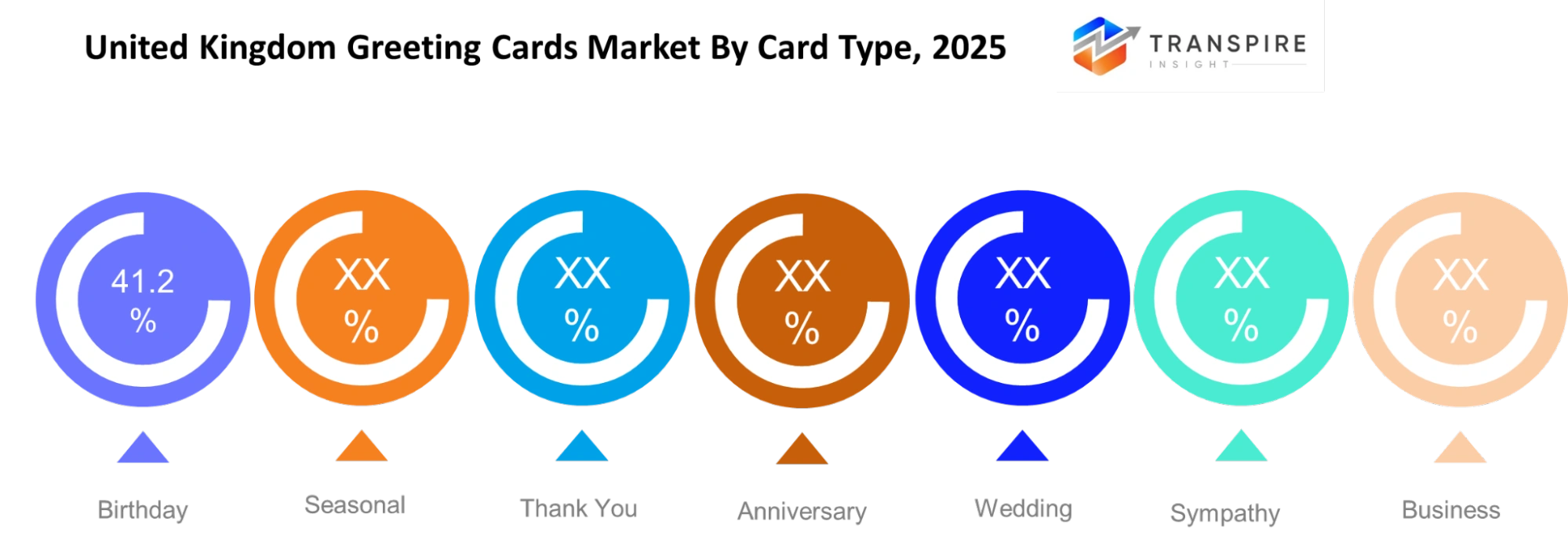
- Birthday cards actually lead the market with almost 34% share in 2025, driven by regular purchases and very consistent demand all year round.
- Seasonal cards make up the second biggest part of the market, supported by Christmas, Easter, Mother's Day, and Father's Day celebrations.
- Personalized and print-on-demand cards are growing the fastest through 2030, really driven by online personalization tools and direct shipping services.
- Personal and household gift-giving totally dominates with approximately 78% market share in 2025, showing just how deeply ingrained the UK's culture of celebrating milestones really is.
- Corporate gifting and employee engagement applications are expanding very quickly as companies build closer ties with their customers and employees.
- Subscription gifting services are starting to emerge as whole new sources of revenue by increasing how often younger shoppers buy things.
- Individual consumers remain the biggest end-user group, contributing nearly 85% of our total market revenue in 2025.
What are the Key Drivers, Restraints, and Opportunities in the United Kingdom Greeting Cards Market?
The strongest driving force behind the UK Greeting Cards Market's growth is the fast integration of digital personalization into our traditional card buying habits. This change really took off during the COVID-19 pandemic - as consumers started using online gifting platforms even more and retailers put a lot of effort into developing their e-commerce capabilities. Platforms allowing customers to upload pictures, create custom messages, and set up direct deliveries have completely changed greeting cards from low-profit impulse buys into high-end items. This has raised our average order values and created many new recurring revenue streams via subscription services, reminder-based purchasing, and data-driven customer retention programs.
The biggest obstacle we face is the ongoing decline in high street foot traffic and the continued closure of independent retail stores. This problem is quite structural - because consumer buying habits have permanently shifted towards digital channels, yet physical retailers keep facing very high rents, energy, and labor costs. Smaller card manufacturers often rely greatly on these outlets to get noticed and sell their products. When stores close, market access becomes much more concentrated among larger digital players, slowing down growth opportunities for smaller brands and reducing the overall market diversity and revenue potential significantly.
Our next major growth phase will be in AI-powered hyper-personalization and business-to-business (B2B) relationship management. Businesses are starting to use customized greeting cards much more to increase customer loyalty and employee satisfaction. Companies that combine customer data analysis, automated event reminders, and print-on-demand technologies can really build highly scalable B2B revenue channels that go way beyond traditional consumer gifting categories.
What Has the Impact of Artificial Intelligence Been on the United Kingdom Greeting Cards Market?
Artificial intelligence and advanced digital technologies are reshaping the United Kingdom Greeting Cards Market by transforming personalization, inventory management, and customer engagement. Online greeting card platforms increasingly use AI algorithms to analyze purchasing history, seasonal behavior, and recipient preferences to generate tailored design recommendations and message suggestions. This automation reduces design turnaround times and improves conversion rates by presenting customers with more relevant products. Machine learning models are also helping publishers forecast demand patterns around key events such as Christmas, Mother's Day, and birthdays, allowing companies to optimize print volumes and reduce excess inventory costs. Print-on-demand technologies integrated with AI-driven forecasting enable businesses to shorten production cycles and improve operational efficiency.
Digital retailers are further using predictive analytics to automate reminder systems for recurring events, increasing customer retention and repeat purchases throughout the year. Data-driven optimization also supports dynamic pricing strategies and targeted marketing campaigns, improving average order values and marketing return on investment. However, a key limitation remains the high cost of integrating AI systems with legacy publishing, inventory, and retail infrastructure. Smaller independent publishers often lack the financial resources and customer data volumes required to train effective AI models, creating an adoption gap between large digital platforms and traditional card retailers.
Key Market Trends
- Since 2020, online greeting card purchases have expanded significantly as consumers embraced scheduled deliveries, mobile ordering, and direct-to-recipient gifting services.
- Personalized cards have moved from a niche category to a mainstream offering, with platforms like Moonpig and Funky Pigeon integrating photo uploads and custom messaging.
- Retailers have reduced reliance on large inventories by adopting print-on-demand production models that minimize waste and improve product availability.
- Consumer preferences have shifted toward premium designs, textured paper, and luxury finishes, increasing average transaction values across the industry.
- Sustainability has become a competitive differentiator, with brands adopting FSC-certified paper, recyclable packaging, and responsibly sourced materials since 2021.
- Independent card creators have gained visibility through online marketplaces, reducing traditional dependence on high street retailers and physical shelf space.
- Corporate gifting has evolved beyond seasonal campaigns, with businesses increasingly using customized cards for customer retention and employee engagement.
- Data analytics and automated reminder systems have changed purchasing behavior by encouraging repeat orders for birthdays, anniversaries, and recurring events.
- High street retailers have accelerated omnichannel investments as declining foot traffic since 2020 reshaped long-term sales strategies.
- Leading players, including Hallmark, Card Factory, and Moonpig, are expanding digital capabilities to capture younger consumers who expect convenience and personalization.
United Kingdom Greeting Cards Market Segmentation
By Card Type:
Birthday cards hold the largest position because birthdays create recurring purchase occasions every year across all age groups. Families, friends, workplaces, and educational institutions regularly exchange birthday cards, which keeps sales consistent throughout the year. Personalization options such as photographs, handwritten messages, and premium finishes have further strengthened this category. Retailers and online platforms continue expanding product collections to serve different customer preferences and spending levels.
Seasonal cards form another important category because celebrations such as Christmas, Easter, Mother’s Day, and Father’s Day generate concentrated purchasing activity during specific periods. Seasonal collections often include limited-edition designs that encourage early purchases. Anniversary, wedding, thank you, and sympathy cards maintain steady demand because life events continue creating emotional connections that digital communication often cannot replace.
Business cards and other specialized greeting cards have also gained importance in recent years. Corporate organizations increasingly use customized cards to strengthen relationships with employees, clients, and business partners. Premium materials, sustainable paper sourcing, and unique designs have become key purchasing factors. Product diversification allows manufacturers to target multiple customer groups while improving overall revenue opportunities.
By Distribution Channel:
Supermarkets remain an important sales channel because convenience influences purchasing decisions. Consumers frequently add greeting cards to regular shopping trips, allowing retailers to capture impulse purchases. Large supermarket chains also provide affordable options that appeal to price-sensitive buyers. Strong physical visibility continues to support sales performance across urban and suburban areas.
Specialty stores maintain relevance by offering premium collections, independent designer products, and personalized shopping experiences. Gift shops also attract consumers looking for unique products for special occasions. Physical stores have adjusted strategies by combining traditional retail experiences with online ordering services. This approach helps businesses maintain customer engagement despite changes in shopping habits.
Online channels continue expanding because digital platforms simplify personalization and direct-to-recipient delivery. Mobile applications, automated reminders, and print-on-demand services have changed purchasing behavior over the past few years. Companies can collect customer preference data and provide tailored recommendations for future purchases. Omnichannel strategies will remain important as retailers balance digital convenience with physical store experiences.
What are the Key Use Cases Driving the United Kingdom Greeting Cards Market?
Personal milestone celebrations remain the dominant use case because birthdays, anniversaries, and seasonal occasions generate recurring purchases throughout the year. Birthday-related purchases contribute the highest transaction volumes since consumers repeatedly buy cards for family members, friends, colleagues, and school communities.
Corporate relationship management and employee engagement have become important secondary applications. Small and medium-sized enterprises increasingly use customized cards to strengthen client relationships, recognize employee achievements, and support festive campaigns during major holiday periods.
Emerging applications include subscription-based gifting services and AI-enabled personalization platforms. Retailers are also experimenting with automated reminder systems that synchronize with digital calendars and allow consumers to schedule purchases months in advance. These services remain at an early stage but show strong potential as convenience and personalization become central purchasing factors.
|
Report Metrics |
Details |
|
Market size value in 2025 |
USD 1.81 Billion |
|
Market size value in 2026 |
USD 1.838 Billion |
|
Revenue forecast in 2033 |
USD 2.047 Billion |
|
Growth rate |
CAGR of 1.55% from 2026 to 2033 |
|
Base year |
2025 |
|
Historical data |
2021 - 2024 |
|
Forecast period |
2026 - 2033 |
|
Report coverage |
Revenue forecast, competitive landscape, growth factors, and trends |
|
Regional scope |
United Kingdom |
|
Key company profiled |
Hallmark, Moonpig, Funky Pigeon, American Greetings, Card Factory, UK Greetings, Papier, Scribbler, Thortful, Clintons, IG Design Group, Tesco, Sainsbury's, M&S, WHSmith |
|
Customization scope |
Free report customization (country, regional & segment scope). Avail customized purchase options to meet your exact research needs. |
|
Report Segmentation |
By Card Type (Birthday, Seasonal, Thank You, Anniversary, Wedding, Sympathy, Business, Others); By Distribution Channel (Supermarkets, Specialty Stores, Online, Gift Shops, Others) |
Which Regions are Driving the United Kingdom Greeting Cards Market Growth?
England leads the market because it combines the country's largest consumer base with the strongest retail and e-commerce infrastructure. Major cities such as London, Manchester, Birmingham, and Leeds support high spending on gifting products and personalized purchases. Large retailers, digital platforms, independent designers, and logistics providers operate within a well-developed commercial ecosystem that keeps products widely accessible. Strong omnichannel networks also allow businesses to efficiently balance physical stores with direct-to-recipient delivery services.
Scotland serves as a stable contributor for different reasons. Consumer behavior places strong emphasis on supporting independent creators, local publishers, and artisan brands rather than relying entirely on national chains. Smaller market size is balanced by resilient spending patterns and a growing presence of specialty retailers. Consistent investment in digital storefronts and local production capabilities helps maintain steady revenue generation across the region.
Wales is emerging as the fastest-growing region as digital adoption creates new opportunities for smaller businesses. Improved e-commerce accessibility and lower barriers to entry have enabled independent card makers to reach customers nationwide without extensive retail networks. Sustainable product offerings and personalized designs are gaining traction among younger consumers. Growth between 2026 and 2033 will create attractive opportunities for new entrants that can combine local craftsmanship with scalable online distribution models.
Who are the Key Players in the United Kingdom Greeting Cards Market and How Do They Compete?
Competition in the United Kingdom Greeting Cards Market remains moderately fragmented because large retail brands, digital platforms, supermarket chains, and independent creators compete simultaneously. Traditional companies continue defending market share, but digital-first businesses have changed customer expectations around speed, personalization, and convenience. The primary basis of competition has shifted from price alone to service capabilities, customization, and omnichannel accessibility. Companies that combine strong online platforms with efficient fulfillment networks are gaining an advantage over businesses that rely heavily on physical retail sales.
Moonpig and Funky Pigeon have built competitive positions around technology-driven personalization. Moonpig differentiates itself through automated reminder systems, mobile-first purchasing, and extensive customer data analytics that encourage repeat orders throughout the year. Funky Pigeon focuses on rapid customization and direct-to-recipient delivery services integrated with photo-upload features. Both companies continue expanding digital capabilities to improve customer retention and increase average order values.
Card Factory, Hallmark, and UK Greetings use different approaches to strengthen market positions. Card Factory combines affordable pricing with broad physical store coverage while expanding online ordering services. Hallmark differentiates itself through premium designs, licensed collections, and emotional storytelling that appeals to multiple age groups. UK Greetings focuses on strong retailer partnerships and diversified distribution networks that place products across supermarkets, convenience stores, and independent outlets, reducing dependence on any single sales channel.
Company List
- Hallmark
- Moonpig
- Funky Pigeon
- American Greetings
- Card Factory
- UK Greetings
- Papier
- Scribbler
- Thortful
- Clintons
- IG Design Group
- Tesco
- Sainsbury's
- M&S (Marks & Spencer)
- WHSmith
Recent Development News
"In January 2026, Card Factory completed the acquisition and integration of Funky Pigeon into its growth strategy. The move strengthened Card Factory's digital personalization capabilities and expanded its reach beyond traditional high street retail into online greeting cards and gifting services.https://www.londonstockexchange.com
"In March 2026, Moonpig expanded its eCard offering and enhanced digital greeting card functionality. The update reinforced Moonpig's strategy of building recurring digital engagement alongside physical card sales and personalized gifting services.https://help.moonpig.com
"In November 2025, Moonpig introduced enhanced personalization features, including AI-assisted writing tools, video integration, and expanded customization options. The initiative strengthened customer retention by increasing the value of personalized purchases and differentiating the platform from conventional card retailers.https://www.moonpig.com
What Strategic Insights Define the Future of the United Kingdom Greeting Cards Market?
Over the next five to seven years, the United Kingdom Greeting Cards Market is structurally moving toward a data-enabled relationship commerce model rather than a traditional retail product industry. The underlying force behind this shift is the convergence of personalization technology, digital purchasing behavior, and recurring event-based consumption patterns. Companies will increasingly compete on customer retention capabilities instead of product variety alone, transforming greeting cards into part of a broader gifting and customer engagement ecosystem.
A less visible risk lies in market concentration among a small number of digital platforms. As customer data, delivery infrastructure, and personalization technologies become key competitive assets, smaller publishers may struggle to access audiences without becoming dependent on dominant online intermediaries. This could reduce innovation diversity and create pricing power imbalances over time.
An emerging opportunity is the development of AI-driven life event management platforms that integrate calendars, purchasing histories, and automated gifting recommendations. Market participants should invest in first-party customer data ecosystems and scalable print-on-demand networks now, as ownership of customer relationships will become more valuable than expanding physical retail footprints.
United Kingdom Greeting Cards Market Report Segmentation
By Card Type
- Birthday
- Seasonal
- Thank You
- Anniversary
- Wedding
- Sympathy
- Business
- Others
By Distribution Channel
- Supermarkets
- Specialty Stores
- Online
- Gift Shops
- Others
Frequently Asked Questions
Find quick answers to common questions.
The expected United Kingdom Greeting Cards Market size for the market will be USD 2.047 Billion in 2033.
Key segments for the United Kingdom Greeting Cards Market are By Card Type (Birthday, Seasonal, Thank You, Anniversary, Wedding, Sympathy, Business, Others); By Distribution Channel (Supermarkets, Specialty Stores, Online, Gift Shops, Others)
Major United Kingdom Greeting Cards Market players are Hallmark, Moonpig, Funky Pigeon, American Greetings, Card Factory, UK Greetings, Papier, Scribbler, Thortful, Clintons, IG Design Group, Tesco, Sainsbury's, M&S, WHSmith.
The United Kingdom Greeting Cards Market size is USD 1.81 Million in 2025.
The United Kingdom Greeting Cards Market CAGR is 1.55% from 2026 to 2033.
- Hallmark
- Moonpig
- Funky Pigeon
- American Greetings
- Card Factory
- UK Greetings
- Papier
- Scribbler
- Thortful
- Clintons
- IG Design Group
- Tesco
- Sainsbury's
- M&S (Marks & Spencer)
- WHSmith
About the Authors

Chetan Dhatrak
I’m Chetan Dhatrak, a Senior Research Analyst at Transpire Insight, specializing in the Consumer Goods, Foods and Beverages industry. I focus on analyzing market trends, consumer behavior, competitive landscapes, and industry developments to deliver accurate, data-driven insights. My research at Transpire Insight is built on credible sources and in-depth analysis, helping businesses and readers better understand market dynamics, emerging opportunities, and evolving consumer preferences. I’m committed to creating reliable, well-researched content that supports informed decision-making and reflects the latest developments in the consumer goods and food & beverage sectors.

Chakradhar Khansole
Chakradhar serves as the Research Director at Transpire Insight, bringing over 8 years of experience in technology, innovation, and strategic market intelligence. He specializes in transforming complex market data into actionable business insights that enable organizations to make informed, growth-oriented decisions. Recognized for his strategic vision and analytical expertise, Chakradhar leads high-impact research initiatives, delivering comprehensive market assessments, competitive intelligence, and forward-looking industry analysis.
Recently Published Reports
-
Apr 2026
Bottled Water Market
Bottled Water Market Size, Share & Analysis Report By Product Type (Still Bottled Water, Carbonated Bottled Water, Functional Bottled Water, and Others), By Packaging (PET, Cans, and Others), By Sales Channel (Supermarkets/Hypermarkets, Convenience Stores/Drug Stores, Grocery Stores/Club Stores, Foodservice, and Others) and Geography (North America, Europe, Asia-Pacific, Middle East and Africa, South and Central America), 2021 - 2032
-
Apr 2026
Color Cosmetic Packaging Market
Color Cosmetic Packaging Market Size, Share & Analysis Report By Application (Mascara Packaging, Liquid Packaging, and Liquid Face), By Type (Tubes & Bottles, Pens & Markers, Compacts & Containers, and Droppers & Pumps), and Geography (North America, Europe, Asia-Pacific, Middle East and Africa, South and Central America), 2021 - 2031
-
Apr 2026
External Microphone For Camera Market
External Microphone For Camera Market Size, Share & Analysis Report By Type (Shotgun Microphone, Lavalier Microphone, and Others), By Application (Digital Camera, Professional Video Camera, and Others), and Geography (North America, Europe, Asia-Pacific, Middle East and Africa, South and Central America), 2021 - 2031
-
Apr 2026
Foot Orthotic Insoles Market
Foot Orthotic Insoles Market Size, Share & Analysis Report By Type (Pre-fabricated, and Custom-made), By Material (Thermoplastic, Composite Carbon Fiber, and Others), By Distribution Channel (Drug Stores, Hospitals & Clinics, and Others), and Geography (North America, Europe, Asia-Pacific, Middle East and Africa, South and Central America), 2021 - 2031