
United Kingdom Cardiovascular Health Supplements Market Summary
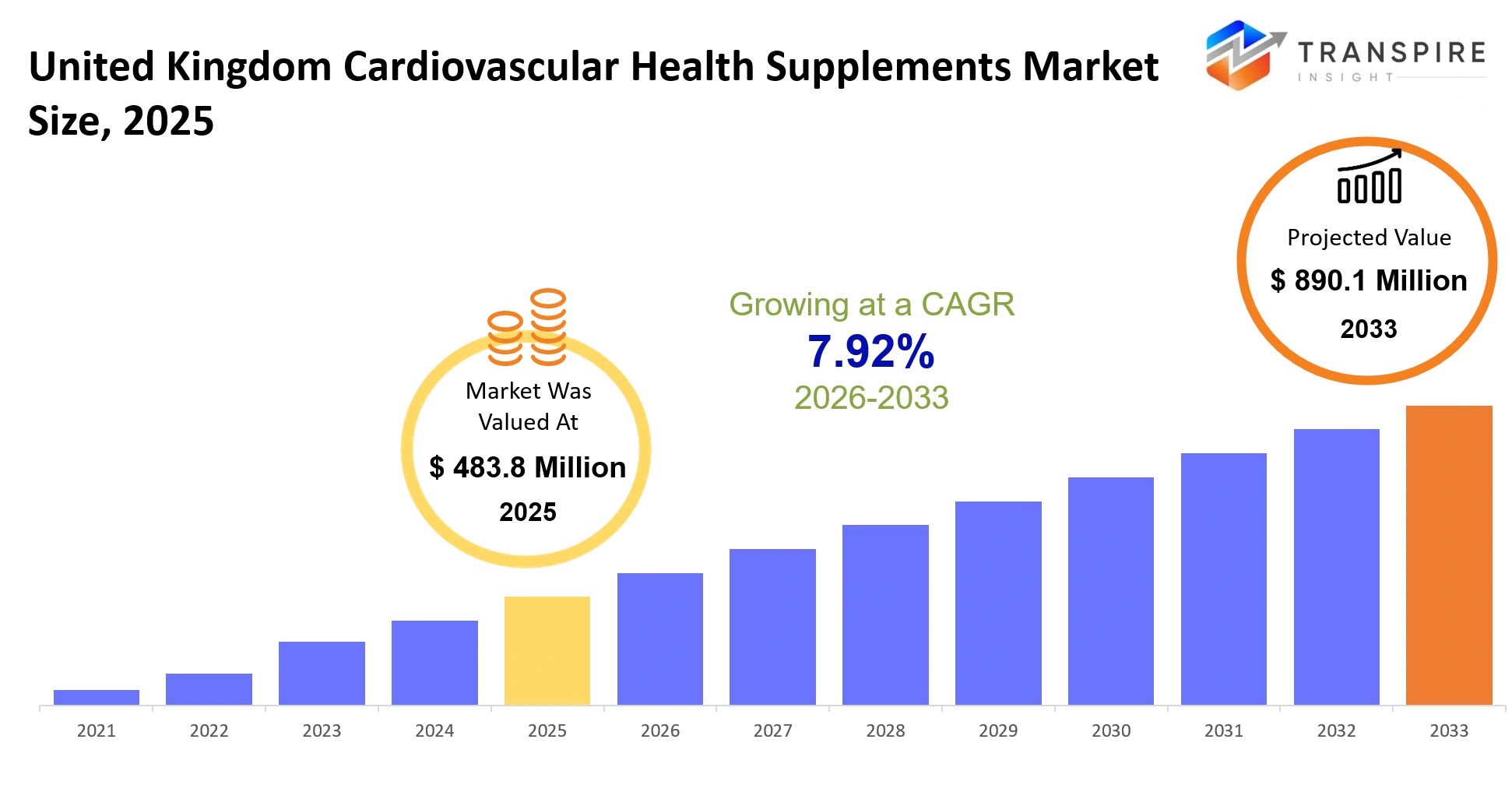
As per Transpire Insight Analysis the United Kingdom Cardiovascular Health Supplements Market size is estimated at USD 483.8 Million in 2025 and is anticipated to reach USD 890.1 Million by 2033, growing at a CAGR of 7.92% from 2026 to 2033.
In the United Kingdom, the Cardiovascular Health Supplements Market is basically there for people who want to stay on top of their heart wellbeing, with daily nutritional products, even when they're mostly just trying to keep a balanced diet and follow preventive healthcare plans, sometimes with medical advice in the background. You will notice these items are commonly used to help keep cholesterol, blood pressure, and circulation in a healthy lane, while also supporting the wider cardiovascular performance, so for many it feels like a kinda accessible choice for long-term wellness that doesn't require being in a clinic setting all the time.
Over the past three to five years, the whole market has been drifting more toward formulations that are backed by evidence, with ingredients that have been clinically studied, so the vibe is less guesswork and more proof. At the same time, buyers and regulators seem to want higher product quality , plus clearer and more transparent labeling. This shift got a stronger push after the COVID-19 pandemic, because a lot of people started thinking about preventive health more seriously and also about building resilient personal healthcare habits they could actually stick to. But now, since consumers increasingly care about measurable health outcomes, manufacturers put in more effort into research, better premium ingredient sourcing, and digital health collaborations. Together these moves improve product trust, they widen both retail and online distribution reach, and somehow make it easier for higher value products to be adopted. That combination also creates a steadier revenue runway across the United Kingdom.
United Kingdom Cardiovascular Health Supplements Market Size & Forecast:
- United Kingdom Cardiovascular Health Supplements Market Size 2025: USD 483.8 Million
- Expected Market Value 2033: USD 890.1 Million
- Forecast CAGR: 7.92%
- Leading region in 2025: England
- Fastest Growing region: Scotland
- Key Profile: Nature's Bounty, NOW Foods, Herbalife, GSK, Bayer, Nestlé Health Science, Blackmores, Swisse, Vitabiotics, Holland & Barrett, Solgar, Amway, Nordic Naturals, Nature Made, Garden of Life.
Key Market Insights
- In 2025, England kind of dominated the market with about 82% market share, backed by thick retail networks, higher health care spending, and broader uptake of preventive nutrition in everyday use. It’s like the numbers reflect that push, even if it sounds a bit basic.
- Scotland is expected to be the fastest growing regional market from 2026–2032, mainly because of healthy ageing initiatives and the steady expansion of specialist nutrition retail channels, which is not surprising really.
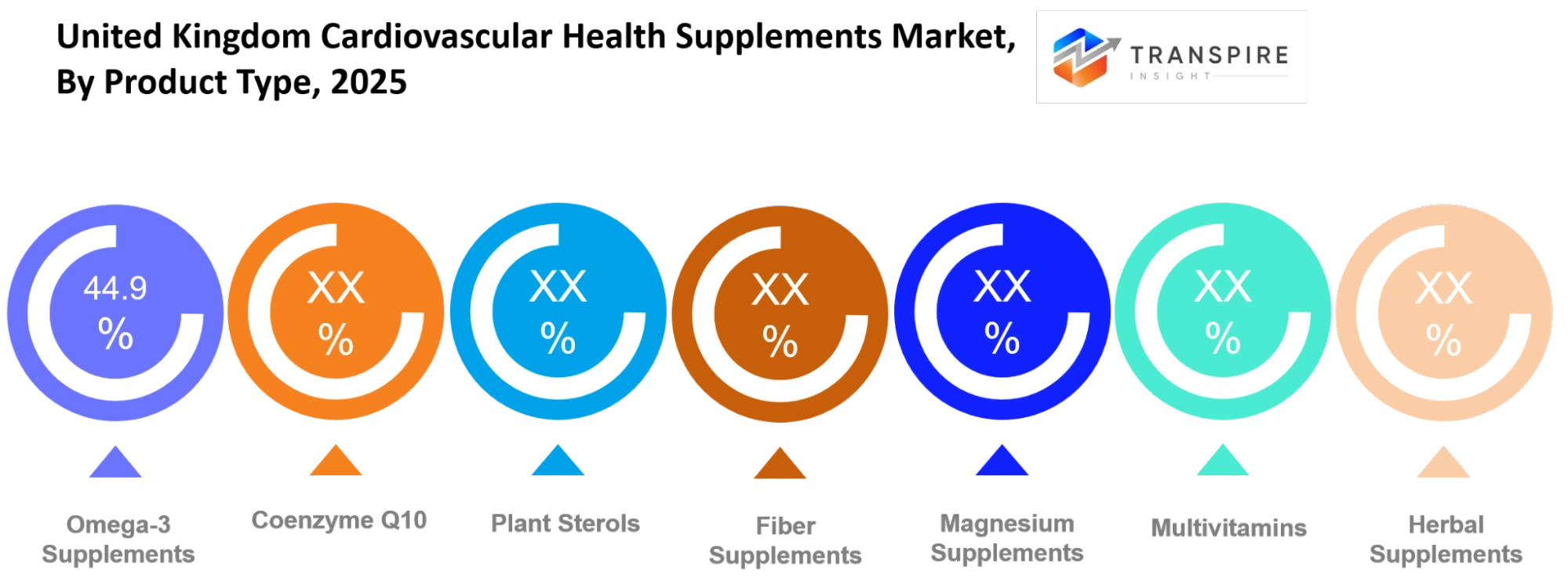
- For the product side, Omega-3 supplements lead the segment, holding nearly 38% market share in 2025. That happens due to solid clinical backing , plus ongoing premium product innovation that keeps improving.
- Coenzyme Q10 supplements will mostly stay in the second-biggest position, while manufacturers keep pushing new high absorption variants meant for older consumers and cardiovascular wellness routines, kind of like a steady trend.
- On the other hand, Plant sterol supplements are expected to move up the quickest in the market, becoming the fastest-growth product category somewhere between 2026 and 2032.
- The tailwinds are cholesterol management recommendations , together with the general functional nutrition trend that everyone seems to be following.
- Looking at application, cholesterol management still takes the lead with around 44% market share in 2025. This reflects preventive healthcare priorities and nutritional interventions that physicians actively support.
- Blood pressure management is likely to grow the fastest across the forecast period, as personalized wellness strategies get more widely adopted , especially when people start treating prevention as a long term habit.
- As for end users, adults aged 45 years and above remain the main group, holding roughly 61% market share. This is supported by routine preventive supplement consumption, pretty consistent across time.
- Meanwhile, younger health conscious adults are the fastest-growing end-user category, since wearable health monitoring encourages earlier cardiovascular wellness management, even before symptoms show up.
What are the Key Drivers, Restraints, and Opportunities in the United Kingdom Cardiovascular Health Supplements Market?
The main growth driver i s the move toward preventive cardiovascular care backed by evidence-based nutrition, and yeah it kinda shifts when people think about it. Updated clinical research, pharmacy guidance, and routine cholesterol monitoring have made consumers more willing to start supplements sooner, not only after advanced heart issues show up. Digital health platforms, along with home diagnostic services, also push the pattern along because they hand people measurable wellness indicators. Premium formulations—using clinically studied ingredients—tend to be priced higher, and that helps manufacturer margins too. Retailers further increase their shelf presence for heart-health items, since repeat buying is stronger there than in many general wellness categories. All of this together supports wider adoption and continuing revenue expansion across the market.
The biggest structural restraint is basically proving health claims under very strict regulatory rules, while still trying to keep product differentiation clear. Clinical validation means long research timelines plus major compliance expenses, and smaller manufacturers often can’t absorb that fast enough. From the Transpire Insight review of regional procurement announcements and launch timing, supply chain concentration is still the most practical execution risk. If a company depends on imported marine oils, botanical extracts and specialty ingredients, then procurement delays and cost swings become more likely. Those pressures can slow down premium product launches, and in turn, they can mute potential revenue even when consumer demand looks supportive.
There’s a real opportunity that’s kinda obvious, in personalized nutrition backed up by biomarker testing, digital health platforms and AI assisted supplement suggestions. If you put money into precision wellness technologies , manufacturers can build much more tailored formulas that connect to cholesterol profiles , blood pressure signals, and the whole metabolic health picture. On top of that, subscription based nutrition services help keep customers around longer while making that recurring revenue stream. The firms that bring together clinically validated products with digital monitoring systems, are likely to end up in a strong spot for the next phase of market growth, even if the trail is a bit winding.
What Has the Impact of Artificial Intelligence Been on the United Kingdom Cardiovascular Health Supplements Market?
Artificial intelligence and digital tech are, in a way , reshaping the cardiovascular supplements market, mainly by helping with product design, making manufacturing more efficient, and also strengthening consumer interaction. More and more manufacturers are turning to AI driven quality control setups that can track ingredient uniformity, flag small production drifts, and even handle compliance paperwork automation across multiple factories. On the digital side, platforms sort through regulatory reporting faster and they can speed up formulation validation too, because they process big bodies of nutritional research data. Machine learning models also support forecasting , they estimate regional buying tendencies, adjust inventory placement, and try to see seasonal demand changes ahead across pharmacy, retail, and e-commerce. Because of this kind of prediction, companies are better at avoiding stockouts, while also cutting down the cost of too much inventory and improving how quickly the supply network can react.
Some firms are also leaning on AI powered recommendation tools to personalize supplement choices, using health questionnaires, wearable summaries, and purchasing routines. That tends to lift retention and drive repeat buys. Operational outcomes improve as well, since production timing gets better, ingredient wastage goes down, and procurement planning becomes more accurate. Still, adoption is not fully everywhere, because connecting these systems can be expensive, and health datasets are often fragmented. Many manufacturers also don’t have standardized consumer health records that are needed to train highly precise predictive models, so AI results in personalized nutrition stay limited, even though the long term commercial upside is pretty sizable.
Key Market Trends
- Since 2023, the clinically supported formulations have kinda taken over from generic products, as manufacturers compete more and more using validated ingredients and , very transparent scientific evidence.
- From 2024–2026, personalized nutrition platforms grew fast, mixing biomarker testing with tailored cardiovascular supplement suggestions, like it’s all becoming more “precision” somehow.
- After 2024, direct-to-consumer subscription models really picked up , which helped repeat buying rates and also made the recurring revenue more solid.
- AI-assisted demand forecasting eased those inventory imbalances across the major supplement manufacturers between 2023 and 2025, so operational efficiency improved too, not just in theory.
- Meanwhile, plant-based omega alternatives saw real commercial expansion after 2024, which also hints at ingredient diversification and supply resilience strategies, at least from what the market signals.
- Haleon moved faster with investment in science backed consumer wellness innovation, to strengthen its premium cardiovascular nutrition positioning.
- Vitabiotics expanded their clinically researched heart health formulations, sort of targeting ageing populations, with more differentiated nutritional solutions, instead of the usual baseline approach, honestly.
- In the UK, during 2025, pharmacy-led preventive health programs were pushing for stronger supplement recommendations, which in a way helped consumers choose more high value cardiovascular nutrition options.
- Also, between 2023 and 2025, premium clean-label products, with traceable ingredients, picked up a lot of retail shelf space , so it seems like quality expectations are getting tighter, and pretty quickly too.
United Kingdom Cardiovascular Health Supplements Market Segmentation
By Product Type :
Omega-3 supplements keep a kind of leading role, mostly because solid clinical proof backs cardiovascular wellness and cholesterol management, even when people are skeptical at first. Coenzyme Q10 is still getting more traction, since many consumers look for nutritional support that helps energy production and heart performance too. Plant sterols draw attention for lowering cholesterol, while fiber supplements kind of team up with digestive wellness and cardiovascular benefits at the same time. Magnesium supplements also keep steady demand because a balanced mineral intake supports muscle function and heart function, not just one or the other.
Multivitamins stay a go-to daily wellness choice, offering broad nutritional support in a simple routine. Herbal supplements keep pulling in buyers who want plant based cardiovascular solutions, with traditional ingredients that feel familiar. Other specialty products broaden the lineup by offering focused pairings and blends, backed by scientific studies. Going forward, product innovation, cleaner labels, and premium formulations should help brands compete across every segment, and honestly, that competition seems to be heating up.
By Form :
Capsules are still the go-to format, mostly because convenient dosing, longer shelf life, and ingredient stability really do help with everyday use, I mean people can just stick with it. Tablets also keep a solid hold on the market since they tend to be more affordable and they’re widely available across pharmacies as well as retail stores. Softgels stay pretty popular for omega-3 products, because better absorption and easier swallowing kind of make it the obvious choice for a lot of customers. Gummies keep growing too, especially with younger consumers who want convenient daily nutrition, it feels more casual or something.
Powders and liquid formulations fit people who need more flexible dosing or faster absorption, so that’s a different kind of appeal. Effervescent tablets are catching attention from buyers who want a convenient way to consume supplements without having to swallow solid tablets, which is honestly a nice barrier remover. Other delivery formats start showing up in the market with targeted solutions, aimed at premium and personalized nutrition. Manufacturers keep pushing improvements in taste, convenience, and bioavailability, so they can stand out from the crowd and not just be another label on a shelf.
By Distribution Channel :
Pharmacies still seem like the main distribution route, mostly because trusted healthcare guidance really helps people decide what to buy for cardiovascular nutrition products, and that matters. Online retail keeps showing big momentum too, with wider product availability, subscription services, and pricing that is often more competitive than before. Supermarkets and hypermarkets stay pretty steady in sales, they just give convenient access to well known supplement brands. Health stores pull in shoppers who want premium formulations, plus some specialist nutritional advice, kind of the whole package.
Direct selling also plays a part , it supports customer engagement via more personalized product recommendations and these longer term purchasing relationships. Specialty stores keep bringing in science backed nutritional products that are aimed at particular cardiovascular needs, so it feels more focused. Hospital pharmacies hold an important place as well, especially for post treatment nutritional support with professional oversight. Other retail channels are growing too, as digital commerce and omnichannel strategies keep making product access easier and smoother for everyone.
By End User :
Adults make up the biggest chunk of the customer base, mostly because preventive wellness and everyday nutritional support are still top things people want to buy. The elderly consumers keep pulling in a lot of revenue too, via longer-term cardiovascular health management, it’s pretty steady. Athletes too are leaning into heart-support supplements more and more, once endurance training and recovery programs start getting more structured , then it kinda follows. Cardiac patients also pick up clinically supported products, usually alongside medically supervised care plans so nothing feels disconnected.
Women and men alike still go for targeted formulations, made for age-related nutritional requirements as well as lifestyle goals. Preventive healthcare shoppers are one of the fastest growing groups, since routine health monitoring pushes earlier nutritional intervention, and that matters. The other customer groups add extra demand through specialized wellness programs and personalized nutrition plans. And product education, plus healthcare professional recommendations will keep helping the category expand over the long term.
By Application :
Heart health is still the main use case, because long-term wellness plans really push for regular supplement use, kinda steadily. Cholesterol management is also holding a big portion, since clinically studied ingredients help keep lipid levels in a healthy range. Blood pressure support products are getting broader acceptance too, mostly due to targeted formulations that are backed by nutritional research. Circulation support applications keep growing as ingredients are created with the goal to help vascular function
For antioxidant support, demand stays pretty stable, mostly because managing oxidative stress is still one of those key wellness targets. Preventive nutrition keeps boosting market value by encouraging consistent supplementation before advanced cardiovascular conditions even show up. Post-cardiac care products help with nutritional recovery, but they are used under healthcare guidance after medical treatment has happened. Other applications keep opening new doors through specialized formulations that tackle multiple cardiovascular wellness needs, all in one product
What are the Key Use Cases Driving the United Kingdom Cardiovascular Health Supplements Market?
The biggest use case kind of revolves around cholesterol management, through daily cardiovascular nutrition. Adults, older consumers, and people using preventive healthcare buy clinically supported supplements to match a healthier lifestyle and ongoing medical guidance. Health screening programs that run regularly, plus pharmacy suggestions, and employer wellness initiatives help keep purchasing steady across the United Kingdom.
Support for blood pressure ,and circulation is also widening across several end user groups. Cardiac rehabilitation programs are increasingly mixing nutritional supplementation into standard treatment plans, like it’s just part of the routine now. Meanwhile sports nutrition retailers push certain cardiovascular products for endurance focused athletes. Online health platforms add to the trend too, encouraging people to choose the right supplements via digital assessments and educational material, which sounds simple but really drives demand.
New chances are showing up around personalized nutrition tied to biomarker testing and wearable health technology. Healthcare providers, along with digital wellness companies, are starting to connect cardiovascular supplements with personal health data ,then turning it into more tailored wellness programs. And because regulations keep leaning toward evidence backed formulations, these targeted ideas should end up with better commercial pull during the forecast period.
|
Report Metrics |
Details |
|
Market size value in 2025 |
USD 483.8 Million |
|
Market size value in 2026 |
USD 522.1 Million |
|
Revenue forecast in 2033 |
USD 890.1 Million |
|
Growth rate |
CAGR of 7.92% from 2026 to 2033 |
|
Base year |
2025 |
|
Historical data |
2021 - 2024 |
|
Forecast period |
2026 - 2033 |
|
Report coverage |
Revenue forecast, competitive landscape, growth factors, and trends |
|
Regional scope |
United Kingdom (England, Scotland, Wales, Northern Ireland) |
|
Key company profiled |
Nature's Bounty, NOW Foods, Herbalife, GSK, Bayer, Nestlé Health Science, Blackmores, Swisse, Vitabiotics, Holland & Barrett, Solgar, Amway, Nordic Naturals, Nature Made, Garden of Life. |
|
Customization scope |
Free report customization (country, regional & segment scope). Avail customized purchase options to meet your exact research needs. |
|
Report Segmentation |
By Product Type (Omega-3 Supplements, Coenzyme Q10, Plant Sterols, Fiber Supplements, Magnesium Supplements, Multivitamins, Herbal Supplements, Others); By Form (Capsules, Tablets, Softgels, Gummies, Powders, Liquids, Effervescent Tablets, Others); By Distribution Channel (Pharmacies, Online Retail, Supermarkets & Hypermarkets, Health Stores, Direct Selling, Specialty Stores, Hospital Pharmacies, Others); By End User (Adults, Elderly Consumers, Athletes, Cardiac Patients, Women, Men, Preventive Healthcare Consumers, Others); By Application (Heart Health, Cholesterol Management, Blood Pressure Support, Circulation Support, Antioxidant Support, Preventive Nutrition, Post-Cardiac Care, Others). |
Which Regions are Driving the United Kingdom Cardiovascular Health Supplements Market Growth?
The South East of England makes up roughly 35% of the total market revenue, so yeah it feels like the main regional driver. There is strong healthcare infrastructure , lots of broad pharmacy networks, and pretty steady compliance with United Kingdom food supplement rules, which supports ongoing product availability and keeps consumer trust from slipping. Plus you’ve got global nutrition brands, contract manufacturers, research organizations, and advanced distribution facilities working together in a sort of streamlined commercial ecosystem. That combo supports product development, and it also helps keep supply steady across the country. Going forward, further investment in preventive healthcare programs, premium retail formats, and digital commerce should help keep that leadership position for most of the forecast horizon .
Meanwhile, the North West of England delivers a stable contribution, mostly because the region balances manufacturing capability, healthcare services, and well known retail distribution channels. Regional economic resilience and predictable regulatory compliance make investors more comfortable looking at long term plans for nutritional products, instead of chasing short term volume growth. The ties between manufacturers, pharmacies, healthcare providers, and major retail chains also stay strong, which results in dependable buying patterns across several consumer groups. In other words, that structural steadiness helps revenue stay consistent even when consumer preferences shift and broader economic conditions wobble a bit.
Scotland is set to see the fastest growth sometime during the 2026–2033 window , mainly because there’s been more investment into preventive healthcare initiatives and, honestly, better access to digital health services as well. In the same direction, online nutrition platforms keep expanding and the backing for healthy ageing programs has boosted demand for cardiovascular supplements that are supported by clinical evidence. Local healthcare partnerships, plus easier reach to specialist nutritional products, keeps building commercial chances across both urban and rural communities. All of that momentum should set up really attractive conditions for fresh product launches, premium nutrition brands , and technology-driven wellness businesses across the whole forecast period.
Who are the Key Players in the United Kingdom Cardiovascular Health Supplements Market and How Do They Compete?
Competition across the market is still kinda moderately fragmented, where multinational supplement companies rub shoulders with specialist nutrition brands as well as pharmacy-focused businesses. In the end, product quality, clinical evidence, ingredient transparency, and distribution reach become more meaningful competitive advantages than price alone. Established brands keep defending their slice of the pie using research-backed formulations , though some smaller specialists lean into more targeted nutrition and premium ingredients, instead of trying to cover everything with broad product portfolios .
Haleon seems to strengthen its market position by expanding science-backed consumer health products, backed by extensive pharmacy relationships and that well known healthcare branding. Vitabiotics concentrates on clinically researched formulations and ongoing product development, and that’s where the differentiation comes from : evidence-based nutrition aimed at specific health outcomes. Holland & Barrett pushes forward with premium cardiovascular supplement ranges, while it also blends physical retail locations with digital commerce and personalized wellness services .
BioCare is basically about nutritional products that practitioners actually suggest, built on high quality ingredients and rather specialist formulations that seem to fit the preferences of healthcare professionals. Solgar then shows up with a different vibe, more like premium ingredient sourcing, clean label style formulations, and ongoing investment into product innovation, so it pulls in consumers who want high quality nutritional supplements. Nature’s Bounty instead makes things more available by pushing retail expansion and keeping diversified product lines, which gives stronger visibility across pharmacies, supermarkets, and even online sales channels, and honestly it makes it easier to spot them.
Company List
- Nature's Bounty
- NOW Foods
- Herbalife
- GSK
- Bayer
- Nestlé Health Science
- Blackmores
- Swisse
- Vitabiotics
- Holland & Barrett
- Solgar
- Amway
- Nordic Naturals
- Nature Made
- Garden of Life
Recent Development News
In January 2026, Haleon announced an evolution of its operating model to accelerate growth across its Vitamins, Minerals and Supplements portfolio, including Centrum. The investment is expected to strengthen innovation, improve execution, and support faster commercialization of cardiovascular and preventive nutrition products.
Source: https://www.haleon.com/
In June 2026, Haleon submitted a bid for U.S. dietary supplements manufacturer Thorne, seeking to expand its presence in the nutritional supplements business. The proposed acquisition reflects continued investment in premium supplement portfolios, including products such as omega-3 and magnesium, strengthening long-term competitive positioning.
Source: https://www.reuters.com/
What Strategic Insights Define the Future of the United Kingdom Cardiovascular Health Supplements Market?
The United Kingdom Cardiovascular Health Supplements market is set to trend toward precision nutrition, backed by clinical validation , digital health linkage, and sort of personalized wellness programs, during the next five to seven years. You can see this structural shift coming mostly from the wider use of health data, more strict evidence expectations for nutritional products, and tighter collaboration between healthcare providers and nutrition companies. A less obvious risk is the dependence on imported speciality ingredients like marine oils, plant extracts, where supply concentration and price swings might lower product availability, and then squeeze margins even if overall sales still look healthy. At the same time an opportunity is quietly building through biomarker-based nutrition platforms that fuse diagnostic testing with customized supplement guidance , so the value proposition becomes stronger for preventive care. The firms that start early with clinically validated formulations, resilient sourcing relationships, and integrated digital health ecosystems will likely be in a better spot to win premium customers and keep a steady long-term revenue trajectory.
United Kingdom Cardiovascular Health Supplements Market Report Segmentation
By Product Type
- Omega-3 Supplements
- Coenzyme Q10
- Plant Sterols
- Fiber Supplements
- Magnesium Supplements
- Multivitamins
- Herbal Supplements
By Form
- Capsules
- Tablets
- Softgels
- Gummies
- Powders
- Liquids
- Effervescent Tablets
By Distribution Channel
- Pharmacies
- Online Retail
- Supermarkets & Hypermarkets
- Health Stores
- Direct Selling
- Specialty Stores
- Hospital Pharmacies
By End User
- Adults
- Elderly Consumers
- Athletes
- Cardiac Patients
- Women
- Men
- Preventive Healthcare Consumers
By Application
- Heart Health
- Cholesterol Management
- Blood Pressure Support
- Circulation Support
- Antioxidant Support
- Preventive Nutrition
- Post-Cardiac Care
Frequently Asked Questions
Find quick answers to common questions.
The expected United Kingdom Cardiovascular Health Supplements Market size for the market will be USD 890.1 Million in 2033.
Key segments for the United Kingdom Cardiovascular Health Supplements Market are By Product Type (Omega-3 Supplements, Coenzyme Q10, Plant Sterols, Fiber Supplements, Magnesium Supplements, Multivitamins, Herbal Supplements, Others); By Form (Capsules, Tablets, Softgels, Gummies, Powders, Liquids, Effervescent Tablets, Others); By Distribution Channel (Pharmacies, Online Retail, Supermarkets & Hypermarkets, Health Stores, Direct Selling, Specialty Stores, Hospital Pharmacies, Others); By End User (Adults, Elderly Consumers, Athletes, Cardiac Patients, Women, Men, Preventive Healthcare Consumers, Others); By Application (Heart Health, Cholesterol Management, Blood Pressure Support, Circulation Support, Antioxidant Support, Preventive Nutrition, Post-Cardiac Care, Others).
Major United Kingdom Cardiovascular Health Supplements Market players are Nature's Bounty, NOW Foods, Herbalife, GSK, Bayer, Nestlé Health Science, Blackmores, Swisse, Vitabiotics, Holland & Barrett, Solgar, Amway, Nordic Naturals, Nature Made, Garden of Life.
The United Kingdom Cardiovascular Health Supplements Market size is USD 483.8 Million in 2025.
The United Kingdom Cardiovascular Health Supplements Market CAGR is 7.92% from 2026 to 2033.
- Nature's Bounty
- NOW Foods
- Herbalife
- GSK
- Bayer
- Nestlé Health Science
- Blackmores
- Swisse
- Vitabiotics
- Holland & Barrett
- Solgar
- Amway
- Nordic Naturals
- Nature Made
- Garden of Life
About the Authors

Pankaj Ghogare Patil
I am Pankaj Ghogare Patil, a Senior Research Analyst at Transpire Insight, specializing in the Pharmaceutical, Chemicals & Materials, Healthcare IT, and Biotechnology industry. My expertise lies in conducting comprehensive market research, analyzing industry trends, evaluating competitive landscapes, and translating complex data into actionable insights. At Transpire Insight, I closely follow emerging technologies, regulatory developments, and market innovations to create accurate, well-researched, and informative content that helps businesses and professionals make informed decisions. I am committed to producing credible, evidence-based articles that reflect industry best practices while making technical topics accessible and valuable for a broad audience.

Chakradhar Khansole
Chakradhar serves as the Research Director at Transpire Insight, bringing over 8 years of experience in technology, innovation, and strategic market intelligence. He specializes in transforming complex market data into actionable business insights that enable organizations to make informed, growth-oriented decisions. Recognized for his strategic vision and analytical expertise, Chakradhar leads high-impact research initiatives, delivering comprehensive market assessments, competitive intelligence, and forward-looking industry analysis.
Recently Published Reports
-
Jul 2026
Alopecia Treatment Market
Alopecia Treatment Market Size, Share & Analysis Report By Disease Type (Alopecia Areata, Cicatricial Alopecia, Traction Alopecia, Alopecia Totalis, Androgenetic Alopecia, Alopecia Universalis, and Other Disease Types), By Treatment Type (Topical Treatments, Oral Medications, Injectable Therapies, and Hair Transplantation), By Gender (Male, and Female), By Distribution Channel (Hospitals and Clinics, Retail Pharmacies, and Online Retailers), and Geography (North America, Europe, Asia-Pacific, Middle East and Africa, South and Central America), 2021 - 2031
-
Jul 2026
Medical Ultrasound Probe Market
Medical Ultrasound Probe Market Size, Share & Analysis Report By Type (Linear Type, Convex Type, Endocavitary Probe, Phased Array/Cardiac Probe, Transesophageal (TEE) Probe, and Others), By Application (Ophthalmology, Cardiology, Musculoskeletal, Oncology, Obstetrics & Gynecology, General Imaging, and Others), By End User (Hospitals & Clinics, Diagnostic Centers, Ambulatory Surgical Centers, and Others), and Geography (North America, Europe, Asia-Pacific, Middle East and Africa, South and Central America), 2021 – 2031
-
May 2026
Biosimilars Market
Biosimilars Market By Product Type (Monoclonal Antibodies, Recombinant Hormones, Erythropoietin, G-CSF, Others), By Indication (Oncology, Autoimmune Diseases, Blood Disorders, Diabetes, Others), By Manufacturing Type (In-House Manufacturing, Contract Manufacturing), By Distribution Channel (Hospital Pharmacies, Retail Pharmacies, Online Pharmacies), By Industry Analysis, Size, Share, Growth, Trends, and Forecasts 2021-2033
-
Apr 2026
Gastrointestinal Endoscopy Market
Gastrointestinal Endoscopy Market By Type (Rigid Gastrointestinal Endoscope, Flexible Gastrointestinal Endoscopes, Disposable Gastrointestinal Endoscope), By Procedure Type (Colonoscopy, Gastroscopy, Duodenoscopy, Enteroscopy, Flexible Sigmoidoscopy, Others), By Application (Diagnosis, Treatment), By End-Users (Hospitals, Ambulatory Surgical Centers, Specialty Clinics, Laboratories, Others), By Industry Analysis, Size, Share, Growth, Trends, and Forecasts 2021-2033