

United Kingdom Car Wash Services Market Summary
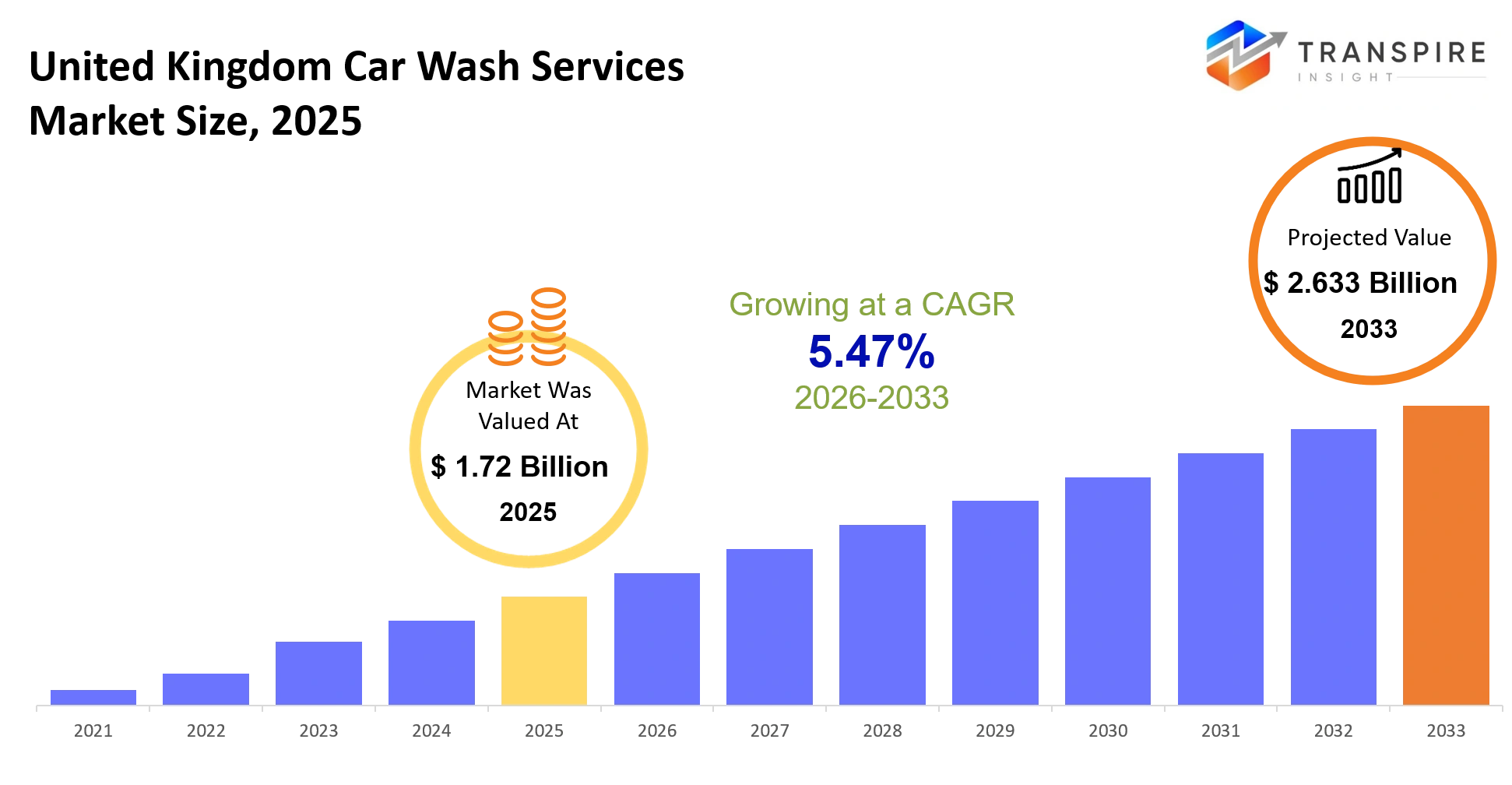
As per Transpire Insight Analysis the United Kingdom Car Wash Services Market size is estimated at USD 1.72 Billion in 2025 and is anticipated to reach USD 2.633 Billion by 2033, growing at a CAGR of 5.47% from 2026 to 2033.
The United Kingdom car wash services market kinda supports vehicle owners too, along with fleet operators, rental companies, and commercial transport businesses, by keeping vehicles clean, helping protect the exterior finish, and in general preserving the asset value . In the real world, professional car wash facilities also let companies keep their brand presentation standards, while cutting down the time , labor, and water use you’d normally deal with during manual washing . As vehicle ownership habits have changed and fleet utilization has gotten more intense, many providers have moved past just basic washing and started offering things like detailing , protective coating , and even subscription-like maintenance packages.
In the last three to five years, the whole space has leaned more toward automated setups, water-efficient operations, and digitally connected service models. This shift is backed by cashless payments, plus app based customer engagement, which makes the experience feel more smooth. Meanwhile, stricter environmental expectations around water usage, and wastewater management, have pushed operators to put money into recycling systems and compliant infrastructure. Then COVID-19 happened, and it sort of accelerated the demand for contactless transactions, along with more convenient service formats, so automated facilities and digital booking platforms got adopted faster. Overall these changes have boosted operational efficiency , improved customer retention, and helped service providers earn stronger recurring revenue , especially via premium add-ons and membership style programs .
United Kingdom Car Wash Services Market Size & Forecast:
- United Kingdom Car Wash Services Market Size 2025: USD 1.72 Billion
- Expected Market Value 2033: USD 2.633 Billion
- Forecast CAGR: 5.47%
- Leading region in 2025: England
- Fastest Growing region: Scotland
- Key Profile: IMO Car Wash, Waves Car Wash, Wilcomatic, Kärcher, WashTec, Ryko Solutions, Magic Hand Car Wash, Dropless, Wash Doctors, Aqua Clean, BP Car Wash, Shell Car Wash, Morrisons Car Wash, Asda Car Wash, Car Spa
Key Market Insights
- In 2025 England pretty much dominated the market, with an estimated 68% market share , helped along by dense vehicle ownership, commercial fleets, and those really extensive professional wash networks that seem to be everywhere.
- Scotland, though, is projected to be the fastest-growing regional market during 2025–2033 , mainly because of investments in automated facilities and the ongoing rise in premium vehicle ownership, so you get that whole “upgrade” effect.
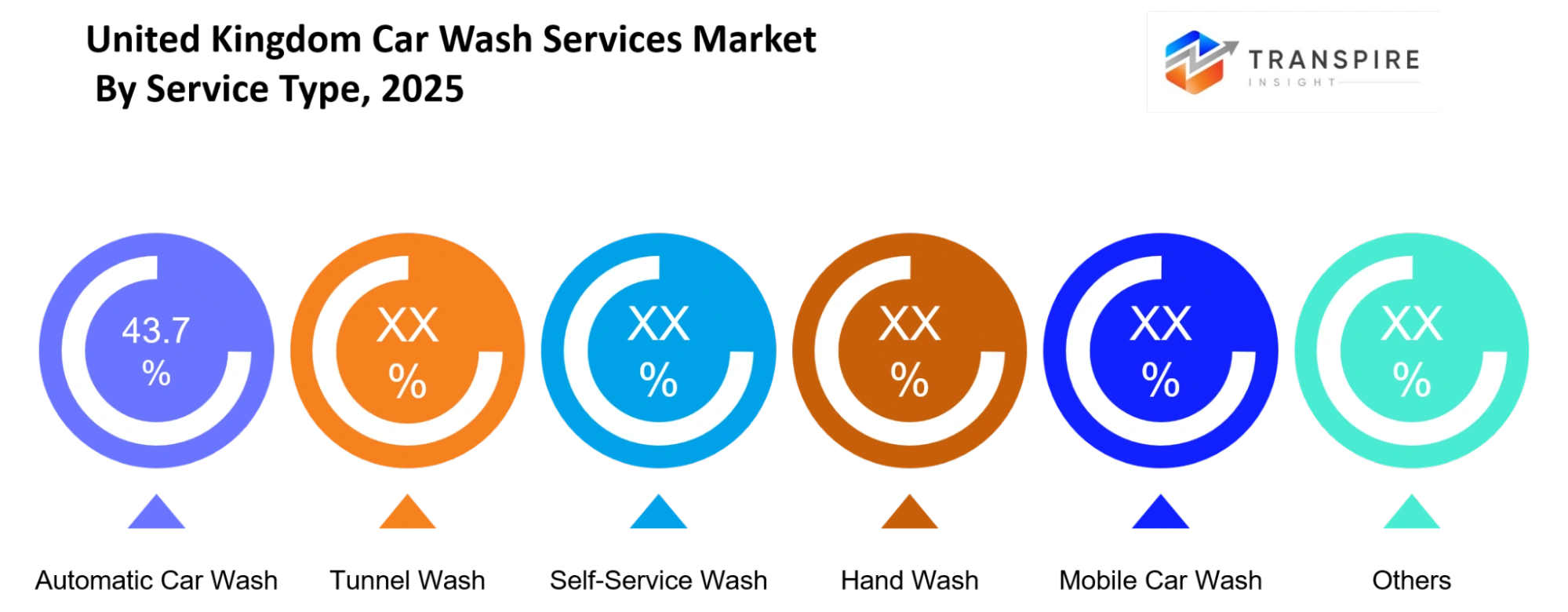
- When it comes to wash types, automatic and conveyor car wash services led the service segment, holding about 46% market share in 2025. Operators were basically choosing high throughput locations and steady, reliable service quality, even when demand shifts a bit.
- Exterior wash and basic cleaning stayed the second biggest service category, as value focused consumers kept picking lower priced maintenance packages across many urban areas.
- Premium detailing and ceramic coating services are expected to see the fastest growth through 2033, backed by higher value vehicle ownership and subscription style maintenance programs that people can stick with.
- Passenger vehicles made up nearly 74% of total applications in 2025, which ties back to the country’s large privately owned vehicle fleet and the repeat visits that happen more often than not.
- Commercial fleet washing is forecast to grow at the quickest pace through 2033, as logistics operators take up scheduled cleaning contracts , along with digital fleet management tools to keep things organized.
- For end users, individual vehicle owners represented roughly 67% of end user revenue in 2025, because routine maintenance plus convenience stayed the main purchase drivers.
- Meanwhile fleet operators are expected to become the fastest-growing end user group through 2033. Contract based washing improves vehicle availability and brand presentation , so it’s kind of a win win.
What are the Key Drivers, Restraints, and Opportunities in the United Kingdom Car Wash Services Market?
Digital payment uptake and tighter environmental compliance rules are still probably the biggest pushes behind market expansion, even if it feels a bit slow at times. Water recycling norms and wastewater management expectations have basically forced many operators to swap out ageing equipment for more automated, self managed systems, so yeah. Fleet operators too tend to favor contract based cleaning agreements, because a more predictable maintenance rhythm cuts down vehicle downtime. Subscription style programs then help keep customers longer and support steadier recurring revenue. Together these things nudge up average spending per customer, while also boosting operating efficiency at professional washing sites.
Now the biggest structural restraint is the really high capital need for modern automated setups and the kind of water recycling infrastructure that actually meets compliance. Smaller standalone operators often end up postponing upgrades, not because they don’t care, but because financing costs stay elevated. And don’t forget site availability, especially in urban areas, it limits network expansion in practice. From a Transpire Insight look at regional procurement announcements and launch timing, supply chain concentration seems to be the main execution risk. When deliveries slip, equipment shows up late, projects run longer, near term revenue growth gets muted, and new service launches are postponed across multiple regional markets, which is not great for momentum.
The most solid, long-range opening seems to be in those connected automated service platforms, mixing artificial intelligence with predictive maintenance together with fleet management software, kind of end to end. Commercial transport businesses are more and more asking for centralized agreements that cover several locations at once, not piecemeal. Also, electric vehicle ownership drives a different kind of need, people want premium detailing and paint protection services, rather than going straight to mechanical repairs. In Scotland and a handful of other smaller urban centres, there are credible expansion chances since professional wash penetration is still sitting under the levels seen in the big metro markets, so there is room for fresh investment and franchise growth.
What Has the Impact of Artificial Intelligence Been on the United Kingdom Car Wash Services Market?
Artificial intelligence along with digital technologies are, kind of slowly, reshaping professional vehicle cleaning workflows by boosting automation, better equipment monitoring , and more direct customer engagement. In a lot of modern wash sites, AI-enabled control setups are being used more and more to tune water usage, manage chemicals dosing, handle the queue flow, and even decide the wash cycle kind based on vehicle dimensions and how dirty, basically, the vehicle looks in the first place. Digital inspection cameras can automatically capture vehicle profiles and then nudge the team toward the right wash programs, which cuts down on manual involvement, but also tends to make service more steady or consistent.
Machine learning is also useful for predictive maintenance, because it studies equipment vibration signals, motor behaviour, pump pressure trends, and overall operating hours before a failure actually shows up. This means operators can plan service during quieter windows, not when everything is busy, so fewer surprises happen and the downtime stays lower, while equipment life usually gets extended. In parallel, AI-supported forecasting instruments look at weather trajectories, seasonal traffic rhythms, fleet contracts, and prior customer visit patterns to refine staffing plans and inventory routines. Put together, these tools push higher asset utilization , improve throughput, and bring down operational costs, while the customers often feel it via shorter waiting times and faster turnarounds.
Still, the roll-out isn’t equally smooth everywhere. In many places the implementation pace is uneven, mainly due to high integration expenses, trouble aligning with older or legacy equipment, and a lack of useful operational data coming from smaller independent facilities. Also, a lot of operators tend to need improved connectivity and refreshed digital infrastructure before more advanced AI platforms can deliver reliable operational benefits across multiple sites, not just one location.
Key Market Trends
- Automated conveyor systems kinda replaced the manual processes across more places between 2021 and 2025, which improved throughput , while also lowering how much labour they depend on.
- Water recycling installations really picked up after tighter environmental compliance expectations started showing up, so operators could cut freshwater usage by as much as 80% at modern facilities, essentially.
- Digital memberships plus app based payment platforms expanded quite a lot after 2020, and that helped build steadier recurring revenue , along with better customer retention overall.
- Premium detailing, ceramic coatings, and paint protection packages gained a bigger share between 2022 and 2025, mainly as higher value vehicle ownership kept rising.
- Fleet management contracts increased too, because logistics companies outsourced scheduled vehicle cleaning to boost fleet availability and also keep up corporate branding.
- Equipment manufacturers like WashTec and Kärcher increased their investment in intelligent, energy efficient wash technologies with lower operating costs, which sounds simple but matters.
- Cashless transactions became the standard across many professional facilities by 2025, shrinking transaction time and supporting fully automated service workflows without as many manual steps.
- AI supported predictive maintenance tools started replacing calendar based servicing, this improved equipment availability , and it reduced those unexpected maintenance interruptions.
- Franchise operators moved into secondary cities between 2023 and 2025, which strengthened regional coverage beyond the usual metropolitan markets.
- Sustainability reporting has turned into a stronger competitive differentiator, as commercial customers increasingly look at water efficiency and environmental compliance when they pick suppliers.
United Kingdom Car Wash Services Market Segmentation
By Service Type :
Automatic car wash services take up a big portion, mostly because they move quickly, keep cleaning quality steady and also they need less human labor than before. For this reason you end up seeing high daily vehicle volumes without much hassle. Tunnel wash facilities keep getting built along busy urban corridors, where the whole quick turnaround part is basically non negotiable for customer satisfaction. Meanwhile hand wash services stay in a stable spot by targeting premium vehicles and people who want a more detailed exterior plus interior cleaning, kind of like a careful touch.
Self-service locations also draw in a lot of cost-conscious drivers since they offer flexible washing options , right at convenient spots. On top of that mobile car wash services keep growing as customers find them through online booking platforms and then set flexible schedules for residential as well as commercial needs. Premium detailing, ceramic coatings, and paint protection packages bring extra revenue streams for operators focused on luxury vehicles. Other specialized options, such as waterless cleaning and eco-friendly washing, help broaden the service list too, while matching changing customer preferences more closely.
By Payment Type :
Digital payment methods have, basically, turned into the main choice for transactions with contactless cards, mobile wallets, and QR code payments. They kind of simplify the customer experience and make it feel smoother overall. With faster payment processing there’s less waiting time which helps operational efficiency, especially across high traffic areas or locations. Subscription plans keep on expanding too, because monthly packages make people come back more often and operators get steadier revenue. Cash payments are still around in many facilities, more so at independent service spots where people expect it.
These subscription models help build customer loyalty with unlimited wash plans and premium maintenance packages, not just one thing but a bundle idea. At the same time business fleets can benefit from centralized digital billing and automated payment records that make expense management easier, like way easier. Other options, like prepaid vouchers and corporate accounts, also support commercial customers with tailored billing arrangements. Overall, payment modernization boosts convenience for customers while it also improves how service providers manage finances.
By Vehicle Type :
Passenger cars are still the biggest chunk of the vehicle segment, mostly because routine washing kinda keeps the whole look intact, and that also helps resale value plus paint quality, you know. When more people own private cars it keeps demand steady in both city areas and out in the suburbs. Premium vehicle owners usually go for detailing and protective coating services more often, and that’s what pushes the average order amount higher. With service options that are easy to reach, customers tend to come back again and again, all year long, and it makes things feel more continuous.
Light commercial vehicles also hold up demand, because delivery fleets really need regular cleaning to keep professional branding visible and to meet day to day operational expectations. Heavy commercial vehicles are leaning more toward scheduled washing contracts, which helps their fleet presentation and supports regulatory compliance in a more straightforward way. Meanwhile, other kinds of vehicles, like specialty units and recreational vehicles, add more work for operators who have bigger washing facilities and enough capacity. Basically, covering a wider range of vehicles creates stronger revenue chances across several types of customers, and that spread matters.
By Location :
Standalone facilities really do win out because the bigger operating area lets you put in advanced gear, set up multiple wash bays, and offer those extra premium detailing services, basically more than just the quick rinse. There’s also strong visibility, and it’s easy for vehicles to get in and out, which helps keep customer traffic steady through the week, even when the schedule feels irregular. Fuel station sites are still a big deal too, since the washing services pair naturally with refueling, and the whole thing feels more convenient for customers in one stop, less time, more smooth.
Shopping mall setups keep pulling in visitors who are looking for a mixed experience—retail together with vehicle maintenance—so it’s like, you get something done and you browse right after, without too much hassle. As for the other places, like parking complexes and commercial centers they open up extra business chances especially in densely populated zones. Picking the right location stays crucial because accessibility affects how often people come by and how well the operation performs, period. Investment keeps leaning toward spots with strong traffic flow and solid infrastructure, not just a decent frontage. And this location diversity basically lets operators serve residential, business, and transit-based customers all in a more efficient way, rather than relying on one kind of crowd.
By End User :
Individual customers take the biggest portion, largely because routine vehicle upkeep keeps the looks in good shape and also helps preserve long-term value. Membership programs and those seasonal promotions nudge people back for more visits, which supports steady business results, almost like clockwork. Premium cleaning packages pull in owners who want a more refined finish and protective treatments that actually hold up. In the end, day to day convenience is still a major deciding factor in most city markets.
Commercial fleet operators are the fastest-growing group, since scheduled washing supports corporate visibility and keeps vehicles ready for use. Logistics companies, rental providers, and other service fleets are leaning more and more toward long-term cleaning contracts, so maintenance planning stays simpler. Then there are other end users, like government organizations and institutional vehicle operators, they add more demand through periodic service agreements. Overall, the wider commercial uptake makes recurring revenue prospects stronger.
By Mode :
Offline services keep leading the market, since fixed facilities supply automated tools, trained personnel, and broad cleaning options, basically everything you need. At the same time, established locations build customer confidence through steady service standards and easy to recognize branding, so people know what to expect. Digital booking systems are also stepping in more often alongside the usual process, because they cut down on waiting time and help customers plan their schedules a bit better. When tech is integrated well, it boosts day to day efficiency without fully swapping out the physical service hubs.
Meanwhile, on-demand app based services are growing because customers want a more convenient arrangement, plus mobile payments, and yes, vehicle cleaning right at the doorstep. These digital platforms make it easier to choose time slots flexibly while operators can handle workforce allocation more effectively, not just randomly. Other service channels, such as corporate agreement scheduling and membership access, tend to increase retention through more personal and well matched service offerings. Overall, technology integration will keep lifting service accessibility and business performance across the industry.
What are the Key Use Cases Driving the United Kingdom Car Wash Services Market?
Most of the market action kind of comes from day to day car rinsing, especially for passenger cars, done at professional wash sites. People who own private vehicles end up picking automatic and tunnel wash setups because steady exterior care keeps the paint looking better, protects paint quality, keeps resale more solid , and honestly it also saves time. With high vehicle density in many urban neighborhoods, the service demand stays fairly constant, which in turn keeps recurring income flowing for the operators.
On the commercial side , fleet cleaning is moving forward pretty quickly across logistics, vehicle rental, and corporate transport operations. Fixed washing agreements are becoming a thing, because they help hold onto brand presence while also cutting down the paperwork side, mainly via centralized billing. Mobile car wash companies are also getting more customers from office parks and residential communities, where convenience really nudges people toward purchase.
Fresh opportunities are popping up around premium ceramic coating, paint protection, and water mindful cleaning options made for electric cars and high end vehicles. Wash facilities that have advanced water recycling systems are starting to look like strong partners for organizations that need to meet environmental requirements. These focused offerings should add even more value as premium vehicle ownership grows, and as sustainability expectations continue to develop.
|
Report Metrics |
Details |
|
Market size value in 2025 |
USD 1.72 Billion |
|
Market size value in 2026 |
USD 1.814 Billion |
|
Revenue forecast in 2033 |
USD 2.633 Billion |
|
Growth rate |
CAGR of 5.47% from 2026 to 2033 |
|
Base year |
2025 |
|
Historical data |
2021 - 2024 |
|
Forecast period |
2026 - 2033 |
|
Report coverage |
Revenue forecast, competitive landscape, growth factors, and trends |
|
Regional scope |
United Kingdom (England, Scotland, Wales, Northern Ireland) |
|
Key company profiled |
IMO Car Wash, Waves Car Wash, Wilcomatic, Kärcher, WashTec, Ryko Solutions, Magic Hand Car Wash, Dropless, Wash Doctors, Aqua Clean, BP Car Wash, Shell Car Wash, Morrisons Car Wash, Asda Car Wash, Car Spa . |
|
Customization scope |
Free report customization (country, regional & segment scope). Avail customized purchase options to meet your exact research needs. |
|
Report Segmentation |
By Service Type (Automatic Car Wash, Tunnel Wash, Self-Service Wash, Hand Wash, Mobile Car Wash, Others); By Payment Type (Cash, Digital Payment, Subscription, Others); By Vehicle Type (Passenger Cars, LCVs, HCVs, Others); By Location (Standalone, Fuel Stations, Malls, Others); By End User (Individual, Commercial Fleet, Others); By Mode (Offline, On-Demand App-Based, Others) |
Which Regions are Driving the United Kingdom Car Wash Services Market Growth?
England, accounts for roughly 68% of overall market revenue, and it still feels like the main regional driver. Strong transport infrastructure , steady environmental compliance needs , and relatively high vehicle ownership all help people move toward professional washing services. There’s also a pretty mature setup: big franchise networks, equipment suppliers, digital payment providers, and commercial fleet operators, they all kind of reinforce each other, so more investment keeps showing up. Looking ahead, more automated sites, subscription options , plus more premium vehicle care offerings should keep England in the lead the whole way through the forecast.
The Midlands comes next as the second-largest contributor, mainly because solid industrial activity and some fairly balanced urban development keep service demand steady across the year. Distribution hubs, manufacturing centers, and commercial transport corridors keep generating repeat work from logistics operators and fleet owners, rather than leaning mostly on everyday private vehicle traffic. Local spending looks predictable too, and existing business activity adds a kind of resilience when economic conditions start shifting. Plus, consistent commercial contracts make the Midlands a dependable stream of long term revenue for companies running these services.
Scotland should see the quickest expansion across the 2026–2033 stretch , mainly because more people are putting money into automated facilities and water-saving washing systems. Along the last few years , fleet modernization has sped things up, along with premium vehicle ownership growing, and also digital booking platforms getting more traction. That mix has kind of boosted the regional momentum in a noticeable way.
Local operators are rolling out upgraded gear that helps with environmental compliance while also making day-to-day operations more efficient, which sounds simple but it matters a lot. With this strong expansion potential on the horizon, there should be good opportunities for franchise operators, equipment suppliers, and technology providers looking to get a foothold in these emerging regional markets.
Who are the Key Players in the United Kingdom Car Wash Services Market and How Do They Compete?
Competition still feels kinda fragmented, like national chains sitting next to regional operators , plus franchise networks and independents all going after slightly different customer groups. How good the service is, the automation tech used, how many locations there are, pricing, and even digital convenience seem to steer competitive positioning way more than price by itself. The more established operators are still updating their facilities, swapping in automated systems and rolling out membership programs, while the smaller players tend to lean into mobile services, premium detailing, and those more localized customer ties to keep their ground.
IMO Car Wash stands out as one of the country’s largest site networks, and it keeps putting money into digital payment systems and membership programs, which sort of pushes repeat visits. WashTec competes by leaning on advanced automated washing equipment, water recycling technologies, and intelligent control systems that help commercial operators run more efficiently. Kärcher meanwhile focuses on energy-efficient cleaning solutions and ongoing equipment innovation, so customers can trim operating expenses without giving up on cleaning performance.
Wilcomatic focuses on commercial vehicle washing systems for buses, logistics fleets and industrial operators who need proper heavy duty cleaning, kinda nonstop. Christ Wash Systems keeps growing by leaning into advanced automation, plus tailored installation jobs, so operators can reach higher throughput and also deal with less maintenance later on. In general, product innovation, technology upgrades and regional expansion are still the main playbooks—especially since customer expectations keep moving toward services that are quicker, more digitally connected, and better aligned with environmental compliance.
Company List
- IMO Car Wash
- Waves Car Wash
- Wilcomatic
- Kärcher
- WashTec
- Ryko Solutions
- Magic Hand Car Wash
- Dropless
- Wash Doctors
- Aqua Clean
- BP Car Wash
- Shell Car Wash
- Morrisons Car Wash
- Asda Car Wash
- Car Spa
Recent Development News
In June 2025, IMO Car Wash launched Quick Pay, an app-based digital payment service across the UK and Germany. The launch reduced payment friction, supported faster vehicle throughput, and strengthened digital customer engagement for professional car wash operators. Source https://www.prnewswire.com/
In May 2025, WashTec launched SmartCare Connect together with new digital services including WashNow, EasyCarWash PRO, and CarWash Assist. The connected platform enables remote monitoring, subscription-based services, and digital sales channels, helping operators improve uptime and customer retention. Sourcehttps://www.washtec.com/
What Strategic Insights Define the Future of the United Kingdom Car Wash Services Market?
In the United Kingdom, the car wash services market is likely to drift toward integrated mobility support, not just standalone vehicle cleaning, over the next five to seven years. Growth will get more and more tied to digital subscriptions, automated day to day operations, water recycling technologies and longer term fleet service contracts that bring in steadier revenue, rather than those quick one off transactions.
There’s also a risk that’s kind of less visible, it sits in how concentrated the automated equipment suppliers can be. If components become scarce, or if pricing pressure ramps up, network expansion could slow down and then investment returns may get weaker.
At the same time there’s an opportunity that’s starting to show up more clearly, around dedicated cleaning and surface protection programs for electric vehicle fleets. This is especially true as corporate electrification targets accelerate, across logistics and business transport.
Market players may do better if they invest early in AI-enabled equipment monitoring, plus scalable water recovery systems, and multi-location fleet partnerships. That combination can build stronger operational resilience, while also setting businesses up for higher margin commercial contracts and the continuing shift in environmental compliance rules.
United Kingdom Car Wash Services Market Report Segmentation
By Service Type
- Automatic Car Wash
- Tunnel Wash
- Self-Service Wash
- Hand Wash
- Mobile Car Wash
By Payment Type
- Cash
- Digital Payment
- Subscription
By Vehicle Type
- Passenger Cars
- LCVs
- HCVs
By Location
- Standalone
- Fuel Stations
- Malls
By End User
- Individual
- Commercial Fleet
By Mode
- Offline
- On-Demand App-Based
Frequently Asked Questions
Find quick answers to common questions.
The expected United Kingdom Car Wash Services Market size for the market will be USD 2.633 Billion in 2033.
Key segments for the United Kingdom Car Wash Services Market are By Service Type (Automatic Car Wash, Tunnel Wash, Self-Service Wash, Hand Wash, Mobile Car Wash, Others); By Payment Type (Cash, Digital Payment, Subscription, Others); By Vehicle Type (Passenger Cars, LCVs, HCVs, Others); By Location (Standalone, Fuel Stations, Malls, Others); By End User (Individual, Commercial Fleet, Others); By Mode (Offline, On-Demand App-Based, Others).
Major United Kingdom Car Wash Services Market players are IMO Car Wash, Waves Car Wash, Wilcomatic, Kärcher, WashTec, Ryko Solutions, Magic Hand Car Wash, Dropless, Wash Doctors, Aqua Clean, BP Car Wash, Shell Car Wash, Morrisons Car Wash, Asda Car Wash, Car Spa.
The United Kingdom Car Wash Services Market size is USD 1.72 Billion in 2025.
The United Kingdom Car Wash Services Market CAGR is 5.47% from 2026 to 2033.
- IMO Car Wash
- Waves Car Wash
- Wilcomatic
- Kärcher
- WashTec
- Ryko Solutions
- Magic Hand Car Wash
- Dropless
- Wash Doctors
- Aqua Clean
- BP Car Wash
- Shell Car Wash
- Morrisons Car Wash
- Asda Car Wash
- Car Spa
About the Authors

Mayur Shinde
I am Mayur Shinde, a Senior Research Analyst at Transpire Insight, specializing in the Automotive & Transportation and Information & Communication Technology (ICT) Industry. My work focuses on analyzing emerging market trends, technological advancements, competitive landscapes, and industry developments to deliver accurate, data-driven insights. I am passionate about transforming complex market information into clear, actionable content that helps businesses, professionals, and decision-makers stay informed and make confident strategic decisions.

Chakradhar Khansole
Chakradhar serves as the Research Director at Transpire Insight, bringing over 8 years of experience in technology, innovation, and strategic market intelligence. He specializes in transforming complex market data into actionable business insights that enable organizations to make informed, growth-oriented decisions. Recognized for his strategic vision and analytical expertise, Chakradhar leads high-impact research initiatives, delivering comprehensive market assessments, competitive intelligence, and forward-looking industry analysis.
Recently Published Reports
-
Apr 2026
ATV & UTV Market
ATV & UTV Market Size, Share & Analysis Report By Type (ATV, and UTV), By Variants (Less Than 400 CC, 400 CC To 800 CC, and More Than 800 CC), and Geography (North America, Europe, Asia-Pacific, Middle East and Africa, South and Central America), 2021 - 2031
-
Apr 2026
Automotive Central Gateway Module Market
Automotive Central Gateway Module Market Size, Share & Analysis Report By Type (Ethernet Central Gateway Module, CAN Central Gateway Module, LIN Central Gateway Module, and FlexRay), By Application (Powertrain Control, Body Control, Infotainment System, Advanced Driver Assistance Systems (ADAS), and Others), By End User (Passenger Vehicles, and Commercial Vehicles), and Geography (North America, Europe, Asia-Pacific, Middle East and Africa, South and Central America), 2021 - 2031
-
Apr 2026
Automotive Engine Oil Filter Market
Automotive Engine Oil Filter Market Size, Share & Analysis Report By Filter Type (Fuel Filter, Engine Oil Filter, Hydraulic Oil Filter, and Others), By Filter Media (Cellulose, Synthetic, and Micro), By Sales Channel (OEMs, and Aftermarket), By Vehicle Type (Passenger Cars, Light Commercial Vehicles, Heavy Duty Trucks, Buses and Coaches, and Off-road Vehicles), and Geography (North America, Europe, Asia-Pacific, Middle East and Africa, South and Central America), 2021 - 2031
-
Apr 2026
Automotive Parts Aluminium Die Casting Market
Automotive Parts Aluminium Die Casting Market Size, Share & Analysis Report By Production Process (Pressure Die Casting, Vacuum Die Casting, Squeeze Die Casting, Gravity Die Casting), By Application (Body Parts, Engine Parts, Transmission Parts, Battery And Related Components, Other Application Types), and Geography (North America, Europe, Asia-Pacific, Middle East and Africa, South and Central America), 2021 - 2031
Our Clients



