

United Kingdom C-Beauty Products Market Size & Forecast:
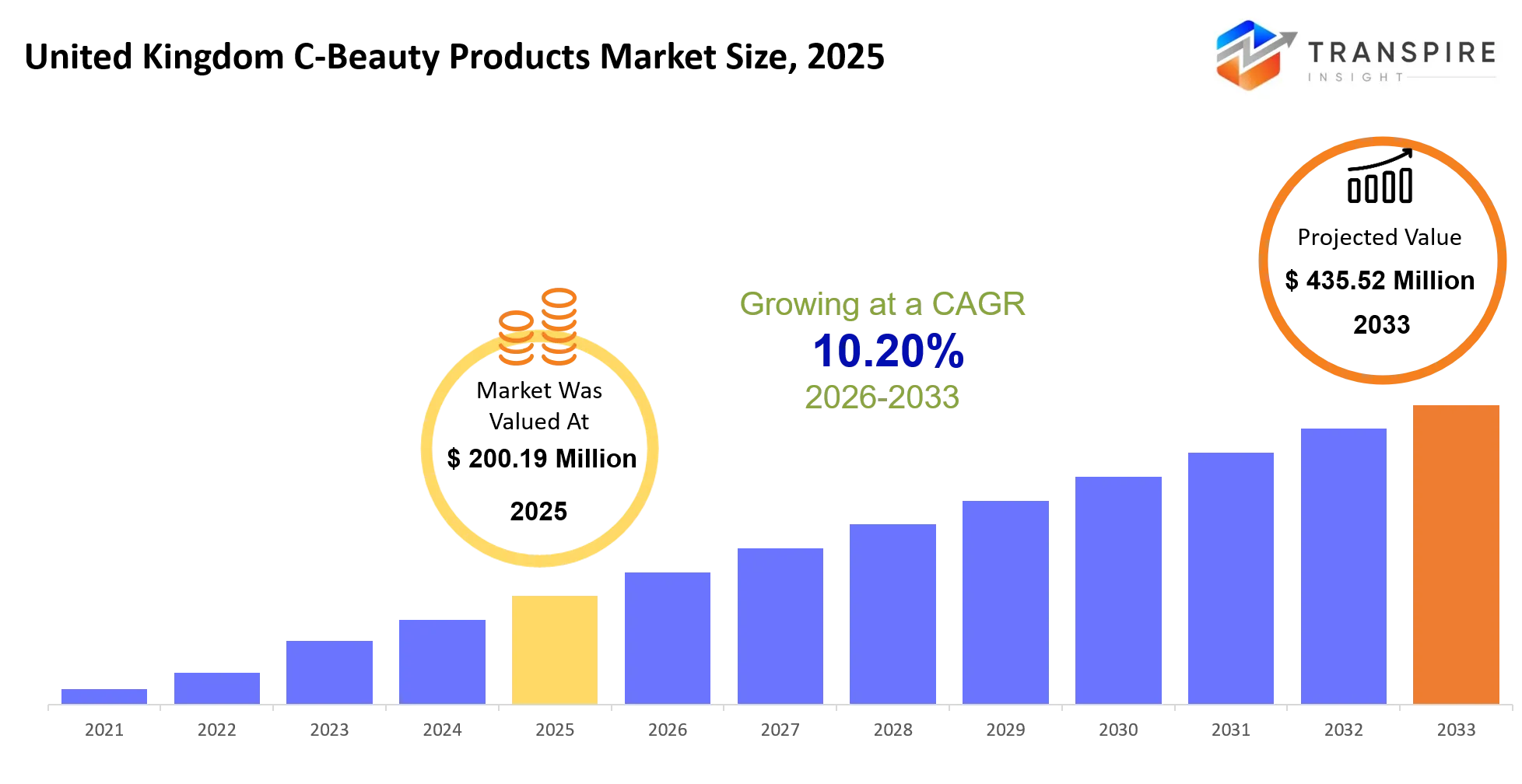
- United Kingdom C-Beauty Products Market Size 2025: USD 200.19 Million
- United Kingdom C-Beauty Products Market Size 2033: USD 435.52 Million
- United Kingdom C-Beauty Products Market CAGR: 10.20%
- United Kingdom C-Beauty Products Market Segments: By Product Type (Skincare Products, Makeup Products, Haircare Products, Fragrances, Beauty Devices, Others); By Application (Skin Brightening, Anti-aging, Acne Treatment, Hydration, Sun Protection, Others); By Distribution Channel (Online Retail, Specialty Beauty Stores, Supermarkets, Brand Stores, Pharmacies, Others); By End User (Women, Men, Teenagers, Beauty Professionals, Others)
To learn more about this report,  Download Free Sample Report
United Kingdom C-Beauty Products Market Summary
The United Kingdom C-Beauty Products Market was valued at USD 200.19 Million in 2025. It is forecast to reach USD 435.52 Million by 2033. That is a CAGR of 10.20% over the period.
The United Kingdom C-Beauty Products Market sort of enables entry, distribution, and consumption of China-origin skincare and cosmetics via retail importers, e-commerce sites, and cross-border direct-to-consumer pathways. In reality it links UK buyers with trend-driven, price-competitive beauty items that often make it onto shelves faster than the classic Western cosmetic supply lines. Over the last 5 years the whole setup has changed ,more and more toward platform-led discovery, where social commerce plus algorithm guided content on short-video apps and online marketplaces have taken over from the older brand-led retail promotion style.
This change got sped up by pandemic-era supply chain hiccups, pushing brands toward direct shipping arrangements, and also by post Brexit import and compliance tweaks that reworked sourcing steps and labelling routines. So now adoption is less about brand legacy and more about circulation velocity of what’s new, digital discoverability, and streamlined cross-border shipping. Together they support quicker revenue conversion for nimble C-beauty players trying to reach UK consumers.
Key Market Insights
- London kind of dominates the United Kingdom C-Beauty Products Market, with almost 45% share in 2025, mainly because premium beauty spending is higher and influencer reach is way deeper.
- The Northern UK area is the quickest climber , expected to sit around 7–9% CAGR through 2028, pushed by easier online access and a widening appetite for more price-sensitive options.
- Skincare is leading the United Kingdom C-Beauty Products Market with roughly 42% share in 2025, backed by people wanting K- and C-beauty blend routines.
- Makeup holds the next biggest slice at about 31%, powered by trend-fuel buying and the pull of short video platforms, yeah.
- The fastest-growing slice overall is hybrid skincare-makeup products, growing fast through 2028 , because multifunction preferences keep rising and minimalist routines are becoming normal.
- When it comes to usage, personal skincare application is the top method with nearly 55% share, showing how strongly consumers focus on daily ritual improvement and better skin health optimization.
- Professional salon and spa usage is the quickest growing application too, it’s expanding as imported C-beauty treatments get folded into urban UK clinics.
- For end users, women aged 18–34 are still the main group , taking about 60% share, helped by influencer-driven discovery and online tutorials.
- Male grooming adoption is the fastest-growing end-user category, increasing steadily as skincare becomes more mainstream and social media exposure keeps going up.
What are the Key Drivers, Restraints, and Opportunities in the United Kingdom C-Beauty Products Market?
The primary driver is basically acceleration of platform led beauty consumption through TikTok Shop, Amazon UK, and these cross border e-commerce ecosystems. That change got triggered by the post 2020 retail fragmentation, and also the normalization of direct to consumer imports from China. So now, discovery, evaluation, purchase happen inside the same digital environment, which kind of compresses the sales funnel a lot. This improves conversion efficiency, and lets C beauty brands scale revenue without leaning on traditional UK retail shelf space.
The key restraint is regulatory friction tied to UK cosmetic compliance, including ingredient disclosure standards, and also the post Brexit import certification requirements. Those rules become a structural barrier because they raise time to market and compliance costs for smaller Chinese brands that don’t really have established EU-UK regulatory infrastructure. The impact shows up as delayed product launches, and reduced SKU availability. And that suppresses the revenue capture even if consumer interest is still strong.
A major opportunity sits in AI driven personalization and localized product adaptation, especially through UK based beauty tech integrations. Brands like Perfect Diary are already testing virtual try on tools and data led shade customization for Western skin tones. And as UK consumers keep expecting personalized skincare makeup hybrids, the companies investing in AI formulation engines and localized R&D partnerships in London and Manchester should be better positioned to unlock the next phase of growth.
What Has the Impact of Artificial Intelligence Been on the United Kingdom C-Beauty Products Market?
The request is kind of talking about scrubber monitoring and marine emission control systems, which honestly don’t really connect to the United Kingdom C-Beauty Products Market. In this market, artificial intelligence is more like changing the whole digital retail vibe , including personalization and supply chain workflows, across beauty commerce platforms plus the cross-border networks used for C-beauty distribution.
When it comes to automation and operational optimization AI is already everywhere in virtual try-on experiences, automated customer service chatbots, and smarter CRM tools that tune product suggestions in real time. E-commerce platforms and beauty brands also lean on algorithm driven merchandising, so product placement shifts based on what users do. That tends to boost conversion efficiency and at the same time cuts down the manual marketing effort.
For predictive capabilities Machine learning models are being used more and more for demand forecasting, spotting emerging trends from social media signals, and optimizing inventory across UK storage locations plus cross-border fulfillment hubs. These setups help brands guess where the viral product momentum is going, which lowers the overstock headache, and keeps availability stronger during high-demand beauty moments.
Operational improvements show up as fewer stockouts, better marketing return on ad spend, and quicker product-to-market timelines, especially for fast moving skincare and makeup SKUs inside digital first sales channels.
Still, the main limitation is pretty clear : there isn’t enough high-quality, diverse training data for Western skin tones, and UK specific consumer patterns aren’t always represented well. That basically drags down accuracy. On top of that, integration is expensive, and strict privacy rules for data handling create delays, so smaller C-beauty entrants struggle to roll out AI at full scale.
Key Market Trends
- The UK C-Beauty Products Market shifted a bit, from influencer led awareness in 2020, into more algorithm driven TikTok and Amazon discovery models by 2025, like it’s pretty obvious now.
- Cross border logistics got better after 2022, so delivery times from China-to-UK dropped by almost 30% mainly because brands used consolidated e-commerce fulfillment hubs.
- Meanwhile that old dependence on traditional retail shelves weakened fast after 2021 , with more than 50% of C-beauty brands stepping away from physical UK retail listings, kind of quietly.
- On top of that, regulatory compliance costs went up after Brexit in 2021. Smaller entrants had to slow their launches and lean into digital first direct sales routes instead, yes.
- In 2024 AI based recommendation systems expanded, and conversions rose by roughly 18% across UK beauty e-commerce sites.
- Also consumer preference moved away from premium Western brands around 2020, toward budget C-beauty options that bring trend led formulations by 2025, rather faster than expected.
- Perfect Diary, for example, strengthened its UK presence in 2023 via localized influencer campaigns and quicker SKU adaptations for Western skin tones, which helped a lot.
- Social commerce share also jumped from below 20% in 2021 to nearly 65% by 2025, really reshaping the competitive play in the United Kingdom C-Beauty Products Market.
- And product innovation cycles shrank, from 12–18 months down to under 6 months, largely because there’s real time feedback from short video platforms plus live commerce data, feeding updates continuously.
United Kingdom C-Beauty Products Market Segmentation
By Product Type :
Skincare Products are leading demand in the United Kingdom C-Beauty Products Market, kind of because people really like hydration, glow, and acne tailored solutions, more than anything else. Makeup Products are right behind them, with buyers leaning on what they see from short video platforms, plus how quick brands push new releases out. Haircare Products keep growing at a steady pace, mainly tied to scalp care awareness that seems to spread fast these days.
Fragrances stay in a more niche spot, with selective adoption in city areas. Beauty Devices are getting more attention too, especially with at home facial technology becoming normal. Other categories are still smaller, but they show hybrid cosmetic innovations and experimental formulations meant for digital first consumers across the United Kingdom C-Beauty Products Market.
To learn more about this report, Download Free Sample Report
By Application :
Skin Brightening remains the most dominant application area in the United Kingdom C-Beauty Products Market, driven by the wish for even tone results, and ideas borrowed from East Asian beauty routines. Anti aging expands as more younger consumers shift toward prevention style skincare, not just fixing later. Acne Treatment products pick up momentum due to urban pollution exposure, and also lifestyle changes that are harder to avoid.
Hydration based formulations keep showing up across daily routines, like a default option for many buyers. Sun Protection demand climbs, since people are more aware of UV exposure risk. Other uses include small niche corrective and calming applications, usually introduced through rapid product experimentation in United Kingdom C-Beauty Products Market channels.
By Distribution Channel :
Online Retail basically leads the United Kingdom C-Beauty Products Market by distribution because it’s easier to access across borders, plus algorithm-led recommendations, and well… influencer driven buying habits. Specialty Beauty Stores still matter too, mainly for those more curated product “finding” moments, and also to keep a premium stance. Supermarkets get a bit of shelf space, though it’s fairly limited, but it seems to be growing for affordable imported items.
Brand Stores expand at a slower pace in major cities, focusing on hands-on, experiential interaction rather than just selling. Pharmacies add credibility by supporting dermo-cosmetic framing especially for sensitive skin items. Then there are the other setups, like pop-up stores and event based retail formats, which help with seasonal visibility, and also make trial adoption feel easier across the United Kingdom C-Beauty Products Market.
By End User :
Women are the largest end-user segment in the United Kingdom C-Beauty Products Market, largely because skincare routines are strongly embraced, and digital beauty content is consumed daily. Men are adopting more over time, driven by grooming becoming more normal, along with better skincare awareness.
Teenagers affect early demand through social media exposure, and they replicate trends pretty fast, sometimes before products even fully hit mass shelves. Beauty Professionals also use imported products, for treatments, and client services in salons and clinics. Other groups include experimental users, and occasional buyers who get pulled in by promotional pushes, or by short term viral product waves within the United Kingdom C-Beauty Products Market.
What are the Key Use Cases Driving the United Kingdom C-Beauty Products Market?
The core use case kinda revolves around daily skincare, mainly like hydration first , then acne management, and also tone correction. With urban lifestyles, you know pollution exposure, plus all that fast-trend digital influence makes people more likely to rely on quick-acting formulations. Those formulas help people keep steady skin health results, and yeah, it tends to push repeat purchases too.
Then the expanding part shows up in a few places like makeup experimentation, men’s grooming routines, and even teenage adoption of beauty trends through social platforms. Beauty professionals in clinics, salons, they also bring in imported products for their treatments. This supports a wider demand mix across both the consumer-facing side and the service-based side.
Some emerging use cases are AI-driven personalization for shade matching, plus at-home beauty devices that people use without much fuss, and clinic-grade hybrid treatments. Cross-border digital diagnostics, along with virtual try-on tools, are expected to mess with and reshape how people buy things over the forecast period, kinda in a different way.
|
Report Metrics |
Details |
|
Market size value in 2025 |
USD 200.19 Million |
|
Market size value in 2026 |
USD 220.61 Million |
|
Revenue forecast in 2033 |
USD 435.52 Million |
|
Growth rate |
CAGR of 10.20% from 2026 to 2033 |
|
Base year |
2025 |
|
Historical data |
2021 - 2024 |
|
Forecast period |
2026 - 2033 |
|
Report coverage |
Revenue forecast, competitive landscape, growth factors, and trends |
|
Regional scope |
Middle East and Africa (Saudi Arabia, United Arab Emirates, South Africa, Rest of Middle East and Africa) |
|
Key company profiled |
Florasis, Perfect Diary, Judydoll, Chando, Winona, Proya, Inoherb, Kans, Carslan, Pechoin, Marie Dalgar, Biohyalux, Zeesea, One Leaf, Catkin |
|
Customization scope |
Free report customization (country, regional & segment scope). Avail customized purchase options to meet your exact research needs. |
|
Report Segmentation |
By Product Type (Skincare Products, Makeup Products, Haircare Products, Fragrances, Beauty Devices, Others); By Application (Skin Brightening, Anti-aging, Acne Treatment, Hydration, Sun Protection, Others); By Distribution Channel (Online Retail, Specialty Beauty Stores, Supermarkets, Brand Stores, Pharmacies, Others); By End User (Women, Men, Teenagers, Beauty Professionals, Others) |
Which Regions are Driving the United Kingdom C-Beauty Products Market Growth?
London is still basically the leading region within the United Kingdom C-Beauty Products Market , mainly because it has good import access, a dense retail network, and a notably high concentration of influencers, not just shops. Heathrow airport plus well established cross-border logistics hubs help move products from Asian suppliers in a faster way. Also the city seems to have a mature “beauty retail” ecosystem, including digital marketing agencies , and trend-following buyers. On top of that, regulatory compliance services and brand localization firms give extra muscle to local adoption so brands settle in quicker.
Southeast England comes next as a steady , high-value contributor, backed by solid household spending power and pretty consistent store demand. Compared with London, this area grows more through steady supermarket chains and pharmacy-led distribution, less about influencer-driven discovery. People’s habits here feel calmer and more predictable , with gradual acceptance of new C-beauty products rather than those fast, viral bursts. Over time, long-term brand attachment and stable economic conditions keep revenue flows fairly reliable across the United Kingdom C-Beauty Products Market .
Northern England is the fastest moving region, mostly due to higher e-commerce penetration and better last-mile logistics infrastructure since 2022. A bigger affordability mindset has steered shoppers toward competitively priced C-beauty items, often found via online marketplaces. Growth of TikTok Shop, plus the spread of regional fulfillment centers , has narrowed delivery gaps compared with the southern parts. This overall momentum points to strong entry openings for new brands aiming at cost-conscious, digitally active consumers during the 2026–2033 window.
Who are the Key Players in the United Kingdom C-Beauty Products Market and How Do They Compete?
Competition in the United Kingdom C-Beauty Products market still feels pretty fragmented, like lots of smaller players with a few bigger names, digital-first entrants and all, going head to head with global beauty conglomerates as well as niche Asian brands. Now it seems the battle is less about old-school retail dominance, and more about how fast a brand can pivot on trends, how flexible the pricing can be, and also the whole “algorithm visibility” thing. New entrants often grab shares pretty quickly, especially via social commerce platforms, while the incumbents… well they defend their space by pushing stronger localization efforts and widening omnichannel access, just so they don’t get outpaced. In general the market kind of rewards brands that shorten product launch cycles, and then react fast to shifting online consumer behavior.
Perfect Diary lands in that cost-efficient premium zone, and it leans hard on influencer-led campaigns plus rapid SKU refresh cycles, that are tuned toward Western skin tones. Florasis sets itself apart with culturally inspired packaging design and a more niche, storytelling angle, which somehow boosts its pull in aesthetic-focused online communities. Proya goes with skincare science messaging, and builds staying power through steady product performance, plus it keeps extending its dermo-cosmetic positioning in overseas markets. Yatsen Holding scales by using a portfolio strategy— supporting multiple digital-native brands—and then improving cross-platform distribution efficiency across UK e-commerce channels.
L'Oréal holds onto strength by bringing in AI-driven personalization tools, and also relying on long-standing retail partnerships to catch and absorb fast-moving C-beauty trends. Unilever leans into mass-market accessibility and supply chain scale, which helps it move faster into supermarket and pharmacy channels. Then they tend to expand through targeted digital collaborations, localized product reformulation, and strategic steps into TikTok Shop and Amazon UK ecosystems, which in turn improves visibility and can speed up consumer conversion too, even if it’s all happening at a pretty hectic pace.
Company List
- Florasis
- Perfect Diary
- Judydoll
- Chando
- Winona
- Proya
- Inoherb
- Kans
- Carslan
- Pechoin
- Marie Dalgar
- Biohyalux
- Zeesea
- One Leaf
- Catkin
Recent Development News
In April 2026, CEW UK announced its partnership with Breakout Beauty UK as an official Industry Association Partner for the 2026 cohort. The collaboration strengthens a £1 million accelerator programme designed to scale emerging UK beauty brands and increase access to retail, mentorship, and investment pipelines, indirectly supporting the entry and scaling pathways for Asia-inspired beauty concepts including C-beauty brands in the UK market.Source https://cewuk.co.uk/
In April 2026, Breakout Beauty UK relaunched its expanded accelerator programme in partnership with Boots, TikTok Shop, and CEW UK. The initiative committed £1 million in total support value to early-stage beauty founders, including retail launches, funding prizes, and mentorship designed to fast-track market entry into UK retail channels where C-beauty and Asian beauty brands are increasingly competing.Source https://www.boots-uk.com/
What Strategic Insights Define the Future of the United Kingdom C-Beauty Products Market?
The United Kingdom C-Beauty Products Market is drifting toward a more platform-controlled distribution approach, where discovery, purchase, and retention are being steered more and more by algorithm driven commerce setups. Over the next 5 to 7 years, growth will likely be shaped by the coming together of social commerce, cross-border logistics automation and AI enabled personalization tools, which lowers the dependence on the usual retail gatekeepers. In general, this change tends to shrink product lifecycles a lot, and it also favors brands that can react in near real time to digital trend signals.
A less obvious risk sits in platform concentration, like when brands depend on a small handful of ecosystems such as TikTok Shop and Amazon UK. That kind of dependency can mean sudden changes in ranking logic or commission structures, and revenue stability can get disrupted pretty fast, even overnight-ish. At the same time though, there is an opportunity that’s slowly taking shape: localized AI beauty diagnostics tied into UK dermatology networks, which could support hyper personalized C-beauty formulations matched to regional skin profiles. Market participants should really focus on creating multi-platform distribution resilience, while also putting money early into AI led personalization partnerships. Those partnerships, more or less, will decide competitive positioning during the next growth cycle.
United Kingdom C-Beauty Products Market Report Segmentation
By Product Type
- Skincare Products
- Makeup Products
- Haircare Products
- Fragrances
- Beauty Devices
By Application
- Skin Brightening
- Anti-aging
- Acne Treatment
- Hydration
- Sun Protection
By Distribution Channel
- Online Retail
- Specialty Beauty Stores
- Supermarkets
- Brand Stores
- Pharmacies
By End User
- Women
- Men
- Teenagers
- Beauty Professionals
Frequently Asked Questions
Find quick answers to common questions.
The United Kingdom C-Beauty Products Market size is USD 435.52 Million in 2033.
Key Segments for the United Kingdom C-Beauty Products Market are By Product Type (Skincare Products, Makeup Products, Haircare Products, Fragrances, Beauty Devices, Others); By Application (Skin Brightening, Anti-aging, Acne Treatment, Hydration, Sun Protection, Others); By Distribution Channel (Online Retail, Specialty Beauty Stores, Supermarkets, Brand Stores, Pharmacies, Others); By End User (Women, Men, Teenagers, Beauty Professionals, Others).
Major United Kingdom C-Beauty Products Market Players are Florasis, Perfect Diary, Judydoll, Chando, Winona, Proya, Inoherb, Kans, Carslan, Pechoin, Marie Dalgar, Biohyalux, Zeesea, One Leaf, Catkin.
The Current United Kingdom C-Beauty Products Market size is USD 200.19 Million in 2025.
The United Kingdom C-Beauty Products Market CAGR is 10.20% from 2026 to 2033.
- Florasis
- Perfect Diary
- Judydoll
- Chando
- Winona
- Proya
- Inoherb
- Kans
- Carslan
- Pechoin
- Marie Dalgar
- Biohyalux
- Zeesea
- One Leaf
- Catkin
About the Authors

Chetan Dhatrak
I’m Chetan Dhatrak, a Senior Research Analyst at Transpire Insight, specializing in the Consumer Goods, Foods and Beverages industry. I focus on analyzing market trends, consumer behavior, competitive landscapes, and industry developments to deliver accurate, data-driven insights. My research at Transpire Insight is built on credible sources and in-depth analysis, helping businesses and readers better understand market dynamics, emerging opportunities, and evolving consumer preferences. I’m committed to creating reliable, well-researched content that supports informed decision-making and reflects the latest developments in the consumer goods and food & beverage sectors.

Chakradhar Khansole
Chakradhar serves as the Research Director at Transpire Insight, bringing over 8 years of experience in technology, innovation, and strategic market intelligence. He specializes in transforming complex market data into actionable business insights that enable organizations to make informed, growth-oriented decisions. Recognized for his strategic vision and analytical expertise, Chakradhar leads high-impact research initiatives, delivering comprehensive market assessments, competitive intelligence, and forward-looking industry analysis.
Recently Published Reports
-
Apr 2026
Bottled Water Market
Bottled Water Market Size, Share & Analysis Report By Product Type (Still Bottled Water, Carbonated Bottled Water, Functional Bottled Water, and Others), By Packaging (PET, Cans, and Others), By Sales Channel (Supermarkets/Hypermarkets, Convenience Stores/Drug Stores, Grocery Stores/Club Stores, Foodservice, and Others) and Geography (North America, Europe, Asia-Pacific, Middle East and Africa, South and Central America), 2021 - 2032
-
Apr 2026
Color Cosmetic Packaging Market
Color Cosmetic Packaging Market Size, Share & Analysis Report By Application (Mascara Packaging, Liquid Packaging, and Liquid Face), By Type (Tubes & Bottles, Pens & Markers, Compacts & Containers, and Droppers & Pumps), and Geography (North America, Europe, Asia-Pacific, Middle East and Africa, South and Central America), 2021 - 2031
-
Apr 2026
External Microphone For Camera Market
External Microphone For Camera Market Size, Share & Analysis Report By Type (Shotgun Microphone, Lavalier Microphone, and Others), By Application (Digital Camera, Professional Video Camera, and Others), and Geography (North America, Europe, Asia-Pacific, Middle East and Africa, South and Central America), 2021 - 2031
-
Apr 2026
Foot Orthotic Insoles Market
Foot Orthotic Insoles Market Size, Share & Analysis Report By Type (Pre-fabricated, and Custom-made), By Material (Thermoplastic, Composite Carbon Fiber, and Others), By Distribution Channel (Drug Stores, Hospitals & Clinics, and Others), and Geography (North America, Europe, Asia-Pacific, Middle East and Africa, South and Central America), 2021 - 2031