

Global K-Beauty Products Market Size & Forecast
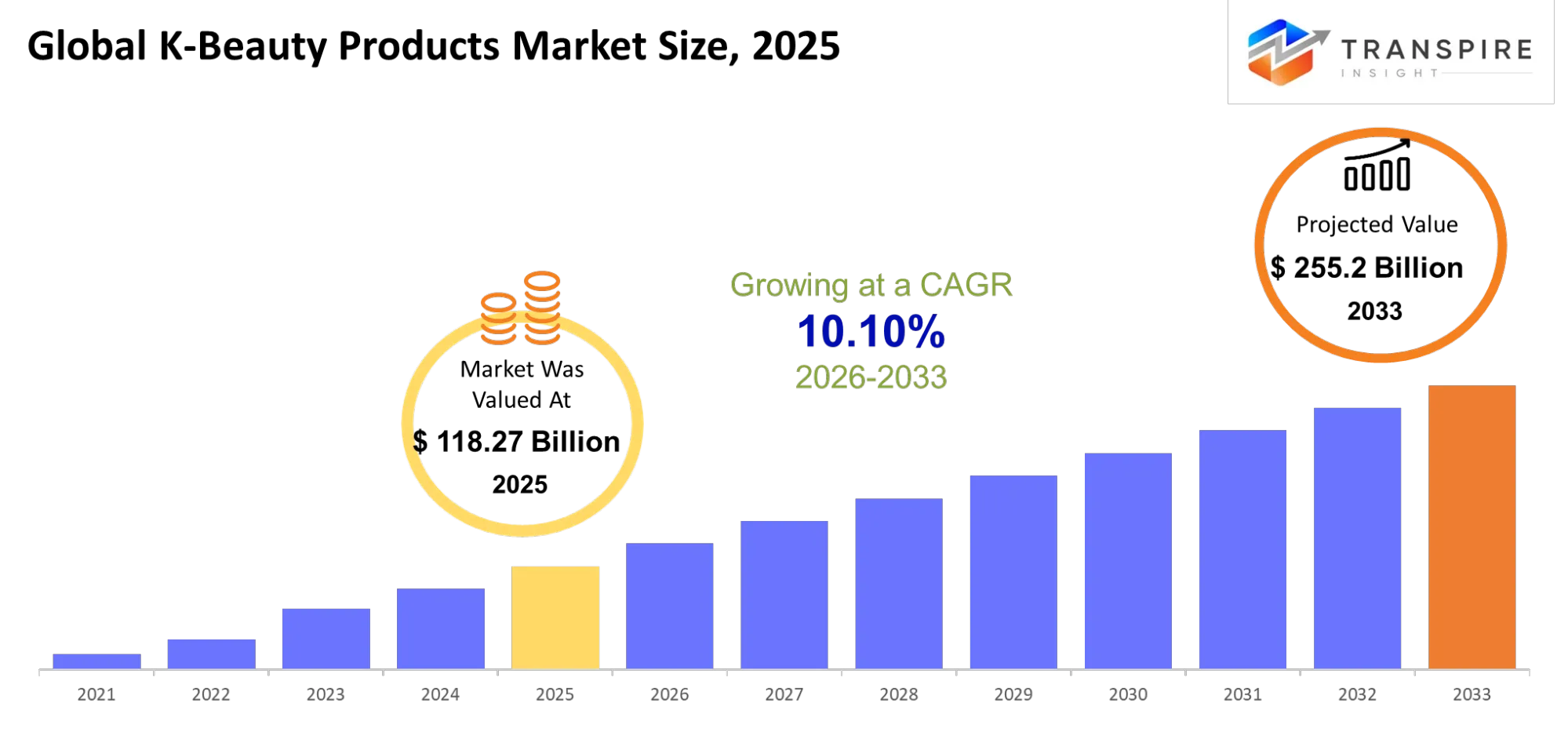
- Global K-Beauty Products Market Size 2025: USD 118.27 Billion
- Global K-Beauty Products Market Size 2033: USD 255.2 Billion
- Global K-Beauty Products Market CAGR: 10.10%
- Global K-Beauty Products Market Segments: By Product Type (Skin Care, Hair Care, Makeup, Personal Care), By Distribution Channel (Online Retail, Specialty Stores, Supermarkets & Hypermarkets), By End-User (Men, Women)
To learn more about this report,  Download Free Sample Report
Global K-Beauty Products Market Summary
Korean beauty really catches consumer demand through complex skincare routines, innovative formulation of ingredients, and an accessible luxurious touch that combines dermatological effectiveness with very attractive appearance. The K-beauty category spans all sorts of skin care products - like essences, serums, sheet masks, and moisturizers - that actually started out in South Korea. The category also covers hair care, makeup, and personal care products sold under the Korean beauty look and our manufacturing standards.
The structural growth driver really is the global spread of Korean skincare methods and the rise of social media influencer endorsements - creating really measurable demand among Gen Z and millennial consumers all over North America, Europe, and Southeast Asia. Korean beauty products entered Western markets through specialty stores and online platforms starting back in 2010 - and really accelerated quite dramatically after 2015 when major brands such as Amorepacific, LG Household & Health Care, and some smaller labels like Cosrx launched their direct-to-consumer digital marketing campaigns on Instagram and YouTube. These campaigns really changed how consumers saw Korean beauty - shifting it from a pretty niche Asian import to a mainstream skincare category right up there with American and European prestige brands.
Market expansion from 2020 forward really accelerated because of pandemic-driven online shopping adoption - plus the explosion of TikTok-driven beauty trends featuring K-beauty products, and the entry of big conglomerates like Estee Lauder Companies, which acquired Dr. Jart+ in 2020, into the category as a growth opportunity. Over the 2026 to 2033 period, K-beauty market growth will still be driven by reaching more customers in underdeveloped regions, especially Latin America and parts of Africa where Korean beauty only has less than five percent of retail shelf space - and by expanding the category itself within existing markets as new product subcategories such as vegan skincare and eco-friendly packaging gain popularity.
Key Global K-Beauty Products Market Insights
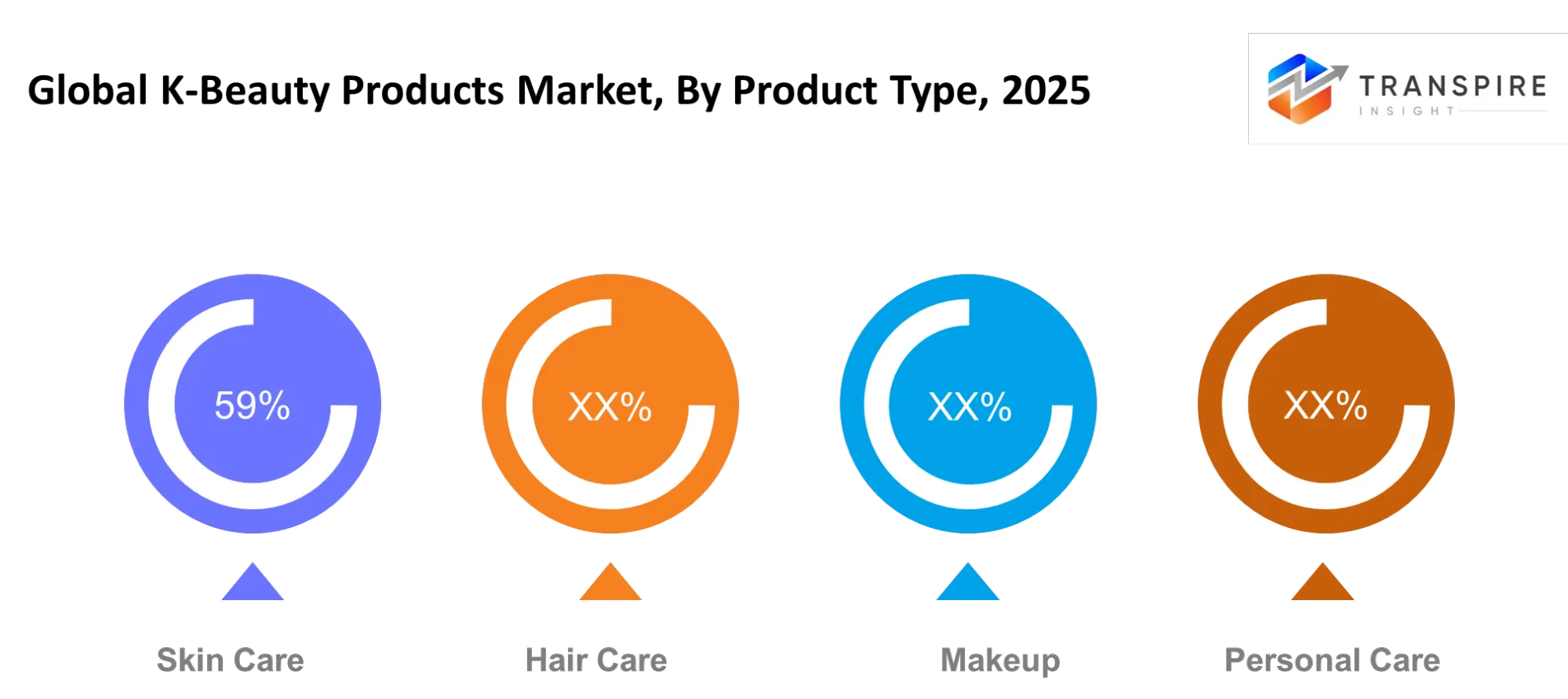
- Skin care products command 59% of global K-beauty market revenue in 2024, anchored by essences, serums, sheet masks, and moisturizers that define the Korean multistep skincare routine and generate the highest per-unit margins across all product categories.
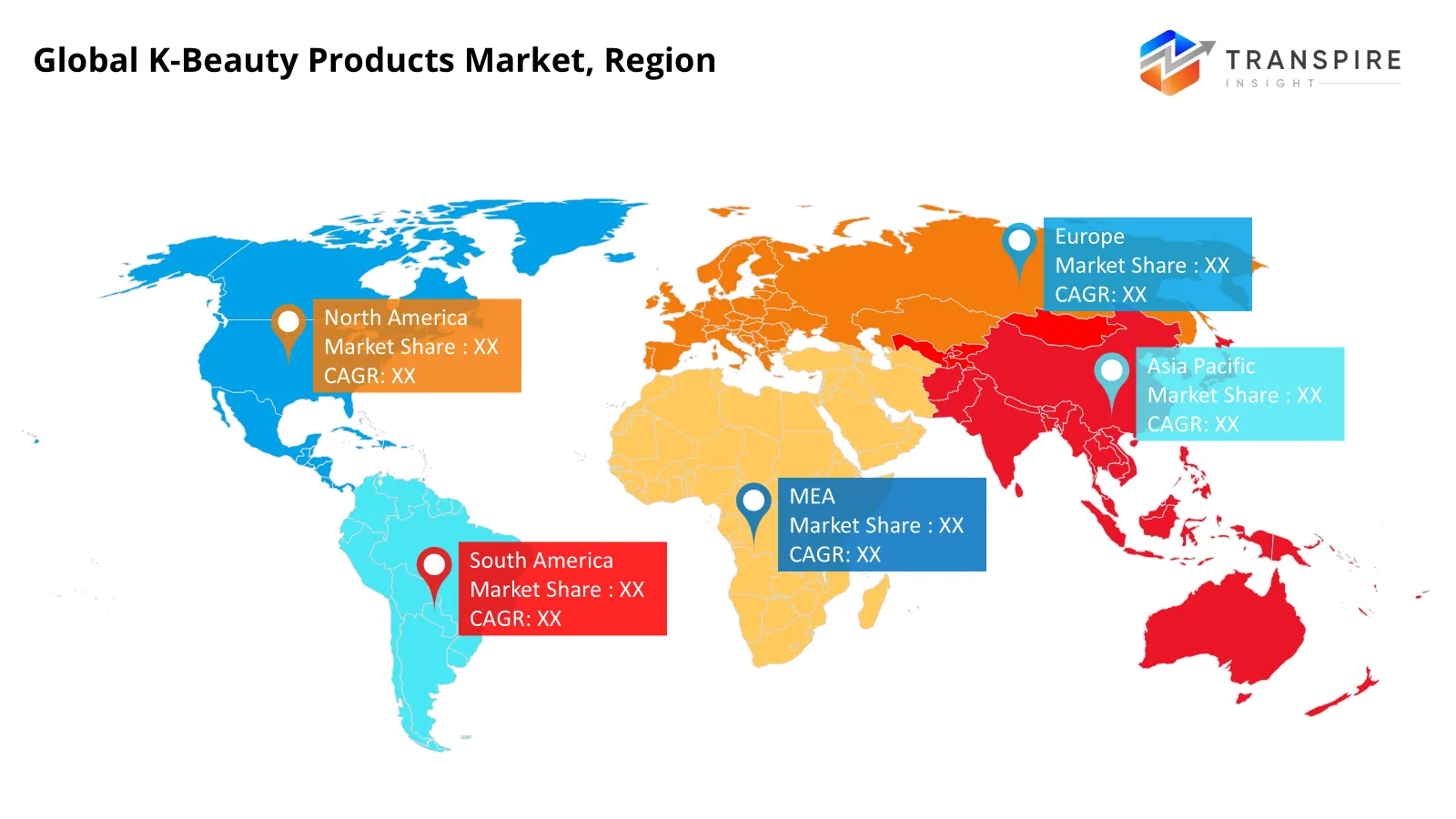
- Asia-Pacific accounts for approximately 62% of global K-beauty market revenue in 2024, with South Korea, China, and Southeast Asia representing the core demand base that generates over USD 73 Billion in annual revenue.
- The online retail channel is the dominant distribution mode, representing approximately 58% of global K-beauty sales in 2024, driven by direct-to-consumer brand websites, Amazon, Sephora, and Yesstyle that collectively reach over 750 Million active beauty shoppers.
- Amorepacific Corporation and LG Household & Health Care Ltd. together control approximately 28% of global K-beauty market revenue through multiple subsidiary brands including Laneige, Sulwhasoo, The Face Shop, Innisfree, and Etude House.
- Female consumers account for 74% of global K-beauty market revenue in 2024, though the male skincare segment is the fastest-growing demographic at 18% CAGR through 2033 as K-beauty brands normalize skincare routines for men.
- China is the second-largest K-beauty market after South Korea, generating approximately USD 35 Billion in annual revenue in 2024 through a combination of Chinese imports of Korean brands and Chinese manufacturing of K-beauty lookalike formulations.
- North America and Europe together represent approximately 28% of global K-beauty market revenue, with penetration highest in major urban centers including New York, Los Angeles, London, and Paris where specialty retail and online reach over 40% of target consumers.
- Independent K-beauty brands including Cosrx, Dr. Jart+, Banila Co., and Clio Cosmetics have captured 22% of global market revenue through social media marketing and direct-to-consumer digital channels that bypass traditional retail intermediaries.
- Specialty beauty retailers including Sephora, Ulta Beauty, and local equivalents account for 26% of global K-beauty distribution in 2024, positioning K-beauty as a core merchandise category within their broader beauty assortment.
- Sheet masks represent the most recognized K-beauty product category in Western markets, commanding 34% of the skin care segment and serving as the entry-level product that converts consumers to broader K-beauty skincare routines.
What are the Key Drivers, Restraints, and Opportunities in the Global K-Beauty Products Market?
The main driver is the global standardization of multi-step skincare routines as a common consumer practice. In 2010, a ten-step Korean skincare routine seemed quite excessive and very time-consuming to Western consumers used to three-step regimens. By 2024, market research indicates that 51% of female beauty consumers in North America and Europe practice a five-step or longer skincare routine at least every other day, and Korean beauty brands really lead the discussion about what products constitute an effective routine. This normalization creates a lot of demand for the specific product types that Korean beauty offers: essences with very high viscosity and hydration delivery, serums with very high concentrations of active ingredients, and sheet masks that give you occlusive treatment in a very convenient format. Competitors using traditional Western formulation methods have a hard time replicating these product features, giving Korean brands a sustainable formulation edge that goes beyond brand preference into product efficacy perception itself.
Ingredient sourcing and our supply chain complexity really present operational obstacles. Korean beauty brands really rely on specific relationships with ingredient suppliers in South Korea and a few special countries for fermented extracts, plant-derived actives, and proprietary complexes that are quite difficult to replicate or substitute without losing the perceived authenticity of the product itself. Tariffs, shipping delays, and regulatory compliance for importing ingredients into the United States, European Union, and other developed markets adds 8 to 15 percent to the cost of the final product for brands that source from Korea. Moreover, Korean beauty manufacturing has historically been concentrated in South Korea, creating single-country supply weakness. A few brands, such as Cosrx and Nature Republic, have actually diversified manufacturing to China and Southeast Asia in response, yet this creates a quality perception risk since consumers really associate authentic K-beauty with South Korean manufacturing origins themselves. The complexity of managing compliant ingredient supplies while maintaining the perceived authenticity really restricts margin growth for brands running at scale.
Men's-focused K-beauty skincare represents the biggest growth opportunity for the 2026 to 2033 period. Men's skincare currently accounts for only 9% of the global K-beauty market revenue in 2024, but demand is really growing at 18% CAGR as social media, celebrity endorsements, and workplace culture increasingly normalize skincare as a male self-care practice rather than a traditionally feminine activity itself. Korean beauty brands are culturally placed to capture this opportunity because Korean celebrity culture and entertainment media really normalize male skincare more than similar Western media does. Brands launching dedicated male skincare lines or repackaging existing products with a masculine visual identity are really catching the fastest-growing consumer group.
What Has the Impact of Artificial Intelligence Been on the Global K-Beauty Products Market?
Artificial intelligence really affects the K-beauty market in three main ways: personalized skincare routine suggestion engines, virtual try-on technology for makeup products, and supply chain optimization for inventory and demand forecasting. K-beauty brands like Amorepacific, Sulwhasoo, and Laneige have set up AI chatbots and quiz-based recommendation engines on their websites that evaluate your skin condition, sensitivity, climate, and lifestyle factors so they can recommend highly customized product sets from their entire product line. These recommendation engines really boost the average order value by 18 to 24 percent since they suggest complementary products and decrease the customer choice friction that occurs when brands offer 40 or even more skincare products across multiple price levels and formula types.
Virtual try-on technology, powered by computer vision, lets customers apply makeup products in augmented reality right before buying them, greatly decreasing the psychological barrier to buying makeup online. Clio Cosmetics, TonyMoly, and Banila Co. have all added AR try-on features to their websites and mobile apps, and market studies show that shoppers who play with try-on technology end up buying makeup at 2. 3 times the rate of shoppers who don't use the feature. Supply chain optimization uses machine learning to forecast demand patterns across all different regional markets and automatically adjusts production schedules and inventory distribution, reducing overstock in slower-selling markets while also avoiding stockouts in higher-demand channels. For brands managing 200 or more SKUs across 15 or more countries all at once, this optimization really saves them 12 to 18 percent in warehouse costs while improving in-stock rates from 84 percent to 92 percent.
Key Market Trends
- Skin care dominates at 59% of market revenue in 2024, with essences and serums accounting for 44% of skin care sales, sheet masks 34%, and creams and moisturizers 22% of the skin care subcategory.
- Hair care products represent 18% of K-beauty market revenue in 2024, growing at 8.5% CAGR through 2033 as K-beauty hair treatments and styling products gain market awareness in Western markets.
- Makeup commands 15% of K-beauty market revenue in 2024, with BB creams, cushion foundations, and tinting products that originated in Korea maintaining category leadership despite competition from Western prestige brands.
- Personal care including body lotions, hand creams, and lip balms accounts for 8% of K-beauty market revenue in 2024, growing at 9.2% CAGR through 2033 as K-beauty brands extend their reach beyond face care.
- China is growing at 12% CAGR through 2033, outpacing global K-beauty market growth as Chinese consumers upgrade from domestic brands to imported Korean premium offerings.
- Southeast Asia including Thailand, Vietnam, Philippines, and Indonesia grows at 11.8% CAGR through 2033, driven by rising middle-class income, urban migration, and aspirational consumption of Korean pop culture products.
- North America is growing at 7.2% CAGR through 2033, driven by market penetration into secondary and tertiary cities where K-beauty awareness remains underdeveloped compared to major metropolitan centers.
- Europe is growing at 6.8% CAGR through 2033, slower than global average due to high competition from established local prestige brands and regulatory requirements for ingredient approval that add time and cost to product launches.
- Direct-to-consumer digital channels are growing at 14% CAGR through 2033, outpacing wholesale channels as brands capture higher margins by controlling the customer experience and eliminating retail intermediary markups.
- Male skincare is growing at 18% CAGR through 2033, making it the fastest-growing consumer segment despite representing only 9% of current market revenue.
Global K-Beauty Products Market Segmentation
By Product Type
Skin care products command 59% of global K-beauty market revenue in 2024. The segment includes essences, serums, sheet masks, creams, moisturizers, and treatment products that define the Korean multistep skincare methodology. Essences and serums alone represent 44% of skin care revenue, driven by the Korean concept of layering multiple active-ingredient products to address specific skin concerns sequentially. This segment generates the highest per-unit margins of all K-beauty categories and attracts the most innovation investment from major brands. Growth through 2033 is sustained by continuing consumer adoption of multistep routines and expansion into new treatment formats including sleeping masks and ampule serums.
Hair care products represent 18% of K-beauty market revenue in 2024 and are growing at 8.5% CAGR through 2033. The category includes hair shampoos, conditioners, treatment masks, and styling products marketed under Korean beauty standards. K-beauty hair care differentiates from Western offerings through emphasis on moisture retention, protein-infused formulations, and styling products that enhance rather than damage hair texture. Growth is driven by increasing awareness among non-Asian consumers that Korean hair care products address specific concerns including frizz, volume, and scalp health that mainstream Western products do not adequately address.
Makeup products command 15% of K-beauty market revenue in 2024, with BB creams, cushion foundations, and tinting lipsticks that originated in Korea leading the category. Makeup is growing slower than skin care because Western prestige brands maintain strong market positions in foundation and lip color, and K-beauty makeup differentiation relies on specific product formats rather than ingredient innovation. Opportunity for growth emerges in eye makeup and brow products where K-beauty brands offer distinctive shades and formulations.
To learn more about this report, Download Free Sample Report
By Distribution Channel
Online retail represents 58% of global K-beauty market revenue in 2024 and is the fastest-growing distribution channel at 14% CAGR through 2033. This dominance reflects the category's origin in digital-native marketing on Instagram and YouTube, the ability of online retailers to stock diverse product ranges that overwhelm physical store space constraints, and the geographic reach of digital channels to consumers in markets where K-beauty specialty retail has not yet developed. Direct-to-consumer brand websites account for 28% of online sales, while marketplace retailers including Amazon and Yesstyle account for 48%, and Sephora and equivalent specialty beauty retailers represent 24% of online K-beauty sales.
Specialty beauty stores including Sephora, Ulta Beauty, and local regional equivalents account for 26% of global K-beauty distribution in 2024. This channel is growing at 5.8% CAGR through 2033 as K-beauty becomes an established merchandise category within broader beauty retail, though growth lags online because store inventory is limited to the highest-velocity SKUs and price points that specialty retailers accept. Specialty retail serves as a crucial touchpoint for consumers in markets where e-commerce adoption is lower, particularly among consumers over age 45.
Supermarkets and hypermarkets including Walmart, Tesco, and equivalent mass retailers account for 16% of global K-beauty distribution in 2024. This channel is growing at 4.2% CAGR through 2033 as K-beauty brands build relationships with mass retailers to reach price-sensitive consumers and consumers who do not shop specialty beauty retailers. Mass retail distribution tends to limit product assortment to best-selling introductory SKUs, so this channel captures fewer margin dollars than specialty or direct channels despite reaching the broadest consumer base.
By End-User
Female consumers account for 74% of global K-beauty market revenue in 2024. Women drive demand for all K-beauty product categories, with the highest engagement in skincare and makeup where aspirational consumer behavior and social media influence create measurable purchasing power. Female consumers average USD 180 in annual K-beauty spending in developed markets, compared to USD 42 for male consumers. Growth among female consumers is tempered by market maturation in developed regions but accelerates in emerging markets where female income and consumer spending power are rising.
Male consumers currently represent 26% of global K-beauty market revenue in 2024 but are the fastest-growing demographic at 18% CAGR through 2033. Male K-beauty consumers are disproportionately concentrated in Asia where skincare is already normalized as male self-care, but male consumers in North America and Europe are entering the market at accelerating rates. The average male K-beauty consumer spends USD 42 annually on skincare and personal care products in developed markets, compared to female consumers who spend 4.3 times more, indicating substantial runway for growth as male skincare adoption accelerates.
What are the Key Use Cases Driving the Global K-Beauty Products Market?
The dominant use case is really the adoption of multi-step skincare routines by consumers aged 18 to 35 who use K-beauty products to construct quite detailed skincare plans that take care of several skin problems all at once. K-beauty brands promote individual products as part of an entire routine - and consumers very often purchase five to ten products from one brand or combine products from different brands so they can really customise their routine. This gives us a very high customer lifetime value since adopting a multi-step routine really locks consumers into ongoing repurchase behaviour as products run out on 30 to 90-day replacement cycles.
Addressing specific skin problems such as hyperpigmentation, uneven textures, and sensitivity represents our second main use case. K-beauty brands develop marketing stories around treating particular conditions with targeted product combinations - and consumers experiencing these concerns seek out K-beauty solutions after reading about targeted treatment methods through social media influencers and online reviews. The use case actually produces much higher average order values because consumers buy several targeted products instead of just one general-purpose solution.
Gift-giving occasions like holidays, birthdays, and special celebrations really drive quite a lot of the K-beauty market volume - especially in Asia where cosmetics are considered culturally proper gifts and where K-beauty premium brands hold the same gift price tier as luxury accessories. K-beauty brands package products in really visually appealing sets that work as gift items themselves - and specialty retailers really dedicate loads of shelf space to gift sets during the peak gifting seasons. This use case creates some very seasonal revenue spikes and really encourages trial adoption among gift receivers who turn into repeat customers.
Report Overview Table
|
Report Metrics |
Details |
|
Market size value in 2024 |
USD 118.27 Billion |
|
Market size value in 2025 |
USD 130.1 Billion |
|
Revenue forecast in 2033 |
USD 255.2 Billion |
|
Growth rate |
CAGR of 10.10% from 2025 to 2033 |
|
Base year |
2024 |
|
Historical data |
2020 - 2023 |
|
Forecast period |
2025 - 2033 |
|
Report coverage |
Revenue forecast, competitive landscape, growth factors, and trends |
|
Regional scope |
South Korea; China; Japan; Southeast Asia (Thailand, Vietnam, Philippines, Indonesia); North America (United States, Canada, Mexico); Europe (United Kingdom, Germany, France, Italy, Spain); Australia; New Zealand; India; Brazil |
|
Key companies profiled |
Amorepacific Corporation, LG Household & Health Care Ltd., Innisfree Corporation, Etude House, The Face Shop, Laneige, Sulwhasoo, Dr. Jart+ (Estee Lauder Companies), Cosrx Inc., Missha (Able C&C Co. Ltd.), Nature Republic Co. Ltd., TonyMoly Co. Ltd., Skinfood Co. Ltd., Banila Co., Clio Cosmetics Co. Ltd. |
|
Customization scope |
Free report customization (country, regional & segment scope). Avail customized purchase options to meet your exact research needs. |
|
Report Segmentation |
By Product Type (Skin Care, Hair Care, Makeup, Personal Care), By Distribution Channel (Online Retail, Specialty Stores, Supermarkets & Hypermarkets), By End-User (Men, Women) |
Which Regions are Driving the Global K-Beauty Products Market Growth?
South Korea is really the foundation of the K-beauty market: generating about $24 billion annually by 2024 - and it's still the starting point for brand development, product innovation, and trends influencing our global market dynamics. Korean consumers hold the highest per capita skincare spending worldwide - around $850 per year - and our domestic market acts almost like a testing ground for new product formats and combinations of ingredients that are later exported to other countries' markets. Well-known brands such as Amorepacific and LG Household & Health Care have quite large retail networks all over South Korea and use their domestic market leadership to build their international brand value.
China is the second biggest K-beauty market - generating about $35 billion annually by 2024 - and it's growing at 12% per year through 2033. Chinese consumers think Korean beauty products are really premium imported items - similar to European luxury brands - and many Korean brands (like Laneige and Sulwhasoo) really stand out in Chinese department stores and online marketplaces. China's manufacture of 'K-beauty lookalike' products has started as a budget-friendly option for consumers unwilling to spend money on authentic imported Korean brands - which creates some pretty competitive dynamics - making it harder for real Korean brands to keep their profit margins high.
Southeast Asia - with countries such as Thailand, Vietnam, the Philippines, and Indonesia - generates about $12 billion in K-beauty market revenue by 2024 - and it's growing at 11. 8% per year through 2033. Urban migration, rising middle-class incomes, and cultural close ties to Korean entertainment media make it easier for K-beauty to gain more traction here. Sales through online marketplaces like Lazada and Shopee reach younger, urban-living consumers - who are really the target demographic for K-beauty brands in the area.
To learn more about this report, Download Free Sample Report
Who are the Key Players in the Global K-Beauty Products Market and How Do They Compete?
Amorepacific Corporation is the biggest player in the worldwide K-beauty market - holding around 18% of global market revenue itself thanks to its collection of subsidiary brands: Laneige, Sulwhasoo, The Face Shop, Innisfree, Etude House, and lots more. Amorepacific outcompetes by diversifying its brand portfolio quite effectively, allowing the company to serve loads of different market segments and price ranges with individual brands - instead of trying to cover all bases under one single corporate umbrella. Laneige and Sulwhasoo hold the top spot in the premium segment, Innisfree and The Face Shop cater to mid-range customers, and Etude House targets younger, very budget-conscious groups.
LG Household & Health Care Ltd. is the number two player - controlling about 10% of global market revenue with Missha, Innisfree, Etude House, and other subsidiary brands they own. LG Household competes by leveraging the company's own resources in product development to create truly differentiated formulas - and by distributing through their well-established relationships with retail partners and logistics networks. The company really has a lot of vertical integration in manufacturing and supply chain, which helps maintain decent profit margins - despite super competitive pricing pressure.
Independent brands such as Cosrx, Dr. Jart+, Banila Co., Clio Cosmetics, and TonyMoly together hold around 22% of global market revenue. These brands compete through lots of online social media marketing, direct digital channels, and really differentiating products with very specific effectiveness claims or design aesthetics. Cosrx, for instance, has really cornered the market in Korean products for fighting acne with serums through really targeted marketing to people with acne-prone skin. Dr. Jart+ was actually bought by Estee Lauder Companies in 2020 - signaling a major company's interest in buying up those rapidly growing independent brands.
Global K-Beauty Products Market Companies
- Amorepacific Corporation
- LG Household & Health Care Ltd.
- Innisfree Corporation
- Etude House
- The Face Shop
- Laneige
- Sulwhasoo
- Dr. Jart+ (Estee Lauder Companies)
- Cosrx Inc.
- Missha (Able C&C Co. Ltd.)
- Nature Republic Co. Ltd.
- TonyMoly Co. Ltd.
- Skinfood Co. Ltd.
- Banila Co.
- Clio Cosmetics Co. Ltd.
Recent Developments
In April 2026, Amorepacific Corporation launched a dedicated male skincare line under the Laneige brand called Laneige Men, featuring five products designed for male skin physiology and marketed through social media influencers in the male wellness space. The launch reflects the company's recognition that male skincare represents the fastest-growing demographic segment and represents a deliberate strategic expansion beyond the company's traditional female-focused skincare positioning. https://www.amorepacific.com
In March 2026, Cosrx Inc. announced a direct partnership with Amazon to establish a dedicated Cosrx storefront on Amazon Global that enables consumers in 12 new countries to purchase Cosrx products with fulfillment from a European distribution center, expanding geographic reach and reducing shipping times compared to previous direct-to-consumer models. The expansion acknowledges Amazon's dominance in the online beauty retail channel and Cosrx's strategy to reduce reliance on third-party marketplace sellers who capture significant margin. https://www.cosrx.com
What Strategic Insights Define the Future of the Global K-Beauty Products Market?
The global K-beauty products market continues to shrink around the portfolios of large conglomerates through acquisitions of fast-growing independent brands and tuck-in acquisitions of related product categories. Estee Lauder Companies, LVMH, Coty Inc., and other major beauty conglomerates consider acquiring K-beauty brands a strategic priority so as to access the demographic groups and distribution channels in which K-beauty brands significantly outperform. This consolidation will quicken through 2030 as private equity firms and strategic buyers notice that K-beauty brand valuation multiples remain lower than those of similar American or European brands even though they show equivalent growth rates and profit margins.
Geographic expansion into relatively unpenetrated markets such as Latin America, Africa, and Eastern Europe will speed up as K-beauty brands recognize that category recognition in these regions remains below 15 percent despite similarities to early-adopter North American and Western European markets in terms of demographics and income. Brands will team up with local distributors and adjust their marketing messages to match regional aesthetic tastes and skin problems more closely rather than expecting a global message to be effective everywhere. The strategic opportunity for first-mover brands is enormous since well-established competitors in these regions have yet to lock in most of the market.
The shift towards sustainable and ethical K-beauty products will become even more pronounced through 2033 since Gen Z consumers demonstrate a clear willingness to pay more money for products that have sustainable packaging, vegan formulas, and very transparent supply chains. Brands such as Banila Co., Clio Cosmetics, and emerging independents are currently getting a foothold in this segment, and acquisition by major conglomerates shows that the segment will develop from niche to widely accepted by 2030. Brands that don't manage to create believable sustainability positioning risk losing Gen Z consumers to competitors who do.
Global K-Beauty Products Market Report Segmentation
By Product Type
- Skin Care
- Hair Care
- Makeup
- Personal Care
By Distribution Channel
- Online Retail
- Specialty Stores
- Supermarkets & Hypermarkets
By End-User
- Men
- Women
Frequently Asked Questions
Find quick answers to common questions.
The Global K-Beauty Products Market size is expected to reach USD 255.2 Billion by 2033.
The key segments are By Product Type (Skin Care, Hair Care, Makeup, Personal Care), By Distribution Channel (Online Retail, Specialty Stores, Supermarkets & Hypermarkets), and By End-User (Men, Women).
Major players include Amorepacific Corporation, LG Household & Health Care Ltd., Innisfree Corporation, Etude House, The Face Shop, Laneige, Sulwhasoo, Dr. Jart+ (Estee Lauder Companies), Cosrx Inc., Missha (Able C&C Co. Ltd.), Nature Republic Co. Ltd., TonyMoly Co. Ltd., Skinfood Co. Ltd., Banila Co., and Clio Cosmetics Co. Ltd.
The Global K-Beauty Products Market size is USD 118.27 Billion in 2024.
The Global K-Beauty Products Market CAGR is 10.10% from 2025 to 2033.
- Amorepacific Corporation
- LG Household & Health Care Ltd.
- Innisfree Corporation
- Etude House
- The Face Shop
- Laneige
- Sulwhasoo
- Dr. Jart+ (Estee Lauder Companies)
- Cosrx Inc.
- Missha (Able C&C Co. Ltd.)
- Nature Republic Co. Ltd.
- TonyMoly Co. Ltd.
- Skinfood Co. Ltd.
- Banila Co.
- Clio Cosmetics Co. Ltd.
Recently Published Reports
-
Apr 2026
Bottled Water Market
Bottled Water Market Size, Share & Analysis Report By Product Type (Still Bottled Water, Carbonated Bottled Water, Functional Bottled Water, and Others), By Packaging (PET, Cans, and Others), By Sales Channel (Supermarkets/Hypermarkets, Convenience Stores/Drug Stores, Grocery Stores/Club Stores, Foodservice, and Others) and Geography (North America, Europe, Asia-Pacific, Middle East and Africa, South and Central America), 2021 - 2032
-
Apr 2026
Color Cosmetic Packaging Market
Color Cosmetic Packaging Market Size, Share & Analysis Report By Application (Mascara Packaging, Liquid Packaging, and Liquid Face), By Type (Tubes & Bottles, Pens & Markers, Compacts & Containers, and Droppers & Pumps), and Geography (North America, Europe, Asia-Pacific, Middle East and Africa, South and Central America), 2021 - 2031
-
Apr 2026
External Microphone For Camera Market
External Microphone For Camera Market Size, Share & Analysis Report By Type (Shotgun Microphone, Lavalier Microphone, and Others), By Application (Digital Camera, Professional Video Camera, and Others), and Geography (North America, Europe, Asia-Pacific, Middle East and Africa, South and Central America), 2021 - 2031
-
Apr 2026
Foot Orthotic Insoles Market
Foot Orthotic Insoles Market Size, Share & Analysis Report By Type (Pre-fabricated, and Custom-made), By Material (Thermoplastic, Composite Carbon Fiber, and Others), By Distribution Channel (Drug Stores, Hospitals & Clinics, and Others), and Geography (North America, Europe, Asia-Pacific, Middle East and Africa, South and Central America), 2021 - 2031