

United Kingdom Assisted Reproductive Technology Market Summary
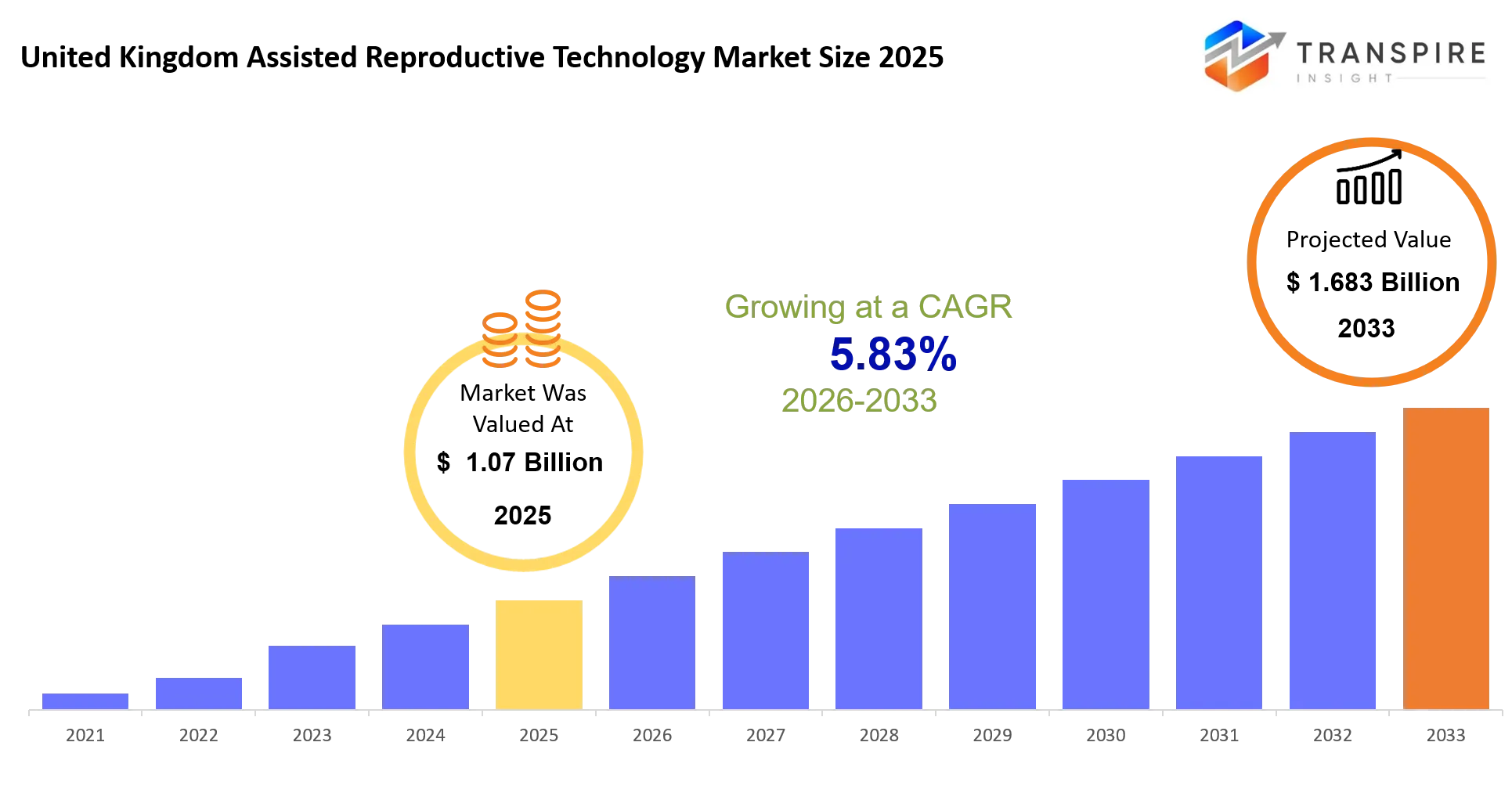
As per Transpire Insight Analysis the United Kingdom Assisted Reproductive Technology Market size is estimated at USD 1.07 Billion in 2025 and is anticipated to reach USD 1.683 Billion by 2033, growing at a CAGR of 5.83% from 2026 to 2033.
The United Kingdom assisted reproductive technology market kind of backs fertility clinics, hospitals, and specialized laboratories, helping people and couples deal with infertility, keep fertility safe before medical treatments, and also plan family building with more clinical detail than before. And it is not just about delivering treatment. The market lets healthcare providers tune embryo selection , speed up laboratory work, and support better patient results by using newer reproductive technologies plus more connected clinical workflows. So yeah this very real role has made assisted reproductive technology a big piece of today’s reproductive healthcare, in both public and private environments.
In the last three to five years, the whole market has moved toward data driven embryo evaluation , genetic testing, and automation inside embryology labs, instead of relying so much on more subjective methods. The whole COVID-19 pandemic disrupted fertility services, and that changed treatment paths, leaving a backlog of late procedures. After that, clinics started to expand capacity and modernize day to day operations. When procedure volumes came back up, providers put money into digital patient management tools and more advanced lab platforms to raise success rates while also coping with bigger caseloads. Taken together this modernization plus operational growth is supporting clinic revenues, pushing further investment in specialized fertility infrastructure, and widening access to advanced reproductive services across the United Kingdom.
United Kingdom Assisted Reproductive Technology Market Size & Forecast:
- United Kingdom Assisted Reproductive Technology Market Size 2025: USD 1.07 Billion
- Expected Market Value 2033: USD 1.683 Billion
- Forecast CAGR: 5.83%
- Leading region in 2025: United States
- Fastest Growing region: Canada
- Key Profile: CooperSurgical, Vitrolife, Merck KGaA, Cook Medical, Genea Biomedx, FUJIFILM Irvine Scientific, Hamilton Thorne, Esco Medical, Nidacon, Rocket Medical, Cryos International, Ferring Pharmaceuticals, IVFtech, Labotect, The Fertility Partnership
Key Market Insights
- Southern England kind of dominated the market in 2025 with roughly 42% share, backed by fairly dense fertility clinic networks and specialized reproductive labs which, honestly, makes sense if you think about logistics.
- Scotland is also projected to be the fastest-growing regional market during the forecast period, mainly because healthcare investment and specialist fertility capacity keep getting expanded bit by bit.
- When it comes to service type, in vitro fertilization (IVF) services really led things with close to 63% market share in 2025, largely because clinics pushed for additional advanced treatment cycles and stronger laboratory capabilities.
- Intracytoplasmic sperm injection (ICSI) stayed in the second spot for the service segment, with male infertility diagnosis going up across specialist fertility centres, and that naturally pulls demand.
- Fertility preservation services are forecast to show the fastest growth all the way through 2032, as elective egg freezing and oncology related preservation procedures continue to expand.
- For application type, infertility treatment applications held the largest share at about 74% in 2025, supported by better treatment completion rates and technology assisted clinical workflows which can feel a bit faster in practice.
- Fertility preservation applications are expected to see the quickest expansion over the forecast period, driven by broader elective adoption and medical uptake.
- Specialist fertility clinics accounted for nearly 68% market share in 2025, mostly because integrated laboratory infrastructure helps improve procedural efficiency and treatment success outcomes.
- Last, hospital-based fertility centres are projected to grow the fastest among end users through 2032, following continued investment in multidisciplinary reproductive medicine programmes; that kind of integrated approach tends to scale.
What are the Key Drivers, Restraints, and Opportunities in the United Kingdom Assisted Reproductive Technology Market?
The main growth driver is fast adoption of advanced embryo selection technologies, mixed with a broader uptake of preimplantation genetic testing. In practice, clinical evidence pointing to better implantation outcomes has basically pushed fertility providers to modernize their lab setup, not just casually, but in a very deliberate way. Digital imaging, automated embryo monitoring, and precision diagnostics have shortened the lab timelines, while also making treatment delivery more consistent. When clinics start showing stronger results, it naturally pulls in more patients. With more treatment cycles happening, clinic revenue rises, and that in turn supports further investment across the reproductive healthcare sector
The hardest restraint still looks like a high treatment cost, paired with uneven funding availability across NHS commissioning regions. To expand lab capacity, clinics end up needing costly equipment, specialist embryologists, and tight regulatory compliance processes. These kinds of structural limits don't flip quickly, because workforce preparation takes several years. From the Transpire Insight review of regional procurement updates and release timing , the supply chain concentration continues to be the main execution risk. Equipment procurement delays, plus staffing shortages, keep pushing out clinic expansion, which then reduces treatment capacity, and finally caps the possible revenue growth.
The best opportunity kind of sits in AI-driven reproductive medicine, fertility preservation too. There’s real momentum behind automated embryology labs, cloud based patient handling, and precision genetic analytics that actually lead to tangible operational upgrades. Meanwhile private healthcare organizations keep growing specialist fertility centers across parts that are still underserved. If fertility preservation happens earlier, helped by employer health benefits and oncology programs, then it should open up more treatment throughput while also strengthening the market over the longer run.
What Has the Impact of Artificial Intelligence Been on the United Kingdom Assisted Reproductive Technology Market?
Artificial intelligence an d digital tech are, kind of in a real way, transforming assisted reproductive services across the United Kingdom, by upping laboratory accuracy, giving workflow automation a bigger role, and helping with patient management. AI driven embryo imaging platforms can automatically track embryo development, sort morphological characteristics, and support embryologists with steadier decision guidance while also trimming down the amount of manual watching that has to happen. At the same time digital laboratory management systems automate quality checks, watch equipment status, and handle regulatory paperwork, which tends to make daily operations more uniform, and more compliant.
Machine learning models are also increasingly used to predict embryo viability, estimate the chance of treatment success, and suggest personalised stimulation plans. They do this by analysing large clinical datasets, which in turn helps clinicians tune treatment strategy, while lowering the odds of unnecessary procedures and making better use of lab capacity. Automated scheduling, electronic patient records, and connected lab platforms have shortened admin tasks, bumped laboratory throughput, and cut operational costs across busy high volume fertility centres. What’s more, smoother workflows make it easier for clinics to add extra treatment cycles without staffing growing in the same proportion.
Still, broad AI deployment is not fully smooth. It is held back by integration expenses, clinical data that is split into different silos, and the constant need for validation over time, and across different groups of patients. Laboratory protocol differences, plus limited interoperability between digital platforms, can reduce how well the algorithms perform in actual clinical settings. Ongoing funding for data standardisation and interoperable fertility technologies will likely decide how fast adoption moves forward.
Key Market Trends
- Since 2022, time-lapse embryo imaging kinda replaced the usual manual check in lots of big fertility centres, and it sort of improved lab consistency and the way clinical choices get made.
- Fertility preservation services also expanded pretty fast after 2021, because elective egg freezing, and oncology-related programmes, got more clinical traction, like more widely used.
- AI assisted embryo selection tools saw stronger commercial uptake from 2023 to 2026, and that helped embryologists standardise grading a bit more and streamline treatment workflows, in a clearer way.
- Private fertility providers accelerated their regional growth during 2024 and 2025 by opening extra satellite clinics that stayed connected to central embryology laboratories, in practice.
- Preimplantation genetic testing adoption kept rising because many clinics focused on boosting implantation success, while also cutting down on repeat treatment cycles.
- Digital patient engagement platforms became pretty much standard across major providers by 2025, which means remote consultations, treatment tracking, and electronic consent management all became normal.
- Lab automation investments reduced the need for a lot of manual handling, while also improving quality assurance and operational efficiency across high volume fertility facilities.
- Strategic partnerships between tech developers and fertility clinics sped up the rollout of advanced imaging, AI analytics, and connected lab platforms, after 2023.
- Workforce shortages pushed clinics to favour automated lab technologies, so they could grow treatment capacity without matching increases in specialist staffing, not exactly proportional.
United Kingdom Assisted Reproductive Technology Market Segmentation
By Procedure :
IVF takes the biggest share I think, mostly because fertility centres keep getting better at lab techniques, embryo culture methods, and also treatment planning. When clinical success rates go up, and when availability gets wider, then procedure volumes stay pretty steady in both private care and public care settings too. Next comes ICSI, which is another big procedure, especially because male infertility cases often need a more targeted fertilisation approach. Frozen embryo transfer is also really growing in popularity, the more clinics aim for flexible scheduling and improved embryo preservation.
Artificial insemination is still a solid option for the right clinical situations, since the procedural complexity is lower, so access becomes easier for more people. Other procedures then step in to handle specialised reproductive needs and to broaden treatment choices, especially when fertility conditions are more complex. Overall, continuous investment in lab technology and embryo handling methods should help procedural efficiency. And clinical innovation, even if it sounds simple, will still back balanced growth across every procedure category.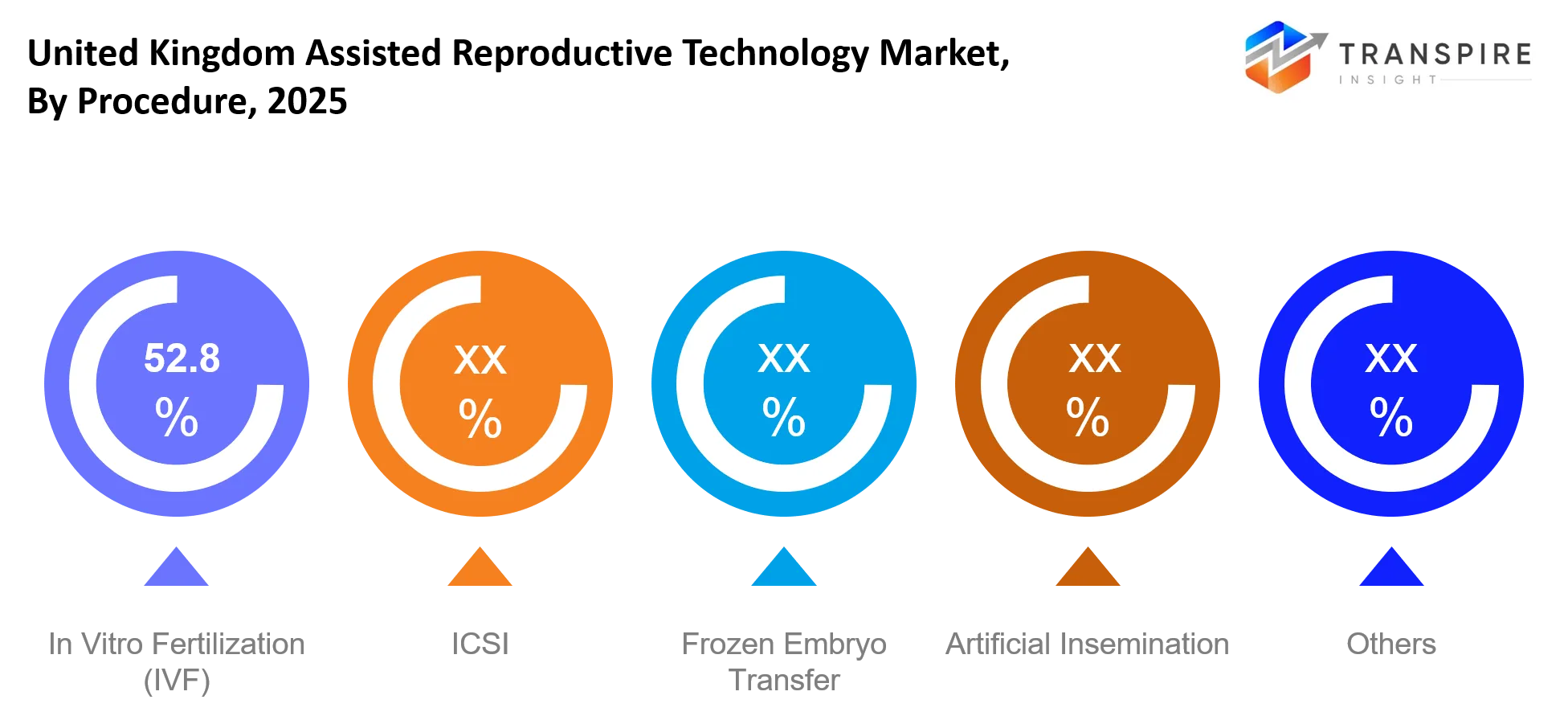
By Product :
Reagents make up a big part of the spend, mainly because each treatment cycle leans on dependable lab materials for fertilisation and embryo development, like everything is kind of, “needs to work or nothing happens”. Culture media matter a lot too, since they help maintain controlled embryo growth during the various stages of treatment. Consumables keep steady demand, because normal lab work means sterile items get replaced often, not just now and then. Instruments still stay crucial, as fertility centres invest in more advanced imaging systems , incubators, and laboratory automation, basically to see better and run faster.
Other products also back up specialised lab work and the quality assurance side of things. Nowadays, better lab infrastructure keeps pushing upgrades across long standing fertility centres. Larger treatment numbers will support continuous buying of lab supplies. And improvements in technology will open up extra chances across product categories.
By End User :
Fertility clinics end up leading the market because specialized reproductive services, experienced embryologists, and really dedicated lab facilities help cover the full treatment path way, or so it feels. Meanwhile hospitals keep expanding their reproductive medicine departments , to deliver more integrated fertility care next to the wider healthcare. Cryobanks stay important too ,mainly from secure storage of eggs, sperm and embryos, for later use in future treatment. Research institutes also add value by backing clinical studies and reproductive technology development, in a more or less steady way.
Other healthcare places offer extra reproductive services for particular patient groups, depending on needs and capacity. Increasing capacity across the specialist centers will improve treatment access over the next few years. Investment in lab quality plus digital systems will also strengthen how operations run, day to day. With broader service availability, the market development should keep moving in a sustainable direction.
By Patient Type :
Female infertility basically ends up being the largest patient category, because a bunch of reproductive conditions end up needing assisted fertility treatment, so it stacks up. Male infertility also counts for a big portion since better diagnostic methods are now catching more clinical cases that then need advanced procedures, like ICSI. Unexplained infertility keeps creating steady demand too, because after the usual investigations people still may not find a clear medical cause . Early diagnosis then helps a lot with clinical planning, across these different patient groups, in a more orderly way.
Other patient categories show up as well, especially where reproductive situations are more complicated and a personalised approach is needed. Diagnostic technologies are improving, which should help with more accurate treatment selection. If fertility services expand, access to specialised reproductive care should get easier. And clinical advancements, overall, will support stronger outcomes across the range of patient categories.
By Age Group :
In the 30–39 years age group is where the biggest share sits, mostly because lots of fertility treatments happen during this stage of family planning. Under 30 still shows up as a smaller but steady segment, mostly bolstered by medical fertility preservation and a chosen set of infertility cases, you know. Over 40 keeps growing too , as more advanced reproductive techniques make treatment possibilities feel more reachable for older patients. Age-specific treatment planning helps clinicians make clearer decisions, or at least better ones.
Other age categories also include patients with particular reproductive healthcare needs. Fertility preservation services will still back younger adults who are going through medical treatments that can affect reproductive health. More advanced lab methods will keep improving the treatment options across a broader range of age groups. Personalised clinical care will also stay a key factor for treatment success.
By Cycle Type :
Fresh cycles still kind of represent an important treatment option, because in selected patients there can be immediate embryo transfer right after fertilisation. Frozen cycles keep on expanding thanks to improved cryopreservation techniques, these methods actually help clinical planning and make flexibility easier. Better embryo survival after thawing has pushed a wider adoption across specialist fertility centres, even when people think it might be narrower. Clinical evidence keeps getting stronger, so confidence in frozen embryo transfer keeps growing .
Other cycle types also help match individual treatment requirements, based on medical assessment and not just a one size fit all idea. Lab improvements will raise overall efficiency across the various treatment pathways. Ongoing investment in cryopreservation technology should support continued growth of cycles in the coming years. A balanced use between fresh and frozen approaches should improve the broader treatment flexibility overall.
What are the Key Use Cases Driving the United Kingdom Assisted Reproductive Technology Market?
Most of the demand kind of piles in from infertility treatment, w ith in vitro fertilization (IVF) being the main application, across fertility clinics ,and hospital based reproductive centers. People facing age related infertility, male factor issues, and unexplained fertility troubles show up with the biggest procedure counts, and this is backed by rising clinical success results plus broader uptake of more advanced reproductive technologies.
Then there’s extra pull coming from fertility preservation services, especially for oncology patients, and for folks who are postponing parenthood for career or personal reasons. Services like donor egg, donor sperm, and embryo options are also growing, largely because licensed fertility centers can handle more complicated reproductive requirements, and because family structures are changing too.
Looking further ahead, longer term chances are showing up in preimplantation genetic testing for embryo choice and AI assisted embryo evaluation. More frequent use of reproductive technologies among single parents and same sex families, together with shifting regulatory direction and precision reproductive care, will open up new routes for specialized fertility service providers during the forecast window.
|
Report Metrics |
Details |
|
Market size value in 2025 |
USD 1.07 Billion |
|
Market size value in 2026 |
USD 1.132 Billion |
|
Revenue forecast in 2033 |
USD 1.683 Billion |
|
Growth rate |
CAGR of 5.83% from 2026 to 2033 |
|
Base year |
2025 |
|
Historical data |
2021 - 2024 |
|
Forecast period |
2026 - 2033 |
|
Report coverage |
Revenue forecast, competitive landscape, growth factors, and trends |
|
Regional scope |
United Kingdom (England, Scotland, Wales, Northern Ireland) |
|
Key company profiled |
CooperSurgical, Vitrolife, Merck KGaA, Cook Medical, Genea Biomedx, FUJIFILM Irvine Scientific, Hamilton Thorne, Esco Medical, Nidacon, Rocket Medical, Cryos International, Ferring Pharmaceuticals, IVFtech, Labotect, The Fertility Partnership . |
|
Customization scope |
Free report customization (country, regional & segment scope). Avail customized purchase options to meet your exact research needs. |
|
Report Segmentation |
By Procedure (IVF, ICSI, Frozen Embryo Transfer, Artificial Insemination, Others); By Product (Instruments, Reagents, Media, Consumables, Others); By End User (Fertility Clinics, Hospitals, Cryobanks, Research Institutes, Others); By Patient Type (Male Infertility, Female Infertility, Unexplained Infertility, Others); By Age Group (Below 30 Years, 30–39 Years, Above 40 Years, Others); By Cycle Type (Fresh Cycles, Frozen Cycles, Others) |
Which Regions are Driving the United Kingdom Assisted Reproductive Technology Market Growth?
South East England kinda runs the United Kingdom Assisted Reproductive Technology Market, with an estimated 38% of the whole revenue share. The area tends to have a fairly dense cluster of licensed fertility clinics, plus solid National Health Service referral pathways, and this well-established regulatory oversight that helps keep treatment levels pretty consistent. You also see academic hospitals and private fertility providers, then research institutions, and even specialized laboratory suppliers, all feeding into one reproductive healthcare ecosystem. If we keep seeing investment into newer laboratory technologies, and patient interest staying high , then this region should keep that top position across the forecast window.
London is next, the second-largest regional market, and it’s notable because it has lots of private fertility services , aimed at domestic and international patients rather than covering every area in a broad geographic sense. Eligible patients often get stable reimbursement terms, there are higher disposable incomes, and healthcare investment stays steady, which together supports dependable procedure volumes. On top of that, the region pulls in fertility specialists, embryologists, and international partnerships that reinforce clinical know-how. Because of these setup advantages, London remains a dependable generator of recurring revenue, even if the operating costs are higher.
Scotland is projected to see the fastest growth over the forecast period. The expanded investment in reproductive healthcare infrastructure, plus better access to fertility services, and more general awareness of fertility preservation has really pushed up treatment uptake across the region. There is also more collaboration between public healthcare providers and specialized fertility clinics, which is helping services expand beyond the big city areas. This overall momentum is basically creating attractive openings for technology suppliers, laboratory equipment manufacturers and fertility service providers that want to grow between 2026 and 2033.
Who are the Key Players in the United Kingdom Assisted Reproductive Technology Market and How Do They Compete?
In the United Kingdom Assisted Reproductive Technology market competition is kind of moderately consolidated, with well established fertility clinic groups competing next to specialized independent providers , and honestly it’s not just about price. It’s more about technology know-how, clinical success outcomes, the lab’s real expertise, plus how patients get treated day to day. Most existing providers keep pushing their positions by investing in newer embryology tools, digital patient engagement , and broader treatment menus. At the same time specialist clinics tend to lean into personalized care and more niche reproductive services, rather than trying to outbid everyone.
CARE Fertility differentiates itself with a wide nationwide clinic presence, investment in embryo assessment technologies, and research partnerships that help maintain high clinical benchmarks. IVI RMA Global competes by blending global reproductive medicine experience with advanced genetic testing, and consistent laboratory protocols while also expanding via cross-border knowledge sharing. Bourn Hall Clinic puts emphasis on clinical innovation, fertility preservation, and individualized treatment pathways backed by decades of reproductive medicine practice. The Lister Fertility Clinic supports its position through specialist consultant teams, advanced diagnostic capabilities , and access to multidisciplinary healthcare services, all within a premium clinic environment. CREATE Fertility competes using mild IVF treatment protocols that aim to offer tailored options, and ongoing investment in digital consultations plus patient-centered care helps improve accessibility across the United Kingdom.
Company List
Vitrolife
Cook Medical
FUJIFILM Irvine Scientific
Hamilton Thorne
Nidacon
Rocket Medical
Cryos International
Ferring Pharmaceuticals
IVFtech
Labotect
The Fertility Partnership
Recent Development News
In April 2025, The Wyatt Foundation and The Conceive Fertility Foundation launched the 2025 IVF Grant Program, with CooperSurgical joining as a funding partner to support preimplantation genetic testing (PGT) with ICSI. The initiative improves access to assisted reproductive treatment by reducing financial barriers for IVF patients and encouraging adoption of advanced fertility services. Sourcehttps://www.prnewswire.com/
In December 2025, IVFmicro, a University of Leeds spin-out, secured £3.5 million in funding led by Northern Gritstone, with support from Innovate UK, to commercialize its microfluidic embryo culture technology. The investment will accelerate development of next-generation IVF systems designed to improve embryo quality and pregnancy outcomes, supporting innovation within the United Kingdom assisted reproductive technology ecosystem.
Source https://www.thetimes.com/
What Strategic Insights Define the Future of the United Kingdom Assisted Reproductive Technology Market?
The United Kingdom Assisted Reproductive Technology Market is kinda moving toward a more technology intensive, and personalized care model , pushed by delayed parenthood, wider fertility preservation demand, and ongoing improvements in embryo selection lab automation, and reproductive genetics. The growth part will depend more and more on clinical efficiency and outcomes you can actually measure, not just on doing more procedures.
There is also a less obvious risk, like uneven access to care because of regional funding differences and shifting regulatory rules, which might funnel demand toward a smaller set of big fertility providers and, in turn, lower competitive variety.
At the same time, there is a real chance showing up: the merging of artificial intelligence with time lapse embryo imaging, plus data driven treatment planning, especially as digital healthcare infrastructure keeps getting more mature. Market players should focus on teaming up with technology developers , and they should invest in lab capabilities that can scale—so success rates get better while access expands in less served areas, across the forecast period.
United Kingdom Assisted Reproductive Technology Market Report Segmentation
By Procedure
- IVF
- ICSI
- Frozen Embryo Transfer
- Artificial Insemination
By Product
- Instruments
- Reagents
- Media
- Consumables
By End User
- Fertility Clinics
- Hospitals
- Cryobanks
- Research Institutes
By Patient Type
- Male Infertility
- Female Infertility
- Unexplained Infertility
By Age Group
- Below 30 Years
- 30–39 Years
- Above 40 Years
By Cycle Type
- Fresh Cycles
- Frozen Cycles
Frequently Asked Questions
Find quick answers to common questions.
The Expected United Kingdom Assisted Reproductive Technology Market size for the Market will be USD 1.683 Billion in 2033.
Key Segments for the United Kingdom Assisted Reproductive Technology Market are By Procedure (IVF, ICSI, Frozen Embryo Transfer, Artificial Insemination, Others); By Product (Instruments, Reagents, Media, Consumables, Others); By End User (Fertility Clinics, Hospitals, Cryobanks, Research Institutes, Others); By Patient Type (Male Infertility, Female Infertility, Unexplained Infertility, Others); By Age Group (Below 30 Years, 30–39 Years, Above 40 Years, Others); By Cycle Type (Fresh Cycles, Frozen Cycles, Others).
Major United Kingdom Assisted Reproductive Technology Market players are CooperSurgical, Vitrolife, Merck KGaA, Cook Medical, Genea Biomedx, FUJIFILM Irvine Scientific, Hamilton Thorne, Esco Medical, Nidacon, Rocket Medical, Cryos International, Ferring Pharmaceuticals, IVFtech, Labotect, The Fertility Partnership.
The Current United Kingdom Assisted Reproductive Technology Market size is USD 1.07 Billion in 2025.
The United Kingdom Assisted Reproductive Technology Market CAGR is 5.83% from 2026 to 2033.
CooperSurgical
Vitrolife
Merck KGaA
Cook Medical
Genea Biomedx
FUJIFILM Irvine Scientific
Hamilton Thorne
Esco Medical
Nidacon
Rocket Medical
Cryos International
Ferring Pharmaceuticals
IVFtech
Labotect
The Fertility Partnership
About the Authors

Pankaj Ghogare Patil
I am Pankaj Ghogare Patil, a Senior Research Analyst at Transpire Insight, specializing in the Pharmaceutical, Chemicals & Materials, Healthcare IT, and Biotechnology industry. My expertise lies in conducting comprehensive market research, analyzing industry trends, evaluating competitive landscapes, and translating complex data into actionable insights. At Transpire Insight, I closely follow emerging technologies, regulatory developments, and market innovations to create accurate, well-researched, and informative content that helps businesses and professionals make informed decisions. I am committed to producing credible, evidence-based articles that reflect industry best practices while making technical topics accessible and valuable for a broad audience.

Chakradhar Khansole
Chakradhar serves as the Research Director at Transpire Insight, bringing over 8 years of experience in technology, innovation, and strategic market intelligence. He specializes in transforming complex market data into actionable business insights that enable organizations to make informed, growth-oriented decisions. Recognized for his strategic vision and analytical expertise, Chakradhar leads high-impact research initiatives, delivering comprehensive market assessments, competitive intelligence, and forward-looking industry analysis.
Recently Published Reports
-
Jul 2026
Alopecia Treatment Market
Alopecia Treatment Market Size, Share & Analysis Report By Disease Type (Alopecia Areata, Cicatricial Alopecia, Traction Alopecia, Alopecia Totalis, Androgenetic Alopecia, Alopecia Universalis, and Other Disease Types), By Treatment Type (Topical Treatments, Oral Medications, Injectable Therapies, and Hair Transplantation), By Gender (Male, and Female), By Distribution Channel (Hospitals and Clinics, Retail Pharmacies, and Online Retailers), and Geography (North America, Europe, Asia-Pacific, Middle East and Africa, South and Central America), 2021 - 2031
-
Jul 2026
Medical Ultrasound Probe Market
Medical Ultrasound Probe Market Size, Share & Analysis Report By Type (Linear Type, Convex Type, Endocavitary Probe, Phased Array/Cardiac Probe, Transesophageal (TEE) Probe, and Others), By Application (Ophthalmology, Cardiology, Musculoskeletal, Oncology, Obstetrics & Gynecology, General Imaging, and Others), By End User (Hospitals & Clinics, Diagnostic Centers, Ambulatory Surgical Centers, and Others), and Geography (North America, Europe, Asia-Pacific, Middle East and Africa, South and Central America), 2021 – 2031
-
May 2026
Biosimilars Market
Biosimilars Market By Product Type (Monoclonal Antibodies, Recombinant Hormones, Erythropoietin, G-CSF, Others), By Indication (Oncology, Autoimmune Diseases, Blood Disorders, Diabetes, Others), By Manufacturing Type (In-House Manufacturing, Contract Manufacturing), By Distribution Channel (Hospital Pharmacies, Retail Pharmacies, Online Pharmacies), By Industry Analysis, Size, Share, Growth, Trends, and Forecasts 2021-2033
-
Apr 2026
Gastrointestinal Endoscopy Market
Gastrointestinal Endoscopy Market By Type (Rigid Gastrointestinal Endoscope, Flexible Gastrointestinal Endoscopes, Disposable Gastrointestinal Endoscope), By Procedure Type (Colonoscopy, Gastroscopy, Duodenoscopy, Enteroscopy, Flexible Sigmoidoscopy, Others), By Application (Diagnosis, Treatment), By End-Users (Hospitals, Ambulatory Surgical Centers, Specialty Clinics, Laboratories, Others), By Industry Analysis, Size, Share, Growth, Trends, and Forecasts 2021-2033