Transportation and Logistics Market Summary:
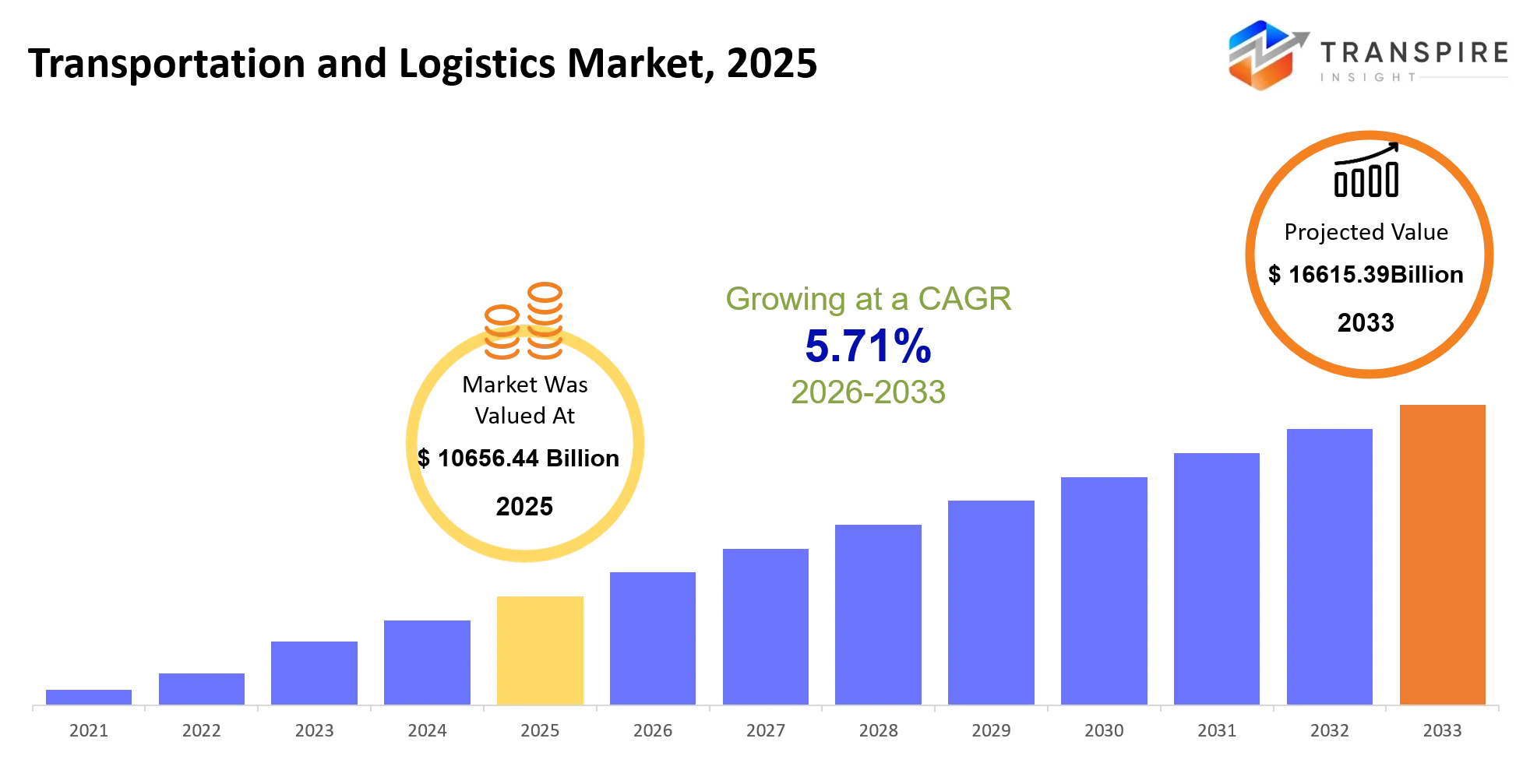
As per Transpire Insight Analysis, the Transportation and Logistics Market size is estimated at USD 10656.44 billion in 2025 and is anticipated to reach USD 16615.39 billion by 2033, growing at a CAGR of 5.71% from 2026 to 2033.
The Transportation and Logistics Market supports moving materials, finished products and items that people buy from one place to another, both inside a country and across the world. Over the years, the industry has stopped using just old ways of moving goods and started using technology to make things better. Companies are now putting money into automated warehouses, checking where their products are at any moment and using tools to manage shipping. The growth of shopping and new ways of trading between countries have made it more important to have flexible ways to move things. A big change is the use of logistics systems that bring together moving goods, storing them and delivering them all in one place. Problems in the flow of goods have made companies want to get supplies from different places and make their delivery systems stronger. These changes are helping the market grow because more and more companies are depending on transportation services to keep costs under control, deliver things faster, and make sure everything keeps moving.
Transportation and Logistics Market Size & Forecast:
- Market Size 2025: USD 10656.44 Billion
- Expected Market Value (2033): USD 16615.39 Billion
- Forecast CAGR (2026–2033): 5.71%
- Leading Region in 2025: Asia Pacific
- Fastest Growing Region: Asia Pacific
- Key Company Profiles: DHL, UPS, FedEx, Maersk, Kuehne+Nagel, DSV, DB Schenker, C.H. Robinson, XPO, GXO Logistics, Nippon Express, Expeditors, J.B. Hunt, Ryder System, CEVA Logistics
Key Market Insights:
The market is moving towards integrated supply chain activities, digitised freight management, and new demands in international trade.
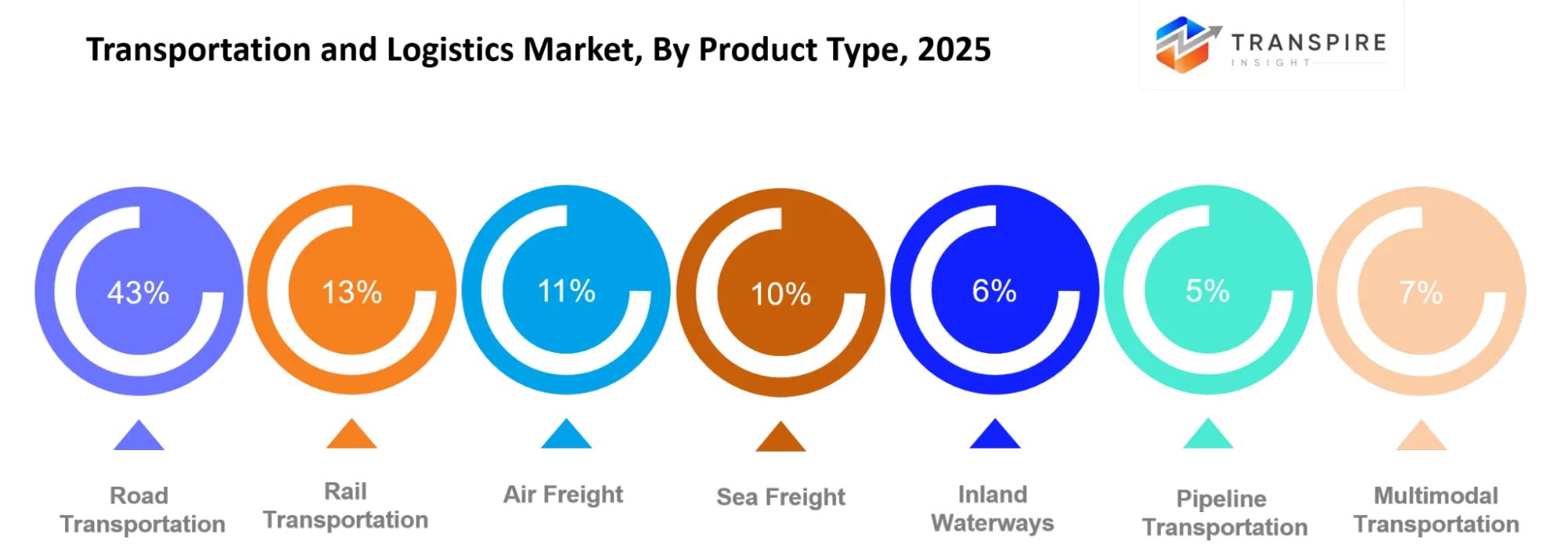
- Road transport holds 48.0% of the market due to the versatility of freight carriage and last-mile delivery capabilities.
- Rail transportation accounts for 13.0% of the market, with rail carriers concentrating on cargo capacity, intermodal solutions, and increased efficiency in cargo carriage across long distances.
- Sea freight accounts for 10.0% of the market, with shipping companies improving their fleet and port connections and the digitalisation of cargo management processes.
- Inland waterways take up 6.0% of total transport operations and offer an alternative means of transporting bulk cargo through the existing waterways.
- Multimodal transportation comprises 7.0% of the market and reflects increasing interest in using road, rail, sea and air networks for freight carriage.
- Pipeline transportation represents 5.0% of the market and offers unique solutions for the transportation of petroleum, natural gas, and compatible cargo.
What are the Key Drivers, Restraints, and Opportunities in the Transportation and Logistics Market?
Drivers
The growing trends of cross-border and e-commerce trading are posing high demands for reliable freight logistics, warehousing, and last-mile delivery. The fast pace of shopping has forced retailers to build bigger distribution chains and shorter delivery times. This situation drives logistics suppliers to make investments in automated fulfilment centres, transport management systems, and integrated transport services, enabling them to carry large shipments and services.
Restraints
There is still a problem of high operating expenditure for the transportation and logistics industry. Changing fuel prices, transport servicing, labour costs, infrastructure problems, and regulatory compliance pose additional costs on the business. For smaller logistics companies, this problem is especially challenging due to small amounts of available funds for investing into upgraded transport fleets, software, and operations in different regions.
Opportunities
Digital freight solutions, warehouse automation, and environmentally friendly Air Freight transportation provide new-market opportunities. Logistics companies are able to have tighter control over the movement of goods, make better use of transportation assets, and reduce excess transportation costs through connectivity. The fast-growing manufacturing and consumer markets in Asia-Pacific present promising opportunities for warehousing, delivery, and logistics services in cross-border trade.
|
Driver |
Relative Impact on Growth (%) |
Geographic Relevance |
Impact Timeline |
Demand Strength |
Growth Mechanism (5–10 words) |
Key Beneficiaries (5–10 words) |
Major Constraint (5–10 words) |
|
Expansion of E-commerce and Cross-Border Trade |
27% |
Asia Pacific, North America, Europe |
Short-term |
High |
Rising online orders increase freight and parcel shipments. |
E-commerce platforms, courier companies, freight forwarders, retailers. |
High delivery costs and cross-border customs complexities. |
|
Increasing Investment in Transportation and Logistics Infrastructure |
23% |
Asia Pacific, North America, Middle East |
Long-term |
High |
Port expansion and road upgrades improve cargo movement. |
Port operators, infrastructure developers, shipping companies, logistics providers. |
High capital expenditure and lengthy project completion periods. |
|
Supply Chain Diversification and Resilience Strategies |
20% |
North America, Europe, Asia Pacific |
Medium-term |
High |
Supplier diversification increases demand for flexible logistics networks. |
Freight forwarders, shipping lines, warehouse operators, manufacturers. |
Geopolitical uncertainty and fragmented international trade regulations. |
|
Digitalization, AI and Automation in Logistics Operations |
17% |
North America, Europe, Asia Pacific |
Medium-term |
High |
AI improves routing, inventory visibility and delivery efficiency. |
Technology vendors, logistics operators, fleet owners, freight forwarders. |
Integration costs and cybersecurity risks limit adoption. |
|
Growing Demand for Sustainable Transportation and Green Logistics |
13% |
Europe, North America, Asia Pacific |
Long-term |
High |
Emission regulations accelerate adoption of cleaner transport solutions. |
Electric vehicle manufacturers, shipping companies, green logistics providers. |
High transition costs and limited alternative-fuel infrastructure. |
|
Total |
100% |
— |
— |
— |
— |
— |
— |
What Has the Impact of Artificial Intelligence Been on the Transportation and Logistics Market?
AI is changing the transportation and logistics industry in terms of shipment management, optimisation of routing and resource allocation. Logistics service providers utilise AI technology for analysing traffic patterns, schedule of deliveries, fuel consumption, and available vehicles before choosing the routes of delivery. These technologies help to reduce unnecessary transportation, optimise the use of fleets, and ensure regular delivery of cargo. Moreover, predictive analytics based on AI technologies allows predicting shipment delays, equipment failures, and warehouse needs. In terms of warehouse management, the utilisation of automation through AI technologies will enable the identification, sorting, and selection of orders, making it possible for distribution centres to manage larger amounts of cargo. AI technology can be used in customer service portals to provide information about shipments, answer standard questions, and optimise delivery communication. An example of cooperation between DHL and Alibaba.com that was made demonstrates how AI-powered commerce platforms can connect shipping quotations, booking and shipment fulfilment for international businesses. Utilisation of these technologies requires significant investments, reliable operational data, and integration into the logistics framework. Small companies on the market may face difficulties with the implementation of such AI systems due to these factors.
Instance
In March 2026,This logistics firm scaled up its AI-powered logistics network with hundreds of interconnected AI agents to automate planning, freight matching, pricing, appointment booking, and tracking. According to its report, the shipments optimised with AI moved 11% faster than average to market and had 7% higher on-time pickups, which suggests AI's role in improving logistics efficie15.
Key Market Trends:
Market is shifting towards transportation and logistics services are making gradual moves away from traditional modes of freight transportation into a more connected supply chain system driven by data.
- The increase in e-commerce activities and the rise in deliveries have led firms to invest in enhancing their fulfilment centres, parcel sorting, and distribution operations.
- Increased order volume processing requires automated warehouses for picking, sorting and inventory control by enterprises.
- Businesses are beginning to utilize different modes of transport such as roads, railways, sea and air to make their deliveries more flexible and reduce risks associated with single transport logistics operations.
- The use of GPS tracking and Internet of Things technologies in monitoring the movement of vehicles and delivery processes has become more common among businesses.
- Supply chain disruptions are leading more manufacturing firms to diversify sources of materials and add other distribution centers rather than relying only on logistics routes.
- Environmental concerns have become the basis for firms to invest in fleet management of environmentally friendly transport solutions.
Transportation and Logistics Market Segmentation
By Mode
road transport leads the market share at 48.0%, owing to its ability to link manufacturing plants, warehouses, retail stores, and customers. It can be used for both short- and long-distance haulage. Rail transport captures 13.0%, while air transport takes up 11.0%, due to bulk cargo and time-sensitive goods, respectively. The market share of sea transport is 10.0%, multimodal transport is 7.0%, inland waterway is 6.0%, while pipeline transport is 5.0%. Increasing investment in intermodal links and transportation infrastructure is expected to enhance transportation efficiency.
By Service Type
Freight transport continues to remain an important service since it involves transporting the cargo manufactured by producers or distributors to consumption points. Warehousing and freight forwarding services are becoming increasingly important since firms are looking for better management of inventories and coordination of international shipments. Last-mile delivery and courier & express delivery services will benefit from increased online retailing and shorter delivery timelines. Customs brokerage and value-added logistics will become important for firms handling complex cross-border supply chain operations.
By End User
Industrial manufacturing is another key provider of logistics demand, as industrial firms consistently move raw materials, parts, and finished goods. Retail and e-commerce companies are expanding demand for fulfilment centres, parcel delivery, and reverse logistics as consumers' buying habits evolve. Vehicles and other products need dedicated vehicles and shipping capabilities in the automotive industry, while transportation for heavy machinery, industrial products, and customs goods is vital to the construction and energy sectors. Unique requirements of each industry should continue to generate additional potential revenue streams for logistics operators.
By Transport Type
Domestic transport involves the transport of goods between cities within the same country, whereas international and cross-border transportation involves transportation between countries, thus linking companies with foreign traders. Long-haul transport is used to transport goods between far-away industrial and commercial centres, and short-haul and urban transportation is used for the distribution of goods within regions and between urban centres. Intermodal transportation is gaining traction as it involves transporting goods using two or more different modes of transportation in the same supply chain.
By Technology
Digital technologies such as transportation management systems and warehouse management systems are increasingly becoming critical enablers of freight and inventory coordination. IoT tracking supports visibility and shipment tracking, while artificial intelligence and analytics can be applied to transportation demand planning, network operations, and other cargo and inventory management decisions. Blockchain has potential applications in shipment documentation and transaction transparency. Autonomous vehicles and digital freight platforms are also drawing the attention of logistics providers seeking to increase capacity utilization and automate manual coordination. Further investments in digital technologies are likely to support growing technology adoption within the logistics network.
By Business Model
This remains an important operating model as businesses can outsource aspects of transportation, warehousing and distribution to third-party logistics (3PL) providers. Fourth-party logistics (4PL) providers might coordinate the supply chain involving a number of logistics providers. Asset-based operators will have transportation and storage infrastructure controlled by the provider, while non-asset-based providers will coordinate transportation and warehousing activity via an external network. Contract logistics and integrated logistics providers tend to foster long-term customer relationships compared with spot logistics providers, while an increased degree of outsourcing and customised supply chain management is expected to buoy the models.
What are the Key Use Cases Driving the Transportation and Logistics Market?
Roadway transportation is used to transport materials, consumer goods, and finished goods among factories, distributors, retailers, and customers. The new applications being considered by the road segment include international freight forwarding, temperature-controlled healthcare shipping, distribution of automotive parts, and online retail fulfilment. Such logistics services will need coordinated warehousing and delivery of goods from warehouses through shipping. Upcoming applications being considered for the road transport business sector include intelligent scheduling of fleets through AI, automation of warehouse operations, digital booking of shipments, and multimodal connected freight transportation.
|
Report Metrics |
Details |
|
Market size value in 2025 |
USD 10656.44 Billion |
|
Market size value in 2026 |
USD 11264.95 Billion |
|
Revenue forecast in 2033 |
USD 16615.39 Billion |
|
Growth rate |
CAGR of 5.71% from 2026 to 2033 |
|
Base year |
2025 |
|
Historical data |
2021 - 2024 |
|
Forecast period |
2026 - 2033 |
|
Report coverage |
Revenue forecast, competitive landscape, growth factors, and trends |
|
Regional scope |
United States; Canada; Mexico; United Kingdom; Germany; France; Italy; Spain; Denmark; Sweden; Norway; China; Japan; India; Australia; South Korea; Thailand; Brazil; Argentina; South Africa; Saudi Arabia; United Arab Emirates |
|
Key company profiled |
DHL, UPS, FedEx, Maersk, Kuehne+Nagel, DSV, DB Schenker, C.H. Robinson, XPO, GXO Logistics, Nippon Express, Expeditors, J.B. Hunt, Ryder System, CEVA Logistics |
|
Customization scope |
Free report customization (country, regional & segment scope). Avail customized purchase options to meet your exact research needs. |
|
Report Segmentation |
Mode (Road Transportation, Rail Transportation, Air Freight, Sea Freight, Inland Waterways, Pipeline Transportation, Multimodal Transportation); Service Type (Freight Transportation, Warehousing, Freight Forwarding, Courier & Express, Last-Mile Delivery, Customs Brokerage, Value-Added Logistics); End User (Manufacturing, Retail & E-Commerce, Automotive, Healthcare, Food & Beverage, Construction, Energy); Transport Type (Domestic, International, Cross-Border, Long-Haul, Short-Haul, Urban, Intermodal); Technology (TMS, WMS, IoT Tracking, AI & Analytics, Blockchain, Autonomous Vehicles, Digital Freight Platforms); Business Model (3PL, 4PL, Asset-Based, Non-Asset-Based, Integrated Logistics, Contract Logistics, Spot Logistics) |
Which Regions are Driving the Transportation and Logistics Market Growth?
North America
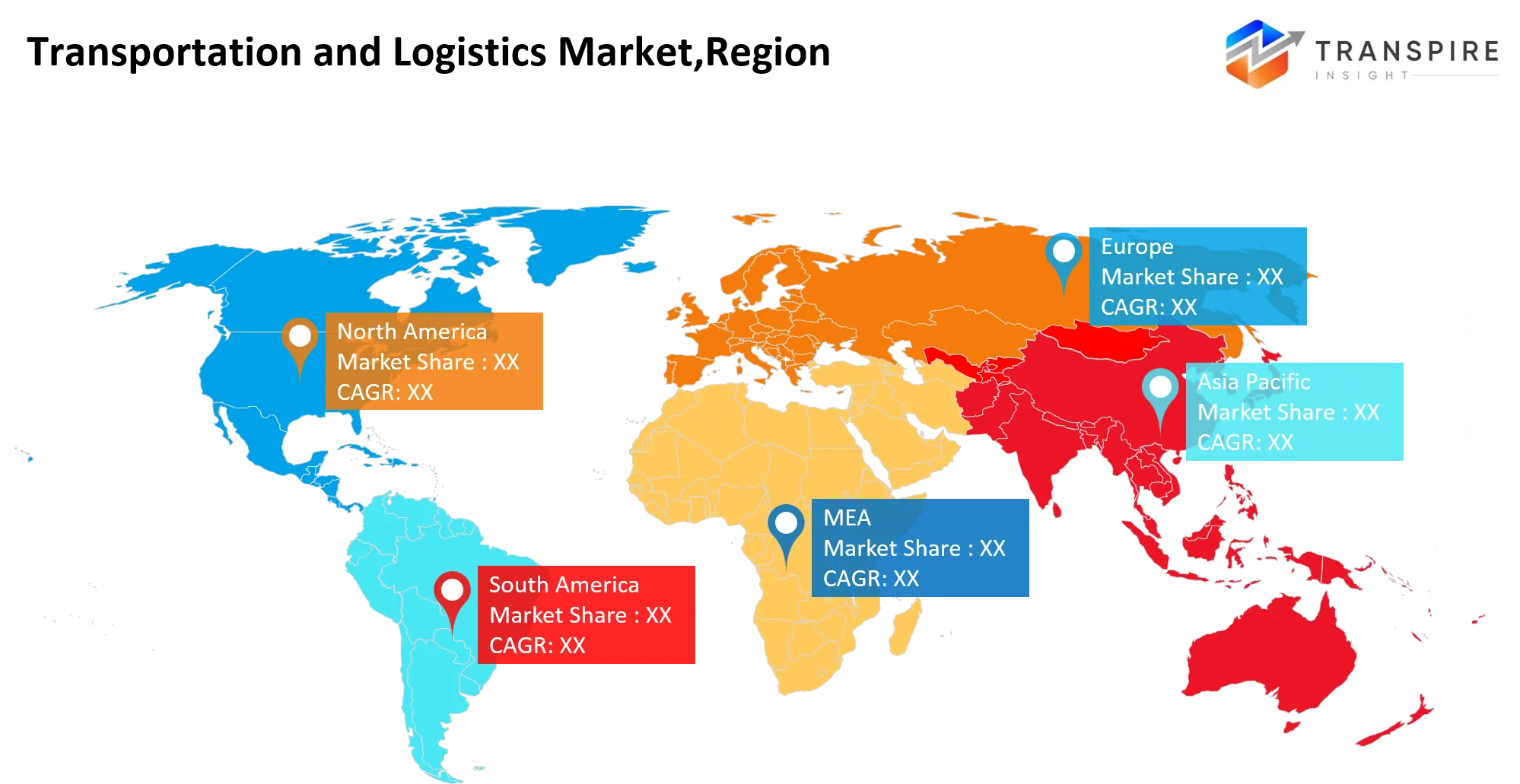
North America constitutes 25.0% of the Transportation and Logistics Market. It has a well-established freight infrastructure and large distribution networks. It has good road and rail transport links, warehouses, and logistics service providers. Trade among the United States, Canada, and Mexico leads to steady demand for freight forwarding and integrated transport services. Warehouse automation, digital freight management, and supply chain visibility contribute to the development of the regional market.
In March 202, DHL Supply Chain launched 10 dedicated logistics facilities with over 7 million sq. ft. of warehousing space to cater to increasing demand for data centre logistics, enhancing warehousing and distribution capability in North America.
Europe
Europe accounts for 22.0% of the market, and its transport network is based on developed road infrastructure, trade connections, and rail and maritime freight services. In contrast to North America, cross-border movements in Europe significantly influence logistics operations due to the presence of interconnected national markets. Focus on efficient transportation, environmental sustainability of the environment, and sustainable freight transportation motivates companies to invest in the modernisation of fleets and alternative transportation options. Rail freight, intermodal terminals, and low-emission logistics will contribute to the maintenance of the market position in the region.
In April 2026, CEVA Logistics rolled out 165 new DAF trucks as part of its investment in the UK road freight network. The majority of the trucks will be running on HVO fuel, aiding in freight capacity expansion and reducing emission from transport.
Asia Pacific
The Asia-Pacific region dominates the Transportation and Logistics Market, having a market share of 41.5%, due to the large presence of the manufacturing industry, development of the e-commerce segment, and rising international trade. The countries contributing to the market include China, India, Japan, and South Korea, owing to manufacturing activity, exports, and high demand for domestic transportation. Infrastructure development, expansion of ports, and improvement in road/rail connectivity will improve freight transport facilities in the region. Growth in manufacturing clusters and e-commerce will provide more opportunities for logistics services.
In March 2026,Maersk launched its 1.1 million sq. ft. World Gateway II facility in Singapore, integrating automated storage and robotic technology into the facility.
Who are the Key Players in the Transportation and Logistics Market and how do they compete?
This market of Transportation and Logistics is quite competitive and differentiated on the basis of transportation networks, international freight, technology implementation and supply chain management solutions. The companies involved in this market include DHL Group, FedEx Corporation, United Parcel Service (UPS), A.P. Moller-Maersk, DSV, Kuehne+Nagel, C.H. Robinson, DB Schenker, GXO Logistics, and CMA CGM. In the industry, the competition is now based on service dependability, geography, efficiency, and the ability to provide logistics solutions on an end-to-end basis. DHL Group focuses on logistics services that include contract logistics, international freight forwarding, and supply chain management solutions. A wide warehousing network and the implementation of technologies set DHL apart. Robinson provides unique transportation management and freight brokerage services. The firms that operate in this market use innovation and alliances to expand geographically and through acquisitions.
Transportation and Logistics Market companies
- DHL
- UPS
- FedEx
- Maersk
- Kuehne+Nagel
- DSV
- DB Schenker
- C.H. Robinson
- XPO
- GXO Logistics
- Nippon Express
- Expeditors
- J.B. Hunt
- Ryder System
- CEVA Logistics
|
Company |
Est. Revenue Share Range |
Key Offerings |
Strategic Positioning |
Geographic Strength |
Technology Focus |
|
DHL Group |
Estimated 4.0–6.0% |
Express delivery, freight forwarding, contract logistics, e-commerce logistics |
Integrated logistics leadership through diversified services |
Europe, North America, Asia Pacific |
AI-driven logistics, warehouse automation, predictive analytics, IoT |
|
United Parcel Service (UPS) |
Estimated 4.0–6.0% |
Parcel delivery, international shipping, healthcare logistics, supply chain management |
Premium parcel network with integrated healthcare logistics specialization |
North America, Europe, Asia Pacific |
Route optimization, automated sorting, real-time shipment visibility |
|
FedEx Corporation |
Estimated 4.0–6.0% |
Express transportation, freight services, international shipping, e-commerce delivery |
Time-definite delivery leadership supported by extensive air networks |
North America, Asia Pacific, Europe |
AI routing, predictive delivery analytics, automated sorting systems |
|
DSV A/S |
Estimated 2.0–3.0% |
Air freight, sea freight, road transportation, contract logistics |
Asset-light logistics scale following Schenker acquisition |
Europe, North America, Asia Pacific |
AI-powered planning, digital freight platforms, transport management systems |
|
A.P. Moller–Maersk |
Estimated 2.0–4.0% |
Container shipping, inland transportation, air freight, integrated logistics |
End-to-end supply chain integration through maritime infrastructure |
Asia Pacific, Europe, North America |
Digital supply chain platforms, cargo visibility, automated port operations |
|
CMA CGM Group |
Estimated 2.0–4.0% |
Container shipping, air cargo, freight forwarding, contract logistics |
Maritime-led diversification into integrated logistics services |
Europe, Asia Pacific, Middle East & Africa |
Smart shipping, container tracking, digital freight management |
|
Kuehne+Nagel |
Estimated 1.5–2.5% |
Sea logistics, air logistics, road logistics, contract logistics |
Asset-light forwarding leadership with specialized industry solutions |
Europe, Asia Pacific, North America |
Digital freight platforms, predictive analytics, automated logistics planning |
|
Nippon Express Holdings |
Estimated 1.0–2.0% |
International freight forwarding, domestic transportation, warehousing, project logistics |
Integrated logistics provider with strong Asian market positioning |
Asia Pacific, Europe, North America |
Warehouse automation, logistics visibility, digital supply chain management |
|
C.H. Robinson |
Estimated 0.8–1.5% |
Truckload brokerage, less-than-truckload, ocean freight, air freight |
Technology-enabled freight brokerage and transportation management |
North America, Europe, Asia Pacific |
AI-powered freight matching, predictive pricing, transportation analytics |
|
XPO, Inc. |
Estimated 0.5–1.0% |
Less-than-truckload transportation, European road freight, cross-border logistics |
Specialized LTL network with operational efficiency differentiation |
North America, Europe |
Automated freight terminals, shipment tracking, network optimization |
Recent Development News
In September 2026, DHL Group collaborated with Alibaba.com in an attempt to examine AI logistics capabilities for small and medium businesses. This collaboration seeks to link AI sourcing and commerce functions to freight quotes, shipment bookings, and international logistics.
In June 2025, Descartes Systems Group acquired PackageRoute in order to enhance its carrier management abilities for the final mile. The acquisition led to the addition of route optimisation, delivery visibility, and fleet management solutions to its GroundCloud solution.
What Strategic Insights Define the Future of the Transportation and Logistics Market?
The future of the Transportation and Logistics Market is predicted to be contingent on interconnected transportation systems, automated warehouses, and supply chain management systems. Companies will have to give importance to digital freight, AI planning, and real-time shipment visibility in order to make their operations more efficient. One key growth opportunity for the industry in the future will be the Asia-Pacific region due to increasing demand for more freight and distribution as a result of manufacturing activities, online business operations, and infrastructure development. Nevertheless, reliance on fuel, geopolitical instability, and high costs of transportation are some of the risks that can impact operations. Logistics providers must invest in building diversified transportation systems, developing warehousing facilities, and implementing technology to enhance fleet management and shipment coordination.
Mode
- Road Transportation
- Rail Transportation
- Air Freight
- Sea Freight
- Inland Waterways
- Pipeline Transportation
- Multimodal Transportation
Service Type
- Freight Transportation
- Warehousing
- Freight Forwarding
- Courier & Express
- Last-Mile Delivery
- Customs Brokerage
- Value-Added Logistics
End User
- Manufacturing
- Retail & E-Commerce
- Automotive
- Healthcare
- Food & Beverage
- Construction
- Energy
Transport Type
- Domestic
- International
- Cross-Border
- Long-Haul
- Short-Haul
- Urban
- Intermodal
Technology
- TMS
- WMS
- IoT Tracking
- AI & Analytics
- Blockchain
- Autonomous Vehicles
- Digital Freight Platforms
Business Model
- 3PL
- 4PL
- Asset-Based
- Non-Asset-Based
- Integrated Logistics
- Contract Logistics
- Spot Logistics
Frequently Asked Questions
Find quick answers to common questions.
The transportation and logistics market size was valued at USD 10656.44 Billion in 2025 and is poised to reach USD 16615.39 Billion by 2033, expanding at a 5.71% CAGR.
Key segments for the transportation and logistics market are Mode (Road Transportation, Rail Transportation, Air Freight, Sea Freight, Inland Waterways, Pipeline Transportation, Multimodal Transportation); Service Type (Freight Transportation, Warehousing, Freight Forwarding, Courier & Express, Last-Mile Delivery, Customs Brokerage, Value-Added Logistics); End User (Manufacturing, Retail & E-Commerce, Automotive, Healthcare, Food & Beverage, Construction, Energy); Transport Type (Domestic, International, Cross-Border, Long-Haul, Short-Haul, Urban, Intermodal); Technology (TMS, WMS, IoT Tracking, AI & Analytics, Blockchain, Autonomous Vehicles, Digital Freight Platforms); Business Model (3PL, 4PL, Asset-Based, Non-Asset-Based, Integrated Logistics, Contract Logistics, Spot Logistics)
Growth is primarily driven by increasing demand for efficient supply chain management, growing investments in transportation infrastructure, adoption of digital logistics technologies, and rising demand for faster and cost-effective delivery services.
The market is led by major manufacturers including DHL, UPS, FedEx, Maersk, Kuehne+Nagel, DSV, DB Schenker, C.H. Robinson, XPO, GXO Logistics, Nippon Express, Expeditors, J.B. Hunt, Ryder System, CEVA Logistics
Asia Pacific has the largest share of the transportation and logistics market. It is supported by factors like rapid industrialisation, proliferation of international trade, rise in e-commerce activity, development of infrastructure, and investments in ports, railways, and roads. The presence of a solid manufacturing sector and ascending need for effective supply chain solutions augment the market share.
Business opportunities within the worldwide logistics and transportation industry include the adoption of AI for working the supply chain operations, logistics developments for e-commerce, demand for cold chain transportation, the development of clever warehouses, ultimate mile supplying, and the implementation of green transportation and electric logistics fleet.
- DHL
- UPS
- FedEx
- Maersk
- Kuehne+Nagel
- DSV
- DB Schenker
- C.H. Robinson
- XPO
- GXO Logistics
- Nippon Express
- Expeditors
- J.B. Hunt
- Ryder System
- CEVA Logistics
About the Authors

Mayur Shinde
I am Mayur Shinde, a Senior Research Analyst at Transpire Insight, specializing in the Automotive & Transportation and Information & Communication Technology (ICT) Industry. My work focuses on analyzing emerging market trends, technological advancements, competitive landscapes, and industry developments to deliver accurate, data-driven insights. I am passionate about transforming complex market information into clear, actionable content that helps businesses, professionals, and decision-makers stay informed and make confident strategic decisions.

Chakradhar Khansole
Chakradhar serves as the Research Director at Transpire Insight, bringing over 8 years of experience in technology, innovation, and strategic market intelligence. He specializes in transforming complex market data into actionable business insights that enable organizations to make informed, growth-oriented decisions. Recognized for his strategic vision and analytical expertise, Chakradhar leads high-impact research initiatives, delivering comprehensive market assessments, competitive intelligence, and forward-looking industry analysis.
Recently Published Reports
-
Apr 2026
ATV & UTV Market
ATV & UTV Market Size, Share & Analysis Report By Type (ATV, and UTV), By Variants (Less Than 400 CC, 400 CC To 800 CC, and More Than 800 CC), and Geography (North America, Europe, Asia-Pacific, Middle East and Africa, South and Central America), 2021 - 2031
-
Apr 2026
Automotive Central Gateway Module Market
Automotive Central Gateway Module Market Size, Share & Analysis Report By Type (Ethernet Central Gateway Module, CAN Central Gateway Module, LIN Central Gateway Module, and FlexRay), By Application (Powertrain Control, Body Control, Infotainment System, Advanced Driver Assistance Systems (ADAS), and Others), By End User (Passenger Vehicles, and Commercial Vehicles), and Geography (North America, Europe, Asia-Pacific, Middle East and Africa, South and Central America), 2021 - 2031
-
Apr 2026
Automotive Engine Oil Filter Market
Automotive Engine Oil Filter Market Size, Share & Analysis Report By Filter Type (Fuel Filter, Engine Oil Filter, Hydraulic Oil Filter, and Others), By Filter Media (Cellulose, Synthetic, and Micro), By Sales Channel (OEMs, and Aftermarket), By Vehicle Type (Passenger Cars, Light Commercial Vehicles, Heavy Duty Trucks, Buses and Coaches, and Off-road Vehicles), and Geography (North America, Europe, Asia-Pacific, Middle East and Africa, South and Central America), 2021 - 2031
-
Apr 2026
Automotive Parts Aluminium Die Casting Market
Automotive Parts Aluminium Die Casting Market Size, Share & Analysis Report By Production Process (Pressure Die Casting, Vacuum Die Casting, Squeeze Die Casting, Gravity Die Casting), By Application (Body Parts, Engine Parts, Transmission Parts, Battery And Related Components, Other Application Types), and Geography (North America, Europe, Asia-Pacific, Middle East and Africa, South and Central America), 2021 - 2031
Our Clients